ECHO Hemodynamics
Assessment of Intra-Cardiac Pressures
Presented by Avneesh Raj
Doppler Shift
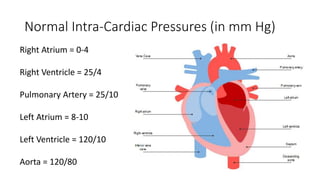
Normal Intra-Cardiac Pressures (in mm Hg)
Right Atrium = 0-4
Right Ventricle = 25/4
Pulmonary Artery = 25/10
Left Atrium = 8-10
Left Ventricle = 120/10
Aorta = 120/80
Simplified Bernoulli’s Equation
• Based on the law of conservation of mass.
• Energy per unit volume before = Energy per unit volume after
• P + ρgh + ½ ρv2 = constant (main equation)
Pressure Gradient = 4 V2
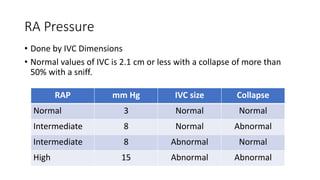
RA Pressure
• Done by IVC Dimensions
• Normal values of IVC is 2.1 cm or less with a collapse of more than
50% with a sniff.
RAP mm Hg IVC size Collapse
Normal 3 Normal Normal
Intermediate 8 Normal Abnormal
Intermediate 8 Abnormal Normal
High 15 Abnormal Abnormal
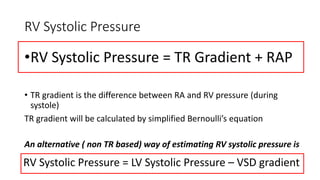
RV Systolic Pressure
•RV Systolic Pressure = TR Gradient + RAP
• TR gradient is the difference between RA and RV pressure (during
systole)
TR gradient will be calculated by simplified Bernoulli’s equation
An alternative ( non TR based) way of estimating RV systolic pressure is
RV Systolic Pressure = LV Systolic Pressure – VSD gradient
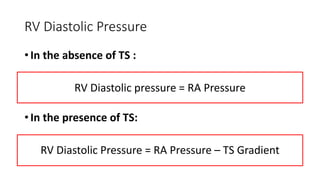
RV Diastolic Pressure
• In the absence of TS :
RV Diastolic pressure = RA Pressure
• In the presence of TS:
RV Diastolic Pressure = RA Pressure – TS Gradient
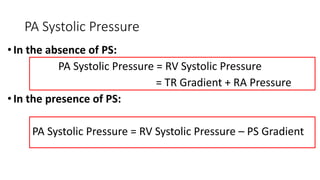
PA Systolic Pressure
•In the absence of PS:
PA Systolic Pressure = RV Systolic Pressure
= TR Gradient + RA Pressure
•In the presence of PS:
PA Systolic Pressure = RV Systolic Pressure – PS Gradient
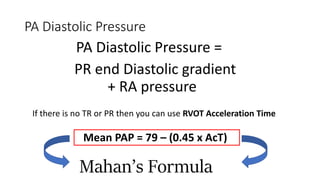
PA Diastolic Pressure
PA Diastolic Pressure =
+ RA pressure
PR end Diastolic gradient
If there is no TR or PR then you can use RVOT Acceleration Time
Mean PAP = 79 – (0.45 x AcT)
Mahan’s Formula
Calculation of LA Pressure
• This is when there is no MS, MR or Prosthetic valve
LAP = 1.24 [ ( E/e`) + 1.9]
Simplifying this equation
LAP = ( E/e`) + 4
• If ( E/e`) = 8 then LA pressure is normal
• If ( E/e`) ≥ 15 then LA pressure is high
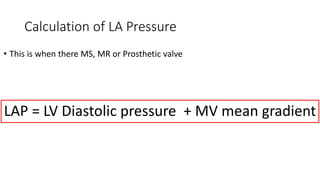
Calculation of LA Pressure
• This is when there MS, MR or Prosthetic valve
LAP = LV Diastolic pressure + MV mean gradient
Estimating LA pressure by ( E/e`) may be
inaccurate in:
•Mitral Stenosis
•Mitral annular Calcification
•Prosthetic Mitral Valve
•Mitral Regurgitation
•Diffuse severe LV dysfunction
LV Systolic Pressure
• In pts without Aortic Valve Disease:
LV systolic pressure = Systolic BP
• In pts with AS or LVOT obstruction
LV systolic pressure = systolic BP + 70% of the gradient
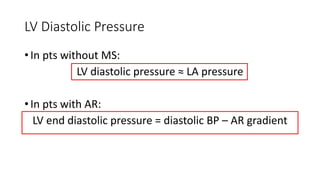
LV Diastolic Pressure
• In pts without MS:
LV diastolic pressure ≈ LA pressure
• In pts with AR:
LV end diastolic pressure = diastolic BP – AR gradient
Thank you 

Echo hemodynamics by Avneesh Raj

  • 1.
    ECHO Hemodynamics Assessment ofIntra-Cardiac Pressures Presented by Avneesh Raj
  • 2.
  • 3.
    Normal Intra-Cardiac Pressures(in mm Hg) Right Atrium = 0-4 Right Ventricle = 25/4 Pulmonary Artery = 25/10 Left Atrium = 8-10 Left Ventricle = 120/10 Aorta = 120/80
  • 4.
    Simplified Bernoulli’s Equation •Based on the law of conservation of mass. • Energy per unit volume before = Energy per unit volume after • P + ρgh + ½ ρv2 = constant (main equation) Pressure Gradient = 4 V2
  • 5.
    RA Pressure • Doneby IVC Dimensions • Normal values of IVC is 2.1 cm or less with a collapse of more than 50% with a sniff. RAP mm Hg IVC size Collapse Normal 3 Normal Normal Intermediate 8 Normal Abnormal Intermediate 8 Abnormal Normal High 15 Abnormal Abnormal
  • 6.
    RV Systolic Pressure •RVSystolic Pressure = TR Gradient + RAP • TR gradient is the difference between RA and RV pressure (during systole) TR gradient will be calculated by simplified Bernoulli’s equation An alternative ( non TR based) way of estimating RV systolic pressure is RV Systolic Pressure = LV Systolic Pressure – VSD gradient
  • 7.
    RV Diastolic Pressure •In the absence of TS : RV Diastolic pressure = RA Pressure • In the presence of TS: RV Diastolic Pressure = RA Pressure – TS Gradient
  • 8.
    PA Systolic Pressure •Inthe absence of PS: PA Systolic Pressure = RV Systolic Pressure = TR Gradient + RA Pressure •In the presence of PS: PA Systolic Pressure = RV Systolic Pressure – PS Gradient
  • 9.
    PA Diastolic Pressure PADiastolic Pressure = + RA pressure PR end Diastolic gradient If there is no TR or PR then you can use RVOT Acceleration Time Mean PAP = 79 – (0.45 x AcT) Mahan’s Formula
  • 10.
    Calculation of LAPressure • This is when there is no MS, MR or Prosthetic valve LAP = 1.24 [ ( E/e`) + 1.9] Simplifying this equation LAP = ( E/e`) + 4 • If ( E/e`) = 8 then LA pressure is normal • If ( E/e`) ≥ 15 then LA pressure is high
  • 11.
    Calculation of LAPressure • This is when there MS, MR or Prosthetic valve LAP = LV Diastolic pressure + MV mean gradient
  • 12.
    Estimating LA pressureby ( E/e`) may be inaccurate in: •Mitral Stenosis •Mitral annular Calcification •Prosthetic Mitral Valve •Mitral Regurgitation •Diffuse severe LV dysfunction
  • 13.
    LV Systolic Pressure •In pts without Aortic Valve Disease: LV systolic pressure = Systolic BP • In pts with AS or LVOT obstruction LV systolic pressure = systolic BP + 70% of the gradient
  • 14.
    LV Diastolic Pressure •In pts without MS: LV diastolic pressure ≈ LA pressure • In pts with AR: LV end diastolic pressure = diastolic BP – AR gradient
  • 15.