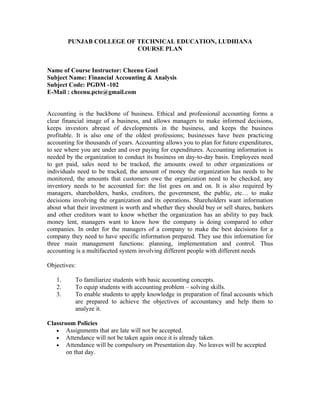
PUNJAB COLLEGE OF TECHNICAL EDUCATION, LUDHIANA
                          COURSE PLAN


Name of Course Instructor: Cheenu Goel
Subject Name: Financial Accounting & Analysis
Subject Code: PGDM -102
E-Mail : cheenu.pcte@gmail.com


Accounting is the backbone of business. Ethical and professional accounting forms a
clear financial image of a business, and allows managers to make informed decisions,
keeps investors abreast of developments in the business, and keeps the business
profitable. It is also one of the oldest professions; businesses have been practicing
accounting for thousands of years. Accounting allows you to plan for future expenditures,
to see where you are under and over paying for expenditures. Accounting information is
needed by the organization to conduct its business on day-to-day basis. Employees need
to get paid, sales need to be tracked, the amounts owed to other organizations or
individuals need to be tracked, the amount of money the organization has needs to be
monitored, the amounts that customers owe the organization need to be checked, any
inventory needs to be accounted for: the list goes on and on. It is also required by
managers, shareholders, banks, creditors, the government, the public, etc… to make
decisions involving the organization and its operations. Shareholders want information
about what their investment is worth and whether they should buy or sell shares, bankers
and other creditors want to know whether the organization has an ability to pay back
money lent, managers want to know how the company is doing compared to other
companies. In order for the managers of a company to make the best decisions for a
company they need to have specific information prepared. They use this information for
three main management functions: planning, implementation and control. Thus
accounting is a multifaceted system involving different people with different needs

Objectives:

   1.      To familiarize students with basic accounting concepts.
   2.      To equip students with accounting problem – solving skills.
   3.      To enable students to apply knowledge in preparation of final accounts which
           are prepared to achieve the objectives of accountancy and help them to
           analyze it.

Classroom Policies
   • Assignments that are late will not be accepted.
   • Attendance will not be taken again once it is already taken.
   • Attendance will be compulsory on Presentation day. No leaves will be accepted
       on that day.
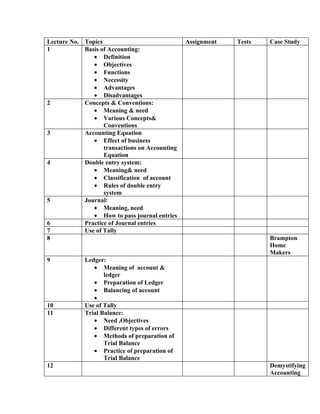
Lecture No. Topics                              Assignment   Tests   Case Study
1           Basis of Accounting:
               • Definition
               • Objectives
               • Functions
               • Necessity
               • Advantages
               • Disadvantages
2           Concepts & Conventions:
               • Meaning & need
               • Various Concepts&
                   Conventions
3           Accounting Equation
               • Effect of business
                   transactions on Accounting
                   Equation
4           Double entry system:
               • Meaning& need
               • Classification of account
               • Rules of double entry
                   system
5           Journal:
               • Meaning, need
               • How to pass journal entries
6           Practice of Journal entries
7           Use of Tally
8                                                                    Brampton
                                                                     Home
                                                                     Makers
9            Ledger:
                • Meaning of account &
                    ledger
                • Preparation of Ledger
                • Balancing of account
                •
10           Use of Tally
11           Trial Balance:
                • Need ,Objectives
                • Different types of errors
                • Methods of preparation of
                    Trial Balance
                • Practice of preparation of
                    Trial Balance
12                                                                   Demystifying
                                                                     Accounting
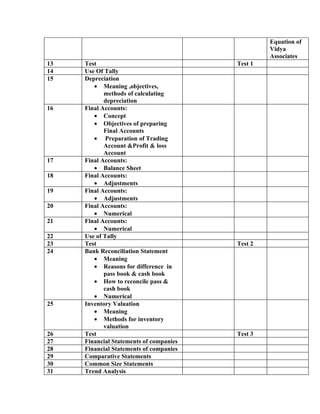
Equation of
                                                  Vidya
                                                  Associates
13   Test                                Test 1
14   Use Of Tally
15   Depreciation
        • Meaning ,objectives,
            methods of calculating
            depreciation
16   Final Accounts:
        • Concept
        • Objectives of preparing
            Final Accounts
        • Preparation of Trading
            Account &Profit & loss
            Account
17   Final Accounts:
        • Balance Sheet
18   Final Accounts:
        • Adjustments
19   Final Accounts:
        • Adjustments
20   Final Accounts:
        • Numerical
21   Final Accounts:
        • Numerical
22   Use of Tally
23   Test                                Test 2
24   Bank Reconciliation Statement
        • Meaning
        • Reasons for difference in
            pass book & cash book
        • How to reconcile pass &
            cash book
        • Numerical
25   Inventory Valuation
        • Meaning
        • Methods for inventory
            valuation
26   Test                                Test 3
27   Financial Statements of companies
28   Financial Statements of companies
29   Comparative Statements
30   Common Size Statements
31   Trend Analysis
E:\Cheenu Pcte\Course Module\Pgdm Accounts

E:\Cheenu Pcte\Course Module\Pgdm Accounts

  • 1.
    PUNJAB COLLEGE OFTECHNICAL EDUCATION, LUDHIANA COURSE PLAN Name of Course Instructor: Cheenu Goel Subject Name: Financial Accounting & Analysis Subject Code: PGDM -102 E-Mail : cheenu.pcte@gmail.com Accounting is the backbone of business. Ethical and professional accounting forms a clear financial image of a business, and allows managers to make informed decisions, keeps investors abreast of developments in the business, and keeps the business profitable. It is also one of the oldest professions; businesses have been practicing accounting for thousands of years. Accounting allows you to plan for future expenditures, to see where you are under and over paying for expenditures. Accounting information is needed by the organization to conduct its business on day-to-day basis. Employees need to get paid, sales need to be tracked, the amounts owed to other organizations or individuals need to be tracked, the amount of money the organization has needs to be monitored, the amounts that customers owe the organization need to be checked, any inventory needs to be accounted for: the list goes on and on. It is also required by managers, shareholders, banks, creditors, the government, the public, etc… to make decisions involving the organization and its operations. Shareholders want information about what their investment is worth and whether they should buy or sell shares, bankers and other creditors want to know whether the organization has an ability to pay back money lent, managers want to know how the company is doing compared to other companies. In order for the managers of a company to make the best decisions for a company they need to have specific information prepared. They use this information for three main management functions: planning, implementation and control. Thus accounting is a multifaceted system involving different people with different needs Objectives: 1. To familiarize students with basic accounting concepts. 2. To equip students with accounting problem – solving skills. 3. To enable students to apply knowledge in preparation of final accounts which are prepared to achieve the objectives of accountancy and help them to analyze it. Classroom Policies • Assignments that are late will not be accepted. • Attendance will not be taken again once it is already taken. • Attendance will be compulsory on Presentation day. No leaves will be accepted on that day.
  • 2.
    Lecture No. Topics Assignment Tests Case Study 1 Basis of Accounting: • Definition • Objectives • Functions • Necessity • Advantages • Disadvantages 2 Concepts & Conventions: • Meaning & need • Various Concepts& Conventions 3 Accounting Equation • Effect of business transactions on Accounting Equation 4 Double entry system: • Meaning& need • Classification of account • Rules of double entry system 5 Journal: • Meaning, need • How to pass journal entries 6 Practice of Journal entries 7 Use of Tally 8 Brampton Home Makers 9 Ledger: • Meaning of account & ledger • Preparation of Ledger • Balancing of account • 10 Use of Tally 11 Trial Balance: • Need ,Objectives • Different types of errors • Methods of preparation of Trial Balance • Practice of preparation of Trial Balance 12 Demystifying Accounting
  • 3.
    Equation of Vidya Associates 13 Test Test 1 14 Use Of Tally 15 Depreciation • Meaning ,objectives, methods of calculating depreciation 16 Final Accounts: • Concept • Objectives of preparing Final Accounts • Preparation of Trading Account &Profit & loss Account 17 Final Accounts: • Balance Sheet 18 Final Accounts: • Adjustments 19 Final Accounts: • Adjustments 20 Final Accounts: • Numerical 21 Final Accounts: • Numerical 22 Use of Tally 23 Test Test 2 24 Bank Reconciliation Statement • Meaning • Reasons for difference in pass book & cash book • How to reconcile pass & cash book • Numerical 25 Inventory Valuation • Meaning • Methods for inventory valuation 26 Test Test 3 27 Financial Statements of companies 28 Financial Statements of companies 29 Comparative Statements 30 Common Size Statements 31 Trend Analysis