
From Personal Meaning to Shared Understanding: The Nature of Discussion in a Community of Inquiry David S. Stein, Constance E. Wanstreet,  Cheryl L. Engle, Hilda R. Glazer, Ruth A. Harris, Susan M. Johnston,  Mona R. Simons, and Lynn A. Trinko
 
Shared Understanding Shared understanding is conceptually defined as the dynamic relationship of incorporating personal meaning and integrating knowledge that has been received by the group.
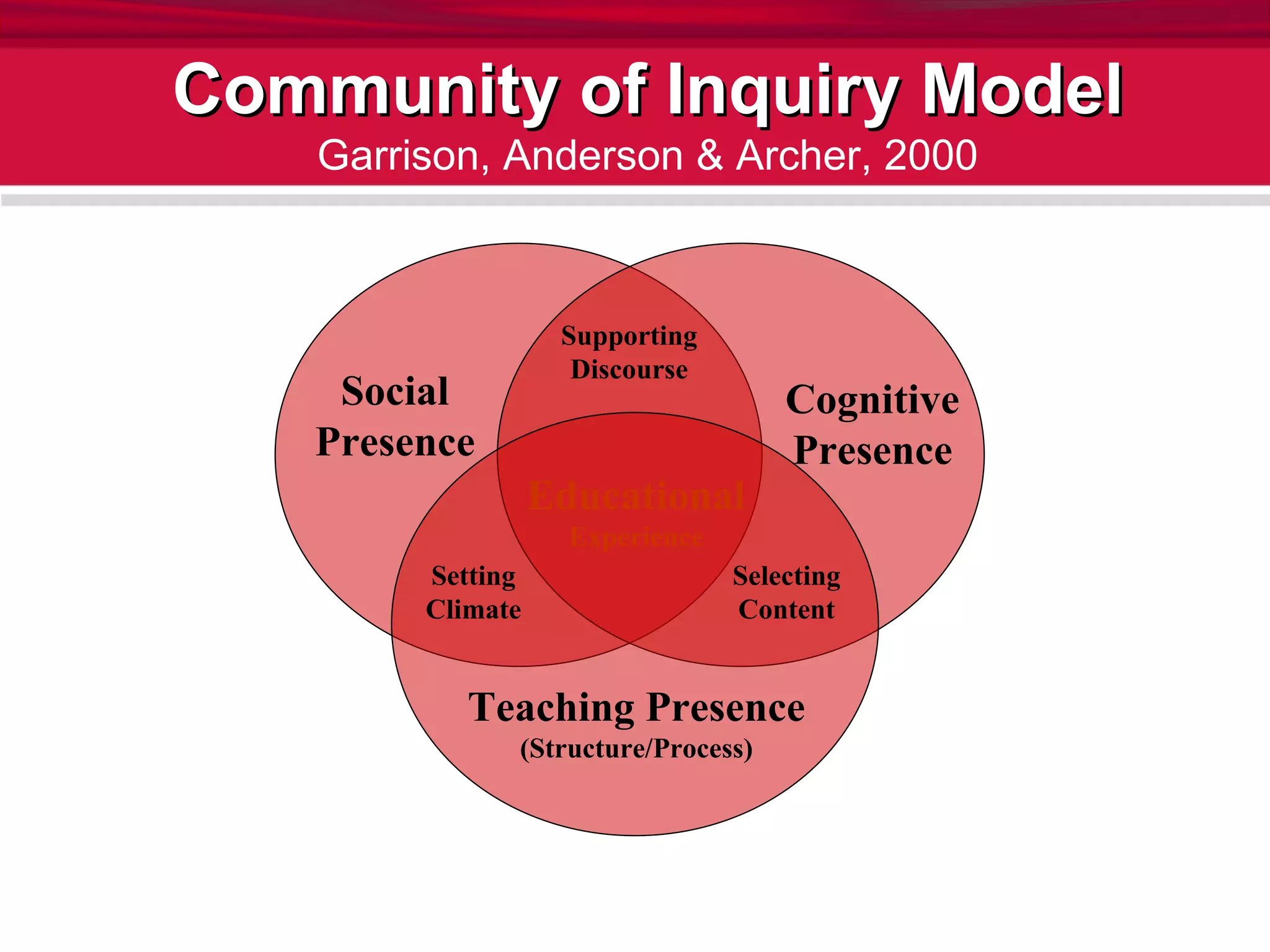
Social Presence Cognitive Presence Teaching Presence (Structure/Process) Educational Experience Supporting Discourse Setting Climate Selecting Content Community of Inquiry Model Garrison, Anderson & Archer, 2000
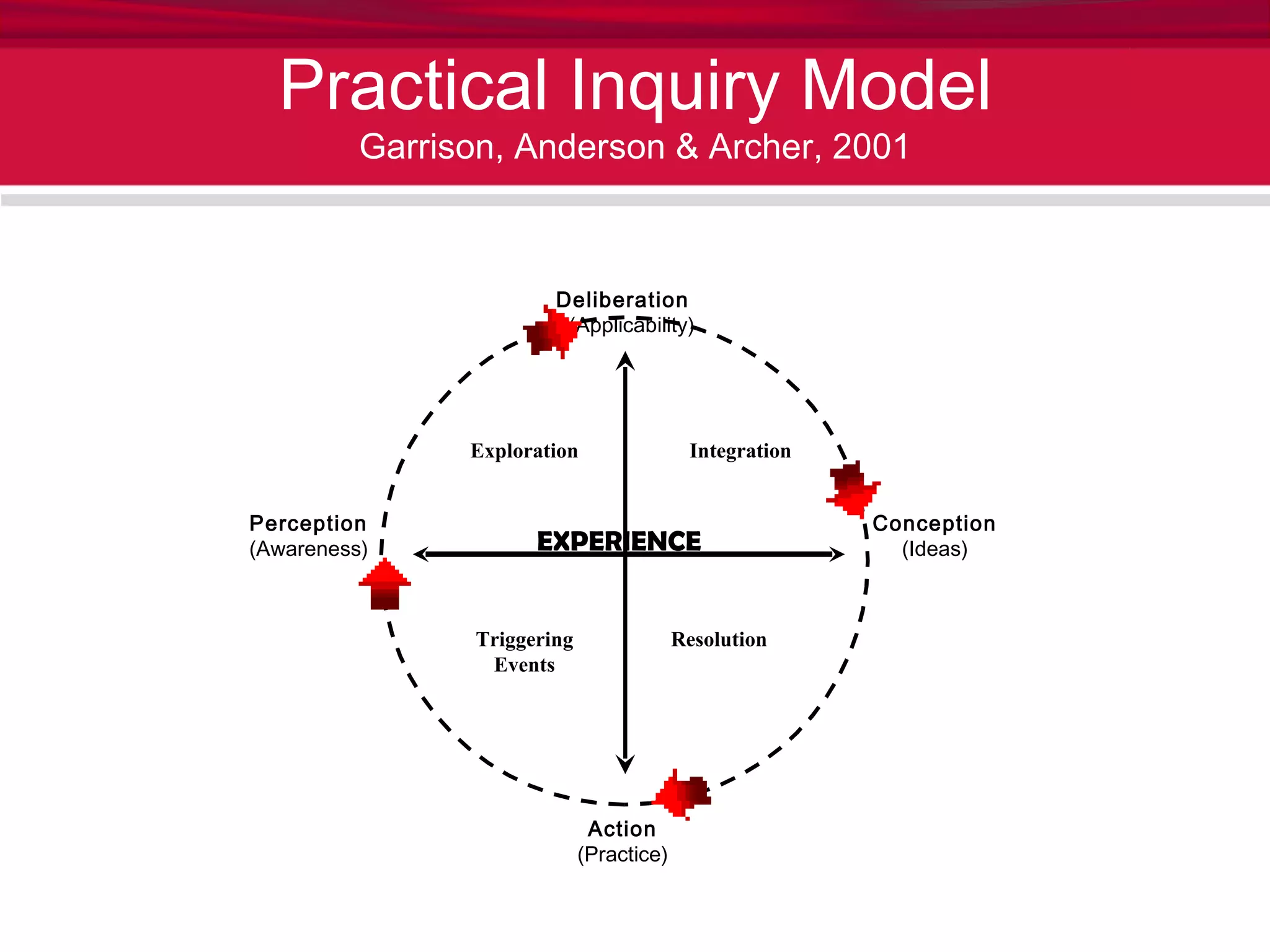
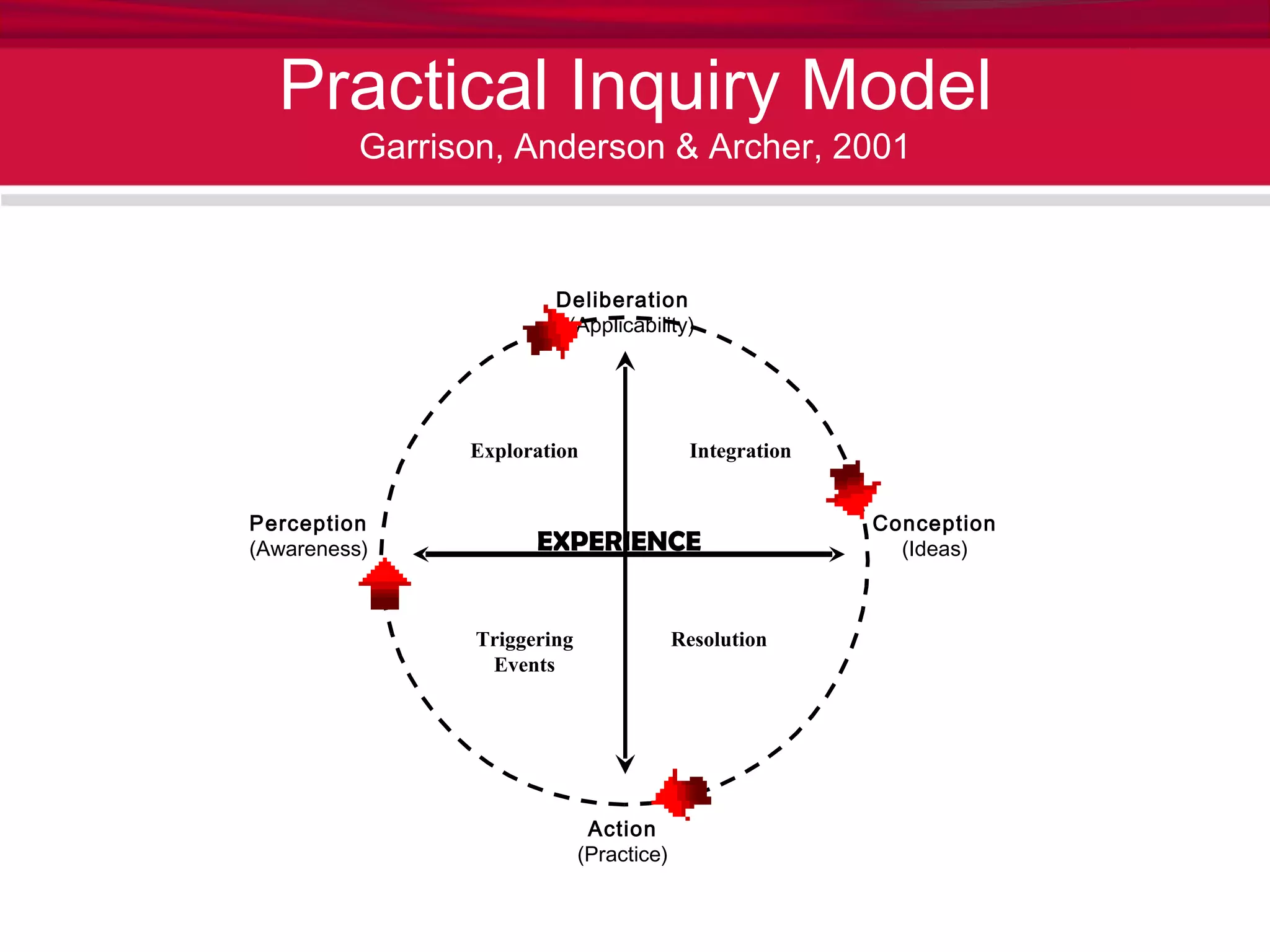
Practical Inquiry Model Garrison, Anderson & Archer, 2001 Deliberation (Applicability) Conception (Ideas) Perception (Awareness) Action (Practice) EXPERIENCE Exploration Integration Triggering Events Resolution
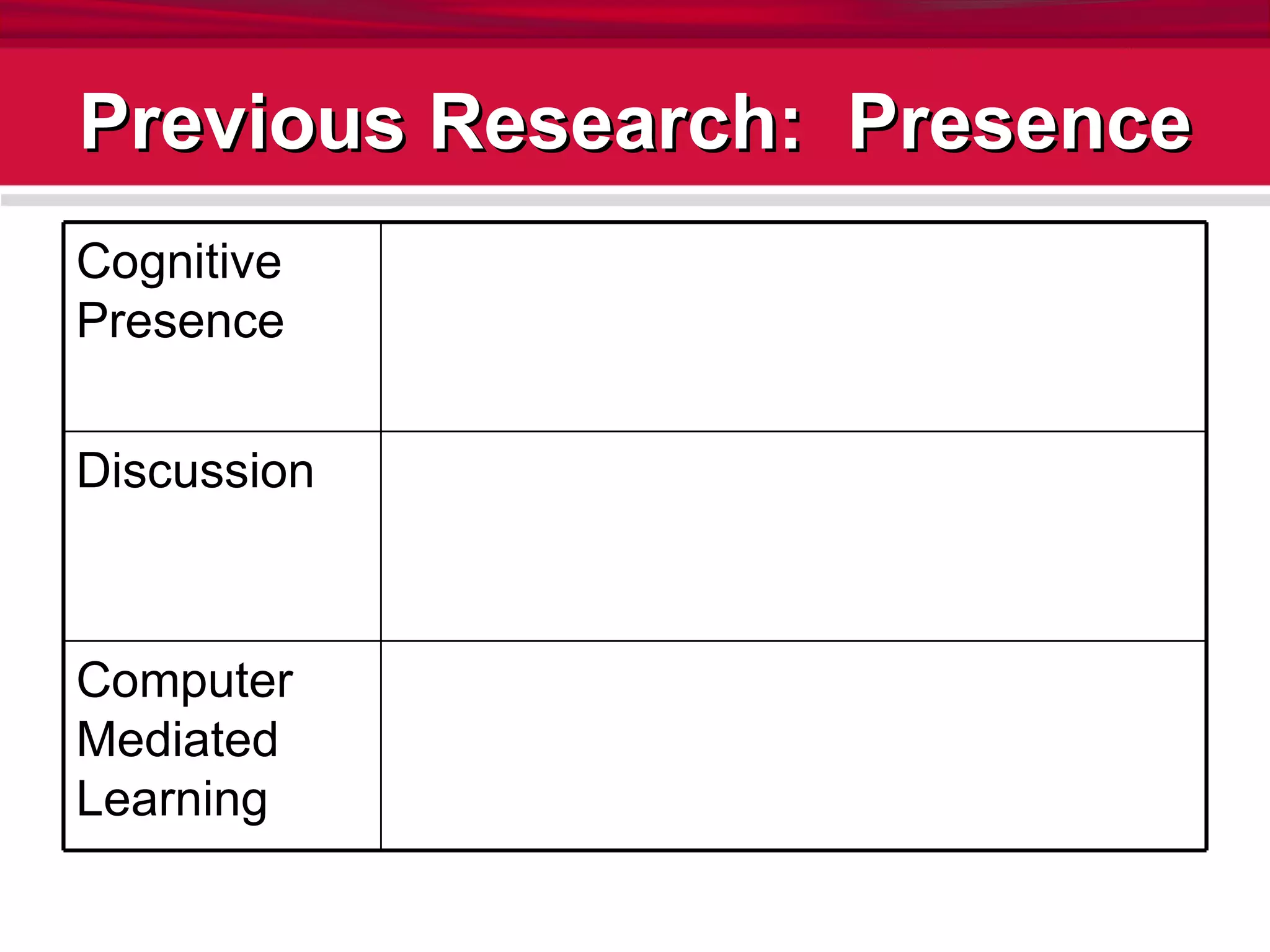
Previous Research:  Presence Computer Mediated Learning Discussion Cognitive Presence
Purpose of Study To examine how shared meaning develops through the chat process in a way that reflects the dynamic relationship between personal meaning and shared understanding.
Research Questions What is the process by which shared understanding develops in chat learning spaces? How does the conversation flow during a chat in terms of the practical inquiry model?
Method This ex post facto study used a quantitative content analysis to investigate the development of cognitive presence through the practical inquiry process.
Course Background Learners studied the role of adult education in American society Seven groups formed by learners’ affinity or proximity to one another in initial class Five groups chose to work online and two chose to conduct their small group discussions face-to-face
Course Activities Three face-to-face sessions:  at beginning, middle, and end of course Weekly small-group discussions related to course readings and questions posed by instructor Groups discussed issues via chat sessions Group moderator synthesized discussion and posted to discussion board
Study Design Of the groups available to us one was selected at random Time 1 (week 3) and Time 2 (week 7) of the group’s transcripts were analyzed
Units of Meaning Chat Transcripts A complete participant response Example:  “I know that this is vague, but we have to start somewhere.  end” Discussion Posting Analyzed at the paragraph level
Coding Triggering Event  Exploration Integration Resolution
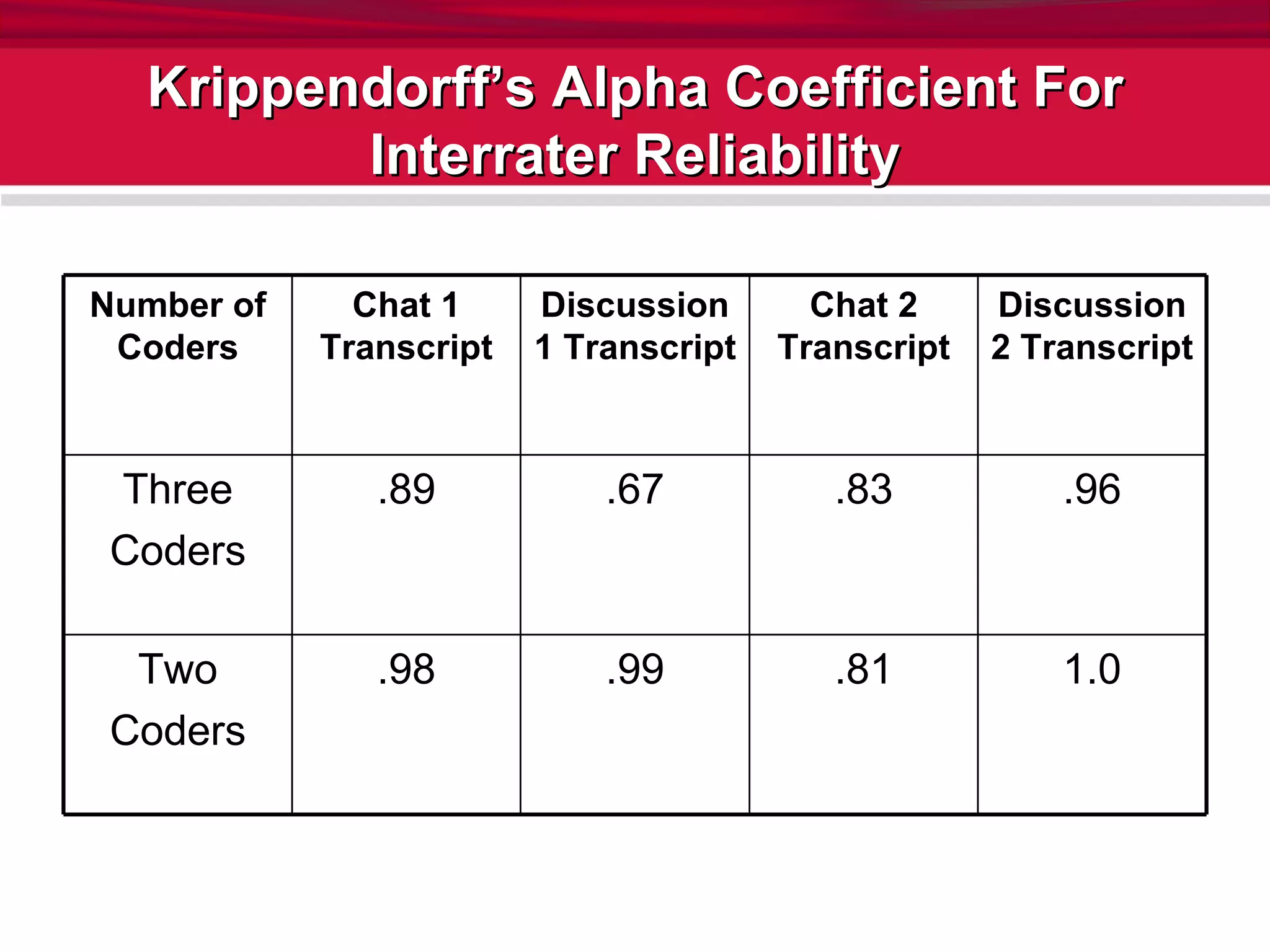
Krippendorff’s Alpha Coefficient For Interrater Reliability 1.0 .81 .99 .98 Two Coders .96 .83 .67 .89 Three Coders Discussion 2 Transcript Chat 2 Transcript Discussion 1 Transcript Chat 1 Transcript Number of Coders
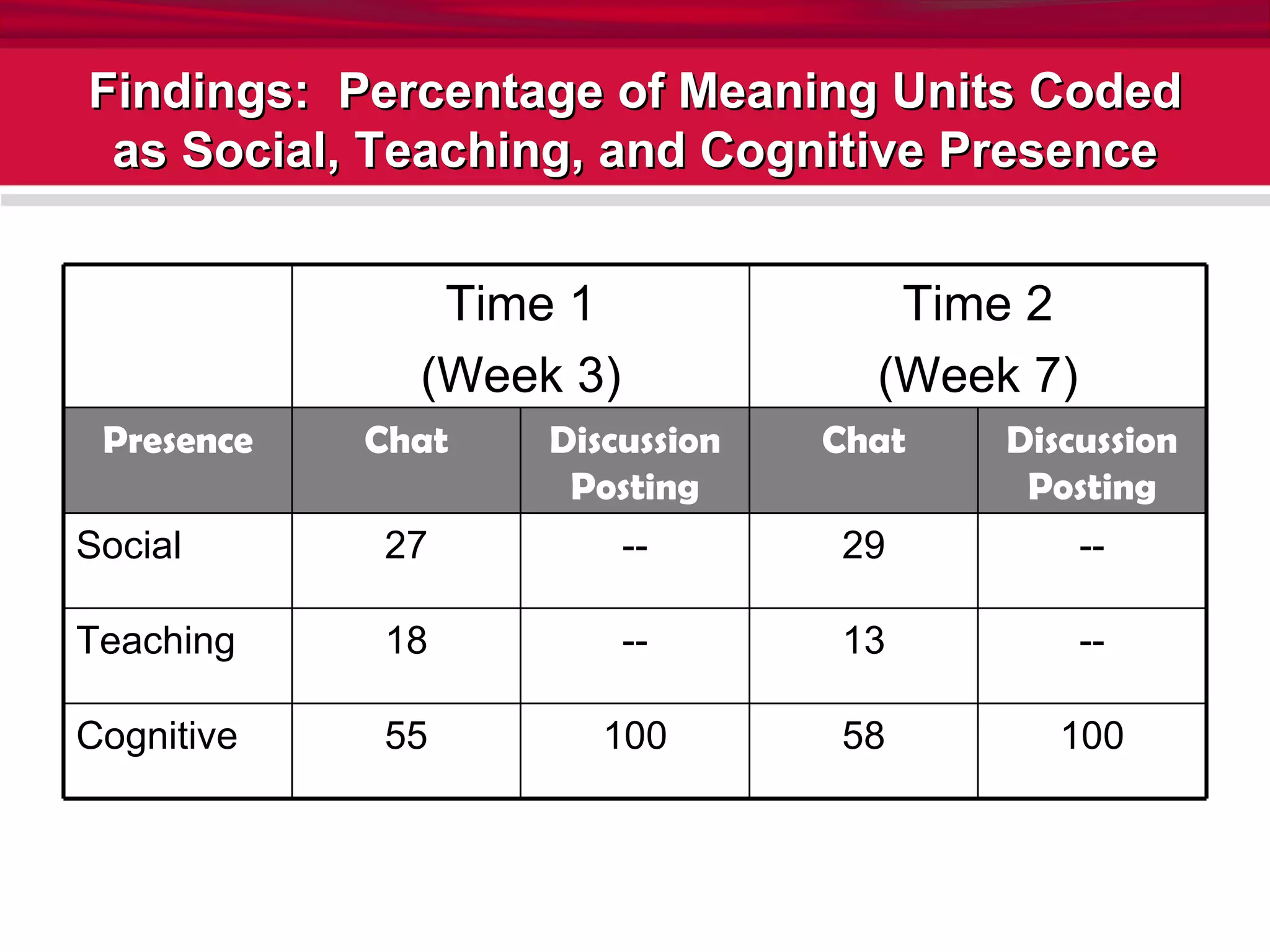
Findings:  Percentage of Meaning Units Coded as Social, Teaching, and Cognitive Presence 100 58 100 55 Cognitive -- 13 -- 18 Teaching -- 29 -- 27 Social Discussion Posting Chat Discussion Posting Chat Presence Time 2 (Week 7) Time 1 (Week 3)
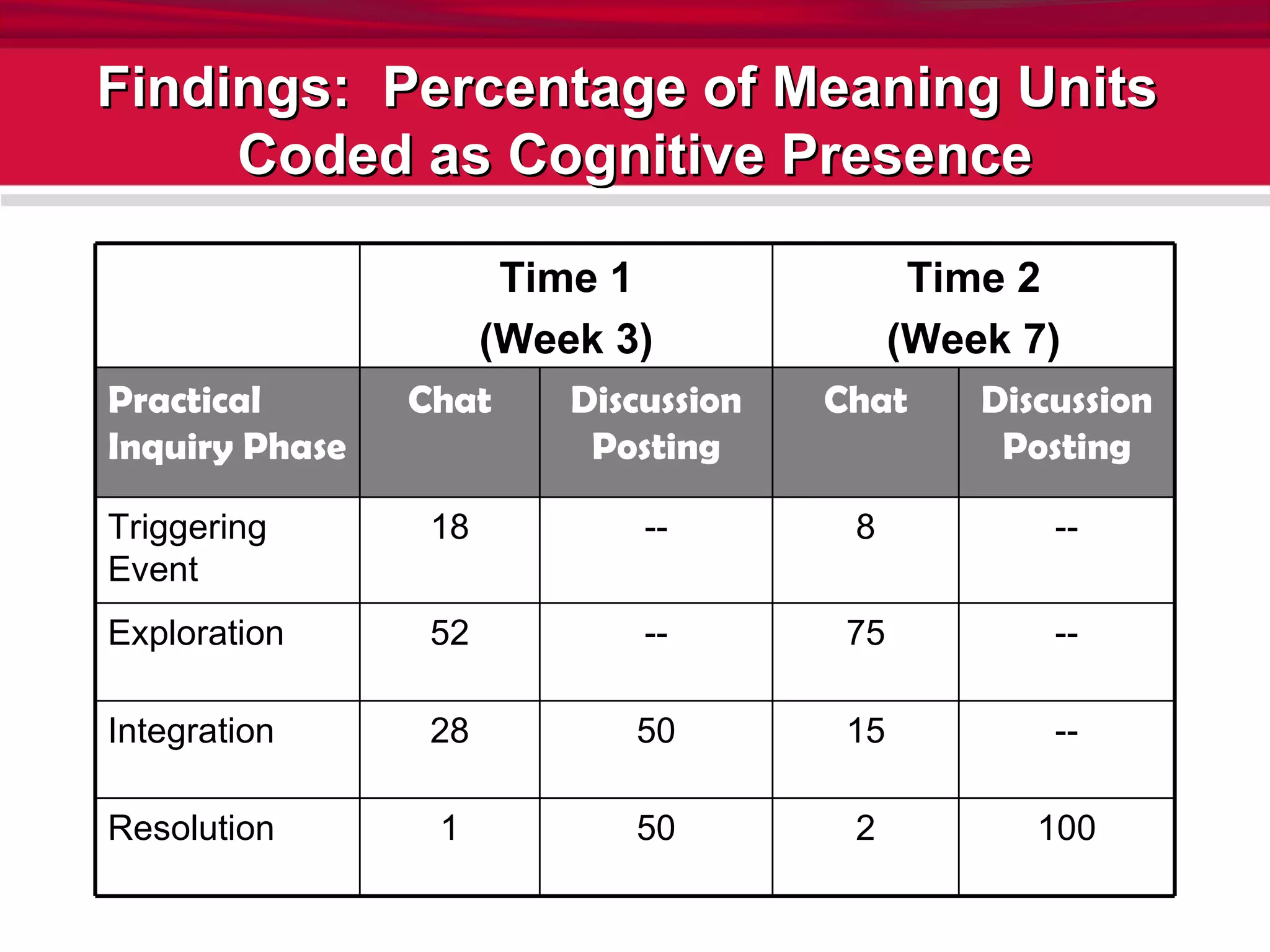
Findings:  Percentage of Meaning Units  Coded as Cognitive Presence 100 2 50 1 Resolution -- 15 50 28 Integration -- 75 -- 52 Exploration -- 8 -- 18 Triggering Event Discussion Posting Chat Discussion Posting Chat Practical Inquiry Phase Time 2 (Week 7) Time 1 (Week 3)
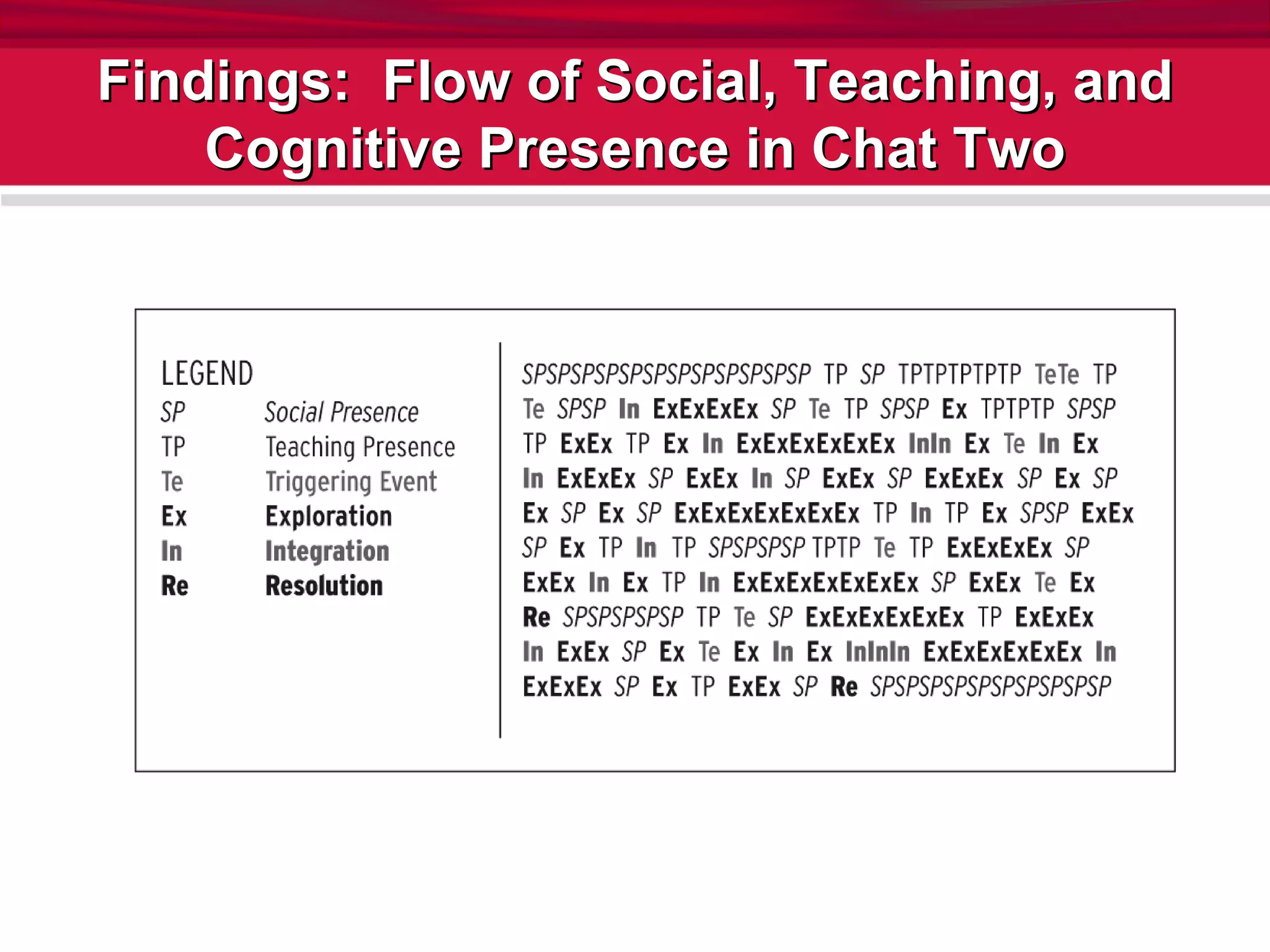
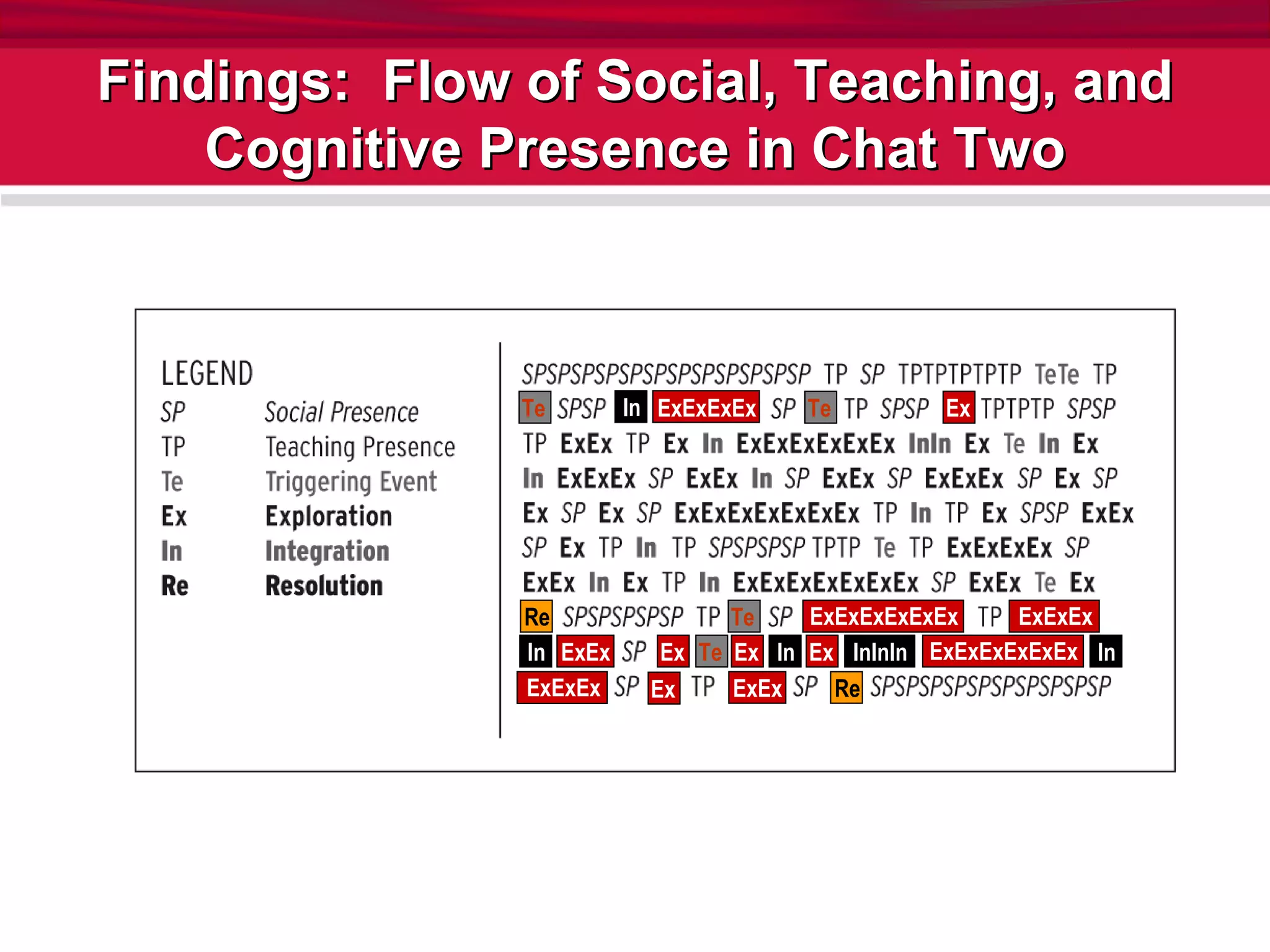
Findings:  Flow of Social, Teaching, and Cognitive Presence in Chat Two
Findings:  Flow of Social, Teaching, and Cognitive Presence in Chat Two Te In ExExExEx Te Ex ExExExExExEx Re Te ExExEx In Te Ex ExExEx Re Ex In Ex ExExExExExEx InInIn In ExEx Ex ExEx
Practical Inquiry Model Garrison, Anderson & Archer, 2001 Deliberation (Applicability) Conception (Ideas) Perception (Awareness) Action (Practice) EXPERIENCE Exploration Integration Triggering Events Resolution
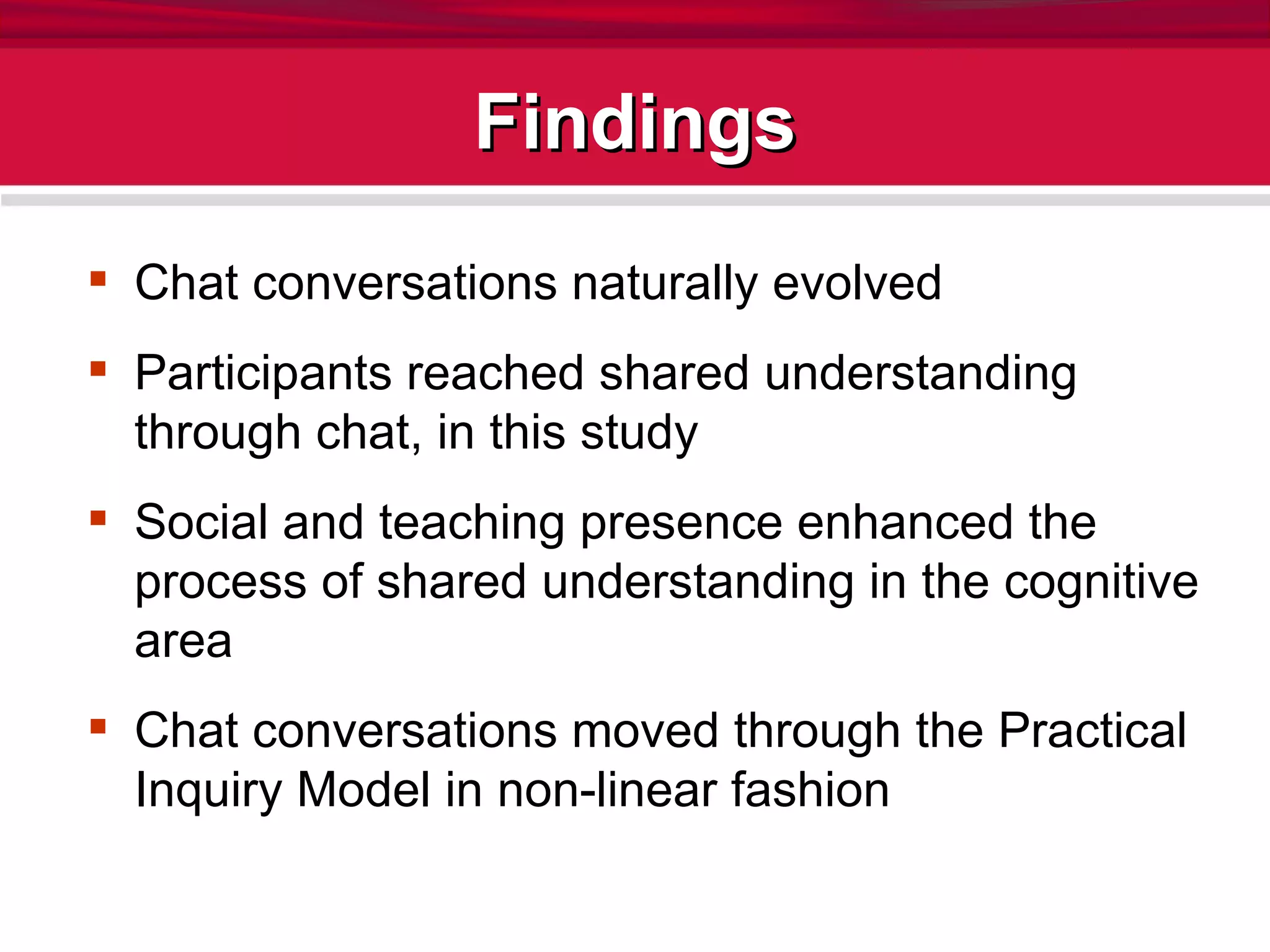
Findings Chat conversations naturally evolved Participants reached shared understanding through chat, in this study Social and teaching presence enhanced the process of shared understanding in the cognitive area Chat conversations moved through the Practical Inquiry Model in non-linear fashion
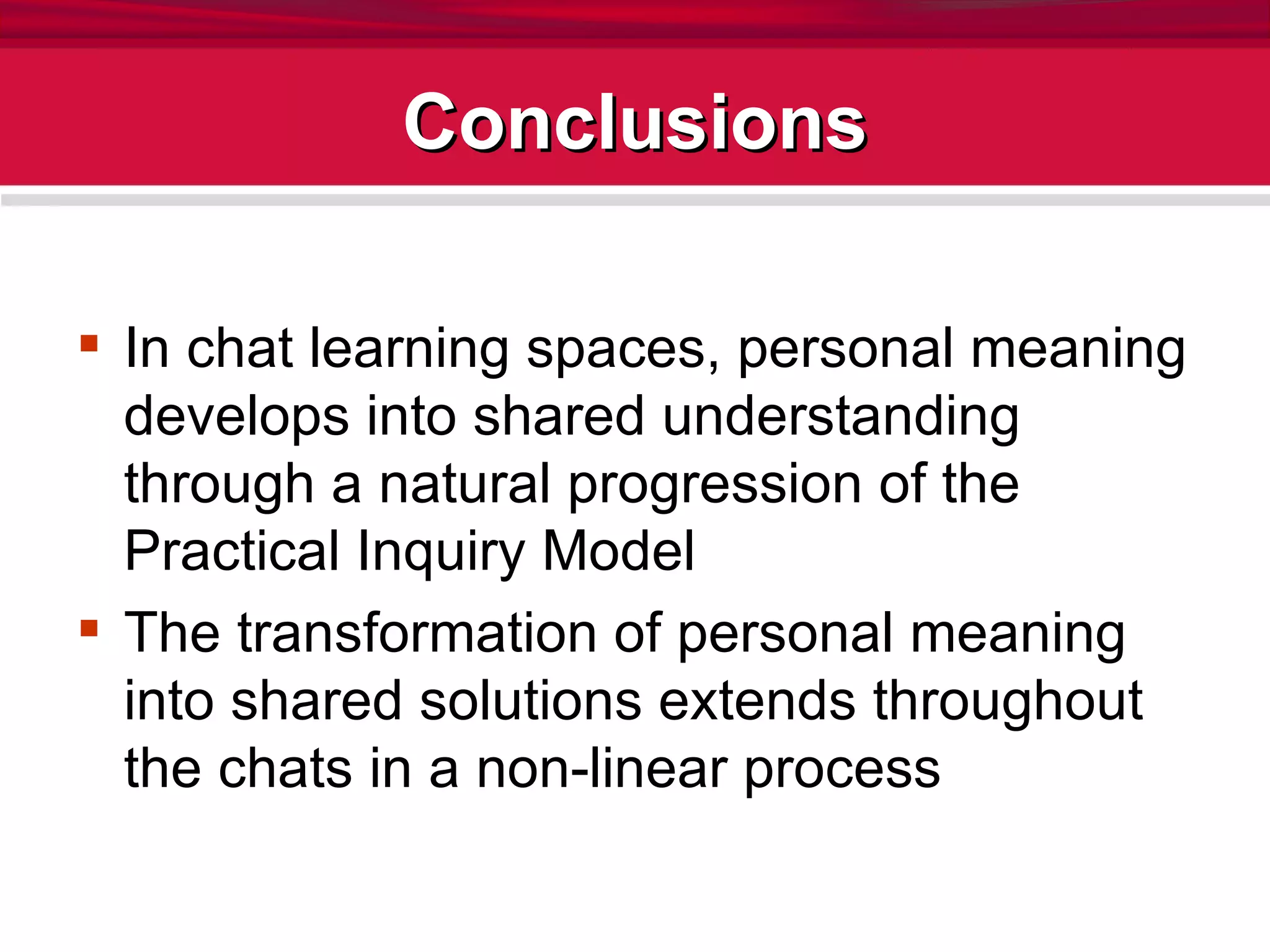
Conclusions In chat learning spaces, personal meaning develops into shared understanding through a natural progression of the Practical Inquiry Model The transformation of personal meaning into shared solutions extends throughout the chats in a non-linear process
Recommendations The use of chat spaces may need to be considered as it has the potential to increase higher-order thinking when used in the context of a community of inquiry
References Anderson, T., Rourke, L., Archer, W., & Garrison, R. (2001). Assessing teaching presence in computer conferencing transcripts.  The Journal of Asynchronous Learning Networks, 5( 2). Retrieved December 15, 2005, from http://www.aln.org/publications/jaln/v5n2/v5n2_anderson Brookfield, S. D., & Preskill, S. (2005).  Discussion as a way of teaching: Tools and techniques for democratic classrooms,  2nd ed. San Francisco, CA: Jossey-Bass.  Garrison, R., Anderson, T., and Archer, W. (2000). Critical inquiry in a text-based environment: Computer conferencing in higher education.  The Internet and Higher Education,   2 (2-3), 87-105. Garrison, R., Anderson, T., and Archer, W. (2001). Critical thinking and computer conferencing: A model and tool to assess cognitive presence.  American Journal of Distance Education, 15 (1), 7-23. Krippendorff, K. (2004).  Content analysis: An introduction to its methodology , 2nd ed. Beverly Hills, CA: Sage. Meyer, K. A. (2003). Face-to-face versus threaded discussions: The role of time and higher-order thinking.  Journal of Asynchronous Learning Networks, 7 (3). Retrieved June 16, 2006, from http://www.sloan-c.org/publications/jaln/v7n3/pdf/v7n3_meyer.pdf  Neuendorf, K. A. (2002).  The content analysis guidebook.  Thousand Oaks, CA: Sage. Pawan, F., Paulus, T. M., Yalcin, S., & Chang, C-F. (2003). Online learning: Patterns of engagement and interaction among in-service teachers.  Language Learning & Technology, 7 (3), 118-140. Strijbos, J., Martens, R. L., Prins, F. J., & Jochems, W. M. (2005). Content analysis: What are they talking about?  Computers & Education,  46(2006), 29-48. Retrieved June 16, 2006, from http://www.elsevier.com/locate/compedu  Vaughan, N., & Garrison, D. R. (2005). Creating cognitive presence in a blended faculty development community.  The Internet and Higher Education ,  8,  1-12.
For More Information Contact David S. Stein, Ph.D. stein.1@osu.edu  Ruth A. Harris  [email_address] Lynn A. Trinko [email_address]

From Personal Meaning to Shared Understanding: The Nature of Discussion in a Community of Inquiry

  • 1.
    From Personal Meaningto Shared Understanding: The Nature of Discussion in a Community of Inquiry David S. Stein, Constance E. Wanstreet, Cheryl L. Engle, Hilda R. Glazer, Ruth A. Harris, Susan M. Johnston, Mona R. Simons, and Lynn A. Trinko
  • 2.
  • 3.
    Shared Understanding Sharedunderstanding is conceptually defined as the dynamic relationship of incorporating personal meaning and integrating knowledge that has been received by the group.
  • 4.
    Social Presence CognitivePresence Teaching Presence (Structure/Process) Educational Experience Supporting Discourse Setting Climate Selecting Content Community of Inquiry Model Garrison, Anderson & Archer, 2000
  • 5.
    Practical Inquiry ModelGarrison, Anderson & Archer, 2001 Deliberation (Applicability) Conception (Ideas) Perception (Awareness) Action (Practice) EXPERIENCE Exploration Integration Triggering Events Resolution
  • 6.
    Previous Research: Presence Computer Mediated Learning Discussion Cognitive Presence
  • 7.
    Purpose of StudyTo examine how shared meaning develops through the chat process in a way that reflects the dynamic relationship between personal meaning and shared understanding.
  • 8.
    Research Questions Whatis the process by which shared understanding develops in chat learning spaces? How does the conversation flow during a chat in terms of the practical inquiry model?
  • 9.
    Method This expost facto study used a quantitative content analysis to investigate the development of cognitive presence through the practical inquiry process.
  • 10.
    Course Background Learnersstudied the role of adult education in American society Seven groups formed by learners’ affinity or proximity to one another in initial class Five groups chose to work online and two chose to conduct their small group discussions face-to-face
  • 11.
    Course Activities Threeface-to-face sessions: at beginning, middle, and end of course Weekly small-group discussions related to course readings and questions posed by instructor Groups discussed issues via chat sessions Group moderator synthesized discussion and posted to discussion board
  • 12.
    Study Design Ofthe groups available to us one was selected at random Time 1 (week 3) and Time 2 (week 7) of the group’s transcripts were analyzed
  • 13.
    Units of MeaningChat Transcripts A complete participant response Example: “I know that this is vague, but we have to start somewhere. end” Discussion Posting Analyzed at the paragraph level
  • 14.
    Coding Triggering Event Exploration Integration Resolution
  • 15.
    Krippendorff’s Alpha CoefficientFor Interrater Reliability 1.0 .81 .99 .98 Two Coders .96 .83 .67 .89 Three Coders Discussion 2 Transcript Chat 2 Transcript Discussion 1 Transcript Chat 1 Transcript Number of Coders
  • 16.
    Findings: Percentageof Meaning Units Coded as Social, Teaching, and Cognitive Presence 100 58 100 55 Cognitive -- 13 -- 18 Teaching -- 29 -- 27 Social Discussion Posting Chat Discussion Posting Chat Presence Time 2 (Week 7) Time 1 (Week 3)
  • 17.
    Findings: Percentageof Meaning Units Coded as Cognitive Presence 100 2 50 1 Resolution -- 15 50 28 Integration -- 75 -- 52 Exploration -- 8 -- 18 Triggering Event Discussion Posting Chat Discussion Posting Chat Practical Inquiry Phase Time 2 (Week 7) Time 1 (Week 3)
  • 18.
    Findings: Flowof Social, Teaching, and Cognitive Presence in Chat Two
  • 19.
    Findings: Flowof Social, Teaching, and Cognitive Presence in Chat Two Te In ExExExEx Te Ex ExExExExExEx Re Te ExExEx In Te Ex ExExEx Re Ex In Ex ExExExExExEx InInIn In ExEx Ex ExEx
  • 20.
    Practical Inquiry ModelGarrison, Anderson & Archer, 2001 Deliberation (Applicability) Conception (Ideas) Perception (Awareness) Action (Practice) EXPERIENCE Exploration Integration Triggering Events Resolution
  • 21.
    Findings Chat conversationsnaturally evolved Participants reached shared understanding through chat, in this study Social and teaching presence enhanced the process of shared understanding in the cognitive area Chat conversations moved through the Practical Inquiry Model in non-linear fashion
  • 22.
    Conclusions In chatlearning spaces, personal meaning develops into shared understanding through a natural progression of the Practical Inquiry Model The transformation of personal meaning into shared solutions extends throughout the chats in a non-linear process
  • 23.
    Recommendations The useof chat spaces may need to be considered as it has the potential to increase higher-order thinking when used in the context of a community of inquiry
  • 24.
    References Anderson, T.,Rourke, L., Archer, W., & Garrison, R. (2001). Assessing teaching presence in computer conferencing transcripts. The Journal of Asynchronous Learning Networks, 5( 2). Retrieved December 15, 2005, from http://www.aln.org/publications/jaln/v5n2/v5n2_anderson Brookfield, S. D., & Preskill, S. (2005). Discussion as a way of teaching: Tools and techniques for democratic classrooms, 2nd ed. San Francisco, CA: Jossey-Bass. Garrison, R., Anderson, T., and Archer, W. (2000). Critical inquiry in a text-based environment: Computer conferencing in higher education. The Internet and Higher Education, 2 (2-3), 87-105. Garrison, R., Anderson, T., and Archer, W. (2001). Critical thinking and computer conferencing: A model and tool to assess cognitive presence. American Journal of Distance Education, 15 (1), 7-23. Krippendorff, K. (2004). Content analysis: An introduction to its methodology , 2nd ed. Beverly Hills, CA: Sage. Meyer, K. A. (2003). Face-to-face versus threaded discussions: The role of time and higher-order thinking. Journal of Asynchronous Learning Networks, 7 (3). Retrieved June 16, 2006, from http://www.sloan-c.org/publications/jaln/v7n3/pdf/v7n3_meyer.pdf Neuendorf, K. A. (2002). The content analysis guidebook. Thousand Oaks, CA: Sage. Pawan, F., Paulus, T. M., Yalcin, S., & Chang, C-F. (2003). Online learning: Patterns of engagement and interaction among in-service teachers. Language Learning & Technology, 7 (3), 118-140. Strijbos, J., Martens, R. L., Prins, F. J., & Jochems, W. M. (2005). Content analysis: What are they talking about? Computers & Education, 46(2006), 29-48. Retrieved June 16, 2006, from http://www.elsevier.com/locate/compedu Vaughan, N., & Garrison, D. R. (2005). Creating cognitive presence in a blended faculty development community. The Internet and Higher Education , 8, 1-12.
  • 25.
    For More InformationContact David S. Stein, Ph.D. stein.1@osu.edu Ruth A. Harris [email_address] Lynn A. Trinko [email_address]

Editor's Notes

  • #2 Introductions of presenters. Acknowledgement of Dr. Stein and entire research team present. Many of us incorporate group work in our courses with adult learners because we believe it's important to achieving learning goals. When we talk about the benefits of working in groups, we often hear the expression "shared understanding." Our study looked at how shared understanding developed in a course about the historical and philosophical foundations of adult education in America.