Jo De Cock - CEO NIHDI
04-02-2016 - OECD Paris
OECD Joint Network of
Senior Budget and Health
Officials:
The Belgian Experience
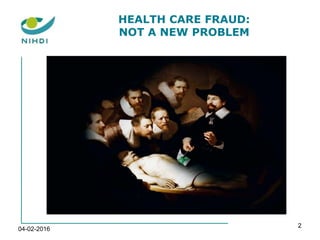
HEALTH CARE FRAUD:
NOT A NEW PROBLEM
04-02-2016
2
04-02-2016
3
HEALTH CARE FRAUD:
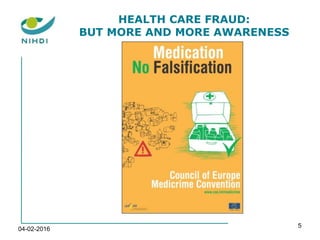
BUT MORE AND MORE AWARENESS
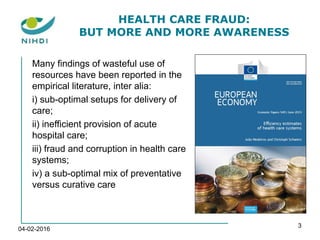
Many findings of wasteful use of
resources have been reported in the
empirical literature, inter alia:
i) sub-optimal setups for delivery of
care;
ii) inefficient provision of acute
hospital care;
iii) fraud and corruption in health care
systems;
iv) a sub-optimal mix of preventative
versus curative care
HEALTH CARE FRAUD:
BUT MORE AND MORE AWARENESS
04-02-2016
4
HEALTH CARE FRAUD:
BUT MORE AND MORE AWARENESS
04-02-2016
5
SUSTAINABILITY OF HEALTH CARE
SYSTEMS: WHAT’S THE RIGHT WAY ?
• Investing less resources ?
• Developing additional funding mechanisms ?
• Reducing waste, increasing value ?
04-02-2016
6
WASTE
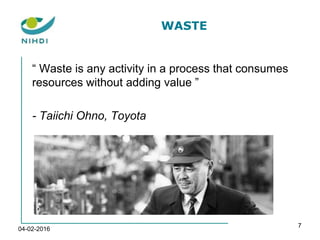
“ Waste is any activity in a process that consumes
resources without adding value ”
- Taiichi Ohno, Toyota
04-02-2016
7
HEALTH CARE FRAUD:
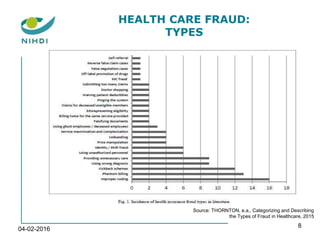
TYPES
04-02-2016
8
Source: THORNTON, e.a., Categorizing and Describing
the Types of Fraud in Healthcare, 2015
FRAUD AND ABUSE:
A PICTURE OF A BROAD LANDSCAPE
04-02-2016
9
Source: EHFCN
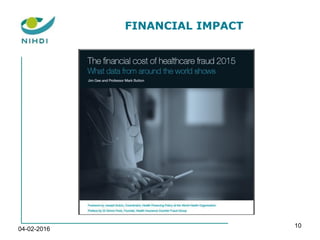
FINANCIAL IMPACT
04-02-2016
10
COMBATING FRAUD
A essential element for good governance health
systems:
• Rules
• Tools
• Manpower
• Cooperation
04-02-2016
11
THE BELGIAN EXPERIENCE:
MAIN TRENDS
• From incidental, anecdotal interventions to
strategic, robust and integrated approach
• From exclusive top down strategy to active and
responsible partnerships
• From a vision unilateraly based on criminal law to
a multidimensional policy
• From primitive datasets to more sophisicated
databases, datalinkage and datamining
• From national dimension to international
cooperation
04-02-2016
12
THE BELGIAN EXPERIENCE:
GENERAL FEATURES
- Primary control: sickness funds; second line: NIHDI
- Specific department of medical evaluation and control of NIHDI,
organised on a multidisciplinary basis and associated in establishing
legislation
- Triple mission
• Information for providers (e.g. ‘infobox’)
• Control: reality and conformity checks as well as
overconsumption (not easy!)
• Evaluation (feedback mirror for providers and impact analysis)
- Yearly ‘ICE’ program
- Research and investigation capacity (direct access to claims data
and medical files)
- Fast and efficient procedures (e.g. suspension payments),
specialised jurisdictions
04-02-2016
13
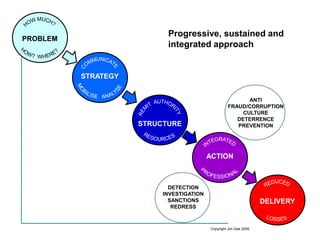
ANTI
FRAUD/CORRUPTION
CULTURE
DETERRENCE
PREVENTION
DETECTION
INVESTIGATION
SANCTIONS
REDRESS
PROBLEM
STRATEGY
STRUCTURE
ACTION
DELIVERY
Progressive, sustained and
integrated approach
Copyright Jim Gee 2009
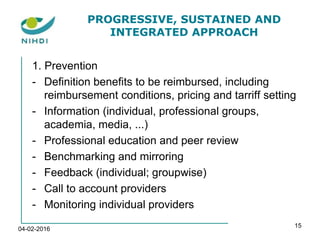
PROGRESSIVE, SUSTAINED AND
INTEGRATED APPROACH
1. Prevention
- Definition benefits to be reimbursed, including
reimbursement conditions, pricing and tarriff setting
- Information (individual, professional groups,
academia, media, ...)
- Professional education and peer review
- Benchmarking and mirroring
- Feedback (individual; groupwise)
- Call to account providers
- Monitoring individual providers
04-02-2016
15
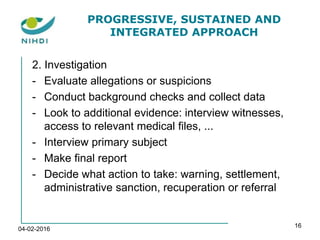
PROGRESSIVE, SUSTAINED AND
INTEGRATED APPROACH
2. Investigation
- Evaluate allegations or suspicions
- Conduct background checks and collect data
- Look to additional evidence: interview witnesses,
access to relevant medical files, ...
- Interview primary subject
- Make final report
- Decide what action to take: warning, settlement,
administrative sanction, recuperation or referral
04-02-2016
16
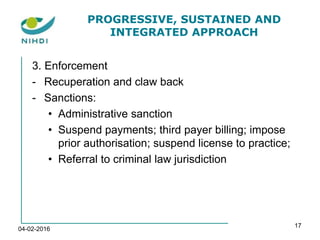
PROGRESSIVE, SUSTAINED AND
INTEGRATED APPROACH
3. Enforcement
- Recuperation and claw back
- Sanctions:
• Administrative sanction
• Suspend payments; third payer billing; impose
prior authorisation; suspend license to practice;
• Referral to criminal law jurisdiction
04-02-2016
17
THE BELGIAN EXPERIENCE:
CONCRETE EXAMPLES
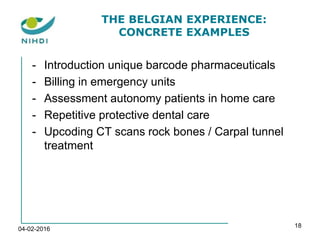
- Introduction unique barcode pharmaceuticals
- Billing in emergency units
- Assessment autonomy patients in home care
- Repetitive protective dental care
- Upcoding CT scans rock bones / Carpal tunnel
treatment
04-02-2016
18
THE BELGIAN EXPERIENCE:
NEW DEVELOPMENTS
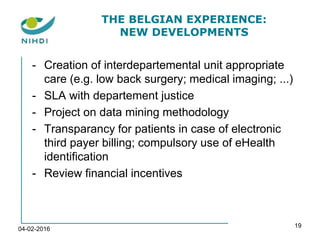
- Creation of interdepartemental unit appropriate
care (e.g. low back surgery; medical imaging; ...)
- SLA with departement justice
- Project on data mining methodology
- Transparancy for patients in case of electronic
third payer billing; compulsory use of eHealth
identification
- Review financial incentives
04-02-2016
19
COMBATING FRAUD AND ABUSE:
CRITICAL SUCCESSFACTORS
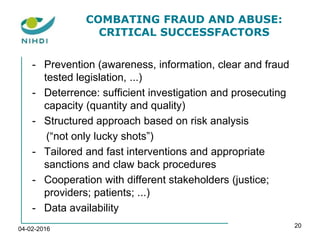
- Prevention (awareness, information, clear and fraud
tested legislation, ...)
- Deterrence: sufficient investigation and prosecuting
capacity (quantity and quality)
- Structured approach based on risk analysis
(“not only lucky shots”)
- Tailored and fast interventions and appropriate
sanctions and claw back procedures
- Cooperation with different stakeholders (justice;
providers; patients; ...)
- Data availability
04-02-2016
20
04-02-2016
21
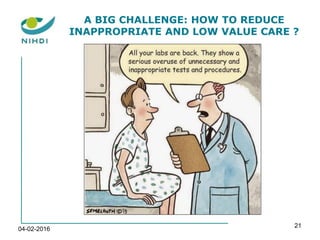
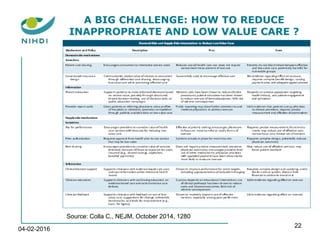
A BIG CHALLENGE: HOW TO REDUCE
INAPPROPRIATE AND LOW VALUE CARE ?
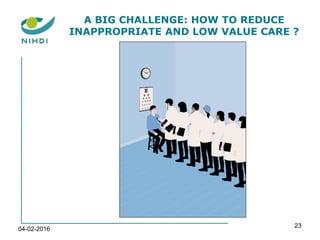
A BIG CHALLENGE: HOW TO REDUCE
INAPPROPRIATE AND LOW VALUE CARE ?
04-02-2016
22
Source: Colla C., NEJM, October 2014, 1280
04-02-2016
23
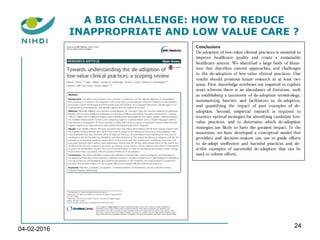
A BIG CHALLENGE: HOW TO REDUCE
INAPPROPRIATE AND LOW VALUE CARE ?
04-02-2016
24
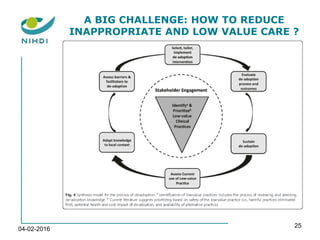
A BIG CHALLENGE: HOW TO REDUCE
INAPPROPRIATE AND LOW VALUE CARE ?
04-02-2016
25
A BIG CHALLENGE: HOW TO REDUCE
INAPPROPRIATE AND LOW VALUE CARE ?
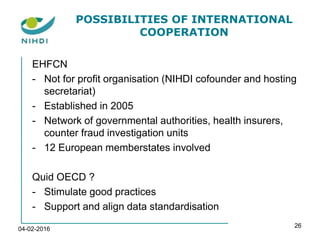
POSSIBILITIES OF INTERNATIONAL
COOPERATION
EHFCN
- Not for profit organisation (NIHDI cofounder and hosting
secretariat)
- Established in 2005
- Network of governmental authorities, health insurers,
counter fraud investigation units
- 12 European memberstates involved
Quid OECD ?
- Stimulate good practices
- Support and align data standardisation
04-02-2016
26
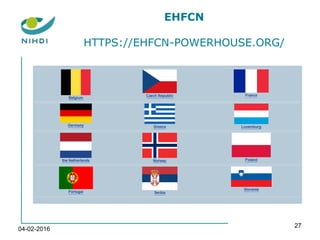
EHFCN
HTTPS://EHFCN-POWERHOUSE.ORG/
04-02-2016
27
THANK YOU FOR YOUR
ATTENTION !
04-02-2016
28

Purchasing arrangements - the Belgian experience

  • 1.
    Jo De Cock- CEO NIHDI 04-02-2016 - OECD Paris OECD Joint Network of Senior Budget and Health Officials: The Belgian Experience
  • 2.
    HEALTH CARE FRAUD: NOTA NEW PROBLEM 04-02-2016 2
  • 3.
    04-02-2016 3 HEALTH CARE FRAUD: BUTMORE AND MORE AWARENESS Many findings of wasteful use of resources have been reported in the empirical literature, inter alia: i) sub-optimal setups for delivery of care; ii) inefficient provision of acute hospital care; iii) fraud and corruption in health care systems; iv) a sub-optimal mix of preventative versus curative care
  • 4.
    HEALTH CARE FRAUD: BUTMORE AND MORE AWARENESS 04-02-2016 4
  • 5.
    HEALTH CARE FRAUD: BUTMORE AND MORE AWARENESS 04-02-2016 5
  • 6.
    SUSTAINABILITY OF HEALTHCARE SYSTEMS: WHAT’S THE RIGHT WAY ? • Investing less resources ? • Developing additional funding mechanisms ? • Reducing waste, increasing value ? 04-02-2016 6
  • 7.
    WASTE “ Waste isany activity in a process that consumes resources without adding value ” - Taiichi Ohno, Toyota 04-02-2016 7
  • 8.
    HEALTH CARE FRAUD: TYPES 04-02-2016 8 Source:THORNTON, e.a., Categorizing and Describing the Types of Fraud in Healthcare, 2015
  • 9.
    FRAUD AND ABUSE: APICTURE OF A BROAD LANDSCAPE 04-02-2016 9 Source: EHFCN
  • 10.
  • 11.
    COMBATING FRAUD A essentialelement for good governance health systems: • Rules • Tools • Manpower • Cooperation 04-02-2016 11
  • 12.
    THE BELGIAN EXPERIENCE: MAINTRENDS • From incidental, anecdotal interventions to strategic, robust and integrated approach • From exclusive top down strategy to active and responsible partnerships • From a vision unilateraly based on criminal law to a multidimensional policy • From primitive datasets to more sophisicated databases, datalinkage and datamining • From national dimension to international cooperation 04-02-2016 12
  • 13.
    THE BELGIAN EXPERIENCE: GENERALFEATURES - Primary control: sickness funds; second line: NIHDI - Specific department of medical evaluation and control of NIHDI, organised on a multidisciplinary basis and associated in establishing legislation - Triple mission • Information for providers (e.g. ‘infobox’) • Control: reality and conformity checks as well as overconsumption (not easy!) • Evaluation (feedback mirror for providers and impact analysis) - Yearly ‘ICE’ program - Research and investigation capacity (direct access to claims data and medical files) - Fast and efficient procedures (e.g. suspension payments), specialised jurisdictions 04-02-2016 13
  • 14.
  • 15.
    PROGRESSIVE, SUSTAINED AND INTEGRATEDAPPROACH 1. Prevention - Definition benefits to be reimbursed, including reimbursement conditions, pricing and tarriff setting - Information (individual, professional groups, academia, media, ...) - Professional education and peer review - Benchmarking and mirroring - Feedback (individual; groupwise) - Call to account providers - Monitoring individual providers 04-02-2016 15
  • 16.
    PROGRESSIVE, SUSTAINED AND INTEGRATEDAPPROACH 2. Investigation - Evaluate allegations or suspicions - Conduct background checks and collect data - Look to additional evidence: interview witnesses, access to relevant medical files, ... - Interview primary subject - Make final report - Decide what action to take: warning, settlement, administrative sanction, recuperation or referral 04-02-2016 16
  • 17.
    PROGRESSIVE, SUSTAINED AND INTEGRATEDAPPROACH 3. Enforcement - Recuperation and claw back - Sanctions: • Administrative sanction • Suspend payments; third payer billing; impose prior authorisation; suspend license to practice; • Referral to criminal law jurisdiction 04-02-2016 17
  • 18.
    THE BELGIAN EXPERIENCE: CONCRETEEXAMPLES - Introduction unique barcode pharmaceuticals - Billing in emergency units - Assessment autonomy patients in home care - Repetitive protective dental care - Upcoding CT scans rock bones / Carpal tunnel treatment 04-02-2016 18
  • 19.
    THE BELGIAN EXPERIENCE: NEWDEVELOPMENTS - Creation of interdepartemental unit appropriate care (e.g. low back surgery; medical imaging; ...) - SLA with departement justice - Project on data mining methodology - Transparancy for patients in case of electronic third payer billing; compulsory use of eHealth identification - Review financial incentives 04-02-2016 19
  • 20.
    COMBATING FRAUD ANDABUSE: CRITICAL SUCCESSFACTORS - Prevention (awareness, information, clear and fraud tested legislation, ...) - Deterrence: sufficient investigation and prosecuting capacity (quantity and quality) - Structured approach based on risk analysis (“not only lucky shots”) - Tailored and fast interventions and appropriate sanctions and claw back procedures - Cooperation with different stakeholders (justice; providers; patients; ...) - Data availability 04-02-2016 20
  • 21.
    04-02-2016 21 A BIG CHALLENGE:HOW TO REDUCE INAPPROPRIATE AND LOW VALUE CARE ?
  • 22.
    A BIG CHALLENGE:HOW TO REDUCE INAPPROPRIATE AND LOW VALUE CARE ? 04-02-2016 22 Source: Colla C., NEJM, October 2014, 1280
  • 23.
    04-02-2016 23 A BIG CHALLENGE:HOW TO REDUCE INAPPROPRIATE AND LOW VALUE CARE ?
  • 24.
    04-02-2016 24 A BIG CHALLENGE:HOW TO REDUCE INAPPROPRIATE AND LOW VALUE CARE ?
  • 25.
    04-02-2016 25 A BIG CHALLENGE:HOW TO REDUCE INAPPROPRIATE AND LOW VALUE CARE ?
  • 26.
    POSSIBILITIES OF INTERNATIONAL COOPERATION EHFCN -Not for profit organisation (NIHDI cofounder and hosting secretariat) - Established in 2005 - Network of governmental authorities, health insurers, counter fraud investigation units - 12 European memberstates involved Quid OECD ? - Stimulate good practices - Support and align data standardisation 04-02-2016 26
  • 27.
  • 28.
    THANK YOU FORYOUR ATTENTION ! 04-02-2016 28