ROEVER ENGINEERING COLLEGE
(Approvedby AICTE, New Delhi and Affiliated to Anna University, Chennai)
( Inclusion under Sections 2(F) and 12 (B) of the UGC Act, 1956)
ELAMBALUR, PERAMBALUR – 621 220
DEPARTMENT OF ELECTRONICS & COMMUNICATION ENGINEERING
QUESTION BANK
PART- A
S.No Questions CO BTL PO
1 Define Cell, Cluster. 1 1 1
2 What is meant by frequency reuse? 1 1 1
3 What is channel assignment? What are the types? 1 2 2
4 Define hand off. Write the types of hand off. 1 2 2
5 What is frequency reuse ratio? 1 1 1
6 Define Grade of service. 1 2 2
9 Define MS, BS and MSC. 1 1 1
10 Define handoff process. 1 1 1
12 What are the techniques used to expand the capacity of cellular system? 1 1 2
13 What do you mean by DCA? 1 2 2
14 What are the major types of cellular interference? 1 1 1
15 List the techniques to avoid interference.
1
2 2
Course Code & Name : C301/ WIRELESS COMMUNICATION L T P C 3 0 2 4
Sub Code : EC3501 Year/Sem : III/V AY: 2022-2023
UNITI THE CELLULAR CONCEPT SYSTEM DESIGN FUNDAMENTALS
9
Introduction-Frequency Reuse-Channel Assignment Strategies-Handoff Strategies: Prioritizing
Handoffs, Practical Handoff Considerations. Interference And System Capacity: Co-Channel
Interference And System Capacity-Channel Planning For Wireless Systems, Adjacent Channel
Interference, Power Control For Reducing Interference, Trunking And Grade Of Service. Improving
Coverage and Capacity in Cellular Systems: Cell Splitting, Sectoring.
2.
PART- B
S.No QuestionsCO BTL PO
1 Explain in detail about channel assignment strategies. 2 1 2
2
Demonstrate the scenario of handoff at cell boundary and Prioritizing Handoffs
in detail.
2 2 2
3
Explain in detail how to improve coverage and channel capacity in cellular
systems.
2 1 1,2
4
i) Explain the umbrella cell concept.
ii) Discuss the impact of interference in a cellular system.
2 1 1,2
5 Explain the method for increasing the capacity of wireless cellular network. 2 1 2
6 Describe the Power Control For Reducing Interference. 2 1 2
7
Explain about co-channel interference and adjacent channel interference.
Describe the technique to avoid interference.
2 2 1
8
With the help of a neat diagram explain about frequency reuse and the
advantages of it.
2 3 1,2
9
A spectrum of 30 MHz is allocated to a wireless FDD cellular system which uses
two 25 KHz simplex channels to provides full duplex voice and control
channels. Compute the number of channels available per cell if a system uses 4
cell reuse. Also repeat the computation for 12 cell reuse. If 1 MHz of the
allocated spectrum is dedicated to control channels, determine an equitable
distribution of control channels and voice channels in each cell for each of the
three systems.
2 3 1,2
10
If a total of 33 MHz of bandwidth is allocated to a particular FDD cellular
telephone system which uses two 25 kHz simplex channels to provide full
duplex voice and control channels, compute the number of channels available
per cell if a system uses (a) four-cell reuse, (b) seven-cell reuse, and (c) 12-cell
reuse. If 1 MHz of the allocated spectrum is dedicated to control channels,
construct an equitable distribution of control channels and voice channels in each
cell for each of the three systems.
2 3 1,2
3.
PART- A
S.No QuestionsCO BTL PO
1
Mention the propagation mechanisms of EM waves?
2 1 1
2
What are the factors influencing small scale fading?
2 1 1
3
Illustrate the features of multipath propagation.
2 3 2
4
Differentiate time selective and frequency selective channel.
2 3 2
5 What do you mean by small scale fading? 2 1 1
6 Define Doppler shift. 2 2 2
7 Define coherence time and coherence bandwidth. 2 2 2
8
Relate small scale fading and large scale fading.
2 2 2
9 State Huygens’s principle. 2 1 1
10 What is the significance of propagation model? 2 3 1
11 Define coherence time and coherence bandwidth. 2 2 2
12
Give the differences between Small scale and large scale Fading.
2 2 2
13
State the drawbacks of free space model.
2 2 2
14
Define Brewster angle.
2 1 1
15.
Find the far field distance for an antenna with maximum dimension of
2 m and operating frequency of 1 GHz.
2 2 1,2
UNIT II- MOBILE RADIO PROPAGATION 9
Large Scale Path Loss: Introduction To Radio Wave Propagation - Free Space Propagation Model –
Three Basic Propagation Mechanism: Reflection – Brewster Angle- Diffraction Scattering. Small Scale
Fading And Multipath: Small Scale Multipath Propagation, Factors Influencing Small-Scale Fading,
Doppler Shift, Coherence Bandwidth, Doppler Spread And Coherence Time. Types Of Small- Scale
Fading: Fading Effects Due To Multipath Time Delay Spread, Fading Effects Due To Doppler Spread.
4.
PART -B
S.No QuestionsCO BTL PO
1
Explain the free space propagation model in detail with no obstacle in between
the TX and RX. 2 1 2
2 Describe the of the two-ray ground reflection model and obtain the path loss. 2 1 2
3 Illustrate the fading effects due to Multipath time delay spread. 2 2 1,2
4 Summarize about the factors which influence small scale fading. 2 2 1,2
5 Illustrate Knife-edge Diffraction model with Fresnel zones. 2 2 2
6
In digital cellular system if fc=900MHz and the mobile velocity is 70km/hr,
evaluate the received carrier frequency if the mobile
(i) Directly towards the transmitter (positive Doppler shift)
(ii) Directly away from the transmitter (negative Doppler shift)
(iii) In the direction perpendicular to the direction of the arrival of the transmitted
signal.
2 3 2
7
Assume if a transmitter produces 50 W of power, express the transmit power in
units of dBm and dBW. 50W is applied to a unity gain antenna with a 900 MHz
carrier frequency. Solve for the received power in dBm at a free space distance of
100m from the antenna also justify the analytical expression by computing the
received power at 10 km.
2 3 2
8
If the transmitter power is 1W and carrier frequency is 2.4 GHz and the receiver
is at a distance of 1 mile (1.6 km) from the transmitter. Assume that the
transmitter and receiver antenna gains are 1.6. Determine the received power in
dBm in the free space of a signal, the path loss in dB and the transmission delay?
2 3 2
9
In the following cases tell whether the two ray model could be applied and justify
why or why not Case (i) : h1=35m, hr=3m, d=250 m case (ii) : h1=30m,
hr=1.5m, d=450 m
2 3 1,2
10
Explain Flat fading and frequency selective fading in detail.
2 2 1
5.
PART -A
S.No QuestionsCO BTL PO
1 What are the advantages of Digital Modulation? 3 2 2
2 What are the Factors that Influence The Choice Of Digital Modulation? 3 1 1
3 What are the techniques used to improve the received signal quality? 3 3 2
4 How GMSK signal is generated? 3 1 1
5 List the advantages and disadvantages of FH-SS. 3 2 2
6 What is Direct-sequence spread-spectrum? 3 2 2
7 List its advantages and disadvantage of DS-SS. 3 3 1
9 Why diversity and equalization techniques are used? 3 2 2
10 Define Processing Gain. 3 1 2
11 What is meant by Polarization diversity? 3 1 1
12 What is meant by time and frequency diversity? 3 3 1
13 Differentiate micro and macro diversity. 3 1 1
14 What are the nonlinear equalization methods used? 3 1 2
15 Why GMSK is preferred for multiuser cellular communication? 3 2 2
PART- B
S.No Questions CO BTL PO
1 Explain the classification of equalizers. 4 4 2
2 Briefly explain about linear and non-linear equalizers 4 1 1
3 Explain with neat diagram, the principle of Gaussian Minimum shift keying
receiver and mention how this is different from MSK.
4 2 1,2
4 Explain about MLSE equalizer. 4 1 1,2
5 Discuss in detail about the different micro diversity concepts 4 2 2
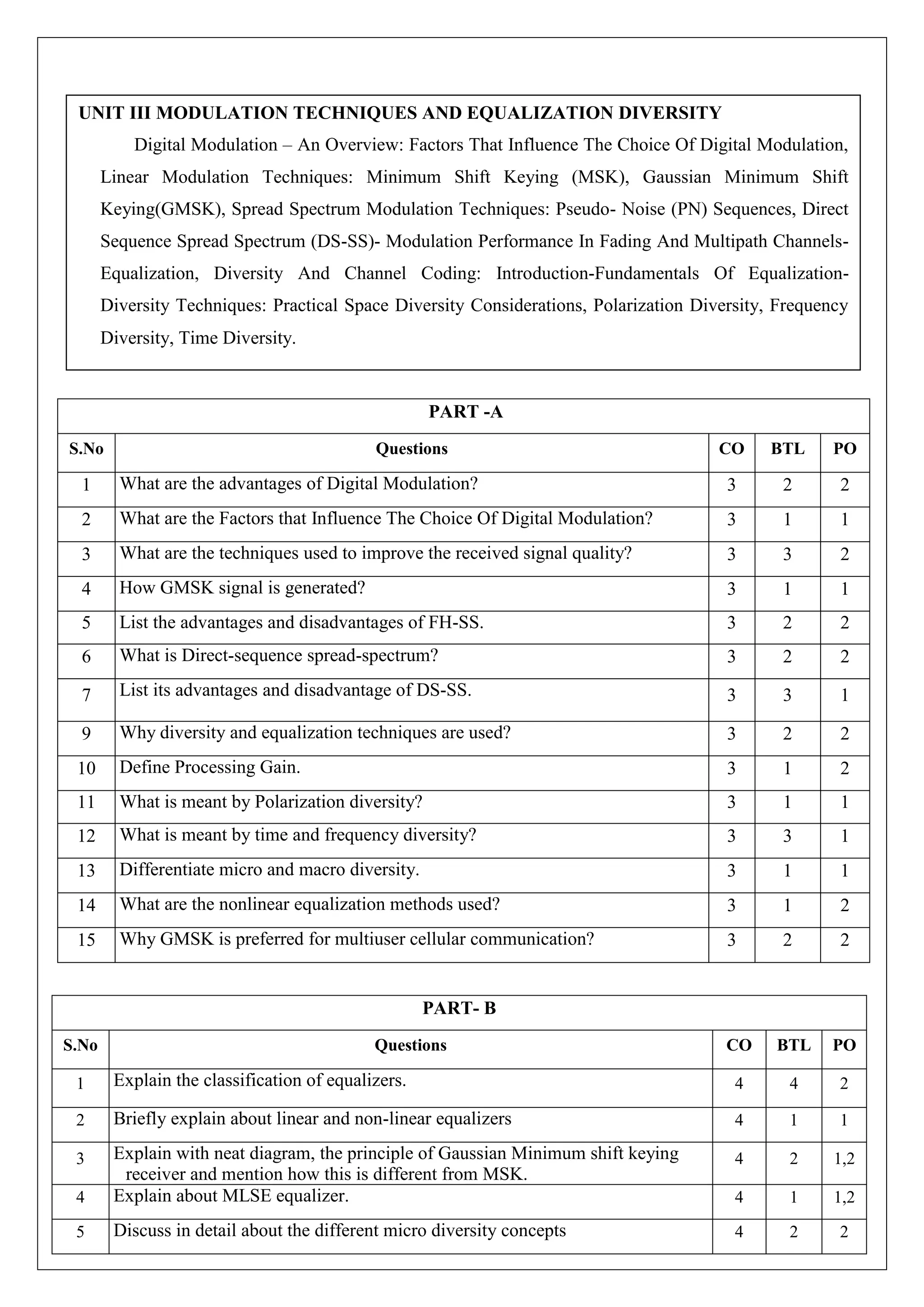
UNIT III MODULATION TECHNIQUES AND EQUALIZATION DIVERSITY
Digital Modulation – An Overview: Factors That Influence The Choice Of Digital Modulation,
Linear Modulation Techniques: Minimum Shift Keying (MSK), Gaussian Minimum Shift
Keying(GMSK), Spread Spectrum Modulation Techniques: Pseudo- Noise (PN) Sequences, Direct
Sequence Spread Spectrum (DS-SS)- Modulation Performance In Fading And Multipath Channels-
Equalization, Diversity And Channel Coding: Introduction-Fundamentals Of Equalization-
Diversity Techniques: Practical Space Diversity Considerations, Polarization Diversity, Frequency
Diversity, Time Diversity.
6.
PART- A
S.No QuestionsCO BTL PO
1 What is meant by Multiple Access? 4 4 2
2 What are the features of TDMA? 4 4 2
3 What are the features of FDMA? 4 4 2
4 Compare TDMA, FDMA and CDMA. 4 3 1,2
5 What is Space Division Multiple Access (SDMA)? 4 2 1
6 State the advantages of CDMA over FDMA? 4 3 1,2
7 Mention the types of Multiple Access. 4 4 1,2
8 How CDMA handle near-far problem? 4 3 1
9 Write the expression for number of channels in TDMA? 4 2 11
10 Define spatial multiplexing. 4 1 1
PART-B
S.No Questions CO BTL PO
1
Summarize the features of various multiple access techniques used in
wireless mobile communication. State the advantages and disadvantages
of each technique.
4 2 2
2 Compare and contrast the features of FDMA,TDMA and CDMA 4 2 1
6 Explain details about direct sequence spread spectrum (DS/SS). 4 4 2
7 Describe any two adaptation algorithms for Mean square error Equalizers 4 2 1
8 i) With a neat block diagram explain the principle of Macro diversity
ii)Explain the operation of an adaptive equalizer at the receiver side
4 2 1
9 Describe on Polarization and space diversity. 4 2 1
10 Derive the mean square error for a generic adaptive equalizer. 4 1 1
11 Explain any two diversity techniques to combat small scale fading 4 2 1
12 Describe any two adaptation algorithms for Mean square error Equalizers. 4 1 1
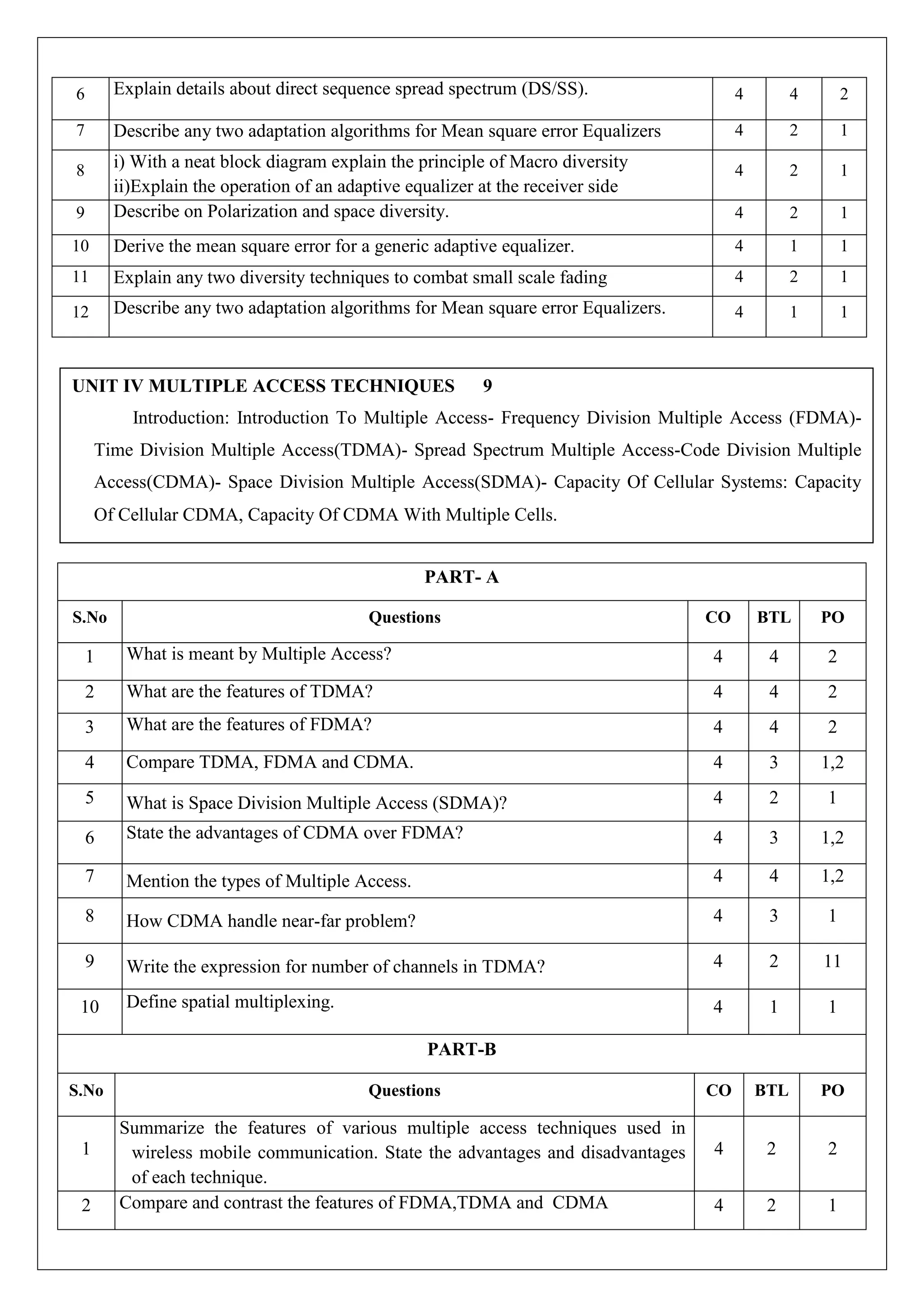
UNIT IV MULTIPLE ACCESS TECHNIQUES 9
Introduction: Introduction To Multiple Access- Frequency Division Multiple Access (FDMA)-
Time Division Multiple Access(TDMA)- Spread Spectrum Multiple Access-Code Division Multiple
Access(CDMA)- Space Division Multiple Access(SDMA)- Capacity Of Cellular Systems: Capacity
Of Cellular CDMA, Capacity Of CDMA With Multiple Cells.
7.
3 Explain indetail about FDMA and its advantages and disadvantages. 4 4 2
4 Explain in details about CDMA and its advantages and applications. 4 3 1,2
5 Explain details about TDMA and its advantages and disadvantages. 4 2 1
6 Explain details about the features of SDMA and its advantages. 4 2 1
7 With neat diagram explain the forward and reverse CDMA channel
Structure.
4 3 1
PART- A
S.No Questions CO BTL PO
1 Difference Between Wireless And Fixed Telephone Networks 5 2 2
2 What is PSTN? 5 1 1
3 What are the limitations in wireless Networking? 5 1 1
4 Write the objective of PCS PSN. 5 1 2
5 List the advantages of the second generation wireless systems? 5 2 2
6 Differences between Packet Vs Circuit Switching 5 1 1
7 Write the advantages of Packet Switching. 5 1 1
8 Name the types of routing services used in wireless network? 5 2 1
9 What is Packet Reservation Multiple Access? 5 2 1
10 What is meant by Universal Mobile Telecommunication Systems (UMTS)? 5 1 1
11 Write the function of IS-41? 5 2 1
12 Differenciate between Connection oriented and Connection less service. 5 1 1,2
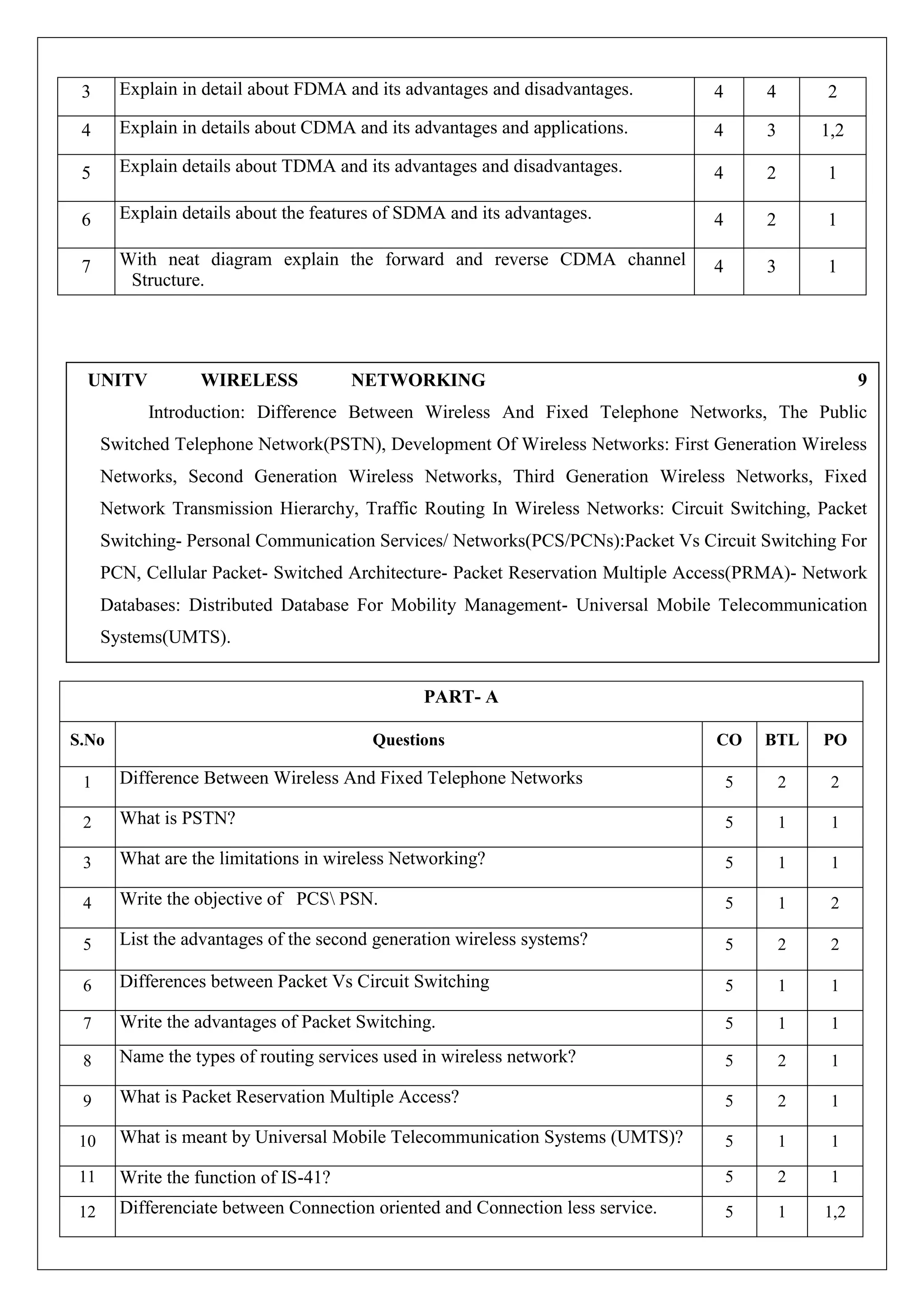
UNITV WIRELESS NETWORKING 9
Introduction: Difference Between Wireless And Fixed Telephone Networks, The Public
Switched Telephone Network(PSTN), Development Of Wireless Networks: First Generation Wireless
Networks, Second Generation Wireless Networks, Third Generation Wireless Networks, Fixed
Network Transmission Hierarchy, Traffic Routing In Wireless Networks: Circuit Switching, Packet
Switching- Personal Communication Services/ Networks(PCS/PCNs):Packet Vs Circuit Switching For
PCN, Cellular Packet- Switched Architecture- Packet Reservation Multiple Access(PRMA)- Network
Databases: Distributed Database For Mobility Management- Universal Mobile Telecommunication
Systems(UMTS).
.
8.
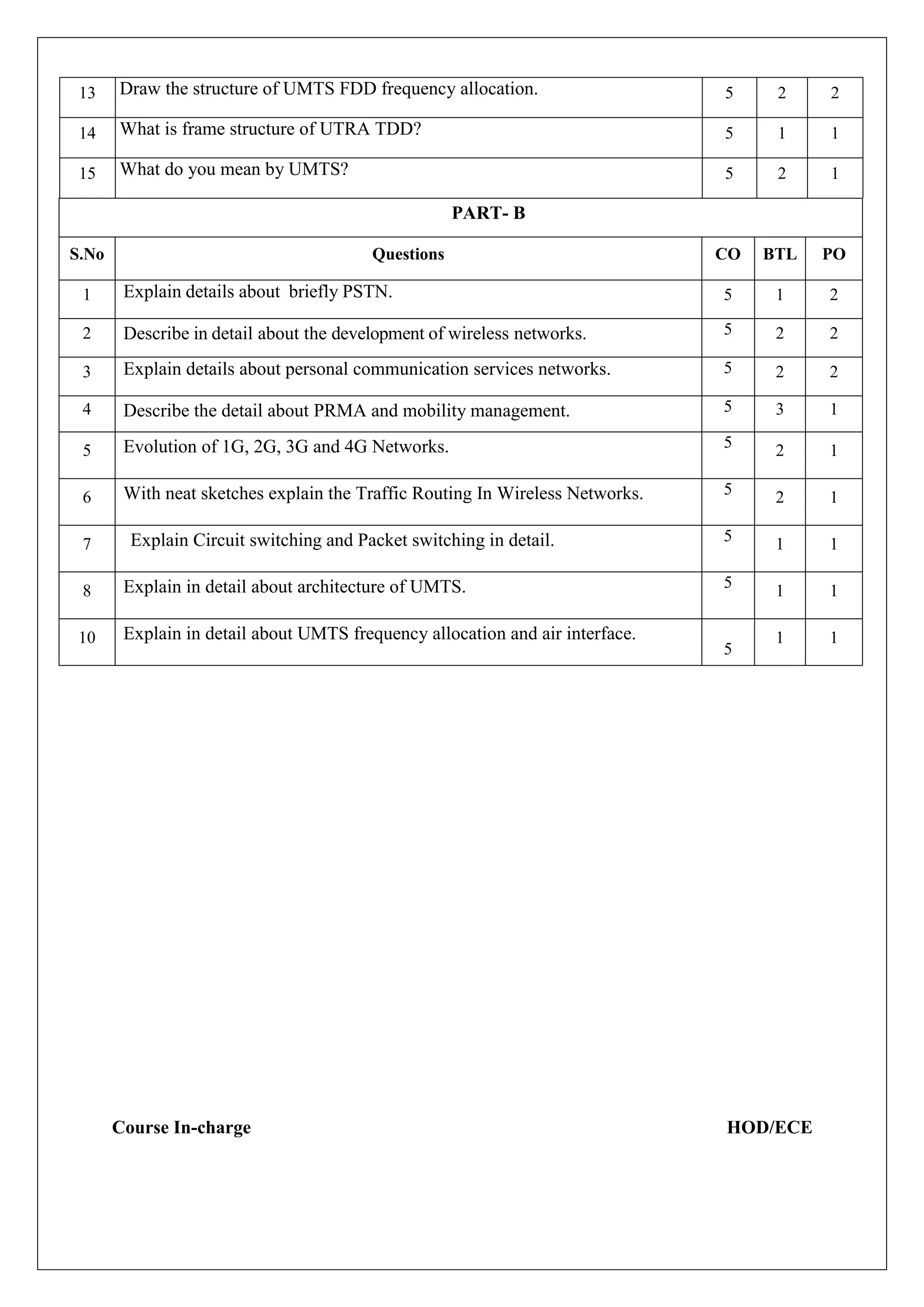
13 Draw thestructure of UMTS FDD frequency allocation. 5 2 2
14 What is frame structure of UTRA TDD? 5 1 1
15 What do you mean by UMTS? 5 2 1
PART- B
S.No Questions CO BTL PO
1 1. Explain details about briefly PSTN. 5 1 2
2 2. Describe in detail about the development of wireless networks. 5 2 2
3 3. Explain details about personal communication services networks. 5 2 2
4 4. Describe the detail about PRMA and mobility management. 5 3 1
5 5. Evolution of 1G, 2G, 3G and 4G Networks. 5 2 1
6 6. With neat sketches explain the Traffic Routing In Wireless Networks. 5 2 1
7 7. Explain Circuit switching and Packet switching in detail. 5 1 1
8 8. Explain in detail about architecture of UMTS. 5 1 1
10 9. Explain in detail about UMTS frequency allocation and air interface.
5
1 1
Course In-charge HOD/ECE