PRISTINE 
Programmability In RINA for European 
supremacy of virTualised NEtworks 
● Stein Gjessing, University of Oslo, Norway 
@ictpristine
PRISTINE Background: RINA 
• RINA is an emerging clean-slate programmable 
networking approach 
• Centered on Inter-Process Communication (IPC) 
• Supports 
• high scalability 
• multi-homing 
• built-in security 
• seamless access to real-time information 
• operation in dynamic environments
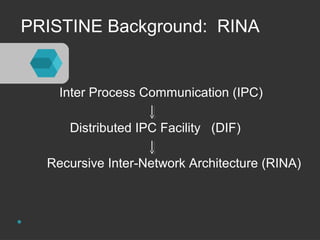
PRISTINE Background: RINA 
Inter Process Communication (IPC) 
Distributed IPC Facility (DIF) 
Recursive Inter-Network Architecture (RINA)
PRISTINE: Main results at end 
● Software Development Kit for the RINA implementation, 
(building on initially developed one by the IRATI project) 
● Specification and implementation of policies that address 
congestion control, quality of service, addressing, routing, 
authentication, access control and resiliency 
● First spec. and impl. of a DIF Management System (DMS) 
● Three prototypes for the three use cases: 
distributed cloud, datacentre networking, network serv. provider 
● First RINA Simulator.
PRISTINE: Results Oct. 2014 
● Initial implementation of the Software 
Development Kit (Linux Kernel) for a RINA implementation. 
● Identification of the relevant RINA IPC Process components and 
policies for : 
• Congestion avoidance/control, Distributed resource allocation, Addressing 
and routing, Authentication, authorization and confidentiality, Security 
coordination within a DIF, Reliability and high availability and Network 
Management 
● Draft specification of a RINA DIF Management System (DMS) 
● Set of draft designs of RINA-based solutions for the Distributed 
Cloud, Datacenter Networking and Network Service Provider use 
cases. 
● Initial proof of concept implementation of a RINA Simulator.
Future Topics / Areas 
PRISTINE 
 Specification of techniques to enhance performance and resource 
utilization in networks. 
 Specification of innovative security and reliability enablers to 
support authentication, access control, encryption and security 
coordination within virtual networks. 
 Framework for multi-layer configuration, performance and security 
management. 
 Network architecture, protocols and interfaces that support 
(distributed) applications. 
 Deployment and experiments with alternative network architectures 
(alternatives to the regular TCP/IP-stack).
PRISTINE 
Questions ? 
●Stein Gjessing, University of Oslo, Norway

EC Net Tech FI Cluster meeting October 23 2014 PRISTINE

  • 1.
    PRISTINE Programmability InRINA for European supremacy of virTualised NEtworks ● Stein Gjessing, University of Oslo, Norway @ictpristine
  • 2.
    PRISTINE Background: RINA • RINA is an emerging clean-slate programmable networking approach • Centered on Inter-Process Communication (IPC) • Supports • high scalability • multi-homing • built-in security • seamless access to real-time information • operation in dynamic environments
  • 3.
    PRISTINE Background: RINA Inter Process Communication (IPC) Distributed IPC Facility (DIF) Recursive Inter-Network Architecture (RINA)
  • 4.
    PRISTINE: Main resultsat end ● Software Development Kit for the RINA implementation, (building on initially developed one by the IRATI project) ● Specification and implementation of policies that address congestion control, quality of service, addressing, routing, authentication, access control and resiliency ● First spec. and impl. of a DIF Management System (DMS) ● Three prototypes for the three use cases: distributed cloud, datacentre networking, network serv. provider ● First RINA Simulator.
  • 5.
    PRISTINE: Results Oct.2014 ● Initial implementation of the Software Development Kit (Linux Kernel) for a RINA implementation. ● Identification of the relevant RINA IPC Process components and policies for : • Congestion avoidance/control, Distributed resource allocation, Addressing and routing, Authentication, authorization and confidentiality, Security coordination within a DIF, Reliability and high availability and Network Management ● Draft specification of a RINA DIF Management System (DMS) ● Set of draft designs of RINA-based solutions for the Distributed Cloud, Datacenter Networking and Network Service Provider use cases. ● Initial proof of concept implementation of a RINA Simulator.
  • 6.
    Future Topics /Areas PRISTINE  Specification of techniques to enhance performance and resource utilization in networks.  Specification of innovative security and reliability enablers to support authentication, access control, encryption and security coordination within virtual networks.  Framework for multi-layer configuration, performance and security management.  Network architecture, protocols and interfaces that support (distributed) applications.  Deployment and experiments with alternative network architectures (alternatives to the regular TCP/IP-stack).
  • 7.
    PRISTINE Questions ? ●Stein Gjessing, University of Oslo, Norway

Editor's Notes

  • #6 * set of draft designs of RINA-based solutions for the Distributed Cloud, Datacenter Networking and Network Service Provider use cases. Each design specification includes the type of DIFs in the scenario, the requirements each DIF has to fulfill and the relationships between DIFs; the requirements for the Network Management System and the requirements for supporting tools and subsystems that allow RINA to interoperate with current technologies and applications.