Monday Tutorial sessions
An Introduction to RINA
Dimitri Staessens - iMinds
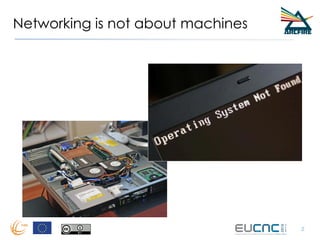
Networking is not about machines
2
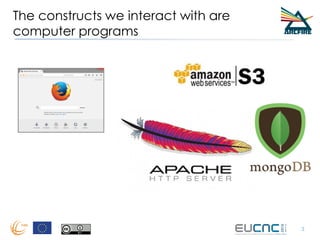
The constructs we interact with are
computer programs
3
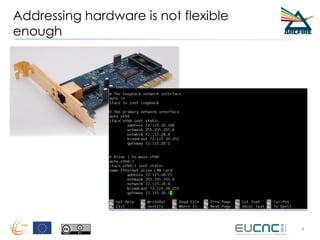
Addressing hardware is not flexible
enough
4
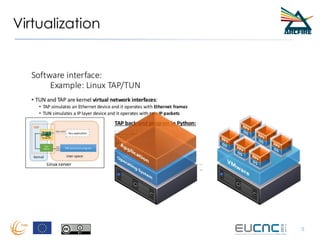
Virtualization
5
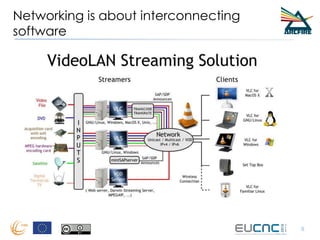
Networking is about interconnecting
software
6
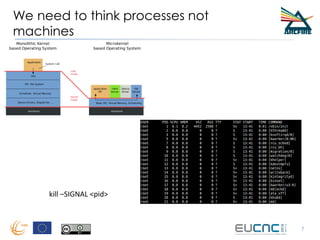
We need to think processes not
machines
7
kill –SIGNAL <pid>
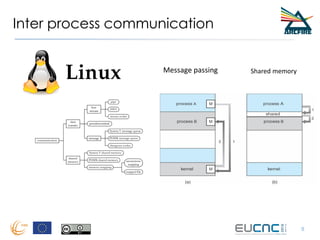
Inter process communication
8
Message passing Shared memory
Message Passing IPC has a simple API
9
fd[1] fd[0]
int pipe (pipefd, /* flags */);
int read (pipefd[0], <buf>, len);
int write (pipefd[1], <buf>, len);
Basic premise of RINA
10
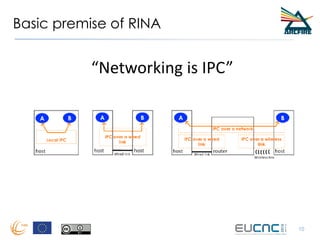
“Networking is IPC”
Single system
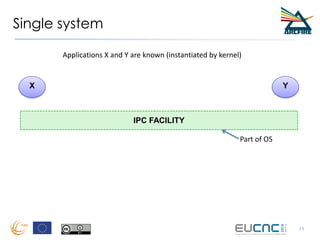
11
IPC FACILITY
X Y
Applications X and Y are known (instantiated by kernel)
Part of OS
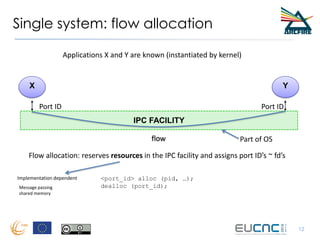
Single system: flow allocation
12
IPC FACILITY
X Y
Port ID Port ID
flow
Flow allocation: reserves resources in the IPC facility and assigns port ID’s ~ fd’s
Applications X and Y are known (instantiated by kernel)
Part of OS
<port_id> alloc (pid, …);
dealloc (port_id);
Implementation dependent
Message passing
shared memory
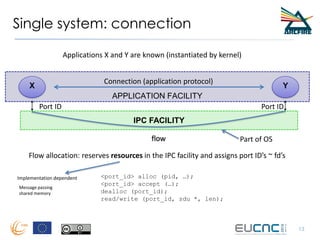
Single system: connection
13
IPC FACILITY
X Y
Port ID Port ID
flow
Flow allocation: reserves resources in the IPC facility and assigns port ID’s ~ fd’s
Applications X and Y are known (instantiated by kernel)
Part of OS
<port_id> alloc (pid, …);
<port_id> accept (…);
dealloc (port_id);
read/write (port_id, sdu *, len);
Implementation dependent
Message passing
shared memory
APPLICATION FACILITY
Connection (application protocol)
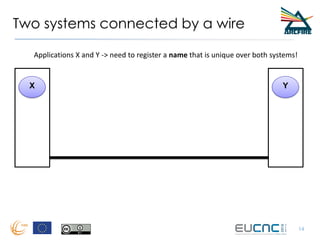
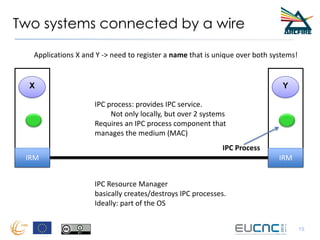
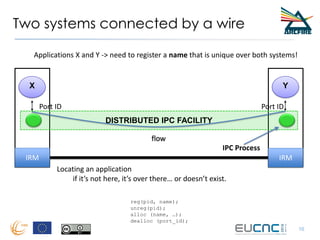
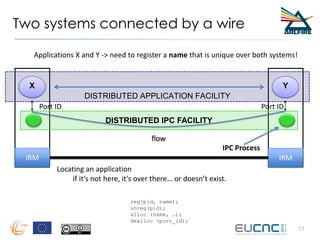
Two systems connected by a wire
14
X Y
Applications X and Y -> need to register a name that is unique over both systems!
Two systems connected by a wire
15
X Y
IPC process: provides IPC service.
Not only locally, but over 2 systems
Requires an IPC process component that
manages the medium (MAC)
Applications X and Y -> need to register a name that is unique over both systems!
IPC Process
IRM IRM
IPC Resource Manager
basically creates/destroys IPC processes.
Ideally: part of the OS
Two systems connected by a wire
16
DISTRIBUTED IPC FACILITY
X Y
Port ID Port ID
flow
IPC Process
Locating an application
if it’s not here, it’s over there… or doesn’t exist.
Applications X and Y -> need to register a name that is unique over both systems!
reg(pid, name);
unreg(pid);
alloc (name, …);
dealloc (port_id);
IRMIRM
DISTRIBUTED APPLICATION FACILITY
Two systems connected by a wire
17
DISTRIBUTED IPC FACILITY
X Y
Port ID Port ID
flow
IPC Process
Locating an application
if it’s not here, it’s over there… or doesn’t exist.
Applications X and Y -> need to register a name that is unique over both systems!
reg(pid, name);
unreg(pid);
alloc (name, …);
dealloc (port_id);
IRM IRM
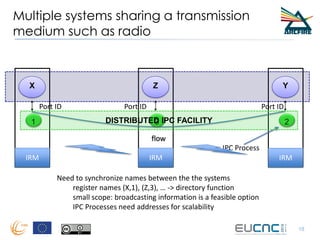
Multiple systems sharing a transmission
medium such as radio
18
X Y
Port ID Port ID
flow
IPC Process
1 2
Z
3
Port ID
Need to synchronize names between the the systems
register names (X,1), (Z,3), … -> directory function
small scope: broadcasting information is a feasible option
IPC Processes need addresses for scalability
DISTRIBUTED IPC FACILITY
IRMIRM IRM
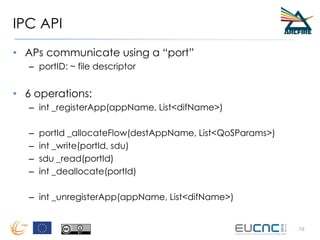
IPC API
• APs communicate using a “port”
– portID: ~ file descriptor
• 6 operations:
– int _registerApp(appName, List<difName>)
– portId _allocateFlow(destAppName, List<QoSParams>)
– int _write(portId, sdu)
– sdu _read(portId)
– int _deallocate(portId)
– int _unregisterApp(appName, List<difName>)
19
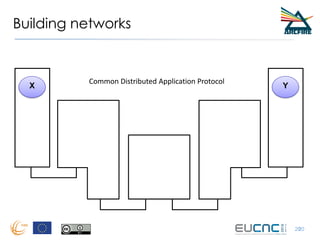
Building networks
20
X Y
Common Distributed Application Protocol
20
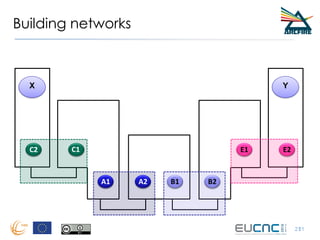
Building networks
21
X Y
21
C2 C1
A1 A2 B1 B2
E1 E2
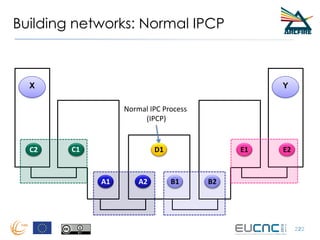
Building networks: Normal IPCP
22
X Y
22
C2 C1
A1 A2 B1 B2
E1 E2
Normal IPC Process
(IPCP)
D1
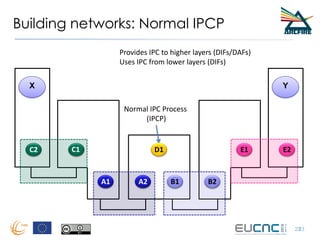
Building networks: Normal IPCP
23
X Y
23
C2 C1
A1 A2 B1 B2
E1 E2
Provides IPC to higher layers (DIFs/DAFs)
Uses IPC from lower layers (DIFs)
Normal IPC Process
(IPCP)
D1
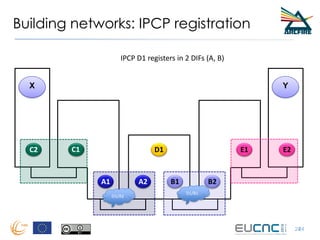
Building networks: IPCP registration
24
X Y
A1 A2 B1 B2
C2 C1 E1 E2D1
24
IPCP D1 registers in 2 DIFs (A, B)
D1/A2
D1/B1
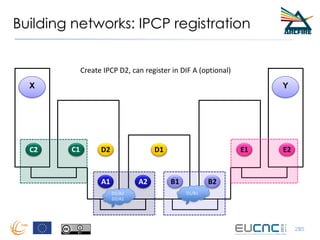
Building networks: IPCP registration
25
X Y
A1 A2 B1 B2
C2 C1 E1 E2D1
25
D2
D1/A2
D2/A1
D1/B1
Create IPCP D2, can register in DIF A (optional)
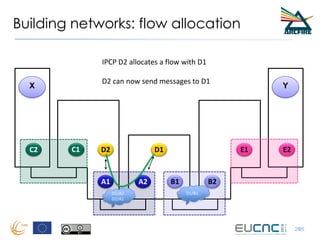
Building networks: flow allocation
26
X Y
A1 A2 B1 B2
C2 C1 E1 E2D1
26
D2
IPCP D2 allocates a flow with D1
D2 can now send messages to D1
D1/A2
D2/A1
D1/B1
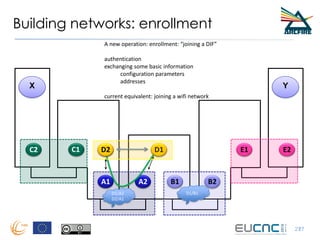
Building networks: enrollment
27
X Y
A1 A2 B1 B2
C2 C1 E1 E2D1
27
D2
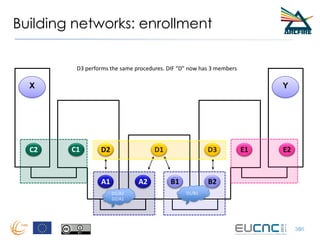
A new operation: enrollment: “joining a DIF”
authentication
exchanging some basic information
configuration parameters
addresses
current equivalent: joining a wifi network
D1D2
D1/A2
D2/A1
D1/B1
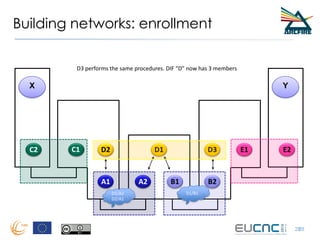
Building networks: enrollment
28
X Y
A1 A2 B1 B2
C2 C1 E1 E2
28
D3 performs the same procedures. DIF “D” now has 3 members
D1 D3D2
D1/A2
D2/A1
D1/B1
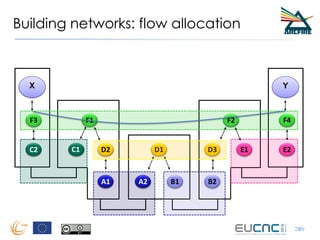
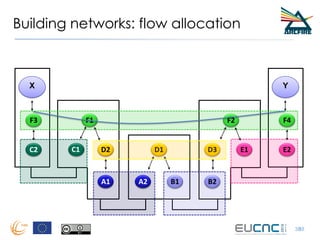
Building networks: flow allocation
29
X Y
A1 A2 B1 B2
C2 C1 E1 E2
F1 F2F3 F4
D1 D3D2
29
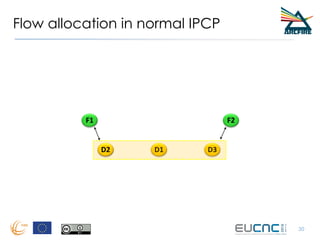
Flow allocation in normal IPCP
30
F1 F2
D1 D3D2
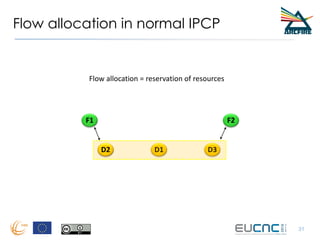
Flow allocation in normal IPCP
31
F1 F2
D1 D3D2
Flow allocation = reservation of resources
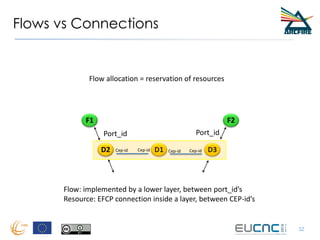
Flows vs Connections
32
F1 F2
D1 D3D2
Port_id Port_id
Cep-id Cep-id Cep-id Cep-id
Flow: implemented by a lower layer, between port_id’s
Resource: EFCP connection inside a layer, between CEP-id’s
Flow allocation = reservation of resources
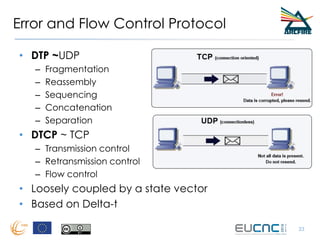
Error and Flow Control Protocol
• DTP ~UDP
– Fragmentation
– Reassembly
– Sequencing
– Concatenation
– Separation
• DTCP ~ TCP
– Transmission control
– Retransmission control
– Flow control
• Loosely coupled by a state vector
• Based on Delta-t
33
Delta-t (Watson, 1981)
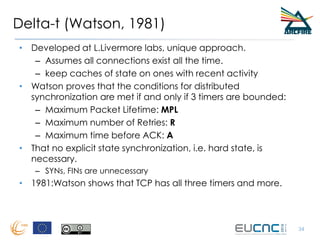
• Developed at L.Livermore labs, unique approach.
– Assumes all connections exist all the time.
– keep caches of state on ones with recent activity
• Watson proves that the conditions for distributed
synchronization are met if and only if 3 timers are bounded:
– Maximum Packet Lifetime: MPL
– Maximum number of Retries: R
– Maximum time before ACK: A
• That no explicit state synchronization, i.e. hard state, is
necessary.
– SYNs, FINs are unnecessary
• 1981:Watson shows that TCP has all three timers and more.
34
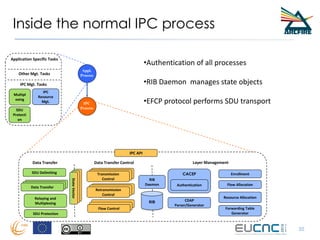
Inside the normal IPC process
IPC
Process
IPC API
Data Transfer Data Transfer Control Layer Management
SDU Delimiting
Data Transfer
Relaying and
Multiplexing
SDU Protection
Transmission
Control
Retransmission
Control
Flow Control
RIB
Daemon
RIB CDAP
Parser/Generator
CACEP Enrollment
Flow Allocation
Resource Allocation
Forwarding Table
Generator
Authentication
StateVector
StateVector
StateVector
Data TransferData Transfer
Transmission
Control
Transmission
Control
Retransmission
Control
Retransmission
Control
Flow Control
Flow Control
Appl.
Process
IPC
Resource
Mgt.
SDU
Protecti
on
Multipl
exing
IPC Mgt. Tasks
Other Mgt. Tasks
Application Specific Tasks
•Authentication of all processes
•RIB Daemon manages state objects
•EFCP protocol performs SDU transport
35
Building networks: enrollment
36
X Y
A1 A2 B1 B2
C2 C1 E1 E2
36
D3 performs the same procedures. DIF “D” now has 3 members
D1 D3D2
D1/A2
D2/A1
D1/B1
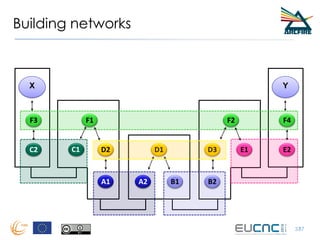
Building networks
37
X Y
A1 A2 B1 B2
C2 C1 E1 E2
F1 F2F3 F4
D1 D3D2
37
Building networks: flow allocation
38
X Y
A1 A2 B1 B2
C2 C1 E1 E2
F1 F2F3 F4
D1 D3D2
38
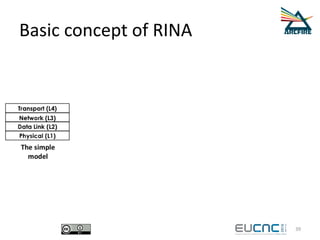
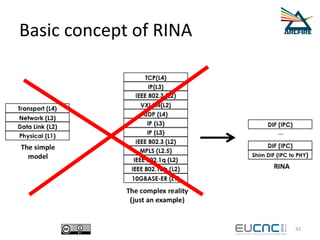
Basic concept of RINA
39
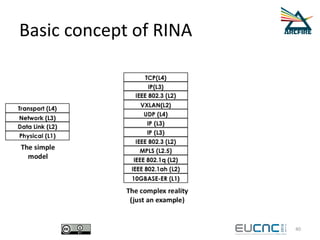
Basic concept of RINA
40
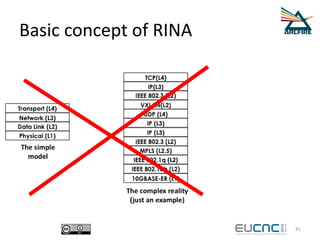
Basic concept of RINA
41
Basic concept of RINA
42
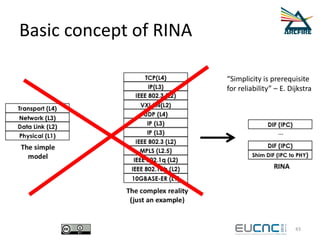
Basic concept of RINA
43
“Simplicity is prerequisite
for reliability” – E. Dijkstra
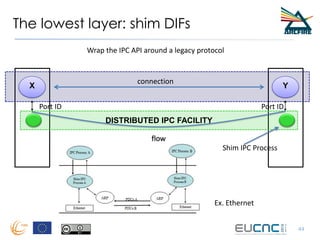
The lowest layer: shim DIFs
44
DISTRIBUTED IPC FACILITY
X Y
connection
Port ID Port ID
flow
Shim IPC Process
Wrap the IPC API around a legacy protocol
Ex. Ethernet
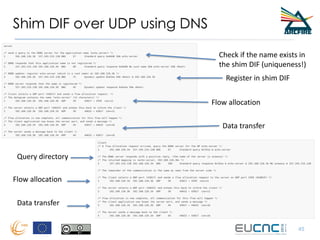
Shim DIF over UDP using DNS
45
Register in shim DIF
Flow allocation
Data transfer
Query directory
Flow allocation
Data transfer
Check if the name exists in
the shim DIF (uniqueness!)
46
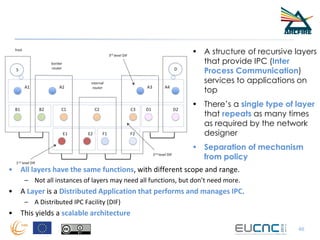
• A structure of recursive layers
that provide IPC (Inter
Process Communication)
services to applications on
top
• There’s a single type of layer
that repeats as many times
as required by the network
designer
• Separation of mechanism
from policy
• All layers have the same functions, with different scope and range.
– Not all instances of layers may need all functions, but don’t need more.
• A Layer is a Distributed Application that performs and manages IPC.
– A Distributed IPC Facility (DIF)
• This yields a scalable architecture
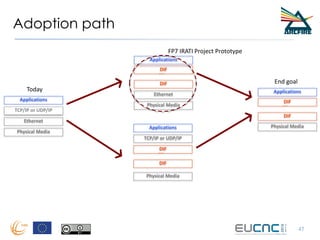
Adoption path
47
TCP/IP or UDP/IP
Ethernet
Physical Media
Applications
Ethernet
Physical Media
Applications
DIF
DIF
…
Physical Media
ApplicationsToday
DIF
DIF
…
TCP/IP or UDP/IP
Physical Media
Applications
DIF
DIF
…
End goal
FP7 IRATI Project Prototype
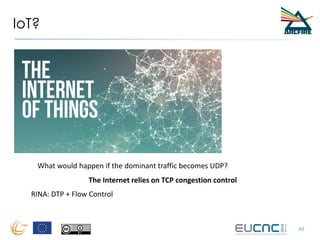
IoT?
48
RINA: DTP + Flow Control
The Internet relies on TCP congestion control
What would happen if the dominant traffic becomes UDP?
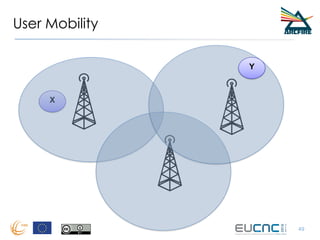
User Mobility
49
X
Y
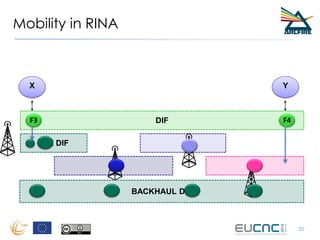
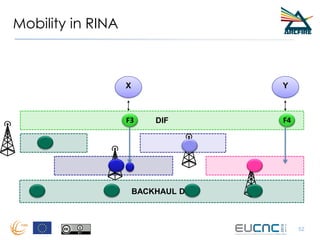
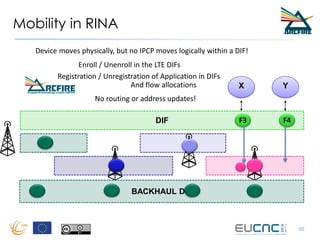
Mobility in RINA
50
DIF
X Y
LTE DIF
F3 F4
BACKHAUL DIF
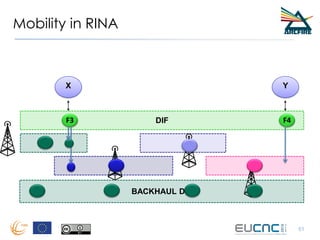
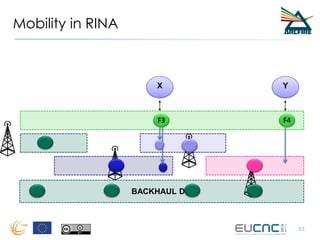
Mobility in RINA
51
DIF
Y
F4
X
F3
BACKHAUL DIF
Mobility in RINA
52
DIF
Y
F4
X
F3
BACKHAUL DIF
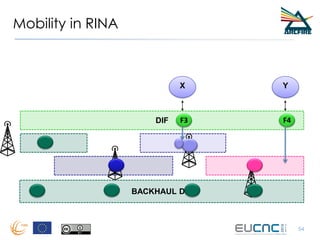
Mobility in RINA
53
DIF
Y
F4
X
F3
BACKHAUL DIF
Mobility in RINA
54
DIF
Y
F4
X
F3
BACKHAUL DIF
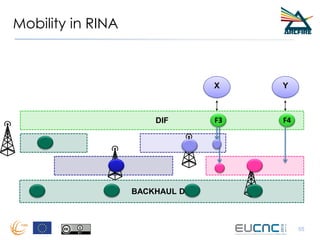
Mobility in RINA
55
DIF
Y
F4
X
F3
BACKHAUL DIF
Mobility in RINA
56
DIF
Y
F4
X
F3
BACKHAUL DIF
Registration / Unregistration of Application in DIFs
No routing or address updates!
Device moves physically, but no IPCP moves logically within a DIF!
And flow allocations
Enroll / Unenroll in the LTE DIFs
57
Thank you.
Recursive Congestion
Management in RINA
Peyman Teymoori
June 27, 2016
2
Layering in Networking – OSI vs. RINA
•  From the OSI perspective:
each layer performs a specific task or tasks and builds upon the
preceding layer until the communications are complete.
•  In Recursive InterNetworking Architecture (RINA):
every layer (called “Distributed InterProcess Communication (IPC)
Facility” (DIF)) has some mechanisms and policies with the goal of:
–  providing and managing the communication among its entities
–  “Mechanisms” are the same in various DIFs.
–  “Policies” can be programmed differently in various DIFs.
3
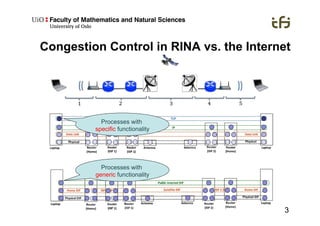
Congestion Control in RINA vs. the Internet
FP7-619305 PRISTINE Collaborative Project
B8.2. Work Package 3
Processes with
specific functionality
Processes with
generic functionality
4
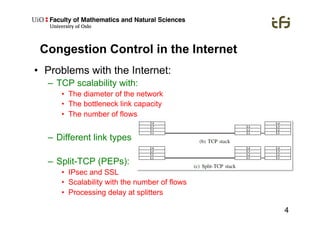
Congestion Control in the Internet
•  Problems with the Internet:
–  TCP scalability with:
•  The diameter of the network
•  The bottleneck link capacity
•  The number of flows
–  Different link types
–  Split-TCP (PEPs):
•  IPsec and SSL
•  Scalability with the number of flows
•  Processing delay at splitters
5
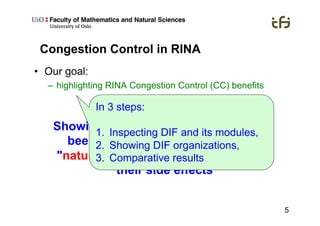
Congestion Control in RINA
•  Our goal:
–  highlighting RINA Congestion Control (CC) benefits
Showing that improvements that have
been done to TCP on the internet
"naturally appear" with RINA without
their side effects
In 3 steps:
1.  Inspecting DIF and its modules,
2.  Showing DIF organizations,
3.  Comparative results
6
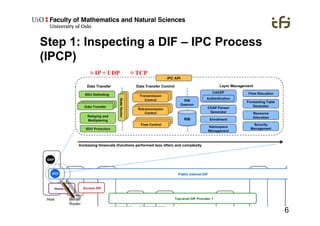
Step 1: Inspecting a DIF – IPC Process
(IPCP)
≈ IP + UDP ≈ TCP
7
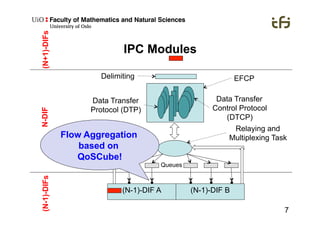
IPC Modules
Delimiting
Data Transfer
Protocol (DTP)
Data Transfer
Control Protocol
(DTCP)
(N-1)-DIF A (N-1)-DIF B
N-DIF(N-1)-DIFs
Queues
Relaying and
Multiplexing TaskFlow Aggregation
based on
QoSCube!
EFCP
(N+1)-DIFs
8
Error and Flow Control Protocol (EFCP)
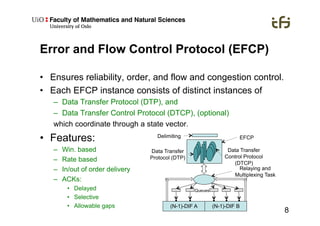
•  Ensures reliability, order, and flow and congestion control.
•  Each EFCP instance consists of distinct instances of
–  Data Transfer Protocol (DTP), and
–  Data Transfer Control Protocol (DTCP), (optional)
which coordinate through a state vector.
•  Features:
–  Win. based
–  Rate based
–  In/out of order delivery
–  ACKs:
•  Delayed
•  Selective
•  Allowable gaps
Delimiting
Data Transfer
Protocol (DTP)
Data Transfer
Control Protocol
(DTCP)
(N-1)-DIF A (N-1)-DIF B
Queues
Relaying and
Multiplexing Task
EFCP
9
Data Transfer Protocol (DTP)
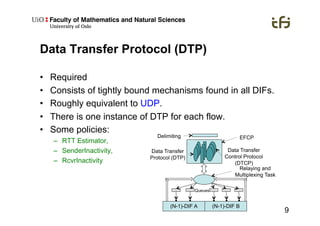
•  Required
•  Consists of tightly bound mechanisms found in all DIFs.
•  Roughly equivalent to UDP.
•  There is one instance of DTP for each flow.
•  Some policies:
–  RTT Estimator,
–  SenderInactivity,
–  RcvrInactivity
Delimiting
Data Transfer
Protocol (DTP)
Data Transfer
Control Protocol
(DTCP)
(N-1)-DIF A (N-1)-DIF B
Queues
Relaying and
Multiplexing Task
EFCP
10
Data Transfer Control Protocol (DTCP)
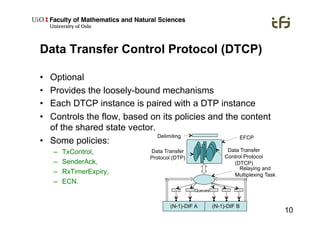
•  Optional
•  Provides the loosely-bound mechanisms
•  Each DTCP instance is paired with a DTP instance
•  Controls the flow, based on its policies and the content
of the shared state vector.
•  Some policies:
–  TxControl,
–  SenderAck,
–  RxTimerExpiry,
–  ECN.
Delimiting
Data Transfer
Protocol (DTP)
Data Transfer
Control Protocol
(DTCP)
(N-1)-DIF A (N-1)-DIF B
Queues
Relaying and
Multiplexing Task
EFCP
11
Step 2: Some DIF Configurations in RINA
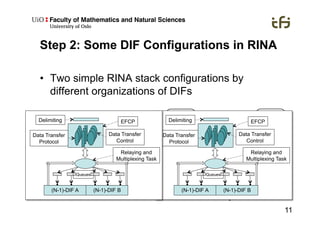
•  Two simple RINA stack configurations by
different organizations of DIFs
Delimiting
Data Transfer
Protocol
Data Transfer
Control
(N-1)-DIF A (N-1)-DIF B
Queues
Relaying and
Multiplexing Task
EFCPDelimiting
Data Transfer
Protocol
Data Transfer
Control
(N-1)-DIF A (N-1)-DIF B
Queues
Relaying and
Multiplexing Task
EFCP
12
A General DIF Configuration
“Error and Flow Control Protocol” (EFCP),
“Relaying and Multiplexing Task” (RMT),
“Resource Allocation” (RA).
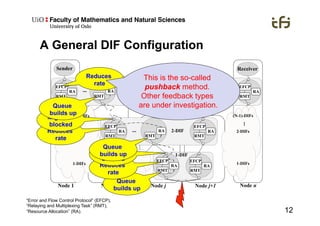
Queue
builds up
Reduces
rate
Might be
blocked
Queue
builds up
Reduces
rate
Might be
blocked
Queue
builds up
Reduces
rate
This is the so-called
pushback method.
Other feedback types
are under investigation.
13
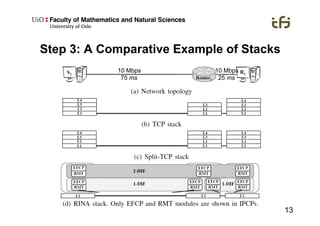
Step 3: A Comparative Example of Stacks
10 Mbps
75 ms
10 Mbps
25 ms
14
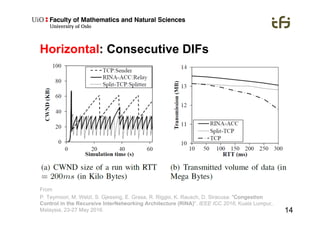
Horizontal: Consecutive DIFs
From
P. Teymoori, M. Welzl, S. Gjessing, E. Grasa, R. Riggio, K. Rausch, D. Siracusa: "Congestion
Control in the Recursive InterNetworking Architecture (RINA)", IEEE ICC 2016, Kuala Lumpur,
Malaysia, 23-27 May 2016.
15
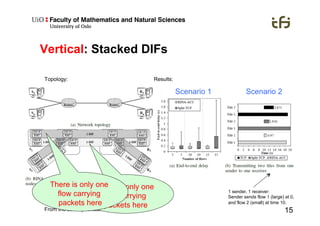
Vertical: Stacked DIFs
Topology: Results:
From the same publication
1 sender, 1 receiver:
Sender sends flow 1 (large) at 0,
and flow 2 (small) at time 10.
There is only one
flow carrying
packets here
There is only one
flow carrying
packets here
Scenario 1 Scenario 2
16
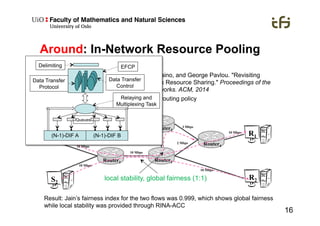
Around: In-Network Resource Pooling
•  A follow-up to: Psaras, Ioannis, Lorenzo Saino, and George Pavlou. "Revisiting
Resource Pooling: The Case for In-Network Resource Sharing." Proceedings of the
13th ACM Workshop on Hot Topics in Networks. ACM, 2014
•  Easily implementable in RINA by an RMT routing policy
S1
S2
R1
R2
Router1
Router3
Router2
Router4
10 Mbps
10 Mbps
2 Mbps
3 Mbps
3 Mbps
10 Mbps
10 Mbps
10 Mbps
local stability, global fairness (1:1)
Result: Jain’s fairness index for the two flows was 0.999, which shows global fairness
while local stability was provided through RINA-ACC
Delimiting
Data Transfer
Protocol
Data Transfer
Control
(N-1)-DIF A (N-1)-DIF B
Queues
Relaying and
Multiplexing Task
EFCP
17
Discussion
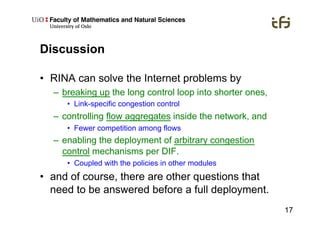
•  RINA can solve the Internet problems by
–  breaking up the long control loop into shorter ones,
•  Link-specific congestion control
–  controlling flow aggregates inside the network, and
•  Fewer competition among flows
–  enabling the deployment of arbitrary congestion
control mechanisms per DIF.
•  Coupled with the policies in other modules
•  and of course, there are other questions that
need to be answered before a full deployment.
18
Thank you!
Questions?
Large scale RINA Experimentation on FIRE +
RINA for converged operator networks in
5G scenarios
Leonardo Bergesio, Eduard Grasa – i2CAT
June 27th 2016, Athens
Large scale RINA Experimentation on FIRE +
An Operator Network today and the
converged vision
2
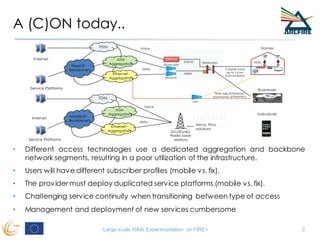
A (C)ON today..
Large-scale RINA Experimentation on FIRE+ 3
• Different access technologies use a dedicated aggregation and backbone
network segments, resulting in a poor utilization of the infrastructure.
• Users will have different subscriber profiles (mobile vs. fix).
• The provider must deploy duplicated service platforms (mobile vs. fix).
• Challenging service continuity when transitioning between type of access
• Management and deployment of new services cumbersome
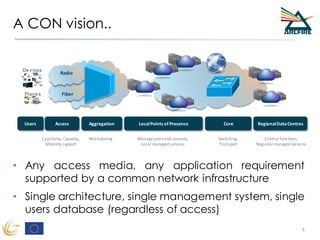
A CON vision..
• Any access media, any application requirement
supported by a common network infrastructure
• Single architecture, single management system, single
users database (regardless of access)
4
Manageusersand sessions,
Local managed services
Capillarity,Capacity,
Mobility support
Multiplexing Switching,
Transport
Control functions,
Regional managed services
Devices
Places
Users Access Aggregation LocalPoints of Presence Core RegionalDataCentres
Radio
Fiber
Large scale RINA Experimentation on FIRE +
The all-IP approach
Current protocol stack limitations
5
xDSL FTTH WiFi 4G
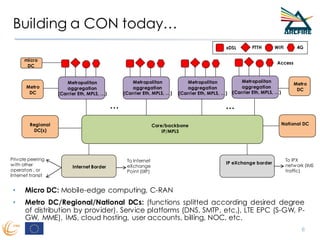
Building a CON today…
6
National DCRegional
DC(s)
Metropolitan
aggregation
(Carrier Eth, MPLS, …)
Metropolitan
aggregation
… …
Metro
DC
Metro
DC
Access
Internet Border
Private peering
with other
operators , or
Internet transit
To Internet
eXchange
Point (IXP)
IP eXchange border
To IPX
network (IMS
traffic)
micro
DC
Metropolitan
aggregation
(Carrier Eth, MPLS, …)
Metropolitan
aggregation
Metropolitan
aggregation
(Carrier Eth, MPLS, …)
Metropolitan
aggregation
Metropolitan
aggregation
(Carrier Eth, MPLS, …)
• Micro DC: Mobile-edge computing, C-RAN
• Metro DC/Regional/National DCs: (functions splitted according desired degree
of distribution by provider). Service platforms (DNS, SMTP, etc.), LTE EPC (S-GW, P-
GW, MME), IMS, cloud hosting, user accounts, billing, NOC, etc.
Core/backbone
IP/MPLS
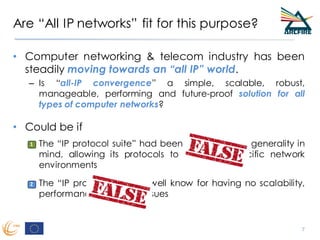
Are “All IP networks” fit for this purpose?
• Computer networking & telecom industry has been
steadily moving towards an “all IP” world.
– Is “all-IP convergence” a simple, scalable, robust,
manageable, performing and future-proof solution for all
types of computer networks?
• Could be if
– The “IP protocol suite” had been designed with generality in
mind, allowing its protocols to adapt to specific network
environments
– The “IP protocol suite” is well know for having no scalability,
performance or security issues
7
1
2
1
42
Large scale RINA Experimentation on FIRE +
The RINA approach
And its benefits
8
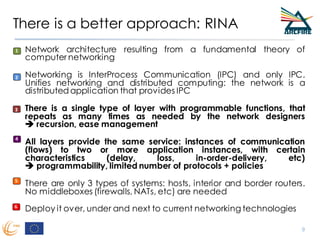
There is a better approach: RINA
• Network architecture resulting from a fundamental theory of
computer networking
• Networking is InterProcess Communication (IPC) and only IPC.
Unifies networking and distributed computing: the network is a
distributed application that provides IPC
• There is a single type of layer with programmable functions, that
repeats as many times as needed by the network designers
 recursion, ease management
• All layers provide the same service: instances of communication
(flows) to two or more application instances, with certain
characteristics (delay, loss, in-order-delivery, etc)
 programmability, limited number of protocols + policies
• There are only 3 types of systems: hosts, interior and border routers.
No middleboxes (firewalls, NATs, etc) are needed
• Deploy it over, under and next to current networking technologies
9
1
2
3
4
5
6
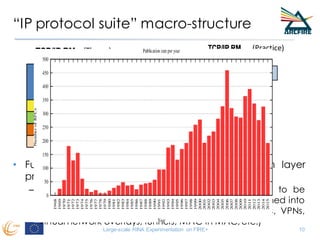
“IP protocol suite” macro-structure
• Functional layers organized for modularity, each layer
provides a different service to each other
– As the RM is applied to the real world, it proofs to be
incomplete. As a consequence, new layers are patched into
the reference model as needed (layers 2.5, VLANs, VPNs,
virtual network overlays, tunnels, MAC-in-MAC, etc.)
Large-scale RINA Experimentation on FIRE+ 10
(Theory) (Practice)
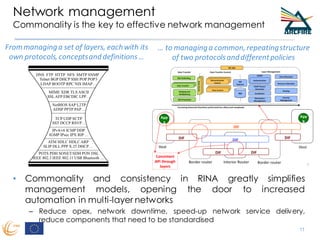
Network management
Commonality is the key to effective network management
11
• Commonality and consistency in RINA greatly simplifies
management models, opening the door to increased
automation in multi-layer networks
– Reduce opex, network downtime, speed-up network service delivery,
reduce components that need to be standardised
Frommanaginga set of layers, eachwith its
own protocols,conceptsanddefinitions…
… to managinga common,repeatingstructure
of two protocolsanddifferentpolicies
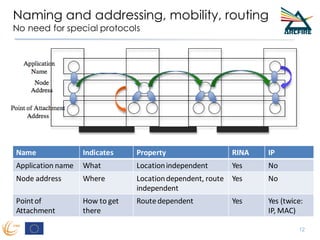
Naming and addressing, mobility, routing
No need for special protocols
12
Name Indicates Property RINA IP
Application name What Locationindependent Yes No
Node address Where Locationdependent, route
independent
Yes No
Pointof
Attachment
How to get
there
Route dependent Yes Yes (twice:
IP, MAC)
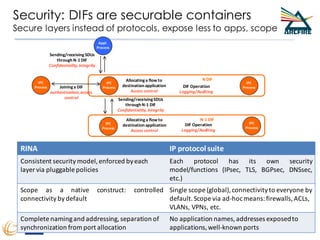
Security: DIFs are securable containers
Secure layers instead of protocols, expose less to apps, scope
Large-scale RINA Experimentation on FIRE+ 13
Allocatinga flow to
destination application
Access control
Sending/receivingSDUs
through N-1 DIF
Confidentiality,integrity
N DIF
N-1 DIF
IPC
Process
IPC
Process
IPC
Process
IPC
Process Joininga DIF
authentication,access
control
Sending/receiving SDUs
through N-1 DIF
Confidentiality,integrity
Allocatinga flow to
destination application
Access control
IPC
Process
Appl.
Process
DIF Operation
Logging/Auditing
DIF Operation
Logging/Auditing
RINA IP protocolsuite
Consistent security model,enforced byeach
layer via pluggable policies
Each protocol has its own security
model/functions (IPsec, TLS, BGPsec, DNSsec,
etc.)
Scope as a native construct: controlled
connectivity bydefault
Single scope (global),connectivityto everyone by
default.Scope via ad-hocmeans:firewalls, ACLs,
VLANs, VPNs, etc.
Complete namingand addressing,separation of
synchronization fromport allocation
No application names,addresses exposedto
applications, well-known ports
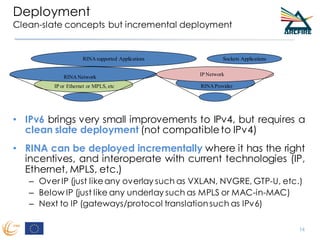
Deployment
Clean-slate concepts but incremental deployment
14
• IPv6 brings very small improvements to IPv4, but requires a
clean slate deployment (not compatibleto IPv4)
• RINA can be deployed incrementally where it has the right
incentives, and interoperate with current technologies (IP,
Ethernet, MPLS, etc.)
– Over IP (just likeany overlay such as VXLAN, NVGRE, GTP-U, etc.)
– Below IP (just like any underlay such as MPLS or MAC-in-MAC)
– Next to IP (gateways/protocol translationsuch as IPv6)
IP Network
RINAProvider
RINANetwork
Sockets ApplicationsRINAsupported Applications
IP or Ethernet or MPLS, etc
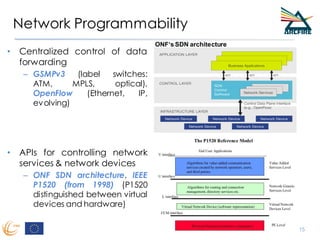
Network Programmability
• Centralized control of data
forwarding
– GSMPv3 (label switches:
ATM, MPLS, optical),
OpenFlow (Ethernet, IP,
evolving)
• APIs for controlling network
services & network devices
– ONF SDN architecture, IEEE
P1520 (from 1998) (P1520
distinguished between virtual
devices and hardware)
15
ONF‘s SDN architecture
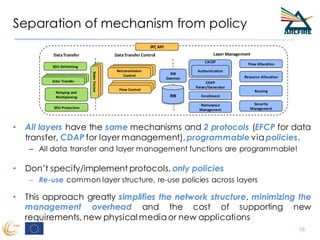
Separation of mechanism from policy
16
IPC API
DataTransfer DataTransfer Control Layer Management
SDU Delimiting
Data Transfer
Relaying and
Multiplexing
SDU Protection
Retransmission
Control
Flow Control
RIB
Daemon
RIB
CDAP
Parser/Generator
CACEP
Enrollment
Flow Allocation
Resource Allocation
Routing
Authentication
StateVector
StateVector
StateVector
Data TransferData Transfer
Retransmission
Control
Retransmission
Control
Flow Control
Flow Control
Namespace
Management
Security
Management
• All layers have the same mechanisms and 2 protocols (EFCP for data
transfer, CDAP for layer management),programmable via policies.
– All data transfer and layer management functions are programmable!
• Don’t specify/implement protocols, only policies
– Re-use common layer structure, re-use policies across layers
• This approach greatly simplifies the network structure, minimizing the
management overhead and the cost of supporting new
requirements, new physical media or new applications
Large scale RINA Experimentation on FIRE +
From all-IP to RINA
Examples exploiting recursion
17
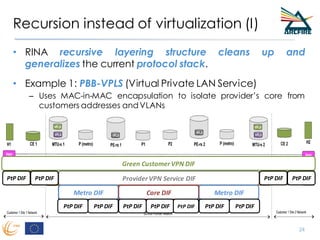
Recursion instead of virtualization (I)
• RINA recursive layering structure cleans up and
generalizes the current protocol stack.
• Example 1: PBB-VPLS (Virtual Private LAN Service)
– Uses MAC-in-MAC encapsulation to isolate provider’s core from
customers addresses andVLANs
24
Green CustomerVPN DIF
ProviderVPN Service DIF
Metro DIF Metro DIFCore DIF
PtP DIF PtP DIF PtP DIF PtP DIF
PtP DIFPtP DIFPtP DIFPtP DIF PtP DIF PtP DIF PtP DIF
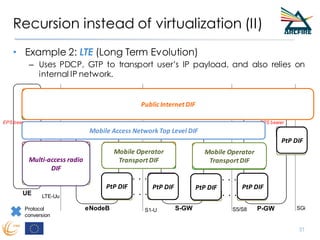
Recursion instead of virtualization (II)
• Example 2: LTE (Long Term Evolution)
– Uses PDCP, GTP to transport user’s IP payload, and also relies on
internal IP network.
31
IP (e.g. Internet)
TCP or UDP
PDCP GTP-U
Protocol
conversion
GTP-U
RLC
MAC
L1
UDP
IP (LTE transport)
MAC MAC. . .
L1 . . . L1
UDP
IP (LTE transport)
MAC MAC. . .
L1 . . . L1UE
eNodeB S-GW P-GW
EPS bearerEPS bearer
LTE-Uu
S1-U S5/S8
MAC
L1
SGi
PublicInternet DIF
Mobile Access Network Top Level DIF
Multi-access radio
DIF
Mobile Operator
TransportDIF
Mobile Operator
Transport DIF
PtP DIF PtP DIF PtP DIF PtP DIF
PtP DIF
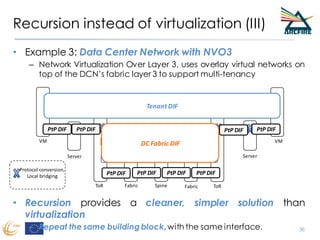
Recursion instead of virtualization (III)
• Example 3: Data Center Network with NVO3
– Network Virtualization Over Layer 3, uses overlay virtual networks on
top of the DCN’s fabric layer 3 to support multi-tenancy
• Recursion provides a cleaner, simpler solution than
virtualization
– Repeat the same building block, with the same interface. 36
ToR ToRFabric Spine Fabric
Server ServerIPv4 orIPv6 (Fabric layer)
UDPVM VM
Ethernet Ethernet Ethernet Ethernet
VXLAN802.1Q802.3 802.1Q
IPv4 orIPv6 (tenant overlay)
TCP orUDP orSCTP, … (transport layer)
802.3
Protocol conversion,
Local bridging PtP DIF PtP DIF PtP DIF PtP DIF
PtP DIF PtP DIFPtP DIFPtP DIF
DC Fabric DIF
Tenant DIF
Large scale RINA Experimentation on FIRE +
A Service Provider Network design with
RINA
37
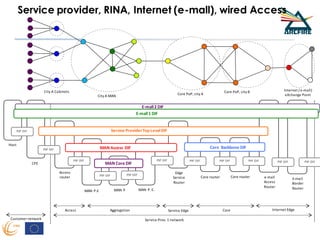
Service provider, RINA, Internet (e-mall), wired Access
Access
router
PtP DIF
CPE
Edge
Service
Router
MAN P.E MAN P. E.
MAN Access DIF
MAN Core DIF
PtP DIF PtP DIF
PtP DIF PtP DIF
MAN P
PtP DIF
Host
Core Backbone DIF
PtP DIF
Core router Core router e-mall
Access
Router
E-mall
Border
Router
Customer network Service Prov. 1 network
Access Aggregation Service Edge Core Internet Edge
Internet ( e-mall)
eXchange Point
Core PoP, city B
Core PoP, city A
City A MAN
City A Cabinets
PtP DIF PtP DIF PtP DIF
Service ProviderTop LevelDIF
E-mall1 DIF
PtP DIF
E-mall2 DIF
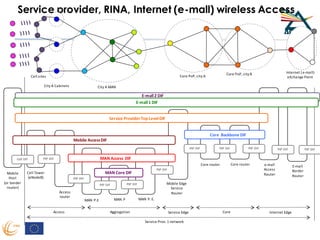
Service provider, RINA, Internet (e-mall) wireless Access
Access
router
PtP DIF
Cell Tower
(eNodeB)
Mobile Edge
Service
Router
MAN P.E MAN P. E.
MAN Access DIF
MAN Core DIF
PtP DIF
PtP DIF
PtP DIF PtP DIF
MAN P
Cell DIF
Mobile
Host
(or border
router)
Core Backbone DIF
PtP DIF
Core router Core router e-mall
Access
Router
E-mall
Border
Router
Service Prov. 1 network
Access Aggregation Service Edge Core Internet Edge
PtP DIF PtP DIF PtP DIF
Service ProviderTop LevelDIF
E-mall1 DIF
PtP DIF
E-mall2 DIF
Mobile AccessDIF
Internet ( e-mall)
eXchange Point
Core PoP, city B
Core PoP, city A
City A MANCity A Cabinets
Cell sites
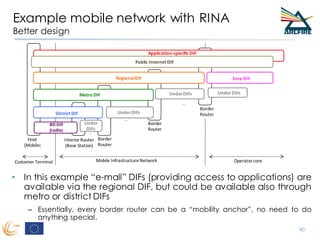
Example mobile network with RINA
Better design
40
Border
Router
Core DIF
UnderDIFs
Border
Router
UnderDIFs
Border
Router
InteriorRouter
(Base Station)
Host
(Mobile)
BD DIF
(radio)
Under
DIFs
District DIF
Metro DIF
RegionalDIF
Public Internet DIF
Application-specific DIF
Mobile InfrastructureNetworkCustomer Terminal
…
…
…
• In this example “e-mall” DIFs (providing access to applications) are
available via the regional DIF, but could be available also through
metro or district DIFs
– Essentially, every border router can be a “mobility anchor”, no need to do
anything special.
UnderDIFs
Operatorcore
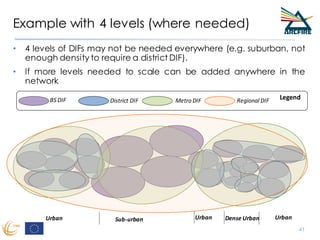
Example with 4 levels (where needed)
41
Urban Sub-urban Urban UrbanDense Urban
BS DIF District DIF LegendMetro DIF Regional DIF
• 4 levels of DIFs may not be needed everywhere (e.g. suburban, not
enough density to require a district DIF).
• If more levels needed to scale can be added anywhere in the
network
Large scale RINA Experimentation on FIRE +
Thank you!
42
Large scale RINA Experimentation on FIRE +
Backup slides
43
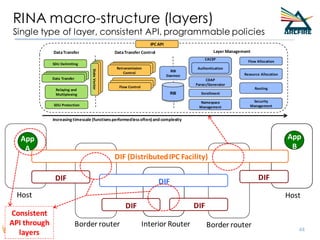
RINA macro-structure (layers)
Single type of layer, consistent API, programmable policies
44
Host
Border router Interior Router
DIF
DIF DIF
Border router
DIFDIF
DIF (DistributedIPC Facility)
Host
App
A
App
B
Consistent
API through
layers
IPC API
DataTransfer DataTransfer Control Layer Management
SDU Delimiting
Data Transfer
Relaying and
Multiplexing
SDU Protection
Retransmission
Control
Flow Control
RIB
Daemon
RIB
CDAP
Parser/Generator
CACEP
Enrollment
Flow Allocation
Resource Allocation
Routing
Authentication
StateVector
StateVector
StateVector
Data TransferData Transfer
Retransmission
Control
Retransmission
Control
Flow Control
Flow Control
Increasingtimescale (functionsperformedlessoften) and complexity
Namespace
Management
Security
Management
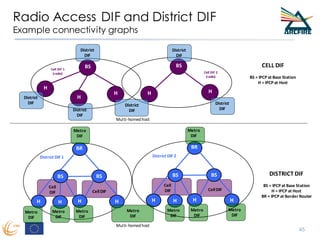
Radio Access DIF and District DIF
Example connectivity graphs
Multi-homed host
BR
BS
H H H
BS
H
Metro
DIF
Metro
DIF
Metro
DIF
BR
BS
H H H
BS
H
Metro
DIF
Metro
DIF
Metro
DIF
Multi-homed host
Metro
DIF
Metro
DIF
Metro
DIF
District DIF 1 District DIF 2
CellDIF
Cell
DIF
CellDIF
Cell
DIF
DISTRICT DIF
BS = IPCP at Base Station
H = IPCP at Host
BR = IPCP at Border Router
BS
H
BS
H H
H
H
Cell DIF 1
(radio) Cell DIF 2
(radio)
District
DIF
District
DIF
District
DIF
District
DIF
District
DIF
District
DIF
CELL DIF
BS = IPCP at Base Station
H = IPCP at Host
45
E-mall
DIF
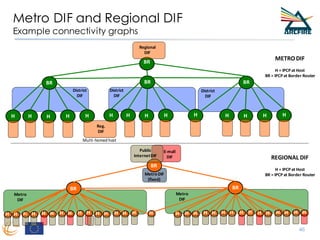
Metro DIF and Regional DIF
Example connectivity graphs
METRO DIF
H = IPCP at Host
BR = IPCP at Border Router
H H H H H
BR
H H H H H
BR
Multi-homed host
Reg.
DIF
H H H H
H
BR
H
District
DIF
District
DIF
District
DIF
BR
Regional
DIF
H
H H HH H HH H H HH H HH H H HH H HH H H HH H H
Metro
DIF
BR
HH H HH H H HH H HH H H HH H HH H HH H HH
Metro
DIF
BR
BR
Metro DIF
(fixed)
Public
InternetDIF
REGIONAL DIF
H = IPCP at Host
BR = IPCP at Border Router
46
Securing RINA networks
Tutorial 1: RINA: a future--proof approach towards re-
architecting the infocomms protocol stack
supporting Cloud, IoT and beyond 5G requirements
Securing RINA networks
Miquel Tarzan (presenter), Eduard Grasa, Ondrej Lichtner,
Ondrej Rysavy, Hamid Asgari, John Day, Lou Chitkushev
FP7 PRISTINE
EuCNC 2016, Athens, June 27th 2016
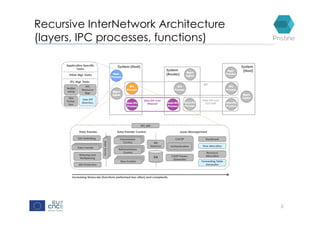
Recursive InterNetwork Architecture
(layers, IPC processes, functions)
2
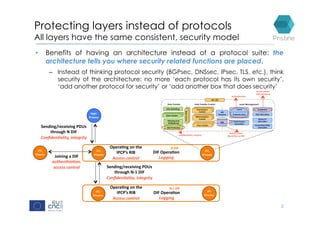
Protecting layers instead of protocols
All layers have the same consistent, security model
3
•  Benefits of having an architecture instead of a protocol suite: the
architecture tells you where security related functions are placed.
–  Instead of thinking protocol security (BGPsec, DNSsec, IPsec, TLS, etc.), think
security of the architecture: no more ‘each protocol has its own security’,
‘add another protocol for security’ or ‘add another box that does security’
Opera&ng	on	the		
IPCP’s	RIB	
Access	control	
Sending/receiving	PDUs	
through	N-1	DIF	
Confiden.ality,	integrity	
																																																													N	DIF	
																																																													N-1	DIF	
IPC		
Process	
IPC		
Process	
IPC		
Process	
IPC		
Process	
Joining	a	DIF	
authen.ca.on,	
access	control	
Sending/receiving	PDUs	
through	N	DIF	
Confiden.ality,	integrity	
Opera&ng	on	the		
IPCP’s	RIB	
Access	control	
IPC		
Process	
Appl.		
Process	
Access	control	
(DIF	members)	
Confiden.ality,	integrity	
Authen.ca.on	
Access	control	
Opera.ons	on	RIB	
DIF	Opera&on	
Logging	
DIF	Opera&on	
Logging
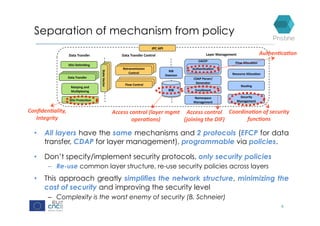
Separation of mechanism from policy
4
IPC	API	
Data	Transfer	 Data	Transfer	Control	 Layer	Management	
SDU	Delimi&ng	
Data	Transfer		
Relaying	and	
Mul&plexing	
SDU	Protec&on	
Retransmission	
Control	
Flow	Control	
RIB	
Daemon	
RIB	
CDAP	Parser/
Generator	
CACEP	
Enrollment	
Flow	Alloca&on	
Resource	Alloca&on	
Rou&ng	
Authen&ca&on	
State	Vector	
State	Vector	
State	Vector	
Data	Transfer		Data	Transfer		
Retransmission	
Control	
Retransmission	
Control	
Flow	Control	
Flow	Control	
Namespace		
Management	
Security	
Management	
•  All layers have the same mechanisms and 2 protocols (EFCP for data
transfer, CDAP for layer management), programmable via policies.
•  Don’t specify/implement security protocols, only security policies
–  Re-use common layer structure, re-use security policies across layers
•  This approach greatly simplifies the network structure, minimizing the
cost of security and improving the security level
–  Complexity is the worst enemy of security (B. Schneier)
Authen.ca.on	
Access	control	(layer	mgmt	
opera.ons)	
Access	control		
(joining	the	DIF)	
Coordina.on	of	security	
func.ons	
Confiden.ality,		
Integrity
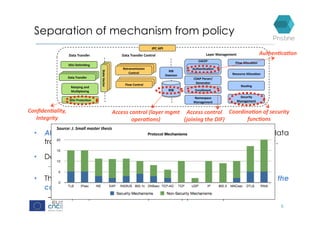
Separation of mechanism from policy
5
IPC	API	
Data	Transfer	 Data	Transfer	Control	 Layer	Management	
SDU	Delimi&ng	
Data	Transfer		
Relaying	and	
Mul&plexing	
SDU	Protec&on	
Retransmission	
Control	
Flow	Control	
RIB	
Daemon	
RIB	
CDAP	Parser/
Generator	
CACEP	
Enrollment	
Flow	Alloca&on	
Resource	Alloca&on	
Rou&ng	
Authen&ca&on	
State	Vector	
State	Vector	
State	Vector	
Data	Transfer		Data	Transfer		
Retransmission	
Control	
Retransmission	
Control	
Flow	Control	
Flow	Control	
Namespace		
Management	
Security	
Management	
•  All layers have the same mechanisms and 2 protocols (EFCP for data
transfer, CDAP for layer management), programmable via policies.
•  Don’t specify/implement security protocols, only security policies
–  Re-use common layer structure, re-use security policies across layers
•  This approach greatly simplifies the network structure, minimizing the
cost of security and improving the security level
–  Complexity is the worst enemy of security (B. Schneier)
Authen.ca.on	
Access	control	(layer	mgmt	
opera.ons)	
Access	control		
(joining	the	DIF)	
Coordina.on	of	security	
func.ons	
Confiden.ality,		
Integrity	
Source:	J.	Small	master	thesis
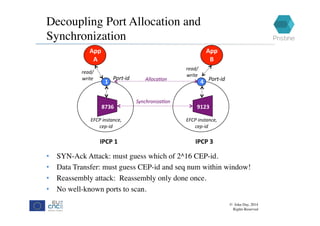
Decoupling Port Allocation and
Synchronization
© John Day, 2014
Rights Reserved
IPCP	1P		
A	
App		
A	
Port-id	
read/	
write	
1	
EFCP	instance,	
cep-id	
8736	
IPCP	3P		
A	
App		
B	
Port-id	
read/	
write	
4	
EFCP	instance,	
cep-id	
9123	
Synchroniza9on	
•  SYN-Ack Attack: must guess which of 2^16 CEP-id.
•  Data Transfer: must guess CEP-id and seq num within window!
•  Reassembly attack: Reassembly only done once.
•  No well-known ports to scan.
Alloca9on
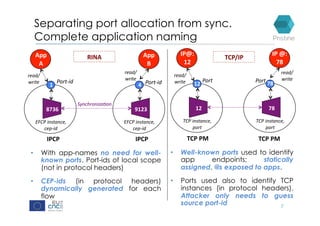
Separating port allocation from sync.
Complete application naming
•  With app-names no need for well-
known ports. Port-ids of local scope
(not in protocol headers)
•  CEP-ids (in protocol headers)
dynamically generated for each
flow
7
IPCPP		
A	
App		
A	
Port-id	
read/	
write	
1	
EFCP	instance,	
cep-id	
8736	
IPCPP		
A	
App		
B	
Port-id	
read/	
write	
4	
EFCP	instance,	
cep-id	
9123	
Synchroniza9on	
•  Well-known ports used to identify
app endpoints; statically
assigned. @s exposed to apps.
•  Ports used also to identify TCP
instances (in protocol headers).
Attacker only needs to guess
source port-id
RINA	 TCP/IP	
IP@:	
12	
Port	
read/	
write	
12	
TCP	instance,	
port	
12	
IP	@:		
78	
Port	
read/	
write	
78	
TCP	instance,	
port	
78	
TCP	PM	
A	
TCP	PM	
A
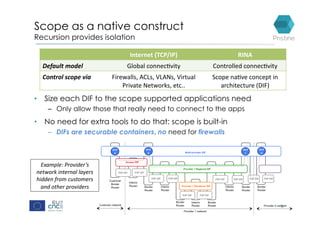
Scope as a native construct
Recursion provides isolation
•  Size each DIF to the scope supported applications need
–  Only allow those that really need to connect to the apps
•  No need for extra tools to do that: scope is built-in
–  DIFs are securable containers, no need for firewalls
8
Internet	(TCP/IP)	 RINA	
Default	model	 Global	connec*vity	 Controlled	connec*vity	
Control	scope	via	 Firewalls,	ACLs,	VLANs,	Virtual	
Private	Networks,	etc..	
Scope	na*ve	concept	in	
architecture	(DIF)	
Example:	Provider’s	
network	internal	layers	
hidden	from	customers	
and	other	providers
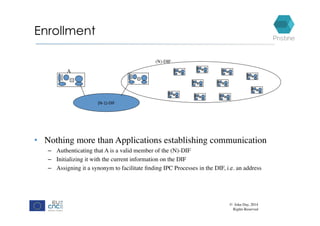
Enrollment
(N-1)-DIF	
(N)-DIF
A
•  Nothing more than Applications establishing communication
–  Authenticating that A is a valid member of the (N)-DIF
–  Initializing it with the current information on the DIF
–  Assigning it a synonym to facilitate finding IPC Processes in the DIF, i.e. an address
© John Day, 2014
Rights Reserved
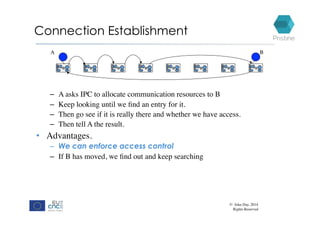
Connection Establishment
A BA B
–  A asks IPC to allocate communication resources to B
–  Keep looking until we find an entry for it.
–  Then go see if it is really there and whether we have access.
–  Then tell A the result.
•  Advantages.
–  We can enforce access control
–  If B has moved, we find out and keep searching
© John Day, 2014
Rights Reserved
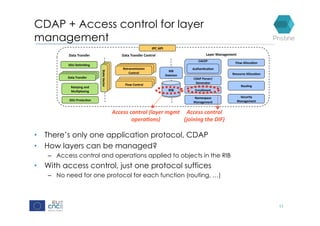
CDAP + Access control for layer
management
•  There’s only one application protocol, CDAP
•  How layers can be managed?
–  Access control and operations applied to objects in the RIB
•  With access control, just one protocol suffices
–  No need for one protocol for each function (routing, …)
11
IPC	API	
Data	Transfer	 Data	Transfer	Control	 Layer	Management	
SDU	Delimi&ng	
Data	Transfer		
Relaying	and	
Mul&plexing	
SDU	Protec&on	
Retransmission	
Control	
Flow	Control	
RIB	
Daemon	
RIB	
CDAP	Parser/
Generator	
CACEP	
Enrollment	
Flow	Alloca&on	
Resource	Alloca&on	
Rou&ng	
Authen&ca&on	
State	Vector	
State	Vector	
State	Vector	
Data	Transfer		Data	Transfer		
Retransmission	
Control	
Retransmission	
Control	
Flow	Control	
Flow	Control	
Namespace		
Management	
Security	
Management	
Access	control	(layer	mgmt	
opera.ons)	
Access	control		
(joining	the	DIF)
Customer	network	
Interior	
Router	
Customer	
Border	
Router	
Interior	
Router	 Border	
Router	
P2P DIF
Interior	
Router	
P2P DIF
Border	
Router	
P2P DIF P2P DIF
Interior	
Router	
Border	
Router	
Provider	1	Backbone	DIF	
P2P DIF
Border	
Router	
Provider	1	Regional	DIF	
Mul&-provider	DIF	
P2P DIF
Access	DIF	
P2P DIFP2P DIF
Provider	1	network	
Provider	2	network	
IPCP		
A	
IPCP		
B	
IPCP		
C	
P2P DIF P2P DIF
IPCP		
D	
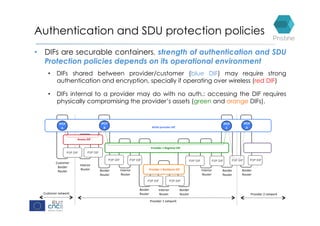
•  DIFs are securable containers, strength of authentication and SDU
Protection policies depends on its operational environment
•  DIFs shared between provider/customer (blue DIF) may require strong
authentication and encryption, specially if operating over wireless (red DIF)
•  DIFs internal to a provider may do with no auth.: accessing the DIF requires
physically compromising the provider’s assets (green and orange DIFs).
Border	
Router	
Authentication and SDU protection policies
Authentication policy: SSH2-based (I)
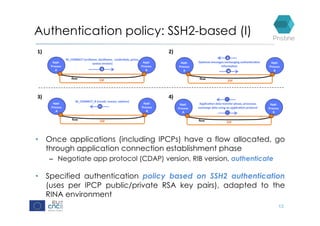
•  Once applications (including IPCPs) have a flow allocated, go
through application connection establishment phase
–  Negotiate app protocol (CDAP) version, RIB version, authenticate
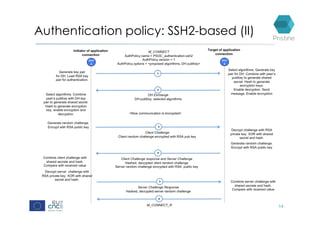
•  Specified authentication policy based on SSH2 authentication
(uses per IPCP public/private RSA key pairs), adapted to the
RINA environment
13
Authentication policy: SSH2-based (II)
14
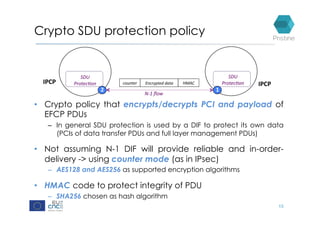
Crypto SDU protection policy
•  Crypto policy that encrypts/decrypts PCI and payload of
EFCP PDUs
–  In general SDU protection is used by a DIF to protect its own data
(PCIs of data transfer PDUs and full layer management PDUs)
•  Not assuming N-1 DIF will provide reliable and in-order-
delivery -> using counter mode (as in IPsec)
–  AES128 and AES256 as supported encryption algorithms
•  HMAC code to protect integrity of PDU
–  SHA256 chosen as hash algorithm
15
1	2	
IPCPP		
A	
IPCPP		
A	
N-1	flow	
SDU		
Protec9on	
SDU		
Protec9on	counter	 Encrypted	data	 HMAC
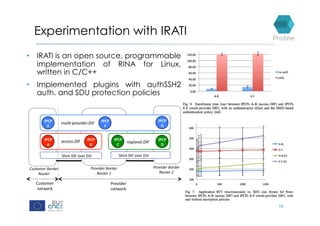
Experimentation with IRATI
16
Provider	Border	
Router	1	
Provider	Border	
Router	2	
Customer	Border	
Router	
Shim	DIF	over	Eth	 Shim	DIF	over	Eth	
IPCP	
A	
IPCP	
B	
access.DIF	 IPCP	
C	
IPCP	
D	
regional.DIF	
IPCP	
E	
IPCP	
F	
IPCP	
G	
mul9-provider.DIF	
Customer		
network	
Provider		
network	
•  IRATI is an open source, programmable
implementation of RINA for Linux,
written in C/C++
•  Implemented plugins with authSSH2
auth. and SDU protection policies
17
Ques*ons?
RINASim
● Vladimír Veselý
● Brno University of Technology, Czech Republic
● ivesely@fit.vutbr.cz
@ictpristine Athens, 27th June 2016 1
Agenda
 Introduction
 OMNeT++ Handbook
 Component overview
 Interactive Demo
@ictpristine Athens, 27th June 2016 2
@ictpristine Athens, 27th June 2016 3
Introduction
How to install?
Where to get it?
Documentation and useful links.
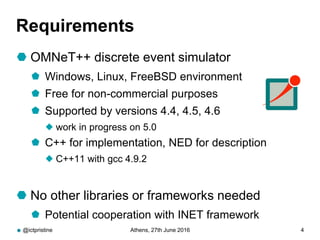
Requirements
 OMNeT++ discrete event simulator
 Windows, Linux, FreeBSD environment
 Free for non-commercial purposes
 Supported by versions 4.4, 4.5, 4.6
 work in progress on 5.0
 C++ for implementation, NED for description
 C++11 with gcc 4.9.2
 No other libraries or frameworks needed
 Potential cooperation with INET framework
@ictpristine Athens, 27th June 2016 4
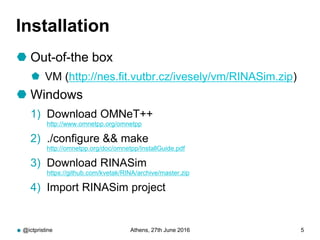
Installation
 Out-of-the box
 VM (http://nes.fit.vutbr.cz/ivesely/vm/RINASim.zip)
 Windows
1) Download OMNeT++
http://www.omnetpp.org/omnetpp
2) ./configure && make
http://omnetpp.org/doc/omnetpp/InstallGuide.pdf
3) Download RINASim
https://github.com/kvetak/RINA/archive/master.zip
4) Import RINASim project
@ictpristine Athens, 27th June 2016 5
Navigation
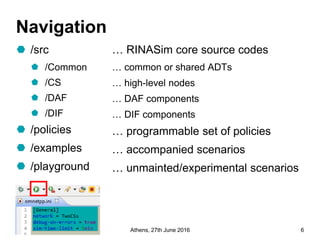
 /src
 /Common
 /CS
 /DAF
 /DIF
 /policies
 /examples
 /playground
… RINASim core source codes
… common or shared ADTs
… high-level nodes
… DAF components
… DIF components
… programmable set of policies
… accompanied scenarios
… unmainted/experimental scenarios
@ictpristine Athens, 27th June 2016 6
Documentation
 Doxygen
 http://nes.fit.vutbr.cz/ivesely/doxy
 Important ADTs, ongoing work
 PRISTINE D2.4 and D2.6
 http://ict-pristine.eu/?p=472
 http://ict-pristine.eu/?p=772
 Skype group chat
 skype:?chat&blob=-
bdq6qH_uDXIlbRk_4_XwqZyplfXPl4
IzCq4P-S0BrsttjgPR8CNJKV9-
Yyn1TYopaYZD2g3bIC_Yv0C
@ictpristine Athens, 27th June 2016 7
@ictpristine Athens, 27th June 2016 8
OMNeT++ Handbook
The fast and the furios basic 101 introductory
course about OMNeT++
Simulation Module
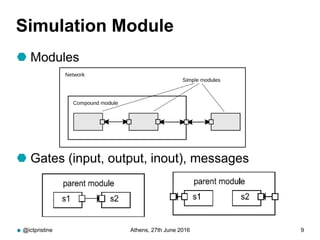
 Modules
 Gates (input, output, inout), messages
@ictpristine Athens, 27th June 2016 9
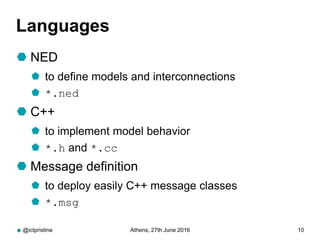
Languages
 NED
 to define models and interconnections
 *.ned
 C++
 to implement model behavior
 *.h and *.cc
 Message definition
 to deploy easily C++ message classes
 *.msg
@ictpristine Athens, 27th June 2016 10
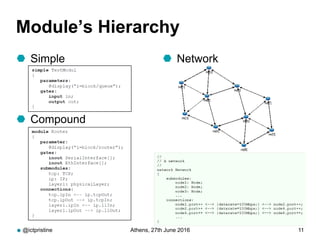
Module’s Hierarchy
 Simple
 Compound
 Network
@ictpristine Athens, 27th June 2016 11
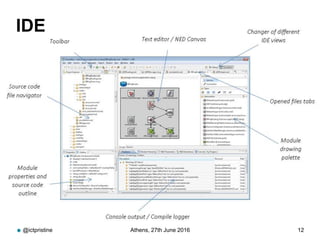
IDE
@ictpristine Athens, 27th June 2016 12
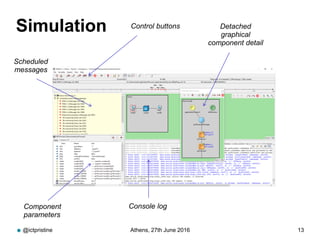
Simulation
@ictpristine Athens, 27th June 2016 13
Scheduled
messages
Component
parameters
Console log
Detached
graphical
component detail
Control buttons
@ictpristine Athens, 27th June 2016 14
RINASim Overview
Components and their purpose
Design
 Split between mechanism and policy
 Interface like modules
 Simulations allow changing of parameters
 Statically preconfigured
 NED parameters in omnetpp.ini
 config.xml
 On-the-fly
@ictpristine Athens, 27th June 2016 15
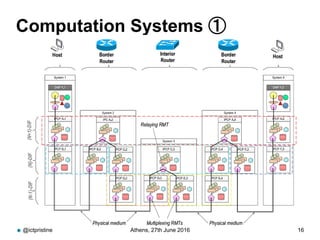
Computation Systems ①
@ictpristine Athens, 27th June 2016 16
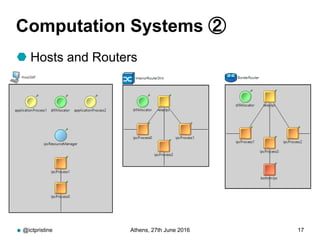
Computation Systems ②
 Hosts and Routers
@ictpristine Athens, 27th June 2016 17
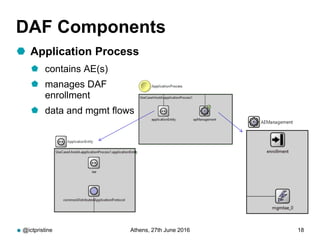
DAF Components
 Application Process
 contains AE(s)
 manages DAF
enrollment
 data and mgmt flows
@ictpristine Athens, 27th June 2016 18
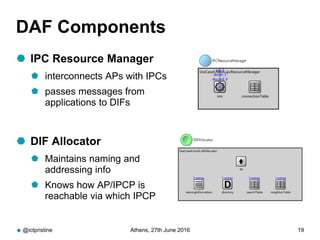
DAF Components
 IPC Resource Manager
 interconnects APs with IPCs
 passes messages from
applications to DIFs
 DIF Allocator
 Maintains naming and
addressing info
 Knows how AP/IPCP is
reachable via which IPCP
@ictpristine Athens, 27th June 2016 19
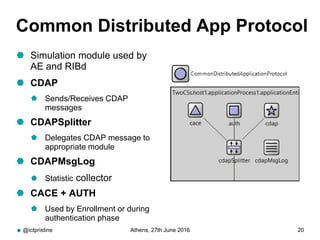
Common Distributed App Protocol
 Simulation module used by
AE and RIBd
 CDAP
 Sends/Receives CDAP
messages
 CDAPSplitter
 Delegates CDAP message to
appropriate module
 CDAPMsgLog
 Statistic collector
 CACE + AUTH
 Used by Enrollment or during
authentication phase
@ictpristine Athens, 27th June 2016 20
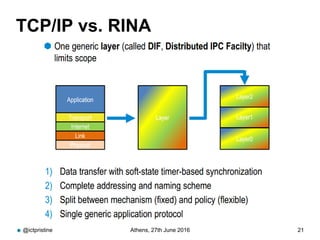
TCP/IP vs. RINA
@ictpristine Athens, 27th June 2016 21
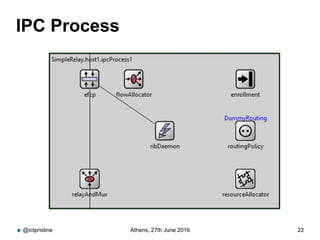
IPC Process
@ictpristine Athens, 27th June 2016 22
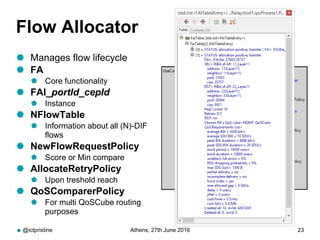
Flow Allocator
 Manages flow lifecycle
 FA
 Core functionality
 FAI_portId_cepId
 Instance
 NFlowTable
 Information about all (N)-DIF
flows
 NewFlowRequestPolicy
 Score or Min compare
 AllocateRetryPolicy
 Upon treshold reach
 QoSComparerPolicy
 For multi QoSCube routing
purposes
@ictpristine Athens, 27th June 2016 23
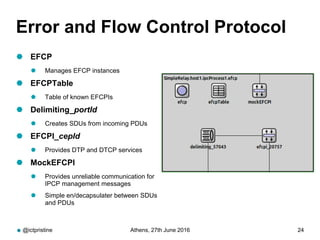
Error and Flow Control Protocol
 EFCP
 Manages EFCP instances
 EFCPTable
 Table of known EFCPIs
 Delimiting_portId
 Creates SDUs from incoming PDUs
 EFCPI_cepId
 Provides DTP and DTCP services
 MockEFCPI
 Provides unreliable communication for
IPCP management messages
 Simple en/decapsulater between SDUs
and PDUs
@ictpristine Athens, 27th June 2016 24
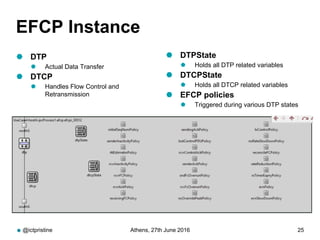
EFCP Instance
 DTP
 Actual Data Transfer
 DTCP
 Handles Flow Control and
Retransmission
@ictpristine Athens, 27th June 2016 25
 DTPState
 Holds all DTP related variables
 DTCPState
 Holds all DTCP related variables
 EFCP policies
 Triggered during various DTP states
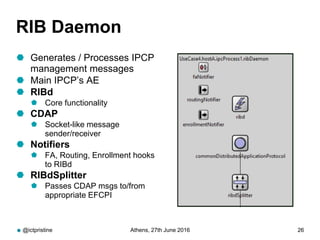
RIB Daemon
 Generates / Processes IPCP
management messages
 Main IPCP’s AE
 RIBd
 Core functionality
 CDAP
 Socket-like message
sender/receiver
 Notifiers
 FA, Routing, Enrollment hooks
to RIBd
 RIBdSplitter
 Passes CDAP msgs to/from
appropriate EFCPI
@ictpristine Athens, 27th June 2016 26
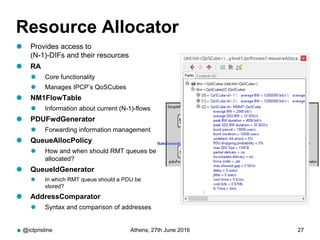
Resource Allocator
 Provides access to
(N-1)-DIFs and their resources
 RA
 Core functionality
 Manages IPCP’s QoSCubes
 NM1FlowTable
 Information about current (N-1)-flows
 PDUFwdGenerator
 Forwarding information management
 QueueAllocPolicy
 How and when should RMT queues be
allocated?
 QueueIdGenerator
 In which RMT queue should a PDU be
stored?
 AddressComparator
 Syntax and comparison of addresses
@ictpristine Athens, 27th June 2016 27
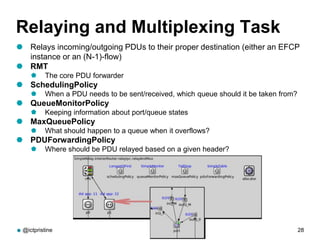
Relaying and Multiplexing Task
 Relays incoming/outgoing PDUs to their proper destination (either an EFCP
instance or an (N-1)-flow)
 RMT
 The core PDU forwarder
 SchedulingPolicy
 When a PDU needs to be sent/received, which queue should it be taken from?
 QueueMonitorPolicy
 Keeping information about port/queue states
 MaxQueuePolicy
 What should happen to a queue when it overflows?
 PDUForwardingPolicy
 Where should be PDU relayed based on a given header?
@ictpristine Athens, 27th June 2016 28
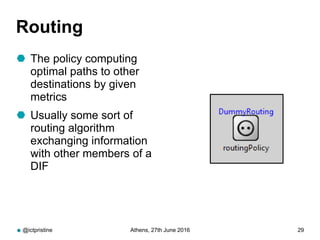
Routing
 The policy computing
optimal paths to other
destinations by given
metrics
 Usually some sort of
routing algorithm
exchanging information
with other members of a
DIF
@ictpristine Athens, 27th June 2016 29
@ictpristine Athens, 27th June 2016 30
Interactive Demo
How IPC works between two hosts
interconnected to a common node?
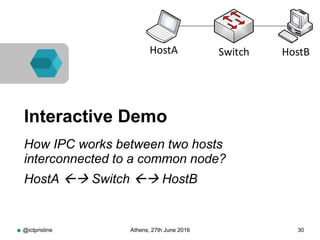
HostA  Switch  HostB
HostA HostBSwitch
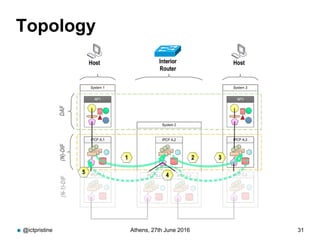
Topology
@ictpristine Athens, 27th June 2016 31
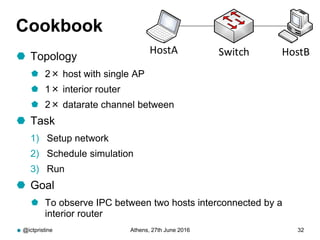
Cookbook
 Topology
 2× host with single AP
 1× interior router
 2× datarate channel between
 Task
1) Setup network
2) Schedule simulation
3) Run
 Goal
 To observe IPC between two hosts interconnected by a
interior router
@ictpristine Athens, 27th June 2016 32
HostA HostBSwitch
1) Setup network
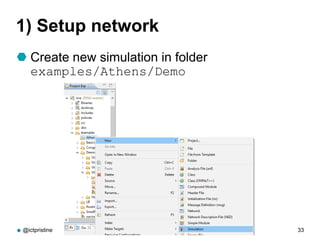
 Create new simulation in folder
examples/Athens/Demo
@ictpristine Athens, 27th June 2016 33
1) Setup network
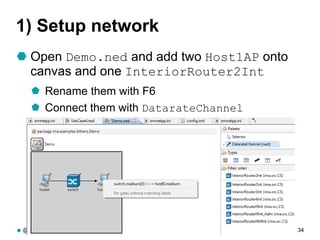
 Open Demo.ned and add two Host1AP onto
canvas and one InteriorRouter2Int
 Rename them with F6
 Connect them with DatarateChannel
@ictpristine Athens, 27th June 2016 34
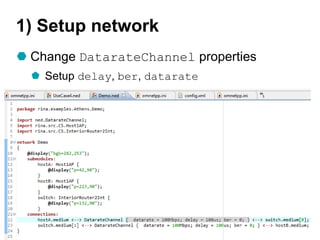
1) Setup network
 Change DatarateChannel properties
 Setup delay, ber, datarate
@ictpristine Athens, 27th June 2016 35
1) Setup network
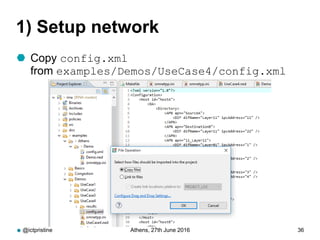
 Copy config.xml
from examples/Demos/UseCase4/config.xml
@ictpristine Athens, 27th June 2016 36
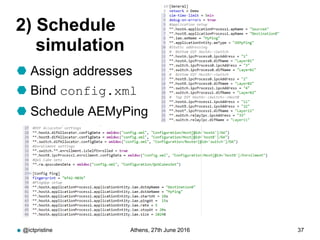
2) Schedule
simulation
 Assign addresses
 Bind config.xml
 Schedule AEMyPing
@ictpristine Athens, 27th June 2016 37
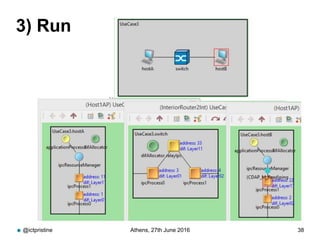
3) Run
@ictpristine Athens, 27th June 2016 38
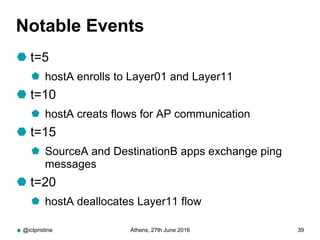
Notable Events
 t=5
 hostA enrolls to Layer01 and Layer11
 t=10
 hostA creats flows for AP communication
 t=15
 SourceA and DestinationB apps exchange ping
messages
 t=20
 hostA deallocates Layer11 flow
@ictpristine Athens, 27th June 2016 39
Conclusion
 RINASim
 Educational tool
 A way how to visualize what is happening in the native
RINA network
 Helping to improve learning curve
 Research tool
 http://ict-pristine.eu/?page_id=35
@ictpristine Athens, 27th June 2016 40
RINASim
● Comments?
Questions?
Suggestions?
@ictpristine Athens, 27th June 2016 41
The IRATI stack
A programmable RINA implementation for Linux/OS
27th June 2016
Vincenzo Maffione, Nextworks
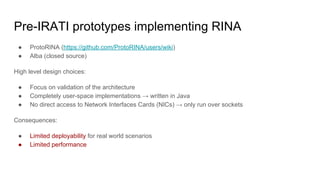
Pre-IRATI prototypes implementing RINA
● ProtoRINA (https://github.com/ProtoRINA/users/wiki)
● Alba (closed source)
High level design choices:
● Focus on validation of the architecture
● Completely user-space implementations → written in Java
● No direct access to Network Interfaces Cards (NICs) → only run over sockets
Consequences:
● Limited deployability for real world scenarios
● Limited performance
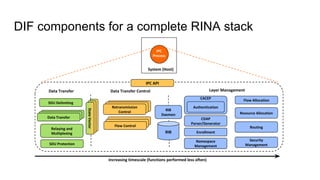
DIF components for a complete RINA stack
IPC
Process
IPC API
Data Transfer Data Transfer Control Layer Management
SDU Delimiting
Data Transfer
Relaying and
Multiplexing
SDU Protection
Retransmission
Control
Flow Control
RIB
Daemon
RIB
CDAP
Parser/Generator
CACEP
Enrollment
Flow Allocation
Resource Allocation
Routing
Authentication
StateVector
StateVector
StateVector
Data TransferData Transfer
Retransmission
Control
Retransmission
Control
Flow Control
Flow Control
Namespace
Management
Security
Management
Increasing timescale (functions performed less often)
System (Host)
About IPC Processes
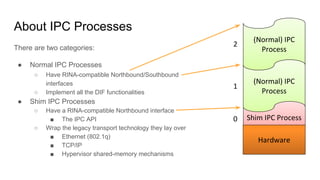
There are two categories:
● Normal IPC Processes
○ Have RINA-compatible Northbound/Southbound
interfaces
○ Implement all the DIF functionalities
● Shim IPC Processes
○ Have a RINA-compatible Northbound interface
■ The IPC API
○ Wrap the legacy transport technology they lay over
■ Ethernet (802.1q)
■ TCP/IP
■ Hypervisor shared-memory mechanisms
Shim IPC Process
(Normal) IPC
Process
(Normal) IPC
Process
0
1
2
Hardware
The IRATI stack
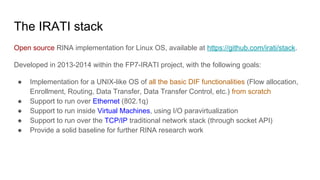
Open source RINA implementation for Linux OS, available at https://github.com/irati/stack.
Developed in 2013-2014 within the FP7-IRATI project, with the following goals:
● Implementation for a UNIX-like OS of all the basic DIF functionalities (Flow allocation,
Enrollment, Routing, Data Transfer, Data Transfer Control, etc.) from scratch
● Support to run over Ethernet (802.1q)
● Support to run inside Virtual Machines, using I/O paravirtualization
● Support to run over the TCP/IP traditional network stack (through socket API)
● Provide a solid baseline for further RINA research work
IRATI functionalities splitting (2)
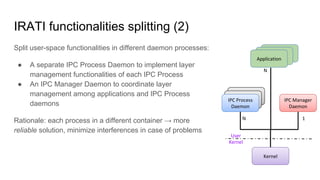
Split user-space functionalities in different daemon processes:
● A separate IPC Process Daemon to implement layer
management functionalities of each IPC Process
● An IPC Manager Daemon to coordinate layer
management among applications and IPC Process
daemons
Rationale: each process in a different container → more
reliable solution, minimize interferences in case of problems
IPC Process
Daemon
IPC Process
Daemon
N
User
Kernel
Application
1
IPC Manager
Daemon
Application
Kernel
IPC Process
Daemon
Application
N
Communication among components
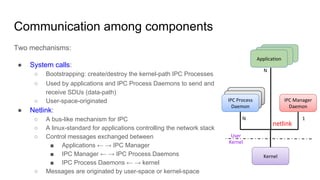
Two mechanisms:
● System calls:
○ Bootstrapping: create/destroy the kernel-path IPC Processes
○ Used by applications and IPC Process Daemons to send and
receive SDUs (data-path)
○ User-space-originated
● Netlink:
○ A bus-like mechanism for IPC
○ A linux-standard for applications controlling the network stack
○ Control messages exchanged between
■ Applications ← → IPC Manager
■ IPC Manager ← → IPC Process Daemons
■ IPC Process Daemons ← → kernel
○ Messages are originated by user-space or kernel-space
netlink
IPC Process
Daemon
IPC Process
Daemon
N
User
Kernel
Application
1
IPC Manager
Daemon
Application
Kernel
IPC Process
Daemon
Application
N
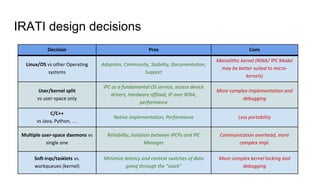
IRATI design decisions
Decision Pros Cons
Linux/OS vs other Operating
systems
Adoption, Community, Stability, Documentation,
Support
Monolithic kernel (RINA/ IPC Model
may be better suited to micro-
kernels)
User/kernel split
vs user-space only
IPC as a fundamental OS service, access device
drivers, hardware offload, IP over RINA,
performance
More complex implementation and
debugging
C/C++
vs Java, Python, …
Native implementation, Performance Less portability
Multiple user-space daemons vs
single one
Reliability, Isolation between IPCPs and IPC
Manager
Communication overhead, more
complex impl.
Soft-irqs/tasklets vs.
workqueues (kernel)
Minimize latency and context switches of data
going through the “stack”
More complex kernel locking and
debugging
Core
Normal IPC Process datapath
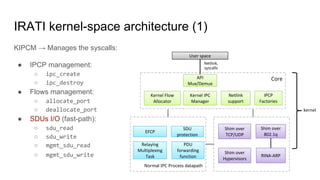
IRATI kernel-space architecture (1)
KIPCM → Manages the syscalls:
● IPCP management:
○ ipc_create
○ ipc_destroy
● Flows management:
○ allocate_port
○ deallocate_port
● SDUs I/O (fast-path):
○ sdu_read
○ sdu_write
○ mgmt_sdu_read
○ mgmt_sdu_write
API
Mux/Demux
Kernel IPC
Manager
IPCP
Factories
Kernel Flow
Allocator
EFCP
Relaying
Multiplexing
Task
PDU
forwarding
function
Netlink
support
Netlink,
syscalls
User space
Shim over
802.1q
RINA-ARP
Shim over
Hypervisors
kernel
Shim over
TCP/UDP
SDU
protection
Core
Normal IPC Process datapath
IRATI kernel-space architecture (2)
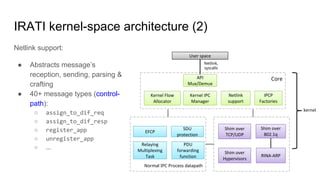
Netlink support:
● Abstracts message’s
reception, sending, parsing &
crafting
● 40+ message types (control-
path):
○ assign_to_dif_req
○ assign_to_dif_resp
○ register_app
○ unregister_app
○ ...
API
Mux/Demux
Kernel IPC
Manager
IPCP
Factories
Kernel Flow
Allocator
EFCP
Relaying
Multiplexing
Task
PDU
forwarding
function
Netlink
support
Netlink,
syscalls
User space
Shim over
802.1q
RINA-ARP
Shim over
Hypervisors
kernel
Shim over
TCP/UDP
SDU
protection
Core
Normal IPC Process datapath
IRATI kernel-space architecture (3)
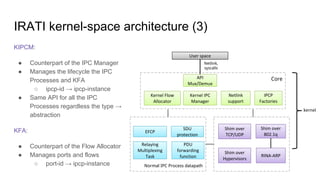
KIPCM:
● Counterpart of the IPC Manager
● Manages the lifecycle the IPC
Processes and KFA
○ ipcp-id → ipcp-instance
● Same API for all the IPC
Processes regardless the type →
abstraction
KFA:
● Counterpart of the Flow Allocator
● Manages ports and flows
○ port-id → ipcp-instance
API
Mux/Demux
Kernel IPC
Manager
IPCP
Factories
Kernel Flow
Allocator
EFCP
Relaying
Multiplexing
Task
PDU
forwarding
function
Netlink
support
Netlink,
syscalls
User space
Shim over
802.1q
RINA-ARP
Shim over
Hypervisors
kernel
Shim over
TCP/UDP
SDU
protection
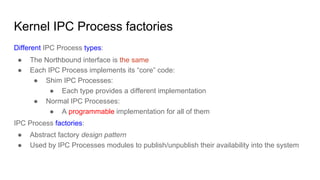
Kernel IPC Process factories
Different IPC Process types:
● The Northbound interface is the same
● Each IPC Process implements its “core” code:
● Shim IPC Processes:
● Each type provides a different implementation
● Normal IPC Processes:
● A programmable implementation for all of them
IPC Process factories:
● Abstract factory design pattern
● Used by IPC Processes modules to publish/unpublish their availability into the system
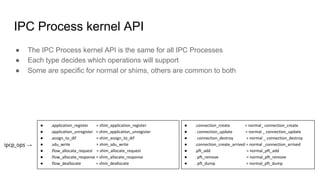
IPC Process kernel API
● The IPC Process kernel API is the same for all IPC Processes
● Each type decides which operations will support
● Some are specific for normal or shims, others are common to both
● .connection_create = normal_ connection_create
● . connection_update = normal _ connection_update
● . connection_destroy = normal _ connection_destroy
● .connection_create_arrived = normal _connection_arrived
● .pft_add = normal_pft_add
● . pft_remove = normal_pft_remove
● . pft_dump = normal_pft_dump
● .application_register = shim_application_register
● .application_unregister = shim_application_unregister
● .assign_to_dif = shim_assign_to_dif
● .sdu_write = shim_sdu_write
● .flow_allocate_request = shim_allocate_request
● .flow_allocate_response = shim_allocate_response
● .flow_deallocate = shim_deallocate
ipcp_ops →
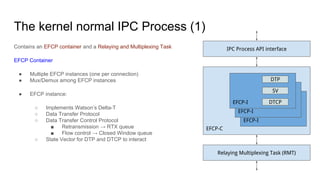
The kernel normal IPC Process (1)
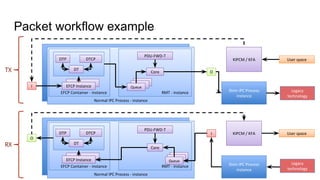
Contains an EFCP container and a Relaying and Multiplexing Task
EFCP Container
● Multiple EFCP instances (one per connection)
● Mux/Demux among EFCP instances
● EFCP instance:
○ Implements Watson’s Delta-T
○ Data Transfer Protocol
○ Data Transfer Control Protocol
■ Retransmission → RTX queue
■ Flow control → Closed Window queue
○ State Vector for DTP and DTCP to interact
EFCP-C
EFCP-I
EFCP-I
EFCP-I
DTP
SV
DTCP
IPC Process API interface
Relaying Multiplexing Task (RMT)
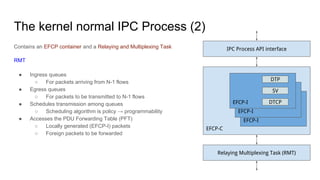
The kernel normal IPC Process (2)
Contains an EFCP container and a Relaying and Multiplexing Task
RMT
● Ingress queues
○ For packets arriving from N-1 flows
● Egress queues
○ For packets to be transmitted to N-1 flows
● Schedules transmission among queues
○ Scheduling algorithm is policy → programmability
● Accesses the PDU Forwarding Table (PFT)
○ Locally generated (EFCP-I) packets
○ Foreign packets to be forwarded
EFCP-C
EFCP-I
EFCP-I
EFCP-I
DTP
SV
DTCP
IPC Process API interface
Relaying Multiplexing Task (RMT)
IRATI Shim IPC Processes
● Implemented entirely in kernel-space → easy access to I/O devices
● Lowest part of the IRATI stack --> They wrap a legacy transport technology
● Currently 3 shims available:
● shim-eth-vlan:
● Runs over 802.1Q (Ethernet with VLAN tagging)
● shim-hv:
● Targets hypervisor-based environments (QEMU-KVM and Xen)
● Allows removing unnecessary layering commonly used in traditional VM networking environments (e.g.
software bridges, virtual-NICs), with two advantages:
● Increased performances
● Reduced maintenance costs
● shim-tcp-udp
● Runs RINA over traditional TCP or UDP sockets
● Allows for interoperability over existing IP networks.
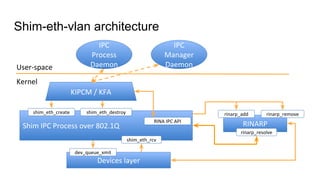
Shim-eth-vlan architecture
User-space
Kernel
KIPCM / KFA
Shim IPC Process over 802.1Q
Devices layer
RINARP
rinarp_add rinarp_remove
rinarp_resolve
dev_queue_xmit
RINA IPC API
IPC
Process
Daemon
IPC
Manager
Daemon
shim_eth_rcv
shim_eth_destroyshim_eth_create
Normal IPC Process - instance
EFCP Container - instance
EFCP Instance
RMT - instance
PDU-FWD-T
Core O
I
Shim IPC Process
instance
Normal IPC Process - instance
EFCP Container - instance
EFCP Instance
RMT - instance
PDU-FWD-T
Core
I
O
Shim IPC Process
instance
KIPCM / KFA
User space
User space
Queue
Queue
Queue
Queue
Queue
Queue
DTP DTCP
DT
DTP DTCP
DT
KIPCM / KFA
Packet workflow example
Legacy
technology
Legacy
technology
TX
RX
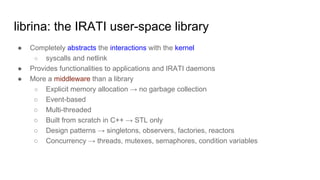
librina: the IRATI user-space library
● Completely abstracts the interactions with the kernel
○ syscalls and netlink
● Provides functionalities to applications and IRATI daemons
● More a middleware than a library
○ Explicit memory allocation → no garbage collection
○ Event-based
○ Multi-threaded
○ Built from scratch in C++ → STL only
○ Design patterns → singletons, observers, factories, reactors
○ Concurrency → threads, mutexes, semaphores, condition variables
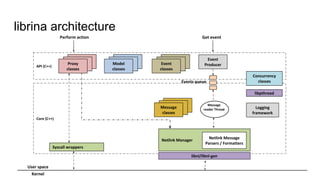
librina architecture
API (C++)
Core (C++)
libnl/libnl-gen
Kernel
Perform action
Netlink Manager Netlink Message
Parsers / Formatters
Message
classes
Message
classes
Message
classes
Syscall wrappers
Message
reader Thread
Message
classes
Message
classes
Proxy
classes
Message
classes
Message
classes
Model
classes
Message
classes
Message
classes
Event
classes
libpthread
Concurrency
classes
Logging
framework
Events queue
Event
Producer
User space
Get event
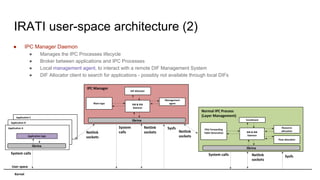
IRATI user-space architecture (2)
● IPC Manager Daemon
● Manages the IPC Processes lifecycle
● Broker between applications and IPC Processes
● Local management agent, to interact with a remote DIF Management System
● DIF Allocator client to search for applications - possibly not available through local DIFs
Kernel
User space
Netlink
sockets
Normal IPC Process
(Layer Management)Application C
RIB & RIB
Daemon
librina
Resource
allocation
Flow allocation
Enrollment
PDU Forwarding
Table Generation
Application B
System calls Netlink
sockets
Sysfs
IPC Manager
RIB & RIB
Daemon
librina
Management
agent
DIF Allocator
Main logic
System calls
Netlink
sockets
SysfsApplication A
librina
Application logic
System
calls Netlink
sockets
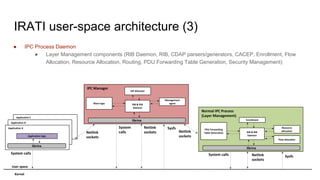
IRATI user-space architecture (3)
Kernel
User space
Netlink
sockets
Normal IPC Process
(Layer Management)Application C
RIB & RIB
Daemon
librina
Resource
allocation
Flow allocation
Enrollment
PDU Forwarding
Table Generation
Application B
System calls Netlink
sockets
Sysfs
IPC Manager
RIB & RIB
Daemon
librina
Management
agent
DIF Allocator
Main logic
System calls
Netlink
sockets
SysfsApplication A
librina
Application logic
System
calls Netlink
sockets
● IPC Process Daemon
● Layer Management components (RIB Daemon, RIB, CDAP parsers/generators, CACEP, Enrollment, Flow
Allocation, Resource Allocation, Routing, PDU Forwarding Table Generation, Security Management)
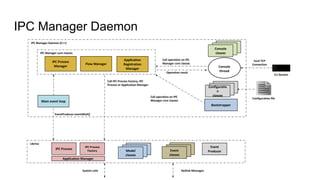
IPC Manager Daemon
IPC Manager Daemon (C++)
Librina
IPC Process
Factory
IPC Process
Message
classes
Message
classes
Event
classes
Event
Producer
Message
classes
Message
classes
Model
classes
System calls Netlink Messages
Console
thread
local TCP
Connection
Main event loop
EventProducer.eventWait()
IPC Manager core classes
IPC Process
Manager
Flow Manager
Application
Registration
Manager
Call IPC Process Factory, IPC
Process or Application Manager
Call operation on IPC
Manager core classes
Application Manager
CLI Session
Message
classes
Message
classes
Console
classes
Operation result
Bootstrapper
Configuration fileCall operation on IPC
Manager core classes
Message
classes
Message
classes
Configuratio
n
classes
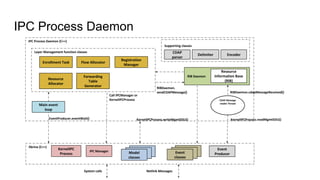
IPC Process Daemon
IPC Process Daemon (C++)
librina (C++)
IPC Manager
KernelIPC
Process
Message
classes
Message
classes
Event
classes
Event
Producer
Message
classes
Message
classes
Model
classes
System calls Netlink Messages
CDAP Message
reader Thread
KernelIPCProcess.readMgmtSDU()
RIB Daemon
Resource
Information Base
(RIB)
RIBDaemon.cdapMessageReceived()
Main event
loop
EventProducer.eventWait()
Supporting classes
Delimiter Encoder
CDAP
parser
Layer Management function classes
Enrollment Task Flow Allocator
Resource
Allocator
Forwarding
Table
Generator
Registration
Manager
Call IPCManager or
KernelIPCProcess
RIBDaemon.
sendCDAPMessage()
KernelIPCProcess.writeMgmtSDU()
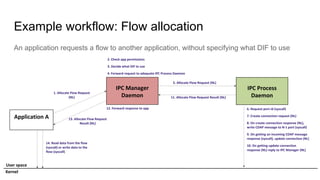
Example workflow: Flow allocation
An application requests a flow to another application, without specifying what DIF to use
Application A
Kernel
User space
IPC Manager
Daemon
IPC Process
Daemon
1. Allocate Flow Request
(NL)
2. Check app permissions
3. Decide what DIF to use
4. Forward request to adequate IPC Process Daemon
5. Allocate Flow Request (NL)
6. Request port-id (syscall)
7. Create connection request (NL)
8. On create connection response (NL),
write CDAP message to N-1 port (syscall)
9. On getting an incoming CDAP message
response (syscall), update connection (NL)
10. On getting update connection
response (NL) reply to IPC Manager (NL)
11. Allocate Flow Request Result (NL)
12. Forward response to app
13. Allocate Flow Request
Result (NL)
14. Read data from the flow
(syscall) or write data to the
flow (syscall)
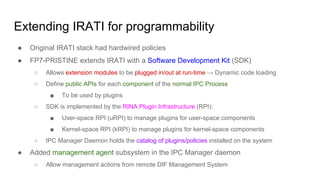
Extending IRATI for programmability
● Original IRATI stack had hardwired policies
● FP7-PRISTINE extends IRATI with a Software Development Kit (SDK)
○ Allows extension modules to be plugged in/out at run-time → Dynamic code loading
○ Define public APIs for each component of the normal IPC Process
■ To be used by plugins
○ SDK is implemented by the RINA Plugin Infrastructure (RPI):
■ User-space RPI (uRPI) to manage plugins for user-space components
■ Kernel-space RPI (kRPI) to manage plugins for kernel-space components
○ IPC Manager Daemon holds the catalog of plugins/policies installed on the system
● Added management agent subsystem in the IPC Manager daemon
○ Allow management actions from remote DIF Management System
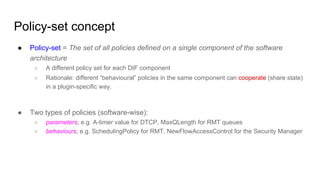
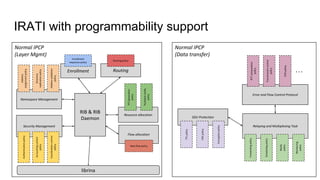
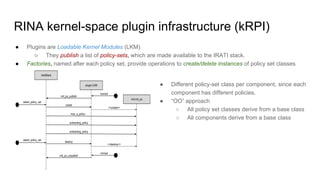
Policy-set concept
● Policy-set = The set of all policies defined on a single component of the software
architecture
○ A different policy set for each DIF component
○ Rationale: different “behavioural” policies in the same component can cooperate (share state)
in a plugin-specific way.
● Two types of policies (software-wise):
○ parameters, e.g. A-timer value for DTCP, MaxQLength for RMT queues
○ behaviours, e.g. SchedulingPolicy for RMT, NewFlowAccessControl for the Security Manager
IRATI with programmability support
Normal IPCP
(Data transfer)
Error and Flow Control Protocol
Relaying and Multiplexing Task
SDU Protection
. . .
Normal IPCP
(Layer Mgmt)
RIB & RIB
Daemon
librina
Resource allocation
Flow allocation
Enrollment
Namespace Management
Security Management
Routing
Address
assignmentpolicy
Directory
replicationpolicy
Addressvalidation
policy
Enrollment
sequence policy
Routing policy
TTLpolicy
CRCpolicy
Encryptionpolicy
Forwardingpolicy
Schedulingpolicy
MaxQ
policy
Monitoring
policy
New flow policy
PFTgeneration
policy
Pushbacknotify
policy
RTTcomputation
policy
Transmissioncontrol
policy
ECNpolicy
Authenticationpolicy
Accountingcontrol
policy
Coordinationcontrol
policy
RINA kernel-space plugin infrastructure (kRPI)
● Plugins are Loadable Kernel Modules (LKM)
○ They publish a list of policy-sets, which are made available to the IRATI stack.
● Factories, named after each policy set, provide operations to create/delete instances of policy set classes
● Different policy-set class per component, since each
component has different policies.
● “OO” approach
○ All policy set classes derive from a base class
○ All components derive from a base class
RINA user-space plugin infrastructure (uRPI)
● Same concepts as kRPI (factories, lifecycle, policy classes), different implementation
● Plugins are shared objects dynamically loaded by the IPCP Daemon, loaded through the
libdl library
Code status
● Sources are partitioned into four different packages
○ rinad: provides the IPC Process & IPC Manager daemons (user-space parts)
■ Depends on librina
○ rina-tools: provides the rina-echo-time application
■ Depends on librina
○ librina: user-space libraries
■ Depends on the IRATI modified Linux kernel
○ linux: the Linux sources enhanced with RINA functionalities (kernel-space parts)
■ Sources almost confined in net/rina, to allow easier upgrades
● Build systems for librina, rinad and rina-tools is based on autotools
Thanks
librina sublibraries
● librina-application
○ Provides the APIs that allow an application to use RINA natively
■ allocate and deallocate flows
■ read and write SDUs to that flows
■ register/unregister to one or more DIFs
● librina-ipc-manager
○ Provides the APIs that facilitate the IPC Manager to perform the tasks related to IPC Process management
■ creation, deletion and configuration of IPC Processes
● librina-ipc-process
○ Provides APIs that allow an IPC Process to
■ configure the PDU forwarding table
■ create and delete EFCP instances
■ request the allocation of kernel resources to support a flow
● librina-cdap
○ Implementation of the CDAP protocol

Eucnc rina-tutorial

  • 1.
    Monday Tutorial sessions AnIntroduction to RINA Dimitri Staessens - iMinds
  • 2.
    Networking is notabout machines 2
  • 3.
    The constructs weinteract with are computer programs 3
  • 4.
    Addressing hardware isnot flexible enough 4
  • 5.
  • 6.
    Networking is aboutinterconnecting software 6
  • 7.
    We need tothink processes not machines 7 kill –SIGNAL <pid>
  • 8.
  • 9.
    Message Passing IPChas a simple API 9 fd[1] fd[0] int pipe (pipefd, /* flags */); int read (pipefd[0], <buf>, len); int write (pipefd[1], <buf>, len);
  • 10.
    Basic premise ofRINA 10 “Networking is IPC”
  • 11.
    Single system 11 IPC FACILITY XY Applications X and Y are known (instantiated by kernel) Part of OS
  • 12.
    Single system: flowallocation 12 IPC FACILITY X Y Port ID Port ID flow Flow allocation: reserves resources in the IPC facility and assigns port ID’s ~ fd’s Applications X and Y are known (instantiated by kernel) Part of OS <port_id> alloc (pid, …); dealloc (port_id); Implementation dependent Message passing shared memory
  • 13.
    Single system: connection 13 IPCFACILITY X Y Port ID Port ID flow Flow allocation: reserves resources in the IPC facility and assigns port ID’s ~ fd’s Applications X and Y are known (instantiated by kernel) Part of OS <port_id> alloc (pid, …); <port_id> accept (…); dealloc (port_id); read/write (port_id, sdu *, len); Implementation dependent Message passing shared memory APPLICATION FACILITY Connection (application protocol)
  • 14.
    Two systems connectedby a wire 14 X Y Applications X and Y -> need to register a name that is unique over both systems!
  • 15.
    Two systems connectedby a wire 15 X Y IPC process: provides IPC service. Not only locally, but over 2 systems Requires an IPC process component that manages the medium (MAC) Applications X and Y -> need to register a name that is unique over both systems! IPC Process IRM IRM IPC Resource Manager basically creates/destroys IPC processes. Ideally: part of the OS
  • 16.
    Two systems connectedby a wire 16 DISTRIBUTED IPC FACILITY X Y Port ID Port ID flow IPC Process Locating an application if it’s not here, it’s over there… or doesn’t exist. Applications X and Y -> need to register a name that is unique over both systems! reg(pid, name); unreg(pid); alloc (name, …); dealloc (port_id); IRMIRM
  • 17.
    DISTRIBUTED APPLICATION FACILITY Twosystems connected by a wire 17 DISTRIBUTED IPC FACILITY X Y Port ID Port ID flow IPC Process Locating an application if it’s not here, it’s over there… or doesn’t exist. Applications X and Y -> need to register a name that is unique over both systems! reg(pid, name); unreg(pid); alloc (name, …); dealloc (port_id); IRM IRM
  • 18.
    Multiple systems sharinga transmission medium such as radio 18 X Y Port ID Port ID flow IPC Process 1 2 Z 3 Port ID Need to synchronize names between the the systems register names (X,1), (Z,3), … -> directory function small scope: broadcasting information is a feasible option IPC Processes need addresses for scalability DISTRIBUTED IPC FACILITY IRMIRM IRM
  • 19.
    IPC API • APscommunicate using a “port” – portID: ~ file descriptor • 6 operations: – int _registerApp(appName, List<difName>) – portId _allocateFlow(destAppName, List<QoSParams>) – int _write(portId, sdu) – sdu _read(portId) – int _deallocate(portId) – int _unregisterApp(appName, List<difName>) 19
  • 20.
    Building networks 20 X Y CommonDistributed Application Protocol 20
  • 21.
    Building networks 21 X Y 21 C2C1 A1 A2 B1 B2 E1 E2
  • 22.
    Building networks: NormalIPCP 22 X Y 22 C2 C1 A1 A2 B1 B2 E1 E2 Normal IPC Process (IPCP) D1
  • 23.
    Building networks: NormalIPCP 23 X Y 23 C2 C1 A1 A2 B1 B2 E1 E2 Provides IPC to higher layers (DIFs/DAFs) Uses IPC from lower layers (DIFs) Normal IPC Process (IPCP) D1
  • 24.
    Building networks: IPCPregistration 24 X Y A1 A2 B1 B2 C2 C1 E1 E2D1 24 IPCP D1 registers in 2 DIFs (A, B) D1/A2 D1/B1
  • 25.
    Building networks: IPCPregistration 25 X Y A1 A2 B1 B2 C2 C1 E1 E2D1 25 D2 D1/A2 D2/A1 D1/B1 Create IPCP D2, can register in DIF A (optional)
  • 26.
    Building networks: flowallocation 26 X Y A1 A2 B1 B2 C2 C1 E1 E2D1 26 D2 IPCP D2 allocates a flow with D1 D2 can now send messages to D1 D1/A2 D2/A1 D1/B1
  • 27.
    Building networks: enrollment 27 XY A1 A2 B1 B2 C2 C1 E1 E2D1 27 D2 A new operation: enrollment: “joining a DIF” authentication exchanging some basic information configuration parameters addresses current equivalent: joining a wifi network D1D2 D1/A2 D2/A1 D1/B1
  • 28.
    Building networks: enrollment 28 XY A1 A2 B1 B2 C2 C1 E1 E2 28 D3 performs the same procedures. DIF “D” now has 3 members D1 D3D2 D1/A2 D2/A1 D1/B1
  • 29.
    Building networks: flowallocation 29 X Y A1 A2 B1 B2 C2 C1 E1 E2 F1 F2F3 F4 D1 D3D2 29
  • 30.
    Flow allocation innormal IPCP 30 F1 F2 D1 D3D2
  • 31.
    Flow allocation innormal IPCP 31 F1 F2 D1 D3D2 Flow allocation = reservation of resources
  • 32.
    Flows vs Connections 32 F1F2 D1 D3D2 Port_id Port_id Cep-id Cep-id Cep-id Cep-id Flow: implemented by a lower layer, between port_id’s Resource: EFCP connection inside a layer, between CEP-id’s Flow allocation = reservation of resources
  • 33.
    Error and FlowControl Protocol • DTP ~UDP – Fragmentation – Reassembly – Sequencing – Concatenation – Separation • DTCP ~ TCP – Transmission control – Retransmission control – Flow control • Loosely coupled by a state vector • Based on Delta-t 33
  • 34.
    Delta-t (Watson, 1981) •Developed at L.Livermore labs, unique approach. – Assumes all connections exist all the time. – keep caches of state on ones with recent activity • Watson proves that the conditions for distributed synchronization are met if and only if 3 timers are bounded: – Maximum Packet Lifetime: MPL – Maximum number of Retries: R – Maximum time before ACK: A • That no explicit state synchronization, i.e. hard state, is necessary. – SYNs, FINs are unnecessary • 1981:Watson shows that TCP has all three timers and more. 34
  • 35.
    Inside the normalIPC process IPC Process IPC API Data Transfer Data Transfer Control Layer Management SDU Delimiting Data Transfer Relaying and Multiplexing SDU Protection Transmission Control Retransmission Control Flow Control RIB Daemon RIB CDAP Parser/Generator CACEP Enrollment Flow Allocation Resource Allocation Forwarding Table Generator Authentication StateVector StateVector StateVector Data TransferData Transfer Transmission Control Transmission Control Retransmission Control Retransmission Control Flow Control Flow Control Appl. Process IPC Resource Mgt. SDU Protecti on Multipl exing IPC Mgt. Tasks Other Mgt. Tasks Application Specific Tasks •Authentication of all processes •RIB Daemon manages state objects •EFCP protocol performs SDU transport 35
  • 36.
    Building networks: enrollment 36 XY A1 A2 B1 B2 C2 C1 E1 E2 36 D3 performs the same procedures. DIF “D” now has 3 members D1 D3D2 D1/A2 D2/A1 D1/B1
  • 37.
    Building networks 37 X Y A1A2 B1 B2 C2 C1 E1 E2 F1 F2F3 F4 D1 D3D2 37
  • 38.
    Building networks: flowallocation 38 X Y A1 A2 B1 B2 C2 C1 E1 E2 F1 F2F3 F4 D1 D3D2 38
  • 39.
  • 40.
  • 41.
  • 42.
  • 43.
    Basic concept ofRINA 43 “Simplicity is prerequisite for reliability” – E. Dijkstra
  • 44.
    The lowest layer:shim DIFs 44 DISTRIBUTED IPC FACILITY X Y connection Port ID Port ID flow Shim IPC Process Wrap the IPC API around a legacy protocol Ex. Ethernet
  • 45.
    Shim DIF overUDP using DNS 45 Register in shim DIF Flow allocation Data transfer Query directory Flow allocation Data transfer Check if the name exists in the shim DIF (uniqueness!)
  • 46.
    46 • A structureof recursive layers that provide IPC (Inter Process Communication) services to applications on top • There’s a single type of layer that repeats as many times as required by the network designer • Separation of mechanism from policy • All layers have the same functions, with different scope and range. – Not all instances of layers may need all functions, but don’t need more. • A Layer is a Distributed Application that performs and manages IPC. – A Distributed IPC Facility (DIF) • This yields a scalable architecture
  • 47.
    Adoption path 47 TCP/IP orUDP/IP Ethernet Physical Media Applications Ethernet Physical Media Applications DIF DIF … Physical Media ApplicationsToday DIF DIF … TCP/IP or UDP/IP Physical Media Applications DIF DIF … End goal FP7 IRATI Project Prototype
  • 48.
    IoT? 48 RINA: DTP +Flow Control The Internet relies on TCP congestion control What would happen if the dominant traffic becomes UDP?
  • 49.
  • 50.
    Mobility in RINA 50 DIF XY LTE DIF F3 F4 BACKHAUL DIF
  • 51.
  • 52.
  • 53.
  • 54.
  • 55.
  • 56.
    Mobility in RINA 56 DIF Y F4 X F3 BACKHAULDIF Registration / Unregistration of Application in DIFs No routing or address updates! Device moves physically, but no IPCP moves logically within a DIF! And flow allocations Enroll / Unenroll in the LTE DIFs
  • 57.
  • 58.
    Recursive Congestion Management inRINA Peyman Teymoori June 27, 2016
  • 59.
    2 Layering in Networking– OSI vs. RINA •  From the OSI perspective: each layer performs a specific task or tasks and builds upon the preceding layer until the communications are complete. •  In Recursive InterNetworking Architecture (RINA): every layer (called “Distributed InterProcess Communication (IPC) Facility” (DIF)) has some mechanisms and policies with the goal of: –  providing and managing the communication among its entities –  “Mechanisms” are the same in various DIFs. –  “Policies” can be programmed differently in various DIFs.
  • 60.
    3 Congestion Control inRINA vs. the Internet FP7-619305 PRISTINE Collaborative Project B8.2. Work Package 3 Processes with specific functionality Processes with generic functionality
  • 61.
    4 Congestion Control inthe Internet •  Problems with the Internet: –  TCP scalability with: •  The diameter of the network •  The bottleneck link capacity •  The number of flows –  Different link types –  Split-TCP (PEPs): •  IPsec and SSL •  Scalability with the number of flows •  Processing delay at splitters
  • 62.
    5 Congestion Control inRINA •  Our goal: –  highlighting RINA Congestion Control (CC) benefits Showing that improvements that have been done to TCP on the internet "naturally appear" with RINA without their side effects In 3 steps: 1.  Inspecting DIF and its modules, 2.  Showing DIF organizations, 3.  Comparative results
  • 63.
    6 Step 1: Inspectinga DIF – IPC Process (IPCP) ≈ IP + UDP ≈ TCP
  • 64.
    7 IPC Modules Delimiting Data Transfer Protocol(DTP) Data Transfer Control Protocol (DTCP) (N-1)-DIF A (N-1)-DIF B N-DIF(N-1)-DIFs Queues Relaying and Multiplexing TaskFlow Aggregation based on QoSCube! EFCP (N+1)-DIFs
  • 65.
    8 Error and FlowControl Protocol (EFCP) •  Ensures reliability, order, and flow and congestion control. •  Each EFCP instance consists of distinct instances of –  Data Transfer Protocol (DTP), and –  Data Transfer Control Protocol (DTCP), (optional) which coordinate through a state vector. •  Features: –  Win. based –  Rate based –  In/out of order delivery –  ACKs: •  Delayed •  Selective •  Allowable gaps Delimiting Data Transfer Protocol (DTP) Data Transfer Control Protocol (DTCP) (N-1)-DIF A (N-1)-DIF B Queues Relaying and Multiplexing Task EFCP
  • 66.
    9 Data Transfer Protocol(DTP) •  Required •  Consists of tightly bound mechanisms found in all DIFs. •  Roughly equivalent to UDP. •  There is one instance of DTP for each flow. •  Some policies: –  RTT Estimator, –  SenderInactivity, –  RcvrInactivity Delimiting Data Transfer Protocol (DTP) Data Transfer Control Protocol (DTCP) (N-1)-DIF A (N-1)-DIF B Queues Relaying and Multiplexing Task EFCP
  • 67.
    10 Data Transfer ControlProtocol (DTCP) •  Optional •  Provides the loosely-bound mechanisms •  Each DTCP instance is paired with a DTP instance •  Controls the flow, based on its policies and the content of the shared state vector. •  Some policies: –  TxControl, –  SenderAck, –  RxTimerExpiry, –  ECN. Delimiting Data Transfer Protocol (DTP) Data Transfer Control Protocol (DTCP) (N-1)-DIF A (N-1)-DIF B Queues Relaying and Multiplexing Task EFCP
  • 68.
    11 Step 2: SomeDIF Configurations in RINA •  Two simple RINA stack configurations by different organizations of DIFs Delimiting Data Transfer Protocol Data Transfer Control (N-1)-DIF A (N-1)-DIF B Queues Relaying and Multiplexing Task EFCPDelimiting Data Transfer Protocol Data Transfer Control (N-1)-DIF A (N-1)-DIF B Queues Relaying and Multiplexing Task EFCP
  • 69.
    12 A General DIFConfiguration “Error and Flow Control Protocol” (EFCP), “Relaying and Multiplexing Task” (RMT), “Resource Allocation” (RA). Queue builds up Reduces rate Might be blocked Queue builds up Reduces rate Might be blocked Queue builds up Reduces rate This is the so-called pushback method. Other feedback types are under investigation.
  • 70.
    13 Step 3: AComparative Example of Stacks 10 Mbps 75 ms 10 Mbps 25 ms
  • 71.
    14 Horizontal: Consecutive DIFs From P.Teymoori, M. Welzl, S. Gjessing, E. Grasa, R. Riggio, K. Rausch, D. Siracusa: "Congestion Control in the Recursive InterNetworking Architecture (RINA)", IEEE ICC 2016, Kuala Lumpur, Malaysia, 23-27 May 2016.
  • 72.
    15 Vertical: Stacked DIFs Topology:Results: From the same publication 1 sender, 1 receiver: Sender sends flow 1 (large) at 0, and flow 2 (small) at time 10. There is only one flow carrying packets here There is only one flow carrying packets here Scenario 1 Scenario 2
  • 73.
    16 Around: In-Network ResourcePooling •  A follow-up to: Psaras, Ioannis, Lorenzo Saino, and George Pavlou. "Revisiting Resource Pooling: The Case for In-Network Resource Sharing." Proceedings of the 13th ACM Workshop on Hot Topics in Networks. ACM, 2014 •  Easily implementable in RINA by an RMT routing policy S1 S2 R1 R2 Router1 Router3 Router2 Router4 10 Mbps 10 Mbps 2 Mbps 3 Mbps 3 Mbps 10 Mbps 10 Mbps 10 Mbps local stability, global fairness (1:1) Result: Jain’s fairness index for the two flows was 0.999, which shows global fairness while local stability was provided through RINA-ACC Delimiting Data Transfer Protocol Data Transfer Control (N-1)-DIF A (N-1)-DIF B Queues Relaying and Multiplexing Task EFCP
  • 74.
    17 Discussion •  RINA cansolve the Internet problems by –  breaking up the long control loop into shorter ones, •  Link-specific congestion control –  controlling flow aggregates inside the network, and •  Fewer competition among flows –  enabling the deployment of arbitrary congestion control mechanisms per DIF. •  Coupled with the policies in other modules •  and of course, there are other questions that need to be answered before a full deployment.
  • 75.
  • 76.
    Large scale RINAExperimentation on FIRE + RINA for converged operator networks in 5G scenarios Leonardo Bergesio, Eduard Grasa – i2CAT June 27th 2016, Athens
  • 77.
    Large scale RINAExperimentation on FIRE + An Operator Network today and the converged vision 2
  • 78.
    A (C)ON today.. Large-scaleRINA Experimentation on FIRE+ 3 • Different access technologies use a dedicated aggregation and backbone network segments, resulting in a poor utilization of the infrastructure. • Users will have different subscriber profiles (mobile vs. fix). • The provider must deploy duplicated service platforms (mobile vs. fix). • Challenging service continuity when transitioning between type of access • Management and deployment of new services cumbersome
  • 79.
    A CON vision.. •Any access media, any application requirement supported by a common network infrastructure • Single architecture, single management system, single users database (regardless of access) 4 Manageusersand sessions, Local managed services Capillarity,Capacity, Mobility support Multiplexing Switching, Transport Control functions, Regional managed services Devices Places Users Access Aggregation LocalPoints of Presence Core RegionalDataCentres Radio Fiber
  • 80.
    Large scale RINAExperimentation on FIRE + The all-IP approach Current protocol stack limitations 5
  • 81.
    xDSL FTTH WiFi4G Building a CON today… 6 National DCRegional DC(s) Metropolitan aggregation (Carrier Eth, MPLS, …) Metropolitan aggregation … … Metro DC Metro DC Access Internet Border Private peering with other operators , or Internet transit To Internet eXchange Point (IXP) IP eXchange border To IPX network (IMS traffic) micro DC Metropolitan aggregation (Carrier Eth, MPLS, …) Metropolitan aggregation Metropolitan aggregation (Carrier Eth, MPLS, …) Metropolitan aggregation Metropolitan aggregation (Carrier Eth, MPLS, …) • Micro DC: Mobile-edge computing, C-RAN • Metro DC/Regional/National DCs: (functions splitted according desired degree of distribution by provider). Service platforms (DNS, SMTP, etc.), LTE EPC (S-GW, P- GW, MME), IMS, cloud hosting, user accounts, billing, NOC, etc. Core/backbone IP/MPLS
  • 82.
    Are “All IPnetworks” fit for this purpose? • Computer networking & telecom industry has been steadily moving towards an “all IP” world. – Is “all-IP convergence” a simple, scalable, robust, manageable, performing and future-proof solution for all types of computer networks? • Could be if – The “IP protocol suite” had been designed with generality in mind, allowing its protocols to adapt to specific network environments – The “IP protocol suite” is well know for having no scalability, performance or security issues 7 1 2 1 42
  • 83.
    Large scale RINAExperimentation on FIRE + The RINA approach And its benefits 8
  • 84.
    There is abetter approach: RINA • Network architecture resulting from a fundamental theory of computer networking • Networking is InterProcess Communication (IPC) and only IPC. Unifies networking and distributed computing: the network is a distributed application that provides IPC • There is a single type of layer with programmable functions, that repeats as many times as needed by the network designers  recursion, ease management • All layers provide the same service: instances of communication (flows) to two or more application instances, with certain characteristics (delay, loss, in-order-delivery, etc)  programmability, limited number of protocols + policies • There are only 3 types of systems: hosts, interior and border routers. No middleboxes (firewalls, NATs, etc) are needed • Deploy it over, under and next to current networking technologies 9 1 2 3 4 5 6
  • 85.
    “IP protocol suite”macro-structure • Functional layers organized for modularity, each layer provides a different service to each other – As the RM is applied to the real world, it proofs to be incomplete. As a consequence, new layers are patched into the reference model as needed (layers 2.5, VLANs, VPNs, virtual network overlays, tunnels, MAC-in-MAC, etc.) Large-scale RINA Experimentation on FIRE+ 10 (Theory) (Practice)
  • 86.
    Network management Commonality isthe key to effective network management 11 • Commonality and consistency in RINA greatly simplifies management models, opening the door to increased automation in multi-layer networks – Reduce opex, network downtime, speed-up network service delivery, reduce components that need to be standardised Frommanaginga set of layers, eachwith its own protocols,conceptsanddefinitions… … to managinga common,repeatingstructure of two protocolsanddifferentpolicies
  • 87.
    Naming and addressing,mobility, routing No need for special protocols 12 Name Indicates Property RINA IP Application name What Locationindependent Yes No Node address Where Locationdependent, route independent Yes No Pointof Attachment How to get there Route dependent Yes Yes (twice: IP, MAC)
  • 88.
    Security: DIFs aresecurable containers Secure layers instead of protocols, expose less to apps, scope Large-scale RINA Experimentation on FIRE+ 13 Allocatinga flow to destination application Access control Sending/receivingSDUs through N-1 DIF Confidentiality,integrity N DIF N-1 DIF IPC Process IPC Process IPC Process IPC Process Joininga DIF authentication,access control Sending/receiving SDUs through N-1 DIF Confidentiality,integrity Allocatinga flow to destination application Access control IPC Process Appl. Process DIF Operation Logging/Auditing DIF Operation Logging/Auditing RINA IP protocolsuite Consistent security model,enforced byeach layer via pluggable policies Each protocol has its own security model/functions (IPsec, TLS, BGPsec, DNSsec, etc.) Scope as a native construct: controlled connectivity bydefault Single scope (global),connectivityto everyone by default.Scope via ad-hocmeans:firewalls, ACLs, VLANs, VPNs, etc. Complete namingand addressing,separation of synchronization fromport allocation No application names,addresses exposedto applications, well-known ports
  • 89.
    Deployment Clean-slate concepts butincremental deployment 14 • IPv6 brings very small improvements to IPv4, but requires a clean slate deployment (not compatibleto IPv4) • RINA can be deployed incrementally where it has the right incentives, and interoperate with current technologies (IP, Ethernet, MPLS, etc.) – Over IP (just likeany overlay such as VXLAN, NVGRE, GTP-U, etc.) – Below IP (just like any underlay such as MPLS or MAC-in-MAC) – Next to IP (gateways/protocol translationsuch as IPv6) IP Network RINAProvider RINANetwork Sockets ApplicationsRINAsupported Applications IP or Ethernet or MPLS, etc
  • 90.
    Network Programmability • Centralizedcontrol of data forwarding – GSMPv3 (label switches: ATM, MPLS, optical), OpenFlow (Ethernet, IP, evolving) • APIs for controlling network services & network devices – ONF SDN architecture, IEEE P1520 (from 1998) (P1520 distinguished between virtual devices and hardware) 15 ONF‘s SDN architecture
  • 91.
    Separation of mechanismfrom policy 16 IPC API DataTransfer DataTransfer Control Layer Management SDU Delimiting Data Transfer Relaying and Multiplexing SDU Protection Retransmission Control Flow Control RIB Daemon RIB CDAP Parser/Generator CACEP Enrollment Flow Allocation Resource Allocation Routing Authentication StateVector StateVector StateVector Data TransferData Transfer Retransmission Control Retransmission Control Flow Control Flow Control Namespace Management Security Management • All layers have the same mechanisms and 2 protocols (EFCP for data transfer, CDAP for layer management),programmable via policies. – All data transfer and layer management functions are programmable! • Don’t specify/implement protocols, only policies – Re-use common layer structure, re-use policies across layers • This approach greatly simplifies the network structure, minimizing the management overhead and the cost of supporting new requirements, new physical media or new applications
  • 92.
    Large scale RINAExperimentation on FIRE + From all-IP to RINA Examples exploiting recursion 17
  • 93.
    Recursion instead ofvirtualization (I) • RINA recursive layering structure cleans up and generalizes the current protocol stack. • Example 1: PBB-VPLS (Virtual Private LAN Service) – Uses MAC-in-MAC encapsulation to isolate provider’s core from customers addresses andVLANs 24 Green CustomerVPN DIF ProviderVPN Service DIF Metro DIF Metro DIFCore DIF PtP DIF PtP DIF PtP DIF PtP DIF PtP DIFPtP DIFPtP DIFPtP DIF PtP DIF PtP DIF PtP DIF
  • 94.
    Recursion instead ofvirtualization (II) • Example 2: LTE (Long Term Evolution) – Uses PDCP, GTP to transport user’s IP payload, and also relies on internal IP network. 31 IP (e.g. Internet) TCP or UDP PDCP GTP-U Protocol conversion GTP-U RLC MAC L1 UDP IP (LTE transport) MAC MAC. . . L1 . . . L1 UDP IP (LTE transport) MAC MAC. . . L1 . . . L1UE eNodeB S-GW P-GW EPS bearerEPS bearer LTE-Uu S1-U S5/S8 MAC L1 SGi PublicInternet DIF Mobile Access Network Top Level DIF Multi-access radio DIF Mobile Operator TransportDIF Mobile Operator Transport DIF PtP DIF PtP DIF PtP DIF PtP DIF PtP DIF
  • 95.
    Recursion instead ofvirtualization (III) • Example 3: Data Center Network with NVO3 – Network Virtualization Over Layer 3, uses overlay virtual networks on top of the DCN’s fabric layer 3 to support multi-tenancy • Recursion provides a cleaner, simpler solution than virtualization – Repeat the same building block, with the same interface. 36 ToR ToRFabric Spine Fabric Server ServerIPv4 orIPv6 (Fabric layer) UDPVM VM Ethernet Ethernet Ethernet Ethernet VXLAN802.1Q802.3 802.1Q IPv4 orIPv6 (tenant overlay) TCP orUDP orSCTP, … (transport layer) 802.3 Protocol conversion, Local bridging PtP DIF PtP DIF PtP DIF PtP DIF PtP DIF PtP DIFPtP DIFPtP DIF DC Fabric DIF Tenant DIF
  • 96.
    Large scale RINAExperimentation on FIRE + A Service Provider Network design with RINA 37
  • 97.
    Service provider, RINA,Internet (e-mall), wired Access Access router PtP DIF CPE Edge Service Router MAN P.E MAN P. E. MAN Access DIF MAN Core DIF PtP DIF PtP DIF PtP DIF PtP DIF MAN P PtP DIF Host Core Backbone DIF PtP DIF Core router Core router e-mall Access Router E-mall Border Router Customer network Service Prov. 1 network Access Aggregation Service Edge Core Internet Edge Internet ( e-mall) eXchange Point Core PoP, city B Core PoP, city A City A MAN City A Cabinets PtP DIF PtP DIF PtP DIF Service ProviderTop LevelDIF E-mall1 DIF PtP DIF E-mall2 DIF
  • 98.
    Service provider, RINA,Internet (e-mall) wireless Access Access router PtP DIF Cell Tower (eNodeB) Mobile Edge Service Router MAN P.E MAN P. E. MAN Access DIF MAN Core DIF PtP DIF PtP DIF PtP DIF PtP DIF MAN P Cell DIF Mobile Host (or border router) Core Backbone DIF PtP DIF Core router Core router e-mall Access Router E-mall Border Router Service Prov. 1 network Access Aggregation Service Edge Core Internet Edge PtP DIF PtP DIF PtP DIF Service ProviderTop LevelDIF E-mall1 DIF PtP DIF E-mall2 DIF Mobile AccessDIF Internet ( e-mall) eXchange Point Core PoP, city B Core PoP, city A City A MANCity A Cabinets Cell sites
  • 99.
    Example mobile networkwith RINA Better design 40 Border Router Core DIF UnderDIFs Border Router UnderDIFs Border Router InteriorRouter (Base Station) Host (Mobile) BD DIF (radio) Under DIFs District DIF Metro DIF RegionalDIF Public Internet DIF Application-specific DIF Mobile InfrastructureNetworkCustomer Terminal … … … • In this example “e-mall” DIFs (providing access to applications) are available via the regional DIF, but could be available also through metro or district DIFs – Essentially, every border router can be a “mobility anchor”, no need to do anything special. UnderDIFs Operatorcore
  • 100.
    Example with 4levels (where needed) 41 Urban Sub-urban Urban UrbanDense Urban BS DIF District DIF LegendMetro DIF Regional DIF • 4 levels of DIFs may not be needed everywhere (e.g. suburban, not enough density to require a district DIF). • If more levels needed to scale can be added anywhere in the network
  • 101.
    Large scale RINAExperimentation on FIRE + Thank you! 42
  • 102.
    Large scale RINAExperimentation on FIRE + Backup slides 43
  • 103.
    RINA macro-structure (layers) Singletype of layer, consistent API, programmable policies 44 Host Border router Interior Router DIF DIF DIF Border router DIFDIF DIF (DistributedIPC Facility) Host App A App B Consistent API through layers IPC API DataTransfer DataTransfer Control Layer Management SDU Delimiting Data Transfer Relaying and Multiplexing SDU Protection Retransmission Control Flow Control RIB Daemon RIB CDAP Parser/Generator CACEP Enrollment Flow Allocation Resource Allocation Routing Authentication StateVector StateVector StateVector Data TransferData Transfer Retransmission Control Retransmission Control Flow Control Flow Control Increasingtimescale (functionsperformedlessoften) and complexity Namespace Management Security Management
  • 104.
    Radio Access DIFand District DIF Example connectivity graphs Multi-homed host BR BS H H H BS H Metro DIF Metro DIF Metro DIF BR BS H H H BS H Metro DIF Metro DIF Metro DIF Multi-homed host Metro DIF Metro DIF Metro DIF District DIF 1 District DIF 2 CellDIF Cell DIF CellDIF Cell DIF DISTRICT DIF BS = IPCP at Base Station H = IPCP at Host BR = IPCP at Border Router BS H BS H H H H Cell DIF 1 (radio) Cell DIF 2 (radio) District DIF District DIF District DIF District DIF District DIF District DIF CELL DIF BS = IPCP at Base Station H = IPCP at Host 45
  • 105.
    E-mall DIF Metro DIF andRegional DIF Example connectivity graphs METRO DIF H = IPCP at Host BR = IPCP at Border Router H H H H H BR H H H H H BR Multi-homed host Reg. DIF H H H H H BR H District DIF District DIF District DIF BR Regional DIF H H H HH H HH H H HH H HH H H HH H HH H H HH H H Metro DIF BR HH H HH H H HH H HH H H HH H HH H HH H HH Metro DIF BR BR Metro DIF (fixed) Public InternetDIF REGIONAL DIF H = IPCP at Host BR = IPCP at Border Router 46
  • 106.
    Securing RINA networks Tutorial1: RINA: a future--proof approach towards re- architecting the infocomms protocol stack supporting Cloud, IoT and beyond 5G requirements Securing RINA networks Miquel Tarzan (presenter), Eduard Grasa, Ondrej Lichtner, Ondrej Rysavy, Hamid Asgari, John Day, Lou Chitkushev FP7 PRISTINE EuCNC 2016, Athens, June 27th 2016
  • 107.
  • 108.
    Protecting layers insteadof protocols All layers have the same consistent, security model 3 •  Benefits of having an architecture instead of a protocol suite: the architecture tells you where security related functions are placed. –  Instead of thinking protocol security (BGPsec, DNSsec, IPsec, TLS, etc.), think security of the architecture: no more ‘each protocol has its own security’, ‘add another protocol for security’ or ‘add another box that does security’ Opera&ng on the IPCP’s RIB Access control Sending/receiving PDUs through N-1 DIF Confiden.ality, integrity N DIF N-1 DIF IPC Process IPC Process IPC Process IPC Process Joining a DIF authen.ca.on, access control Sending/receiving PDUs through N DIF Confiden.ality, integrity Opera&ng on the IPCP’s RIB Access control IPC Process Appl. Process Access control (DIF members) Confiden.ality, integrity Authen.ca.on Access control Opera.ons on RIB DIF Opera&on Logging DIF Opera&on Logging
  • 109.
    Separation of mechanismfrom policy 4 IPC API Data Transfer Data Transfer Control Layer Management SDU Delimi&ng Data Transfer Relaying and Mul&plexing SDU Protec&on Retransmission Control Flow Control RIB Daemon RIB CDAP Parser/ Generator CACEP Enrollment Flow Alloca&on Resource Alloca&on Rou&ng Authen&ca&on State Vector State Vector State Vector Data Transfer Data Transfer Retransmission Control Retransmission Control Flow Control Flow Control Namespace Management Security Management •  All layers have the same mechanisms and 2 protocols (EFCP for data transfer, CDAP for layer management), programmable via policies. •  Don’t specify/implement security protocols, only security policies –  Re-use common layer structure, re-use security policies across layers •  This approach greatly simplifies the network structure, minimizing the cost of security and improving the security level –  Complexity is the worst enemy of security (B. Schneier) Authen.ca.on Access control (layer mgmt opera.ons) Access control (joining the DIF) Coordina.on of security func.ons Confiden.ality, Integrity
  • 110.
    Separation of mechanismfrom policy 5 IPC API Data Transfer Data Transfer Control Layer Management SDU Delimi&ng Data Transfer Relaying and Mul&plexing SDU Protec&on Retransmission Control Flow Control RIB Daemon RIB CDAP Parser/ Generator CACEP Enrollment Flow Alloca&on Resource Alloca&on Rou&ng Authen&ca&on State Vector State Vector State Vector Data Transfer Data Transfer Retransmission Control Retransmission Control Flow Control Flow Control Namespace Management Security Management •  All layers have the same mechanisms and 2 protocols (EFCP for data transfer, CDAP for layer management), programmable via policies. •  Don’t specify/implement security protocols, only security policies –  Re-use common layer structure, re-use security policies across layers •  This approach greatly simplifies the network structure, minimizing the cost of security and improving the security level –  Complexity is the worst enemy of security (B. Schneier) Authen.ca.on Access control (layer mgmt opera.ons) Access control (joining the DIF) Coordina.on of security func.ons Confiden.ality, Integrity Source: J. Small master thesis
  • 111.
    Decoupling Port Allocationand Synchronization © John Day, 2014 Rights Reserved IPCP 1P A App A Port-id read/ write 1 EFCP instance, cep-id 8736 IPCP 3P A App B Port-id read/ write 4 EFCP instance, cep-id 9123 Synchroniza9on •  SYN-Ack Attack: must guess which of 2^16 CEP-id. •  Data Transfer: must guess CEP-id and seq num within window! •  Reassembly attack: Reassembly only done once. •  No well-known ports to scan. Alloca9on
  • 112.
    Separating port allocationfrom sync. Complete application naming •  With app-names no need for well- known ports. Port-ids of local scope (not in protocol headers) •  CEP-ids (in protocol headers) dynamically generated for each flow 7 IPCPP A App A Port-id read/ write 1 EFCP instance, cep-id 8736 IPCPP A App B Port-id read/ write 4 EFCP instance, cep-id 9123 Synchroniza9on •  Well-known ports used to identify app endpoints; statically assigned. @s exposed to apps. •  Ports used also to identify TCP instances (in protocol headers). Attacker only needs to guess source port-id RINA TCP/IP IP@: 12 Port read/ write 12 TCP instance, port 12 IP @: 78 Port read/ write 78 TCP instance, port 78 TCP PM A TCP PM A
  • 113.
    Scope as anative construct Recursion provides isolation •  Size each DIF to the scope supported applications need –  Only allow those that really need to connect to the apps •  No need for extra tools to do that: scope is built-in –  DIFs are securable containers, no need for firewalls 8 Internet (TCP/IP) RINA Default model Global connec*vity Controlled connec*vity Control scope via Firewalls, ACLs, VLANs, Virtual Private Networks, etc.. Scope na*ve concept in architecture (DIF) Example: Provider’s network internal layers hidden from customers and other providers
  • 114.
    Enrollment (N-1)-DIF (N)-DIF A •  Nothing morethan Applications establishing communication –  Authenticating that A is a valid member of the (N)-DIF –  Initializing it with the current information on the DIF –  Assigning it a synonym to facilitate finding IPC Processes in the DIF, i.e. an address © John Day, 2014 Rights Reserved
  • 115.
    Connection Establishment A BAB –  A asks IPC to allocate communication resources to B –  Keep looking until we find an entry for it. –  Then go see if it is really there and whether we have access. –  Then tell A the result. •  Advantages. –  We can enforce access control –  If B has moved, we find out and keep searching © John Day, 2014 Rights Reserved
  • 116.
    CDAP + Accesscontrol for layer management •  There’s only one application protocol, CDAP •  How layers can be managed? –  Access control and operations applied to objects in the RIB •  With access control, just one protocol suffices –  No need for one protocol for each function (routing, …) 11 IPC API Data Transfer Data Transfer Control Layer Management SDU Delimi&ng Data Transfer Relaying and Mul&plexing SDU Protec&on Retransmission Control Flow Control RIB Daemon RIB CDAP Parser/ Generator CACEP Enrollment Flow Alloca&on Resource Alloca&on Rou&ng Authen&ca&on State Vector State Vector State Vector Data Transfer Data Transfer Retransmission Control Retransmission Control Flow Control Flow Control Namespace Management Security Management Access control (layer mgmt opera.ons) Access control (joining the DIF)
  • 117.
    Customer network Interior Router Customer Border Router Interior Router Border Router P2P DIF Interior Router P2PDIF Border Router P2P DIF P2P DIF Interior Router Border Router Provider 1 Backbone DIF P2P DIF Border Router Provider 1 Regional DIF Mul&-provider DIF P2P DIF Access DIF P2P DIFP2P DIF Provider 1 network Provider 2 network IPCP A IPCP B IPCP C P2P DIF P2P DIF IPCP D •  DIFs are securable containers, strength of authentication and SDU Protection policies depends on its operational environment •  DIFs shared between provider/customer (blue DIF) may require strong authentication and encryption, specially if operating over wireless (red DIF) •  DIFs internal to a provider may do with no auth.: accessing the DIF requires physically compromising the provider’s assets (green and orange DIFs). Border Router Authentication and SDU protection policies
  • 118.
    Authentication policy: SSH2-based(I) •  Once applications (including IPCPs) have a flow allocated, go through application connection establishment phase –  Negotiate app protocol (CDAP) version, RIB version, authenticate •  Specified authentication policy based on SSH2 authentication (uses per IPCP public/private RSA key pairs), adapted to the RINA environment 13
  • 119.
  • 120.
    Crypto SDU protectionpolicy •  Crypto policy that encrypts/decrypts PCI and payload of EFCP PDUs –  In general SDU protection is used by a DIF to protect its own data (PCIs of data transfer PDUs and full layer management PDUs) •  Not assuming N-1 DIF will provide reliable and in-order- delivery -> using counter mode (as in IPsec) –  AES128 and AES256 as supported encryption algorithms •  HMAC code to protect integrity of PDU –  SHA256 chosen as hash algorithm 15 1 2 IPCPP A IPCPP A N-1 flow SDU Protec9on SDU Protec9on counter Encrypted data HMAC
  • 121.
    Experimentation with IRATI 16 Provider Border Router 1 Provider Border Router 2 Customer Border Router Shim DIF over Eth Shim DIF over Eth IPCP A IPCP B access.DIF IPCP C IPCP D regional.DIF IPCP E IPCP F IPCP G mul9-provider.DIF Customer network Provider network •  IRATI is an open source, programmable implementation of RINA for Linux, written in C/C++ •  Implemented plugins with authSSH2 auth. and SDU protection policies
  • 122.
  • 123.
    RINASim ● Vladimír Veselý ●Brno University of Technology, Czech Republic ● ivesely@fit.vutbr.cz @ictpristine Athens, 27th June 2016 1
  • 124.
    Agenda  Introduction  OMNeT++Handbook  Component overview  Interactive Demo @ictpristine Athens, 27th June 2016 2
  • 125.
    @ictpristine Athens, 27thJune 2016 3 Introduction How to install? Where to get it? Documentation and useful links.
  • 126.
    Requirements  OMNeT++ discreteevent simulator  Windows, Linux, FreeBSD environment  Free for non-commercial purposes  Supported by versions 4.4, 4.5, 4.6  work in progress on 5.0  C++ for implementation, NED for description  C++11 with gcc 4.9.2  No other libraries or frameworks needed  Potential cooperation with INET framework @ictpristine Athens, 27th June 2016 4
  • 127.
    Installation  Out-of-the box VM (http://nes.fit.vutbr.cz/ivesely/vm/RINASim.zip)  Windows 1) Download OMNeT++ http://www.omnetpp.org/omnetpp 2) ./configure && make http://omnetpp.org/doc/omnetpp/InstallGuide.pdf 3) Download RINASim https://github.com/kvetak/RINA/archive/master.zip 4) Import RINASim project @ictpristine Athens, 27th June 2016 5
  • 128.
    Navigation  /src  /Common /CS  /DAF  /DIF  /policies  /examples  /playground … RINASim core source codes … common or shared ADTs … high-level nodes … DAF components … DIF components … programmable set of policies … accompanied scenarios … unmainted/experimental scenarios @ictpristine Athens, 27th June 2016 6
  • 129.
    Documentation  Doxygen  http://nes.fit.vutbr.cz/ivesely/doxy Important ADTs, ongoing work  PRISTINE D2.4 and D2.6  http://ict-pristine.eu/?p=472  http://ict-pristine.eu/?p=772  Skype group chat  skype:?chat&blob=- bdq6qH_uDXIlbRk_4_XwqZyplfXPl4 IzCq4P-S0BrsttjgPR8CNJKV9- Yyn1TYopaYZD2g3bIC_Yv0C @ictpristine Athens, 27th June 2016 7
  • 130.
    @ictpristine Athens, 27thJune 2016 8 OMNeT++ Handbook The fast and the furios basic 101 introductory course about OMNeT++
  • 131.
    Simulation Module  Modules Gates (input, output, inout), messages @ictpristine Athens, 27th June 2016 9
  • 132.
    Languages  NED  todefine models and interconnections  *.ned  C++  to implement model behavior  *.h and *.cc  Message definition  to deploy easily C++ message classes  *.msg @ictpristine Athens, 27th June 2016 10
  • 133.
    Module’s Hierarchy  Simple Compound  Network @ictpristine Athens, 27th June 2016 11
  • 134.
  • 135.
    Simulation @ictpristine Athens, 27thJune 2016 13 Scheduled messages Component parameters Console log Detached graphical component detail Control buttons
  • 136.
    @ictpristine Athens, 27thJune 2016 14 RINASim Overview Components and their purpose
  • 137.
    Design  Split betweenmechanism and policy  Interface like modules  Simulations allow changing of parameters  Statically preconfigured  NED parameters in omnetpp.ini  config.xml  On-the-fly @ictpristine Athens, 27th June 2016 15
  • 138.
    Computation Systems ① @ictpristineAthens, 27th June 2016 16
  • 139.
    Computation Systems ② Hosts and Routers @ictpristine Athens, 27th June 2016 17
  • 140.
    DAF Components  ApplicationProcess  contains AE(s)  manages DAF enrollment  data and mgmt flows @ictpristine Athens, 27th June 2016 18
  • 141.
    DAF Components  IPCResource Manager  interconnects APs with IPCs  passes messages from applications to DIFs  DIF Allocator  Maintains naming and addressing info  Knows how AP/IPCP is reachable via which IPCP @ictpristine Athens, 27th June 2016 19
  • 142.
    Common Distributed AppProtocol  Simulation module used by AE and RIBd  CDAP  Sends/Receives CDAP messages  CDAPSplitter  Delegates CDAP message to appropriate module  CDAPMsgLog  Statistic collector  CACE + AUTH  Used by Enrollment or during authentication phase @ictpristine Athens, 27th June 2016 20
  • 143.
    TCP/IP vs. RINA @ictpristineAthens, 27th June 2016 21
  • 144.
  • 145.
    Flow Allocator  Managesflow lifecycle  FA  Core functionality  FAI_portId_cepId  Instance  NFlowTable  Information about all (N)-DIF flows  NewFlowRequestPolicy  Score or Min compare  AllocateRetryPolicy  Upon treshold reach  QoSComparerPolicy  For multi QoSCube routing purposes @ictpristine Athens, 27th June 2016 23
  • 146.
    Error and FlowControl Protocol  EFCP  Manages EFCP instances  EFCPTable  Table of known EFCPIs  Delimiting_portId  Creates SDUs from incoming PDUs  EFCPI_cepId  Provides DTP and DTCP services  MockEFCPI  Provides unreliable communication for IPCP management messages  Simple en/decapsulater between SDUs and PDUs @ictpristine Athens, 27th June 2016 24
  • 147.
    EFCP Instance  DTP Actual Data Transfer  DTCP  Handles Flow Control and Retransmission @ictpristine Athens, 27th June 2016 25  DTPState  Holds all DTP related variables  DTCPState  Holds all DTCP related variables  EFCP policies  Triggered during various DTP states
  • 148.
    RIB Daemon  Generates/ Processes IPCP management messages  Main IPCP’s AE  RIBd  Core functionality  CDAP  Socket-like message sender/receiver  Notifiers  FA, Routing, Enrollment hooks to RIBd  RIBdSplitter  Passes CDAP msgs to/from appropriate EFCPI @ictpristine Athens, 27th June 2016 26
  • 149.
    Resource Allocator  Providesaccess to (N-1)-DIFs and their resources  RA  Core functionality  Manages IPCP’s QoSCubes  NM1FlowTable  Information about current (N-1)-flows  PDUFwdGenerator  Forwarding information management  QueueAllocPolicy  How and when should RMT queues be allocated?  QueueIdGenerator  In which RMT queue should a PDU be stored?  AddressComparator  Syntax and comparison of addresses @ictpristine Athens, 27th June 2016 27
  • 150.
    Relaying and MultiplexingTask  Relays incoming/outgoing PDUs to their proper destination (either an EFCP instance or an (N-1)-flow)  RMT  The core PDU forwarder  SchedulingPolicy  When a PDU needs to be sent/received, which queue should it be taken from?  QueueMonitorPolicy  Keeping information about port/queue states  MaxQueuePolicy  What should happen to a queue when it overflows?  PDUForwardingPolicy  Where should be PDU relayed based on a given header? @ictpristine Athens, 27th June 2016 28
  • 151.
    Routing  The policycomputing optimal paths to other destinations by given metrics  Usually some sort of routing algorithm exchanging information with other members of a DIF @ictpristine Athens, 27th June 2016 29
  • 152.
    @ictpristine Athens, 27thJune 2016 30 Interactive Demo How IPC works between two hosts interconnected to a common node? HostA  Switch  HostB HostA HostBSwitch
  • 153.
  • 154.
    Cookbook  Topology  2×host with single AP  1× interior router  2× datarate channel between  Task 1) Setup network 2) Schedule simulation 3) Run  Goal  To observe IPC between two hosts interconnected by a interior router @ictpristine Athens, 27th June 2016 32 HostA HostBSwitch
  • 155.
    1) Setup network Create new simulation in folder examples/Athens/Demo @ictpristine Athens, 27th June 2016 33
  • 156.
    1) Setup network Open Demo.ned and add two Host1AP onto canvas and one InteriorRouter2Int  Rename them with F6  Connect them with DatarateChannel @ictpristine Athens, 27th June 2016 34
  • 157.
    1) Setup network Change DatarateChannel properties  Setup delay, ber, datarate @ictpristine Athens, 27th June 2016 35
  • 158.
    1) Setup network Copy config.xml from examples/Demos/UseCase4/config.xml @ictpristine Athens, 27th June 2016 36
  • 159.
    2) Schedule simulation  Assignaddresses  Bind config.xml  Schedule AEMyPing @ictpristine Athens, 27th June 2016 37
  • 160.
    3) Run @ictpristine Athens,27th June 2016 38
  • 161.
    Notable Events  t=5 hostA enrolls to Layer01 and Layer11  t=10  hostA creats flows for AP communication  t=15  SourceA and DestinationB apps exchange ping messages  t=20  hostA deallocates Layer11 flow @ictpristine Athens, 27th June 2016 39
  • 162.
    Conclusion  RINASim  Educationaltool  A way how to visualize what is happening in the native RINA network  Helping to improve learning curve  Research tool  http://ict-pristine.eu/?page_id=35 @ictpristine Athens, 27th June 2016 40
  • 163.
  • 164.
    The IRATI stack Aprogrammable RINA implementation for Linux/OS 27th June 2016 Vincenzo Maffione, Nextworks
  • 165.
    Pre-IRATI prototypes implementingRINA ● ProtoRINA (https://github.com/ProtoRINA/users/wiki) ● Alba (closed source) High level design choices: ● Focus on validation of the architecture ● Completely user-space implementations → written in Java ● No direct access to Network Interfaces Cards (NICs) → only run over sockets Consequences: ● Limited deployability for real world scenarios ● Limited performance
  • 166.
    DIF components fora complete RINA stack IPC Process IPC API Data Transfer Data Transfer Control Layer Management SDU Delimiting Data Transfer Relaying and Multiplexing SDU Protection Retransmission Control Flow Control RIB Daemon RIB CDAP Parser/Generator CACEP Enrollment Flow Allocation Resource Allocation Routing Authentication StateVector StateVector StateVector Data TransferData Transfer Retransmission Control Retransmission Control Flow Control Flow Control Namespace Management Security Management Increasing timescale (functions performed less often) System (Host)
  • 167.
    About IPC Processes Thereare two categories: ● Normal IPC Processes ○ Have RINA-compatible Northbound/Southbound interfaces ○ Implement all the DIF functionalities ● Shim IPC Processes ○ Have a RINA-compatible Northbound interface ■ The IPC API ○ Wrap the legacy transport technology they lay over ■ Ethernet (802.1q) ■ TCP/IP ■ Hypervisor shared-memory mechanisms Shim IPC Process (Normal) IPC Process (Normal) IPC Process 0 1 2 Hardware
  • 168.
    The IRATI stack Opensource RINA implementation for Linux OS, available at https://github.com/irati/stack. Developed in 2013-2014 within the FP7-IRATI project, with the following goals: ● Implementation for a UNIX-like OS of all the basic DIF functionalities (Flow allocation, Enrollment, Routing, Data Transfer, Data Transfer Control, etc.) from scratch ● Support to run over Ethernet (802.1q) ● Support to run inside Virtual Machines, using I/O paravirtualization ● Support to run over the TCP/IP traditional network stack (through socket API) ● Provide a solid baseline for further RINA research work
  • 169.
    IRATI functionalities splitting(2) Split user-space functionalities in different daemon processes: ● A separate IPC Process Daemon to implement layer management functionalities of each IPC Process ● An IPC Manager Daemon to coordinate layer management among applications and IPC Process daemons Rationale: each process in a different container → more reliable solution, minimize interferences in case of problems IPC Process Daemon IPC Process Daemon N User Kernel Application 1 IPC Manager Daemon Application Kernel IPC Process Daemon Application N
  • 170.
    Communication among components Twomechanisms: ● System calls: ○ Bootstrapping: create/destroy the kernel-path IPC Processes ○ Used by applications and IPC Process Daemons to send and receive SDUs (data-path) ○ User-space-originated ● Netlink: ○ A bus-like mechanism for IPC ○ A linux-standard for applications controlling the network stack ○ Control messages exchanged between ■ Applications ← → IPC Manager ■ IPC Manager ← → IPC Process Daemons ■ IPC Process Daemons ← → kernel ○ Messages are originated by user-space or kernel-space netlink IPC Process Daemon IPC Process Daemon N User Kernel Application 1 IPC Manager Daemon Application Kernel IPC Process Daemon Application N
  • 171.
    IRATI design decisions DecisionPros Cons Linux/OS vs other Operating systems Adoption, Community, Stability, Documentation, Support Monolithic kernel (RINA/ IPC Model may be better suited to micro- kernels) User/kernel split vs user-space only IPC as a fundamental OS service, access device drivers, hardware offload, IP over RINA, performance More complex implementation and debugging C/C++ vs Java, Python, … Native implementation, Performance Less portability Multiple user-space daemons vs single one Reliability, Isolation between IPCPs and IPC Manager Communication overhead, more complex impl. Soft-irqs/tasklets vs. workqueues (kernel) Minimize latency and context switches of data going through the “stack” More complex kernel locking and debugging
  • 172.
    Core Normal IPC Processdatapath IRATI kernel-space architecture (1) KIPCM → Manages the syscalls: ● IPCP management: ○ ipc_create ○ ipc_destroy ● Flows management: ○ allocate_port ○ deallocate_port ● SDUs I/O (fast-path): ○ sdu_read ○ sdu_write ○ mgmt_sdu_read ○ mgmt_sdu_write API Mux/Demux Kernel IPC Manager IPCP Factories Kernel Flow Allocator EFCP Relaying Multiplexing Task PDU forwarding function Netlink support Netlink, syscalls User space Shim over 802.1q RINA-ARP Shim over Hypervisors kernel Shim over TCP/UDP SDU protection
  • 173.
    Core Normal IPC Processdatapath IRATI kernel-space architecture (2) Netlink support: ● Abstracts message’s reception, sending, parsing & crafting ● 40+ message types (control- path): ○ assign_to_dif_req ○ assign_to_dif_resp ○ register_app ○ unregister_app ○ ... API Mux/Demux Kernel IPC Manager IPCP Factories Kernel Flow Allocator EFCP Relaying Multiplexing Task PDU forwarding function Netlink support Netlink, syscalls User space Shim over 802.1q RINA-ARP Shim over Hypervisors kernel Shim over TCP/UDP SDU protection
  • 174.
    Core Normal IPC Processdatapath IRATI kernel-space architecture (3) KIPCM: ● Counterpart of the IPC Manager ● Manages the lifecycle the IPC Processes and KFA ○ ipcp-id → ipcp-instance ● Same API for all the IPC Processes regardless the type → abstraction KFA: ● Counterpart of the Flow Allocator ● Manages ports and flows ○ port-id → ipcp-instance API Mux/Demux Kernel IPC Manager IPCP Factories Kernel Flow Allocator EFCP Relaying Multiplexing Task PDU forwarding function Netlink support Netlink, syscalls User space Shim over 802.1q RINA-ARP Shim over Hypervisors kernel Shim over TCP/UDP SDU protection
  • 175.
    Kernel IPC Processfactories Different IPC Process types: ● The Northbound interface is the same ● Each IPC Process implements its “core” code: ● Shim IPC Processes: ● Each type provides a different implementation ● Normal IPC Processes: ● A programmable implementation for all of them IPC Process factories: ● Abstract factory design pattern ● Used by IPC Processes modules to publish/unpublish their availability into the system
  • 176.
    IPC Process kernelAPI ● The IPC Process kernel API is the same for all IPC Processes ● Each type decides which operations will support ● Some are specific for normal or shims, others are common to both ● .connection_create = normal_ connection_create ● . connection_update = normal _ connection_update ● . connection_destroy = normal _ connection_destroy ● .connection_create_arrived = normal _connection_arrived ● .pft_add = normal_pft_add ● . pft_remove = normal_pft_remove ● . pft_dump = normal_pft_dump ● .application_register = shim_application_register ● .application_unregister = shim_application_unregister ● .assign_to_dif = shim_assign_to_dif ● .sdu_write = shim_sdu_write ● .flow_allocate_request = shim_allocate_request ● .flow_allocate_response = shim_allocate_response ● .flow_deallocate = shim_deallocate ipcp_ops →
  • 177.
    The kernel normalIPC Process (1) Contains an EFCP container and a Relaying and Multiplexing Task EFCP Container ● Multiple EFCP instances (one per connection) ● Mux/Demux among EFCP instances ● EFCP instance: ○ Implements Watson’s Delta-T ○ Data Transfer Protocol ○ Data Transfer Control Protocol ■ Retransmission → RTX queue ■ Flow control → Closed Window queue ○ State Vector for DTP and DTCP to interact EFCP-C EFCP-I EFCP-I EFCP-I DTP SV DTCP IPC Process API interface Relaying Multiplexing Task (RMT)
  • 178.
    The kernel normalIPC Process (2) Contains an EFCP container and a Relaying and Multiplexing Task RMT ● Ingress queues ○ For packets arriving from N-1 flows ● Egress queues ○ For packets to be transmitted to N-1 flows ● Schedules transmission among queues ○ Scheduling algorithm is policy → programmability ● Accesses the PDU Forwarding Table (PFT) ○ Locally generated (EFCP-I) packets ○ Foreign packets to be forwarded EFCP-C EFCP-I EFCP-I EFCP-I DTP SV DTCP IPC Process API interface Relaying Multiplexing Task (RMT)
  • 179.
    IRATI Shim IPCProcesses ● Implemented entirely in kernel-space → easy access to I/O devices ● Lowest part of the IRATI stack --> They wrap a legacy transport technology ● Currently 3 shims available: ● shim-eth-vlan: ● Runs over 802.1Q (Ethernet with VLAN tagging) ● shim-hv: ● Targets hypervisor-based environments (QEMU-KVM and Xen) ● Allows removing unnecessary layering commonly used in traditional VM networking environments (e.g. software bridges, virtual-NICs), with two advantages: ● Increased performances ● Reduced maintenance costs ● shim-tcp-udp ● Runs RINA over traditional TCP or UDP sockets ● Allows for interoperability over existing IP networks.
  • 180.
    Shim-eth-vlan architecture User-space Kernel KIPCM /KFA Shim IPC Process over 802.1Q Devices layer RINARP rinarp_add rinarp_remove rinarp_resolve dev_queue_xmit RINA IPC API IPC Process Daemon IPC Manager Daemon shim_eth_rcv shim_eth_destroyshim_eth_create
  • 181.
    Normal IPC Process- instance Normal IPC Process - instance Normal IPC Process - instance EFCP Container - instance EFCP Instance RMT - instance PDU-FWD-T Core O I Shim IPC Process instance Normal IPC Process - instance EFCP Container - instance EFCP Instance RMT - instance PDU-FWD-T Core I O Shim IPC Process instance KIPCM / KFA User space User space Queue Queue Queue Queue Queue Queue DTP DTCP DT DTP DTCP DT KIPCM / KFA Packet workflow example Legacy technology Legacy technology TX RX
  • 182.
    librina: the IRATIuser-space library ● Completely abstracts the interactions with the kernel ○ syscalls and netlink ● Provides functionalities to applications and IRATI daemons ● More a middleware than a library ○ Explicit memory allocation → no garbage collection ○ Event-based ○ Multi-threaded ○ Built from scratch in C++ → STL only ○ Design patterns → singletons, observers, factories, reactors ○ Concurrency → threads, mutexes, semaphores, condition variables
  • 183.
    librina architecture API (C++) Core(C++) libnl/libnl-gen Kernel Perform action Netlink Manager Netlink Message Parsers / Formatters Message classes Message classes Message classes Syscall wrappers Message reader Thread Message classes Message classes Proxy classes Message classes Message classes Model classes Message classes Message classes Event classes libpthread Concurrency classes Logging framework Events queue Event Producer User space Get event
  • 184.
    IRATI user-space architecture(2) ● IPC Manager Daemon ● Manages the IPC Processes lifecycle ● Broker between applications and IPC Processes ● Local management agent, to interact with a remote DIF Management System ● DIF Allocator client to search for applications - possibly not available through local DIFs Kernel User space Netlink sockets Normal IPC Process (Layer Management)Application C RIB & RIB Daemon librina Resource allocation Flow allocation Enrollment PDU Forwarding Table Generation Application B System calls Netlink sockets Sysfs IPC Manager RIB & RIB Daemon librina Management agent DIF Allocator Main logic System calls Netlink sockets SysfsApplication A librina Application logic System calls Netlink sockets
  • 185.
    IRATI user-space architecture(3) Kernel User space Netlink sockets Normal IPC Process (Layer Management)Application C RIB & RIB Daemon librina Resource allocation Flow allocation Enrollment PDU Forwarding Table Generation Application B System calls Netlink sockets Sysfs IPC Manager RIB & RIB Daemon librina Management agent DIF Allocator Main logic System calls Netlink sockets SysfsApplication A librina Application logic System calls Netlink sockets ● IPC Process Daemon ● Layer Management components (RIB Daemon, RIB, CDAP parsers/generators, CACEP, Enrollment, Flow Allocation, Resource Allocation, Routing, PDU Forwarding Table Generation, Security Management)
  • 186.
    IPC Manager Daemon IPCManager Daemon (C++) Librina IPC Process Factory IPC Process Message classes Message classes Event classes Event Producer Message classes Message classes Model classes System calls Netlink Messages Console thread local TCP Connection Main event loop EventProducer.eventWait() IPC Manager core classes IPC Process Manager Flow Manager Application Registration Manager Call IPC Process Factory, IPC Process or Application Manager Call operation on IPC Manager core classes Application Manager CLI Session Message classes Message classes Console classes Operation result Bootstrapper Configuration fileCall operation on IPC Manager core classes Message classes Message classes Configuratio n classes
  • 187.
    IPC Process Daemon IPCProcess Daemon (C++) librina (C++) IPC Manager KernelIPC Process Message classes Message classes Event classes Event Producer Message classes Message classes Model classes System calls Netlink Messages CDAP Message reader Thread KernelIPCProcess.readMgmtSDU() RIB Daemon Resource Information Base (RIB) RIBDaemon.cdapMessageReceived() Main event loop EventProducer.eventWait() Supporting classes Delimiter Encoder CDAP parser Layer Management function classes Enrollment Task Flow Allocator Resource Allocator Forwarding Table Generator Registration Manager Call IPCManager or KernelIPCProcess RIBDaemon. sendCDAPMessage() KernelIPCProcess.writeMgmtSDU()
  • 188.
    Example workflow: Flowallocation An application requests a flow to another application, without specifying what DIF to use Application A Kernel User space IPC Manager Daemon IPC Process Daemon 1. Allocate Flow Request (NL) 2. Check app permissions 3. Decide what DIF to use 4. Forward request to adequate IPC Process Daemon 5. Allocate Flow Request (NL) 6. Request port-id (syscall) 7. Create connection request (NL) 8. On create connection response (NL), write CDAP message to N-1 port (syscall) 9. On getting an incoming CDAP message response (syscall), update connection (NL) 10. On getting update connection response (NL) reply to IPC Manager (NL) 11. Allocate Flow Request Result (NL) 12. Forward response to app 13. Allocate Flow Request Result (NL) 14. Read data from the flow (syscall) or write data to the flow (syscall)
  • 189.
    Extending IRATI forprogrammability ● Original IRATI stack had hardwired policies ● FP7-PRISTINE extends IRATI with a Software Development Kit (SDK) ○ Allows extension modules to be plugged in/out at run-time → Dynamic code loading ○ Define public APIs for each component of the normal IPC Process ■ To be used by plugins ○ SDK is implemented by the RINA Plugin Infrastructure (RPI): ■ User-space RPI (uRPI) to manage plugins for user-space components ■ Kernel-space RPI (kRPI) to manage plugins for kernel-space components ○ IPC Manager Daemon holds the catalog of plugins/policies installed on the system ● Added management agent subsystem in the IPC Manager daemon ○ Allow management actions from remote DIF Management System
  • 190.
    Policy-set concept ● Policy-set= The set of all policies defined on a single component of the software architecture ○ A different policy set for each DIF component ○ Rationale: different “behavioural” policies in the same component can cooperate (share state) in a plugin-specific way. ● Two types of policies (software-wise): ○ parameters, e.g. A-timer value for DTCP, MaxQLength for RMT queues ○ behaviours, e.g. SchedulingPolicy for RMT, NewFlowAccessControl for the Security Manager
  • 191.
    IRATI with programmabilitysupport Normal IPCP (Data transfer) Error and Flow Control Protocol Relaying and Multiplexing Task SDU Protection . . . Normal IPCP (Layer Mgmt) RIB & RIB Daemon librina Resource allocation Flow allocation Enrollment Namespace Management Security Management Routing Address assignmentpolicy Directory replicationpolicy Addressvalidation policy Enrollment sequence policy Routing policy TTLpolicy CRCpolicy Encryptionpolicy Forwardingpolicy Schedulingpolicy MaxQ policy Monitoring policy New flow policy PFTgeneration policy Pushbacknotify policy RTTcomputation policy Transmissioncontrol policy ECNpolicy Authenticationpolicy Accountingcontrol policy Coordinationcontrol policy
  • 192.
    RINA kernel-space plugininfrastructure (kRPI) ● Plugins are Loadable Kernel Modules (LKM) ○ They publish a list of policy-sets, which are made available to the IRATI stack. ● Factories, named after each policy set, provide operations to create/delete instances of policy set classes ● Different policy-set class per component, since each component has different policies. ● “OO” approach ○ All policy set classes derive from a base class ○ All components derive from a base class
  • 193.
    RINA user-space plugininfrastructure (uRPI) ● Same concepts as kRPI (factories, lifecycle, policy classes), different implementation ● Plugins are shared objects dynamically loaded by the IPCP Daemon, loaded through the libdl library
  • 194.
    Code status ● Sourcesare partitioned into four different packages ○ rinad: provides the IPC Process & IPC Manager daemons (user-space parts) ■ Depends on librina ○ rina-tools: provides the rina-echo-time application ■ Depends on librina ○ librina: user-space libraries ■ Depends on the IRATI modified Linux kernel ○ linux: the Linux sources enhanced with RINA functionalities (kernel-space parts) ■ Sources almost confined in net/rina, to allow easier upgrades ● Build systems for librina, rinad and rina-tools is based on autotools
  • 195.
  • 196.
    librina sublibraries ● librina-application ○Provides the APIs that allow an application to use RINA natively ■ allocate and deallocate flows ■ read and write SDUs to that flows ■ register/unregister to one or more DIFs ● librina-ipc-manager ○ Provides the APIs that facilitate the IPC Manager to perform the tasks related to IPC Process management ■ creation, deletion and configuration of IPC Processes ● librina-ipc-process ○ Provides APIs that allow an IPC Process to ■ configure the PDU forwarding table ■ create and delete EFCP instances ■ request the allocation of kernel resources to support a flow ● librina-cdap ○ Implementation of the CDAP protocol