“E-BANKING: USES AND
PERCEPTION AMONG CUSTOMERS
OF HDFC BANK”
SCHOOL OF BUSINESS
FACULTY OF MANAGEMENT
SHRI MATA VAISHNO DEVI UNIVERSITY
MANZOOR SHAIR
14MMB013
MBA-2015-16
Introduction to E-banking
•E-banking refers to electronic banking. E-banking is also called as
"Virtual Banking" or "Online Banking.
•Under e-banking, the banking services are delivered by way of a
Computer-Controlled System.
•E-banking provides ease and flexibility to the customers to
perform his banking transaction without standing in the queues in
the bank.
•The main USs of e-banking are:
•Control
• Speed
•Ease of use
•Savings.
Popular services covered under E-banking
•Automated teller machines
•Credit Cards
•Debit Cards
•Smart Cards
•Electronic fund transfer system
•Mobile banking
•Internet banking
•Telephone banking
Research methodology and Data
collection:
•The methods adopted for studying the objectives of the project
was surveying the account holders of HDFC bank.
•Simple random sampling was used, with a sample size of 100
customers.
•Survey with the help of structured questionnaire was used to
collect primary data, secondary data was collected from
magazines, internet and previous research findings.
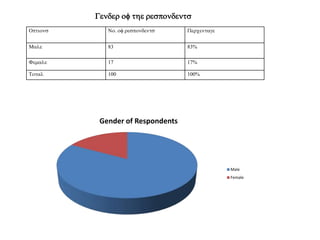
Gender of Respondents
Male
Female
Options No. of respondents ercentage
Male 83 83%
Female 17 17%
Total 100 100%
Gender of the respondents
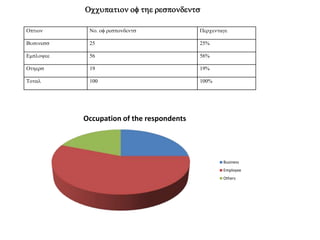
Option No. of respondents ercentage
Business 25 25%
Employee 56 56%
Others 19 19%
Total 100 100%
Occupation of the respondents
Business
Employee
Others
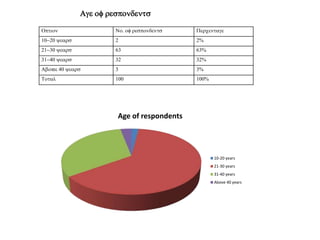
Option No. of respondents ercentage
10-20 years 2 2%
21-30 years 63 63%
31-40 years 32 32%
Above 40 years 3 3%
Total 100 100%
Age of respondents
Age of respondents
10-20 years
21-30 years
31-40 years
Above 40 years
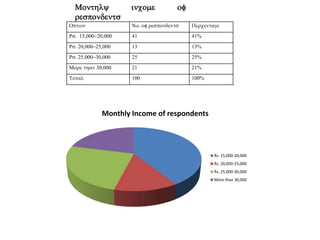
Option No. of respondents ercentage
Rs. 15,000-20,000 41 41%
Rs. 20,000-25,000 13 13%
Rs. 25,000-30,000 25 25%
More than 30,000 21 21%
Total 100 100%
Monthly income of
respondents
Monthly Income of respondents
Rs. 15,000-20,000
Rs. 20,000-25,000
Rs. 25,000-30,000
More than 30,000
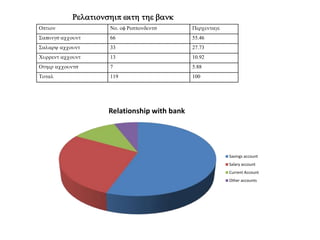
Option No. of Respondents ercentage
Savings account 66 55.46
Salary account 33 27.73
Current account 13 10.92
Other accounts 7 5.88
Total 119 100
Relationship with the bank
Relationship with bank
Savings account
Salary account
Current Account
Other accounts
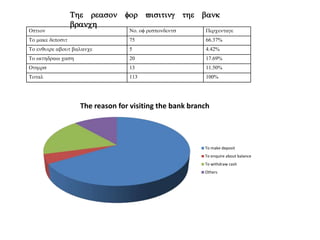
Option No. of respondents ercentage
To make deposit 75 66.37%
To enquire about balance 5 4.42%
To withdraw cash 20 17.69%
Others 13 11.50%
Total 113 100%
The reason for visiting the bank
branch
The reason for visiting the bank branch
To make deposit
To enquire about balance
To withdraw cash
Others
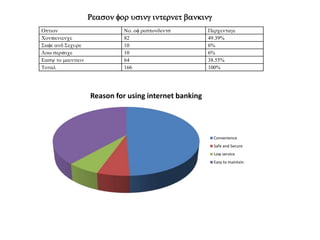
Option No. of respondents ercentage
Convenience 82 49.39%
Safe and Secure 10 6%
Low service 10 6%
Easy to maintain 64 38.55%
Total 166 100%
Reason for using internet banking
Convenience
Safe and Secure
Low service
Easy to maintain
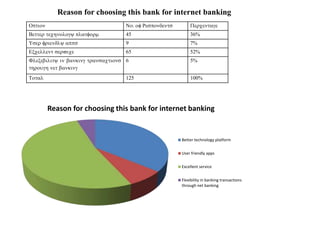
Option No. of Respondents ercentage
Better technology platform 45 36%
User friendly apps 9 7%
Excellent service 65 52%
Flexibility in banking transactions
through net banking
6 5%
Total 125 100%
Reason for choosing this bank for internet banking
Better technology platform
User friendly apps
Excellent service
Flexibility in banking transactions
through net banking
Option No. of Respondents ercentage
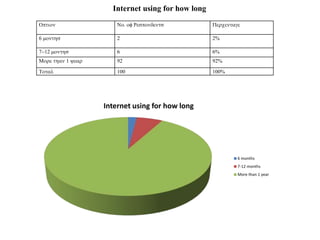
6 months 2 2%
7-12 months 6 6%
More than 1 year 92 92%
Total 100 100%
Internet using for how long
6 months
7-12 months
More than 1 year
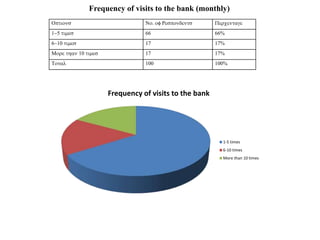
Options No. of Respondents ercentage
1-5 times 66 66%
6-10 times 17 17%
More than 10 times 17 17%
Total 100 100%
Frequency of visits to the bank (monthly)
Frequency of visits to the bank
1-5 times
6-10 times
More than 10 times
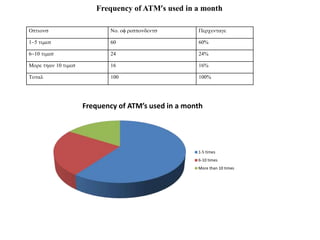
Options No. of respondents ercentage
1-5 times 60 60%
6-10 times 24 24%
More than 10 times 16 16%
Total 100 100%
Frequency of ATM’s used in a month
1-5 times
6-10 times
More than 10 times
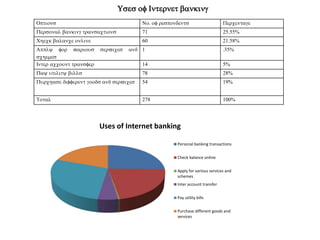
Options No. of respondents ercentage
ersonal banking transactions 71 25.55%
Check balance online 60 21.58%
Apply for various services and
schemes
1 .35%
Inter account transfer 14 5%
ay utility bills 78 28%
urchase different goods and services 54 19%
Total 278 100%
Uses of Internet banking
Personal banking transactions
Check balance online
Apply for various services and
schemes
Inter account transfer
Pay utility bills
Purchase different goods and
services
Findings of the study:
•It is identified that only employees are using more internet banking as
compared to the other people.
•In gender wise category mostly the users are males. The usage of internet
banking in females is very less.
•It is identifies that only people in the category of 21-40 are using
internet banking. Below 20 and above 40 age group are using less internet
banking service.
•The people who are drawing the salary between rupees 15,000-20,000 were
more responsive to this study.
•It is evident that most of the respondents choose internet banking
because of its convenience and it is easy to maintain internet banking
transactions.
•As most of the respondents are employees so their frequency of visiting
the bank is minimal.
•opular uses of internet banking among customers are personal banking
Suggestions and Conclusions:
•The bank should concentrate on creating awareness among business holders and
students.
•The involvement of female customers should be improved by the bank.
•The transactions relating to senior citizens like pension and retirement benefits should be
provided through e-banking.
•The bank should encourage their customers to use e-banking as a alternative way of
banking as compared to traditional banking.
•Activities should be undertaken by the bank to attract new customers towards e-banking
by providing attractive offers and schemes to new and current customers.
•The bank can offer customise e-banking services to the customers according to their
spending patterns and needs.
• Bank should enable high class IT efficiency.
•To make customers realise that they are in full control of their account and its related
transactions.
Bibliography
•Laukkan, T., Sinkkonen, S. and Laukkanen, .(2009, p. 111),
Communication strategies to overcome functional and
psychological resistance to internet banking, International
Journal Information Management, Vol 29:2, pp.111-118
•Balachander, K.G: Electronic Banking in Malaysia: A Note on
Evolution of services and consumer reactions, Multimedia
University, Malaysia at http/www.mmu.edu.my
•The Impact of E-banking on Customer Satisfaction by Ahmad
bello Dogarawa, Department of Accounting, Ahmadu Bello
University Zaria Nigeria (The Impact of E-banking on Custo.)
•Avasthi GM, Information Technology in Banking: Challenge
for Regulators rajnan Vol. 29, No. 4, pp. 3-17.
•Wenninger, J. , The Emerging Role of Banks in E-Commerce,
Current Issues in Economics and Finance, Vol. 6 No. 3, Federal
Reserve Bank of New York. ( March 2000)
•.hdfcbank.com/aboutus/default.htm

E-banking: Uses and perception.

  • 1.
    “E-BANKING: USES AND PERCEPTIONAMONG CUSTOMERS OF HDFC BANK” SCHOOL OF BUSINESS FACULTY OF MANAGEMENT SHRI MATA VAISHNO DEVI UNIVERSITY MANZOOR SHAIR 14MMB013 MBA-2015-16
  • 2.
    Introduction to E-banking •E-bankingrefers to electronic banking. E-banking is also called as "Virtual Banking" or "Online Banking. •Under e-banking, the banking services are delivered by way of a Computer-Controlled System. •E-banking provides ease and flexibility to the customers to perform his banking transaction without standing in the queues in the bank. •The main USs of e-banking are: •Control • Speed •Ease of use •Savings.
  • 3.
    Popular services coveredunder E-banking •Automated teller machines •Credit Cards •Debit Cards •Smart Cards •Electronic fund transfer system •Mobile banking •Internet banking •Telephone banking
  • 4.
    Research methodology andData collection: •The methods adopted for studying the objectives of the project was surveying the account holders of HDFC bank. •Simple random sampling was used, with a sample size of 100 customers. •Survey with the help of structured questionnaire was used to collect primary data, secondary data was collected from magazines, internet and previous research findings.
  • 5.
    Gender of Respondents Male Female OptionsNo. of respondents ercentage Male 83 83% Female 17 17% Total 100 100% Gender of the respondents
  • 6.
    Option No. ofrespondents ercentage Business 25 25% Employee 56 56% Others 19 19% Total 100 100% Occupation of the respondents Occupation of the respondents Business Employee Others
  • 7.
    Option No. ofrespondents ercentage 10-20 years 2 2% 21-30 years 63 63% 31-40 years 32 32% Above 40 years 3 3% Total 100 100% Age of respondents Age of respondents 10-20 years 21-30 years 31-40 years Above 40 years
  • 8.
    Option No. ofrespondents ercentage Rs. 15,000-20,000 41 41% Rs. 20,000-25,000 13 13% Rs. 25,000-30,000 25 25% More than 30,000 21 21% Total 100 100% Monthly income of respondents Monthly Income of respondents Rs. 15,000-20,000 Rs. 20,000-25,000 Rs. 25,000-30,000 More than 30,000
  • 9.
    Option No. ofRespondents ercentage Savings account 66 55.46 Salary account 33 27.73 Current account 13 10.92 Other accounts 7 5.88 Total 119 100 Relationship with the bank Relationship with bank Savings account Salary account Current Account Other accounts
  • 10.
    Option No. ofrespondents ercentage To make deposit 75 66.37% To enquire about balance 5 4.42% To withdraw cash 20 17.69% Others 13 11.50% Total 113 100% The reason for visiting the bank branch The reason for visiting the bank branch To make deposit To enquire about balance To withdraw cash Others
  • 11.
    Option No. ofrespondents ercentage Convenience 82 49.39% Safe and Secure 10 6% Low service 10 6% Easy to maintain 64 38.55% Total 166 100% Reason for using internet banking Reason for using internet banking Convenience Safe and Secure Low service Easy to maintain
  • 12.
    Option No. ofRespondents ercentage Better technology platform 45 36% User friendly apps 9 7% Excellent service 65 52% Flexibility in banking transactions through net banking 6 5% Total 125 100% Reason for choosing this bank for internet banking Reason for choosing this bank for internet banking Better technology platform User friendly apps Excellent service Flexibility in banking transactions through net banking
  • 13.
    Option No. ofRespondents ercentage 6 months 2 2% 7-12 months 6 6% More than 1 year 92 92% Total 100 100% Internet using for how long Internet using for how long 6 months 7-12 months More than 1 year
  • 14.
    Options No. ofRespondents ercentage 1-5 times 66 66% 6-10 times 17 17% More than 10 times 17 17% Total 100 100% Frequency of visits to the bank (monthly) Frequency of visits to the bank 1-5 times 6-10 times More than 10 times
  • 15.
    Options No. ofrespondents ercentage 1-5 times 60 60% 6-10 times 24 24% More than 10 times 16 16% Total 100 100% Frequency of ATM’s used in a month Frequency of ATM’s used in a month 1-5 times 6-10 times More than 10 times
  • 16.
    Options No. ofrespondents ercentage ersonal banking transactions 71 25.55% Check balance online 60 21.58% Apply for various services and schemes 1 .35% Inter account transfer 14 5% ay utility bills 78 28% urchase different goods and services 54 19% Total 278 100% Uses of Internet banking Uses of Internet banking Personal banking transactions Check balance online Apply for various services and schemes Inter account transfer Pay utility bills Purchase different goods and services
  • 17.
    Findings of thestudy: •It is identified that only employees are using more internet banking as compared to the other people. •In gender wise category mostly the users are males. The usage of internet banking in females is very less. •It is identifies that only people in the category of 21-40 are using internet banking. Below 20 and above 40 age group are using less internet banking service. •The people who are drawing the salary between rupees 15,000-20,000 were more responsive to this study. •It is evident that most of the respondents choose internet banking because of its convenience and it is easy to maintain internet banking transactions. •As most of the respondents are employees so their frequency of visiting the bank is minimal. •opular uses of internet banking among customers are personal banking
  • 18.
    Suggestions and Conclusions: •Thebank should concentrate on creating awareness among business holders and students. •The involvement of female customers should be improved by the bank. •The transactions relating to senior citizens like pension and retirement benefits should be provided through e-banking. •The bank should encourage their customers to use e-banking as a alternative way of banking as compared to traditional banking. •Activities should be undertaken by the bank to attract new customers towards e-banking by providing attractive offers and schemes to new and current customers. •The bank can offer customise e-banking services to the customers according to their spending patterns and needs. • Bank should enable high class IT efficiency. •To make customers realise that they are in full control of their account and its related transactions.
  • 19.
    Bibliography •Laukkan, T., Sinkkonen,S. and Laukkanen, .(2009, p. 111), Communication strategies to overcome functional and psychological resistance to internet banking, International Journal Information Management, Vol 29:2, pp.111-118 •Balachander, K.G: Electronic Banking in Malaysia: A Note on Evolution of services and consumer reactions, Multimedia University, Malaysia at http/www.mmu.edu.my •The Impact of E-banking on Customer Satisfaction by Ahmad bello Dogarawa, Department of Accounting, Ahmadu Bello University Zaria Nigeria (The Impact of E-banking on Custo.) •Avasthi GM, Information Technology in Banking: Challenge for Regulators rajnan Vol. 29, No. 4, pp. 3-17. •Wenninger, J. , The Emerging Role of Banks in E-Commerce, Current Issues in Economics and Finance, Vol. 6 No. 3, Federal Reserve Bank of New York. ( March 2000) •.hdfcbank.com/aboutus/default.htm