EASTER
in Bulgaria
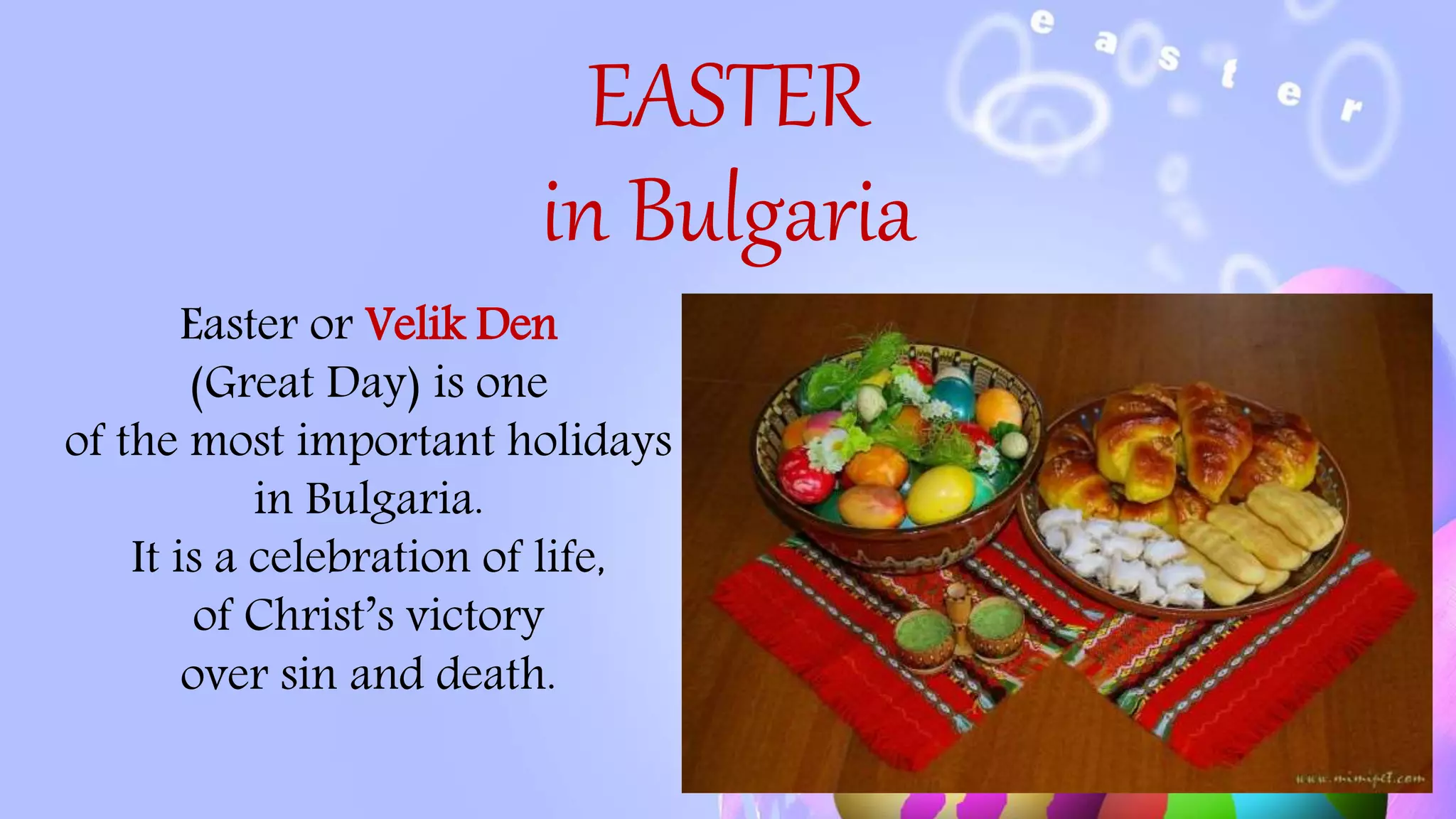
Easter or Velik Den
(Great Day) is one
of the most important holidays
in Bulgaria.
It is a celebration of life,
of Christ’s victory
over sin and death.
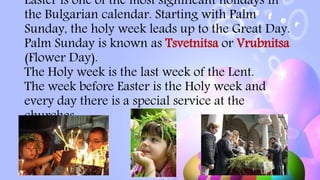
Easter is one of the most significant holidays in
the Bulgarian calendar. Starting with Palm
Sunday, the holy week leads up to the Great Day.
Palm Sunday is known as Tsvetnitsa or Vrubnitsa
(Flower Day).
The Holy week is the last week of the Lent.
The week before Easter is the Holy week and
every day there is a special service at the
churches.
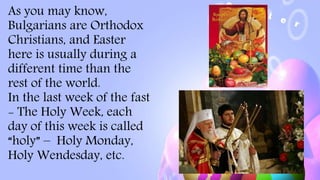
As you may know,
Bulgarians are Orthodox
Christians, and Easter
here is usually during a
different time than the
rest of the world.
In the last week of the fast
- The Holy Week, each
day of this week is called
“holy” – Holy Monday,
Holy Wendesday, etc.
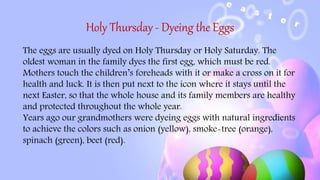
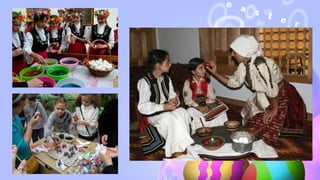
Holy Thursday - Dyeing the Eggs
The eggs are usually dyed on Holy Thursday or Holy Saturday. The
oldest woman in the family dyes the first egg, which must be red.
Mothers touch the children’s foreheads with it or make a cross on it for
health and luck. It is then put next to the icon where it stays until the
next Easter, so that the whole house and its family members are healthy
and protected throughout the whole year.
Years ago our grandmothers were dyeing eggs with natural ingredients
to achieve the colors such as onion (yellow), smoke-tree (orange),
spinach (green), beet (red).
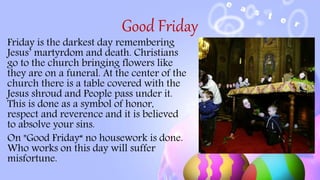
Good Friday
Friday is the darkest day remembering
Jesus’ martyrdom and death. Christians
go to the church bringing flowers like
they are on a funeral. At the center of the
church there is a table covered with the
Jesus shroud and People pass under it.
This is done as a symbol of honor,
respect and reverence and it is believed
to absolve your sins.
On "Good Friday“ no housework is done.
Who works on this day will suffer
misfortune.
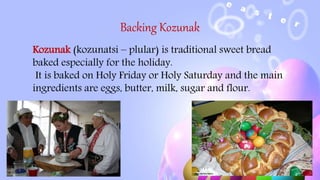
Backing Kozunak
Kozunak (kozunatsi – plular) is traditional sweet bread
baked especially for the holiday.
It is baked on Holy Friday or Holy Saturday and the main
ingredients are eggs, butter, milk, sugar and flour.
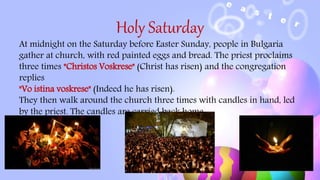
Holy Saturday
At midnight on the Saturday before Easter Sunday, people in Bulgaria
gather at church, with red painted eggs and bread. The priest proclaims
three times "Christos Voskrese" (Christ has risen) and the congregation
replies
"Vo istina voskrese" (Indeed he has risen).
They then walk around the church three times with candles in hand, led
by the priest. The candles are carried back home.
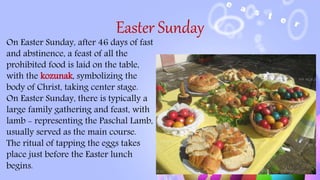
Easter Sunday
On Easter Sunday, after 46 days of fast
and abstinence, a feast of all the
prohibited food is laid on the table,
with the kozunak, symbolizing the
body of Christ, taking center stage.
On Easter Sunday, there is typically a
large family gathering and feast, with
lamb - representing the Paschal Lamb,
usually served as the main course.
The ritual of tapping the eggs takes
place just before the Easter lunch
begins.
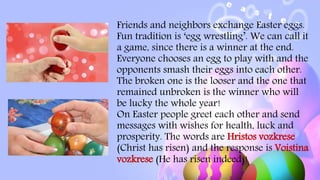
Friends and neighbors exchange Easter eggs.
Fun tradition is ‘egg wrestling’. We can call it
a game, since there is a winner at the end.
Everyone chooses an egg to play with and the
opponents smash their eggs into each other.
The broken one is the looser and the one that
remained unbroken is the winner who will
be lucky the whole year!
On Easter people greet each other and send
messages with wishes for health, luck and
prosperity. The words are Hristos vozkrese
(Christ has risen) and the response is Voistina
vozkrese (He has risen indeed)!
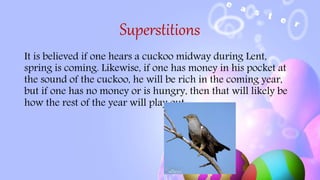
Superstitions
It is believed if one hears a cuckoo midway during Lent,
spring is coming. Likewise, if one has money in his pocket at
the sound of the cuckoo, he will be rich in the coming year,
but if one has no money or is hungry, then that will likely be
how the rest of the year will play out.
This project has been funded with support from the European
Commission.
This publication [communication] reflects the views only of
the author, and the Commission cannot be held responsible
for any use which may be made of the information contained
therein.
March 2017

Easter tradition

  • 1.
    EASTER in Bulgaria Easter orVelik Den (Great Day) is one of the most important holidays in Bulgaria. It is a celebration of life, of Christ’s victory over sin and death.
  • 2.
    Easter is oneof the most significant holidays in the Bulgarian calendar. Starting with Palm Sunday, the holy week leads up to the Great Day. Palm Sunday is known as Tsvetnitsa or Vrubnitsa (Flower Day). The Holy week is the last week of the Lent. The week before Easter is the Holy week and every day there is a special service at the churches.
  • 3.
    As you mayknow, Bulgarians are Orthodox Christians, and Easter here is usually during a different time than the rest of the world. In the last week of the fast - The Holy Week, each day of this week is called “holy” – Holy Monday, Holy Wendesday, etc.
  • 4.
    Holy Thursday -Dyeing the Eggs The eggs are usually dyed on Holy Thursday or Holy Saturday. The oldest woman in the family dyes the first egg, which must be red. Mothers touch the children’s foreheads with it or make a cross on it for health and luck. It is then put next to the icon where it stays until the next Easter, so that the whole house and its family members are healthy and protected throughout the whole year. Years ago our grandmothers were dyeing eggs with natural ingredients to achieve the colors such as onion (yellow), smoke-tree (orange), spinach (green), beet (red).
  • 6.
    Good Friday Friday isthe darkest day remembering Jesus’ martyrdom and death. Christians go to the church bringing flowers like they are on a funeral. At the center of the church there is a table covered with the Jesus shroud and People pass under it. This is done as a symbol of honor, respect and reverence and it is believed to absolve your sins. On "Good Friday“ no housework is done. Who works on this day will suffer misfortune.
  • 7.
    Backing Kozunak Kozunak (kozunatsi– plular) is traditional sweet bread baked especially for the holiday. It is baked on Holy Friday or Holy Saturday and the main ingredients are eggs, butter, milk, sugar and flour.
  • 8.
    Holy Saturday At midnighton the Saturday before Easter Sunday, people in Bulgaria gather at church, with red painted eggs and bread. The priest proclaims three times "Christos Voskrese" (Christ has risen) and the congregation replies "Vo istina voskrese" (Indeed he has risen). They then walk around the church three times with candles in hand, led by the priest. The candles are carried back home.
  • 9.
    Easter Sunday On EasterSunday, after 46 days of fast and abstinence, a feast of all the prohibited food is laid on the table, with the kozunak, symbolizing the body of Christ, taking center stage. On Easter Sunday, there is typically a large family gathering and feast, with lamb - representing the Paschal Lamb, usually served as the main course. The ritual of tapping the eggs takes place just before the Easter lunch begins.
  • 10.
    Friends and neighborsexchange Easter eggs. Fun tradition is ‘egg wrestling’. We can call it a game, since there is a winner at the end. Everyone chooses an egg to play with and the opponents smash their eggs into each other. The broken one is the looser and the one that remained unbroken is the winner who will be lucky the whole year! On Easter people greet each other and send messages with wishes for health, luck and prosperity. The words are Hristos vozkrese (Christ has risen) and the response is Voistina vozkrese (He has risen indeed)!
  • 11.
    Superstitions It is believedif one hears a cuckoo midway during Lent, spring is coming. Likewise, if one has money in his pocket at the sound of the cuckoo, he will be rich in the coming year, but if one has no money or is hungry, then that will likely be how the rest of the year will play out.
  • 13.
    This project hasbeen funded with support from the European Commission. This publication [communication] reflects the views only of the author, and the Commission cannot be held responsible for any use which may be made of the information contained therein. March 2017