EARTHQUAKES
Earth Science
Ms. Kreuziger
INTRODUCTION
Today we will be talking about earthquakes, the types of faults and their
wave types.
The standards:
HS-ESS1-5. Evaluate evidence of the past and current movements of
continental and oceanic crust and the theory of plate tectonics to explain
the ages of crustal rocks
HS-ESS2-1. Develop a model to illustrate how Earth’s internal and surface
processes operate at different spatial and temporal scales to form
continental and ocean-floor features
JUST CURIOUS
Describe a time when you felt an
earthquake? If you haven't what do you
imagine it to be like?
FAULTS
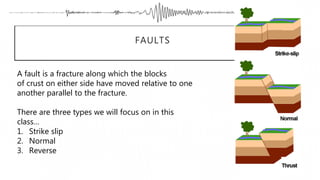
A fault is a fracture along which the blocks
of crust on either side have moved relative to one
another parallel to the fracture.
There are three types we will focus on in this
class…
1. Strike slip
2. Normal
3. Reverse
STRIKE-SLIP
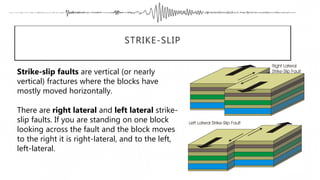
Strike-slip faults are vertical (or nearly
vertical) fractures where the blocks have
mostly moved horizontally.
There are right lateral and left lateral strike-
slip faults. If you are standing on one block
looking across the fault and the block moves
to the right it is right-lateral, and to the left,
left-lateral.
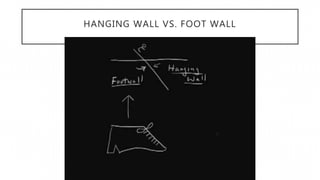
HANGING WALL VS. FOOT WALL
NORMAL
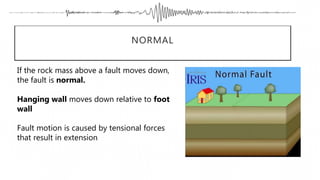
If the rock mass above a fault moves down,
the fault is normal.
Hanging wall moves down relative to foot
wall
Fault motion is caused by tensional forces
that result in extension
REVERSE
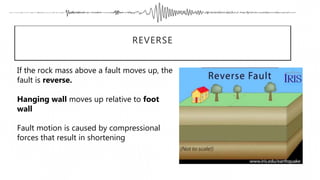
If the rock mass above a fault moves up, the
fault is reverse.
Hanging wall moves up relative to foot
wall
Fault motion is caused by compressional
forces that result in shortening
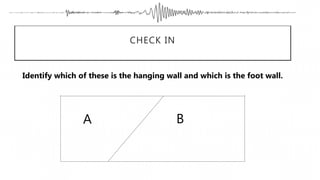
CHECK IN
Identify which of these is the hanging wall and which is the foot wall.
A B
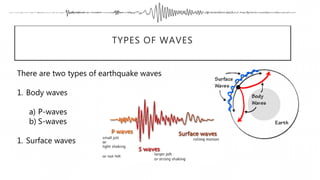
TYPES OF WAVES
There are two types of earthquake waves
1. Body waves
a) P-waves
b) S-waves
1. Surface waves
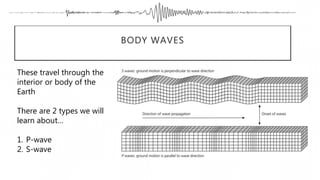
BODY WAVES
These travel through the
interior or body of the
Earth
There are 2 types we will
learn about…
1. P-wave
2. S-wave
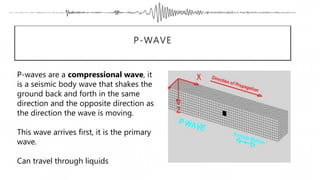
P-WAVE
P-waves are a compressional wave, it
is a seismic body wave that shakes the
ground back and forth in the same
direction and the opposite direction as
the direction the wave is moving.
This wave arrives first, it is the primary
wave.
Can travel through liquids
S-WAVE
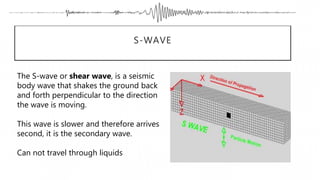
The S-wave or shear wave, is a seismic
body wave that shakes the ground back
and forth perpendicular to the direction
the wave is moving.
This wave is slower and therefore arrives
second, it is the secondary wave.
Can not travel through liquids
CHECK IN
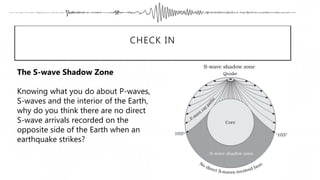
The S-wave Shadow Zone
Knowing what you do about P-waves,
S-waves and the interior of the Earth,
why do you think there are no direct
S-wave arrivals recorded on the
opposite side of the Earth when an
earthquake strikes?
SURFACE WAVES
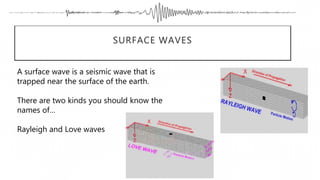
A surface wave is a seismic wave that is
trapped near the surface of the earth.
There are two kinds you should know the
names of…
Rayleigh and Love waves
LET’S PRACTICE!
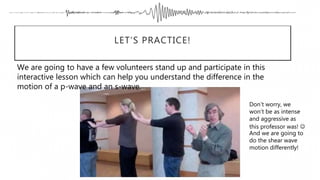
We are going to have a few volunteers stand up and participate in this
interactive lesson which can help you understand the difference in the
motion of a p-wave and an s-wave.
Don’t worry, we
won’t be as intense
and aggressive as
this professor was! 
And we are going to
do the shear wave
motion differently!

Earthquakes

  • 1.
  • 2.
    INTRODUCTION Today we willbe talking about earthquakes, the types of faults and their wave types. The standards: HS-ESS1-5. Evaluate evidence of the past and current movements of continental and oceanic crust and the theory of plate tectonics to explain the ages of crustal rocks HS-ESS2-1. Develop a model to illustrate how Earth’s internal and surface processes operate at different spatial and temporal scales to form continental and ocean-floor features
  • 3.
    JUST CURIOUS Describe atime when you felt an earthquake? If you haven't what do you imagine it to be like?
  • 4.
    FAULTS A fault isa fracture along which the blocks of crust on either side have moved relative to one another parallel to the fracture. There are three types we will focus on in this class… 1. Strike slip 2. Normal 3. Reverse
  • 5.
    STRIKE-SLIP Strike-slip faults arevertical (or nearly vertical) fractures where the blocks have mostly moved horizontally. There are right lateral and left lateral strike- slip faults. If you are standing on one block looking across the fault and the block moves to the right it is right-lateral, and to the left, left-lateral.
  • 6.
  • 7.
    NORMAL If the rockmass above a fault moves down, the fault is normal. Hanging wall moves down relative to foot wall Fault motion is caused by tensional forces that result in extension
  • 8.
    REVERSE If the rockmass above a fault moves up, the fault is reverse. Hanging wall moves up relative to foot wall Fault motion is caused by compressional forces that result in shortening
  • 9.
    CHECK IN Identify whichof these is the hanging wall and which is the foot wall. A B
  • 10.
    TYPES OF WAVES Thereare two types of earthquake waves 1. Body waves a) P-waves b) S-waves 1. Surface waves
  • 11.
    BODY WAVES These travelthrough the interior or body of the Earth There are 2 types we will learn about… 1. P-wave 2. S-wave
  • 12.
    P-WAVE P-waves are acompressional wave, it is a seismic body wave that shakes the ground back and forth in the same direction and the opposite direction as the direction the wave is moving. This wave arrives first, it is the primary wave. Can travel through liquids
  • 13.
    S-WAVE The S-wave orshear wave, is a seismic body wave that shakes the ground back and forth perpendicular to the direction the wave is moving. This wave is slower and therefore arrives second, it is the secondary wave. Can not travel through liquids
  • 14.
    CHECK IN The S-waveShadow Zone Knowing what you do about P-waves, S-waves and the interior of the Earth, why do you think there are no direct S-wave arrivals recorded on the opposite side of the Earth when an earthquake strikes?
  • 15.
    SURFACE WAVES A surfacewave is a seismic wave that is trapped near the surface of the earth. There are two kinds you should know the names of… Rayleigh and Love waves
  • 16.
    LET’S PRACTICE! We aregoing to have a few volunteers stand up and participate in this interactive lesson which can help you understand the difference in the motion of a p-wave and an s-wave. Don’t worry, we won’t be as intense and aggressive as this professor was!  And we are going to do the shear wave motion differently!