Lesson 2: Earthquakes
When an earthquake occurs, a lot of energy is given off. This energy
travels through the Earth in the form of waves called seismic waves.
There are two kinds of seismic waves.
• Body waves are seismic waves that travel through the inside of
Earth to the surface.
• Surface waves are seismic waves that travel through the top part
of Earth’s crust.
There are two kinds of BODY WAVES: P waves and S
waves
Lesson 2: Earthquakes
There are two kinds of BODY WAVES: P waves and S
waves
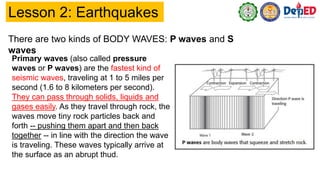
Primary waves (also called pressure
waves or P waves) are the fastest kind of
seismic waves, traveling at 1 to 5 miles per
second (1.6 to 8 kilometers per second).
They can pass through solids, liquids and
gases easily. As they travel through rock, the
waves move tiny rock particles back and
forth -- pushing them apart and then back
together -- in line with the direction the wave
is traveling. These waves typically arrive at
the surface as an abrupt thud.
Lesson 2: Earthquakes
There are two kinds of BODY WAVES: P waves and S
waves
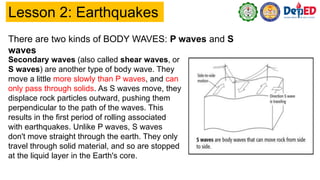
Secondary waves (also called shear waves, or
S waves) are another type of body wave. They
move a little more slowly than P waves, and can
only pass through solids. As S waves move, they
displace rock particles outward, pushing them
perpendicular to the path of the waves. This
results in the first period of rolling associated
with earthquakes. Unlike P waves, S waves
don't move straight through the earth. They only
travel through solid material, and so are stopped
at the liquid layer in the Earth's core.
Lesson 2: Earthquakes
There are two kinds of Seismic WAVES: Body waves and
Surface waves
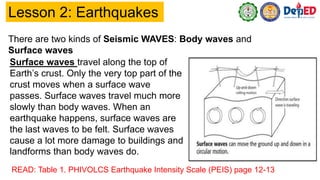
Surface waves travel along the top of
Earth’s crust. Only the very top part of the
crust moves when a surface wave
passes. Surface waves travel much more
slowly than body waves. When an
earthquake happens, surface waves are
the last waves to be felt. Surface waves
cause a lot more damage to buildings and
landforms than body waves do.
READ: Table 1. PHIVOLCS Earthquake Intensity Scale (PEIS) page 12-13
Lesson 2: Earthquakes
There are two kinds of Surface
waves:
• L wave (Love wave)
• R wave (Rayleigh wave)
READ: Table 1. PHIVOLCS Earthquake Intensity Scale (PEIS) page 12-13

Earthquake.pptx

  • 1.
    Lesson 2: Earthquakes Whenan earthquake occurs, a lot of energy is given off. This energy travels through the Earth in the form of waves called seismic waves. There are two kinds of seismic waves. • Body waves are seismic waves that travel through the inside of Earth to the surface. • Surface waves are seismic waves that travel through the top part of Earth’s crust. There are two kinds of BODY WAVES: P waves and S waves
  • 2.
    Lesson 2: Earthquakes Thereare two kinds of BODY WAVES: P waves and S waves Primary waves (also called pressure waves or P waves) are the fastest kind of seismic waves, traveling at 1 to 5 miles per second (1.6 to 8 kilometers per second). They can pass through solids, liquids and gases easily. As they travel through rock, the waves move tiny rock particles back and forth -- pushing them apart and then back together -- in line with the direction the wave is traveling. These waves typically arrive at the surface as an abrupt thud.
  • 3.
    Lesson 2: Earthquakes Thereare two kinds of BODY WAVES: P waves and S waves Secondary waves (also called shear waves, or S waves) are another type of body wave. They move a little more slowly than P waves, and can only pass through solids. As S waves move, they displace rock particles outward, pushing them perpendicular to the path of the waves. This results in the first period of rolling associated with earthquakes. Unlike P waves, S waves don't move straight through the earth. They only travel through solid material, and so are stopped at the liquid layer in the Earth's core.
  • 4.
    Lesson 2: Earthquakes Thereare two kinds of Seismic WAVES: Body waves and Surface waves Surface waves travel along the top of Earth’s crust. Only the very top part of the crust moves when a surface wave passes. Surface waves travel much more slowly than body waves. When an earthquake happens, surface waves are the last waves to be felt. Surface waves cause a lot more damage to buildings and landforms than body waves do. READ: Table 1. PHIVOLCS Earthquake Intensity Scale (PEIS) page 12-13
  • 5.
    Lesson 2: Earthquakes Thereare two kinds of Surface waves: • L wave (Love wave) • R wave (Rayleigh wave) READ: Table 1. PHIVOLCS Earthquake Intensity Scale (PEIS) page 12-13