By: Lauren Showers
EDU 290 Tu/Th 11:00am


EARTHQUAKES
WHAT IS AN EARTHQUAKE?

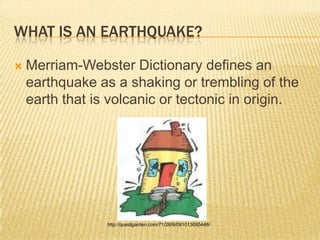
   Merriam-Webster Dictionary defines an
    earthquake as a shaking or trembling of the
    earth that is volcanic or tectonic in origin.


                 http://questgarden.com/71/26/9/081013095448/
HOW DO EARTHQUAKES OCCUR?

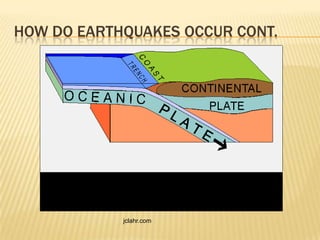
 Earthquakes occur when two blocks of land
  suddenly slip past each other along a fault
  line(USGS).
 The location in which the earthquake starts is
  called the Hypocenter. The location directly
  above the hypocenter on the earth’s surface
  is called the Epicenter (USGS).
HOW DO EARTHQUAKES OCCUR CONT.


            jclahr.com
WHERE DO EARTHQUAKES OCCUR

Earthquakes occur along fault lines. There are
three major types of fault lines.

               Strike-slip Faults
                Normal Faults

                Reverse Faults
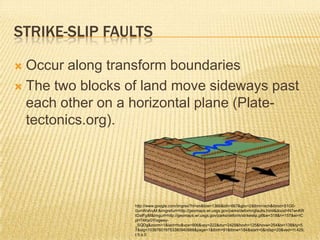
STRIKE-SLIP FAULTS

 Occur along transform boundaries
 The two blocks of land move sideways past
  each other on a horizontal plane (Plate-
  tectonics.org).


                  http://www.google.com/imgres?hl=en&biw=1366&bih=667&gbv=2&tbm=isch&tbnid=S1G0-
                  0umWsfvyM:&imgrefurl=http://geomaps.wr.usgs.gov/parks/deform/gfaults.html&docid=N7wnKR
                  tOalFgiM&imgurl=http://geomaps.wr.usgs.gov/parks/deform/strikeslip.gif&w=318&h=157&ei=IC
                  pHT4KsGYixgwey-
                  _SQDg&zoom=1&iact=hc&vpx=906&vpy=222&dur=2429&hovh=125&hovw=254&tx=138&ty=5
                  7&sig=103976019753380940988&page=1&tbnh=91&tbnw=184&start=0&ndsp=20&ved=1t:429,
                  r:5,s:0
STRIKE-SLIP FAULTS CONT.

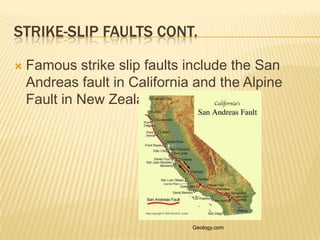
   Famous strike slip faults include the San
    Andreas fault in California and the Alpine
    Fault in New Zealand.


                               Geology.com
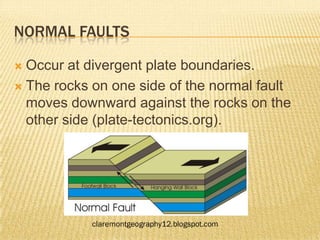
NORMAL FAULTS

 Occur at divergent plate boundaries.
 The rocks on one side of the normal fault
  moves downward against the rocks on the
  other side (plate-tectonics.org).
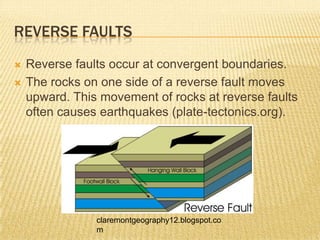
REVERSE FAULTS
   Reverse faults occur at convergent boundaries.
   The rocks on one side of a reverse fault moves
    upward. This movement of rocks at reverse faults
    often causes earthquakes (plate-tectonics.org).


                claremontgeography12.blogspot.co
                m
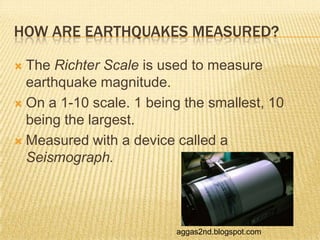
HOW ARE EARTHQUAKES MEASURED?

 The Richter Scale is used to measure
  earthquake magnitude.
 On a 1-10 scale. 1 being the smallest, 10
  being the largest.
 Measured with a device called a
  Seismograph.


                         aggas2nd.blogspot.com
TYPES OF WAVES

 There are two types of waves associated
  with earthquakes.
 P-Waves

 S-waves
TYPES OF WAVES CONT.

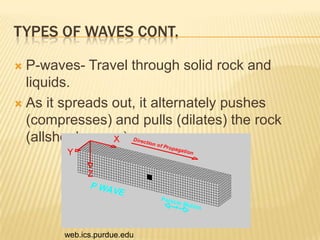
 P-waves- Travel through solid rock and
  liquids.
 As it spreads out, it alternately pushes
  (compresses) and pulls (dilates) the rock
  (allshookup.org).


        web.ics.purdue.edu
TYPES OF WAVES CONT.
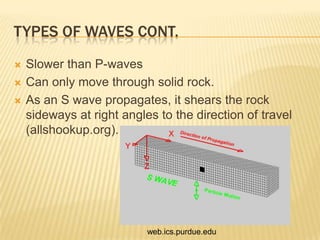
   Slower than P-waves
   Can only move through solid rock.
   As an S wave propagates, it shears the rock
    sideways at right angles to the direction of travel
    (allshookup.org).


                           web.ics.purdue.edu
AFTERSHOCKS

 Smaller earthquakes that occur after the
  main earthquake.
 Aftershocks can last for weeks or months
  after an earthquake.
 The larger the main earthquake, the longer
  aftershocks will continue to occur(usgs.gov).
PROTECTING YOURSELF IN AN EARTHQUAKE

   “Drop, cover, and hold on!”
   Drop down to your knees
   Cover your head and neck
   Hold on to a sturdy structure (if available).
REFERENCES
   http://www.merriam-webster.com/dictionary/earthquake
   http://earthquake.usgs.gov/learn/kids/eqscience.php
   http://www.plate-tectonics.org/earthquakes/types-of-
    faults.html
   http://allshookup.org/quakes/wavetype.htm
   http://earthquakecountry.info/dropcoverholdon/

Earthquakes

  • 1.
    By: Lauren Showers EDU290 Tu/Th 11:00am EARTHQUAKES
  • 2.
    WHAT IS ANEARTHQUAKE?  Merriam-Webster Dictionary defines an earthquake as a shaking or trembling of the earth that is volcanic or tectonic in origin. http://questgarden.com/71/26/9/081013095448/
  • 3.
    HOW DO EARTHQUAKESOCCUR?  Earthquakes occur when two blocks of land suddenly slip past each other along a fault line(USGS).  The location in which the earthquake starts is called the Hypocenter. The location directly above the hypocenter on the earth’s surface is called the Epicenter (USGS).
  • 4.
    HOW DO EARTHQUAKESOCCUR CONT. jclahr.com
  • 5.
    WHERE DO EARTHQUAKESOCCUR Earthquakes occur along fault lines. There are three major types of fault lines.  Strike-slip Faults  Normal Faults  Reverse Faults
  • 6.
    STRIKE-SLIP FAULTS  Occuralong transform boundaries  The two blocks of land move sideways past each other on a horizontal plane (Plate- tectonics.org). http://www.google.com/imgres?hl=en&biw=1366&bih=667&gbv=2&tbm=isch&tbnid=S1G0- 0umWsfvyM:&imgrefurl=http://geomaps.wr.usgs.gov/parks/deform/gfaults.html&docid=N7wnKR tOalFgiM&imgurl=http://geomaps.wr.usgs.gov/parks/deform/strikeslip.gif&w=318&h=157&ei=IC pHT4KsGYixgwey- _SQDg&zoom=1&iact=hc&vpx=906&vpy=222&dur=2429&hovh=125&hovw=254&tx=138&ty=5 7&sig=103976019753380940988&page=1&tbnh=91&tbnw=184&start=0&ndsp=20&ved=1t:429, r:5,s:0
  • 7.
    STRIKE-SLIP FAULTS CONT.  Famous strike slip faults include the San Andreas fault in California and the Alpine Fault in New Zealand. Geology.com
  • 8.
    NORMAL FAULTS  Occurat divergent plate boundaries.  The rocks on one side of the normal fault moves downward against the rocks on the other side (plate-tectonics.org).
  • 9.
    REVERSE FAULTS  Reverse faults occur at convergent boundaries.  The rocks on one side of a reverse fault moves upward. This movement of rocks at reverse faults often causes earthquakes (plate-tectonics.org). claremontgeography12.blogspot.co m
  • 10.
    HOW ARE EARTHQUAKESMEASURED?  The Richter Scale is used to measure earthquake magnitude.  On a 1-10 scale. 1 being the smallest, 10 being the largest.  Measured with a device called a Seismograph. aggas2nd.blogspot.com
  • 11.
    TYPES OF WAVES There are two types of waves associated with earthquakes.  P-Waves  S-waves
  • 12.
    TYPES OF WAVESCONT.  P-waves- Travel through solid rock and liquids.  As it spreads out, it alternately pushes (compresses) and pulls (dilates) the rock (allshookup.org). web.ics.purdue.edu
  • 13.
    TYPES OF WAVESCONT.  Slower than P-waves  Can only move through solid rock.  As an S wave propagates, it shears the rock sideways at right angles to the direction of travel (allshookup.org). web.ics.purdue.edu
  • 14.
    AFTERSHOCKS  Smaller earthquakesthat occur after the main earthquake.  Aftershocks can last for weeks or months after an earthquake.  The larger the main earthquake, the longer aftershocks will continue to occur(usgs.gov).
  • 15.
    PROTECTING YOURSELF INAN EARTHQUAKE  “Drop, cover, and hold on!”  Drop down to your knees  Cover your head and neck  Hold on to a sturdy structure (if available).
  • 16.
    REFERENCES  http://www.merriam-webster.com/dictionary/earthquake  http://earthquake.usgs.gov/learn/kids/eqscience.php  http://www.plate-tectonics.org/earthquakes/types-of- faults.html  http://allshookup.org/quakes/wavetype.htm  http://earthquakecountry.info/dropcoverholdon/