1970s
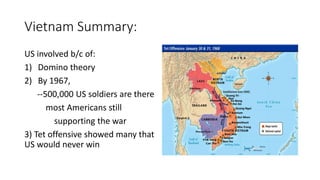
Vietnam Summary:
US involved b/c of:
1) Domino theory
2) By 1967,
--500,000 US soldiers are there
most Americans still
supporting the war
3) Tet offensive showed many that
US would never win
End of Vietnam:
I: Nixon becomes President in 1968
A. Promise to end Vietnam War
1. Peace with honor
--this attitude prolonged the war several more years
2. bombs Cambodia and Laos
--to show North Vietnamese the US is strong
3. Vietnamization
--makes the Vietnamese take more responsibility for
fight
-- begins to remove US troops
B. Support for Nixon and Vietnam erodes
1. People are against bombing Cambodia and
Laos
2. Congress revokes the Gulf of Tonkin resolution
a. Nixon authorizes attacks in Cambodia
without Congress
approval
3. Kent State
a. National Guardsmen shoot student protestors
-- most people thought guardsmen were
correct
--regular people were getting tired of protests
4. Pentagon papers
a. Secret documents released showing there never
was
a plan to end the Vietnam war
C. Nixon appeals to the “silent majority” for support
a. silent majority = regular people who want law
and order and peace with honor
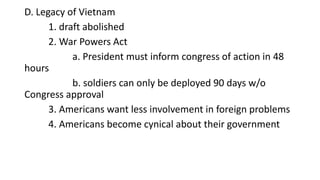
D. Legacy of Vietnam
1. draft abolished
2. War Powers Act
a. President must inform congress of action in 48
hours
b. soldiers can only be deployed 90 days w/o
Congress approval
3. Americans want less involvement in foreign problems
4. Americans become cynical about their government
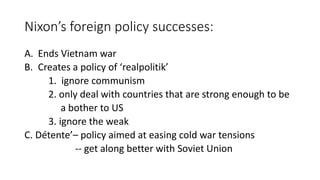
Nixon’s foreign policy successes:
A. Ends Vietnam war
B. Creates a policy of ‘realpolitik’
1. ignore communism
2. only deal with countries that are strong enough to be
a bother to US
3. ignore the weak
C. Détente’– policy aimed at easing cold war tensions
-- get along better with Soviet Union
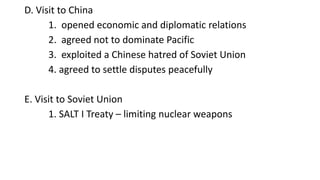
D. Visit to China
1. opened economic and diplomatic relations
2. agreed not to dominate Pacific
3. exploited a Chinese hatred of Soviet Union
4. agreed to settle disputes peacefully
E. Visit to Soviet Union
1. SALT I Treaty – limiting nuclear weapons
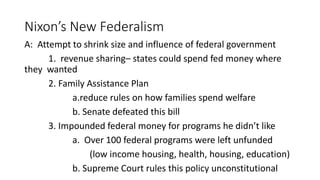
Nixon’s New Federalism
A: Attempt to shrink size and influence of federal government
1. revenue sharing– states could spend fed money where
they wanted
2. Family Assistance Plan
a.reduce rules on how families spend welfare
b. Senate defeated this bill
3. Impounded federal money for programs he didn’t like
a. Over 100 federal programs were left unfunded
(low income housing, health, housing, education)
b. Supreme Court rules this policy unconstitutional
B: Law and order politics
1. Promised the “silent majority” end of protests and riots
a. Illegal spying and wiretaps on liberals and Democrats
b. CIA investigates anti government protestors
c. IRS audits anti war protestors
d. Complained that the media only supported the liberals
2. Tries to turn Southerners into Republicans
a. slows integration
b. Opposed the Voting rights act
c. Opposed court ordered busing (Swann v Charlotte Meck
Schools)
d. Appointed conservative justices to the Supreme Court

Early 70s nixon for virtual

  • 2.
  • 3.
    Vietnam Summary: US involvedb/c of: 1) Domino theory 2) By 1967, --500,000 US soldiers are there most Americans still supporting the war 3) Tet offensive showed many that US would never win
  • 4.
    End of Vietnam: I:Nixon becomes President in 1968 A. Promise to end Vietnam War 1. Peace with honor --this attitude prolonged the war several more years 2. bombs Cambodia and Laos --to show North Vietnamese the US is strong 3. Vietnamization --makes the Vietnamese take more responsibility for fight -- begins to remove US troops
  • 5.
    B. Support forNixon and Vietnam erodes 1. People are against bombing Cambodia and Laos 2. Congress revokes the Gulf of Tonkin resolution a. Nixon authorizes attacks in Cambodia without Congress approval
  • 6.
    3. Kent State a.National Guardsmen shoot student protestors -- most people thought guardsmen were correct --regular people were getting tired of protests 4. Pentagon papers a. Secret documents released showing there never was a plan to end the Vietnam war
  • 7.
    C. Nixon appealsto the “silent majority” for support a. silent majority = regular people who want law and order and peace with honor
  • 8.
    D. Legacy ofVietnam 1. draft abolished 2. War Powers Act a. President must inform congress of action in 48 hours b. soldiers can only be deployed 90 days w/o Congress approval 3. Americans want less involvement in foreign problems 4. Americans become cynical about their government
  • 9.
    Nixon’s foreign policysuccesses: A. Ends Vietnam war B. Creates a policy of ‘realpolitik’ 1. ignore communism 2. only deal with countries that are strong enough to be a bother to US 3. ignore the weak C. Détente’– policy aimed at easing cold war tensions -- get along better with Soviet Union
  • 10.
    D. Visit toChina 1. opened economic and diplomatic relations 2. agreed not to dominate Pacific 3. exploited a Chinese hatred of Soviet Union 4. agreed to settle disputes peacefully E. Visit to Soviet Union 1. SALT I Treaty – limiting nuclear weapons
  • 11.
    Nixon’s New Federalism A:Attempt to shrink size and influence of federal government 1. revenue sharing– states could spend fed money where they wanted 2. Family Assistance Plan a.reduce rules on how families spend welfare b. Senate defeated this bill 3. Impounded federal money for programs he didn’t like a. Over 100 federal programs were left unfunded (low income housing, health, housing, education) b. Supreme Court rules this policy unconstitutional
  • 12.
    B: Law andorder politics 1. Promised the “silent majority” end of protests and riots a. Illegal spying and wiretaps on liberals and Democrats b. CIA investigates anti government protestors c. IRS audits anti war protestors d. Complained that the media only supported the liberals
  • 13.
    2. Tries toturn Southerners into Republicans a. slows integration b. Opposed the Voting rights act c. Opposed court ordered busing (Swann v Charlotte Meck Schools) d. Appointed conservative justices to the Supreme Court