English for Academic and
Professional Purposes
Quarter 1 – Module 2:
Summarization of Text
English for Academic and Professional Purposes – Grade 11/12
Alternative Delivery Mode
Quarter 1 – Module 2: Summarization of Text
First Edition, 2020
Republic Act 8293, section 176 states that: No copyright shall subsist in any work of
the Government of the Philippines. However, prior approval of the government agency or office
wherein the work is created shall be necessary for exploitation of such work for profit. Such
agency or office may, among other things, impose as a condition the payment of royalties.
Borrowed materials (i.e., songs, stories, poems, pictures, photos, brand names,
trademarks, etc.) included in this module are owned by their respective copyright holders.
Every effort has been exerted to locate and seek permission to use these materials from their
respective copyright owners. The publisher and authors do not represent nor claim ownership
over them.
Published by the Department of Education
Secretary: Leonor Magtolis Briones
Undersecretary: Diosdado M. San Antonio
Printed in the Philippines by Department of Education – Schools Division of Bataan
Office Address: Provincial Capitol Compound, Balanga City, Bataan
Telefax: (047) 237-2102
E-mail Address: bataan@deped.gov.ph
Development Team of the Module
Writer: Rhenn B. Songco
Editor: Ryan Jake F. Bariacto
Reviewer: Ryan Jake F. Bariacto
Illustrator: Leo Espinosa
Layout Artist: Rhenn B. Songco
Cover Design: LRMDS-Bataan
Management Team:
Schools Division Superintendent : Romeo M. Alip, PhD, CESO V
Asst. Schools Division Superintendent : Roland M. Fronda, EdD, CESE
Chief Education Supervisor, CID : Milagros M. Peñaflor, PhD
Education Program Supervisor, LRMDS : Edgar E. Garcia, MITE
Education Program Supervisor, AP/ADM : Romeo M. Layug
Education Program Supervisor, English : Ilynne SJ Samonte
District Supervisor, Pilar : Teresita R. Ordiales
Division Lead Book Designer : Jenelyn D. Rivero
District LRMDS Coordinator, Pilar : Joseph Ralph S. Dizon, PhD
School LRMDS Coordinator : Rhenn B. Songco
School Principal : Angelo R. Basilio, EdD
District Lead Layout Artist, EAPP : Rhenn B. Songco
District Lead Illustrator, EAPP : Marlon Q. Diego
District Lead Evaluator, EAPP : Rea A. Pangilinan
English for Academic
and Professional
Purposes
Quarter 1 – Module 2:
Summarization of Text
1
Introductory Message
For the facilitator:
Welcome to the English for Academic and Professional Purposes – Grade
11/12 Alternative Delivery Mode (ADM) Module on Summarization of a Text!
This module was collaboratively designed, developed and reviewed by
educators both from public and private institutions to assist you, the teacher or
facilitator in helping the learners meet the standards set by the K to 12 Curriculum
while overcoming their personal, social, and economic constraints in schooling.
This learning resource hopes to engage the learners into guided and
independent learning activities at their own pace and time. Furthermore, this also
aims to help learners acquire the needed 21st century skills while taking into
consideration their needs and circumstances.
In addition to the material in the main text, you will also see this box in the
body of the module:
As a facilitator you are expected to orient the learners on how to use this
module. You also need to keep track of the learners' progress while allowing them to
manage their own learning. Furthermore, you are expected to encourage and assist
the learners as they do the tasks included in the module.
Notes to the Teacher
This contains helpful tips or strategies that
will help you in guiding the learners.
2
For the learner:
Welcome to the English for Academic and Professional Purposes – Grade
11/12 Alternative Delivery Mode (ADM) Module on Summarization of a Text!
The hand is one of the most symbolized part of the human body. It is often
used to depict skill, action and purpose. Through our hands we may learn, create
and accomplish. Hence, the hand in this learning resource signifies that you as a
learner is capable and empowered to successfully achieve the relevant competencies
and skills at your own pace and time. Your academic success lies in your own hands!
This module was designed to provide you with fun and meaningful
opportunities for guided and independent learning at your own pace and time. You
will be enabled to process the contents of the learning resource while being an active
learner.
This module has the following parts and corresponding icons:
What I Need to Know This will give you an idea of the skills or
competencies you are expected to learn in the
module.
What I Know This part includes an activity that aims to
check what you already know about the
lesson to take. If you get all the answers
correct (100%), you may decide to skip this
module.
What’s In This is a brief drill or review to help you link
the current lesson with the previous one.
What’s New In this portion, the new lesson will be
introduced to you in various ways such as a
story, a song, a poem, a problem opener, an
activity or a situation.
What is It This section provides a brief discussion of the
lesson. This aims to help you discover and
understand new concepts and skills.
What’s More This comprises activities for independent
practice to solidify your understanding and
skills of the topic. You may check the
answers to the exercises using the Answer
Key at the end of the module.
What I Have Learned This includes questions or blank
sentence/paragraph to be filled in to process
what you learned from the lesson.
What I Can Do This section provides an activity which will
help you transfer your new knowledge or skill
into real life situations or concerns.
3
Assessment This is a task which aims to evaluate your
level of mastery in achieving the learning
competency.
Additional Activities In this portion, another activity will be given
to you to enrich your knowledge or skill of the
lesson learned. This also tends retention of
learned concepts.
Answer Key This contains answers to all activities in the
module.
At the end of this module you will also find:
The following are some reminders in using this module:
1. Use the module with care. Do not put unnecessary mark/s on any part of the
module. Use a separate sheet of paper in answering the exercises.
2. Don’t forget to answer What I Know before moving on to the other activities
included in the module.
3. Read the instruction carefully before doing each task.
4. Observe honesty and integrity in doing the tasks and checking your answers.
5. Finish the task at hand before proceeding to the next.
6. Return this module to your teacher/facilitator once you are through with it.
If you encounter any difficulty in answering the tasks in this module, do not
hesitate to consult your teacher or facilitator. Always bear in mind that you are
not alone.
We hope that through this material, you will experience meaningful learning and
gain deep understanding of the relevant competencies. You can do it!
References This is a list of all sources used in developing
this module.
4
What I Need to Know
This module is designed and written to help you acquire knowledge of
appropriate reading strategies for a better understanding of academic texts.
At the end of this module, you will be able to produce a detailed abstract of
information gathered from the various academic texts read by:
1. Using various techniques in summarizing a variety of academic texts
(CS_EN11/12A-EAPP-Ia-c-4).
What I Know
What are the five steps in summarizing a text?
Step 1:
__________________________________________________________________________________
Step 2:
__________________________________________________________________________________
Step 3:
__________________________________________________________________________________
Step 4:
__________________________________________________________________________________
Step 5:
__________________________________________________________________________________
5
Lesson
3 Summarization of a Text
Summarization of a text teaches you how to take a large selection of text and
reduce it to the main points for more concise understanding. Upon reading a
passage, summarizing helps you learn to determine essential ideas and consolidate
important details that support them. It is a technique that enables you to focus on
key words and phrases of an assigned text that are worth noting and remembering.
What’s In
Complete the table about Common Types of Text Structure.
Type of Text
Structure
Definition Visual Representation
Description
Cause and Effect
Compare and
Contrast
6
Chronological
Order
Problem and
Solution
What’s New
A Brief History of English
By: Paul Roberts
(1) No understanding of the English language can be very satisfactory
without the notice of the history of the language. But we have to make do with
just a notion. The history of English is long and complicated, and we can only
hit the high spots.
(2) The history of our language begins a little after 600 C.E. Everything
before that was pre-history, which means that we can guess at it but can’t
prove much. For a thousand years or so before the birth of Christ, our
linguistic ancestors were savage wandering through the forest of Northern
Notes to the Teacher
This module prepares the learners to produce abstract of
information gathered from academic texts by using different
techniques in summarization.
7
Europe. Their language was part of the Germanic branch of the Indo-
European family.
(3) At the time of the Roman Empire-say, from the beginning of the
Christian era to around 400 C.E/- the speakers of what was to become
English were scattered along the north coast of Europe. They spoke a dialect
of Low German. More exactly, they spoke several different dialects, since they
were several different tribes. The names given to the tribe who got to English
are Angles, Saxons, and Jutes. For convenience, we can refer to them all as
Anglo-Saxons.
(4) Their first contact with civilization was a rather thin acquaintance
with the Roman Empire on whose borders they lived. Probably some of the
Anglo-Saxons wondered into the empire occasionally, and certainly Roman
merchants and traders travelled among the tribes. At any rate, this period
saw the first if our so many borrowing from Latin. Such words as kettle, wine,
cheese, butter, cheap, plum, gem, bishop, church were borrowed at this
times. They show of the relationships of the Anglo-Saxons with the Romans.
The Anglo-Saxons were learning, getting their first taste of civilization.
(5) They still had a long way to go, however, and their first step was to
help smash the civilization they were learning from. In the fourth century the
Roman power weakened badly. While the Goths were pounding, away at the
Romans in the Mediterranean countries, their relatives, he Anglo-Saxons,
began to attach Britain. (6) The Romans has been the ruling power in Britain
since 43 C.E. They have subjugated the Celts whom they found living there
and had succeeded in settling up a Roman administration. The Roman
influence did not extend to the outlying parts of the British Isles. In Scotland,
Whales, and Ireland the Celts remained free and wild, they made periodic
forays against the Romans in England. Among other defense measures, the
Romans build the famous Roman Walls to ward off the tribes in the north. (7)
Even in England the Roman power was thin. Latin did not become the
language of the country as it did in Gaul and Spain. The mass of people
continued to speak Celtics, with Latin and the Roman civilization it contained
in use as a top dressing.
(8) In the fourth century, troubles multiplied for the Romans in Britain.
Not only did the untamed tribes of Scotland and Whales grow more and more
restive, but also the Anglo-Saxons began to make pirate raids on the eastern
coast. Furthermore, there was growing difficulty everywhere in the Empire,
and the legions in Britain were siphoned off to fight elsewhere. Finally, in 410
C.E. the last Roman ruler in England, bent on becoming the emperor, left the
island and took the last legions with him. The Celts were left in possession of
Britain but almost defenseless against the impending Anglo-Saxons attack.
(9) Not much is surely known about the arrival of the Anglo-Saxons in
England. According to the best early source, the eighth-century historian
Bade, the Jutes came in 449 in response to a plea from the Celtics king,
8
Vortigern, who wanted their help against the Picts attacking the north. The
Jutes subdue the Picts, but then quarrelled and fought with Vortigern, and
with reinforcement from the continent, settled permanently in Kent.
Somewhat later the Angles established themselves in the eastern England and
the Saxons in the south and west. Bede’s account is plausible enough, and
these were probably the main lines of the invasion.
(10) We don’t know, however, that the Angles, Saxons, and Jutes were
long time securing themselves in England. Fighting went on for as long as a
hundred years before the Celts in Celts were all killed, driven into Wales, or
reduced to slavery. This is the period of King Arthur, who was not entirely
mythological. He was a Romanized Celt, a general, though probably not a
king. He had some success against the Anglo-Saxons, but it was only
temporary. By 550 or so the Anglo-Saxon were finally established, English
was in England.
(11) All this is pre-history, so far as the language is concerned. We have
no record of the English language until after 600, when the Anglo-Saxon were
converted to Christianity and learned the Latin alphabets. The conversion
began, to be precise in 597 within thirty to forty years. The conversion was a
great advance for the Anglo-Saxons, not only of the spiritual benefits but also
because it re-established contact with what remained of Roman civilization.
The civilization didn’t amount to much in the year 600, but it was certainly,
superior to anything in England up to the time. (12) It is customary to divide
the history of the English language into three periods: Old English, Middle
English, and Modern English. Old English runs from the earliest record-i.e.
seventh century- to about 1100: Middle English from 1100 to 1450 or 1500;
Modern English form 1500 to the present day. Sometimes Modern English is
further divided into Early Modern, 1500-1700, and Late Modern from 1700 to
the present.
(13) When England came into history, it was divided into several more
or less autonomous kingdoms, some of which at times exercised a certain
amount of control over the others. In the century after the conversion the
most advanced kingdom was Northumbrians, the area between the Humber
River and the Scottish border. By 700 C.E the Northumbrians had developed
a respectable civilization, the finest in Europe. It is sometimes called the
Northumbian Renaissance, and it was the first of the several renaissance
through which Europe struggled upward out of the ruins of the Roman
Empire. It was in this period that the best of the Old English literature was
written, including the epic poem Beowulf.
(14) In the Eighth century, Northumbian power declined, and the center
of the influence moved southward to Mercia, the kingdom of Midlands. A
century later center shifted again, and Wessex, the country of the West
Saxons, became the leading power. The most famous king of the West Saxons
was Alfred the Great, who reigned in the second half of the ninth century,
9
dying in 901. He was famous not only as a military man and administrator
but also as a champion of learning. He founded and supported schools and
translated or caused to be translated many books from Latin into English. At
this time also much of the Northumbian literature of two centuries earlier was
copied in West Saxons. Indeed, the great bulk of Old English writing which
has come down to us is the West Saxon dialect of 900 or later.
(15) In the military sphere, Alfred’s great accomplishment was his
successful opposition to the Viking invasion. In the ninth and tenth centuries,
the Norsemen emerged in their ships from their homeland in Denmark and
the Scandinavian Peninsula. They travelled and attacked and plundered at
their will and almost with impunity. They ravaged Italy and Greece, settled in
France, Russia and Ireland, colonized Iceland and Greenland, and discovered
America several centuries before Columbus. Nor they overlooked England.
(16) After many years of hit-and-run raids, the Norsemen landed an
army on the east coast of England in the year 886. There was nothing much
to oppose them except the Wessex power led by Alfred. The long struggle
ended in 877 with a treaty by which a line was drawn roughly from the
northwest of England to the southwest. On the eastern side of the line, Norse
rule was to prevail. This was called the Danelaw. The western side was to be
governed by Wessex.
(17) The linguistic result of all this was a considerable injection of Norse
into the English language. Norse was at this time not so different from English
as Norwegian or Danish is now. Probably the speakers of English could
understand, more or less, the language of the new comers who had moved
into eastern England. At any rate, there was considerable interchange and
word borrowing. Examples of Norse words in the English language are sky,
give, law, egg, outlaw, leg, ugly, scant, crawl, scowl, take, thrust. There are
hundreds more. We have even borrowed some pronouns from Norse-they,
their, and them. These words were borrowed first by the eastern and northern
dialects and then in the course of hundreds of years made their way into
English generally.
(18) It is supposed also-indeed, it must be true-that the Norsemen
influenced the sound structure and the grammar of English. But this is hard
to demonstrate in detail.
(19) We may now have an example of Old English. The favourite
illustration is the Lord’s Prayer, since it needs no translation. This has come
to us in several different versions, Here is one:
Faeder ure [thorn] u[eth]e eart on heofonum si [thorn] in nama gehalgd.
Tobecume [thorn]in rice. Gewur[eth]e [thorn]in willa on eor[eth]an swa swa on
heofonum. Urne gedaeghwamlican half slye us to daeg. An forgyf us ure gyltas
swa swa we forgyfa[thorn] urum glytendum. And ne gelaed [thorn]u us on cost
nunge ac alys of yfele. So[eth]lice.
10
(20) Some of the differences between this and Modern English are
merely differences in orthography. For instance, the sign æ is what Old
English writers used for a vowel sound like that in modern hat or and. The th
sounds of modern thin or then are represented in Old English by [thorn] or
[eth]. But of course there are many differences in sounds too. Ure is the
ancestor of modern our, but the first vowel was like that in too or ooze. Hlaf
is modern loaf; we have dropped the h sound and changed the vowel, which
in half was pronounce something like the vowel in father. Old English had
some sounds which we do not have. The sound represented by y does not
occur in Modern English. If you pronounced the vowel in bit with your lips
rounded, you may approach it. (21) In grammar, Old English was much more
highly inflected than Modern English is. That is, there were more case endings
for nouns, more person and number ending for verbs, a more complicated
pronoun system, various endings for adjectives, and so on. Old English nouns
had four cases –nominative, genitive, dative, accusative. Adjectives had five-
all these and an instrumental case besides. Present day English has only two
cases from nouns-common case and possessive case. Adjectives now have no
case system at all. On the other hand, we now use more rigid word order and
more structure words (preposition, auxiliaries, and the like) to express
relationships than Old English did.
(22) Some of this grammar we can see in the Lord’s Prayer. Heofonum,
for instance is a dative plural; the nominative singular was heofon. Urne is an
accusative singular; the nominative is ure. In urum gyltendum both words
are dative plural. Forgyfap is the third person plural form of the verb. Word
order is different. “urne gedaeghwamlican half syle us” in place of “Give us
our daily bread.” And so on.
(23) In vocabulary Old English is quite different from Modern English.
Most of the Old English words are what we may call native English; that is,
words which have not been borrowed from other languages but which have
been a part of English ever since English was a part of Indo-European. Old
English did certainly contain borrowed words. We have seen that many
borrowing were coming in from Norse. Rather large numbers had been
borrowed from Latin, too. Some of these were taken while the Anglos-Saxons
were still in the continent (cheese, butter, bishop, kettle, etc.); a large number
came into English after Conversion (angle, candle, priest, martyr, radish,
oyster, purple, school, spend, etc.). But the great majority of Old English
words were native English.
(24) No on the contrary, the majority of words in English are borrowed,
taken mostly from Latin and French. Of the words from The American College
Dictionary only about 14 percent are native. Most of these to be sure, are
common, high frequency words-the, of, I, and because, man, mother, road,
etc.; of the thousand most common words in English, some 62 percent are
native English. Even so, the modern vocabulary is very much Latinized and
Frenchified. The Old English vocabulary was not.
11
(25) Sometime between the year 1000 and 1200 various important
changes took place in the structure of English, and Old English became
Middle English. The political event which facilitated these changes was the
Norman Conquest. The Normans, as the name shows, came originally from
Scandinavia. In the early tenth century they established themselves in
Northern France, adopted the French language, and developed a vigorous
kingdom and a very passable civilization. In the year 1066, led by Duke
William, they crossed the Channel and made themselves master of England.
For the next several hundred years, England was ruled by kings and whose
first language was French.
(26) One might wonder why, after the Norman Conquest, French did
not become the national language, replacing English entirely. The reason is
that the conquest was not a national migration, as the early Anglo-Saxons
invasion had been. Great numbers of Normans came to England, but they
came as rulers and landlords. French became the language of the court, the
language of nobility, the language of the polite society, the language of
literature. But it did not replace the English language as the language of the
people. There must be hundreds of towns and villages in which French was
never heard except when visitors of high station passed through.
(27) But English, though survived as the national language, was
profoundly changed after the Norman Conquest. Some of the changes-in
sound structure and grammar-would no doubt have taken place whether
there have been a conquest or not. Ever before 1066 the case system of
English nouns and adjectives was becoming simplified; people came to rely
more on word order and prepositions than on inflectional endings to
communicate their meanings. The process was speeded up by sound changes
which caused many of the endings to sound alike. But no doubt the conquest
facilitated the changes. German, which did not experience a Norman
Conquest, is today rather highly inflected compared to its cousin English.
(28) But it is in the vocabulary that the effects of the Conquest are most
obvious. French ceased, after a hundred years or so, to be the native language
of very many people in England, but it continued-and continues still- to be a
zealously cultivated sound language, the mirror of elegance and civilization.
When one spoke English, on introduced not only French ideas and French
things but also their French names. This was not only easy but also socially
useful. To pepper one’s conversation with French expressions was to show
that one was well bred, elegant, au courant. The last sentence shows that the
process was not yet dead. By using au courant instead of, say, abreast of
things, the writer indicates that he is no dull clod who knows only English
but an elegant person aware of how things are done in le haut monde.
(29) Thus French word came into English, all sorts of them. There were
words to do with government; parliament, majesty, treaty, alliance, tax,
government; church words; parson, sermon, baptism, incense, religion; words
12
for foods; veal, beef, mutton, bacon, jelly, peach, lemon, cream, biscuit;
colours; blue, scarlet, vermilion, household words; curtain, chair, lamp, towel,
blanket, parlour; play words; dance, chess, music, leisure, conversation;
literary words; story, romance, poet, literary; learned words; study, logic,
grammar, noun, surgeon, anatomy, stomach; just ordinary words of all sorts;
nice, second, very, age, bucket, gentle, final, fault, flower, cry, count, sure,
move, surprise, plain.
(30) All these and thousands more poured into English vocabulary
between 1100 and 1500, until at the end of that time, many people must have
had more French words than English at their command. This is not to say
that English became French. English remained English in sound structure
and in grammar, though these also felt the ripples of the French influence.
The very heart of the vocabulary, too, remained English. Most of the high
frequency words-the pronouns, the prepositions, the conjunctions, the
auxiliaries, as well as a great ordinary nouns and verbs and adjectives-were
not replaced by borrowing.
(31) Middle English, then, was still Germanic language, but it differed
from Old English in many ways. The sound system and the grammar change
a good deal. Speakers made less use of case systems and other influential
devices and relied more on word order and structure words to express their
meanings. This is often said to be simplification, but it isn’t really. Languages
don’t become simpler; they merely exchange one kind of complexity for
another. Modern language is not a simple language, as any foreign speakers
who try to learn it will hasten to tell you.
(32) For us, Middle English is simpler than the Old English just because
it is closer to Modern English. It takes three or four months at least to learn
to read Old English prose and more than that for poetry. But a week of good
study should put one touch with the Middle English poet Chaucer. Indeed
you may be able to make some sense of Chaucer straight off, though you
would need instruction in pronunciation to make it sound like poetry. Here is
a famous passage from the General Prologue to the Canterbury Tales,
fourteenth century:
Ther was also a Nonne, a Prioresse. That of hir smyling was ful simple
and coy; Hir gretteste oot was but by Seint Loy; And she was cleped madame
Eglentyne. Ful weel she soong the service dyvyne. Entuned in hir nose ful
seemly, And Frenshe she spak ful faire and fetisly, After the scole of Stratford-
atte-Bowe, For Frenshe of Parys was to hirse unknowe.
(33) Sometime between 1400 and 1600 English underwent a couple of
sound changes which made language of Shakespeare quite different from that
of Chaucer. Incidentally, these changes contributed much to the chaos in
which English spelling now finds itself.
13
(34) One change was the elimination of a vowel sound in certain
unstressed positions at the end of words. For instance, the words name,
stone, wine, dance were pronounced as two syllables by Chaucer but as just
one by Shakespeare. The e in these words became, as we say, “silent”. But it
wasn’t silent for Chaucer, it represented a vowel sound. So also the words
laughed, seemed, stored would have been pronounced by Chaucer as two-
syllable words. The change was an important one because it affected
thousands of words and gave different aspects to the whole language.
(35) The other change is what is called the Great Vowel Shift. Thus was
a systematic shifting of half a dozen vowels and diphthongs in stressed
syllables. For instance, the word nam had in Middle English a vowel
something like that in the modern word father; wine, had the vowel of modern
mean; he was pronounced something like modern hey; mouse sounded like
moose; moon had the vowel of moan. Again the shift was through going and
affected all the word in which these vowels sounds occurred. Since we still
keep the Middle English system of spelling these words, the differences
between Modern English and Middle English are often more real than
apparent.
(36) The vowel shift has meant also that we have come to use an entirely
different set of symbols for representing vowel sounds that is used by the
writers of such languages as French, Italian or Spanish, in which no such
vowel occurred. If you come across a strange word-say, bine-in an English
book, you will announce it according to the English system, with the vowels
of wine or dine. But if you read bine in the French, Italian, or Spanish book,
you will pronounce it with the vowel of mean or seen.
(37) These two changes, then, produced basic differences between
Middle English and Modern English. But there were several other
developments that had an effect upon the language. One was the invention of
printing, an invention introduced to England by William Caxton in the year
1472. Where before books had been rare and costly, they suddenly become
cheap and common. More and more people learn to read and write. This was
the first of many advances in communication in which have worked to unify
languages and to arrest the development of dialect difference, though of
course the printing affects writing principally rather than speech. Among
other things it hastened the standardization of spelling.
(38) The period of Early Modern English- that is, the sixteenth and
seventeenth centuries-was also the period of the English Renaissance, when
people developed, on the other hand, a keen interest in the past and, on the
other, a more daring and imaginative view of the future. New ideas multiplied,
and new ideas meant new languages. Englishmen had grown accustomed to
borrowing words from French as a result of the Norman Conquest; now they
borrowed from Latin and Greek. As we have seen, English have been raiding
Latin from Old English times and before. But now the floodgates really
14
opened, and thousands of words from the classic languages poured in.
Pedestrian, bonus, anatomy, contradict, climax, dictionary, benefit, multiply,
exist, paragraph, initiate, scene, inspire are random examples. Probably the
average educated American today has more words from French in his
vocabulary than from the native English source and more from Latin than the
French.
(39) The greatest writer of the Early Modern English period is of course
Shakespeare, and the best-known book is the King James Version of the
Bible, published in 1611. The bible (if not Shakespeare) has made many
features of Early Modern English perfectly familiar to many people down to
present time, even though we do not use these features in the present-day
speech and writing. For instance, the old pronounce thou and thee have
dropped out of use now, together with their verb forms, but they are still
familiar to us in prayer and in Biblical quotation. “Whither thou goest, I will
go” Such form as hath and doth have been replaced by has and does, “Goes
he hence tonight? Would now be “Is he going away tonight?” Shakespeare’s
“Fie o’nt, sirrah” would be “Nuts to that, Mac.” Still, all these expressions
linger with us because of the power of the works in which they occur.
(40) It is not always realized, however, that considerable sound changes
have taken place between Early Modern English and the English of the
present day. Shakespearean actors putting on a play speak the words,
properly enough, in their modern pronunciation. But it is very doubtful that
this pronunciation would be understood at all by Shakespeare. In
Shakespeare’s time, the word reason was pronounced raisin; face had the
sound of the modern glass; the l in would, should, palm was pronounce. In
these points and a great many others, the English language has moved a long
way from what it was in 1600.
(41) The history of English since 1700 is filled with many movements
and counter movements, of which we can notice only a couple. One of this is
the vigorous attempt made in the eighteenth century, and rather the half-
hearted attempts made since, to regulate and control the English language.
Many people of the eighteenth century, not understanding very well the forces
which govern the language, proposed to polish and prune and restrict English,
which they felt was proliferating too wildly. There was much talk on an
academy which would rule on what people could and could not say and write.
The academy never came into being, but the eighteenth century did succeed
in establishing certain attitudes which, though they haven’t had much effect
on the development of the language itself, have certainly changed the native
speaker’s feeling about the language.
(42) In part a product of the wish to fix and establish the language was
the development of the dictionary. The first English dictionary was published
in 1603; it was a list of 2,500 words briefly defined. Many others were
published with gradual improvement until Samuel Johnson published his
15
English Dictionary in 1775. This steadily revised, dominated the field in
England for nearly a hundred years. Meanwhile in America, Noah Webster
published his dictionary in 1828, and before long dictionary publishing was
a big business in this country. The last century has seen the publication of
one great dictionary; the twelve volume Oxford English Dictionary, compiled
in the course of seventy-five years through the labour of many scholars. We
have also, of course, numerous commercial dictionaries which are good as the
public wants them to be if not, indeed, rather better.
(43) Another product of the eighteenth century was the invention of
“English Grammar”. As English came to replace Latin as the language of
scholarship it was felt that one should also be able to control and dissect it,
parse and analyse it, as one could Latin. What happened in practice was that
the grammatical description that applied to Latin was removed and
superimposed on English. This was silly, because English is an entirely
different kind of language, with its own forms and signals and ways of
producing meaning. Nevertheless, grammar on the Latin model were worked
out and taught in the schools. In many schools they are still being taught.
This activity is not often popular with school children, but it is sometimes an
interesting and instructive exercise in logic. The principal harm in it is that it
has tended to keep people from being interested in English and has obscured
the real features of English structure.
(44) But probably the most important force in the development of
English in the modern period has been the tremendous expansion of English-
speaking peoples. In 1500 English was minor language, spoken by a few
people on a small island. Now perhaps the greatest language of the world,
spoken natively by over a quarter of a billion people and as a second language
by many millions more. When we speak of English now, we must specify
whether we mean American English, British English, Australian English,
Indian English, or what, since the differences are considerable. The American
cannot go to England, or the Englishman to America confident that he will
always understand and be understood. The Alabaman in Iowa or the Iowan
in Alabama shows himself a foreigner every time he speaks. It is only because
the communication has become fast and easy that English in this period of
its expansion has not broken into a dozen mutually unintelligible languages.
16
What is It
Summarization of text builds your comprehension by helping to reduce
confusion. You should process the information you read with the goal of breaking
down content into succinct pieces. Summarizing text by using writing activities
builds on your prior knowledge, helps improve your writing skills and strengthens
your vocabulary skills.
Simple Steps in Summarizing Text
1. Read the text comprehensively.
The very first step in making a summary is to have a comprehensive reading
skill.
2. Write the main statements.
Underlining or marking the main ideas from a text is the next step.
3. List down supporting details.
Look for the details that support the main idea.
4. Create a summary.
Prepare the first draft of the summary.
5. Adjust summary as needed.
Omit or add any piece of information that is appropriate for making the
summary
17
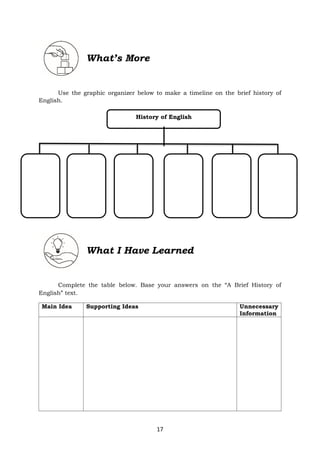
What’s More
Use the graphic organizer below to make a timeline on the brief history of
English.
What I Have Learned
Complete the table below. Base your answers on the “A Brief History of
English” text.
Main Idea Supporting Ideas Unnecessary
Information
History of English
18
What I Can Do
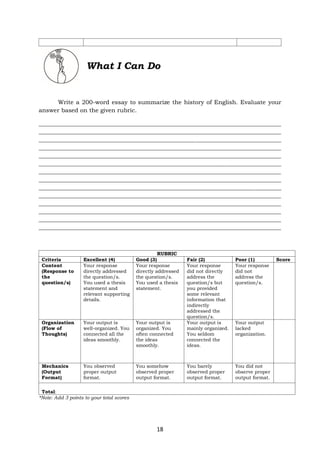
Write a 200-word essay to summarize the history of English. Evaluate your
answer based on the given rubric.
__________________________________________________________________________________
__________________________________________________________________________________
__________________________________________________________________________________
__________________________________________________________________________________
__________________________________________________________________________________
__________________________________________________________________________________
__________________________________________________________________________________
__________________________________________________________________________________
__________________________________________________________________________________
__________________________________________________________________________________
__________________________________________________________________________________
__________________________________________________________________________________
__________________________________________________________________________________
__________________________________________________________________________________
RUBRIC
Criteria Excellent (4) Good (3) Fair (2) Poor (1) Score
Content
(Response to
the
question/s)
Your response
directly addressed
the question/s.
You used a thesis
statement and
relevant supporting
details.
Your response
directly addressed
the question/s.
You used a thesis
statement.
Your response
did not directly
address the
question/s but
you provided
some relevant
information that
indirectly
addressed the
question/s.
Your response
did not
address the
question/s.
Organization
(Flow of
Thoughts)
Your output is
well-organized. You
connected all the
ideas smoothly.
Your output is
organized. You
often connected
the ideas
smoothly.
Your output is
mainly organized.
You seldom
connected the
ideas.
Your output
lacked
organization.
Mechanics
(Output
Format)
You observed
proper output
format.
You somehow
observed proper
output format.
You barely
observed proper
output format.
You did not
observe proper
output format.
Total:
*Note: Add 3 points to your total scores
19
Assessment
From Hand to Mouth
By: Michael C. Corballis
(1) Imagine trying to teach a child to talk without using your hands or any
other means of pointing of gesturing. The task would surely be impossible. There can
be little doubt that bodily gestures are involved in the development of language, both
in the individual and in the species. Yet, once the system is up and running, it can
function entirely on vocalizations, as when two friends chat over the phone and
create in each other’s minds a world of events far removed from the actual sounds
that emerge from their lips. My contention is that the vocal element emerged
relatively late in hominid evolution. If the modern chimpanzee is to be our guide, the
common ancestor of 5 or 6 million years ago would have been utterly incapable of a
telephone conversation but would have been able to make voluntary movements of
hands and face that could the least serve as a platform upon which to build a
language.
(2) Evidence suggests that the vocal machinery necessary for autonomous
speech developed quite recently in hominid evolution. Grammatical language may
well have begun to emerge around 2 million years ago but would at first have been
primary gestural, though no doubt punctuated with grunts and other vocal cries that
were at first largely involuntary and emotional. The complex adjustments necessary
to produce speech as we know it today would have taken some time to evolve, and
may not have been complete until some 170,000 years ago, or even later, when Homo
sapiens emerged to grace, but more often disgrace, the planet. These adjustments
may have been incomplete even in our close relatives the Neanderthals; arguably, it
was this failure that contributed to their demise.
(3) The question now is what were the selective pressures that led to the
eventual dominance of speech? On the face of it, an acoustic medium seems a poor
way to convey information about the world; not for nothing is it said that a picture
is worth a thousand words. Moreover, signed language has all the lexical and
grammatical complexity of spoken language. Primate evolution is itself a testimony
to the primacy of the visual world. We share with monkeys a highly sophisticated
visual system, giving us three- dimension information in colour about us, and an
intricate system for exploring that world through movement and manipulation.
Further, in a hunter- gatherer environment, where predators and prey are major
concern, there are surely advantages in silent communication since sound acts as a
general alert. And yet we came to communicate about the world in a medium that in
all primates except ourselves is primitive and stereotyped- and noisy.
20
(4) Before we consider the pressures that may have favoured vocalization over
gestures, it bears repeating that the switch from hand to mouth was almost certainly
not an abrupt one. In fact, manual gestures still feature prominently in language;
even as fluent speakers gesture almost as much as they vocalize, and of course deaf
communities spontaneously develop signed language. It has also been proposed that
speech itself is in many respects better conceived as composed of gestures rather
than sequences of these elusive phantoms called phonemes. In this view, language
evolved as a system of gestures based on movements of the hands, arms and face,
including movements of the mouth, lips, and tongue. It would not have been a big
steps to add voicing to the gestural repertoire, at first as mere grunts, but later
articulated so that invisible gestures of the oral cavity could rendered accessible, but
to the ear rather than the eye. There may therefore have been continuity from the
language that was almost exclusively manual and facial, though perhaps punctuated
by involuntary grunts, to one in which the vocal component has a much more
extensive repertoire and is under voluntary control. The essential feature of modern
expressive language is not that it is purely vocal, but rather that the component can
function autonomously and provide the grammar as well as meaning of linguistics
communication.
(5) What, then, are the advantages of a language that can operate
autonomously through voice and ear, rather than hand and eye? Why speech?
Advantages of Arbitrary Symbols
(6) One possible advantage of vocal language is its arbitrariness. Except in
rare cases of onomatopoeia, spoken words cannot be iconic, and they therefore offer
scope for creating symbols that distinguish between object or actions that look alike
or might otherwise be confusable. The names of similar animals, such as cats, lions,
tigers, cheetahs, lynxes, and leopards, are rather different. We may be confused as
to which animals is which, bur at least it is clear which one we are talking about.
The shortening of words overtime also makes communication more efficient, and
some of us have been around long enough to see this happen: television has become
TV or telly, microphone has been reduced to mike (or mic), and so on. The fact that
more frequent words tends to be shorter than less frequent ones was noted by the
American philologist George Kingsley Zipf, who related it to a principle of “least
effort.” So long as signs are based on iconic resemblance, the signer has little scope
for these kinds of calibration.
(7) It may well have been very important for hunter-gatherers to identify and
name a great many similar fruits, plants, trees, animals, birds, and so on, and
attempts at iconic representation would eventually only confuse. Jared Diamond
observes that the people living largely traditional lifestyle in New Guinea can name
hundreds of birds, animals, and plants, along with details about each of them. These
people are illiterate, relying on word of mouth to pass on information, not only about
potential foods, but also about how to survive dangers, such as crop failures,
droughts, cyclones, and raids from other tribes. Diamond suggests that the main
21
repository of accumulated information is elderly. He points out that humans are
unique among primates in that they can expect to live to a ripe old age, well beyond
the age of child bearing (although perhaps it was not always so). A slowing down of
senescence may well have been selected in evolution because the knowledge retained
by the elderly enhanced the survival of their younger relatives. An elderly,
knowledgeable granny may help us all live a little longer, and she can also look after
the kids.
(8) In the naming and transmission of such detailed information, iconic
representation would almost certainly be inefficient: edible plants or berries could be
confused with poisonous ones, and animals that attack confused with those that are
benign. This is not to say that gestural signs could not to do the trick. Manual signs
readily become conventionalized and convey abstract information. Nevertheless,
there may be some advantage to using spoken words, since they have virtually no
iconic content to begin with, and so provide a ready-made system for abstraction.
(9) I would be on dangerous ground, however, if I were to insist too strongly
that speech is linguistically superior to signed language. After all, students at
Gallaudet University seem pretty unrestricted in what they can learn; signed
language apparently functions well right through to university level- and still
requires students to learn lots of vocabulary from their suitably elderly professor. It
is nevertheless true that many signs remain iconic, or at least partially so and are
therefore somewhat tethered with respect to modifications that might enhance clarity
or efficiency of expression. But there may well be a trade- off here. Signed language
may easier to learn than spoken ones. Especially in initial stages of acquisition, in
which the child comes to understand the linking of objects and the action with their
linguistic representations. But spoken languages, ones acquired, may relay
messages more accurately, since spoken words are better calibrated to minimize
confusion. Even so, the iconic component is often important, and as I look the
quadrangles outside my office I see how freely the students there are embellishing
their conversations with manual gestures.
In The Dark
(10) Another advantage of speech over gesture is obvious: we can use it in the
dark! This enables us to communicate at night, which not only extends the time
available for meaningful communications but may also have proven decisive in the
competition for space and resources. We of the gentle species Homo sapiens have a
legacy of invasion, having migrated out of Africa into territories inhabited by other
hominins who migrated earlier. Perhaps it was the newfound ability to communicate
vocally, without the need for a visual component that enabled our fore-bearers to
plan, and even carry out, invasion at night, and so vanquish the earlier migrants.
(11) It is not only a question of being able to communicate at night. We can
also speak to people when objects intervene and you can’t see them, as when you
yell to your friend in another room. All this has to do, of course, with the nature of
22
sound itself, which travels equally well in the dark as in the light and wiggles its way
around obstacles. The wall between you and the base drummer next door may
attenuate the sound but does not completely block it. Vision, on the other hand,
depends on light reflected from an external source, such as the sun, and is therefore
ineffective when no such source is available. And the light reflected from the surface
of an object to your eye travels in rigidly straight lines, which means that it can
provide detailed information about shape but is susceptible to occlusion and
interference. In terms of the sheer ability to reach those with whom you are trying to
communicate, words speak louder than actions.
Listen to Me!
(12) Speech does have one disadvantage, though: it is generally accessible to
those around you and is therefore less convenient for sending confidential or secret
messages or for planning an attack on enemies within earshot. To some extent, we
can overcome this impediment by whispering. And sometimes, people resort to
signing. But the general alerting function of sounds also has its advantages. When
Mark Anthony cried, “Friends, Romans, countrymen, lend me ears.” he was trying to
attract attention as well as deliver a message.
(13) In the evolution of speech, the alerting component of language might have
consisted at first simply of grunt that accompany gestures to give emphasis to
specific actions or encourage reluctant offspring to attend while a parent lays down
the law. It is also possible that non-vocal sounds accompanied gestural
communication. Russell Gray has suggested to me that clicking one’s fingers as
children often do when putting their hands up in class to answer a question, may be
a sort of “missing link” between gestural and vocal language. I know of no evidence
that chimpanzees or other nonhuman primates are able to click their fingers as
humans can, although lip smacking, as observed in chimpanzees, may have played
a similar role. Sounds may therefore have played a similar and largely alerting role
in early evolution of language, gradually assuming more prominence in conveying
the message itself.
(14) For humans, visual signals can only attract attention if they occur within
a fairly restricted region of space, whereas the alerting power of sound is more or less
independent of where its source is located relative to listener. And sound is a better
alerting medium in other respects as well. No amount of gesticulation will wake a
sleeping person, whereas a loud yell will usually do the trick. The alerting power of
sound no doubt explains why animals have evolved vocal signals for sending
messages of alarm. Notwithstanding the peacock’s tail or parrot’s gaudy plumage,
even birds prefer to make noises to attract attention, whether in proclaiming territory
or warning of danger. Visual signals are relatively inefficient because they may elude
our gaze, and in any case we can shut them out by closing our eyes, as we vulnerable
to auditory assault.
23
(15) Speech has another, and subtler, attentional advantage. Manual gesture
is much more demanding of attention, since you must keep your eyes fixed on
gesturer in order to extract her meaning, whereas speech can be understood
regardless of where you are looking. There are a number of advantages in being able
to communicate with people without having to look at them. You can effectively divide
attention, using speech to communicate with a companion while visual attention is
deployed elsewhere, perhaps to watch a football game or to engage in some joint
activity, like building a boat. Indeed, the separation of visual and auditory attention
may have been critical in the development of pedagogy.
Three Hands Better than Two (16) Another reason why vocal language may
have arisen is that it proves an extra medium. We have already seen that most people
gesture with their hands, and indeed their faces, while they talk. One might argue
then, that the addition of vocal channel provides additional texture and richness to
the message.
(17) But perhaps it is not a simply a matter of being better. Susan Golden-
Meadow and David McNeill suggest that speech may have evolved because it allows
the vocal and manual components to serve different and complimentary purposes.
Speech is perfectly adequate to convey syntax, which has no iconic or mimetic aspect,
and can relieve the hands and arms of this chore. The hands and arms, of course,
well adapted to providing the mimetic aspect of language, indicating in analogue
fashion the shapes and sizes of things, or the direction of movements, as in the
gesture that might accompany any statement “he went that a-way.” By allowing the
voice to take over the grammatical component, the hands are given free rein, as it
were, to provide the mimetic component.
(18) But speech may have evolved, not because it gave the hands freer rein for
mimetic expression, but rather because it freed the hands to do other activities.
Charles Darwin, who seems to have thought of almost everything, wrote, “We might
have used our fingers as efficient instruments, for a person with practice can report
to a deaf man every word of a speech rapidly delivered at a public meeting, but the
loss of our hands, while thus employed, would have been a serious inconvenience.”
It would clearly be difficult to communicate manually while holding an infant, or
driving a car, or carrying a shopping, yet we can and do talk while doing these things.
(19) Speech has the advantage over manual gestures in that it can be
accomplished in parallel with manual demonstration. Demonstrations might
themselves be considered gestures, of course, but the more explanatory aspect of
pedagogy, involving grammatical structure and symbolic content, would interfere
with manual demonstration if they were too conveyed manually. Clearly, it is much
easier and more informative to talk while demonstrating than to try to mix linguistic
signs in with the demonstration. This is illustrated by a good TV cooking show, where
chefs is seldom at a lost for either word or ingredients. It may not be far fetch to
suppose that the selective advantages of vocal communication emerged when the
hominins began to develop a more advanced tool technology, and they could
24
eventually verbally explain what they were doing while they demonstrated tool-
making techniques. Moreover, if vocal language did not become autonomous until
the emergence of Homo sapiens, this might explain why tools manufacture did not
really begin to develop true diversity and sophistication, and indeed to rival language
itself in this respect, until within the last 100,000 years.
(20) Thus, it was not the emergence of the language itself that gave rise to the
evolutionary explosion that has made our lives so different from our near relatives,
the great apes. Rather, it was the invention of autonomous speech, freeing the hands
for more sophisticated manufacture and allowing language to disengage from other
manual activities, so that people could communicate while changing the baby’s
diapers, and even explain to a novice what they were doing. The idea that language
may have evolved relatively slow, seems much more in accord with biological reality
than the notion of linguistic “big bang” within the past 200,000 years. Language and
manufacture also allowed cultural transmission to become the dominant mode of
inheritance in human life. That ungainly bird, the jumbo jet, could not have been
created without hundreds, perhaps thousands, of years of cultural evolution, and
the brains that created it were not biologically superior to the brains that existed in
100,000 years ago in Africa. The invention of speech may have merely been the first
of many developments that have put us not only on the map, but all over it.
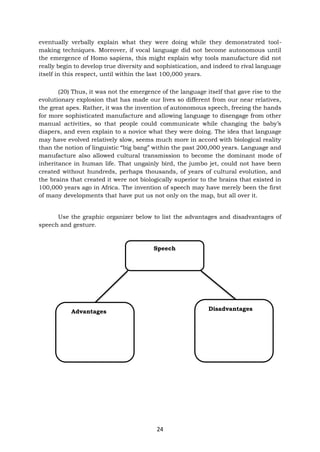
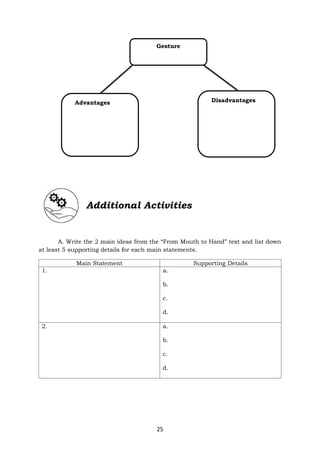
Use the graphic organizer below to list the advantages and disadvantages of
speech and gesture.
Speech
Advantages Disadvantages
25
Additional Activities
A. Write the 2 main ideas from the “From Mouth to Hand” text and list down
at least 5 supporting details for each main statements.
Main Statement Supporting Details
1. a.
b.
c.
d.
2. a.
b.
c.
d.
Gesture
Advantages Disadvantages
26
B. Write a 250-word summary from your answers above. Evaluate your
answer based on the given rubric.
__________________________________________________________________________________
__________________________________________________________________________________
__________________________________________________________________________________
__________________________________________________________________________________
__________________________________________________________________________________
__________________________________________________________________________________
__________________________________________________________________________________
__________________________________________________________________________________
__________________________________________________________________________________
__________________________________________________________________________________
__________________________________________________________________________________
__________________________________________________________________________________
__________________________________________________________________________________
__________________________________________________________________________________
__________________________________________________________________________________
RUBRIC
Criteria Excellent (4) Good (3) Fair (2) Poor (1) Score
Content
(Response to
the
question/s)
Your response
directly addressed
the question/s.
You used a thesis
statement and
relevant supporting
details.
Your response
directly addressed
the question/s.
You used a thesis
statement.
Your response
did not directly
address the
question/s but
you provided
some relevant
information that
indirectly
addressed the
question/s.
Your response
did not
address the
question/s.
Organization
(Flow of
Thoughts)
Your output is
well-organized. You
connected all the
ideas smoothly.
Your output is
organized. You
often connected
the ideas
smoothly.
Your output is
mainly organized.
You seldom
connected the
ideas.
Your output
lacked
organization.
Mechanics
(Output
Format)
You observed
proper output
format.
You somehow
observed proper
output format.
You barely
observed proper
output format.
You did not
observe proper
output format.
Total:
*Note: Add 3 points to your total scores
27
Answer Key
What
I
Know:
1.
Read
the
text.
2.
Write
the
main
idea.
3.
List
down
details.
4.
Create
a
Summary
and;
5.
Adjust
What’s
In:
Answers
may
vary.
What’s
More:
Answers
may
vary.
What
I
have
Learned:
Answers
may
vary.
What
I
Can
Do:
Answers
may
vary.
Assessment:
Answers
may
vary.
Additional
Activities:
Answers
may
vary.
28
References
DepEd (2016). English for Academic and Professional Purposes. Teachers Guide.
First Edition.
DepEd (2016). English for Academic and Professional Purposes. Learners Material.
First Edition.
DepEd (2020). Most Essential Learning Competencies (MELC). English for
Academic and Professional Purposes
For inquiries or feedback, please write or call:
Department of Education – Region III,
Schools Division of Bataan - Curriculum Implementation Division
Learning Resources Management and Development Section (LRMDS)
Provincial Capitol Compound, Balanga City, Bataan
Telefax: (047) 237-2102
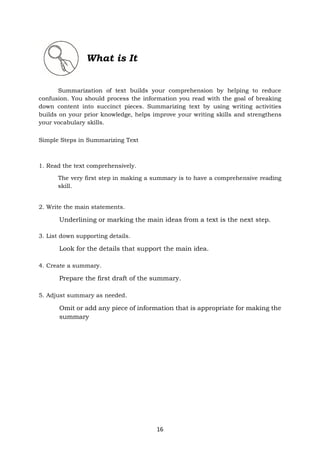
Email Address: bataan@deped.gov.ph

EAPP Quarter 1 – Module 2 Summarization of Text.pdf

  • 1.
    English for Academicand Professional Purposes Quarter 1 – Module 2: Summarization of Text
  • 2.
    English for Academicand Professional Purposes – Grade 11/12 Alternative Delivery Mode Quarter 1 – Module 2: Summarization of Text First Edition, 2020 Republic Act 8293, section 176 states that: No copyright shall subsist in any work of the Government of the Philippines. However, prior approval of the government agency or office wherein the work is created shall be necessary for exploitation of such work for profit. Such agency or office may, among other things, impose as a condition the payment of royalties. Borrowed materials (i.e., songs, stories, poems, pictures, photos, brand names, trademarks, etc.) included in this module are owned by their respective copyright holders. Every effort has been exerted to locate and seek permission to use these materials from their respective copyright owners. The publisher and authors do not represent nor claim ownership over them. Published by the Department of Education Secretary: Leonor Magtolis Briones Undersecretary: Diosdado M. San Antonio Printed in the Philippines by Department of Education – Schools Division of Bataan Office Address: Provincial Capitol Compound, Balanga City, Bataan Telefax: (047) 237-2102 E-mail Address: bataan@deped.gov.ph Development Team of the Module Writer: Rhenn B. Songco Editor: Ryan Jake F. Bariacto Reviewer: Ryan Jake F. Bariacto Illustrator: Leo Espinosa Layout Artist: Rhenn B. Songco Cover Design: LRMDS-Bataan Management Team: Schools Division Superintendent : Romeo M. Alip, PhD, CESO V Asst. Schools Division Superintendent : Roland M. Fronda, EdD, CESE Chief Education Supervisor, CID : Milagros M. Peñaflor, PhD Education Program Supervisor, LRMDS : Edgar E. Garcia, MITE Education Program Supervisor, AP/ADM : Romeo M. Layug Education Program Supervisor, English : Ilynne SJ Samonte District Supervisor, Pilar : Teresita R. Ordiales Division Lead Book Designer : Jenelyn D. Rivero District LRMDS Coordinator, Pilar : Joseph Ralph S. Dizon, PhD School LRMDS Coordinator : Rhenn B. Songco School Principal : Angelo R. Basilio, EdD District Lead Layout Artist, EAPP : Rhenn B. Songco District Lead Illustrator, EAPP : Marlon Q. Diego District Lead Evaluator, EAPP : Rea A. Pangilinan
  • 3.
    English for Academic andProfessional Purposes Quarter 1 – Module 2: Summarization of Text
  • 4.
    1 Introductory Message For thefacilitator: Welcome to the English for Academic and Professional Purposes – Grade 11/12 Alternative Delivery Mode (ADM) Module on Summarization of a Text! This module was collaboratively designed, developed and reviewed by educators both from public and private institutions to assist you, the teacher or facilitator in helping the learners meet the standards set by the K to 12 Curriculum while overcoming their personal, social, and economic constraints in schooling. This learning resource hopes to engage the learners into guided and independent learning activities at their own pace and time. Furthermore, this also aims to help learners acquire the needed 21st century skills while taking into consideration their needs and circumstances. In addition to the material in the main text, you will also see this box in the body of the module: As a facilitator you are expected to orient the learners on how to use this module. You also need to keep track of the learners' progress while allowing them to manage their own learning. Furthermore, you are expected to encourage and assist the learners as they do the tasks included in the module. Notes to the Teacher This contains helpful tips or strategies that will help you in guiding the learners.
  • 5.
    2 For the learner: Welcometo the English for Academic and Professional Purposes – Grade 11/12 Alternative Delivery Mode (ADM) Module on Summarization of a Text! The hand is one of the most symbolized part of the human body. It is often used to depict skill, action and purpose. Through our hands we may learn, create and accomplish. Hence, the hand in this learning resource signifies that you as a learner is capable and empowered to successfully achieve the relevant competencies and skills at your own pace and time. Your academic success lies in your own hands! This module was designed to provide you with fun and meaningful opportunities for guided and independent learning at your own pace and time. You will be enabled to process the contents of the learning resource while being an active learner. This module has the following parts and corresponding icons: What I Need to Know This will give you an idea of the skills or competencies you are expected to learn in the module. What I Know This part includes an activity that aims to check what you already know about the lesson to take. If you get all the answers correct (100%), you may decide to skip this module. What’s In This is a brief drill or review to help you link the current lesson with the previous one. What’s New In this portion, the new lesson will be introduced to you in various ways such as a story, a song, a poem, a problem opener, an activity or a situation. What is It This section provides a brief discussion of the lesson. This aims to help you discover and understand new concepts and skills. What’s More This comprises activities for independent practice to solidify your understanding and skills of the topic. You may check the answers to the exercises using the Answer Key at the end of the module. What I Have Learned This includes questions or blank sentence/paragraph to be filled in to process what you learned from the lesson. What I Can Do This section provides an activity which will help you transfer your new knowledge or skill into real life situations or concerns.
  • 6.
    3 Assessment This isa task which aims to evaluate your level of mastery in achieving the learning competency. Additional Activities In this portion, another activity will be given to you to enrich your knowledge or skill of the lesson learned. This also tends retention of learned concepts. Answer Key This contains answers to all activities in the module. At the end of this module you will also find: The following are some reminders in using this module: 1. Use the module with care. Do not put unnecessary mark/s on any part of the module. Use a separate sheet of paper in answering the exercises. 2. Don’t forget to answer What I Know before moving on to the other activities included in the module. 3. Read the instruction carefully before doing each task. 4. Observe honesty and integrity in doing the tasks and checking your answers. 5. Finish the task at hand before proceeding to the next. 6. Return this module to your teacher/facilitator once you are through with it. If you encounter any difficulty in answering the tasks in this module, do not hesitate to consult your teacher or facilitator. Always bear in mind that you are not alone. We hope that through this material, you will experience meaningful learning and gain deep understanding of the relevant competencies. You can do it! References This is a list of all sources used in developing this module.
  • 7.
    4 What I Needto Know This module is designed and written to help you acquire knowledge of appropriate reading strategies for a better understanding of academic texts. At the end of this module, you will be able to produce a detailed abstract of information gathered from the various academic texts read by: 1. Using various techniques in summarizing a variety of academic texts (CS_EN11/12A-EAPP-Ia-c-4). What I Know What are the five steps in summarizing a text? Step 1: __________________________________________________________________________________ Step 2: __________________________________________________________________________________ Step 3: __________________________________________________________________________________ Step 4: __________________________________________________________________________________ Step 5: __________________________________________________________________________________
  • 8.
    5 Lesson 3 Summarization ofa Text Summarization of a text teaches you how to take a large selection of text and reduce it to the main points for more concise understanding. Upon reading a passage, summarizing helps you learn to determine essential ideas and consolidate important details that support them. It is a technique that enables you to focus on key words and phrases of an assigned text that are worth noting and remembering. What’s In Complete the table about Common Types of Text Structure. Type of Text Structure Definition Visual Representation Description Cause and Effect Compare and Contrast
  • 9.
    6 Chronological Order Problem and Solution What’s New ABrief History of English By: Paul Roberts (1) No understanding of the English language can be very satisfactory without the notice of the history of the language. But we have to make do with just a notion. The history of English is long and complicated, and we can only hit the high spots. (2) The history of our language begins a little after 600 C.E. Everything before that was pre-history, which means that we can guess at it but can’t prove much. For a thousand years or so before the birth of Christ, our linguistic ancestors were savage wandering through the forest of Northern Notes to the Teacher This module prepares the learners to produce abstract of information gathered from academic texts by using different techniques in summarization.
  • 10.
    7 Europe. Their languagewas part of the Germanic branch of the Indo- European family. (3) At the time of the Roman Empire-say, from the beginning of the Christian era to around 400 C.E/- the speakers of what was to become English were scattered along the north coast of Europe. They spoke a dialect of Low German. More exactly, they spoke several different dialects, since they were several different tribes. The names given to the tribe who got to English are Angles, Saxons, and Jutes. For convenience, we can refer to them all as Anglo-Saxons. (4) Their first contact with civilization was a rather thin acquaintance with the Roman Empire on whose borders they lived. Probably some of the Anglo-Saxons wondered into the empire occasionally, and certainly Roman merchants and traders travelled among the tribes. At any rate, this period saw the first if our so many borrowing from Latin. Such words as kettle, wine, cheese, butter, cheap, plum, gem, bishop, church were borrowed at this times. They show of the relationships of the Anglo-Saxons with the Romans. The Anglo-Saxons were learning, getting their first taste of civilization. (5) They still had a long way to go, however, and their first step was to help smash the civilization they were learning from. In the fourth century the Roman power weakened badly. While the Goths were pounding, away at the Romans in the Mediterranean countries, their relatives, he Anglo-Saxons, began to attach Britain. (6) The Romans has been the ruling power in Britain since 43 C.E. They have subjugated the Celts whom they found living there and had succeeded in settling up a Roman administration. The Roman influence did not extend to the outlying parts of the British Isles. In Scotland, Whales, and Ireland the Celts remained free and wild, they made periodic forays against the Romans in England. Among other defense measures, the Romans build the famous Roman Walls to ward off the tribes in the north. (7) Even in England the Roman power was thin. Latin did not become the language of the country as it did in Gaul and Spain. The mass of people continued to speak Celtics, with Latin and the Roman civilization it contained in use as a top dressing. (8) In the fourth century, troubles multiplied for the Romans in Britain. Not only did the untamed tribes of Scotland and Whales grow more and more restive, but also the Anglo-Saxons began to make pirate raids on the eastern coast. Furthermore, there was growing difficulty everywhere in the Empire, and the legions in Britain were siphoned off to fight elsewhere. Finally, in 410 C.E. the last Roman ruler in England, bent on becoming the emperor, left the island and took the last legions with him. The Celts were left in possession of Britain but almost defenseless against the impending Anglo-Saxons attack. (9) Not much is surely known about the arrival of the Anglo-Saxons in England. According to the best early source, the eighth-century historian Bade, the Jutes came in 449 in response to a plea from the Celtics king,
  • 11.
    8 Vortigern, who wantedtheir help against the Picts attacking the north. The Jutes subdue the Picts, but then quarrelled and fought with Vortigern, and with reinforcement from the continent, settled permanently in Kent. Somewhat later the Angles established themselves in the eastern England and the Saxons in the south and west. Bede’s account is plausible enough, and these were probably the main lines of the invasion. (10) We don’t know, however, that the Angles, Saxons, and Jutes were long time securing themselves in England. Fighting went on for as long as a hundred years before the Celts in Celts were all killed, driven into Wales, or reduced to slavery. This is the period of King Arthur, who was not entirely mythological. He was a Romanized Celt, a general, though probably not a king. He had some success against the Anglo-Saxons, but it was only temporary. By 550 or so the Anglo-Saxon were finally established, English was in England. (11) All this is pre-history, so far as the language is concerned. We have no record of the English language until after 600, when the Anglo-Saxon were converted to Christianity and learned the Latin alphabets. The conversion began, to be precise in 597 within thirty to forty years. The conversion was a great advance for the Anglo-Saxons, not only of the spiritual benefits but also because it re-established contact with what remained of Roman civilization. The civilization didn’t amount to much in the year 600, but it was certainly, superior to anything in England up to the time. (12) It is customary to divide the history of the English language into three periods: Old English, Middle English, and Modern English. Old English runs from the earliest record-i.e. seventh century- to about 1100: Middle English from 1100 to 1450 or 1500; Modern English form 1500 to the present day. Sometimes Modern English is further divided into Early Modern, 1500-1700, and Late Modern from 1700 to the present. (13) When England came into history, it was divided into several more or less autonomous kingdoms, some of which at times exercised a certain amount of control over the others. In the century after the conversion the most advanced kingdom was Northumbrians, the area between the Humber River and the Scottish border. By 700 C.E the Northumbrians had developed a respectable civilization, the finest in Europe. It is sometimes called the Northumbian Renaissance, and it was the first of the several renaissance through which Europe struggled upward out of the ruins of the Roman Empire. It was in this period that the best of the Old English literature was written, including the epic poem Beowulf. (14) In the Eighth century, Northumbian power declined, and the center of the influence moved southward to Mercia, the kingdom of Midlands. A century later center shifted again, and Wessex, the country of the West Saxons, became the leading power. The most famous king of the West Saxons was Alfred the Great, who reigned in the second half of the ninth century,
  • 12.
    9 dying in 901.He was famous not only as a military man and administrator but also as a champion of learning. He founded and supported schools and translated or caused to be translated many books from Latin into English. At this time also much of the Northumbian literature of two centuries earlier was copied in West Saxons. Indeed, the great bulk of Old English writing which has come down to us is the West Saxon dialect of 900 or later. (15) In the military sphere, Alfred’s great accomplishment was his successful opposition to the Viking invasion. In the ninth and tenth centuries, the Norsemen emerged in their ships from their homeland in Denmark and the Scandinavian Peninsula. They travelled and attacked and plundered at their will and almost with impunity. They ravaged Italy and Greece, settled in France, Russia and Ireland, colonized Iceland and Greenland, and discovered America several centuries before Columbus. Nor they overlooked England. (16) After many years of hit-and-run raids, the Norsemen landed an army on the east coast of England in the year 886. There was nothing much to oppose them except the Wessex power led by Alfred. The long struggle ended in 877 with a treaty by which a line was drawn roughly from the northwest of England to the southwest. On the eastern side of the line, Norse rule was to prevail. This was called the Danelaw. The western side was to be governed by Wessex. (17) The linguistic result of all this was a considerable injection of Norse into the English language. Norse was at this time not so different from English as Norwegian or Danish is now. Probably the speakers of English could understand, more or less, the language of the new comers who had moved into eastern England. At any rate, there was considerable interchange and word borrowing. Examples of Norse words in the English language are sky, give, law, egg, outlaw, leg, ugly, scant, crawl, scowl, take, thrust. There are hundreds more. We have even borrowed some pronouns from Norse-they, their, and them. These words were borrowed first by the eastern and northern dialects and then in the course of hundreds of years made their way into English generally. (18) It is supposed also-indeed, it must be true-that the Norsemen influenced the sound structure and the grammar of English. But this is hard to demonstrate in detail. (19) We may now have an example of Old English. The favourite illustration is the Lord’s Prayer, since it needs no translation. This has come to us in several different versions, Here is one: Faeder ure [thorn] u[eth]e eart on heofonum si [thorn] in nama gehalgd. Tobecume [thorn]in rice. Gewur[eth]e [thorn]in willa on eor[eth]an swa swa on heofonum. Urne gedaeghwamlican half slye us to daeg. An forgyf us ure gyltas swa swa we forgyfa[thorn] urum glytendum. And ne gelaed [thorn]u us on cost nunge ac alys of yfele. So[eth]lice.
  • 13.
    10 (20) Some ofthe differences between this and Modern English are merely differences in orthography. For instance, the sign æ is what Old English writers used for a vowel sound like that in modern hat or and. The th sounds of modern thin or then are represented in Old English by [thorn] or [eth]. But of course there are many differences in sounds too. Ure is the ancestor of modern our, but the first vowel was like that in too or ooze. Hlaf is modern loaf; we have dropped the h sound and changed the vowel, which in half was pronounce something like the vowel in father. Old English had some sounds which we do not have. The sound represented by y does not occur in Modern English. If you pronounced the vowel in bit with your lips rounded, you may approach it. (21) In grammar, Old English was much more highly inflected than Modern English is. That is, there were more case endings for nouns, more person and number ending for verbs, a more complicated pronoun system, various endings for adjectives, and so on. Old English nouns had four cases –nominative, genitive, dative, accusative. Adjectives had five- all these and an instrumental case besides. Present day English has only two cases from nouns-common case and possessive case. Adjectives now have no case system at all. On the other hand, we now use more rigid word order and more structure words (preposition, auxiliaries, and the like) to express relationships than Old English did. (22) Some of this grammar we can see in the Lord’s Prayer. Heofonum, for instance is a dative plural; the nominative singular was heofon. Urne is an accusative singular; the nominative is ure. In urum gyltendum both words are dative plural. Forgyfap is the third person plural form of the verb. Word order is different. “urne gedaeghwamlican half syle us” in place of “Give us our daily bread.” And so on. (23) In vocabulary Old English is quite different from Modern English. Most of the Old English words are what we may call native English; that is, words which have not been borrowed from other languages but which have been a part of English ever since English was a part of Indo-European. Old English did certainly contain borrowed words. We have seen that many borrowing were coming in from Norse. Rather large numbers had been borrowed from Latin, too. Some of these were taken while the Anglos-Saxons were still in the continent (cheese, butter, bishop, kettle, etc.); a large number came into English after Conversion (angle, candle, priest, martyr, radish, oyster, purple, school, spend, etc.). But the great majority of Old English words were native English. (24) No on the contrary, the majority of words in English are borrowed, taken mostly from Latin and French. Of the words from The American College Dictionary only about 14 percent are native. Most of these to be sure, are common, high frequency words-the, of, I, and because, man, mother, road, etc.; of the thousand most common words in English, some 62 percent are native English. Even so, the modern vocabulary is very much Latinized and Frenchified. The Old English vocabulary was not.
  • 14.
    11 (25) Sometime betweenthe year 1000 and 1200 various important changes took place in the structure of English, and Old English became Middle English. The political event which facilitated these changes was the Norman Conquest. The Normans, as the name shows, came originally from Scandinavia. In the early tenth century they established themselves in Northern France, adopted the French language, and developed a vigorous kingdom and a very passable civilization. In the year 1066, led by Duke William, they crossed the Channel and made themselves master of England. For the next several hundred years, England was ruled by kings and whose first language was French. (26) One might wonder why, after the Norman Conquest, French did not become the national language, replacing English entirely. The reason is that the conquest was not a national migration, as the early Anglo-Saxons invasion had been. Great numbers of Normans came to England, but they came as rulers and landlords. French became the language of the court, the language of nobility, the language of the polite society, the language of literature. But it did not replace the English language as the language of the people. There must be hundreds of towns and villages in which French was never heard except when visitors of high station passed through. (27) But English, though survived as the national language, was profoundly changed after the Norman Conquest. Some of the changes-in sound structure and grammar-would no doubt have taken place whether there have been a conquest or not. Ever before 1066 the case system of English nouns and adjectives was becoming simplified; people came to rely more on word order and prepositions than on inflectional endings to communicate their meanings. The process was speeded up by sound changes which caused many of the endings to sound alike. But no doubt the conquest facilitated the changes. German, which did not experience a Norman Conquest, is today rather highly inflected compared to its cousin English. (28) But it is in the vocabulary that the effects of the Conquest are most obvious. French ceased, after a hundred years or so, to be the native language of very many people in England, but it continued-and continues still- to be a zealously cultivated sound language, the mirror of elegance and civilization. When one spoke English, on introduced not only French ideas and French things but also their French names. This was not only easy but also socially useful. To pepper one’s conversation with French expressions was to show that one was well bred, elegant, au courant. The last sentence shows that the process was not yet dead. By using au courant instead of, say, abreast of things, the writer indicates that he is no dull clod who knows only English but an elegant person aware of how things are done in le haut monde. (29) Thus French word came into English, all sorts of them. There were words to do with government; parliament, majesty, treaty, alliance, tax, government; church words; parson, sermon, baptism, incense, religion; words
  • 15.
    12 for foods; veal,beef, mutton, bacon, jelly, peach, lemon, cream, biscuit; colours; blue, scarlet, vermilion, household words; curtain, chair, lamp, towel, blanket, parlour; play words; dance, chess, music, leisure, conversation; literary words; story, romance, poet, literary; learned words; study, logic, grammar, noun, surgeon, anatomy, stomach; just ordinary words of all sorts; nice, second, very, age, bucket, gentle, final, fault, flower, cry, count, sure, move, surprise, plain. (30) All these and thousands more poured into English vocabulary between 1100 and 1500, until at the end of that time, many people must have had more French words than English at their command. This is not to say that English became French. English remained English in sound structure and in grammar, though these also felt the ripples of the French influence. The very heart of the vocabulary, too, remained English. Most of the high frequency words-the pronouns, the prepositions, the conjunctions, the auxiliaries, as well as a great ordinary nouns and verbs and adjectives-were not replaced by borrowing. (31) Middle English, then, was still Germanic language, but it differed from Old English in many ways. The sound system and the grammar change a good deal. Speakers made less use of case systems and other influential devices and relied more on word order and structure words to express their meanings. This is often said to be simplification, but it isn’t really. Languages don’t become simpler; they merely exchange one kind of complexity for another. Modern language is not a simple language, as any foreign speakers who try to learn it will hasten to tell you. (32) For us, Middle English is simpler than the Old English just because it is closer to Modern English. It takes three or four months at least to learn to read Old English prose and more than that for poetry. But a week of good study should put one touch with the Middle English poet Chaucer. Indeed you may be able to make some sense of Chaucer straight off, though you would need instruction in pronunciation to make it sound like poetry. Here is a famous passage from the General Prologue to the Canterbury Tales, fourteenth century: Ther was also a Nonne, a Prioresse. That of hir smyling was ful simple and coy; Hir gretteste oot was but by Seint Loy; And she was cleped madame Eglentyne. Ful weel she soong the service dyvyne. Entuned in hir nose ful seemly, And Frenshe she spak ful faire and fetisly, After the scole of Stratford- atte-Bowe, For Frenshe of Parys was to hirse unknowe. (33) Sometime between 1400 and 1600 English underwent a couple of sound changes which made language of Shakespeare quite different from that of Chaucer. Incidentally, these changes contributed much to the chaos in which English spelling now finds itself.
  • 16.
    13 (34) One changewas the elimination of a vowel sound in certain unstressed positions at the end of words. For instance, the words name, stone, wine, dance were pronounced as two syllables by Chaucer but as just one by Shakespeare. The e in these words became, as we say, “silent”. But it wasn’t silent for Chaucer, it represented a vowel sound. So also the words laughed, seemed, stored would have been pronounced by Chaucer as two- syllable words. The change was an important one because it affected thousands of words and gave different aspects to the whole language. (35) The other change is what is called the Great Vowel Shift. Thus was a systematic shifting of half a dozen vowels and diphthongs in stressed syllables. For instance, the word nam had in Middle English a vowel something like that in the modern word father; wine, had the vowel of modern mean; he was pronounced something like modern hey; mouse sounded like moose; moon had the vowel of moan. Again the shift was through going and affected all the word in which these vowels sounds occurred. Since we still keep the Middle English system of spelling these words, the differences between Modern English and Middle English are often more real than apparent. (36) The vowel shift has meant also that we have come to use an entirely different set of symbols for representing vowel sounds that is used by the writers of such languages as French, Italian or Spanish, in which no such vowel occurred. If you come across a strange word-say, bine-in an English book, you will announce it according to the English system, with the vowels of wine or dine. But if you read bine in the French, Italian, or Spanish book, you will pronounce it with the vowel of mean or seen. (37) These two changes, then, produced basic differences between Middle English and Modern English. But there were several other developments that had an effect upon the language. One was the invention of printing, an invention introduced to England by William Caxton in the year 1472. Where before books had been rare and costly, they suddenly become cheap and common. More and more people learn to read and write. This was the first of many advances in communication in which have worked to unify languages and to arrest the development of dialect difference, though of course the printing affects writing principally rather than speech. Among other things it hastened the standardization of spelling. (38) The period of Early Modern English- that is, the sixteenth and seventeenth centuries-was also the period of the English Renaissance, when people developed, on the other hand, a keen interest in the past and, on the other, a more daring and imaginative view of the future. New ideas multiplied, and new ideas meant new languages. Englishmen had grown accustomed to borrowing words from French as a result of the Norman Conquest; now they borrowed from Latin and Greek. As we have seen, English have been raiding Latin from Old English times and before. But now the floodgates really
  • 17.
    14 opened, and thousandsof words from the classic languages poured in. Pedestrian, bonus, anatomy, contradict, climax, dictionary, benefit, multiply, exist, paragraph, initiate, scene, inspire are random examples. Probably the average educated American today has more words from French in his vocabulary than from the native English source and more from Latin than the French. (39) The greatest writer of the Early Modern English period is of course Shakespeare, and the best-known book is the King James Version of the Bible, published in 1611. The bible (if not Shakespeare) has made many features of Early Modern English perfectly familiar to many people down to present time, even though we do not use these features in the present-day speech and writing. For instance, the old pronounce thou and thee have dropped out of use now, together with their verb forms, but they are still familiar to us in prayer and in Biblical quotation. “Whither thou goest, I will go” Such form as hath and doth have been replaced by has and does, “Goes he hence tonight? Would now be “Is he going away tonight?” Shakespeare’s “Fie o’nt, sirrah” would be “Nuts to that, Mac.” Still, all these expressions linger with us because of the power of the works in which they occur. (40) It is not always realized, however, that considerable sound changes have taken place between Early Modern English and the English of the present day. Shakespearean actors putting on a play speak the words, properly enough, in their modern pronunciation. But it is very doubtful that this pronunciation would be understood at all by Shakespeare. In Shakespeare’s time, the word reason was pronounced raisin; face had the sound of the modern glass; the l in would, should, palm was pronounce. In these points and a great many others, the English language has moved a long way from what it was in 1600. (41) The history of English since 1700 is filled with many movements and counter movements, of which we can notice only a couple. One of this is the vigorous attempt made in the eighteenth century, and rather the half- hearted attempts made since, to regulate and control the English language. Many people of the eighteenth century, not understanding very well the forces which govern the language, proposed to polish and prune and restrict English, which they felt was proliferating too wildly. There was much talk on an academy which would rule on what people could and could not say and write. The academy never came into being, but the eighteenth century did succeed in establishing certain attitudes which, though they haven’t had much effect on the development of the language itself, have certainly changed the native speaker’s feeling about the language. (42) In part a product of the wish to fix and establish the language was the development of the dictionary. The first English dictionary was published in 1603; it was a list of 2,500 words briefly defined. Many others were published with gradual improvement until Samuel Johnson published his
  • 18.
    15 English Dictionary in1775. This steadily revised, dominated the field in England for nearly a hundred years. Meanwhile in America, Noah Webster published his dictionary in 1828, and before long dictionary publishing was a big business in this country. The last century has seen the publication of one great dictionary; the twelve volume Oxford English Dictionary, compiled in the course of seventy-five years through the labour of many scholars. We have also, of course, numerous commercial dictionaries which are good as the public wants them to be if not, indeed, rather better. (43) Another product of the eighteenth century was the invention of “English Grammar”. As English came to replace Latin as the language of scholarship it was felt that one should also be able to control and dissect it, parse and analyse it, as one could Latin. What happened in practice was that the grammatical description that applied to Latin was removed and superimposed on English. This was silly, because English is an entirely different kind of language, with its own forms and signals and ways of producing meaning. Nevertheless, grammar on the Latin model were worked out and taught in the schools. In many schools they are still being taught. This activity is not often popular with school children, but it is sometimes an interesting and instructive exercise in logic. The principal harm in it is that it has tended to keep people from being interested in English and has obscured the real features of English structure. (44) But probably the most important force in the development of English in the modern period has been the tremendous expansion of English- speaking peoples. In 1500 English was minor language, spoken by a few people on a small island. Now perhaps the greatest language of the world, spoken natively by over a quarter of a billion people and as a second language by many millions more. When we speak of English now, we must specify whether we mean American English, British English, Australian English, Indian English, or what, since the differences are considerable. The American cannot go to England, or the Englishman to America confident that he will always understand and be understood. The Alabaman in Iowa or the Iowan in Alabama shows himself a foreigner every time he speaks. It is only because the communication has become fast and easy that English in this period of its expansion has not broken into a dozen mutually unintelligible languages.
  • 19.
    16 What is It Summarizationof text builds your comprehension by helping to reduce confusion. You should process the information you read with the goal of breaking down content into succinct pieces. Summarizing text by using writing activities builds on your prior knowledge, helps improve your writing skills and strengthens your vocabulary skills. Simple Steps in Summarizing Text 1. Read the text comprehensively. The very first step in making a summary is to have a comprehensive reading skill. 2. Write the main statements. Underlining or marking the main ideas from a text is the next step. 3. List down supporting details. Look for the details that support the main idea. 4. Create a summary. Prepare the first draft of the summary. 5. Adjust summary as needed. Omit or add any piece of information that is appropriate for making the summary
  • 20.
    17 What’s More Use thegraphic organizer below to make a timeline on the brief history of English. What I Have Learned Complete the table below. Base your answers on the “A Brief History of English” text. Main Idea Supporting Ideas Unnecessary Information History of English
  • 21.
    18 What I CanDo Write a 200-word essay to summarize the history of English. Evaluate your answer based on the given rubric. __________________________________________________________________________________ __________________________________________________________________________________ __________________________________________________________________________________ __________________________________________________________________________________ __________________________________________________________________________________ __________________________________________________________________________________ __________________________________________________________________________________ __________________________________________________________________________________ __________________________________________________________________________________ __________________________________________________________________________________ __________________________________________________________________________________ __________________________________________________________________________________ __________________________________________________________________________________ __________________________________________________________________________________ RUBRIC Criteria Excellent (4) Good (3) Fair (2) Poor (1) Score Content (Response to the question/s) Your response directly addressed the question/s. You used a thesis statement and relevant supporting details. Your response directly addressed the question/s. You used a thesis statement. Your response did not directly address the question/s but you provided some relevant information that indirectly addressed the question/s. Your response did not address the question/s. Organization (Flow of Thoughts) Your output is well-organized. You connected all the ideas smoothly. Your output is organized. You often connected the ideas smoothly. Your output is mainly organized. You seldom connected the ideas. Your output lacked organization. Mechanics (Output Format) You observed proper output format. You somehow observed proper output format. You barely observed proper output format. You did not observe proper output format. Total: *Note: Add 3 points to your total scores
  • 22.
    19 Assessment From Hand toMouth By: Michael C. Corballis (1) Imagine trying to teach a child to talk without using your hands or any other means of pointing of gesturing. The task would surely be impossible. There can be little doubt that bodily gestures are involved in the development of language, both in the individual and in the species. Yet, once the system is up and running, it can function entirely on vocalizations, as when two friends chat over the phone and create in each other’s minds a world of events far removed from the actual sounds that emerge from their lips. My contention is that the vocal element emerged relatively late in hominid evolution. If the modern chimpanzee is to be our guide, the common ancestor of 5 or 6 million years ago would have been utterly incapable of a telephone conversation but would have been able to make voluntary movements of hands and face that could the least serve as a platform upon which to build a language. (2) Evidence suggests that the vocal machinery necessary for autonomous speech developed quite recently in hominid evolution. Grammatical language may well have begun to emerge around 2 million years ago but would at first have been primary gestural, though no doubt punctuated with grunts and other vocal cries that were at first largely involuntary and emotional. The complex adjustments necessary to produce speech as we know it today would have taken some time to evolve, and may not have been complete until some 170,000 years ago, or even later, when Homo sapiens emerged to grace, but more often disgrace, the planet. These adjustments may have been incomplete even in our close relatives the Neanderthals; arguably, it was this failure that contributed to their demise. (3) The question now is what were the selective pressures that led to the eventual dominance of speech? On the face of it, an acoustic medium seems a poor way to convey information about the world; not for nothing is it said that a picture is worth a thousand words. Moreover, signed language has all the lexical and grammatical complexity of spoken language. Primate evolution is itself a testimony to the primacy of the visual world. We share with monkeys a highly sophisticated visual system, giving us three- dimension information in colour about us, and an intricate system for exploring that world through movement and manipulation. Further, in a hunter- gatherer environment, where predators and prey are major concern, there are surely advantages in silent communication since sound acts as a general alert. And yet we came to communicate about the world in a medium that in all primates except ourselves is primitive and stereotyped- and noisy.
  • 23.
    20 (4) Before weconsider the pressures that may have favoured vocalization over gestures, it bears repeating that the switch from hand to mouth was almost certainly not an abrupt one. In fact, manual gestures still feature prominently in language; even as fluent speakers gesture almost as much as they vocalize, and of course deaf communities spontaneously develop signed language. It has also been proposed that speech itself is in many respects better conceived as composed of gestures rather than sequences of these elusive phantoms called phonemes. In this view, language evolved as a system of gestures based on movements of the hands, arms and face, including movements of the mouth, lips, and tongue. It would not have been a big steps to add voicing to the gestural repertoire, at first as mere grunts, but later articulated so that invisible gestures of the oral cavity could rendered accessible, but to the ear rather than the eye. There may therefore have been continuity from the language that was almost exclusively manual and facial, though perhaps punctuated by involuntary grunts, to one in which the vocal component has a much more extensive repertoire and is under voluntary control. The essential feature of modern expressive language is not that it is purely vocal, but rather that the component can function autonomously and provide the grammar as well as meaning of linguistics communication. (5) What, then, are the advantages of a language that can operate autonomously through voice and ear, rather than hand and eye? Why speech? Advantages of Arbitrary Symbols (6) One possible advantage of vocal language is its arbitrariness. Except in rare cases of onomatopoeia, spoken words cannot be iconic, and they therefore offer scope for creating symbols that distinguish between object or actions that look alike or might otherwise be confusable. The names of similar animals, such as cats, lions, tigers, cheetahs, lynxes, and leopards, are rather different. We may be confused as to which animals is which, bur at least it is clear which one we are talking about. The shortening of words overtime also makes communication more efficient, and some of us have been around long enough to see this happen: television has become TV or telly, microphone has been reduced to mike (or mic), and so on. The fact that more frequent words tends to be shorter than less frequent ones was noted by the American philologist George Kingsley Zipf, who related it to a principle of “least effort.” So long as signs are based on iconic resemblance, the signer has little scope for these kinds of calibration. (7) It may well have been very important for hunter-gatherers to identify and name a great many similar fruits, plants, trees, animals, birds, and so on, and attempts at iconic representation would eventually only confuse. Jared Diamond observes that the people living largely traditional lifestyle in New Guinea can name hundreds of birds, animals, and plants, along with details about each of them. These people are illiterate, relying on word of mouth to pass on information, not only about potential foods, but also about how to survive dangers, such as crop failures, droughts, cyclones, and raids from other tribes. Diamond suggests that the main
  • 24.
    21 repository of accumulatedinformation is elderly. He points out that humans are unique among primates in that they can expect to live to a ripe old age, well beyond the age of child bearing (although perhaps it was not always so). A slowing down of senescence may well have been selected in evolution because the knowledge retained by the elderly enhanced the survival of their younger relatives. An elderly, knowledgeable granny may help us all live a little longer, and she can also look after the kids. (8) In the naming and transmission of such detailed information, iconic representation would almost certainly be inefficient: edible plants or berries could be confused with poisonous ones, and animals that attack confused with those that are benign. This is not to say that gestural signs could not to do the trick. Manual signs readily become conventionalized and convey abstract information. Nevertheless, there may be some advantage to using spoken words, since they have virtually no iconic content to begin with, and so provide a ready-made system for abstraction. (9) I would be on dangerous ground, however, if I were to insist too strongly that speech is linguistically superior to signed language. After all, students at Gallaudet University seem pretty unrestricted in what they can learn; signed language apparently functions well right through to university level- and still requires students to learn lots of vocabulary from their suitably elderly professor. It is nevertheless true that many signs remain iconic, or at least partially so and are therefore somewhat tethered with respect to modifications that might enhance clarity or efficiency of expression. But there may well be a trade- off here. Signed language may easier to learn than spoken ones. Especially in initial stages of acquisition, in which the child comes to understand the linking of objects and the action with their linguistic representations. But spoken languages, ones acquired, may relay messages more accurately, since spoken words are better calibrated to minimize confusion. Even so, the iconic component is often important, and as I look the quadrangles outside my office I see how freely the students there are embellishing their conversations with manual gestures. In The Dark (10) Another advantage of speech over gesture is obvious: we can use it in the dark! This enables us to communicate at night, which not only extends the time available for meaningful communications but may also have proven decisive in the competition for space and resources. We of the gentle species Homo sapiens have a legacy of invasion, having migrated out of Africa into territories inhabited by other hominins who migrated earlier. Perhaps it was the newfound ability to communicate vocally, without the need for a visual component that enabled our fore-bearers to plan, and even carry out, invasion at night, and so vanquish the earlier migrants. (11) It is not only a question of being able to communicate at night. We can also speak to people when objects intervene and you can’t see them, as when you yell to your friend in another room. All this has to do, of course, with the nature of
  • 25.
    22 sound itself, whichtravels equally well in the dark as in the light and wiggles its way around obstacles. The wall between you and the base drummer next door may attenuate the sound but does not completely block it. Vision, on the other hand, depends on light reflected from an external source, such as the sun, and is therefore ineffective when no such source is available. And the light reflected from the surface of an object to your eye travels in rigidly straight lines, which means that it can provide detailed information about shape but is susceptible to occlusion and interference. In terms of the sheer ability to reach those with whom you are trying to communicate, words speak louder than actions. Listen to Me! (12) Speech does have one disadvantage, though: it is generally accessible to those around you and is therefore less convenient for sending confidential or secret messages or for planning an attack on enemies within earshot. To some extent, we can overcome this impediment by whispering. And sometimes, people resort to signing. But the general alerting function of sounds also has its advantages. When Mark Anthony cried, “Friends, Romans, countrymen, lend me ears.” he was trying to attract attention as well as deliver a message. (13) In the evolution of speech, the alerting component of language might have consisted at first simply of grunt that accompany gestures to give emphasis to specific actions or encourage reluctant offspring to attend while a parent lays down the law. It is also possible that non-vocal sounds accompanied gestural communication. Russell Gray has suggested to me that clicking one’s fingers as children often do when putting their hands up in class to answer a question, may be a sort of “missing link” between gestural and vocal language. I know of no evidence that chimpanzees or other nonhuman primates are able to click their fingers as humans can, although lip smacking, as observed in chimpanzees, may have played a similar role. Sounds may therefore have played a similar and largely alerting role in early evolution of language, gradually assuming more prominence in conveying the message itself. (14) For humans, visual signals can only attract attention if they occur within a fairly restricted region of space, whereas the alerting power of sound is more or less independent of where its source is located relative to listener. And sound is a better alerting medium in other respects as well. No amount of gesticulation will wake a sleeping person, whereas a loud yell will usually do the trick. The alerting power of sound no doubt explains why animals have evolved vocal signals for sending messages of alarm. Notwithstanding the peacock’s tail or parrot’s gaudy plumage, even birds prefer to make noises to attract attention, whether in proclaiming territory or warning of danger. Visual signals are relatively inefficient because they may elude our gaze, and in any case we can shut them out by closing our eyes, as we vulnerable to auditory assault.
  • 26.
    23 (15) Speech hasanother, and subtler, attentional advantage. Manual gesture is much more demanding of attention, since you must keep your eyes fixed on gesturer in order to extract her meaning, whereas speech can be understood regardless of where you are looking. There are a number of advantages in being able to communicate with people without having to look at them. You can effectively divide attention, using speech to communicate with a companion while visual attention is deployed elsewhere, perhaps to watch a football game or to engage in some joint activity, like building a boat. Indeed, the separation of visual and auditory attention may have been critical in the development of pedagogy. Three Hands Better than Two (16) Another reason why vocal language may have arisen is that it proves an extra medium. We have already seen that most people gesture with their hands, and indeed their faces, while they talk. One might argue then, that the addition of vocal channel provides additional texture and richness to the message. (17) But perhaps it is not a simply a matter of being better. Susan Golden- Meadow and David McNeill suggest that speech may have evolved because it allows the vocal and manual components to serve different and complimentary purposes. Speech is perfectly adequate to convey syntax, which has no iconic or mimetic aspect, and can relieve the hands and arms of this chore. The hands and arms, of course, well adapted to providing the mimetic aspect of language, indicating in analogue fashion the shapes and sizes of things, or the direction of movements, as in the gesture that might accompany any statement “he went that a-way.” By allowing the voice to take over the grammatical component, the hands are given free rein, as it were, to provide the mimetic component. (18) But speech may have evolved, not because it gave the hands freer rein for mimetic expression, but rather because it freed the hands to do other activities. Charles Darwin, who seems to have thought of almost everything, wrote, “We might have used our fingers as efficient instruments, for a person with practice can report to a deaf man every word of a speech rapidly delivered at a public meeting, but the loss of our hands, while thus employed, would have been a serious inconvenience.” It would clearly be difficult to communicate manually while holding an infant, or driving a car, or carrying a shopping, yet we can and do talk while doing these things. (19) Speech has the advantage over manual gestures in that it can be accomplished in parallel with manual demonstration. Demonstrations might themselves be considered gestures, of course, but the more explanatory aspect of pedagogy, involving grammatical structure and symbolic content, would interfere with manual demonstration if they were too conveyed manually. Clearly, it is much easier and more informative to talk while demonstrating than to try to mix linguistic signs in with the demonstration. This is illustrated by a good TV cooking show, where chefs is seldom at a lost for either word or ingredients. It may not be far fetch to suppose that the selective advantages of vocal communication emerged when the hominins began to develop a more advanced tool technology, and they could
  • 27.
    24 eventually verbally explainwhat they were doing while they demonstrated tool- making techniques. Moreover, if vocal language did not become autonomous until the emergence of Homo sapiens, this might explain why tools manufacture did not really begin to develop true diversity and sophistication, and indeed to rival language itself in this respect, until within the last 100,000 years. (20) Thus, it was not the emergence of the language itself that gave rise to the evolutionary explosion that has made our lives so different from our near relatives, the great apes. Rather, it was the invention of autonomous speech, freeing the hands for more sophisticated manufacture and allowing language to disengage from other manual activities, so that people could communicate while changing the baby’s diapers, and even explain to a novice what they were doing. The idea that language may have evolved relatively slow, seems much more in accord with biological reality than the notion of linguistic “big bang” within the past 200,000 years. Language and manufacture also allowed cultural transmission to become the dominant mode of inheritance in human life. That ungainly bird, the jumbo jet, could not have been created without hundreds, perhaps thousands, of years of cultural evolution, and the brains that created it were not biologically superior to the brains that existed in 100,000 years ago in Africa. The invention of speech may have merely been the first of many developments that have put us not only on the map, but all over it. Use the graphic organizer below to list the advantages and disadvantages of speech and gesture. Speech Advantages Disadvantages
  • 28.
    25 Additional Activities A. Writethe 2 main ideas from the “From Mouth to Hand” text and list down at least 5 supporting details for each main statements. Main Statement Supporting Details 1. a. b. c. d. 2. a. b. c. d. Gesture Advantages Disadvantages
  • 29.
    26 B. Write a250-word summary from your answers above. Evaluate your answer based on the given rubric. __________________________________________________________________________________ __________________________________________________________________________________ __________________________________________________________________________________ __________________________________________________________________________________ __________________________________________________________________________________ __________________________________________________________________________________ __________________________________________________________________________________ __________________________________________________________________________________ __________________________________________________________________________________ __________________________________________________________________________________ __________________________________________________________________________________ __________________________________________________________________________________ __________________________________________________________________________________ __________________________________________________________________________________ __________________________________________________________________________________ RUBRIC Criteria Excellent (4) Good (3) Fair (2) Poor (1) Score Content (Response to the question/s) Your response directly addressed the question/s. You used a thesis statement and relevant supporting details. Your response directly addressed the question/s. You used a thesis statement. Your response did not directly address the question/s but you provided some relevant information that indirectly addressed the question/s. Your response did not address the question/s. Organization (Flow of Thoughts) Your output is well-organized. You connected all the ideas smoothly. Your output is organized. You often connected the ideas smoothly. Your output is mainly organized. You seldom connected the ideas. Your output lacked organization. Mechanics (Output Format) You observed proper output format. You somehow observed proper output format. You barely observed proper output format. You did not observe proper output format. Total: *Note: Add 3 points to your total scores
  • 30.
  • 31.
    28 References DepEd (2016). Englishfor Academic and Professional Purposes. Teachers Guide. First Edition. DepEd (2016). English for Academic and Professional Purposes. Learners Material. First Edition. DepEd (2020). Most Essential Learning Competencies (MELC). English for Academic and Professional Purposes
  • 32.
    For inquiries orfeedback, please write or call: Department of Education – Region III, Schools Division of Bataan - Curriculum Implementation Division Learning Resources Management and Development Section (LRMDS) Provincial Capitol Compound, Balanga City, Bataan Telefax: (047) 237-2102 Email Address: bataan@deped.gov.ph