Download to read offline
![IOSR Journal of Mechanical and Civil Engineering (IOSR-JMCE)
e-ISSN: 2278-1684,p-ISSN: 2320-334X, Volume 8, Issue 6 (Sep. - Oct. 2013), PP 30-33
www.iosrjournals.org
www.iosrjournals.org 30 | Page
Structural analysis of the magnetic poles of the 20 MeV Injector
Microtron.
Aaqib Gulzar Khan1
, Shubhajit Dutta2
1
(Mechanical Engineering Department, National Institute of Technology, Srinagar, India)
2
(Industrial and Medical Accelerators, Raja Ramanna Centre for Advanced Technology Indore, India)
ABSTRACT: Raja Ramanna Centre for Advanced Technology (RRCAT) has developed a 20 MeV Microtron
used as an electron source for the 2.5 GeV INDUS -2 and 550 MeV INDUS -1particle accelerators. Due to the
presence of revolving electrons inside the Microtron cavity, an Ultra High Vacuum (UHV) is required to be
created inside it. This paper presents a structural analysis of the Microtron magnet poles as they are subjected
to the surrounding atmospheric pressure and the magnetic force of the dipole magnets. The aim of the analysis
is to determine whether the deflection produced in the magnetic poles affects the uniformity of the magnetic field
inside the Microtron cavity as a slight deflection in the magnetic field can cause the electrons to change their
paths and thus they will not come out of the Microtron and die out inside the cavity. The maximum deflection
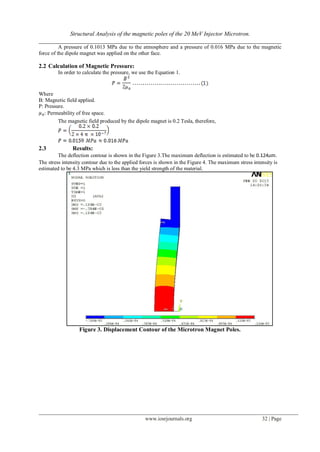
and stress intensity were determined using ANSYS 12.0. The estimated maximum deflection was 0.124 μm which
does not have any significant effect on the uniformity of magnetic field. The estimated maximum stress intensity
was 4.3 MPa which is less than the yield strength of the material used.
Keywords- Finite Element Analysis, INDUS particle accelerator, Microtron, RF Cavity, Simulation in Ansys.
I. INTRODUCTION
The Microtron is a cyclic particle accelerator machine. The Microtron discussed in this paper is located
at Raja Ramanna Centre for Advanced Technology (RRCAT) and is used as a source for delivering 20 MeV
electron beam for the INDUS synchrotron light source facility of RRCAT as shown in Figure 1.
Figure 1: The 20 MeV Injector Microtron at RRCAT.
In this injector Microtron, a Lanthanum hexaboride (LaB6) cathode is used as an electron source. The
thermionically emitted electrons are accelerated in a cylindrical resonator called Radio Frequency (RF) Cavity
(type-II). RF power is fed into the cavity by exciting the E010 oscillating mode at 2856 MHz (wavelength~10
cm) and as a result the electrons gain energy and accelerate inside the RF cavity before they enter into the first
orbit. The beam comes out of the RF cavity travels in a circular orbit inside the vacuum vessel due to its
interaction with the uniform dipole magnetic field acting perpendicular to the plane of the trajectory orbits. As
the beam re-enters into the RF cavity, it is again fed with the RF energy. As a result the beam energy is ramped
up and enters into the next higher orbit [1] [2].](https://image.slidesharecdn.com/e0863033-150115235018-conversion-gate01/85/Structural-analysis-of-the-magnetic-poles-of-the-20-MeV-Injector-Microtron-1-320.jpg)
![IOSR Journal of Mechanical and Civil Engineering (IOSR-JMCE)
e-ISSN: 2278-1684,p-ISSN: 2320-334X, Volume 8, Issue 6 (Sep. - Oct. 2013), PP 30-33
www.iosrjournals.org
www.iosrjournals.org 30 | Page
Structural analysis of the magnetic poles of the 20 MeV Injector
Microtron.
Aaqib Gulzar Khan1
, Shubhajit Dutta2
1
(Mechanical Engineering Department, National Institute of Technology, Srinagar, India)
2
(Industrial and Medical Accelerators, Raja Ramanna Centre for Advanced Technology Indore, India)
ABSTRACT: Raja Ramanna Centre for Advanced Technology (RRCAT) has developed a 20 MeV Microtron
used as an electron source for the 2.5 GeV INDUS -2 and 550 MeV INDUS -1particle accelerators. Due to the
presence of revolving electrons inside the Microtron cavity, an Ultra High Vacuum (UHV) is required to be
created inside it. This paper presents a structural analysis of the Microtron magnet poles as they are subjected
to the surrounding atmospheric pressure and the magnetic force of the dipole magnets. The aim of the analysis
is to determine whether the deflection produced in the magnetic poles affects the uniformity of the magnetic field
inside the Microtron cavity as a slight deflection in the magnetic field can cause the electrons to change their
paths and thus they will not come out of the Microtron and die out inside the cavity. The maximum deflection
and stress intensity were determined using ANSYS 12.0. The estimated maximum deflection was 0.124 μm which
does not have any significant effect on the uniformity of magnetic field. The estimated maximum stress intensity
was 4.3 MPa which is less than the yield strength of the material used.
Keywords- Finite Element Analysis, INDUS particle accelerator, Microtron, RF Cavity, Simulation in Ansys.
I. INTRODUCTION
The Microtron is a cyclic particle accelerator machine. The Microtron discussed in this paper is located
at Raja Ramanna Centre for Advanced Technology (RRCAT) and is used as a source for delivering 20 MeV
electron beam for the INDUS synchrotron light source facility of RRCAT as shown in Figure 1.
Figure 1: The 20 MeV Injector Microtron at RRCAT.
In this injector Microtron, a Lanthanum hexaboride (LaB6) cathode is used as an electron source. The
thermionically emitted electrons are accelerated in a cylindrical resonator called Radio Frequency (RF) Cavity
(type-II). RF power is fed into the cavity by exciting the E010 oscillating mode at 2856 MHz (wavelength~10
cm) and as a result the electrons gain energy and accelerate inside the RF cavity before they enter into the first
orbit. The beam comes out of the RF cavity travels in a circular orbit inside the vacuum vessel due to its
interaction with the uniform dipole magnetic field acting perpendicular to the plane of the trajectory orbits. As
the beam re-enters into the RF cavity, it is again fed with the RF energy. As a result the beam energy is ramped
up and enters into the next higher orbit [1] [2].](https://image.slidesharecdn.com/e0863033-150115235018-conversion-gate01/75/Structural-analysis-of-the-magnetic-poles-of-the-20-MeV-Injector-Microtron-1-2048.jpg)
![Structural Analysis of the magnetic poles of the 20 MeV Injector Microtron.
__________________________________________________________________________________
www.iosrjournals.org 31 | Page
Thus, it is possible for the electron beam to accelerate with different energy gain per orbit and it
reaches to the higher circular trajectory orbits of increasing diameter having common tangent point located in
the cavity as shown in Figure 2. The electron beam is extracted from the 22nd orbit where it reaches to energy
of 20 MeV.
Figure 2. The Schematic Representation of the Microtron orbit.
The vacuum vessel of the Microtron is a cylindrical shell made of ASME SS316L austenitic stainless
steel [3]. The vacuum shell is enclosed by the magnet pole faces of a dipole magnet. The magnet poles and yoke
are made of low carbon steel, IS: 2062. A pair of ultra-high vacuum (UHV) compatible Viton seals is used at the
interfaces to obtain UHV in the vacuum chamber. The pole faces are simply supported on the vacuum shell
which is bolted on the circular yoke at its periphery using multiple equi-spaced bolts as shown in Figure 1.
One of the magnet pole (fixed magnet pole) is rigidly supported on the support structure and is
therefore structurally constrained. While the vacuum chamber is evacuated for UHV, the other magnet pole
(moving magnet pole) is subjected to a differential pressure of one atmosphere and the magnetic force of
attraction of the dipole magnet and is therefore expected to get deflected [1] [2]. This may perturb the magnetic
field in the vacuum chamber. Therefore, the deflection of the magnetic pole is required to be estimated.
II. STRUCTURAL ANALYSIS
The aim is to estimate the deflection of the magnet pole under one atmospheric pressure differential
and the magnetic force of attraction of the dipole magnet using finite element analysis (FEA) in structural
domain [4]. ANSYS 12.0 software is used for this purpose. This analysis used the Tresca’s Criterion of yielding
or the Maximum Shear Stress Theory [5].
2.1 Modelling:
A 3-D modelling of the structure was done. The model consists of a sector of the actual circular plate.
The thickness of the plate is 52mm and its radius is 700mm. An electromagnet is attached to the plate. Its radius
is 514mm and has a thickness of 56mm. The sector angle is 20˚, i.e., only 1/18th of the actual model is being
analyzed due to symmetry present in the model.
The material used is ASME Stainless Steel SS316L and its properties are listed in Table 1. Solid-45
element was used to model the structure and obtain the deflections and stress intensities. The model was simply
supported along the line where yolk is in contact with it.
Table 1. Properties of ASME Stainless Steel SS316L.
Property Value
Young’s Modulus 2.1 105
MPa
Poisson’s Ratio 0.3
Yield Strength 170 MPa
Ultimate Tensile Strength 485 MPa](https://image.slidesharecdn.com/e0863033-150115235018-conversion-gate01/85/Structural-analysis-of-the-magnetic-poles-of-the-20-MeV-Injector-Microtron-2-320.jpg)
![Structural Analysis of the magnetic poles of the 20 MeV Injector Microtron.
__________________________________________________________________________________
www.iosrjournals.org 33 | Page
Figure 4. Stress Intensity Contour of the Microtron Magnet Poles.
III. CONCLUSION
The design of the Microtron plates is very stiff as a result of which the observed maximum deflection
and stress intensity was very small. The distortion in the magnetic field is negligible and thus the design of the
Microtron is satisfactory.
ACKNOWLEDGEMENTS
I would like to express my gratitude to all members of IMA Section, RRCAT, Indore who have helped
& supported me throughout my project.
A special thanks of mine goes to other members of IMA, Mr. R. K. Soni and Mr. Ravindra S.
Chowdary, who helped me in completing the project & exchanged their interesting thoughts & ideas
REFERENCES
[1] Thomas P. Wangler, Principles of RF linear accelerators (111 River Street Hobokin, NJ: John Wiley & Sons Inc., 2008).
[2] Yuri M. Tsipenyuk, Sergey P. Kapitza, The microtron, development & applications (11 New Fetter Lane, London EC4P 4EE: Taylor
& Francis Inc., 2002).
[3] Indian Nuclear Society, Design & fabrication of accelerator components (Project Square, Anushakti Nagar,
Mumbai: Indian Nuclear Society Press, 2006).
[4] J N Reddy, A course on linear & nonlinear finite element analysis (Great Clarendon Street, Oxford OX2 6DP: Oxford University
Press, 2004).
[5] Egor P. Popov, Engineering mechanics of solids (Englewood Cliffs, New Jersey: Prentice-Hall, 1990).](https://image.slidesharecdn.com/e0863033-150115235018-conversion-gate01/85/Structural-analysis-of-the-magnetic-poles-of-the-20-MeV-Injector-Microtron-4-320.jpg)

The document presents a structural analysis of the magnet poles of a 20 MeV injector microtron used as an electron source for particle accelerators at the Raja Ramanna Centre for Advanced Technology. Using ANSYS 12.0 to simulate conditions, the analysis found that the maximum deflection of 0.124 μm and maximum stress intensity of 4.3 MPa do not significantly affect the magnetic field uniformity within the microtron cavity. The results indicate that the design of the structure is robust, with negligible distortion in the magnetic field.


![[IJET-V2I1P8] Authors:Mr. Mayur k Nemade , Porf. S.I.Kolhe](https://cdn.slidesharecdn.com/ss_thumbnails/ijet-v2i1p8-160427182554-thumbnail.jpg?width=640&height=640&fit=bounds)


