How Standards Will Enable Retailers to Compete  in a Consumer Controlled World  Jim Nadler  Principal  [email_address]
  Today’s Agenda Today’s Retail Challenge The New Consumer Dynamic What it Means for Retailers The Project Prioritization Dilemma The Move to “Real Time” Retailing  The Role of Supplier Collaboration How Standards Help “ A Retailer Example”  What About the CLOUD? Conclusion
Today’s Retail Challenge Attract, Build and Retain a  PROFITABLE   Customer Base Drive Operational Efficiencies. Improve Marketing Effectiveness Differentiate with Customer Service Offerings. Meet or  BEAT  Wall Street Expectations Change the Paradigm on  FINANCIAL  Performance Metrics  Drive Increased Performance through Operational Execution across all Channels Increase the Level of Supplier Collaboration as part of  DRIVE  to Execute Strategy  Eliminate Practices and Processes that do not provide increased focus on  CUSTOMER CENTRIC   programs Define and Implement Replicatible  BU$INE$$ PROCE$$   Change
The Retail Challenge The emerging “Consumer in Control” requires new strategies to COMPETE and WIN Industry MUST Move to a Consumer Focused Data Reporting Model  i.e. Integration of Category Management and CRM – “Shopper Marketing” The emergence of the “digital native” and the advance of mobile commerce will forever change the retail landscape What Role will Social Networks Play in the evolution of retail branding  ANYWHERE, ANYTIME Information Access is changing the GAME  Google Price by UPC Research Digital Camera Cost/Features on AMAZON while standing in a  Best BUY Automating the service process will enable retailers to provide added benefits without increased costs.
The New Consumer Dynamic The FRUGAL Consumer IS HERE TO STAY The “New Consumer” has shifted to pragmatic consumption  Consumers ARE Educated About Their Preferences Social Networks are changing the Branding Game Online Shopping Continues to Grow Mobile Commerce is Emerging New Consumer Technology Tools are available every 6  months The New Shopper ROI – “Return on Involvement”
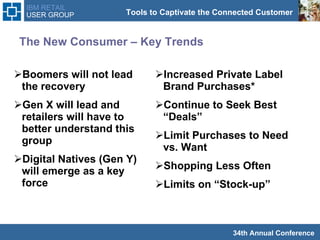
The New Consumer – Key Trends Boomers will not lead the recovery Gen X will lead and retailers will have to better understand this group Digital Natives (Gen Y) will emerge as a key force Increased Private Label Brand Purchases* Continue to Seek Best “Deals”  Limit Purchases to Need vs. Want Shopping Less Often Limits on “Stock-up”
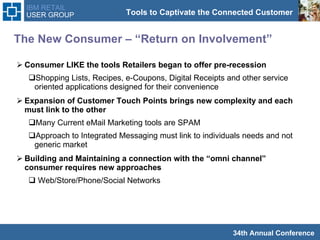
The New Consumer – “Return on Involvement” Consumer LIKE the tools Retailers began to offer pre-recession Shopping Lists, Recipes, e-Coupons, Digital Receipts and other service oriented applications designed for their convenience Expansion of Customer Touch Points brings new complexity and each must link to the other Many Current eMail Marketing tools are SPAM  Approach to Integrated Messaging must link to individuals needs and not generic market Building and Maintaining a connection with the “omni channel” consumer requires new approaches  Web/Store/Phone/Social Networks
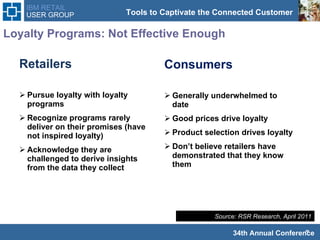
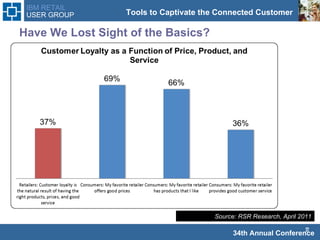
Loyalty Programs: Not Effective Enough Retailers Pursue loyalty with loyalty programs Recognize programs rarely deliver on their promises (have not inspired loyalty) Acknowledge they are challenged to derive insights from the data they collect Consumers Generally underwhelmed to date Good prices drive loyalty Product selection drives loyalty Don’t believe retailers have demonstrated that they know them Source: RSR Research, April 2011
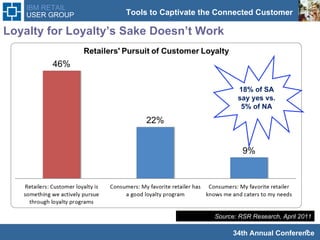
Loyalty for Loyalty’s Sake Doesn’t Work 18% of SA say yes vs. 5% of NA Source: RSR Research, April 2011
Have We Lost Sight of the Basics? Source: RSR Research, April 2011
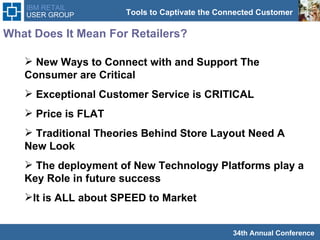
What Does It Mean For Retailers? New Ways to Connect with and Support The Consumer are Critical  Exceptional Customer Service is CRITICAL Price is FLAT Traditional Theories Behind Store Layout Need A New Look  The deployment of New Technology Platforms play a Key Role in future success It is ALL about SPEED to Market
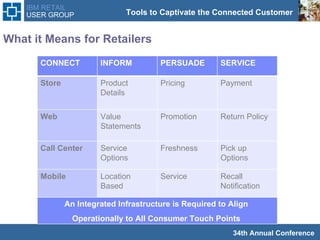
What it Means for Retailers  An Integrated Infrastructure is Required to Align  Operationally to All Consumer Touch Points  CONNECT  INFORM  PERSUADE  SERVICE Store Product Details Pricing Payment Web Value Statements Promotion  Return Policy  Call Center Service Options  Freshness Pick up Options  Mobile Location Based  Service Recall  Notification
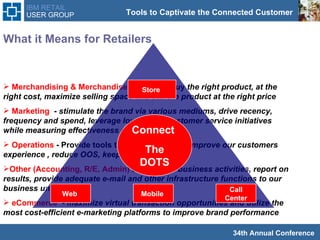
What it Means for Retailers  Merchandising & Merchandise Planning  - buy  the right product, at the right cost, maximize selling space and sell the product at the right price  Marketing  -  stimulate the brand via various mediums, drive recency, frequency and spend, leverage loyalty and customer service initiatives while measuring effectiveness of our efforts  Operations  - Provide tools to the front lines to  improve our customers experience , reduce OOS, keep costs low Other (Accounting, R/E, Admin)  account for business activities, report on results, provide adequate e-mail and other infrastructure functions to our business units  eCommerce   -  maximize virtual transaction opportunities and utilize the most cost-efficient e-marketing platforms to improve brand performance  Store  Web  Call Center Connect  The DOTS Mobile
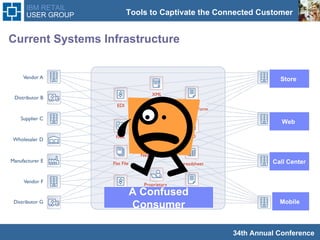
Current Systems Infrastructure Call Center Web  Store  Mobile  A Confused Consumer
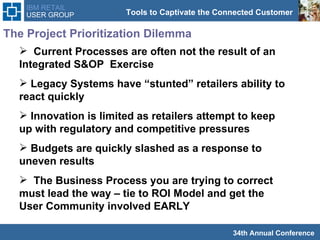
The Project Prioritization Dilemma Current Processes are often not the result of an Integrated S&OP  Exercise Legacy Systems have “stunted” retailers ability to react quickly  Innovation is limited as retailers attempt to keep up with regulatory and competitive pressures Budgets are quickly slashed as a response to uneven results The Business Process you are trying to correct must lead the way – tie to ROI Model and get the User Community involved EARLY
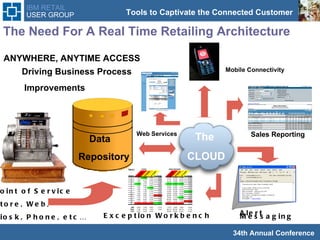
Point of Service Store, Web, Kiosk, Phone, etc… The Need For A Real Time Retailing Architecture Web Services  Alert Messaging  Exception Workbench  Sales Reporting Data Repository Mobile Connectivity The  CLOUD ANYWHERE, ANYTIME ACCESS Driving Business Process   Improvements
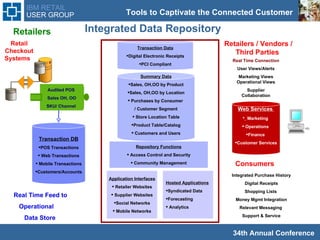
Retailers Transaction Data Digital Electronic Receipts PCI Compliant Integrated Data Repository Summary Data Sales, OH,OO by Product Sales, OH,OO by Location Purchases by Consumer  / Customer Segment Store Location Table Product Table/Catalog Customers and Users Application Interfaces Retailer Websites Supplier Websites Social Networks Mobile Networks Hosted Applications Syndicated Data Forecasting Analytics Repository Functions Access Control and Security Community Management Retailers / Vendors / Third Parties Real Time Connectors Consumers Real Time Connection Application Interfaces Transaction DB POS Transactions Web Transactions Mobile Transactions Customers/Accounts File Transfer User Views/Alerts Marketing Views Operational Views Supplier Collaboration Web Services  Marketing  Operations  Finance  Customer Services Retail Checkout Systems  Real Time Feed to  Operational  Data Store Integrated Purchase History Digital Receipts Shopping Lists  Money Mgmt Integration Relevant Messaging  Support & Service Audited POS  Sales OH, OO SKU/ Channel
Benefits of Retailer/Supplier Collaboration Inventory Management   Reduces purchasing and order management time; less administrative time needed to create and receive product orders, expedite shipments, and  respond to problems Improves demand management thus reducing overtime production labor  costs. Reduces out-of-stocks for both manufacturer and retailer, thereby increasing sales and add to gross margin.  An added benefit:  improved customer service. Reduces buffer stocks; possible reduction in warehouse facilities. Improves transportation efficiencies (truckload capacity) The Role of Enhanced Retailer/Supplier Collaboration
Marketing and Sales Sales and Marketing  Equips marketing managers with marketing management tools Reduces the complexity of marketing by providing new insights Allows you to develop programs that truly serve the needs and wants of your customers Improves ROI on Trade and Consumer promotions Facilitates a shift from “function control” to “enterprise management” of  your marketing strategy (focus on MROI”) Aids in coordination of advertising, consumer promotion, and  trade promotion activities Creates a more unified message that can touch both the head  and heart (appeal to both logic and emotion) Promotion compliance tracking (FASB and EITF acctg guidelines) The Role of  Enhanced Retailer/Supplier Collaboration
How Standards Help? Standards  allow for a framework to move forward quickly while driving down costs  Standards   insure that initial development is reusable  Standards  based solutions enable faster adaption / alignment with your business vision  Standards  enable fast efficient integration of BEST in BREED Solutions
Key Standards POS Log  e-Commerce Payments & PCI  Digital Receipt Data Warehouse Product Database Mobile Commerce  Cloud Computing
A Retailer Example – BevMo!  March 2010 Creates IT’sMo! – a plan based on desire to explore new ways of delivery – step outside traditional thinking – take huge strides to enable rapid deployment of new concepts Use of STANDARDS introduce architectures that conform to NRF/ART’s standards proposed benefits lower initial investment Demonstrate “proof of concept‟ “plug & play‟ thanks to NRF/ART‟s standards rapid delivery lower CapEx somewhat higher OpEx  Systems “on demand” as a utility IT Team growth is minimized - maximum leverage of current resources systems - scalable on demand – tied to company performance with the right partners SOX-compliance concerns diminish (SAS 70)  SOFTWARE-AS-A-SERVICE (SaaS) effective software license model  CLOUD COMPUTING – fast deployment - eliminate hardware acquisition costs
What About The Cloud? Lower cost to engage - minimal infrastructure  Utilization is metered on an “as needed” basis “Pay by The Drink Model”  IT as a Strategic Tool Initial investment = a foundation – Can be leveraged as you move forward  Access – Anywhere / Anytime  Best of All: Cloud = low cost Pilots – minimal risk – parallel approach – current world intact
“  cloud computing is a model for enabling convenient, on-demand network access to a shared pool of configurable computing resources (e.g., networks, servers, storage, applications, and services) that can be rapidly provisioned and released with minimal management effort or service provider interaction. “  2009 National Institute of Standards and Technology  Why The Cloud?
Conclusion Does your Systems Infrastructure provide ANYWHERE ANYTIME Access to Customer Demand Signals  How do you quantify the consumer experience and the investments needed to understand customer vs. product metrics? What service initiatives you offer will provide a meaningful connection to the consumer Data Analysis Tools for Channel Demand Signals – Touch points are Digital  Retail 3.0 Will Require a CHANGE IN THINKING and the Consumer will DEMAND that change A Flexible ARCHITECTURE will be a REQUIREMENT

2011 Presentation Ibm Users Groupv3

  • 1.
    How Standards WillEnable Retailers to Compete in a Consumer Controlled World Jim Nadler Principal [email_address]
  • 2.
    Today’sAgenda Today’s Retail Challenge The New Consumer Dynamic What it Means for Retailers The Project Prioritization Dilemma The Move to “Real Time” Retailing The Role of Supplier Collaboration How Standards Help “ A Retailer Example” What About the CLOUD? Conclusion
  • 3.
    Today’s Retail ChallengeAttract, Build and Retain a PROFITABLE Customer Base Drive Operational Efficiencies. Improve Marketing Effectiveness Differentiate with Customer Service Offerings. Meet or BEAT Wall Street Expectations Change the Paradigm on FINANCIAL Performance Metrics Drive Increased Performance through Operational Execution across all Channels Increase the Level of Supplier Collaboration as part of DRIVE to Execute Strategy Eliminate Practices and Processes that do not provide increased focus on CUSTOMER CENTRIC programs Define and Implement Replicatible BU$INE$$ PROCE$$ Change
  • 4.
    The Retail ChallengeThe emerging “Consumer in Control” requires new strategies to COMPETE and WIN Industry MUST Move to a Consumer Focused Data Reporting Model i.e. Integration of Category Management and CRM – “Shopper Marketing” The emergence of the “digital native” and the advance of mobile commerce will forever change the retail landscape What Role will Social Networks Play in the evolution of retail branding ANYWHERE, ANYTIME Information Access is changing the GAME Google Price by UPC Research Digital Camera Cost/Features on AMAZON while standing in a Best BUY Automating the service process will enable retailers to provide added benefits without increased costs.
  • 5.
    The New ConsumerDynamic The FRUGAL Consumer IS HERE TO STAY The “New Consumer” has shifted to pragmatic consumption Consumers ARE Educated About Their Preferences Social Networks are changing the Branding Game Online Shopping Continues to Grow Mobile Commerce is Emerging New Consumer Technology Tools are available every 6 months The New Shopper ROI – “Return on Involvement”
  • 6.
    The New Consumer– Key Trends Boomers will not lead the recovery Gen X will lead and retailers will have to better understand this group Digital Natives (Gen Y) will emerge as a key force Increased Private Label Brand Purchases* Continue to Seek Best “Deals” Limit Purchases to Need vs. Want Shopping Less Often Limits on “Stock-up”
  • 7.
    The New Consumer– “Return on Involvement” Consumer LIKE the tools Retailers began to offer pre-recession Shopping Lists, Recipes, e-Coupons, Digital Receipts and other service oriented applications designed for their convenience Expansion of Customer Touch Points brings new complexity and each must link to the other Many Current eMail Marketing tools are SPAM Approach to Integrated Messaging must link to individuals needs and not generic market Building and Maintaining a connection with the “omni channel” consumer requires new approaches Web/Store/Phone/Social Networks
  • 8.
    Loyalty Programs: NotEffective Enough Retailers Pursue loyalty with loyalty programs Recognize programs rarely deliver on their promises (have not inspired loyalty) Acknowledge they are challenged to derive insights from the data they collect Consumers Generally underwhelmed to date Good prices drive loyalty Product selection drives loyalty Don’t believe retailers have demonstrated that they know them Source: RSR Research, April 2011
  • 9.
    Loyalty for Loyalty’sSake Doesn’t Work 18% of SA say yes vs. 5% of NA Source: RSR Research, April 2011
  • 10.
    Have We LostSight of the Basics? Source: RSR Research, April 2011
  • 11.
    What Does ItMean For Retailers? New Ways to Connect with and Support The Consumer are Critical Exceptional Customer Service is CRITICAL Price is FLAT Traditional Theories Behind Store Layout Need A New Look The deployment of New Technology Platforms play a Key Role in future success It is ALL about SPEED to Market
  • 12.
    What it Meansfor Retailers An Integrated Infrastructure is Required to Align Operationally to All Consumer Touch Points CONNECT INFORM PERSUADE SERVICE Store Product Details Pricing Payment Web Value Statements Promotion Return Policy Call Center Service Options Freshness Pick up Options Mobile Location Based Service Recall Notification
  • 13.
    What it Meansfor Retailers Merchandising & Merchandise Planning - buy the right product, at the right cost, maximize selling space and sell the product at the right price Marketing - stimulate the brand via various mediums, drive recency, frequency and spend, leverage loyalty and customer service initiatives while measuring effectiveness of our efforts Operations - Provide tools to the front lines to improve our customers experience , reduce OOS, keep costs low Other (Accounting, R/E, Admin) account for business activities, report on results, provide adequate e-mail and other infrastructure functions to our business units eCommerce - maximize virtual transaction opportunities and utilize the most cost-efficient e-marketing platforms to improve brand performance Store Web Call Center Connect The DOTS Mobile
  • 14.
    Current Systems InfrastructureCall Center Web Store Mobile A Confused Consumer
  • 15.
    The Project PrioritizationDilemma Current Processes are often not the result of an Integrated S&OP Exercise Legacy Systems have “stunted” retailers ability to react quickly Innovation is limited as retailers attempt to keep up with regulatory and competitive pressures Budgets are quickly slashed as a response to uneven results The Business Process you are trying to correct must lead the way – tie to ROI Model and get the User Community involved EARLY
  • 16.
    Point of ServiceStore, Web, Kiosk, Phone, etc… The Need For A Real Time Retailing Architecture Web Services Alert Messaging Exception Workbench Sales Reporting Data Repository Mobile Connectivity The CLOUD ANYWHERE, ANYTIME ACCESS Driving Business Process Improvements
  • 17.
    Retailers Transaction DataDigital Electronic Receipts PCI Compliant Integrated Data Repository Summary Data Sales, OH,OO by Product Sales, OH,OO by Location Purchases by Consumer / Customer Segment Store Location Table Product Table/Catalog Customers and Users Application Interfaces Retailer Websites Supplier Websites Social Networks Mobile Networks Hosted Applications Syndicated Data Forecasting Analytics Repository Functions Access Control and Security Community Management Retailers / Vendors / Third Parties Real Time Connectors Consumers Real Time Connection Application Interfaces Transaction DB POS Transactions Web Transactions Mobile Transactions Customers/Accounts File Transfer User Views/Alerts Marketing Views Operational Views Supplier Collaboration Web Services Marketing Operations Finance Customer Services Retail Checkout Systems Real Time Feed to Operational Data Store Integrated Purchase History Digital Receipts Shopping Lists Money Mgmt Integration Relevant Messaging Support & Service Audited POS Sales OH, OO SKU/ Channel
  • 18.
    Benefits of Retailer/SupplierCollaboration Inventory Management Reduces purchasing and order management time; less administrative time needed to create and receive product orders, expedite shipments, and respond to problems Improves demand management thus reducing overtime production labor costs. Reduces out-of-stocks for both manufacturer and retailer, thereby increasing sales and add to gross margin. An added benefit: improved customer service. Reduces buffer stocks; possible reduction in warehouse facilities. Improves transportation efficiencies (truckload capacity) The Role of Enhanced Retailer/Supplier Collaboration
  • 19.
    Marketing and SalesSales and Marketing Equips marketing managers with marketing management tools Reduces the complexity of marketing by providing new insights Allows you to develop programs that truly serve the needs and wants of your customers Improves ROI on Trade and Consumer promotions Facilitates a shift from “function control” to “enterprise management” of your marketing strategy (focus on MROI”) Aids in coordination of advertising, consumer promotion, and trade promotion activities Creates a more unified message that can touch both the head and heart (appeal to both logic and emotion) Promotion compliance tracking (FASB and EITF acctg guidelines) The Role of Enhanced Retailer/Supplier Collaboration
  • 20.
    How Standards Help?Standards allow for a framework to move forward quickly while driving down costs Standards insure that initial development is reusable Standards based solutions enable faster adaption / alignment with your business vision Standards enable fast efficient integration of BEST in BREED Solutions
  • 21.
    Key Standards POSLog e-Commerce Payments & PCI Digital Receipt Data Warehouse Product Database Mobile Commerce Cloud Computing
  • 22.
    A Retailer Example– BevMo! March 2010 Creates IT’sMo! – a plan based on desire to explore new ways of delivery – step outside traditional thinking – take huge strides to enable rapid deployment of new concepts Use of STANDARDS introduce architectures that conform to NRF/ART’s standards proposed benefits lower initial investment Demonstrate “proof of concept‟ “plug & play‟ thanks to NRF/ART‟s standards rapid delivery lower CapEx somewhat higher OpEx Systems “on demand” as a utility IT Team growth is minimized - maximum leverage of current resources systems - scalable on demand – tied to company performance with the right partners SOX-compliance concerns diminish (SAS 70) SOFTWARE-AS-A-SERVICE (SaaS) effective software license model CLOUD COMPUTING – fast deployment - eliminate hardware acquisition costs
  • 23.
    What About TheCloud? Lower cost to engage - minimal infrastructure Utilization is metered on an “as needed” basis “Pay by The Drink Model” IT as a Strategic Tool Initial investment = a foundation – Can be leveraged as you move forward Access – Anywhere / Anytime Best of All: Cloud = low cost Pilots – minimal risk – parallel approach – current world intact
  • 24.
    “ cloudcomputing is a model for enabling convenient, on-demand network access to a shared pool of configurable computing resources (e.g., networks, servers, storage, applications, and services) that can be rapidly provisioned and released with minimal management effort or service provider interaction. “ 2009 National Institute of Standards and Technology Why The Cloud?
  • 25.
    Conclusion Does yourSystems Infrastructure provide ANYWHERE ANYTIME Access to Customer Demand Signals How do you quantify the consumer experience and the investments needed to understand customer vs. product metrics? What service initiatives you offer will provide a meaningful connection to the consumer Data Analysis Tools for Channel Demand Signals – Touch points are Digital Retail 3.0 Will Require a CHANGE IN THINKING and the Consumer will DEMAND that change A Flexible ARCHITECTURE will be a REQUIREMENT

Editor's Notes

  • #10 Differences by segment
  • #17 This is the solution I wanted to discuss. For the first time, there is a way to help significantly improve your supply chain efficiency, improve your bottom line profits, and improve customer loyalty all at the same time. This solution integrates into and supplements your existing infrastructure, and helps add value across the enterprise, and extends the enterprise to both suppliers and customers. It consists of three major modules – or portals. A customer portal, and enterprise or retailer “portal”, and a supplier portal.
  • #25 This research was conducted in late 2007 and published in 2008 as a white paper available on our IBM web site. IDC’s retail unit, Global Retail Insights, studied the factors affecting the cost of owning and operating POS for 3 different retail segments, discovering differences between the segments. They quantified key elements of the TCO for POS in these segments and show what makes an effective TCO analysis in today’s world. I will show you today the major results of this research. Insert for non-US audiences: The principles of TCO that IDC discussed are worldwide. The numeric calculations relied upon U.S.A. data for things like labor costs and power costs.