1www.varindia.com July 2017
VOLUME XVIII ISSUE 11 JULY 2017 PRICE Rs. 50
FDS to provide SI services to Dassault Systemes 	 Fortinet selected by MITC to serve Mumbai citizens
2 May 2017 www.varindia.com
3www.varindia.com May 2017
4 July 2017 www.varindia.com
5www.varindia.com July 2017
Nasscom forecasts $25-
billion potential from
India-Israel startups
The cumulative cross-border
investment in Indian and Israeli
startupshasa$25billionof revenuepotential
by 2025, said a recent report “Collaborative
Innovation: The vehicle driving Indo-Israel
prosperity” of Accenture and NASSCOM.
The report identifies IINSPIRE (Israel-
India Startup Platform for Innovative
Research and Entrepreneurship) framework
to release innovation potential of the
two startup nations. It concludes by
recommending the creation of a program
called IINSPIRE which aims to unleash
the combined power of these two nations
to deliver on Vision 25/25, by combining
their strengths across three areas: talent,
technology and temperament.
HPE and Microsoft to
provide opportunities
to partners through
Cloud28+
Hewlett Packard Enterprise has
formed a go-to-market alliance
with Microsoft through Cloud28+, the
world’s largest, open community dedicated
to increasing enterprise cloud adoption.
Microsoft joins
Cloud28+, an
initiative led and
sponsored by
HPE, as a premier
Microsoft Azure
Stack technology
partner.Bybecoming
a Cloud28+
member, Microsoft will join forces with
HPE to provide partners with new business
opportunities and tools, while accelerating
customer business outcomes powered by a
rich hybrid IT ecosystem.
Trend Micro invests $100 MillionVenture Fund 	 Canon India strengthens its PIXMA Series
SUBSCRIPTION COPY NOT FOR SALEVOLUME XVIII ISSUE 11 JULY 2017 PRICE Rs. 50
36pg
The age of offering next-gen customer experience is here!
16th STAR NITE AWARDS 2017
3rd Nov. 2017
Hotel The Lalit, New Delhi
6 July 2017 www.varindia.com
Transforming the workforce for the digital era
…. Future is eyeing for cognitive computing
HELLO INDIA
When you think about major cloud hyperscales, prominent internet brands like Amazon, Microsoft, Google
and IBM tend to come into our mind. But is this a closed club or is there room for more? Now Alibaba Group
is globally scaling its cloud and digital services platforms to earn its seat. The company that started out as a B2B
portal now touches almost every aspect of the internet and e-commerce sectors.
In the recently-held VARINDIA Infotech Forum, majority of the CIOs talked about increasing digitization,
where every part of our society and economy is being fundamentally transformed because of digital technology
they want to use to develop stronger customer relationships and reshape the sales approach, with executives
spending maximum hours in front of a screen than in the field. Sales engagement on digital channels – like email,
chat, messaging, video conferencing and voice-over-IP – is boosting sales productivity. The digitization efforts by
the government will continue to have a positive impact on the networking market too. The various private and
government players are contributing towards increasing the digital footprint.
Technological change is the overall process of innovation and the technology shift happens with the need
of automated IT systems that can solve problems without requiring human assistance by using machine learning
algorithms. The answer could be cognitive computing. It is the simulation of human thought processes in a
computerized model and it involves self-learning systems that use data mining, pattern recognition and natural
language processing to mimic the way the human brain works.
As India increases its investment in technology, the country’s data center and network infrastructure will undergo a massive
transformation. With this, the digital journey is marching ahead with the introduction of GST. It is not just tax reform, but it is
economic reform. GST is a way forward in the ease of doing business. Now the opportunity is to empower SMEs.
The government hopes there will be a jump of 14 per cent in revenue growth under the new levy as more taxpayers come
into the fold of the formal economy and move on to digital modes of payment. It will bring about an unprecedented
transparency and create data for almost every monetary transaction in the economy. The government hopes, and this, in
turn, will help expand the tax base and secondly, the incentive for cash transactions would reduce. Now they will be able
to take credit for the taxes paid and evasion of taxes will be difficult as transactions have to be reported on the GSTN
portal. So the level of compliance will increase. At the same time, concern about the new reporting requirements could also
mean chaos in the nation where about one-fourth of the population can’t read or write and many offices do not have the
technology needed to file digital returns. It will bring an opportunity for various IT vendors.
Lastly, GST is expected to make India richer, but the transition is going to be time-consuming. So till then let us wait and watch.
7www.varindia.com July 2017
8 July 2017 www.varindia.com
Website: www.varindia.com
CONTENTS
Publisher: Deepak Kumar Sahu
Editor: S Mohini Ratna
Executive Editor: Dr. Vijay Anand
Copy Editor: C. M. Dutta
Consulting Editor: Pravin Prashant
Deputy Editor: Samrita Baruah
Sub - Editor: Aparna Mullick
Art Director: Rakesh Kumar
Network Administrator: Ashok Kumar Singh
Manager-IT: Subhash Mohanta
Manager-SEO: Bidyadhar Behera
BUSINESS:
Commercial Manager: Amit Kumar Jha
Sr. Marketing Manager: Ashok Ranjan Dash
Circulation Executive: Manish Kumar
Marketing Manager: Dipendra Kumar
CORPORATE OFFICE:
VAR House, A-84A/3 Rose Apartment, Paryavaran
complex, Ignou Road, New Delhi - 110030
Tel: 011-41656383, 46061809
Email: edit@varindia.com
Bangalore: Bureau office
Marketing Manager: S. Kamala kar
Correspondent: L. G. Swami
D-103 G.F., Ashish JK Apartments
Thubarahalli Extended Road
Bangaluru- 560066
Tel: 080-49530399 | Mobile:09886280836
E-mail: kamlakar@varindia.com
Mumbai: Bureau office
Regional Manager (West): Anil Kumar
Sr. Correspondent: Mamta S.
Anurag Residency, 203 - “B” Wing, Plot No-5,
Sector-9, Kamothe, Navi Mumbai-410 209
Tel: 022-65561292, Mobile: 08108017479
E-mail: anil@varindia.com, mamta@varindia.com
Chennai: Bureau office
Branch Manager: M.S. Barani
Door. No.8, Plot No.-837,89th Street,
13th Sector, K.K.Nagar, Chennai - 600 078
Mobile: 09444077065
E-mail: barani@varindia.com
Hyderabad: Bureau office
Branch Manager: Sunil Kumar
B 383 HAL Colony, Balanagar
HYDERBAD, Telengana - 500042
Tel: 040-32989844/ Cell No. 08100298033
E-mail: sunil@varindia.com
Kolkata: Bureau office
Marketing Officer: Sunil Kumar
Correspondent: Kiran Kumar
67 Sarada Park, Garia, Kolkata - 700084
Mobile: 08100298033, E-mail: sunil@varindia.com
Mobile: 09903088480, E-mail: kiran@varindia.com
Printed and Published by Deepak Kumar Sahu on behalf of
M/s. Kalinga Digital Media Pvt. Ltd. and Printed at Pushpak
Press Pvt. Ltd. Shed No. 203 - 204, DSIDC Complex, Okhla
Industrial Area, Phase-I, New Delhi-110020 and Published at
A-84A/3 Rose Apartment, Paryavaran complex, Ignou Road,
New Delhi - 110030, Editor - S Mohini Ratna.
For Subscription queries contact: info@varindia.com
Subscription: Rs. 500(12 issues)Rs. 1000 (24 issues)
All payments favouring:
KALINGA DIGITAL MEDIA PVT LTD
© All rights are reserved. No part of this magazine may be
reproduced or copied in any form or by any means without
the prior written permission of the publisher. (1999-2016)
* All disputes are subject to the exclusive jurisdiction of
competent courts and forums in Delhi only.
46pg
INDUSTRY EVENT
30|	 MICROSOFT INSPIRE – an
amalgamation of new ideas
45|	 MSMEs foresee a mix of
opportunities and challenges
under GST regime
LEAD STORY
36|	 The age of offering next-gen
customer experience is here!
42|	 Open Source holds immense
significance for Digital India
COVER STORY
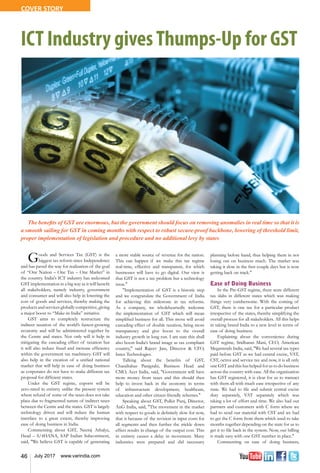
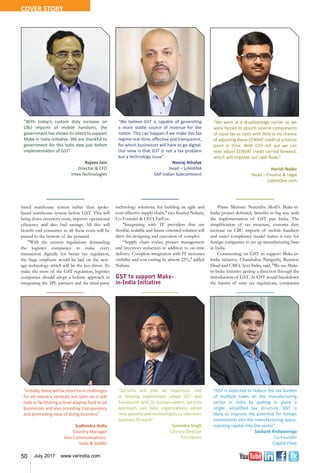
46|	 ICT Industry gives Thumps-Up
for GST
EVENT
30|	 Fortinet unveils new business
opportunities at its annual
SAARC Partner Conference
38|	 15th INFOTECH FORUM 2017 –
Making a Digital-ready Future
possible
FACE TO FACE
27|	 ESDS to be a catalyst in helping
customers go digital
32|	 DeskeraisCreatingCloudPartner
Network in India
33|	 VMware sees NSX adoption as
critical to private cloud strategy
40|	 Lenovo wants to be the
differentiator in after sales
service
REGULARS
Channel Guru	 10
Channel Chief	 12
Round About	 14
Hot Bytes		 16, 18
On the Ramp	 20, 22
Voice N Data	 24
Channel Buzz	 26
Movers & Shakers	 58
41|	 AXILSPOT counts channel friendly
business policy as key to success
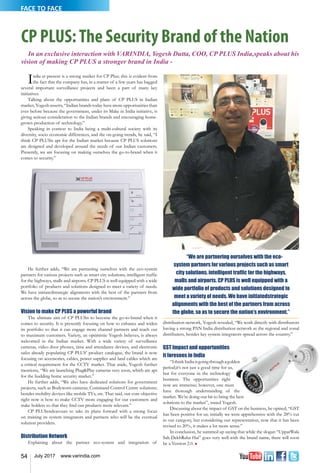
54|	 CP PLUS The Security Brand of the
Nation
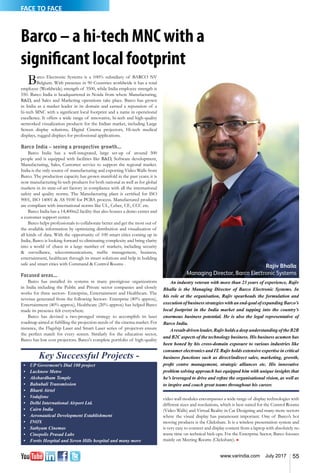
55|	 Barco – a hi-tech MNC with a
significant local footprint
VAR SECURITY
52|	 “Risk assessment of relevant
threats is necessary”
53|	 CP PLUS: The Security Brand of the
Nation
VAR MOBILITY
56|	 Ziox focuses on delivering
consumer-centric products
VAR ANALYSIS
34|	 Petya - the new ransomware
taking the cyber world by storm
9www.varindia.com July 2017
10 July 2017 www.varindia.com
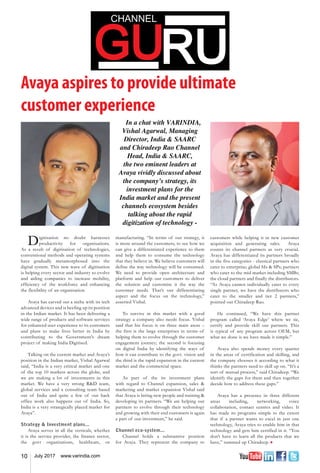
Avaya aspires to provide ultimate
customer experience
In a chat with VARINDIA,
Vishal Agarwal, Managing
Director, India & SAARC
and Chiradeep Rao Channel
Head, India & SAARC,
the two eminent leaders at
Avaya vividly discussed about
the company’s strategy, its
investment plans for the
India market and the present
channels ecosystem besides
talking about the rapid
digitization of technology -
manufacturing. “In terms of our strategy, it
is more around the customers, to see how we
can give a differentiated experience to them
and help them to consume the technology
that they believe in. We believe customers will
define the way technology will be consumed.
We need to provide open architecture and
platform and help our customers to deliver
the solution and customise it the way the
customer needs. That’s our differentiating
aspect and the focus on the technology,”
asserted Vishal.
To survive in this market with a good
strategy a company also needs focus. Vishal
said that his focus is on three main areas –
the first is the large enterprises in terms of
helping them to evolve through the customer
engagement journey; the second is focusing
on digital India by identifying the ways of
how it can contribute to the govt. vision and
the third is the rapid expansion in the current
market and the commercial space.
As part of the its investment plans
with regard to Channel expansion, sales &
marketing and market expansion Vishal said
that Avaya is hiring new people and training &
developing its partners. “We are helping our
partners to evolve through their technology
and growing with their end customers is again
a part of our investment,” he said.
Channel eco-system...
Channel holds a substantive position
for Avaya. They represent the company to
customers while helping it in new customer
acquisition and generating sales. Avaya
counts its channel partners as very crucial.
Avaya has differentiated its partners broadly
in the five categories - classical partners who
cater to enterprise; global SIs & SPs; partners
who cater to the mid market including SMBs;
the cloud partners and finally the distributors.
“As Avaya cannot individually cater to every
single partner, we have the distributors who
cater to the smaller and tier 2 partners,”
pointed out Chiradeep Rao.
He continued, “We have this partner
program called ‘Avaya Edge’ where we tie,
certify and provide skill our partners. This
is typical of any program across OEM, but
what we done is we have made it simple.”
Avaya also spends money every quarter
in the areas of certification and skilling, and
the company chooses it according to what it
thinks the partners need to skill up on. “It’s a
sort of mutual process,” said Chiradeep. “We
identify the gaps for them and then together
decide how to address these gaps.”
Avaya has a presence in three different
areas including, networking, voice
collaboration, contact centres and video. It
has made its programs simple to the extent
that if a partner wants to excel in just one
technology, Avaya tries to enable him in that
technology and gets him certified in it. “You
don’t have to learn all the products that we
have,” summed up Chiradeep. n
Digitisation no doubt harnesses
productivity for organisations.
As a result of digitisation of technologies,
conventional methods and operating systems
have gradually metamorphosed into the
digital system. This new wave of digitisation
is helping every sector and industry to evolve
and aiding companies to increase mobility,
efficiency of the workforce and enhancing
the flexibility of an organisation.
Avaya has carved out a niche with its tech
advanced devices and is beefing up its position
in the Indian market. It has been delivering a
wide range of products and software services
for enhanced user experience to its customers
and plans to make lives better in India by
contributing to the Government’s dream
project of making India Digitised.
Talking on the current market and Avaya’s
position in the Indian market, Vishal Agarwal
said, “India is a very critical market and one
of the top 10 markets across the globe, and
we are making a lot of investments in this
market. We have a very strong R&D team,
global services and a consulting team based
out of India and quite a few of our back
office work also happens out of India. So,
India is a very strategically placed market for
Avaya”.
Strategy & Investment plans...
Avaya serves in all the verticals, whether
it is the service provider, the finance sector,
the govt organisations, healthcare, or
11www.varindia.com July 2017 23www.varindia.com July 2017
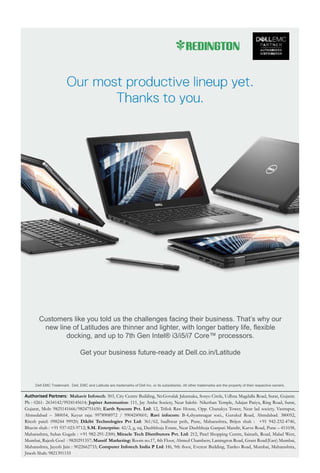
Dell EMC Trademark: Dell, EMC and Latitude are trademarks of Dell Inc. or its subsidiaries. All other trademarks are the property of their respective owners.
Customers like you told us the challenges facing their business. That’s why our
new line of Latitudes are thinner and lighter, with longer battery life, flexible
docking, and up to 7th Gen Intel® i3/i5/i7 Core™ processors.
Get your business future-ready at Dell.co.in/Latitude
Authorised Partners: Mahavir Infotech: 303, City Centre Building, Nr.Govalak Jakatnaka, Sosyo Circle, Udhna Magdalla Road, Surat, Gujarat.
Ph : 0261- 2634142/9924145614; Jupiter Automation: 111, Jay Ambe Society, Near Sakthi- Nikethan Temple, Adajan Patiya, Ring Road, Surat,
Gujarat, Mob: 9825141666/9824751650; Earth Syscom Pvt. Ltd: 12, Trilok Raw House, Opp. Chanakya Tower, Near lad society, Vastrapur,
Ahmedabad – 380054, Keyur raja: 9978908972 / 9904249601; Ravi infocom: B-4,shyamnagar soci., Gurukul Road, Ahmdabad. 380052,
Ritesh patel: 098244 99920; Dikibi Technologies Pvt Ltd: 361/62, budhwar peth, Pune, Maharashtra, Brijen shah : +91 942-232-4746,
Bhavin shah : +91 937-023-9712; S.M. Enterprise: 42/2, g, raj, Dashbhuja Estate, Near Dashbhuja Ganpati Mandir, Karve Road, Pune – 411038,
Maharashtra, Suhas Gugale : +91 982-291-2300; Miracle Tech Distributors Pvt. Ltd: 212, Patel Shopping Centre, Sainath, Road, Malad West,
Mumbai, Rajesh Goel : 9820291357; Massif Marketing: Room no.17, 4th Floor, Ahmed Chambers; Lamington Road, Grant Road(East) Mumbai,
Maharashtra, Jayesh Jain : 9022662733; Computer Infotech India P Ltd: H6, 9th floor, Everest Building, Tardeo Road, Mumbai, Maharashtra,
Jinesh Shah: 9821391155
12 July 2017 www.varindia.com
Veeam ensures Availability to enable
Always-On business for its customers
Veeam is a 10 year old start-up with
headquarters in Switzerland and
having presence in more than 67 countries. It
has more than 2, 45, 000 customers worldwide
with a strong presence in India. In India it
has about 750+ customers with 100+ active
partners in its channel eco-system.
“We are the fastest growing company in
the world with revenues of 720 million dollars
worldwide, which will be reaching 2K million
dollars by 2019,” asserts Ashok.
Veeam does not sell directly and it is
always through the channel ecosystem. It
works very closely hand-on-hand with ISV or
alliance partners. Partners like HP Enterprise,
Cisco, Microsoft and NetApp form part of
this partnership.
The Veeam channel eco-system is also
segregated into tier 1, tier2 and tier3 types
that serve customers across all verticals. In
tier 1 category, Veeam has global SI’s like
IBM, Accenture and in tier2 partner category,
the company has partnership with Indian SI’s
with global presence like Wipro, TCS, Tech
Mahindra and HCL.
Veeam also works with the reseller
community that is the tier 3 partners. The
reseller is typically regional specific and they
don’t have a national presence, but they are
strong in each region and so Veeam works
very closely with these regional partners.
“As part of the go – to - market strategy,
whenever there is a datacenter opportunity,
our ISV partners incorporate Veeam and
send it to the customers. Just to give you an
example- HP Enterprise has got Veeam price
list. When a HPE sales person sells Veeam,
he gets rewarded too. Likewise, we also work
very closely with the CiscoUCS team; so
whenever Cisco uses our opportunity, then by
default the back-up is always from Veeam,”
explains Ashok.
Veeam also categorises its business as
SMB, commercial and enterprise; any deal
value less than $10k is categorised as SMB,
which is primarily run by the channel. Then
there are deals worth $10k to less than $50k
that is categorises undercommercial business.
“To run the commercial business we have
two territory managers (TM) in each regionto
cater to specific verticals.So One TM would
be taking care for Banking, finance and
IT and the other one will be taking care of
manufacturing and services verticals in India.
These territory managers will work with
the tier 1 partners and the global SIs and
approach the customers for opportunities,”
explains Ashok.
Veeam works with two distributors in
Gone are the days where the
brick and mortar companies
used to just write on paper
about the sales they have
done, comeback and give it
to the accounts team, who on
its part will create an invoice
and give it back. Today’s
digital environment demands
organizations to make data
and applications available
24.7.365. This leaves
enterprise with no room for
any downtime or loss of critical
data. Thus setting this context,
Ashok Acharya, Regional
Director, India and SAARC
- Veeam gives an exclusive
interview to VARINDIA while
also speaking about the
company’s roadmap for the
India market -
India –Tech Data and Redington.
Opportunities in India...
With 750 customers, Veeam has just
covered 5% of the market in India, so there
is huge growth opportunity for the company.
“We have not gone deeper into large
enterprise customers and so hiring enterprise
account managersin India to focus on such
deals,” says Ashok. “We will identify the top
20 accounts in each vertical and as a strategy
these enterprise account managers will have
a dedicated sales engineer, who will go in the
accounts sales directly.”
The key focussed verticals for Veeam
is IT & ITeS, manufacturing, banking and
Defence. “With digital transformation, Indian
organizations have no scope for an IT outage,
unavailability of data or web downtime. Since
everyone wants to secure their back-up, they
would require Veeam to enable Always-On
business. Again data needs to bebacked-
upsecurely, so that it is readily available
whenever you want it. That is where Veeam
comes into play,” explains Ashok.
Roadmap for Veeam India...
Ashok wants to see Veeam growing as
the no.1 vendor in the data availability space.
“We always ensure the SLAs that we cover
with customers are the best. Veeam has got
the maximum support ratings worldwide;
we get 72% rating on support and we have a
success rate of 85 % ofour customer renew
license. This is because our engagement with
customer has to be of very high experience,”
says Ashok.
In India Veeam keeps getting repeat
business from its top enterprise customers.
The business of Veeam from Q1, 2016 to
Q1,2017 grew by 34% and in Q2 it grew by 43
%. But Ashok’s vision is to make this growth
100% by next year. n
In India Veeam keeps
getting repeat business
from its top enterprise
customers. The business
of Veeam from Q1, 2016
to Q1, 2017 grew by 34%
and in Q2 it grew by 43
%. But Ashok’s vision
is to make this growth
100% by next year
CHANNEL CHIEF
13www.varindia.com July 2017
14 July 2017 www.varindia.com
ROUND ABOUT
GST: Is it the time for
excitement or prudence?
Finally, it is out – to be precise on 30th June, 2017 at midnight, when
the whole nation was seemingly glued to the TV or mobile screens.
GST is said to give us economic freedom and help us to treat the entire
country as a single economic contiguity. There can be differing views and
perceptions. I do not want to stoke a debate, except by telling that, as an
entrepreneur, GST will influence how I do business, how I plan it, how I
calculate the indirect tax that I pay to the government and how I earn credit
for the taxes that I have paid to the government.
Undeniably, the launch of GST, to me, signifies a new thing. That has
nothing to do with the slogan one India one tax or one India one market.
Presumably, when GST becomes fully matured and is accepted by the people
to whom it is meant, there may be a marked shift in the business operations.
It seeks to subsume all indirect taxes that we pay at central, state and local
levels into a single rate or two. That will have a great positive spinoff since we
are sure of our tax burden, how it is collected and how it is appropriated.
What is GST?
If you ask me how many in India have heard about GST, I would say
hardly there is anyone who has not heard about it. If you ask me how many
would know about how it operates, I would say hardly there is anyone who
knows how it will get rolled out, initial hitches, how these would be resolved,
etc. Nobody should be blamed for that. In a country where more than 1.3
billion live, where taxes particularly indirect taxes are to be paid from birth
to death, several times in a day, how can we predict what challenges the
tax structure pose. Everyone knows – government, tax experts, traders,
industrialists and man on the street – that at the implementation stage there
will be problems. Should that be a limiting factor for introduction of GST
or should it be delayed for quite some time?
Is it a simple tax structure? Again, my take is that it was conceived as
a simple one and many optimistically thought, to begin with, it will have
only two or maximum three slabs of moderate rates. What was originally
conceived as ideal one, had to be considerably watered down due to political
pressure from the states. The Centre had taken three categories of goods
from the purview of GST, viz. alcohol, petroleum products and tobacco.
These goods are generally referred to as non-merit goods and the state
revenue flows mainly from these heads. To that extent, the present GST is
truncated and nobody should be blamed for that. Had the Centre insisted on
the original plan, GST would have been a non-starter.
After a lot of deliberations and consultations with stakeholders, India
has chosen the Canadian model of GST – of course, with some adaptations.
It has three components – CGST (Central Goods and Services Tax), which
will be collected by the Central Government on sales of goods and services.
The other one is SGST (State Goods and Services Tax), which will be
collected by the respective state governments on sales of goods and services
and the third one is IGST (Inter-state Goods and Services Tax), which will
be collected by the Central Government on the inter-state transaction of
goods and services. The collected IGST revenue will be distributed between
the states, as per the view of the proposed GST Council. To compound
further, there are five different rates pegged at 0%, 5%, 12%, 18% and 28%,
besides exempting three items like alcohol, tobacco and petroleum products,
which will continue to remain with the state governments. They are the
major sources of income for the state governments. If you feel that the
GST on the ground is a compressed and compromised one, you are not far
off the truth. Yet, one has to reconcile the political pressure that the Central
Government has undergone to cobble together differing views.
We have to rough up the initial glitches of the GST. The base of the
taxpayers is larger than what it has been earlier. Also, the GSTN (Goods
and Services Network) has to be tested and validated. The digital network
has to support registrations, return filing, tax payments, reconciliation, IGST
settlements,etc.ForaneffectiveGSTtooperate,taxexemptionsandpresence
of multiplicity of rates should be subsumed into bare minimum. Indeed,
there is a lot of spadework still to be done. Granting time to the authorities
to streamline things and iron out glitches is one thing. Equally significant is
compliance. We should develop faith in the system. The human ingenuity
may force people to find newer ways to dodge the taxes. If anybody does
so, it should attract severe penalty. At the same time, authorities should be
considerate and minor aberrations should be condoned and resurgence of
inspector raj as it has been feared in some quarters should be shunned since
business cannot grow in a situation where there is mistrust and vilification.
It is instructive to learn things from the experience of others. More than
140 countries have implemented GST in one form or the other. Barring the
United States, most of the developed world has a form of indirect taxation
similar to that of GST. Some of these countries have faced stiff problems
in the initial stages. We have to learn what those glitches were to preempt
occurrences of such things in our system.
Undoubtedly, the introduction of GST has pitched up the expectations
of the general public. They expect that the prices will come down, tax rates
will be lower, life will be much easier, etc. Bereft of occasional sound and
noise aired from different sources, particularly from the small- and mid-
sized companies taking up job works, industry in general has welcomed the
introduction of GST. They feel that the cascading effect of taxes, which
has played havoc on the growth of the economy, will be a thing of the past,
since the industry will be allowed to take credit on input tax paid so that
nothing is added to the basic tax.
Yet, there are many incongruities to be addressed. Let us take a few
examples how such anomalies will get manifested. In the case of an airline
ticket, if I have to travel from New Delhi to New York, a direct flight will
cost me dear since the GST will be on the entire ticket. On the other hand,
if I take a hoping flight from New Delhi to Dubai and onwards to New
York, I save tax since in the second leg of my travel, I need not have to pay
any GST. Does it mean that the government is inducing the travellers to opt
for hoping flights to save money? Still, the clarity has to emerge how the
exporters have to be insulated from paying tax since the general principle
is not to export tax. The suggestion made by various authorities is that let
the exporter first pay the input tax and later he can claim the refund. This is
going to be a cumbersome procedure since money will be locked up and the
exporter will be subjected to some harrowing experiences.
In summation, I might say that the government, after a long wait, has
shown the political will at last to roll out GST. It was not at all an easy task
and a lot of political tightrope walking had to be resorted to achieve that
feat. That does not mean that the journey from now onwards will be easy,
particularly when the expectations are high amongst all stakeholders. There
is a long way to traverse before we can pat our back. n
15www.varindia.com July 2017
16 July 2017 www.varindia.com
HOT BYTES
Logitech to buy ASTRO
Gaming for $85 million
InflowTechnologiestodistribute
PaloAltoNetworks’SecurityPlatform
LG #KarSalaam campaign wins
laurel at the CMO Asia Awards
Oracle Digital Hub to help SMBs
power digital transformation
FDS to provide SI services
to Dassault Systemes
Fujitsu and SAP SE
expand partnership to aid
customers go digital
Lo g i t e c h
International has
agreed to acquire ASTRO
Gaming for $85 million in
cash, and the acquisition is
expected to close in early
August. With the addition
of ASTRO, the company
is investing in an adjacent
gaming market - the
console gaming market - to
help accelerate the long-
term growth of its gaming
business.
Both the companies
togetherarethenumberone
maker of headsets, mice,
keyboards and streaming
webcams for PC and
console gamers. ASTRO is
best known for its iconic
A40 and A50 headsets
designedforprogamersand
core enthusiasts. ASTRO’s
recently introduced A10
expands the company’s
reach in the console
headset market, offering
the essence of what makes
their headsets premium, but
at a more broadly accessible
price point.
Inflow Technologies
has signed a
distribution agreement
covering India and the
SAARC region with Palo
Alto Networks to deliver its
Next-Generation Security
Platform.
ThePaloAltoNetworks
Next-Generation Security
Platform was built from
the ground up for breach
prevention with threat
information shared across
security functions system-
wide, and is designed to
operate in increasingly
mobile, modern networks.
Inflow’s unique base of
resellers will open up
numerous opportunities
for Palo Alto Networks,
bringing new value to
bolster the vendor’s partner
network. Aggressively
focused on new growth
markets and selling
through awareness, training
and support, Inflow is
committed to providing
technical expertise to
uphold their reputation as a
trusted VAD.
The #KarSalaam
campaign of LG,
which was launched prior
to Republic day this year
(2017) has won the best
social and digital integrated
campaign of the year award
at the recently concluded
CMO Asia Awards.
The#KarSalaaminitiave
is dedicated to the Indian
soldiers. The campaign,
also marking LG’s 20th
year anniversary in the
country invited the whole
nation to come forward
and send their wishes to
the Indian Armed Forces.
It is a manifestation of
LG’s corporate philosophy,
‘Life’s Good’ and a gesture
of the nation’s support and
solidarity to the soldiers
for playing a great role in
assuring that we all lead a
fearless and good life in this
country.
Small and midsize
businesses (SMBs)
will get access to the cloud
solutions and resources
they need to power digital
transformation with the
opening of Oracle’s first
Digital Hub in Asia-
Pacific, which will be
based in Bangalore. The
new facility, one of five
Digital Hubs set to open
in Asia- Pacific, highlights
Oracle’s commitment to
better serving the midsize
market in the new cloud
economy. The Digital Hub
will help SMBs leverage
Oracle Cloud solutions
to streamline operations,
boost innovation and gain
a platform for growth. The
hub will house Oracle’s new
digital sales team and focus
on helping more midsize
organizations transition to
the cloud quickly and easily.
Theteamwillprovidetimely,
personalized and effective
support to customers, using
the latest collaboration
tools, techniques and
technologies to transform
the buying experience.
Fourth Dimension
Solutions (FDS)
has partnered with Dassault
Systèmes to provide
System Integration (SI)
services for the latter’s
portfolio of applications
and industry solution
experiences based on
the 3DEXPERIENCE
platform in the Indian
Subcontinent market.
The agreement covers
both SI services
and product/licence
sale as FDS plans to
increase its revenue from
implementation services.
Amalendu Mukherjee,
Managing Director,
FDS Ltd, said, “This is
a significant landmark
for FDS both locally and
globally as our presence
and capabilities in an
evolving DPMS industry
will be enhanced by
the 3DEXPERIENCE
platform from Dassault
Systèmes. FDS’ holistic
approach offers
organizations with future-
ready solutions that provide
competitive advantage and
market differentiation.”
Fujitsu Limited
and SAP SE have
announced expansion of
their global partnership
to offer advanced ERP
solutions that
use artificial
intelligence (AI)
and the Internet
of Things (IoT).
Based on this
agreement, the
companies aim to
develop solutions
that will accelerate the
digital transformations of
their customers, combining
each company's AI and IoT
technologies based on the
SAP ERP solution, SAP
S/4HANA and the SAP
Leonardo IoT platform.
The companies aim to
accelerate customers'
digital transformation and
plans to jointly develop
industry-vertical-oriented
cloud services, With Fujitsu
offering a one-stop solution
covering all areas, from
service-platform builds to
application development
and operations.
CYIENT inks
agreement with
Kii Corporation
Cyient has
a n n o u n c e d
that it has signed a non-
exclusive business alliance
agreement with Kii
Corporation to explore,
bid and address business
opportunities around smart
city deployments. Through
this agreement, Cyient and
Kii have Corporation have
decided to jointly pursue
business opportunities
globally, by leveraging their
complementing skills and
strengths.
The partnership will
combine Cyient’s domain
expertise and geospatial
capabilities with Kii’s
IoT platform to develop
connected solutions
through smart devices and
applications. Under the
terms of the agreement,
Cyient will also provide Kii
with project delivery and
implementation services.
Telangana
Government
unveils Hy-
Fi Project
Telangana State
Government has
launched the “Hyderabad
City Wi-Fi Project”, also
known as Hy-Fi, with
over 1,000 hotspots across
the state capital which
was inaugurated by the
Hon’ble Mayor of Greater
Hyderabad Municipal
Corporation, Shri Bonthu
Rammohan. The project
will cover 3,000 hotspot
locations within the city.
In June 2015, under the
“Digital Telangana”, the
Government of Telangana
had launched the pilot
version of Hyderabad
City Wi-Fi Project (Hy-Fi)
which saw the government
partner with ISPs to provide
free Wi-Fi for 30 minutes at
approximately 100 public
category locations across
Hyderabad. Over the last
two years, the number has
more than doubled to cover
about 250 locations.
19www.varindia.com June 2017
“PACKS
PLENTY
OF OOMPH”
Windows 10 Pro means business.
Forged from carbon fiber
®
the ThinkPad X1 Carbon is
incredibly thin and
immensely powerful.
Call us at 1800 3000 9990 or
e-mail us at corpsales@lenovo.com
© Lenovo 2017. All rights reserved. Lenovo, the Lenovo logo are trademarks or registered trademarks of Lenovo.
Microsoft and Windows are registered trademarks of Microsoft Corporation in the U.S. and other countries or both.
- LAPTOP
18 July 2017 www.varindia.com
HOT BYTES
Tech Data now a Microsoft CSP Videocon forays into Security
& Surveillance space
Trend Micro invests $100 Million
Venture Fund
Fortinet selected by MITC to
serve Mumbai citizens
Karnataka Government launches
“Program ELEVATE 100”
Wipro ties up with Red Hat for
Cloud Application Factory
Tech Data
C o r p o r a t i o n
has announced that its
Technology Solutions
business, formerly a
division of Avnet, can now
deliver Microsoft’s entire
Cloud portfolio, inclusive
of Azure, SaaS and PaaS,
to their valued channel
partners across India
via the Microsoft Cloud
Solution Provider (CSP)
program. This builds upon
the successful relationship
between Microsoft and
Technology Solutions in
Australia and recent signing
in Vietnam, and will enable
partners in India to build
profitable businesses in
the cloud and create more
recurring revenue.
“This is the next step in
turning our vision to be the
leader in next-generation
technology distribution into
reality,” said Naresh Desai,
VP, Specialist Business,
Asia-Pacific, Tech Data.
“Poweredby Microsoft,our
portfolio of cloud solutions
will enable our partners to
embrace new consumption
models, transform IT and
drive business growth.”
Marking its entry
into the fast-
growing Security and
Surveillance market in
the country, Videocon
Telecom has announced the
launch of its new brand of
“Videocon WallCam”. With
its prime focus on Video
Surveillance products, the
brand while bringing in a
wide range of security and
surveillance products will
cater to the Enterprise,
Government, institutional
and retail (residential and
small commercial set-ups)
segments.
Arvind Bali, CEO,
Videocon Telecom, said,
“The current Video
surveillance market of
approx Rs.3,650 crore
is 55% of the overall
Rs.6,600 crore security &
surveillance market. The
growth will be driven by
households, including small
commercial establishment
(shops & offices) segments
and the key success factor
for market expansion will
be affordability, ease-of-use
(plug-n-play), and quality."
Trend Micro
I n c o r p o r a t e d
has unveiled a corporate
venture fund to explore
emerging technology
markets. With an initial
investment of $100 million,
this venture fund will allow
Trend Micro to nurture a
portfolio of start-ups that
are incubating ideas and
living at the epicenter of
hyper growth markets, such
as the Internet of Things
(IoT). Trend Micro’s
venturewilloffercompanies
financial backing, access
to its world-class global
threat intelligence,
strategic alliances, as well
as its channel of more
than 28,000 partners. In
return, working with these
investments will uncover
insights into emerging
ecosystem opportunities,
disruptive business models,
market gaps and skillset
shortages. These learnings
will influence Trend Micro’s
cybersecurity solution
planning.
Eva Chen, Founder and
CEO, Trend Micro, noted,
“Trend Micro’s vision has
always been to make the
world safe for exchanging
digital information."
Fortinet has
announced that the
Maharashtra Information
Technology Corporation
(MITC)hasselectedFortinet
to provide wireless Internet
access to the citizens of
Mumbai, India. Fortinet’s
access points provide Wi-
Fi internet access for the
public in Mumbai and are
deployed in more than 500
locations across the city for
the Mumbai Wi-Fi project.
Vijay Kumar
Gautam, Principal
Secretary, Information
Technology, Government
of Maharashtra, said,
"Mumbai Wi-Fi project
plays a crucial role in
empowering our citizens
digitally. Our goal was to
cover all major areas in the
city with public Wi-Fi in
order to make important
government services
available online. An
ambitious project like this
required technology that
could scale and be flexibile
to enable more users,
devices, and applications
over time.”
Government of
Karnataka has
introduced the ELEVATE
100 program which aims
to identify and support
100 of the
most innovative
startups in
K a r n a t a k a .
Registrations for
ELEVATE have
already started
from 4th July
and will be open
till 18th July for
all participants
from across Karnataka.
For the first time, the
State Government will
be holding open houses
to identify startups in
Mangalore, Kalaburgi,
Mysuru and Hubli. Startups
from these cities will get an
opportunity to pitch their
ideas to the ELEVATE
team.
ELEVATE is the
brainchild of the Start-
up Cell, Karnataka
Biotechnology and
Information Technology
Services (KBITS).
Wipro has
collaboratedwith
Red Hat to set up a cloud
applicationfactorydesigned
to offer developers and IT
teams a repeatable
and rapid
m e t h o d o l o g y
for application
modernization
across public,
private, and hybrid
clouds. Wipro’s
cloud application factory
will have a dedicated
services team that can help
drive the strategy, design,
and delivery of next-
generation applications
using Red Hat OpenShift
Container Platform.
The duo will provide
dedicated IT consulting
and services teams to help
customers with application
life cycle
management, via
specific roadmaps,
frameworks, and
best practices.
From the initial
discovery phase,
to the strategy and
design phase, and ultimately
when customers are ready
to build a production
environment, the teams will
provide a scalable factory
approachtodevelopingnext
generation applications.
SterliteTech
partners with
Kakinada Smart
City Corporation
Sterlite Tech has
announced that it
has been selected for the
implementation of Smart
City solutions in Kakinada,
Andhra Pradesh, India.
Kakinada Smart City
Corporation selected
Sterlite Tech as its
implementation partner
to deliver various Smart
City-related ICT solutions.
These include Command
Control Centre, CCTV
surveillance, Wi-Fi,
automatic number-plate
recognition, face detection,
waste and disaster
management, among other
platforms, bringing many
technology firsts to India
in terms of horizontal
IoT platform, LoRa-based
city-wide wireless sensor
network and disaster
management systems.
Sophos secures
Workplace
Hub of Konica
Minolta
Sophoshaspartnered
with Konica
MinoltatointegrateSophos
XG Firewall and Sophos
Wireless into Workplace
Hub. Konica Minolta
recently announced
Workplace Hub that
integrates everything from
basic office automation
functions to security, IoT
device management and
data storage in a single
platform designed for
SMEs.
“Due to its easy
management and deep
visibility into network
activity, the XG Firewall
is perfect for Konica
Minolta’s vision for the
workplace We both share
the same philosophy
of providing simple yet
comprehensive technology
for businesses of all sizes,”
said Francois Depayras, VP
for Global OEM Alliances,
Sophos.
19www.varindia.com July 2017
20 July 2017 www.varindia.com
ON THE RAMP
Onymos and Risan bring mobile
apps development technologies
Dell EMC, SAP help MSMEs
become GST-ready
NetRack unveils iRack Block for
Data Center Infra Capsule
Canon India strengthens
its PIXMA Series
Lava enters into notebook
segment with Helium 14
Ricoh India rolls out next
version of RicohDocs 3.0
Onymos has
signed up with
Singapore-headquartered
Risan Asia Business
Partners. With this
partnership, Risan would
provide a holistic market
expansion strategy and
means for taking the
revolutionary mobile apps
development platform
to software developers,
numbering in thousands,
operating throughout the
APAC region.
“With more than half
the world’s mobile users
in Asia Pacific market, it
is natural that the next
generation of leading
mobile apps will be built
in that part of the world.”,
said Shiva Nathan, Founder
& CEO of Onymos Inc.
“Onymos wants to enable
this next generation of
mobile app developers in
Asia Pacific region realize
their vision in the fastest
and most cost-effective
way possible with our
suite of Onymos offerings
including the Onymos
Fabric”, added Nathan.
Dell EMC
will deliver
comprehensive on-premise
digital Enterprise Resource
Planning (ERP) solutions
to enable Micro, Small
& Medium Enterprises
(MSMEs) across India
to become Goods and
Services Tax (GST) ready.
SAP’s pre-packaged “GST-
in-a- Box’” solution will
be available to MSMEs
through joint go-to-market
initiatives across 30 SAP
GST solution centres
across 15 cities in India.
Through the new solutions,
customers can make their
businesses GST-ready in
100 days, thereby ensuring
minimal disruption when
it comes to transitioning to
the new tax model.
The “GST-in-a-Box”
solution from SAP India,
running on infrastructure
solutions provided by Dell
EMC, is aimed at helping
MSMEs digitally transform
their businesses while also
ensuring a smoother and
faster transition to a digital
ERP system.
NetRack has
introduced iRack
Block specially designed
for in-house data center
requirements and infra
capsules. iRack
Block series
is designed to
eliminate large
DC infrastructure
requirementsandto
overcome facility challenges
related to scalability,
efficiency, compliance and
other security issues.
The Racks are IP 50
rated and configured
with a load bearing capacity
of 1,500 kgs in order to
cater the high-density
requirements. These racks
are equipped with multiple
“intelligent” features and
configured with self-
cooled, self-contained and
self-powered features.
"There is a lack of
infrastructure in the small
markets. Hence, we can see
a favourable 'need and the
supply' dynamics in this
space," said Ravi Raj, Brand
Head, Director Sales &
Support, NetRack.
Canon India has
a n n o u n c e d
expansion of its PIXMA
series with the launch of
two new models – PIXMA
TS3170 and PIXMA
E3170.
The PIXMA printers
comes equipped with a
segment – LCD display
with intuitive icons that
guide the user through all
operations from wireless
setup, to making multiple
copies using different
document sizes. Both the
printers come with a class
apart, fingerprint and
scratch resistant glossy grid
pattern on their top surfaces
which makes them easy to
maintain. The enhanced
operation panel features
one-touch switching to
direct wireless connection
and back to standard
network infrastructure
mode.TS3170 is best suited
foroccasionalprintingandis
compatible with affordable
cartridge Canon PG-745s
and CL-746S. E3170 is
best suited for everyday
printing and is compatible
with ink efficient cartridges
PG-47 and Cl-57s which
provides low cost printing
of up to 400 monochrome
documents and 180 colour
documents.
Lava International
announced its entry
into the notebook segment
with the launch of Helium
14.
The Notebook, for
which the company has
collaborated with Microsoft
and Intel, is designed
to offer productive,
simplified and user-friendly
experience. Created to meet
the needs of small business,
Gen-Y, Lava Helium 14
has been launched online
exclusively on Flipkart and
will soon be available at
select retail stores and other
multi-brand outlets across
Delhi NCR, Coimbatore,
Hyderabad and Bangalore
from the first week of July
in its first phase of launch.
Lava Helium 14 is priced at
Rs 14,999.
Gaurav Nigam, Product
Head, Lava International,
said, “The launch of
Helium 14 is an important
milestone in the journey
of Lava as a major Indian
smartphone brand. It
reiterates our commitment
to continued innovation
and is a testimony to the
fact that we understand
consumer needs.”
Ricoh India has
unveiled the next
version of RicohDocs – 3.0
thatenablesuserstomanage
all unstructured content
and automate all business
processes with absolute
ease. This advanced office
productivity platform helps
organize the process of
documentation and record
creation, thus minimizing
the involvement of
professionals in the tedious
regular tasks.
RicohDocs 3.0 is
equipped with various new
modules and advanced
features such as file version
comparison, sharing &
preview of media files and
bulk upload of files, etc.
Significant enhancements
have also been made in
user interface and user
experience in the latest
version of the platform.
RicohDocs is a critical
asset for every organization
to lower risk, reduce
operational cost.
Juniper
launches
Cloud-Grade
Networking
Juniper Networks has
announced Cloud-
Grade Networking that
will give service providers
and enterprises a radically
simplified way to build
cloud networks capable
of deploying services
faster. It introduces a
new set of principles for
the way applications and
services are architected,
delivered and secured. This
approach merges telemetry,
automation and machine
learning capabilities to ease
the IT challenges of cloud
transformation.
Juniper’s Cloud-Grade
Networking comprises four
principles: a platform-first
approach, disaggregation, a
Self-Driving Network, and
pervasive software-defined
security.
RepublicTV
embarks on its
digital presence
Republic TV
has launched
their mobile first digital
destination–Republicworld.
com. Complete with
user-centric features and
cool technology, the
destination aims to provide
personalized and immersive
content experience to its
audiences.
Jay Chauhan, COO,
Republicworld.com, said,
“Inthedigitalcontentspace,
there is no single dominant
global player operating out
of the South Asia and that’s
a big opportunity for us.
Republicworld.com is at
the intersection of Content
and Tech, so we will keep
pushing the boundaries of
what’spossibletoconstantly
engage and improve upon
the user’s experience for
our audiences.”
Republicworld.com
besides having its extremely
popular Live debates will
also build communities
around user habits such
as Entertainment, Music,
Gadgets, Travel, etc.
21www.varindia.com July 2017
22 July 2017 www.varindia.com
ON THE RAMP
HP presents its Pavilion
and Spectre Notebooks
Riverbed unveils“SteelCentral”
Digital Experience
Management Solution
BlackBerry powers Enterprise of
Things with Enhanced Platform
Intel India brings Xeon
Scalable Processors
Cisco launches intent-based
networking solutions
MobiKwik integrated with Samsung
Pay on select Samsung devices
Targeted to meet
needs of students
and professionals, HP
has introduced a range of
powerful notebooks – HP
Pavillion x360 and HP
Spectrex360thatfeaturethe
Windows Ink capabilities.
The notebooks come
packed with latest 7th-
gen processors, IPS FHD
touchscreen display, up
to 4GB Nvidia dedicated
graphics card and hybrid
storage, providing an
unbeatable combination
of power and functionality.
These notebooks come in
sophisticated designs and
features to inspire today’s
students and tomorrow’s
reinventors. The addition
of the HP Active Pen to
its portfolio, aids users to
intuitively turn thoughts
into action, using the
Windows Ink capabilities.
This opens new dimensions
of creativity by allowing
users to draw, highlight
and write directly on the
screen.
Ri v e r b e d
T e c h n o l o g y
has launched the most
complete and integrated
Digital Experience
Management solution in
the market with the latest
release of SteelCentral
which now empowers
customers to measure
and troubleshoot all parts
of the digital experience,
from the user’s experience
on the device to the
back-end network,
infrastructure, cloud and
application.
This new release
features the integration
between SteelCentral
Portal, SteelCentral
Aternity, and SteelCentral
AppInternals. In
addition, the integrated
workflow between
SteelCentral Aternity and
AppInternals provides
an integrated monitoring
system for the entire
end user service and
allows IT to rapidly
troubleshoot business-
criticalapplicationsacross
devices and applications.
BlackBerry has
a n n o u n c e d
productivity and security
enhancements to its
enterprise software
platform designed to power
the Enterprise of Things.
“The explosion of
devices and consumer
applications is making
it increasingly difficult
for enterprises to
balance information
security and compliance
with productivity and
connectivity,” said Billy Ho,
EVPof enterprisesoftware,
BlackBerry. “MDM and
EMM are simply not
enough, which is why we
offer a Unified Endpoint
Management platform that
lets companies secure and
manage these devices. We
are removing one of the
biggest IT challenges –
getting employees to use
corporate applications.”
Intel India has
launcheditsnewIntel
Xeon Scalable processors,
providing businesses with
unparalleled performance
to handle compute-hungry
tasks, including real-
time analytics, virtualized
infrastructure and high-
performance computing.
This marks the greatest set
of data center and network
processor advancements in
a decade.
“As India Inc.
increases its investment in
technology, the country’s
data center and network
infrastructure will undergo
a massive transformation.
Emerging use-cases in the
financial, ITeS, healthcare,
and academic sectors will
necessitate agile networks
that can interpret and
implement decisions based
on artificial intelligence,
HPC, and in the near future,
5G,” said Prakash Mallya,
MD – Sales & Marketing
Group, Intel India. “Intel
processors will address the
increasingly complex and
varied needs of the data
center, enabling customers
to deliver next-generation
business and consumer
experiences."
Cisco has launched
i n t e n t - b a s e d
networking solutions
that represent one of
the most significant
breakthroughs in enterprise
networking which will help
businesses to unlock new
opportunities and solve
previously unsolvable
challenges in an era of
increasing connectivity and
distributed technology.
Cisco's approach creates
an intuitive system that
constantly learns, adapts,
automates and protects,
to optimize network
operations and defend
against today's evolving
threat landscape.
"The network has
never been more critical
to business success, but
it's also never been under
more pressure," said Chuck
Robbins, Chief Executive
Officer for Cisco. "By
building a more intuitive
network, we are creating
an intelligent platform with
unmatched security for
today and for the future
that propels businesses
forward and creates
new opportunities for
people and organizations
everywhere."
Mobikwik has
announced its
association with Samsung
Pay. Under the tie-up,
MobiKwik wallet is now
integrated with Samsung
Pay Mini to enable one-tap
payments at more than 1.4
million MobiKwik powered
merchants pan-India.
MobiKwik will also be
available soon to Samsung
Pay users.
SanjayRazdan,Director,
Samsung Pay Business,
Samsung India said, “We are
enthused by the tremendous
response Samsung Pay has
received since its launch,
both from our consumers
as well as partners. Moving
into the next phase of new
and innovative services
for Samsung Pay, we are
delighted to have MobiKwik
on board as a partner.
As India's biggest, most-
trusted brand of mobile
phones, Samsung remains
committed to a digitally-
empowered economy and
will continue to create
meaningful innovations that
will transform lives.”
Edimax presents
its OAP900
Edimax Technology
has introduced OAP900
which is designed especially
for SMBs which demand
high-network performance.
OAP900 features the latest
2 x 2 IEEE 802.11ac
technology for 5GHz
wireless speeds up to 900
Mbps.
Edimax OAP900
speeds up to 900 Mbps
on the 5GHz band and
can handle intensive tasks,
perfect for audio, video
and voice applications and
significantly faster than
traditional 802.11n Wi-Fi.
OAP900 provides wide,
accessible Wi-Fi coverage
with strong security to
protect sensitive company
information and supervise
access to internal networks.
Edimax Pro OAP900
supports the latest 802.11ac
5 GHz Wi-Fi along with
high-density capacity to
support up to a 50 users
simultaneously.
Linksys unveils
WRT1900ACS
Linksys has launched
the powerful Dual-Band
Gigabit WRT1900ACS
Router that features an
impressive 1.6 GHz dual-
core processor and double
the memory capacity
(512MB DDR3 RAM) to
deliver improved wired,
wireless, and storage device
performance.
The Linksys Router is
made for both home users
and business professionals
operating out of small
offices and start-ups. It is
equipped to meet the needs
of the most demanding
home Wi-Fi networks to
facilitate seamless surfing,
video streaming, gaming
as well as data transfer.
Cutting-edge software
includes Linksys Smart
Wi-Fi Application with
Network Map allowing
users to remotely
monitor and control
their network anywhere,
anytime. Advanced users
can also customize the
WRT1900ACS via open-
source software from third-
party websites.
23www.varindia.com July 2017
24 July 2017 www.varindia.com
VOICE-N-DATA
Nokia andWorldLink to help Nepal
get superfast broadband services
Huawei now a part
of Commonwealth
Telecommunications Organization
Telecom vertical drives India's
external storage market in Q1, 2017
Airtel announces Rs.
2,000 Cr Project
Zyxel rolls out PMG2006-
T20AWireless Router
*astTECSintroducesIPPBXforSMBs
Nokia and
WorldLink are
upgrading 650-km-long
backbone network with
Nokia’s 1830 PSS (Photonic
Service Switch) DWDM
(DenseWavelengthDivision
Multiplexing) technology
to support bandwidth-
hungry entertainment and
enterprise services across
the country. The intercity
network stretches from
Kathmandu to Bhairahawa
and Birgunj, and provides
international connectivity
between Nepal and other
countries, including India.
WorldLink, the largest
fixed broadband operator
in the Himalayan country,
has 120,000 residential
broadband subscribers and
5,000 enterprise broadband
circuits.Itisnowconnecting
10,000 residential Fiber-to-
the-Home (FTTH) service
subscribers every month,
requiring the operator
to meet ever-increasing
demand for network
capacity.
Huawei has
joined the
C o m m o n w e a l t h
Te l e c o m mu n i c a t i o n s
Organization (CTO)
organization as ICT
Sector Member. This is
membership category of
the CTO that is open to the
private sector.
“It gives me great
pleasuretowelcomeHuawei
Technologies as one of our
members. Members of the
CTO greatly benefit from
knowledge and experience
sharing. Huawei’s
membership will help
strengthen our organization
and its contribution
to the use of ICTs for
development across the
Commonwealth,” said
Shola Taylor, the CTO’s
Secretary-General.
The global network
equipment and solution
provider also contributes
to global policy efforts
in areas such as universal
access, infrastructure and
cybersecurity – issues
that the CTO regularly
addresses through forums
and consultations on these
important policy issues.
India'sexternalstorage
market witnessed a
growth of 13.8 percent year
on year (in vendor revenue)
and stood at $74.6 million
in Q1 2017.
Multimillion-dollar
deal in telecommunication
vertical drove this growth
in the external storage
market. Banking, telecom,
professional services,
manufacturing and
government continued to
be the key contributors
in Q1 2017. In addition
to the major verticals,
significant growth is
witnessed in verticals such
as securities, transportation
and insurance during this
period.
Dileep Nadimpalli,
Associate Research
Manager, Enterprise
Infrastructure said,
"External Storage is getting
very dynamic to address
new age demands from
emerging technologies
such as real-time business
analytics,Internetof Things,
augmented reality, robotics,
etc. Flash storage, Hyper-
converged infrastructure
and Software-defined
storage technologies are
getting more relevant
across organizations like
never before."
Bharti Airtel has
announced the
launch of Project Next - its
digital innovation program
aimed at transforming
customer experience across
all of its services and touch
points.
The company plans
to invest up to Rs. 2,000
crores over the next 3
years under Project Next
to launch several exciting
digital innovations to step
change the simplicity and
interactivity of the Airtel
customer experience.
Project Next complements
Airtel’s massive investments
towards building a future
ready network under
Project Leap.
Airtel is redesigning
over 2,500 Airtel stores
across India. The Next-
Gen Airtel Stores have
been conceptualized by the
UK based 8 Inc. The new
stores are wrapped in digital
technologies to make the
customer experience highly
interactive through the
concept of Share, Create
and Experience.
Zyxel has unleashed
PMG2006-T20A
GPON HGU embedded
with a 4-port GbE Switch
enabling it to connect to
peripherals such as IP
cameras, Network Data
Storages, computer servers
and Wi-Fi access points to
share data in high speeds.
The Zyxel PMG2006-
T20A can be connected to
the GPON OLT to offer
network operators with
management and provision
features that support ONT
Management and Control
Interface (OMCI) and TR-
069 management functions
as well. As a result,
operation and maintenance
of the PMG2006-T20A
can be extremely easy and
efficient.
As higher bandwidth
and greater efficiency of
Ethernet cannot guarantee
delivery of high-quality
voice, data and video across
a GPON network, service
providers can freely design
their Advanced Quality of
Service (QoS) policies and
prioritize mission-critical
services such as IPTV and
VoIP based on their service
plan offerings.
*astTECS has launched
*astLite – an IP PBX
solution for SMBs, which is
ideal for offices with 20 – 80
extensions.Itisanintegrated
solution and provides
smaller organizations with
benefits and functionality
of modern IP PBX
and delivers complete
communication and
collaboration capabilities.
It will enable SMBs
to increase efficiency and
productivity by simplifying
the management of
enterprise communication
system. *astLite offers both
classical PBX functionality
and advanced features
and interoperates with
traditional standards-based
telephony systems and
Voice over IP systems. The
compact solution manifests
open standards with no
licence fee, seamless
scalability & easy-to-use
management features, full
unified communication
solution with advanced
mobility, built-in recording,
centralized administration,
enhanced security and
24X7 support.
BSNL empanels
Plintron for
VNO services
Plintron has
empanelled itself
with BSNL and has
become the first Virtual
Network Enabler (VNE)
for enabling the launch of
Virtual Network Operators
in India. Through this
association,Plintronaimsto
help BSNL better monetize
their network assets. Under
this alliance, Plintron will
leverage BSNL’s national
network and provide
services to their customers
efficiently, leading to
increased revenues and
profits.
Plintron, with this
association, will offer
end-to-end services to
Virtual Network Operator
Licence Holders in India.
The services will include
connectivity through
BSNL’s network, Plintron’s
robustMVNEPlatformand
a host of other services.
Ruckus H320
offersWi-Fi
to Hospitality
Market
Ruckus has announced
its fourth-generation wall-
mounted access point (AP)
designed to provide hotel
guests with fast, reliable Wi-
Fi. The Ruckus H320 all-in-
one AP and switch features
the latest 802.11ac Wave 2
technology, enabling guests
to simultaneously connect
multipledevicestohotelWi-
Fi networks. The AP also
allows property managers
to connect wired devices
such as VoIP telephones
and IP-ready televisions
without dedicated per-
device cabling.
The H320 AP and
switch is based on the
802.11acWave2technology
to satisfy steadily increasing
in-room bandwidth
requirements. It includes
two fast Ethernet ports to
enable connectivity for any
wired in-room IP device,
including IPTV, VoIP
phones and IP cameras.
21www.varindia.com June 2017
26 July 2017 www.varindia.com
CHANNEL BUZZ
TAIT organizes GST Awareness
Workshop for Members
DISTREE APAC comes up with annual Asia-Pacific ConsumerTech Channel Survey
Barco showcases its projection
solutions at its partner meet
Trade Association of
Information Technology
(TAIT) has organized awareness
workshop on GST educating
membersonthenewtaxregime.The
sessions were addressed by Sukhjit
Kumar, Additional Commissioner
of Service Tax, Mumbai, and Alok
Pansari, Partner, ASL & Co. Sukhjit
Kumar, Additional Commissioner
of Service Tax, Mumbai, addressed
theTAIT members by giving his
valuable insights into the GST tax
regime. He talked upon various
crucial components of GST
clearing the misconceptions of
the members in terms of stock
clearance, service tax, input credit
and tax computation.
"TAIT members were gearing
up for getting the registration and
Barco has recently
organized a partner meet
in Bangalore. Held on June 22,
2017 at Hotel Taj Vivanta, the
event saw Barco showcasing its
leading-edge projection solutions
to AV System Integrators, AV
consultants and distributors in
the region. Over 100 AV partners
attended the meet and shared
experience in the sessions. A wide
range of interesting, informative
and interactive sessions were also
organized by the team at Barco to
discuss the future of projection
technology and how it will play a
major role in impacting business
productivity.
Enabling superior image
quality, exceptional input and
output density, great expandability
and durability, E2 is currently the
only system available that will drive
HSNcodesdoneinGST,rightsizing
their stocks and preparing their
software on the complaint side and
on the business side. Therefore,
this workshop is a part of our
efforts to educate our members
and prepare them for GST," says
Rushabh Shah, President, TAIT.
Alok Kumar S. Pansari, CA
of ASL & Co., said, "It is a
great opportunity for IT traders
to explore different prospects
such as software and application
development. IT hardware business
will get huge benefits from GST
if they explore different business
avenues. They have huge scope
in the software and application
development but they should
explore opportunities to sustain in
the business."
beyond 80 megapixels of video
content and manage 4K projector
blend with refresh rates up to
60Hz.Barco has also showcased its
innovative collaboration solution,
ClickShare, and how it could
enhancemeetingroomproductivity
for multiple users to transfer and
share content simultaneously on
the display device of their choice.
Major attractions at the event
included Barco’s ProAV and virtual
reality solutions, such as, the most
compact 4K laser phosphor large
venue projector, UDX4K32. Barco
illustrated how its rugged design
and modular components allow
users to reduce shipping and labour
costs as well as servicing hassles,
and benefit from the increased
utilization that the projector offers
with its flexible brightness and
resolution.
DISTREE Asia Pacific
(APAC) has started
collecting responses for its
2017 regional consumer tech
channel survey. Reaching out to
thousands of senior executives
from consumer tech distributors,
retailers and e-tailers across
the region, the survey explores
sales performance, business
confidence, financial trends
and attitudes towards product
categories.
Liam McSherry, Marketing
Director for DISTREE Events,
said, “The APAC Consumer Tech
Channel Survey was established
last year and provided deep
insight on regional market trends.
By repeating the exercise in 2017,
we can compare data points
year-on-year. This research also
identifies key trends that form
the backbone of the content
programme at DISTREE APAC
2017, and provides more visibility
on the consumer tech brands that
channel delegates want to meet.”
The fifth annual DISTREE
APAC will take place at the
Grand Copthorne Waterfront
Hotel in Singapore on 8th
to 10th November 2017.
The regional channel event
gives consumer technology
vendors and brand owners
the opportunity to hold pre-
scheduled one-on-one meetings
with APAC’s leading distributors,
plus senior executives from some
of the region’s top retailers and
e-tailers.
DISTREE APAC covers
a diverse array of consumer
electronics categories including
gaming, lifestyle tech, mobile
devices, mobile accessories, smart
tech, smart home, consumer IT
and related accessories. This
year’s survey runs until 31st July
2017. Consumer tech distributors
and retailers operating in APAC
are invited to participate in this
year’s survey using the following
link:
Five respondents to this year’s
survey (selected at random) will
also receive a complimentary
room upgrade for their stay at
the event hotel in Singapore for
DISTREE APAC 2017. All survey
respondents are cross-checked
against DISTREE’s extensive
APAC channel database and
verified to maintain the quality
of the findings.
With an increased focus on
distribution this year, more than
150 executives representing more
than 130 distributors are set to
attend DISTREE APAC 2017.
In addition, VIP retail and e-tail
executives from across the region
are invited, providing an extra
value-add for exhibitors, creating
more business opportunities for
all attendees.
DISTREE APAC will invite
delegates from the following
markets in South East Asia:
Cambodia, Indonesia, Laos,
Malaysia, Myanmar, Philippines,
Singapore, Thailand and
Vietnam. SAARC countries
of Bangladesh, India, Nepal,
Pakistan and Sri Lanka will also
form part of the delegate base.
Oceania-based channel partners
from Australia and New Zealand
will also receive invites, as will
distributors and key retailers
from Hong Kong, Taiwan, Japan,
Korea and China in North-Asia.
The 2016 Asia-Pacific
Consumer Tech Channel Survey,
which included responses
from distributors and retailers,
revealed that 88% of respondents
expected to increase their vendor
portfolio in the next six months.
27www.varindia.com July 2017
FACE TO FACE
ESDS to be a catalyst in helping
customers go digital
Dr. Rajeev Papneja – COO, EVP, ESDS in
a chat with VARINDIA explains the role the
company has been playing in the datacenter
space through its software defined storage
offering, besides recounting its plans for the IoT
& managed service platforms and the projects it
has bagged in the smart city space -
With the surge in data volumes, current datacenter space available
in India would have got occupied at an unexpected rate with servers,
if it would not have been for the acceptance of Cloud Technology.
Traditionally, increase in data simply transformed into buying more
enterprise storage and manipulating the combination of SATA &
SSD drives and having some form of database clustering in place.
The model doesn’t work in today’s world because it is not about the
storage capacity and cache data anymore, but it is about the IOPS
requirements.
“ESDS for instance saw an unexpected move of critical systems
to the Cloud, especially SAP HANA/S4, by large enterprises. Out
of the many challenges, the decision of architecture and selections
at storage layer play a very crucial role. Having traditional dedicated
SAN storage became a bottleneck, when customers on public cloud
started demanding heavy IOPS. At the same time, it does not provide
the flexibility of borrowing resources from other SAN. With the move
of mission critical systems such as SAP HANA and online businesses
to public cloud, the architecture has to be redefined at the storage
layer for providing the required performance with High Availability
and all this at a cost which is affordable and competitive,” explains Dr.
Rajeev Papneja – COO, EVP, ESDS.
ESDS deploys Software Defined Storage cluster solutions
supporting scale-out SAN that helped the company to deliver
extreme performance coupled with great flexibility, scalability and
enterprise grade data protection and a business module to pay only
for the consumed services. It has connected its Nashik and Mumbai
Datacenters with the connectivity required to move virtual machines
between the two datacenters in near real-time and deployed Software
Defined Networking to facilitate it.
Digitization plans for 2017…
ESDS is presently working on IoT platform that will be powered
by eNlight Cloud. The platform in currently in Beta stage. “We are
coming up with a platform that will not only be device agnostic
but also data format agnostic. IoT is an integral component of the
whole digital disruption. We are working to understand various
customer expectations and are in regular discussions with the CIOs
in the industry to come up with that last piece besides Cloud and
IoT that completes the picture. We see people still confused between
Digitization and Digital Transformation. Similar to the efforts we
had put in starting from year 2011 to facilitate adoption of public
cloud, we will be doing the same to facilitate digital transformation.
Enterprises will also need to change their mindset of working with
any one giant service provider as digital transformation would require
involvement of many vendors as part of the eco-system. Choosing
right partners will decide the fate of the digitization projects taken
up,” says Dr Rajeev.
ESDS has also bagged the Cloud Service Provider contract for
Pune Smart City. The company will continue to focus on working
in majority of the Smart City initiatives this year. “With the “Make
in India” initiative, we are the cloud provider in the nation that has
its own cloud indigenously developed by its CMMI level 3 appraised
dedicated R&D team. We are able to provide the most optimal use of
resources combined with better pricing. We have introduced a unique
concept of vertical auto-scaling that is patented by the US Patent
& Trademark Office and have introduced the concept of pay-per-
consumption in contrast to the pay-per-use billing which is a common
practice in the industry,” cites Dr Rajeev.
Managed services will also remain one of its key differentiators in
the industry with the experience of serving more than 35, 000 clients
from all over the globe for over a decade. It is already looking at
Artificial Intelligence platforms that can provide a seamless experience
to its customers for first level of communication. This will help the
company to utilize more technical people to become experts in real
technology issues thereby providing better support to its customers.
“We anticipate a huge demand in managed services due to the skill
gap between the pace at which technology is getting adapted and the
speed at which the skilled talent is getting ready,” sums up Dr Rajeev.
Top Technologies for ESDS in 2017
Use of dockers: With the enterprises moving to cloud and
running hundreds of Virtual Machines, use of dockers have
started to make lot of sense. There is no point in putting in
dollars on guest operating system for hundreds of VM’s and
also wasting compute resources to run these guest operating
systems. There are some challenges related to security but
similar to adoption of cloud, the concept of containers would
be accepted very soon.
Driving AI: Being in the field of providing managed
services, ESDS is starting to look at Artificial Intelligence
platforms that can provide a seamless experience to its
customers for first level of communication. This will help the
company to utilize more technical people to become experts
in real technology issues thereby providing better support to
customers.
IoT: ESDS is also working on its own IoT platform that
wouldassistwithautomationofmanyactivitiesinDatacenter
and would reduce monitoring efforts.
28 July 2017 www.varindia.com
Corporates while receiving the recognisation at
Annual Infotech Forum 2017
25th May 2017, Hotel Shangri-La, New Delhi
TOP 25 BRANDS IN INDIAN
ICT INDUSTRY 2017
This year’s Brand Book speaks about how technology companies have performed in comparison to
the previous year. In the recently held Infotech Forum 2017 in New Delhi, the Top 25 brands in Indian
ICT industry were awarded, which provides a thorough understanding on how the leading brands have
performed with their cutting-edge technologies, their innovative ways to reach out to and connect
with the consumers/ organizations and how they have enhanced their operational performance
and increased their competitive advantage over competitors. These are the Most Trusted Brands
that reached to consumer’s doorstep and enhanced their performance by the best use of IT.
1 2 3 4 5
21 22 23 24 25
6 7 8 9 10
16 17 18 19 20
11 12 13 14 15
29www.varindia.com July 2017
Awards are being honourd by: Shri P. P. Choudhury, Minister of State of Law, Justice
and Electronics & IT, Government of India, Mr. Anil Swarup, Secretary, Department of
SchoolEducation&Literacy,GoI,Mr.RamanRoy,CMD,QuatrroandChairman,NASSCOM,
Mr. S. N. Tripathy, IAS, Additional Secretary & Development Commissioner, MSME, GoI,
Mr. Rajesh Aggarwal, IAS, Joint Secretary, Ministry of Tribal Affairs, GoI and Dr. B. K.
Murthy, Senior Director (Scientist-G), Department of Electronics & IT, GoI
30 July 2017 www.varindia.com
MICROSOFT INSPIRE – an
amalgamation of new ideas
The Microsoft Inspire, organized by
Microsoft took place from 9th to 13th
July 2017 in Washington D.C. at the Walter
E. Washington Convention Center. Among
the keynote speakers at the event were CEO
Satya Nadella; Microsoft President Brad Smith;
Gavriella Schuster, Microsoft corporate vice
president of the Worldwide Partner Group
and Judson Althoff, Microsoft executive vice
president, Worldwide Commercial Business.
Addressing 17,000 partners from 140 countries,
the INSPIRE event was an ideal conference for
business and channel leaders in SMB, Corporate
Accounts and Enterprise markets and more.
The big idea that came out of this
year’s conference was the crystallization of
Microsoft’s overall strategy. It’s been a huge year
of change for Microsoft as they have realigned
their product stack and strategy for moving
to cloud-based business solutions. Microsoft
remains a partner-focused company, with an
unprecedented opportunity and a mission to
empower every person and machine on this
planet.
In a brief speech, Ron Huddleston,
Microsoft corporate vice president and head
of the company's One Commercial Partner
organization, talked about Microsoft's efforts
to create a single point of contact for partners
through his operation. He also cited the
company's plans to spend $250 million on go-
to-market efforts for partners and to hire new
channel managers to work with partners in
their sales efforts.
“Digital transformation represents a
massive opportunity and Microsoft has always
been a partner-led company,
and this ecosystem drives
local economies and creates
massive growth. Together
we have unprecedented
opportunity, as technology
impacts every aspect of
our global society and
economy,” explained Satya
Nadella, CEO – Microsoft.
“Don’t celebrate technology
for technology’s sake. Our
success is in our customers’
success.”
He further added,
“Microsoft Inspire is where the world meets to
transform business. Companies and businesses
are transforming in the digital era. Our mission
and our commitment to partners is steadfast,
technology and technology paradigms come
and go. One such evolution is the move from
a mobile-first, cloud-first world, to one that is
rooted in the intelligent edge and intelligent
cloud. This shift will bring about more digital
technology in more mainstream ways into every
life and every organization.
64,000 partners are leading
with the cloud solutions. It
is high time for shifting IT
Priorities and Growing Channel
Opportunities. While the world
is getting into a digitised mode,
business leaders are looking
at how they can apply digital
technology and build systems of
intelligence to rethink on how
to empower employees, engage
customers, optimise operations
and transform products.
The need for digital transformation is to “Empower employees, engage customers,
optimise operations and transform products”. Microsoft wants to democratise this
notion of digital transformation so that every business can truly harness the power of
this digital era. It is also trying to change how Microsoft goes to the market and serve
customers better with core solution areas to enable digital transformation....
“Microsoftpartnersemploy17millionpeoplearoundtheworldandwehave
64,000 partners working in cloud services and adding 6,000 new partners each
month. These new partners are coming from other ecosystems. That ability
for us as a partner-led company and a partner ecosystem to continuously
welcome new partners and help them thrive as part of this community can
together help us build the future. Microsoft is not only building IT solutions
solely to support conspicuous consumption, it is also working to make a
positive impact in the world.”
Satya Nadella
CEO – Microsoft
INDUSTRY EVENT
31www.varindia.com July 2017
Muti-device, Multi-sense: The first is
how our digital experience is distributed across
and spans devices, big screens, small screens,
sensors in a room. The user experience is no
longer bound to a device, it travels with you
and it’s multi-sense. The experience may start
with touch on one device, and end with speech
in another device, or ink. Multi-sense is what
developers are building for. The experience
itself is getting richer and distributed.
AI: Artificial intelligence is getting built
into every experience, and we need to take data
and compute to where it’s generated. Whether
in an autonomous car, on a factory floor, or in a
hospital, every one of these experience is going
to be powered by AI.
Serverless: Finally, you need a backend
that facilitates this rich fabric. We are taking
a single user experience and making it span
multiple devices using emerging technology
such as containers and serverless compute.
We’re taking this intelligence and distributing
it to the edge.
Leaders are hungry to empower their
employees, transform and shape culture in this
rapidly changing work environment. We aspire
to build the experiences and tools that make it
possible for every professional in any business
or functional role to be much more productive
in getting things done.
After empowering people within an
organisation, we have to take it a step further, to
ensure we are transforming the processes and
functions people work within it. Remember,
every business process is being digitised. We
want to take these systems of intelligence, these
feedback loops, and connect them together, so
they can provide predictive information.”
Nadella said that while the trend is moving
towards Mobile first/cloud first paradigm
generating $2.5 trillion in IT spending, that
number will surge to $4.5 trillion with the
Intelligent Cloud/Intelligent Edge paradigm.
This brings an increased opportunity with
Digitisation and the opportunity is greater
than before as there is no longer a debate
about whether to host data in a public or
private cloud. “It is clear that what we need is
a distributed hybrid cloud infrastructure. The
richness of your data should be represented in
how it is stored. Finally, we are moving beyond
big data and even machine learning capabilities
to be able to infuse cognitive capabilities, like
computer vision and understanding natural
language, into the applications you build. That's
because Intelligent Cloud/Intelligent Edge will
expand what is generally considered to be "IT
systems" today. With increasing digitization,
where every part of our society and economy
is being fundamentally transformed because of
digital technology, the opportunity is greater
than ever before," Nadella said.
Gavriella Schuster, Microsoft corporate
vice president of the Worldwide Partner
Group spoke about how partners can turn
Your great idea is just the beginning. From there you need to define a
sustainable, profitable business model and build a go-to-market plan that
gives you customer reach and relevance. Great ideas need great execution
to be more than just an academic exercise. I know for a fact that no single
approach will work for every partner. Some partners will focus on building a
services practice, some will develop a channel, while others will take a more
traditional ISV approach.
Gavriella Schuster
Corporate vice president, the Worldwide Partner Group
Microsoft
one’s great idea into a thriving business to
drive digital transformation around the world
and across industries. “Your great idea is just
the beginning. From there you need to define
a sustainable, profitable business model and
build a go-to-market plan that gives you
customer reach and relevance. Great ideas
need great execution to be more than just an
academic exercise. I know for a fact that no
single approach will work for every partner.
Some partners will focus on building a
services practice, some will develop a channel,
while others will take a more traditional ISV
approach. However, regardless of which
business model works for you, I think there
are a few common threads to keep in mind.
Here’s what I recommend.
@	 Know your customer & your market
@	 Grow your technical skills
@	 Build repeatable, scalable solutions
@	 Innovate”
The Microsoft Inspire event was attended
by VARs and partners from across the globe,
including 176 from India. From asserting
that cloud is foundational to enabling digital
transformation to moving beyond big data
and even machine learning capabilities, the
event proved to be a powerhouse for all the
participating partners. n
Moving Azure To Hybrid
Cloud Environments
Microsoft has had huge success with
Azure (cloud computing platform). Now
Microsoft is taking steps to move Azure
into hybrid cloud environments with the
announcement of the general availability of
Azure Stack, an extension of Azure.
Microsoft'shardwarepartners,including
Hewlett Packard Enterprise, Dell EMC and
Lenovo, will ship Azure Stack with their
hardware systems. Microsoft is pricing
Azure Stack using pay-as-you-go use and
capacity-based models. It is also making
available an Azure Stack Development Kit
for building and deploying applications for
Azurehybridcloudenvironments.Microsoft
is offering a free single-server deployment
option of the SDK for trial purposes.
Lastly, when you think about who
you partner with long term, you have to
partner with those who invest, and change,
and lead—and Microsoft has once again
proven that this is them and working with a
goal of increasing partner profitability and
accelerating business growth.
32 July 2017 www.varindia.com
FACE TO FACE
Deskera is Creating Cloud
Partner Network in India
With an experience of 15 years in sales,
Dhananjay Kumar Singh is the sales
Head for North region at Deskera India. He is
also a Business Performance Expert in helping
organizations by Partner farmingand bridging
the gap between the sellers and customers.
He has spearheaded the creation of Partner
network and CA enablement. An advertising
and sales management graduate as well as a
post graduate in Marketing Management, he
has worked with around 4000 IT partners and
8000 CAs in various cities of India. In a chat
with VARINDIA, he reveals about the need of
Partner network, definition of Channel cloud
partners, how Deskera is going to help such
partners and much more:
Deskera is known for its cloud-based
solutions for small and mid-sized businesses.
Incepted in the year 2008, the company
provides sophisticated and simple solutions
that help different companies manage resources
efficiently across departments, from operations
to accounting to sales to HR, on one platform.
The company is headquartered in San Francisco,
California with offices in Singapore, Malaysia
and Indonesia. It has a pan India presence
across eight major cities including Mumbai,
Delhi, Bangalore, Ahmedabad and Pune. A
market leader in integrated cloud-based GST
ERP software, Deskera is among the first few
companies who are GST ready to cater to India’s
biggest tax reform and help companies move
to GST.Today, more than 3,000 businesses,
with approximately 80,000 users, manage their
companies using Deskera products. Deskera’s
mission has always been to provide world-class
technology to mid-sized companies so they can
succeed by running more efficiently.
Channel Partners play a crucial role in
a company’s growth story. They are the
representatives of the company in front of the
customersDeskerahas always recognized the
importance of its channel partners and have
been taking various measures to strengthen
the relationship. One of the many steps in
this direction is creating its own Cloud Partner
network in India –a first-of- its kind initiative.
Those partners who are keen on selling only
Cloud technology products have opportunity
to be a part of this network. The program will
help SME partners to enhance their competency
for better understanding of Cloud and work on
latest technologies.
What is Channel Cloud Partners?
A channel partner is anOrganization or
Platform that provides services or sells products
on behalf of a software/hardware Parent
Company. Value-Added Resellers (VARs),
Managed Service Provider(MSPss), Consultants,
Systems Integrators (SIs), Original Equipment
Manufacturers (OEMs) and Distributors can
be called Channel Partners. Deskera is going to
bring these partners under one umbrella -Cloud
Partners Network in India who will specifically
sell only Cloud-based technology products.
Why is it required?
•	 Currently, there are no companies with
structured partner network in India focusing
only on cloud technology
•	 Most of the of hardware vendors are
looking for alternative business options due to
heavy reduction in IT Hardware business
•	 No company except Tally has ever
worked to create its own partner network by
Partner Farming
•	 Cloud is now widely acceptable and
most of the customers want to shift their data
on the cloud to enable 24*7 access from any
where
•	 67% of India’s population is below 35
years of age and they are eyeing latest services
and solutions. They don’t want to remain
dependent on system based solutions
•	 The second generations of the
traditional partners have entered the family
business and they understand the importance
of Cloud. They want to become cloud solution
partners instead of being Box Sellers
•	 Cloud systems are more secure
•	 Most of the Partners feel we don’t have
the bench strength to do the work at locations
where they don’t have geographical reach. Cloud
can solve this concern as it requires browser and
an internet connection only.
How Deskera is going to
help such partners?
Deskera wants to create a mutually beneficial
ecosystem along with its channel partners.
We are working towards building this Cloud
Partners network. We hopethis initiative will
contribute towards the Indian economy and aid
in the government’s Digital India Campaign.
Deskera products are not limited to accounting
solutions. We have an integratedsuite of
business software that can help organisations
of every size streamline their processes. Our
GST Ready solution has–ERP(Accounting,
Inventory, Taxations-GST ready), MRP,HRMS,
CRM andPROJECT MANAGEMENT.
Who can approach Deskera
for becoming our Partner?
•	 Anyone who wants to understand
about Cloud and latest technology
•	 Thosewhowanttolearnforcontinuous
earning by providing Deskera Applications
•	 IT/Hardware software vendors
•	 CAs as Cloud software consultant
GDPR legislation to influence IT security market to grow in Europe by 16%
Businesses of all sizes
weather large or small
all are scrambling to assess
their General Data Protection
Regulation (GDPR) readiness,
with less than a year to go until its
implementation on 25 May 2018.
The new framework demands a reassessment of
the everyday operational structure for businesses
that handle personal data in the EU. Canalys
forecasts that this will spur the IT security
market in Western and Central Eastern Europe
to grow 16% to US$11.5 billion in 2018.
However, there are significant differences in
preparedness between companies of varied sizes.
“Ourresearchshowsthatlargebusinessesarewell
informed on information security regulations,
with resources in place to ensure compliance.
With ransomware threats such as WannaCry
causing havoc, shareholders will be more willing
to accept increased data security and compliance
budgets to protect their long-term investment,”
said Canalys Senior Analyst Nushin Vaiani.
“SMBs naturally have fewer resources,
putting constraints on implementation. But
there are potentially massive fines for non-
compliance with GDPR, putting SMBs
under threat of bankruptcy. Businesses
must take action now to safeguard from this
danger”, added Vaiani.
Overall, the net effect on SMBs will be
significant and many are turning to their existing
relationships with channel partners for help.
Canalys expects this trend to accelerate, as SMBs
realize they have little time left to implement
changes if they are to meet the deadline.
33www.varindia.com July 2017
VMware sees NSX adoption as
critical to private cloud strategy
Organizations worldwide are realizing
the urgency of transforming their
IT infrastructure to meet challenges of
working across public and private clouds,
improving security, and meeting new
regulatory requirements. The networking
world is undergoing a seismic shift from
hardware to software-defined models. Just as
virtualization transformed physical servers
in a previous generation, it is now driving
network transformation and enabling the
emergence of cloud-based business models.
VMware NSX (network virtualization
and security platform) is a non-disruptive
solution that is deployed on any IP network,
including existing data center network designs
or next generation fabric architectures from
any networking vendor. The NSX network
virtualization platform for VMware is the
central product in the network virtualization
domain that provides the critical third pillar
to its Software Defined Data Center (SDDC)
architecture. Last year VMware exceeded 600
million dollar bookings.
“NSX network virtualization delivers
for networking what VMware has already
delivered for compute and storage. It enables
virtual networks to be created, saved, deleted
and restored on demand without requiring any
reconfiguration of the physical network. This
provides the ability to tie security policies on
a per app basis. Whether the app is running
on a vSphere VM, natively in Amazon or
Azure or one of the cloud datacenters or even
if the app is in a container and tied to the
container or applications – the whole point
is that regardless of where the application is
running or in what kind of framework, NSX
incorporates built-in security to be able to
apply very fine grained policies to protect
those applications,” says Anand Patil, India
Lead - SDDC Sales – VMware.
Opportunities galore in NSX...
Being a new technology, NSX has pretty
high level of services attached with typical
sale as customers need professional services
to help them deploy it right the first time
around. “This is a clear opportunity for
our partners to get the services business.
If a partner is already selling VMware’s
virtualization technology, it gives them access
to additional spends. If they are an existing
networking partner, NSX gives them access
to the customer’s security budget, which is
the fastest growing budget in IT today,” says
Anand.
For VMware’s solution provider partners,
there are pull-through opportunitiesto help
customers integrate NSX into their private
clouds and to make it even easier for customers
to take advantage of hybrid and public cloud
environments– while maintaining the same
security and networking policies across
multiple clouds. By virtualising the network
with NSX, it smoothens the transfer of
workloads from one environment to another,
and paves way to unlock the full potential of
the SDDC. NSX provides inherent security so
when an application moves – security moves
with it – across any cloud.
“We are seeing broad adoption of NSX,
and it is our partners that are driving this
adoption. Adoption of SDDC by our vCloud
Air Network service provider partners
continues to accelerate given the success
our partners have with core products like
vSphere,” cites Anand.
In the last 12 months, NSX adoption
has become an integral part of the private
cloud build-out in large banks, conglomerates
and telecoms within the ITeS segment to
implement security with digital workspaces.
VMware expects this trend to extend to
smaller organizations in these segments as
well. Given the heightened awareness around
cyber-security, VMware is also starting to see
Government and PSUs take a keen interest in
the micro-segmentation capabilities of NSX,
which provides a way to mitigate malware from
spreading within virtualized data centers. n
Anand Patil
India Lead - SDDC Sales
VMware India
FACE TO FACE
Challenges addressed by NSX
•	 Security – NSX enables organizations to divide the data center into distinct security
segments logically, down to the level of the individual workload—irrespective of the
workload’s network subnet or VLAN. IT teams can then define security policies and
controls for each workload based on dynamic security groups, which ensures immediate
responses to threats inside the data center and enforcement down to the individual
virtual machine. Unlike in traditional networks, if an attacker gets through data center
perimeter defenses, threats cannot move laterally within the data center. This can help
mitigate the propagation of malware within the data center.
•	 Automation – NSX addresses the challenge of lengthy network provisioning,
configuration errors, and costly processes by automating labor intensive, error-prone
tasks. NSX creates networks in software, eliminating bottlenecks associated with
hardware based networks
•	 Application Continuity – Since NSX abstracts networking from the underlying
hardware, networking and security policies are attached to their associated workloads.
Organizations can easily replicate entire application environments to remote data
centers for disaster recovery, move them from one corporate data center to another,
or deploy them into a hybrid cloud environment—all in minutes, all without disrupting
the applications, and all without touching the physical network
From a business perspective, NSX is a fast-growing technology for
VMware. It initially built its company on server virtualization, but now
it is a cloud infrastructure and business mobility company. Anand Patil,
India Lead - SDDC Sales - VMware India feels that network virtualization
is a bigger opportunity than server virtualization and it will continue to
be in the world of cross cloud, where customers will run their workloads
and applications across multiple clouds and at the same time manage,
connect and secure them all -
34 July 2017 www.varindia.com
Petya - the new ransomware taking
the cyber world by storm
While 2016 was marked by extraordinary attacks, including multi-million dollar virtual bank heists,
2017 is no less. Just a month after WannaCry locked up thousands of computers, a new wave of
ransomware attacks are targeting users across the world, including India and Europe. It’s the second
major global ransomware attack in the last two months. Consumer, shipping, aviation and oil & gas
companies were hit in the UK, Russia, France, Spain and elsewhere.
VAR ANALYSIS
Petwrap, believed to be an advanced
version of an old ransomware known
as Petya, locked the computer screens of as
many as 20 companies globally with $300 being
demanded to be paid in Bitcoin to free them
up.
Advertsising company WPP, food company
Mondelez, legal firm DLA Piper, French
construction materials company Saint-Gobain
and Russian steel and oil firms Evraz and Rosneft
Maersk and Danish shipping and transport firm
Maersk are some of the companies targeted by
the ransomware, causing serious disruptions
according to people aware of the matter. Indian
subsidiaries of UK and Russia-based oil and gas,
energy and aviation companies were also hit.
Like WannaCry ransomware attack that
affected more than 2, 30,000 computers in over
150 countries, with the UK’s National Health
Service, Spanish phone company Telefonica and
German state railways among those hardest hit,
Petya spreads rapidly through networks that use
Microsoft Windows. The malicious software
spreads rapidly across an organization once
a computer is infected using the EternalBlue
vulnerability in Microsoft Windows or through
two Windows administrative tools. The malware
tries one option and if it doesn’t work, it tries
the next one.
According to the Ukrainian Cyber Police,
the attack appears to have been seeded through
a software update mechanism built into an
accounting program that companies working
with the Ukrainian government need to use. The
ransomware infects computers and then waits
for about an hour before rebooting the machine.
While the machine is rebooting, you can switch
the computer off to prevent the files from being
encrypted and try and rescue the files from the
machine.
According to a Symantec study, there has
been a 36% increase in ransomware attacks
in 2016, with 3x as many as new ransomware
families coming to the block. It has also been
observed that attackers target those countries
that can pay the highest ransom.
How does the industry reacts?
Sophos in its statement said that Petya (or
Petrwrap/Petyawrap) was first discovered in
2016 – it is ransomware that encrypts MFT
(Master File Tree) tables and overwrites the
MBR (Master Boot Record), dropping a ransom
note and leaving victims unable to boot their
computer. “This new variant is particularly
virulent because it uses multiple techniques to
spread automatically within a company’s network
once the first computer is infected.”
Kaspersky Lab experts on the other hand
aim to release new signatures, including for
the System Watcher component as soon as
possible and to determine whether it is possible
to decrypt data locked in the attack – with the
intention of developing a decryption tool as
soon as they can. It also advises all companies to
update their Windows software, to check their
security solution and ensure they have back up
and ransomware detection in place.
Rana Gupta, Vice President – APAC Sales,
Identity and Data Protection, Gemalto opines,
“Because data is the new oil in the digital
economy, ransomware attacks that restrict
access to important data until the attacker
is paid are becoming increasingly common.
However, neither businesses nor individuals
should pay ransoms to unlock any files that
have been affected by a ransomware attack, as
this incentivises and rewards these kinds of
attacks. In order to prevent becoming a victim
of a ransomware attack, data should be backed-
up and encrypted, and stored away from the
network the rest of the data is stored on. This
means that, in the event that a ransomware
attack locks someone out of their files, they will
have secure copies available. By doing this, the
victim would be able to return to business-as-
35www.varindia.com July 2017
usual quickly and efficiently.”
Aamir Lakhani, Senior Security Strategist at
FortinetpointsoutthatPetyausesthesameattack
vector as WannaCry, exploiting the identical
Microsoft vulnerabilities that were uncovered by
the Shadow Brokers earlier this year. “There are a
couple of really interesting aspects to this attack.
The first is that, in spite of the highly publicized
disclosure of the Microsoft vulnerabilities and
patches, and the world-wide nature of the
follow-up WannaCry attack, there are apparently
still thousands of organizations, including those
managing critical infrastructure that have failed
to patch their devices. The second is that this
may simply be a test for delivering future attacks
targeted at newly disclosed vulnerabilities.”
From a financial perspective, WannaCry was
not very successful, as it generated very little
revenue for its developers. This was due, in
part, because researchers were able to find a kill
switch that disabled the attack. Petya’s payload,
however, is much more sophisticated, though it
remains to be seen if it will be more financially
successful than its predecessor.
Sharing her views, Sharda Tickoo, Technical
Head, Trend Micro India says, “In India, so
far we have no cases of Petya that have been
reported to us. The countries most affected are
Europe, typically Ukraine and Russia. We would
recommend the companies to maintain an
important hygiene of regularly taking back-up
of necessary data and proactively monitor the
systems for any suspicious activity. And most
importantly, because it is a ransomware, we have
to secure the email gateway first. There are also
certain URL categorizations employed in work
environment which can block access to malicious
codes. Ensure that all the workstations have least
privilege unless any workstation actually requires
administrator privilege, as the ransomware
spreads and tries to escalate the privileges.”
After the attacks, the IT Advisory/Risk
Advisory team at BDO India released an
advisory alert which says that the malware called,
"Petya" or which security researchers are calling
"NotPetya”, differs from typical ransomware as
it doesn’t just encrypt files, but it also overwrites
and encrypts the master boot record (MBR)1.
“The attack appears to have been initially seeded
through a software update mechanism built
into an accounting program that companies
working with the Ukrainian government need
to use, according to the Ukrainian Cyber
Police. Like WannaCry, NotPetya is spreading
rapidly through networks that use Microsoft
Windows and has already affected large number
of companies, organizations and government
entities on an international scale. As of today, 36
payments have already been made falling prey to
this attack,” it read.
Sivarama Krishnan, Partner & Leader,
Cyber Security - PwC India observes that there
are three propagation attack vectors which has
been observed that the current variants of the
ransomware is using - Eternal blue - exploiting
the MS17-010 vulnerability; Admin$ and WMI.
“The worm spreads only within the subnet of
initially infected host. Infection from internet
systems may be limited (however this is yet to
be confirmed for all variants). The system goes
for a shutdown before being encrypted. In case
in system has shut down automatically without
user intervention - do not restart it. Isolate it
and involve IR teams for disk imaging/analysis
as necessary,” says Sivarama.
“The second ransomware attack less than a
month from WannaCry, has brought to light how
the speed of attacks has changed dramatically,”
says Kartik Shahani, Integrated Security Leader,
IBMIndia/SouthAsia.“Petyashowstheattackers
have learned from WannaCry, and have updated
it be more powerful. What makes Petya different
is that unlike WannaCry, the ransomware can also
infect patched systems on connected networks
using Windows Management Instrumentation
Command-line (WMIC) and PsExec, a remote
command tool from Microsoft. Companies
need to ensure that all systems with network
access in the organization are patched for the
Microsoft vulnerabilities. If infected, the first
step is to disconnect the devices from the
network and shut them down immediately to
lessen the damage. While many companies may
be tempted to pay ransom to get their systems
back online, there are no guarantees that people
who did pay the ransom will receive their files
back.”
Rakesh Kumar Singh, Datacenter lead,
Juniper Networks India contends, “Mainly
corporates which are not in high-tech are
more vulnerable as they have lots of legacy
OS installations that were ignored as they were
used for non-intensive purposes like data entry.
We saw that lots of intellectual property data
was locked out during the WannaCry event.
Since Petya is not only exploiting the same
‘EternalBlue’ vulnerability but additional known
vulnerability that was exposed from prior leaks,
we are expecting a wider impact this time. We
are also expecting that lots of home users
would be affected too. It is a wakeup alert for all
SMBs who avoided moving away from out-of-
support operating systems. The main learning is
that critical data should not be residing on user
desktops.”
Amit Jaju, Executive Director, Fraud
Investigation & Dispute Services, EY India says,
“The recent cyber-attack through the strain of
Petra Ransomware – now called PetWrap has
hit many global companies through a software
update from an Eastern European company. We
have seen that the ransomware could be lethal as
it encrypts the master boot record and hard drive,
making it quite impossible to recover individual
files once the entire hard drive is encrypted.
While the total encryption process may take
over an hour to complete, even a ten minute
window could be sufficient for the ransomware
to make the entire hard drive unusable.”
And so...
India is responding positively with no major
impact on our businesses. During the last attack,
the government activated the ‘preparedness
and response mechanism’, which turns to
India learning two important lessons from this
situation -
• To be always prepared: companies
need to constantly stay up to date for plausible
treats that could come their way
• To have the armour to face such threats:
the IT space needs to have enough skilled
labour to counter such acts efficiently. These
lessons should be implemented effectively
and maintained as a hygiene for all companies
henceforth. n
Top 20 countries based on numbers of affected organizations
36 July 2017 www.varindia.com
The age of offering next-gen
customer experience is here!
Nikunj Murukutla
Sales Director, Consumer and
Small Business, Dell India
"After-sales contributes
to a brand’s capability to
buildenduringrelationships
with its customers"
"The first thing that
organizations need to
understandisthatcustomer
service is not a cost center
anymore."
Sanjay Pai
Managing Director – India,
Genesys
Sudhindra Holla
Country Manager, India & SAARC,
Axis Communications
"A strong after-sales
support team can boost
the brand value amongst
customers"
A product alone does not sell by the brand name. Because of the changing
customer perception as also the multiplicity of product options available
today, after sales service goes a long way as an important factor in helping a
customer decide on a product -
LEAD STORY
37www.varindia.com July 2017
India is one of the largest hubs for
after-sales services. The service sector
is one of the highest contributors to the
Indian economy. It not only brings in scope
for foreign direct investment (FDI) but also
attracts large scale hiring of talent. The
tremendous scope for growth in the Indian
market has set the stage for global players
to build their teams here due to the cost
arbitrage, skilled talent pool and vast hiring
potential of service sector employees.
“With its vast demographic, knowledge
levels, infrastructure availability and distinct
usage habits, India presents a very unique
market opportunity,” reiterates Sudipto
Ghosh, Executive Director – Services, Lenovo
India. “Today, the Indian market receives the
latest products and competes almost at par
with its global counterparts. This leaves the
Indian consumer spoilt for choice across
all price points when it comes to high-end
features. With the ever-increasing digitization
in India, the urban consumer is well informed
and also quick to share their positive or
negative experiences in real-time.”
“Most companies today have a dedicated
department to cater to the customers’ post-
sales needs since it is a critical element of
customer relationship management. While
companies invest in reaching out to newer
markets, one cannot forget the needs of the
existing customer base. A strong after-sales
support team can boost the brand value
amongst customers,” says Sudhindra Holla,
Country Manager, India & SAARC - Axis
Communications.
OpinesBalgoundChougula,VP-Customer
Support & RMA, D-Link (India), “Customer
engagement is a long term commitment and
after-sales plays a crucial role in building a
brand’s credibility. Customers are sensitive
towards brand reputation, and are constantly
looking for friendly local after sales
support.”
With increased penetration of internet
and smartphones, technology companies are
constantly working on disrupting through
better customer experience.
“The first thing that organizations need
to understand is that customer service is not
a cost center anymore. Over time, customers
have started expecting the same quality and
speed from service providers across the
market. India being an important market,
providing an exceptional service is the key
part of people’s overall experience,” Sanjay
Pai, Managing Director – India, Genesys
asserts.
“There is no doubt across any industry
today that the paradigm of the support
and services is undergoing transformation,
shedding its traditional support processes,”
says Srikant Attravanam, Director – Services
and Support, Hitachi Data Systems. “Those
days are fast fading when there used to be
maintenance windows to perform support
activities. Businesses today expect 24X7X365
availability, be it on premise, on cloud, hybrid,
for their critical services with absolute 100%
availability. Gone are those days when
customers used to log a support call in call
centre asking for engineer alignment for an
issue. Today most if not all, Infrastructure
support systems are getting automated,
becoming highly intelligent and are able to
collect, analyse and predict the failures much
in advance before it can cause a negative
impact loaded with AI and call home features
to despatch support engineer or resolve issue
remotely and proactively.”
Innovative customer
experience...
Businesses don’t believe in just selling
products anymore, rather they want to build
a relationship with customers. Through
constant engagement, customers get extra
value with the services and are ensured
the best experience, while boosting loyalty
simultaneously.
“Innovation is the key today. Businesses
need to constantly think of newer ways to
approach the experience factor for their
customers. It is the bridge between how things
were done and how it can be improvised.
There is a dedicated service team to guide
customers if they facing issues with the
products,” says Sanjay.
“Companies are seen reworking on their
philosophies to place customer’s need at the
center of all service initiatives. This value
chain is observed throughout the organization
Marthesh Nagendra
Country Manager
NETGEAR, India & SAARC
"Netgear makes use of
Social Media extensively so
that customers can get in
touch with us on Facebook
and Twitter"
Anurag Gupta
Director - Customer Service
Operations, Xerox India
"Xerox has been the
pioneer in launching the
“AfterSaleServiceConcept”
for office automation in
India."
Srikant Attravanam
Director – Services and Support,
Hitachi Data Systems
"There is no doubt across
any industry today that the
paradigm of the support
and services is undergoing
transformation, shedding
its traditional support
processes."
Sudipto Ghosh
Executive Director – Services,
Lenovo India
"Companies are seen
reworking on their
philosophies to place
customer’s need at the
center of all service
initiatives."
38 July 2017 www.varindia.com
Amrish Mahajan
Director – Customer Support,
Acer
"The next generation
customer experience
centresinvolveutilizationof
a variety of media channels
including chat, Web,
email and video to deliver
content-rich, the consumer-
centric experience."
Prasanta Kr Das
Vice President, Value Solutions,
DASSAULT SYSTEMES
"Our endeavor is to
deliver / create value for
the customer with seamless
customer experience
that our technology and
products can offer"
right from the chairman to last mile consisting
of field force who regularly meet customers
and incorporate their feedback for proactive
corrective actions,” opines Sudipto.
In a bid to simplify customer care,
companies are also adding newer technologies
like Big Data Analytics and AI chatbots in the
back-endto enhancecustomer supportsystem.
Another standout feature of today is the use
of videos which help customers to understand
complex products. “We believe that it is the
provider’s duty to provide support to the
customer as long as the products are in use.
Videos are easy to understand and can guide
them through installation, troubleshooting,
software management and quick tips on using
the right accessories suitable for the right
products,” says Sudhindra.
After-sales is certainly one of the factors
that contribute to a brand’s capability to build
enduring relationships with its customers,
according to Nikunj Murukutla, Sales
Director, Consumer and Small Business, Dell
India. “At Dell, we strive to deliver customer
service across multiple platforms - from
tailor-made technology like SupportAssist
Technology to Dell’s social media assets,
Facebook and Twitter.”
“Xerox has been the pioneer in launching
the “After Sale Service Concept” for office
automation in India. Xerox Service Operations
in fact have been a benchmark for the industry
which evolves with the changing customer
requirements to further enhance the overall
value proposition. Xerox, in its endeavor
to deliver better value to its customers, has
a unique EUREKA Knowledge base, which
has multiple solutions for the same problem
faced by engineers across the globe. This
makes the company an undisputed leader
in the industry, and having a great number
of repeat customers further validates its
strong customer service operations,” says
Anurag Gupta, Director - Customer Service
Operations, Xerox India.
“We make all information to be provided
on the box so that the end customer can easily
call or write to our support. NETGEAR has
close to 15 service centers/pick up points
across India. Customers can also get in touch
with us through NETGEAR India pages
on Facebook and Twitter,” says Marthesh
Nagendra, Country Manager, NETGEAR,
India & SAARC.
Similarly GIGABYTE have been investing
in after-sales service in India for more than
10 years and it has its own repair service
centers and 50+ collection centers in India.
“Our senior engineering team has developed
the auto de-bug software which can detect
the problem within 15 minutes. With its
3D Storage process, Gigabyte can also has
the real-time component and RMA buffer
data. Combining software and hardware set
up in GIGABYTE service centers in metro
locations, 95% of customer’s issue can be
resolved within the same day,” states Sunil
Grewal, Director, GIGABYTE India.
Social media offers the unique opportunity
to listen to customers and engage in a two-
way dialogue with them. There has also been
transformation in consumer conversations
since companies started listening and engaging
with customers on social media and addressing
their concerns in real time. Similarly Apps
also assist consumers to understand products
better and they can access to its worldwide
community which will address to most of
their issues.
Today, brands are using analytical tools
such as big data analytics, predictive analytics,
social media analytics, speech analytics, and
various others to cater to the emotional factor
of customer's experience, thus increasing their
customer base. Every company is looking to
offer a differentiated experience.
“Interestingly, a study commissioned
by Genesys in partnership with Frost &
Sullivan, reveals that India ranks the second
highest, behind China, in IoT-Enabled
customer maturity compared with other
APAC markets. Across India, the research
revealed organizations see high value in
integrating of tools like IoT into their CX
initiatives compared to other markets in the
region. Such insights help roll out successful
implementations to truly realize the potential
of these technologies to improve customer
experience,” says Sanjay Pai.
“In a fast-paced digitized world, a
customer looks for complete information at
one place without any intermediary and hence,
providing real-time information empowers a
customer. Increasingly, they prefer resolving
their own problems as much as possible,” says
Sudipto.
Indeed, in today’s dynamic world a brand
is as good as a customer’s perception basis
his last experience with the brand. Hence it
is imperative for brands alike to constantly
engage, build a sustaining relationship with
the customer and make their journey with the
brand effortless with new age tools like social
media, apps and chatbots.
“Chatbots and apps have come to
forefront with the boom in the worldwide
internet adoption and smartphone market.
Data shows that Tier III Indian cities are the
largest adopters of smartphones and PCs for
communicating with customers, managing
business data and accounting related activities.
Today, one doesn’t expect a person to answer
their queries, rather a bot to guide them
through the process. These technologies have
reduced the average time taken to address
queries by customers. It has also reduced
errors and dependency on humans,” points
out Sudhindra.
Upgradation of technology is one
major step to ensure customer satisfaction.
"Customer engagement
is a long term commitment
and after-sales plays a
crucial role in building a
brand’s credibility."
Balgound Chougula
VP- Customer Support &
RMA, D-Link (India) Ltd.
LEAD STORY
39www.varindia.com July 2017
Sunil Grewal,
Director,
GIGABYTE India
"GIGABYTE have been
investing in after-sales
service in India for more
than 10 years and it has its
own repair service centers
and 50+ collection centers
in India"
Technology in the customer service segment
provides customers with access to proactive
and predictive support rather than just
reactive support. It also helps reduce the time
taken to provide a resolution, benefiting the
company, and satisfying customers.
SaysPrasantaKrDas,VicePresident,Value
Solutions, DASSAULT SYSTEMES, “While
there are app/chat bots for optimization/
suggestions for customer queries before
actually diverting calls to service executives,
the use of Artificial Intelligence or Machine
Learning for customer service in an industry
of 3D design, Digital Mock Up, PLM has
some way to go before it actually can be
implemented on ground and in a country
like India. Our endeavor is to deliver /
create value for the customer with seamless
customer experience that our technology and
products can offer.”
Evolution of Customer
experience centers...
Over the past few years, customers have
evolved in the way they communicate, learn
about products and make purchase decisions.
Next generation customer experience centers
help address the evolving customer behaviour
by allowing companies to redefine and share
a new service vision. Once the basics of
customer service are in place, brands will be
able to integrate customer touch points and
maximize loyalty, irrespective of whether
the approach is through traditional or next
generation customer experience centers.
“The next generation customer
experience centres involve utilization of a
variety of media channels including chat,
Web, email and video to deliver content-
rich, the consumer-centric experience that
eventually and significantly improve client
satisfaction. Customers expect you to know
their problem. This integrated solutions that
combine traditional contact center functions
with enterprise social software, and business
intelligence help to tie all pieces together
and deliver on client expectations. I believe
that adoption of these solutions will increase
responsiveness and reduce query resolution
time and will deliver powerful self-service
solutions that will enhance the consumer
experience,” says Amrish Mahajan, Director
– Customer Support, Acer.
“Experience centers are a great new
approach to showcase products in an
immersive environment. Customers deserve
to experience the products they want to
purchase. While it is still at a nascent stage,
the established customer experience centers
have made an impact on the purchasing
decision of buyers. These centers not only
work as a demonstration space, but also as
an intelligence gathering space. The buyers
who come to these centers review all the
possibilities and provide their feedback on
what could be lacking and features they would
like to include with a particular offering. This
helps the company plan new products and
also form a feedback mechanism with our
SI’s, partners and end users,” says Sudhindra.
India is slowly picking up on the trend
of providing enhanced customer experience
through contact and customer centres. While
it is still at a nascent stage, many brands have
realized the importance of giving customers
a real-world experience of what they have to
offer.
“We believe that the concept of customer
experience centers is evolving, with brands
continuously innovating their offerings to take
experience to the next level. These centers
are equipped with the latest technology and
logistics and can take care of both in warranty
and out of warranty repairs,” says Nikunj.
Role of Channel in services...
Channel partners are extended part of
any brand. The critical retail experience for
customers is delivered through partners.
It is imperative that channel is empowered
with the right information, service back-up,
collaboration, product ranging and regular
training to provide a seamless customer
experience.
Customers are looking to interact with
vendors through seamless ways across multiple
channels. The answer to this is Omnichannel
CustomerService.Everybusinessorganization
is focusing on increasing its customer base
by providing solutions on multiple channels
where customers can interact and their
behaviour can be ascertained. By dynamically
integrating and empowering channels in real-
time, companies will be able to understand,
engage and embrace omnichannel customer
environment.
“Overall communication is the key. Just
as passing of information from Vendor to
channel is important, in the same manner
it is essential for partners to absorb all the
knowledge & pass on the details to end-
customer. Toll free support, service center
information or details on support programs
offered by vendor should be readily available
with re-sellers so that they can pass on the
information accordingly to customers. This
will eventually lead to a seamless customer
experience,” believes Balgound.
“A brand provides a seamless customer
experience when it helps a customer enjoy a
great service and expertise from experienced
professionals until they own its products
India is slowly picking
up on the trend of
providing enhanced
customer experience
through contact and
customer centres. While
it is still at a nascent
stage, many brands have
realized the importance
of giving customers a
real-world experience of
what they have to offer.
and services. Be it offering pre and post-sale
support to making it easier for them to sell, it
covers them all,” says Nikunj.
And so...
Today, services are playing a significant role
in customer satisfaction and retention. It is as
important as product quality since, both equally
help to meet customer’s expectations. It is
helping brands to generate loyal customers and
strengthening the bond with them. These days,
every brand is trying their best to offer finest
services to the customers in order to spread a
positive word of mouth. A satisfied customer
refers your business to other individuals and
eventually leads to more loyal base and sales.
“At Genesys, we constantly experiment with
technology innovations to bring about advanced
customer interface to create a seamless service
experience. The key here is to understand your
customers well. In fact, according to a study
commissioned by Genesys in partnership with
Frost & Sullivan, Indian organizations are open
to implementing new technologies and have
an optimistic view of IoT as a key enabler of
sophisticated customer experiences,” contends
Sanjay Pai.
Balgound also agrees that customer
engagement across various platforms is very
crucial for business these days. “With the advent
of technology & especially internet, people are
constantly looking for immediate solution,” he
concludes.
Companies at the same time are working
towards understanding the changes in the
consumer behaviour and are adapting to them
accordingly. An initiative to engage more
intenselywithcustomers,gainingbettercustomer
insights, and leveraging service propositions is
helping brands grow revenue. n
Samrita Baruah
samrita@varindia.com
40 July 2017 www.varindia.com
Lenovo wants to be the differentiator
in after sales service
With a ‘Different is Better’ philosophy, Lenovo Services is striving hard to bring delight to its customers by adopting innovative service
delivery models. Sudipto Ghosh, Executive Director – Services, Lenovo India speaks to VARINDIA on its various service initiatives taken to
differentiate itself from the rest and how Lenovo is trying to evolve the quality of its services in terms of use of new technologies -
Service forms an important component
for a consumer-centric brand like
Lenovo. With new-age product challenges, it
becomes imperative for a brand to engage with
a customer at every phase of their journey. This
places additional thrust on creating a seamless
customer experience across all channels. As
a result, after-sales service has become the
unique selling proposition and one of the
most critical pieces in the entire customer-
centricity puzzle. With a ‘Different is Better’
philosophy, Lenovo Services is striving hard
to bring delight to its customers by adopting
innovative service delivery models.
Serving customers through
smart services...
In a bid to simplify customer care, Lenovo
has also added newer technologies like Big Data
Analytics IoT and AI chatbots in the back-
end to enhance its customer support system.
“We term them as the Smart services. Our
competition is nowhere close to offering such
services to our customers. When we observed
that 90% of our customers interact on voice
channels, we turned on to these technologies
to leverage it to our customers’ advantage.
In fact, Lenovo is the first IT player to have
partnered with NICE for a special customized
software for speech analytics,” says Sudipto.
In Big data, Lenovo uses the speech
analytics. The advantage of big data is that
they have a 100% check on sample size. Every
call is monitored if whether the db level is
normal or showing any abnormalities. “By
this we will know whether the customer is
happy or not,” he says.
Lenovo has various channels through
which customers can reach them - app, call
center, e-service and even chats. In the chat
service, Lenovo has realized that there are
typically 5 or 6 things that customers come
looking for or want help. “We have developed
an artificial intelligence (an auto chat) which
we call it robotic chat. The machine answers
automatically from the cue word. This is our
chat service on Lenovo’s support website.
The conversation gets intervened by our
chat agents if the autochat cannot handle it
on its own. The advantage here is that quite
a few things can be solved without human
intervention.”
When a customer needs a service, in
several occasions he does not know how
to contact Lenovo. In the newly developed
IoT system, the customer on his desktop or
notebook panel will have a QR code and the
customer just has to scan it and he will get all
the configuration of his Lenovo machine and
that will automatically get linked to Lenovo’s
call center.
Soliciting Quick Response
Time...
Lenovo wants its services to be a
differentiator. “There are instances when
customers also take to social media to put up
any complaints. Though it sounded like threat
for us initially, we started taking it in our stride
and decided to respond to all customer queries
and complaints on social media, especially
Twitter in less than 30 mins. It became a
good opportunity for us. We are calling this
– ‘Break the Wait’. All our initiatives are
primarily leading towards 2 things - how much
effort a customer has to do to reach a service
provider and the acceptance resolution time
(how much time the brand took to resolve the
problem),” points out Sudipto.
Additionally, Lenovo has built the
concept of MITR (means friend) to treat its
customers like a friend. This mindset helps
deliver a better and friendly service. “We
capture “MITR” moments in our daily service
experiences and share them in our periodic
service communication. This helps to keep
the value alive across delivery functions,” he
sums up. n
Samrita Baruah
samrita@varindia.com
From ‘At’ your service to ‘App’ your service...
Of late, Lenovo has shifted its focus from ‘at your service’ to ‘app your service’. The
company has taken a lot of initiatives to develop the Lenovo app, which has been designed
for partners, customers and service engineers -
Lencare app: Lencare App is a 24x7 service and is an innovative support channel where
customers can conveniently track carry in center, check service order status, register a
complaint and schedule a call.
Resolve App: Lenovo has empowered its own engineers too with an app. “Sometimes
when a field engineer goes onsite to get a product fixed, he might need assistance from his
back-end team. The app developed for this purpose is the Resolve App. This also does away
any kind of delays that used to take place in the earlier system,” says Sudipto Ghosh.
‘Speed of Light’ App: This app is built for Lenovo’s partners. “All our 2000 Business
partners have to register with us. Once he gets registered and becomes our authorised
partner, he gets this app with him,” says Sudipto. There are instances when customers
would like to upgrade warranty or add-ons like accidental damage protection, change an
offsite warranty to an onsite warranty and so on. The Speed of Light app is for extending
warranty. “Henceforth any customer who walks into a store, the partner just needs to see
what product type he has and can then search in the app and immediately gets the price
list for it, corresponding to the number of year that he wants his warranty to be extended.
The registration detail will also reach the customer immediately,” he explains.
FACE TO FACE
41www.varindia.com July 2017
FACE TO FACE
AXILSPOT counts channel friendly
business policy as key to success
In a chat with VARINDIA, Pinaki Chatterjee, Regional Director, India & SAARC, AXILSPOT discussed on how
AXILSPOT is proving itself better in the current scenario of India’s digital interface and how it is enabling its partners
while discussing about its future business expansion -
What are the current trends
witnessed in the present
market? How is AXILSPOT
finding the Indian market?
Due to Govt. initiatives like Digital India,
Smart City etc., there is a huge boost in IT
infrastructure; specifically WiFi now is the era.
India IT infrastructure is yet to be developed
unlike other countries where you walk in to any
public place and you can instantly connect to
free WiFi. After Govt. declared multiple smart
cities, WiFi has become the first demand, at the
same time most of these projects are Private
Public investment mode. Therefore the solution
must be technically astounding as well as cost
effective to deliver.
For AXILSPOT, India market is one of
the top most priority, we have dedicated team
to address the needs of Indian customers. We
have our office in India along with a highly
knowledgeable team and a qualified product
manager to take care of India customer. We are
getting enormous response due to the products
that we are offering. We are a company, delivering
products rich in features and offering handsome
margins to our partners and at the same time
cost effective to end customers. It is a win-
win for AXILSPOT and its partners, that’s the
reason; we have an excellent sales infrastructure
in place. We have signed strong and reliable
national distributor Redington and to sum up, we
have 10 exclusive regional distributors across the
county. Apparently we are working on 4 smart
city projects, 7-8 large college campus projects
and many SME and enterprise projects. And
all the credit for the same goes to our peerless
partners who did all the hard work to promote
our brand to their customers.
What makes AXILSPOT different
than its other counterparts?
Just a few of the most important points
which make AXILSPOT the brand we are
1.	 Strong channel friendly business policy
2.	 Reliable distribution network
3.	 We secure our partners margins and projects
through different means
4.	 Performance and stability of the product
5.	 Ease of working
6.	 Easy access to AXILSPOT team and
resources
7.	 Quick resolution to issue if reported
8.	 No tall claims and fake promises
9.	 No stock dumping
How AXILSPOT deals in different
industry verticals? Which
business vertical is earning more
numbers for the company?
Our key focus is SME and Enterprise
customers, we are SI focused brand and we
are focusing on Govt., Education, Hospitality,
Banking, Manufacturing, Mining and Corporate
sector.
Smart city, Education and Govt. is from
where we are expecting our maximum revenue.
Please comment on the current
situation of India in context to
the entire digital interface? How
is AXILSPOT contributing to
this initiative of Digital India?
World is changing fast and Internet is now
a basic need. The old low cost Wi-Fi solution
is not sufficient as it does not perform. Most
of the applications are now migrating to cloud.
And current low cost, low performance products
are not even worth in managing current smart
phone data traffic etc. Most WiFi infrastructure
laid 2-3 years back are now getting upgraded due
to performance demand as well as technology
change. Gone are the days, where high-end
technology was offered only by few premium
brands at premium price. Now technology
changes fast within a year or two and no one
is willing to invest on high cost equipments as
there is no ROI. It is where AXILSPOT can
contribute most, by offering high technology
WiFi equipment/solutions at lower cost along
with strong performance.
For AXILSPOT, India is one of the most
important and focused country. We are here to
make a difference to partners as well as digitalise
India ecosystem. We are already in to multiple
smart city projects, apart from that few Govt.
projects already bear AXILSPOT brand name
on them. And partners are happy as we take care
of their margins and secure their projects.
With the recent escalation
in digital adoption what kind
of opportunities persists for
channel partners at present?
World is changing fast, most of the retail and
highdemandproductshavemovedtoonlinesales.
Current brands crave beyond market size and
had made a gruesome competition due to which
partner bleed at the end. The best way to keep
moving ahead is keep adopting new technologies.
Always practice educating the customers and not
just emphasize on box selling. We at AXILSPOT
offer handsome margins, provide training to
understand current WiFi related technologies.
We’re equipped with wide range of products to
offer from. We don’t sell online and we don’t
dump stocks on partners to avoid unnecessary
challenges. Gone are the days when partners can
be fooled merely by awarding partner certificate.
Now partners look for margins against their
hard work, AXILSPOT is creating an ecosystem
where partner can join hands with us and grow
together with peace of mind.
What are your future plans
to expand the reach of its
operations in the country?
We have just started; we already got the
sales infrastructure, office, PM etc. And moving
ahead, we are in the process of setting up toll
free number. We are looking at the expansion
of sales team, service centres etc. Most of the
setting up of infrastructure has already been
planned and now we are taking steps, one after
another to ensure, by mid of next year we have
the over-all infrastructure is in place. n
42 July 2017 www.varindia.com
LEAD STORY
Neeraj Bhatia
Director - Partner, Alliances &
Commercial Sales, Red Hat India
Mohiuddin Khan Inamdar
Senior Solutions Architect at
Xavient Information Systems
Kamal Brar
VP and GM, APAC
Hortonworks
Open Source holds immense
significance for Digital India
India is one of the biggest users and
contributors to Open Source technology.
It has evolved manifolds from being just
a cost-efficient alternative technology of
proprietary technology to an imperative
technology in Government of India’s flagship
programme- Digital India.
It is true that the revolution of digital
transformation which has currently created
ripples in the entire nation is one of the major
drivers to the growth of Open Source. The
Government of India has encouraged the
adoption of this technology in the Digital
India initiative and this has further encouraged
the CIOs of enterprises and other government
organizations to make a move towards this
technology.
“The rise of digital transformation in
India has pushed the adoption of Open
Source both by enterprises and government.
As per industry reports, by 2020 70% of
all newly deployed applications will run on
an open source databases. The uptake of
the adoption by companies of all sizes is a
direct reflection of the maturity of the open
source solutions. Infact, several institutes are
opting to now including Open Source in their
curriculum,” says Neeraj Bhatia, Director -
Partner, Alliances & Commercial Sales, Red
Hat India.
Government & Open Source
Open Source technology has come across
a long way in terms of maturity and flexibility.
The Government is adopting this technology
as it offers a scalable and robust platform
which in turn provides the best possible
outcome. Moreover, the most important
reason behind its rapid adoption is freedom
43www.varindia.com July 2017
Rajarshi Bhattacharyya
Country Head
Suse
Prashant Gupta
Head of Solutions, Verizon Enterprise
Solutions South East Asia & India
of choice.
“Open source technology today is
fairly mature and it is much more flexible.
Considering the volume of data that the
governments need to process, open source is
the only scalable and robust platform which
can ensure better outcome. Interoperability is
another aspect which goes in favor of Open
Source. Government’s infrastructure and
systems need to support multiple systems,
standards, applications and processes, which
is possible only through the adoption of open
technologies. Government, as customers, also
appreciates freedom of choice—the biggest
advantage of open source. Open source can
be run on mainframes or Desktops, without
compromising on performance or quality,”
views Rajarshi Bhattacharyya, Country Head
– Suse.
The biggest advantage of Open Source
platform is that it drives innovation. It is a
prime reason that many governments across
the globe have policies that support this
platform. Government of India has also
developed BOSS based on Linux operating
system.
“The biggest benefit that Open source
drives is innovation, it provides flexibility
in terms of vendor lock-ins and feature
customization. Another benefit is the faster
time to market. More than 40 + governments
globally have policies supporting this initiative.
The Indian Government has even developed
BOSS (Bharat Operating System Solutions),
which is a Linux-based operating system.
There are still more initiatives required on
the applications and platforms front,” says
Prashant Gupta, Head of Solutions, Verizon
Enterprise Solutions South East Asia &
India.
As Open Source platform offers cost
efficiency, scalability, innovation, rapid
deployment, security and much more so it is
the first choice for Government of India to
leverage the digital transformation initiative
which is presently going on in the country.
“Open Source is a prominent choice of
Government to truly leverage the digital
transformation initiatives. The Government
requires scalable, innovative and high-
quality eGov applications to be developed
in a collaborative manner by encouraging
synergy between departments and private
organizations,” opines Dr. Devasia Kurian,
CEO, *astTECS.
He further adds, “Apart from cost
efficiency, Open Source solutions boast full
range of features, capabilities and functionality
to support a variety of needs. The key
aspects are; agility, freedom to customize,
rapid deployment, scalability, support and
security.”
Importance of Open
Source in Digital India
Digital India initiative is one of the most
important project of Government of India
which has encouraged the entire nation to
go digital. To make it a success Open Source
technology is very significant for it. Moreover,
it is used in different government projects of
Digital India and the policy announced in
2015 also encouraged its adoption.
“Opensource is an extremely important
aspect of Digital India. It offers flexibility
to enable, customize and explore newer
technologies taking advantage of the global
participation, unbound development, service
automation which enables rapid development
& deployment, bringing down the cost
significantly. Open Source is now being used
in various government projects under digital
India program. The Indian Government
also announced its Open source policy in
2015,”states Neeraj Bhatia.
When it comes to success of a new
initiative, it depends on easy implementation
and assembling of a platform which will
encourage the growth of the business. Keeping
this in mind, Mohiuddin Khan Inamdar, Senior
Solutions Architect at Xavient Information
Systems says, “Success of the Digital India
initiative depends on how less it receives
resistance from technology implementation
and how fast a mature platform can be
assembled to support innovation in business.
Adopting and endorsing Open Source is a
great decision to build such an ecosystem.”
Digital India initiative includes three
objectives, to utilize digital infrastructure for
citizens, governance & services on demand
and to empower citizens digitally. For such
initiative Government of India is adopting
Open Source platform as a key which is
helping open source vendors to flourish as
CIOs of various organizations are welcoming
the platform warm heartedly.
“The Digital India initiative by the
Government of India urges everyone to
adopt open standards, promote open source,
and open technologies. This was supported
by Government of India policy on open
source. Open source policy align well with
the Digital India Program, the program seeks
to prepare India for a knowledge economy
with three broad areas of focus: Digital
Infrastructure as a Utility to Every Citizen,
Governance & Services on Demand and
Digital Empowerment of Citizens,” explains
Prashant Gupta.
Further adding to it he says, “Governments
usingopensourcesoftware,asakeycomponent
of 'digital agenda' initiatives that include open
standards and open data policies, to enhance
citizen engagement. The formal adoption
and use of open source is the largest in the
government organizations in the country.
By leveraging the open source technology
for effective governance, the Government
of India is setting a successful example. As
a result, CIOs are turning to open source to
drive digital innovation to support various
business processes with a new angle. Being
a substitute for an expensive solution, open
source is preferred by SMBs, which in turn,
has appositive impact on their businesses.
Hence, a mass adoption of the open source
technology can impact the economy of a
developing country such as India.”
Interoperability is the key to deliver
services through various digital platforms and
hence open source is the crucial technology
for Digital India programme. Realizing the
fact, Government of India has introduced
policies and reforms to uphold the technology.
It has become a preferable technology in all
e-Governance systems.
“Adoption of open source is critical for the
success of Digital India programme, especially
for our e-gov projects and electronic delivery
of services to citizens. Interoperability is
paramount to deliver citizen services through
multiple channels like web and mobile.
It’s evident that the Indian Government is
aware of this and has introduced policies
and reforms to promote the usage and
development of open source technologies.
Open Source Software is now the preference
in all e-Governance systems implemented
by various Government organizations, in
comparison to Closed Source Software. We
are sure that open source can help greatly
Sunil Mehra
Vice President, Cloud Platform
Oracle India
44 July 2017 www.varindia.com
in bridging the digital divide in the country,”
states Rajarshi Bhattacharyya.
Apart from interoperability, another
inportant factor for the enablement of
Government of India's digital vision is India
Stack. It is a set of APIs that encourages
developers to work with various organizations
and government.
“One of the key enablers to India’s digital
vision is India Stack, a set of APIs that
allow developers to work with government,
businesses, and startups. Oracle Cloud
platform has been validated to develop
applications using India Stack services and is
in line with Digital India initiative. With this,
customers can create and test next generation
cloud applications that invoke core India
Stack APIs, including Aadhaar Authentication
and eKYC, eSign and DigiLocker,” says Sunil
Mehra, Vice President – Cloud Platform,
Oracle India.
Opportunities in the market
Worldwide, many governments are getting
associated with open source which is boosting
innovation in the segment. The open source
platform now does not only mean acquiring a
product but also an investment in innovation.
The introduction of policies for open source
by Government of India has acted as a catalyst
in the usage of the platform.
“Across the world many governments
are increasing their engagement on open
source. This is critical to powering a culture
of innovation that is vital to serve the needs
of a modern world. The use of technology,
including open source software, is moving
out of the sphere of simply 'acquiring a
product' to 'investing in innovation'. The
Government of India’s move has triggered a
surge in interest and usage for Open Source
Software (OSS). Although it is difficult to put
a number to it, this is an exciting opportunity
for vendors of OSS and the community at
large to ensure widespread adoption and
a level playing field for all,”explains Kamal
Brar, Vice President and General Manager of
APAC, Hortonworks.
With a similar view Prashant Gupta of
Verizon says that open source market has
widened considerably with government
adopting the platform. It has occupied a
major place in various technologies like
Cloud computing to software defined
network, web and application server, Big
Data etc. “The market for open source
has expanded considerably after the
government started utilizing and promoting
the technology. Open Source was one of
the top Enterprise IT Trends to watch in
2016. From Cloud computing to Software
Defined Networks, Web and Application
servers, Big Data, Analytics and Automation
open source has made a significant place.
Many studies clearly indicated that a vast
majority of organizations have adopted open
source in one way or another. We see even
SMBs embracing open source technology
and sectors such as banking, manufacturing,
software development and business process
have bet big on open source and successfully
deployed solutions.”
The Government’s move of embracing
open source software has been beneficial
for the vendors. This has encouraged many
other verticals apart from government like
telecom, BFSI, manufacturing etc to accept
this technology.
“There has been a concerted effort from
the government to promote the usage and
development of open source technologies
and it’s certainly paying off. As you rightly
pointed out, government in itself is a huge
market for open source, with initiatives such
as Digital India, smart cities and various
other e-gov projects moving to the next
level. And projects like Digital India has
an all-encompassing impact on the whole
ecosystem. So government’s decision to
promote open source has certainly resulted
in more opportunities in other sectors. Other
than the government, Open source today is
widely accepted by verticals such as BFSI,
Telcom, Manufacturing and Enterprise
sector,” mentions Rajarshi Bhattacharyya.
Adoption still lacking behind…
Though Open Source platform is gaining
grounds presently but training and awareness
for the technology is very much required to
take its success to the next level.
“There is a strong ecosystem in place and
the adoption of Open Source is consistently
increasing. Yes, more training and awareness
is required for Open Source to spread and
organizations are making an effort in this
direction. With Open Source becoming
prevalent, there is an increase in demand for
skilled professionals. At *astTECS through
*astTECS academy, we offer comprehensive
training programme on Asterisk solution to
Asterisk user, customers and organizations in
India and many countries across the globe,”
suggests Dr. Devasia Kurian.
Kamal Brar of Hortonworks provides a
similar view and adds that a proper platform
is needed to train and prepare individual
developers on evolving open source software.
“The key concern is training and availability
of talent that will drive the next wave of
adoption. Though, large systems integrators in
India have committed re-skilling of majority
of their workforce on next generation open
source, Cloud and Big Data technologies,
there is a need for a platform to train and
prepare individual developers on emerging
Open Source Software and their upgrades.
At Hortonworks for example, we provide a
set of easy to use Sandbox environments of
fully loaded and tuned with tutorials. These
are all available free to download from our
website.”
Adoption of open source platform is not
enough but empowerment of developers
with an expertise to take advantage and
contribution to the community are also an
important for its success.
“Open Source adoption is increasing in
India with more government entities and
organizations coming to the fore to take
adoptive measures. However, a well-equipped
talent pool and a proper training mechanism
are needed to empower the developers with
the expertise required to take advantage &
contribute to the Open Source Software. Red
Hat offers courses and certifications covering
everything from systems administration
to enterprise application development.
Whether one is a Linux system administrator,
or a cloud and virtualization developer or
architect, Red Hat certifications not only
helps developers advance their careers but
also allows organizations and governments
to hire the best talent,” Neeraj Bhatia.
Apart from lack of skilled developers
other challenges such as absence of vendor
support, software quality and information
security are also there. A strong policy
framework can improve the situation.
“The most important challenge that
organizations face in the adoption of the
open source technology is the lack of skill
availability. Other challenges include lack
of dedicated vendor support, software
quality and information security. This can
be addressed by laying down a robust policy
framework to support adoption. Make in
INDIA can also drive solutions developed
on an open source platform. With the growth
of open source in the Indian market, better
training and more participation will result
in setting a mark in the global open source
market,” highlights Prashant Gupta.
To Conclude…
It is quite evident that with digitalization
and different government initiatives open
source adoption has been encouraged in the
country. The policies of Government of
India in this regard has further strengthened
the position of the platform. All these factors
have not only extended opportunities for the
open source vendors in government segment
but also in other business verticals who were
skeptical in adopting the technology. But it is
also to note that India lacks in terms of skilled
talent in this technological field which is very
critical for the growth and development of
the technology. It is important to provide a
proper platform of training for the developers
to further contribute to the technology. Not
only this challenges like vendor support,
software quality and information security
need to be addressed.
Considering all the aspects we can
conclude that open source software is making
its way to success. n
Aparna Mullick
aparna@varindia.com
Dr. Devasia Kurian
CEO
*astTECS
LEAD STORY
45www.varindia.com July 2017
MSMEs foresee a mix of opportunities
and challenges under GST regime
SAP signs MoU with M/o MSME to launch Bharat ERP
On the occasion of International Day
for MSMEs, SAP has signed a Memorandum
of Understanding (MoU) with the Ministry
of Micro, Small and Medium Enterprises to
jointly launch Bharat ERP. Bharat ERP is
an exclusive program to empower MSMEs
with next-gen technology to fuel their
digital journey. The MoU was signed in the
presence of Kalraj Mishra, Union Minister
for Micro, Small and Medium Enterprises,
Government of India.
As a part of the MoU, SAP India and
the Ministry of MSMEs will collaborate
to enable MSMEs become future-ready
by helping them focus on innovation and
business profitability. The initiative aims to
digitally enable nearly 30,000 MSMEs and
youth in the next three years as the program
expands.
Bharat ERP will be executed through
learning and enablement approach consisting of the following components: SAP to provide software and training curriculum to trainers identified
by Ministry of MSME under the ‘Train the trainer’ method; SAP will facilitate training and enablement courses on SAP Business One solution in
the well-established network of existing technology centres under the control of the ministry; and Post the completion of the course, SAP and the
ministry will offer a joint certification to the candidates to assist in increasing their employability.
With the help of Bharat ERP, MSMEs will be able to access cutting edge, next generation technology from SAP that can streamline and integrate
key processes such as financial, sales, inventory, and more – with a single business software.
Deb Deep Sengupta, President and Managing Director, SAP Indian Subcontinent said, “Our objective through Bharat ERP is to make digital
technologies more accessible to micro and small enterprises, in line with our aim to help businesses of all sizes grow with SAP.”
Luis Murguia, Senior Vice President and General Manager, SAP Business One said, “As India prepares for a more robust trade environment,
MSMEs will need a digital platform and the skillsets to help them gain scale, be more competitive and leverage new technological tools to compete
in the digital economy.”
MSME (Micro small and medium
enterprises) share a major presence in the Indian
economy with a contribution of 37.54% to its
GDP. Also, it has been continuing to maintain
a strong foothold in the market contributing to
nation building. The role of MSME role is very
crucial with regard to job creation, employment
generation, increase in income of people and
the overall economic growth.
The Ministry of MSME with a total budget
of Rs. 85.705Cr, including Government of
India’s contribution of Rs. 58.105Cr during
2017- 18 to 2019-20 has decided to implement
Digital MSME scheme for promotion of
information communication technology in the
MSME sector. Through this the government
envisions to make MSME digital, and plan to
promote ICT in MSME industry along with the
implementation of the scheme.
The GST regime holds an enormous
opportunity for various sectors of the economy
and is expected to herald a new era of indirect
tax regime. By replacing various indirect taxes,
GST is expected to be a key step in the field of
indirect tax reform in India.
The uniform tax reform under GST is
expected to provide a uniform market for
MSMEs. By cutting down multiple taxes, this
reform will increase the flexibility in transfer
of goods, hence reducing the total business
cost. Also with GST enabling a centralized
registration, starting a business would be much
easier. With this act of standardising the process
under the new tax regime, many other activities
like purchase of capital goods and products,
reduction of tax burden on new businesses will
help to boost this sector.
Challenges under the GST regime...
However, just like the opportunities, the
GST regime also throws up a few challenges for
this sector. A section of the MSME industry
holds an opinion of GST posing potential
challenges for the sector. They point out the
reduction in excise duty threshold as their
primary concern, as post GST implementation
the exemption limit will likely to get lower to
25 lakhs from 1.50cr. This means companies
with turnover of more than 25 lakhs will
have to pay the excise duty. They claim, as a
result the MSMEs especially, the small level
enterprises will have to pay a large portion of
their earnings in form of excise duty, hence
putting burden of tax on them. Also it is
believed to increase the cost of the products
for businesses that supply directly to end users
and no differentiation between luxury and
normal goods will affect largely the SMEs
competing against large enterprises.
Nevertheless, for faster GST compliance,
various efforts have been taken by the Ministry
of MSME such as, a GST cell has been formed
at NIMSME, Hyderabad and a digital MSME
scheme has been approved to make MSME
units become GST friendly.
For a better and an efficient GST
implementation, the govt. is also promoting
digital MSME in which cloud computing will
play a pivotal role. The government is putting
lot of efforts and encouraging MSMEs to
adopt the cloud technology, as it is emerging
as a cost effective and viable alternative.
MoU for Bharat ERP signed in the presence of Shri Kalraj Mishra, Union Minister for
Micro, Small and Medium Enterprises, Government of India between Deb Deep Sengupta,
President and Managing Director - SAP Indian Subcontinent and Shri S. N. Tripathy, IAS,
Additional Secretary & Development Commissioner, MSME, Government of India
INDUSTRY EVENT
46 July 2017 www.varindia.com
ICT Industry givesThumps-Up for GST
Goods and Services Tax (GST) is the
biggest tax reform since Independence
and has paved the way for realization of the goal
of “One Nation – One Tax – One Market” in
the country. India's ICT industry has welcomed
GST implementation in a big way as it will benefit
all stakeholders, namely industry, government
and consumer and will also help in lowering the
cost of goods and services, thereby making the
products and services globally competitive, giving
a major boost to “Make-in-India” initiative.
GST aims to completely restructure the
indirect taxation of the world’s fastest-growing
economy and will be administered together by
the Centre and states. Not only will it help in
mitigating the cascading effect of taxation but
it will also reduce fraud and increase efficiency
within the government tax machinery. GST will
also help in the creation of a unified national
market that will help in ease of doing business
as corporates do not have to make different tax
proposal for different states.
Under the GST regime, exports will be
zero-rated in entirety unlike the present system
where refund of some of the taxes does not take
place due to fragmented nature of indirect taxes
between the Centre and the states. GST is largely
technology driven and will reduce the human
interface to a great extent, thereby improving
ease of doing business in India.
Commenting about GST, Neeraj Athalye,
Head – S/4HANA, SAP Indian Subcontinent,
said, "We believe GST is capable of generating
a more stable source of revenue for the nation.
This can happen if we make this tax regime
real-time, effective and transparent, for which
businesses will have to go digital. Our view is
that GST is not a tax problem but a technology
issue."
"Implementation of GST is a historic step
and we congratulate the Government of India
for achieving this milestone in tax reforms.
As a company, we wholeheartedly welcome
the implementation of GST which will mean
simplified business for all. This move will avoid
cascading effect of double taxation, bring more
transparency and give boost to the overall
industry growth in long run. I am sure this shall
also boost India’s brand image as tax compliant
country," said Rajeev Jain, Director & CFO,
Intex Technologies.
Talking about the benefits of GST,
Chandrahas Panigrahi, Business Head and
CMO, Acer India, said, "Government will have
more money from taxes and this should then
help to invest back in the economy in terms
of infrastructure development, healthcare,
education and other citizen-friendly schemes."
Speaking about GST, Pulkit Punj, Director,
AnG India, said, "The movement in the market
with respect to goods is definitely slow for now,
that is because of the revision in input costs for
all segments and then further the trickle down
effect results in change of the output cost. This
in entirety causes a delay in movement. Many
industries were prepared and did necessary
planning before hand, thus helping them in not
losing out on business much. The market was
taking it slow in the first couple days but is now
getting back on track."
Ease of Doing Business
In the Pre-GST regime, there were different
tax slabs in different states which was making
things very cumbersome. With the coming of
GST, there is one tax for a particular product
irrespective of the states, thereby simplifying the
overall process for all stakeholders. All this helps
in taking brand India to a new level in terms of
ease of doing business.
Explaining about the convenience during
GST regime, Sridharan Mani, CEO, American
Megatrends India, said, "We had several tax types
paid before GST as we had central excise, VAT,
CST, octroi and service tax and now, it is all only
one GST and this has helped for us to do business
across the country with ease. All the organization
has GST registered, it is clear for us to transact
with them all with much ease irrespective of any
state. We had to file and submit central excise
duty separately, VAT separately which was
taking a lot of effort and time. We also had our
partners and customers with C form where we
had to send our material with CST and we had
to get the C form from them which used to take
months together depending on the state for us to
get it to file back in the system. Now, our billing
is made easy with one GST number in place."
Commenting on ease of doing business,
The benefits of GST are enormous, but the government should focus on removing anomalies in real time so that it is
a smooth sailing for GST in coming months with respect to robust secure-proof backbone, lowering of threshold limit,
proper implementation of legislation and procedure and no additional levy by states
COVER STORY
47www.varindia.com July 2017
Tally leads the way to make
India GST compliant
With more than 5 million GSTN
registered businesses under its
wings, Tally Solutions, the premier Indian
software company has set its sight on helping
businesses across the board with GST
compliance. The government estimates that
around 9 million businesses will fall under the
GST net. This coupled with the importance of
technology in the GST regime has got software
vendors smacking their lips. However, Tally
has chosen a slightly different path compared
to its peers. The company has been working
extensively to not only equip businesses with
the right technology for GST compliance but
empower them with knowledge of how GST
works. These efforts date back to August last
year, when GST was announced.
The first among its GST awareness
initiatives was the launch of an exclusive
blog on GST (blogs.tallysolutions.com). The
blog houses over 100 rich articles on GST
law, rules, policies and procedures. It also has
posts on impact of GST on various types of
businesses and opinion columns by eminent
representatives of the industry. All articles
in the blog are available in Hindi, Marathi,
Gujarati, Tamil, Telugu & Kannada so that the
reach out can be effective. The blog has so far
had a whopping 33 million + page views.
Following closely on the heels of the
blog was an exclusive mobile app of Tally for
GST which is essentially GST in the pocket
for businesses. The app is available both on
the Playstore as well as the App Store and
apart from the knowledge section, it has a
news tab which keeps the user updated on all
GST developments, a quiz for people to test
their knowledge and provides a simple way
for existing Tally customers to move to the
GST ready version of Tally. The app has been
downloaded more than 2 lakh times already
and was recently one of the featured apps on
the Playstore.
Tally has also been driving several GST
awareness events across the country to help
businesses understand the nuances of the new
law. To ensure effective reach out, the company
collaborated with associations like CAIT (The
Confederation of All India Traders), FAIDA,
CII, ASSOCHAM among others and has so far
conducted more than 5000 events across the
country. The events saw healthy participation
with more than 3 lakh business owners getting
benefitted. The company worked closely with
its 20000+ strong partner network for these
events.
Tally has also been working closely with
Chartered Accountants, Tax Practitioners,
Tax Consultants and accountants in a bid
to help their clients with GST compliance.
They have sought domain expertise from this
community for their events while handling
Key Highlights
•	 The first among its GST awareness
initiativeswasthelaunchofanexclusive
blog on GST (blogs.tallysolutions.com).
•	 All articles in the blog are available in
Hindi, Marathi, Gujarati, Tamil, Telugu
& Kannada so that the reach out can
be effective. The blog has so far had a
whopping 33 million + page views.
•	 Tally has conducted several GST   
awareness events across the country
to help businesses understand the
nuances of the new law.
•	 Tally.ERP 9 Release 6.0. The product
promises GST billing from Day 1,
accurate invoicing and returns and
simple and easy setup for new users.
•	 Tally has built a robust online help
portal, help.tallysolutions.com where
users can easily get their queries
answered through self-help guides,
videos and documents.
Tejas Goenka
Executive Director
Tally Solutions
the technology bit themselves. With a view
to create a pool of GST knowledge and bring
members of the community together, the
company launched an exclusive online portal,
community.tallysolutions.com which hosts a
GST knowledge sharing platform, authored
articles by CAs and interactions with eminent
tax practitioners. Tally firmly believes that the
community will play a key and active role in
making India GST compliant.
As the country moved closer to the launch
of GST, Tally had been up to doing what
it has done so well over the years. Creating
a simple, easy to use and reliable GST
product for businesses. A week before the
launch, Tally launched its GST ready version,
Tally.ERP 9 Release 6.0. The product promises
GST billing from Day 1, accurate invoicing
and returns and simple and easy setup for
new users. To enable their existing customers
to move to the new version with ease,
Tally has built a robust online help portal,
help.tallysolutions.com where users can easily
get their queries answered through self-help
guides, videos and documents. On the day of
the creation of this article, Tally’s GST ready
version had been downloaded more than 1.5
million times and more than half of Tally’s
customers had moved to this release. To
extend on-ground support to its customers
and other businesses alike, the company plans
to hold 7000 Tally GST Camps and Kendras
across the country where people can get their
Tally upgraded, buy a new license and even
seek GST knowledge. To help businesses who
have been using manual methods of book-
keeping, Tally in association with Acer India
and CAIT launched Biz Guru, a one stop plug
and play solution for accounting and GST
compliance. Biz Guru couples Acer’s robust
hardware along with pre-installed GST ready
Tally.ERP 9.
A few months back, Tally also qualified to
become one of the 34 qualified GST Suvidha
Providers (GSPs). This will allow the company
to extend GSTN connectivity services to tax
payers in a seamless manner. Tally’s next
major version of its GST product will have
the benefits of GSP embedded in it which will
further simplify the lives of business people.
A recent study conducted on GST
preparedness among SMEs revealed that more
than 65% of businesses have not yet adopted
a GST software while 22% of them are deeply
concerned about technology adoption for
GST. Further, more than 40% admitted to not
having adequate GST knowledge. However,
Tally’s efforts in educating businesses across
India on GST and equipping them with simple
technology products are going a long way in
narrowing these gaps and the aspiration of a
GST compliant nation seems on track. n
48 July 2017 www.varindia.com
Sudhindra Holla, Country Manager, Axis
Communications, India & SAARC, said,
"Initially, there will be short-term challenges for
all industry verticals but later on it will help in
facilitating a level-playing field to all businesses
and also providing transparency and promoting
ease of doing business."
"With the implementation of GST, we see
the graph of PC adoption going higher in the
comingmonths.Fromthepastcoupleof months,
our team was working towards developing GST-
enabled machines; we have introduced a range
of desktops, laptops and AIOs, which are GST
ready. We see this as a huge opportunity to assist
start-ups, businesses and trades in adopting this
change and growing with economy by utilizing
technology at its best for running their business
and being GST compliant," says Chandrahas
Panigrahi, Business Head and CMO, Acer India.
Talking about ease of doing business, Harish
Naidu, Head – Finance & Legal, LatestOne.com,
says, "We are inventory-based online retailer and
GST will benefit us tremendously as it allows
to adjust various input taxes against the taxes
collected from the end-customers. We were at a
disadvantage earlier as we were forced to absorb
several components of input tax as costs with
little or no chance of adjusting these CENVAT
credit at a future point in time. With GST rollout,
we can now adjust CENVAT credit carried
forward, which will improve our cash flows."
"GSTislikelytoreducethecostof production
and make goods cheaper for consumers,
simultaneously increasing the competitiveness
of Indian export on international platform,"
says B Madhav Reddy, Chief Executive Officer –
eGovernance, Karvy Data Management Services
Limited. "With this stable and transparent tax
structure in place, foreign investment is likely to
grow in India which in turn will create significant
job opportunities. As an individual tax payer, I
must say “Welcome GST.”
Challenges in GST
Implementation
Majority of large and medium companies
have completed their GST implementation
but are facing minor issues as they are yet to
understand one tax regime in toto, understanding
of complete GST process is also a time taking
process as both system as well as process are new
so there is lot of focus on training at different
levels.
Speaking about operational challenges in
implementing GST, Chandrahas Panigrahi,
Business Head and CMO, Acer India, said,
"With GST already implemented from 1st July,
corporateshavebeenfrettingoverthefoursetsof
rules on transition, input tax credit, composition
and valuation. Then, there is the requirement
of fitting your items under the four tax slabs
– 5%, 12%, 18% and 28% – which may evoke
contrasting emotions. The government, has also
initiated the GSTN under which business and
traders will have to register themselves.
Corporates have to be deft to execute a
comprehensive strategy for the new taxation
regime."
"Further, corporations have to also establish
robust processes and systems to ensure master
data changes, rates and rules maintenance,
accurate determination of tax, integration with
various upstream and downstream systems, so
that compliance is effectively managed with a
long-term perspective," added Panigrahi.
Commenting on challenges, Sudhindra
Holla, Country Manager, Axis Communications,
India & SAARC, said, "The GST system is easy
to implement. But we had to understand the
tax breakup and the categories our products
fall under. We also had several discussions
with the partners to clear the doubts on billing
and taxation; now they are ready with the new
process. Another challenge faced by our partners
was regarding the CVD and customs duty
benefit, which have been cleared by removing
most exemptions on input taxes to align with the
GST regime."
"Since the rules and rates under GST were
undergoing constant changes until last minute of
roll out, we had to anticipate and prepare various
scenarios to assess the impact of GST on our
accounting, IT Systems, cash flows and product
pricing. Our IT Systems had to be completely
changed in line with GST rules," says Harish
Naidu, Head – Finance & Legal, LatestOne.
com.
Commenting on GST challenges, Asoke K.
Laha, President & CEO, Interra Information
Technologies, said, "I do not think in our
case we face too many challenges in GST. We
are into software development and provide
software services to clients in and out of India.
What is needed is only to take note of the GST
implication in prices and taxation. GST tax rate
for software developers is 18% with full Input
Tax Credit."
Talking about GST implementation
challenges, Sridharan Mani, CEO, American
Megatrends India, said, "We had to conduct a
session on GST for our staff so that they had
a firsthand information about GST. Also, we
found it challenging to get the GST registration
details of our vendors and our customers and
update the same in our database."
GST and Future Business
In India, the logistics sector is fragmented
but contributes approximately 13-14% of India's
GDP. The rollout of GST effective July 1, 2017
would have a positive impact on the Indian
logistics costs. With the new GST regulation in
place, logistics companies can now adapt hub-
"Well, it's a good initiative taken by Indian
government and the industry is talking it
nicely as well. The movement in the market
with respect to goods is definitely slow for
now, that is because of the revision in input
costs for all segments and then further the
trickle down effect results in change of the
output cost. This in entirety causes a delay
in movement"
Pulkit Punj
Director
AnG India
"We had several tax types paid before
GST as we had central excise, VAT, CST,
octroi and service tax and now, it is all only
one GST and this has helped for us to do
business across the country with ease. All
the organization has GST registered, it is
clear for us to transact with them all with
much ease irrespective of any state. We
had to file and submit central excise duty
separately, VAT separately which was taking
a lot of effort and time"
Sridharan Mani
CEO, American Megatrends India
"We see Make in India initiative getting
a direction through the introduction of
GST. As GST would breakdown the barrier
of state tax regulations, companies in
various sectors would be able to create
manufacturing hubs across the country and
can focus on pan-India operations looking
from an overall economy perspective"
Chandrahas Panigrahi
Business Head and CMO
Acer India
COVER STORY
49www.varindia.com July 2017
"GST will make systems more accountable and
governance more open and transparent..."
Rajan S. Mathews
Director General, Cellular Operators’
Association of India (COAI)
How is GST a significant
milestone for the
Indian economy?
GST is a historic and path-breaking taxation
system, and the telecom industry wholeheartedly
supportsit.Itwilltrulyintroducethelong-desired
structure of One Nation-One Tax and put India
at par with several other nations and strengthen
the federal structure while allowing businesses
to grow without the hindrance of multiple tax
structures. For the telecom industry specifically,
which operates out of 22 telecom circles, GST
will introduce a more streamlined structure of
taxation. In the long run, the telecom players can
reap the benefits both in terms of time and tax
saved.
The industry, while welcoming this iconic
reform, has also requested the government to
lower the tax rate from 18% to at least 12%, as
telecom is an essential service and currently the
industry is in extremely poor financial health.
Also, with the Inter-Ministerial Group (IMG)
taking up the issues related with the financial
health of the telecom sector, it will be prudent
that the sector is given due relaxation so that it
can come out of its present woes and the market
can mature as it moves from voice-led to data-
driven.
COAI members have implemented
GST. Please explain?
Yes, we have all implemented GST, and are
fully aligned with the government. The industry
has been preparing itself for this for the past
year in all earnest, and we are confident that
any issue which crops up during the process
of implementation will be handled with due
expertise and maturity. The industry also strives
to provide the best possible services to the
consumers, while contributing wholeheartedly
to the national goals and the Prime Minister's
vision of Digital India. It must be noted here
that our members have been working very hard
and these efforts have only intensified over the
past many months to ensure a smooth rollout of
this unique taxation system.
It is, indeed, a unique opportunity for all
of us to participate, and we will make our best
possible efforts to ensure that everything goes as
planned, and with as little issues as possible.
What were the operational
challenges in implementing GST?
Forthetelecomindustry,thebiggestchallenge
perhaps was to put in place mechanism which
will ensure a smooth transition and minimum
hassles for our billion-plus consumers. All the
telecom operators, therefore, started working
towards this goal in all earnest, and some of
the best brains were made responsible for the
smooth execution of this herculean task.
However, there are a certain operational
issues that we are still grappling with. These
mainly relate to the fact that for telecom services
the country is divided into 22 circles or service
areas, while GST is mapped to 29 states, and
seven union territories. Dichotomy between
the area covered by telecom circles and state
boundaries would create significant IT and
accounting challenges for operators. There are
also issues regarding billing across overlapping
states, circles and operators.
In many cases, tax has already been paid
on existing stock. But under the new regime,
telcos will have to pay tax on MRP at the time
of supplying to channel partners. Accordingly,
we have requested that credit for tax paid on
vouchers be allowed or be exempt from GST.
Similarly, there are a number of other areas
where there is lack of clarity. We have specifically
requested that the government gives more clarity
on issues like determination of transaction value
for tax, self-supply of services based on state-
wise registrations and various components
related to admissibility of input tax credits.
The industry is committed for a seamless
execution and to continuing to work with the
government for an early resolution.
How has GST implementation
helped telecom operators in
terms of ease-of-doing business?
In the long run, it will definitely help the
telecom operators. While GST will save a
massive amount of man hours, it will also help
us save money, which we used to pay under
several tax heads. GST has always been a system
to look forward to, by the business community
and for an industry like telecom which operates
on pan-India level, it is an ideal system, helping
overcome multiple, cumbersome, separate tax
compliances required by individual states.
How will digital transactions
through GST help in increase
in business for the company?
Digital transactions are going to be the
way forward for doing business very soon.
For businesses which operate in volume and
big numbers, it provides easy access to the
data and helps streamline the cumbersome
taxation process. GST will make systems more
accountable and governance more open and
transparent, thus easing business processes all
around.
How will GST support “Make in
India” initiative in the long run?
GST will put in place the much-needed and
robust taxation process and will bring the whole
country under a single unified tax system. It is
an ideal system to have, when we talk about
corporates from other countries coming to
India for setting up their production base. It
enhances the rate of investment and eliminates
any taxation and regulatory errors in the future,
thereby facilitating ease-of-doing business in
the country as well and making India a more
investment-friendly destination. This is critical
for telecom as a sector in which 100% FDI has
already been allowed by the government.
What are the future challenges
with respect to GST which
needs to be implemented as
per government regulation?
The fact is that, even at the current rate, the
tax rate is much higher in comparison to other
countries. Singapore has a GST rate at only 7%
on telecom services, Malaysia 6% and Australia
10%. Telecom services are a key to the country’s
economic growth and fulfilling the government’s
marquee programmes like Digital India. We had
requested that ideally, the rate be fixed at 5%. But
unfortunately contrary to our submission the tax
has been raised to a rate of 18%, from 15%. This
will have an additional crippling effect on the
industry,if otherformsof relief arenotprovided.
The additional costs involved in implementing
the new tax reform, coupled with the higher
rate, are also likely to slow down the planned
rollout of communications infrastructure across
the country. Further, there are challenges of IT
compatibility which are still being addressed.
Telecom is an essential service and it needs
timely interventions and favourable policies so
that these services are able to reach everyone. It
has been the industry’s continuous endeavour to
connect the unconnected, deliver government
services to every corner of the country and
support the vision of Digital India. We are fully
committed to the Prime Minister's goals for a
better, connected, developed and empowered
India.
50 July 2017 www.varindia.com
based warehouse system rather than spoke-
based warehouse system before GST. This will
bring down inventory costs, improve operational
efficiency and also fuel savings. All this will
benefit end consumer as all these costs will be
passed to the bottom of the pyramid.
"With the current regulations demanding
the logistics companies to make every
transaction digitally for better tax regulation,
the huge emphasis would be laid on the new-
age technology which will be the key driver. To
make the most of the GST regulation, logistics
companies should adopt a holistic approach in
integrating the 3PL partners and the third-party
technology solutions, for building an agile and
cost-effective supply chain," says Kushal Nahata,
Co-Founder & CEO, FarEye.
"Integrating with IT providers that are
flexible, scalable and future-oriented solution will
drive the designing and execution of complex.
“Supply chain cycles, project management
and inventory reduction in addition to on-time
delivery. Complete integration with IT increases
visibility and cost cutting by almost 22%," added
Nahata.
GST to support Make-
in-India Initiative
Prime Minister Narendra Modi's Make-in-
India project definitely benefits in big way with
the implementation of GST pan India. The
simplification of tax structure, customs duty
increase on CBU imports of mobile handsets
and easier compliance model makes it easy for
foreign companies to set up manufacturing base
in India.
Commenting on GST to support Make-in-
India initiative, Chandrahas Panigrahi, Business
Head and CMO, Acer India, said, "We see Make-
in-India initiative getting a direction through the
introduction of GST. As GST would breakdown
the barrier of state tax regulations, companies
"We believe GST is capable of generating
a more stable source of revenue for the
nation. This can happen if we make this tax
regime real-time, effective and transparent,
for which businesses will have to go digital.
Our view is that GST is not a tax problem
but a technology issue"
Neeraj Athalye
Head – S/4HANA
SAP Indian Subcontinent
"With today’s custom duty increase on
CBU imports of mobile handsets, the
government has shown its intent to support
Make in India initiative. We are thankful to
government for this bold step just before
implementation of GST"
Rajeev Jain
Director & CFO
Intex Technologies
"Initially,therewill beshort termchallenges
for all industry verticals but later on it will
help in facilitating a level playing field to all
businesses and also providing transparency
and promoting ease of doing business"
Sudhindra Holla
Country Manager
Axis Communications,
India & SAARC
"We were at a disadvantage earlier as we
were forced to absorb several components
of input tax as costs with little or no chance
of adjusting these CENVAT credit at a future
point in time. With GST roll out we can
now adjust CENVAT credit carried forward,
which will improve our cash flows"
Harish Naidu
Head – Finance & Legal
LatestOne.com
"Security will play an important role
in helping organistions adopt GST and
Forcepoint with its human-centric security
approach can help organisations adopt
new systems and technologies to take their
business forward”
Surendra Singh
Country Director
Forcepoint
"GST is expected to reduce the tax burden
of multiple taxes on the manufacturing
sector in India by putting in place a
single, simplified tax structure. GST is
likely to improve the potential for foreign
investments into the manufacturing space,
injecting capital into the sector"
Sashank Rishyasringa
Co-Founder
Capital Float
COVER STORY
51www.varindia.com July 2017
"With the current regulations demanding
the logistics companies to make every
transaction digitally for better tax
regulation, the huge emphasis would be
laid on the new-age technology which will
be the key driver. To make the most of the
GST regulation, logistics companies should
adopt a holistic approach..."
Kushal Nahata
Co-founder & CEO
FarEye
"In my view the biggest challenge would
be to prepare us to implement the new
regime. India being a vast country and
with a plethora of traditional tax systems in
various states and products simplifying and
recoding is going to take some time and
commitment both for the government and
the manufacturers and service providers"
Asoke K. Laha
President & CEO
Interra Information Technologies
B Madhav Reddy
Chief Executive Officer – eGovernance
Karvy Data Management Services Limited
"GST will definitely help push the Make in
India agenda. We believe that one of the
major impediments to running a smooth
business, especially in the manufacturing
sector is an uncertain and unpredictable tax
regime. Simplification and reduction in tax
burden should help both the producer and
consumers of goods & services. This will
not only make the market more conducive,
but even more competitive"
Vineet Grover
Vice President
Paxcel
in various sectors would be able to create
manufacturing hubs across the country and can
focus on pan-India operations looking from an
overall economy perspective."
"With today’s customs duty increase on CBU
imports of mobile handsets, the government
has shown its intent to support Make in India
initiative. We are thankful to government for
this bold step just before implementation of
GST," says Rajeev Jain, Director & CFO, Intex
Technologies.
"Till now, it was difficult for foreign
companies to manufacture in India due to the
uncertain tax regime. With GST, more foreign
playerswillconsiderIndiaasamanufacturinghub,
which will support the Make-in-India initiative.
With easier compliance model, the businesses
will be able to set up base here with ease. GST
will also boost job creation and strengthen the
current workforce in manufacturing, FMCG, IT,
telecom and e-commerce fields," said Sudhindra
Holla, Country Manager, Axis Communications,
India & SAARC.
Talking about manufacturing in post-GST
regime, Sashank Rishyasringa, Co-Founder,
Capital Float, said, "GST is expected to
reduce the tax burden of multiple taxes on the
manufacturing sector in India by putting in place
a single, simplified tax structure. GST is likely to
improve the potential for foreign investments
into the manufacturing space, injecting capital
into the sector. There is no dearth of human
resource in the country and with increased
capital investments, manufacturers will get the
necessary boost to compete with multinational
companies as well as explore the possibility
of increasing exports to foreign shores. An
additional advantage of increased investments is
an immediate surge in jobs and hiring."
"GST will definitely help push the Make-
in-India agenda. We believe that one of the
major impediments to running a smooth
business, especially in the manufacturing sector
is an uncertain and unpredictable tax regime.
Simplification and reduction in tax burden
should help both the producer and consumers
of goods and services. This will not only make
the market more conducive, but even more
competitive," commented Vineet Grover, Vice-
President, Paxcel.
Future Challenges
Implementing large transformation project
in 29 states and 7 union territories and catering
to a population of 1.25 billion is not an easy
task. So there is bound to be some problem but
the question is how fast these problems can be
rectified. The challenge before GST Committee
is to see to it that how fast they can reduce the rate
of goods and services tax so that they can create
more demand in the market due to reduction of
cost with respect to goods and services.
Commenting on the challenges, Chandrahas
Panigrahi, Business Head and CMO, Acer India,
said, "There are few challenges, which the
government might face: Lowering of threshold
limit should not be a ‘taxing’ burden on small
businessmen in the country; GSTN should have
a robust IT backbone; tax administration staff
at both centre and state to be trained properly
in terms of concept, legislation and procedure;
additional levy on GST would defeat the very
purpose of GST in the country if states charge
additional levy."
"Like any game-changing plan GST which
brings ‘one country one tax’ policy has challenges
to overcome. In my view, the biggest challenge
would be to prepare us to implement the new
regime. India being a vast country and with a
plethora of traditional tax systems in various
states and products simplifying and recoding is
going to take some time and commitment both
for the government and the manufacturers and
service providers," says Asoke K. Laha, President
& CEO, Interra Information Technologies.
Commenting on cybersecurity challenge,
Surendra Singh, Country Director, Forcepoint,
said, "We believe that GST will significantly
enhance the ease of doing business across India
through reduction in multiplicity of taxes and
simpler tax regime. Given the significant increase
in financial information that will now be available
across sources. It is expected that organizations
would need to protect their critical business data
as they adopt new technologies. Security will
play an important role in helping organizations
adopt GST and Forcepoint with its human-
centric security approach can help organizations
adopt new systems and technologies to take their
business forward.” n
Pravin Prashant
pravin@varindia.com
52 July 2017 www.varindia.com
exist in each operating system and take relevant
precautionary measures. Additionally, put in place
an aggressive method of patching the operating
system frequently to reduce the exposure from
vulnerabilities.
What will you do to address the aftermath
of a security breach? The answer is an organized
method to address and control the effect. In
simple words, an incident response plan is a set
of instructions to detect, respond and limit the
impact of a security breach. Every business must
have a plan in place on how to respond in the
event of an incident.”
Government initiatives & Cyber Security
The digital transformation that is taking
place in the country will demand superior
defense from threats. The cyber criminals may
exploit the initiatives. So to make these initiatives
effective government needs to make sure that
the connected devices are secured.
“The cohesive digital footprint shaped by
Digital India and Smart Cities is likely to bring
challenging and increasing demand on resources
to defend against the growing threat levels
and entry points. Although both Smart Cities
and Digital India will generate new economic
and social opportunities, there will also be an
increasingly large attack surface for criminals to
exploit. Government’s initiatives to transform
the country into a digitally connected economy
can be effective only when the security of
the connected devices is guaranteed,” views
Bhaskar. n
Aparna Mullick
aparna@varindia.com
In a chat with VARINDIA, Bhaskar
Agastya- Country Manager- Sales, Ixia,
India discusses the present security landscape
of India, effects of WannaCry in the country,
measures to be taken by a company etc
With the growing trend of Internet of
Things (IoT), Bring Your Own Device
(BYOD) etc India is witnessing a rise in the cyber
security market. The cyber threats are becoming
complex everyday which makes organizations
more vulnerable. In India many organizations
are still using obsolete operating system which
makes it easy for the criminals to attack.
“According to a survey by EY, most
enterprises are not paying enough attention
in building essential capabilities to safeguard
themselves from cyber threats - 55 % do not
have a formal, threat intelligence program, while
44 % do not have vulnerability identification
capability. Further, more than a third does not
have a security operations center to continuously
monitor the systems,” says Bhaskar Agastya-
Country Manager- Sales, Ixia, India.
Security landscape of India
Cyber attacks have evolved in all these years
and with the utilization of sophisticated tools
the cyber criminals carry out various kinds of
attacks. In last two years, the security breaches in
the country have increased considerably.
“The current cyber security landscape in
India presents a far more risky scenario in
terms of sophistication of the attacks. Today,
cybercriminals are leveraging sophisticated tools
to execute various modes of cyber-attacks such
as Advanced Persistent Threat attack, hacking,
data leakage and so on. According to recent
reports, there has been a 40 % quantum jump in
the number of security breaches in the country in
the past two years, and the value tickets of these
breaches are also on the rise in equal proportion,
if not more,” explains Bhaskar.
Effects of WannaCry in India
Off late, the massive hue and cry that took
place across the cyber world was due to a new
ransomware named WannaCry. Apart from
countries like United Kingdom, USA, Spain,
Russia etc, India has also been one of the victims
of this ransomware attack. The number of
compromised computers in India will be high as
a major chunk of the functioning systems run on
pirated Microsoft software.
“India was the third highest worst hit nation
by the ransomware attack with more than
40,000 computers affected. Also, the outspread
of attacks in India was quite high owing to the
number of computers functioning on the pirated
version of Microsoft. ATM machines were
stalled for a couple days because banks weren't
sure of the effect of the attacks. However, very
few victims came forward to report it. Barring
few attacks on standalone machines there has
been no report of any substantial disruption.
Usually, mid and small-sized companies fall
prey to these attacks due to lack of robust cyber
security policy & preparedness when compared
to large organizations,” describes Bhaskar.
Measures to follow
To keep any business at bay from the cyber
attacks, risk assessment is important to get a clear
picture of the possible threats, number of times
it is expected to occur and also estimated loss.
These information will help companies position
them in a better way against cyber threats.
“Each business is exposed to different types
of threats and one must think through the list of
threats that are worth worrying over. This is why
a risk assessment of relevant threats is necessary.
It will give you a fair understanding of which
risks are applicable to the business, how often it
is expected to occur and the estimated loss. With
the help of this information, businesses will be in
a better position to take a call on which risks to
address first and what kind of remedial measures
to adopt. Irrespective of the size of the business,
every organization must have a clear security
policy in place. A policy that defines the usage
of IT resources by employees is an absolute
necessity these days,” suggests Bhaskar.
He adds, “Organizations must also use an in-
depth strategy while designing a secure network.
It is ideal to not rely on a single device or product
completely to administer security. Make sure to
explore the security capabilities of a firewall or
a router and confirm that software and servers
are up-to-date. Employing application proxies
for common applications and protocols is
another way to ensure security by not revealing
internal hosts to the Internet. It is very crucial
to keep a tab on what operating system is
running on each system on the network. This
will help in understanding what vulnerabilities
“Risk assessment of relevant
threats is necessary”
53www.varindia.com July 2017
VAR SECURITY
CP PLUS launches new range, showcases
its product line-up inThailand
CP PLUS has launched its Ultra HD Analog range of cameras and
DVRs. Designed to offer high resolution imagery for revolutionary clarity,
this range will mark a major shift in the capabilities of analog surveillance
systems.
“The Ultra HD Analog range is great for those who are looking for
an IP equivalent performance in analog. It offers excellent image clarity
coupled with Edge Analytics for smart surveillance - a feature that was akin
to IP thus far. What’s more, these cameras produce brilliant images even
in low light conditions, while the edge analytics ensure no trespassing goes
unnoticed,” said Yogesh B. Dutta, COO – CP PLUS.
CP PLUS Ultra HD Analog range marks a significant shift it the quality
of imagery from its earlier counterparts. This range includes Ultra HD
4MP cameras and DVRs that offer distinct, detailed images even in low
light conditions.
Showcase of CP Plus products…
To showcase their latest range of solutions, CP PLUS has recently
hosted a show in Thailand. The show was conducted on the 10th of June
2017 and saw CP PLUS walking its audience through some of its best
sellers and latest developments.
“It was a great show. On showcase were some of our best selling
products and the latest from CP PLUS. The audience was keen to learn
about our new technologies, which is an encouragement for us to come
back each time with better products and solutions. We look forward to
more of such informative and interactive trips; it was certainly a pleasure,”
mentioned Aditya Khemka, Managing Director & CEO – CP PLUS.
Present at the event were more than a 100 CP PLUS premium
partners and system integrators from all across Thailand. The show was
kick started with an introduction to CP PLUS’ exemplary growth story,
sales & support: 040 4816 1111 more details visit: www.rdp.in/gst
1
6 Months free subscription along with your ThinBook or Mini Desktop on your purchase. Intel, Intel Atom, the Intel logo and the Intel Inside logo are trademarks of Intel Corporation in the U.S. and/or other countries.
Windows is a registered trademark of Microsoft Corporation in the United States and other countries. RDP, ThinBook, The RDP Logo and ThinBook logo are registered trademark of RDP in the India. All other trademarks are the property of their respective owners
*FREE
GST Software
Intel®
Quad Core 1.92 GHz Processor
11.6” / 14.1” HD Display Screen
10.5 Hours Battery Backup
Intel®
Quad Core 1.92 GHz Processor
15.6” / 18.5” Display Monitor
Dual Display (VGA+HDMI)
GST Ready
9,999 14,999
post which the audience was introduced to CP PLUS IP, AHD, HDCVI
solutions; Time & Attendance solutions; Home Solutions such as Video
Door Phone and Intrusion alarm systems; its latest BodyWorn cameras for
security personnel; Mobile DVR solutions and Ezykam’s range of compact,
Plug&Play cameras. An elaborate technical session saw Aman Arora of CP
PLUS educate the audience about the trending technologies followed by
a Q&A round. The show was wrapped up with a lucky draw where lucky
guests won iPhone 7.
54 July 2017 www.varindia.com
FACE TO FACE
CP PLUS:The Security Brand of the Nation
In an exclusive interaction with VARINDIA, Yogesh Dutta, COO, CP PLUS India,speaks about his
vision of making CP PLUS a stronger brand in India -
India at present is a strong market for CP Plus; this is evident from
the fact that the company has, in a matter of a few years has bagged
several important surveillance projects and been a part of many key
initiatives.
Talking about the opportunities and plans of CP PLUS in Indian
market, Yogesh asserts, “Indian brands today have more opportunities than
ever before because the government, under its Make in India initiative, is
giving serious consideration to the Indian brands and encouraging home-
grown production of technology.”
Speaking in context to India being a multi-cultural society with its
diversity, socio economic differences, and the on-going trends, he said, “I
think CP PLUSis apt for the Indian market because CP PLUS solutions
are designed and developed around the needs of our Indian customers.
Presently, we are focusing on making ourselves the go-to-brand when it
comes to security.”
He further adds, “We are partnering ourselves with the eco-system
partners for various projects such as smart city solutions, intelligent traffic
for the highways, malls and airports. CP PLUS is well equipped with a wide
portfolio of products and solutions designed to meet a variety of needs.
We have initiatedstrategic alignments with the best of the partners from
across the globe, so as to secure the nation’s environment.”
Vision to make CP PLUS a powerful brand
The ultimate aim of CP PLUSis to become the go-to-brand when it
comes to security. It is presently focusing on how to enhance and widen
its portfolio so that it can engage more channel partners and reach out
to maximum customers. Variety, an optimistic Yogesh believes, is always
welcomed in the Indian market. With a wide variety of surveillance
cameras, video door phones, time and attendance devices, and electronic
safes already populating CP PLUS’ product catalogue, the brand is now
focusing on accessories, cables, power supplies and land cables which are
a critical requirement for the CCTV market. That aside, Yogesh further
mentions, “We are launching Plug&Play cameras very soon, which are apt
for the budding home security market.”
He further adds, “We also have dedicated solutions for government
projects, such as Bodyworn cameras; Command Control Centre solutions;
besides mobility devices like mobile TVs, etc. That said, our core objective
right now is how to make CCTV more engaging for our customers and
stake holders so that they find our products more relevant.”
CP PLUSendeavours to take its plans forward with a strong focus
on training its system integrators and partners who will be the eventual
solution providers.
Distribution Network
Explaining about the partner eco-system and integration of
“We are partnering ourselves with the eco-
system partners for various projects such as smart
city solutions, intelligent traffic for the highways,
malls and airports. CP PLUS is well equipped with a
wide portfolio of products and solutions designed to
meet a variety of needs. We have initiatedstrategic
alignments with the best of the partners from across
the globe, so as to secure the nation’s environment.”
distribution network, Yogesh revealed, “We work directly with distributors
having a strong PAN India distribution network as the regional and zonal
distributers, besides key system integrators spread across the country.”
GST Impact and opportunities
it foresees in India
“IthinkIndiaisgoingthroughagolden
period;it’s not just a good time for us,
but for everyone in the technology
business. The opportunities right
now are immense; however, one must
have thorough understanding of the
market. We’re doing our bit to bring the best
solutions to the market”, stated Yogesh.
Discussing about the impact of GST on the business, he opined, “GST
has been positive for us; initially we were apprehensive with the 28% cut
in our category, but considering our representation, now that it has been
revised to 20%, it makes a lot more sense.”
In conclusion, he summed up saying that while the slogan “UpparWala
Sab DekhRaha Hai” goes very well with the brand name, there will soon
be a Version 2.0. n
55www.varindia.com July 2017
FACE TO FACE
Barco – a hi-tech MNC with a
significant local footprint
An industry veteran with more than 23 years of experience, Rajiv
Bhalla is the Managing Director of Barco Electronic Systems. In
his role at the organisation, Rajiv spearheads the formulation and
execution of business strategies with an end-goal of expanding Barco’s
local footprint in the India market and tapping into the country’s
enormous business potential. He is also the legal representative of
Barco India.
Aresult-driven leader, Rajiv holds a deep understanding of the B2B
and B2C aspects of the technology business. His business acumen has
been honed by his cross-domain exposure to various industries like
consumer electronics and IT. Rajiv holds extensive expertise in critical
business functions such as direct/indirect sales, marketing, growth,
profit centre management, strategic alliances etc. His innovative
problem solving approach has equipped him with unique insights that
he’s leveraged to drive and refine the organisational vision, as well as
to inspire and coach great teams throughout his career.
Barco Electronic Systems is a 100% subsidiary of BARCO NV
Belgium. With presence in 90 Countries worldwide it has a total
employee (Worldwide) strength of 3500, while India employee strength is
550. Barco India is headquartered in Noida from where Manufacturing,
R&D, and Sales and Marketing operations take place. Barco has grown
in India as a market leader in its domain and earned a reputation of a
hi-tech MNC with a significant local footprint and a name in operational
excellence. It offers a wide range of innovative, hi-tech and high-quality
networked visualization products for the Indian market, including Large
Screen display solutions, Digital Cinema projectors, Hi-tech medical
displays, rugged displays for professional applications.
Barco India – seeing a prospective growth...
Barco India has a well-integrated, large set-up of around 500
people and is equipped with facilities like R&D, Software development,
Manufacturing, Sales, Customer service to support the regional market.
India is the only source of manufacturing and exporting Video Walls from
Barco. The production capacity has grown manifold in the past years; it is
now manufacturing hi-tech products for both national as well as for global
markets in its state-of-art factory in compliance with all the international
safety and quality norms. The Manufacturing plant is certified for ISO
9001, ISO 14001 & AS 9100 for PCBA process. Manufactured products
are compliant with international norms like UL, Cebec, CE, CCC etc.
Barco India has a 14,400m2 facility that also houses a demo center and
a customer support center.
Barco helps professionals to collaborate better and get the most out of
the available information by optimizing distribution and visualization of
all kinds of data. With the opportunity of 100 smart cities coming up in
India, Barco is looking forward to eliminating complexity and bring clarity
into a world of chaos in a large number of markets, including security
& surveillance, telecommunications, traffic management, business,
entertainment, healthcare through its smart solutions and help in building
safe and smart cities with Command & Control Rooms .
Focused areas...
Barco has installed its systems in many prestigious organizations
in India including the Public and Private sector companies and closely
works for three sectors- Enterprise, Entertainment and Healthcare. The
revenue generated from the following Sectors- Enterprise (40% approx),
Entertainment (40% approx), Healthcare (20% approx) has helped Barco
made its presence felt everywhere.
Barco has devised a two-pronged strategy to accomplish its laser
roadmap aimed at fulfilling the projection needs of the cinema market. For
instance, the Flagship Laser and Smart Laser series of projectors ensure
the perfect match for every screen. Similarly for the education sector,
Barco has low cost projectors. Barco's complete portfolio of high-quality
Key Successful Projects -
•	 UP Goverment's Dial 100 project
•	 Lucknow Metro
•	 Akshardham Temple
•	 Bahubali Transmission
•	 Bharti Airtel
•	 Vodafone
•	 Delhi International Airport Ltd.
•	 Cairn India
•	 Aeronautical Development Establishment
•	 INOX
•	 Sathyam Cinemas
•	 Cinepolis Prasad Labs
•	 Fortis Hospital and Seven Hills hospital and many more
video wall modules encompasses a wide range of display technologies with
different sizes and resolutions, which is best suited for the Control Rooms
(Video Walls) and Virtual Reality in Car Designing and many more sectors
where the visual display has paramount important. One of Barco’s hot
moving products is the Clickshare. It is a wireless presentation system and
is very easy to connect and display content from a laptop with absolutely no
waste time on technical hick-ups. For the Enterprise Sector, Barco focuses
mainly on Meeting Rooms (Clickshare). n
Rajiv Bhalla
Managing Director, Barco Electronic Systems
56 July 2017 www.varindia.com
VAR MOBILITY
Ziox focusses on delivering
consumer-centric products
Ziox as a handset maker has always been
known for its innovation and latest
products at a pocket-friendly price. The quality
of the products has always been an important
factor for the company. Ziox also concentrates
on their R&D so that it can offer innovative
technology to its customers.
“India along with being a vast market for
technology brands is also a very dynamic and
evolving. It is essential to establish the stronger
communication foothold with your audience.
For Ziox Mobiles, we are known in the market
for our innovative and latest technology products
at the best budgeted prices. Ziox phones bring
unparalleled quality, with dedicated efforts on
R&D. Each product goes through rigorous
quality checks before they hit the market
shelves which assure maximum reliability to
the consumers against the market flooded with
devices which are neither quality assured nor
easy to use,” assures Chiranjib Sarkar, National
Sales Head, Ziox Mobiles.
Consumer centric products
As Ziox targets the mass population, the
company concentrates on delivering consumer-
centric products which will provide a good user
experience. The company offers feature-rich
handsets based on the needs of the audience.
“Ziox is known in the market for both the
segments – feature phones and smartphones.
We have been targeting mass population and our
phones have been tailor-made as per the growing
needs of the audience. Ziox has established
the unique position to deliver comprehensive,
end-to-end solutions to customers, over and
above traditional services, bringing the balanced
consumer mobility ecosystem. The emphasis
is on to deliver the most consumer-centric
products enriching the user experience,” explains
Chiranjib.
Further elaborating, he says, “Our products
are designed with key value propositions each
being unique to itself, focussing on key aspects.
We are constantly upgrading/innovating our
models to appeal to the wider audience.”
Channels
Ziox believes in creating the best products
and providing a high level of service which will,
in turn, paves the way to success. Implementing
this strategy in sales, the major chunk of the
business comes from the traditional distribution
network and also the company is looking forward
to e-commerce distribution.
“Our strategy is simple. We believe that if
you create the best products and create a high
level of service, it’s hard not to be successful in
the long run. In sync with the same thought, in
terms of sales, 95% of our sales comes from
our well-established distribution network, 5%
is limited to e-commerce. We are not present
in organized retail at the moment. However,
our business model shall now see the right mix
of both Online and Offline channels. We will
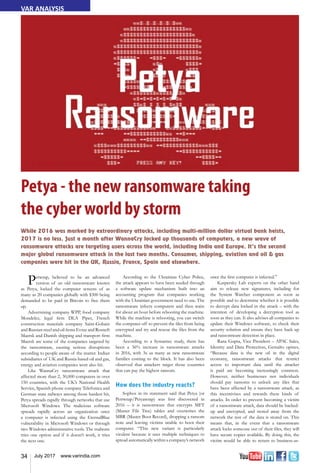
increase the percentage of e-commerce in the
coming months rapidly,” says Chiranjib.
The handset company to mark a presence
in the online market has partnered with few
e-commerce companies.
“Undoubtedly, India is a very big market
and e-commerce is bigger in India. With 30%
of smartphones being sold online, we too have
entered into strategic partnerships with leading
e-commerce partners, namely Flipkart, Snapdeal,
Amazon, Homeshop 18, Shopclues and others,”
he adds.
Service Support
Ziox is well known for its after-sales service
andthecompanyhasauniquereplacementpolicy
that enhances the relation with its consumers.
“Ziox is popularly known among its TG for
the after-sales service. Very recently, we have
introduced a 111 Days Replacement Policy for
our feature phones. This policy is applicable from
the day of activation or purchase (whichever
one is first). This unique policy allows us to
build stronger connect with our customers and
"Ziox is steadily expanding
and growing. We aim to
become a brand to be
reckoned with by hitting
10 million handsets in
the fiscal year 2017-18"
will assure them that we stand for best quality
products and service in the cluttered mobile
market. Started in selective cities, we plan on
extending it to a pan-India level. In addition to
this, we have an Assured 10 Day Service policy,
wherein we will close on any hardware issue
faced by our consumers at a maximum of 10
working days. If in case we are unable to address
the issue at hand, we will replace the device with
a similar condition device on the eleventh day of
complaint login. Servicing the growing customer
needs, we have over 700 service centres across
India with the clear approach – Quality that
speaks!” says Chiranjib.
Looking forward…
The company is witnessing a steady growth
in the Indian market and is aiming to reach 10
million handsets in the current fiscal. To achieve
thetarget,Zioxisplanningtoincreaseproduction
capacity by adding two new manufacturing
units.
“Ziox is steadily expanding and growing.
We aim to become a brand to be reckoned with
by hitting 10 million handsets in the fiscal year
2017-18. To achieve the same, we will be coming
up with more technologically advanced phones.
Also, we will be increasing our production
capacity by adding two more manufacturing
units. Distribution channel will be strengthening
further along with after-sales service,” reveals
Chiranjib.
While talking about market share, Chiranjib
shares, “Ziox has attained a significant market
share, on the back of an aggressive retail and go-
to-market strategy. The brand has made rapid
inroads into the smallest of neighbourhood
stores, not only increasing the dealer count but
also establishing the stronger network. Currently,
with the key focus on Tier-II and Tier-III cities,
Ziox has acquired an aggressive market share
and intends to occupy 3–4% by FY 17-18.” n
Aparna Mullick
aparna@varindia.com
In a chat with VARINDIA, Chiranjib Sarkar, National Sales Head, Ziox
Mobiles, discusses positioning of the company, its products, channels, service
support and targets of the company
57www.varindia.com July 2017
VAR MOBILITY
Honor unveils Honor 8 Pro
priced at Rs 29,999
All-new Spice Brand launches a
new portfolio of mobility devices
InFocus presents itsTurbo
5 in Indian Market
XOLO rolls out Era 1X Pro
Smartphone at Rs.5,888/-
Honor has launched
Honor 8 Pro.
With processing power,
long lasting battery life
and 14.47cm 2K display,
the Honor 8 Pro with
dual-lens camera is packed
into an impossibly thin
6.97mm body. The Honor
8 Pro has been
designed under
the partnership
with Amazon,
G a m e l o f t ,
GoPro, Jaunt
VR and Deep
Silver Fishlabs
to enrich
digital lifestyles
t h r o u g h
e n h a n c e d
s m a r t p h o n e
experiences.
The Honor 8 Pro
offers market-leading
specificationsbypushingthe
boundary of smartphone
design,providing2Kdisplay,
extra-long battery life, dual
camera setup and delivering
powerful performance to
InFocus has
launched its Turbo5
smartphone under the new
brand licensing agreement
signed with Foxconn. This
product is the first from a
series of innovative product
line-up especially developed
for the Indian market,
keeping in context the
Indian consumers’ needs,
under this new strategic
partnership between
InFocus and Foxconn.
The Turbo 5
focussing on reliability
and performance packs
in a high capacity battery
life smartphone of 5000
mAh. With an incredible 34
ensure best experiences
across the scenarios that
today’s smartphone users
care most about. Honor can
do this like no other due
to its unique e-commerce
business model and world-
class R&D capabilities.
India is one of the key
markets for Honor and the
company plans to grow
exponentially with the new
gamut of product offerings.
The global smartphone
major has revamped after
sales services with over 250
service centers across the
country.
Spice brand, a joint
venture between
Transsion Holdings and
Spice Mobility, have
launched an all-new
portfolio of 8 mobile
devices, including 5 feature
phones and 3 smartphones.
The new product
portfoliooffersaesthetically
and stylishly designed
phones with features that
would stand out and appeal
to the youth, and is priced
between Rs.850 to Rs.9,500.
In alignment with the fresh
design created for the
Indian youth, the products
are segmented as F Series
(Music, fun, fashion), K
series (Creative & fashion),
V Series (Value premium,
with focus on performance
and camera), and Z series
which are essentially the
feature phones, offering
best-value & quality with
great design.
Sudhir Kumar, CEO,
Spice Mobile under
TranssionGroup,said, With
the launch of the series, we
have taken a step closer in
creating an inclusive yet
all-new powerful and rich
digital experience for the
young generation of India.
Aligned with the brand
identity and philosophy,
Spice brand wants to fuel
the existing culture of
sharing amongst the Indian
youth."
days of standby time and
doubling as a power bank,
the Turbo 5 ensures endless
entertainment.
The Turbo 5 sports
a 5.2inch HD IPS 2.5D
Glass display that offers
razor sharp display, clear
and striking images. The
device is powered with a 1.3
GHz Quad core processor
and a 2GB/3GB RAM and
16GB/32GB ROM which
is expandable up to 32GB
via a microSD card. The
fingerprint sensor has as
a multipurpose usage, not
only can it unlock the device
but also start flashlight &
click images.
XOLOhaslaunched
Era 1X Pro, a high-
performance smartphone.
The handset comes loaded
with 2GB RAM and
16GB internal memory
which is expandable up
to 32 GB, making it the
most favourable choice
for consumers who are
looking for a smooth
multitasking phone in this
price segment.
To enhance the user’s
experience, XOLO has
done a seamless integration
of hardware and software
in this phone. It exhibits a
premium design with a 5”
HD Ultra bright display
screen with a luminosity of
400and16.7millioncolours,
designed for an enhanced
viewingexperience.Also,the
phone comes loaded with a
memory combination of
2GB RAM and 16GB ROM
which allows consumers
ample space to store up to
4,000 images, 350 videos
and 2,000 audio files in the
smartphone. In terms of
camera combination, Era
1X Pro is equipped with
8MP primary and 5MP
front camera with Dual
LED flash and comes with
a new refreshed camera
user interface called Pro
mode which helps users to
change the settings at the
camera screen itself. The
primary camera comes with
a host of high-end “smart”
features like slow-motion
videos, time lapse videos,
live photos, audio note,
beauty mode, burst mode,
panorama mode and screen
mode. The camera sports
a high precision 4P Largan
lens that makes images look
sharper and clearer.
Moto E4 series
launched with
5,000 mAh
battery priced
at Rs. 9,999
The new Moto
E family, Moto
E4 Series come with
extra power to meet the
requirements and make
the smartphone experience
smarter.
With sharper looks
and major upgrades, they
deliver the things you
want – all day battery,
outstanding display
and advanced camera
capabilities – at just the
right price.
MotoE4Plus,outfitted
with a vibrant, 13.97 cm
(5.5”) HD display wrapped
in smooth metal, it will be
hard to put it down. With
a 5000 mAh battery, you
can go longer without
worrying about recharging
for up to 48 hours. Moto
E4 Plus comes with
the 10W rapid charger,
which gives you hours of
battery life in minutes of
charging.
The Moto E4 Plus
comes with the dual SIM
slots and lets you store as
much as you want on the
32 GB internal storage
that’s expandable up to
128 GB with a dedicated
MicroSD card slot.
Moto E4 Plus features
a 13 MP autofocus rear
camera with flash and
a 5 MP front camera
with a selfie flash and
beautification mode for
stunningly sharp photos –
even in low light.
Make your life
faster with a quad-core
processor and 4G VoLTE
and ViLTE as Moto E4
Plus offers the speed and
power you need to scroll
through your favorite
websites, play games and
more – all without the
wait. And with pure and
latest Android 7.1.1, an
updated version of the
world’s most popular
operating system, you can
expect only the best with
Moto E4 Plus.
58 July 2017 www.varindia.com
NokiaTechnologies hires
Gregory Lee as President
Nokia has announced the appointment of
Gregory Lee as President of Nokia Technologies
and as member of the Group Leadership team,
with immediate effect. Prior to Nokia, Lee served
as President and CEO, Samsung Electronics,
North America, with a focus on driving fast
growth, profitability and operational excellence.
In this capacity, Lee led all of Samsung’s businesses for North America,
managing a portfolio of products including mobile phones and consumer
electronics, as well as those in new market segments such as digital health,
virtual reality devices and digital content.
Lee will be based in California, reporting to Rajeev Suri, Chairman -
Nokia.
Autodesk names new
President and CEO
Autodesk has announced that its board of
directors has appointed Andrew Anagnost,
current interim co-chief executive officer and
chief marketing officer, as the company’s new
President and CEO, effective immediately. He
will also join Autodesk’s board of directors.
The company has also announced that Amar Hanspal, Senior VP, Chief
Product Officer and Interim Co-CEO, has decided to leave the company.
Anagnost, who holds a Ph.D. in Aeronautical Engineering and
Computer Science from Stanford University, began his career at Lockheed
Aeronautical Systems Company and as an NRC fellow at NASA Ames
Research Center. After joining Autodesk in 1997, he held various technical
and strategic roles.
Nikhil Arora appointed
Managing Director
of GoDaddy India
GoDaddy has announced the appointment
of Nikhil Arora as Vice President and Managing
Director for India.
Nikhil will lead corporate strategy, business
development and customer experience for GoDaddy in India. Prior to
joining GoDaddy India, Nikhil led the Asia and India operations for
WeWork.Previously,NikhilservedasVicePresidentandManagingDirector
of Intuit India, where he led Intuit’s India business strategy, strengthened
partnerships and capitalized on social, mobile and global market trends
impacting small businesses. Nikhil has also worked at Laureate Education,
ADP, Delphi Automotive and CBS Television.
Dinesh Malkani resigns as
President of Cisco India
Dinesh Malkani, Cisco India and SAARC
President, has resigned and is now believed to
take on a leadership role at a start-up, but details
of the same could not be ascertained. He will
continue in his role until 31st July and remain
associated with Cisco till the end of September.
Dinesh has played a key role in driving its growth, talent and digital
transformation initiatives in India. After his exit, Cisco will continue to
execute on its long-term strategic focus on India through its investments in
innovation, skills development and digital transformation. People aware of
the development said the company has already conducted an internal and
external search for Malkani’s replacement and will make an announcement
in the next two weeks.
Nitin Rakesh appointed
as chair of NASSCOM
IT Services Council
National Association of Software and
Services Companies (NASSCOM) has appointed
Nitin Rakesh, Chief Executive Officer and
Executive Director of Mphasis, as the Chair of
the IT Services Council.
Nitish Rakesh was elected and unanimously elected as its Chair. His
vision is to transform India’s brand image from a cost competitive offshore
destination to an essential technology partner and work towards bridging
the gap between “Bangalore-and-Bay Area” both from an IP and start-up
perspective. To power these core priorities, building a strong ecosystem to
transform India as a technology destination is vital.
Transsion appointsTathagat
Jena to head marketing
TheChinesemobileOEMgiantTRANSSION
is setting its sights on the lucrative Indian handset
market in the 6k – 20k price band. Tathagat Jena
or “TJ” as he is called, joins them as Sr VP –
Marketing and has been entrusted with the task to
build a strong brand and run an efficient demand
generation programme for the Tecno and Infinix brands.
TJ is a seasoned marketer with nearly two decades of experience, almost
half of which have been spent at Samsung, helping take it from the No.
4 brand in 2008 to numero uno status. In his nearly nine-year journey at
Samsung, TJ has handled multiple roles in marketing and communication.
Before that, he had worked at leading advertising agencies such as Leo
Burnett, Ogilvy and Lowe.
Sandeep Nagpal quits
SAP, joins Cvent
Sandeep Nagpal, who was with SAP earlier,
has joined Cvent as its Vice President and Head
of Marketing.
In his previous stint, Sandeep had served at
SAP as the Head of SME & Partner Marketing
(VP), APAC & Japan. In this role, Sandeep was
responsible for overseeing SAP's Partner, Ecosystem & Volume Business
Marketing Strategy. It also included gaining market share for SAP, increasing
the SAP brand affinity and purchase consideration among the small & mid
market (SME) segment across APJ. He also managed strategic alliances,
VARs & Ecosystem partners marketing programs including affiliate &
influencer marketing, rebate/incentive programs and communications. He
also held the position of Senior Director Marketing when he first joined SAP
in 2010. Sandeep had earlier worked for Nokia as Head – Business Mobility
& Commerce Solutions and Microsoft Corporation as Marketing Lead.
Ziox Mobiles appoints
Vikash Chandra to fuel
online business
Ziox Mobiles has announced the induction
of Mr. Vikash Chandra as the General Manager –
eCommerce & TV Shopping business. The brand
poised to bring its focus and resources to online
space. To fuel further growth, the company aims to strengthen its Online
Business and e-commerce network. Through this strategic appointment,
Ziox Mobiles will now advent its position in eCommerce domain.
Ziox plans to fortify the online business with Vikash Chandra
spearheading the operation. Reinforcing its position, the brand aims to
accomplish online sales of up to 20% of the total sales in this FY 2017-
2018. Marketing data and analytics all concentrated to online sales that
shall bring Ziox the opportunity to expand their reach to the region and
beyond.
Movers & Shakers
59www.varindia.com July 2017
60 July 2017 www.varindia.com
RNI - NO 72399/1999
Reg. No: DL-SW-1/4030/15-17Printing Date 18 & 19
Date of Posting 20 & 21
every month
60 pages including cover56 March 2017 www.varindia.com
RNI - NO 72399/1999
Reg. No: DL-SW-1/4030/15-17Printing Date 18 & 19
Date of Posting 20 & 21
every month
56 pages including cover

E magazine july 2017

  • 1.
    1www.varindia.com July 2017 VOLUMEXVIII ISSUE 11 JULY 2017 PRICE Rs. 50 FDS to provide SI services to Dassault Systemes Fortinet selected by MITC to serve Mumbai citizens
  • 2.
    2 May 2017www.varindia.com
  • 3.
  • 4.
    4 July 2017www.varindia.com
  • 5.
    5www.varindia.com July 2017 Nasscomforecasts $25- billion potential from India-Israel startups The cumulative cross-border investment in Indian and Israeli startupshasa$25billionof revenuepotential by 2025, said a recent report “Collaborative Innovation: The vehicle driving Indo-Israel prosperity” of Accenture and NASSCOM. The report identifies IINSPIRE (Israel- India Startup Platform for Innovative Research and Entrepreneurship) framework to release innovation potential of the two startup nations. It concludes by recommending the creation of a program called IINSPIRE which aims to unleash the combined power of these two nations to deliver on Vision 25/25, by combining their strengths across three areas: talent, technology and temperament. HPE and Microsoft to provide opportunities to partners through Cloud28+ Hewlett Packard Enterprise has formed a go-to-market alliance with Microsoft through Cloud28+, the world’s largest, open community dedicated to increasing enterprise cloud adoption. Microsoft joins Cloud28+, an initiative led and sponsored by HPE, as a premier Microsoft Azure Stack technology partner.Bybecoming a Cloud28+ member, Microsoft will join forces with HPE to provide partners with new business opportunities and tools, while accelerating customer business outcomes powered by a rich hybrid IT ecosystem. Trend Micro invests $100 MillionVenture Fund Canon India strengthens its PIXMA Series SUBSCRIPTION COPY NOT FOR SALEVOLUME XVIII ISSUE 11 JULY 2017 PRICE Rs. 50 36pg The age of offering next-gen customer experience is here! 16th STAR NITE AWARDS 2017 3rd Nov. 2017 Hotel The Lalit, New Delhi
  • 6.
    6 July 2017www.varindia.com Transforming the workforce for the digital era …. Future is eyeing for cognitive computing HELLO INDIA When you think about major cloud hyperscales, prominent internet brands like Amazon, Microsoft, Google and IBM tend to come into our mind. But is this a closed club or is there room for more? Now Alibaba Group is globally scaling its cloud and digital services platforms to earn its seat. The company that started out as a B2B portal now touches almost every aspect of the internet and e-commerce sectors. In the recently-held VARINDIA Infotech Forum, majority of the CIOs talked about increasing digitization, where every part of our society and economy is being fundamentally transformed because of digital technology they want to use to develop stronger customer relationships and reshape the sales approach, with executives spending maximum hours in front of a screen than in the field. Sales engagement on digital channels – like email, chat, messaging, video conferencing and voice-over-IP – is boosting sales productivity. The digitization efforts by the government will continue to have a positive impact on the networking market too. The various private and government players are contributing towards increasing the digital footprint. Technological change is the overall process of innovation and the technology shift happens with the need of automated IT systems that can solve problems without requiring human assistance by using machine learning algorithms. The answer could be cognitive computing. It is the simulation of human thought processes in a computerized model and it involves self-learning systems that use data mining, pattern recognition and natural language processing to mimic the way the human brain works. As India increases its investment in technology, the country’s data center and network infrastructure will undergo a massive transformation. With this, the digital journey is marching ahead with the introduction of GST. It is not just tax reform, but it is economic reform. GST is a way forward in the ease of doing business. Now the opportunity is to empower SMEs. The government hopes there will be a jump of 14 per cent in revenue growth under the new levy as more taxpayers come into the fold of the formal economy and move on to digital modes of payment. It will bring about an unprecedented transparency and create data for almost every monetary transaction in the economy. The government hopes, and this, in turn, will help expand the tax base and secondly, the incentive for cash transactions would reduce. Now they will be able to take credit for the taxes paid and evasion of taxes will be difficult as transactions have to be reported on the GSTN portal. So the level of compliance will increase. At the same time, concern about the new reporting requirements could also mean chaos in the nation where about one-fourth of the population can’t read or write and many offices do not have the technology needed to file digital returns. It will bring an opportunity for various IT vendors. Lastly, GST is expected to make India richer, but the transition is going to be time-consuming. So till then let us wait and watch.
  • 7.
  • 8.
    8 July 2017www.varindia.com Website: www.varindia.com CONTENTS Publisher: Deepak Kumar Sahu Editor: S Mohini Ratna Executive Editor: Dr. Vijay Anand Copy Editor: C. M. Dutta Consulting Editor: Pravin Prashant Deputy Editor: Samrita Baruah Sub - Editor: Aparna Mullick Art Director: Rakesh Kumar Network Administrator: Ashok Kumar Singh Manager-IT: Subhash Mohanta Manager-SEO: Bidyadhar Behera BUSINESS: Commercial Manager: Amit Kumar Jha Sr. Marketing Manager: Ashok Ranjan Dash Circulation Executive: Manish Kumar Marketing Manager: Dipendra Kumar CORPORATE OFFICE: VAR House, A-84A/3 Rose Apartment, Paryavaran complex, Ignou Road, New Delhi - 110030 Tel: 011-41656383, 46061809 Email: edit@varindia.com Bangalore: Bureau office Marketing Manager: S. Kamala kar Correspondent: L. G. Swami D-103 G.F., Ashish JK Apartments Thubarahalli Extended Road Bangaluru- 560066 Tel: 080-49530399 | Mobile:09886280836 E-mail: kamlakar@varindia.com Mumbai: Bureau office Regional Manager (West): Anil Kumar Sr. Correspondent: Mamta S. Anurag Residency, 203 - “B” Wing, Plot No-5, Sector-9, Kamothe, Navi Mumbai-410 209 Tel: 022-65561292, Mobile: 08108017479 E-mail: anil@varindia.com, mamta@varindia.com Chennai: Bureau office Branch Manager: M.S. Barani Door. No.8, Plot No.-837,89th Street, 13th Sector, K.K.Nagar, Chennai - 600 078 Mobile: 09444077065 E-mail: barani@varindia.com Hyderabad: Bureau office Branch Manager: Sunil Kumar B 383 HAL Colony, Balanagar HYDERBAD, Telengana - 500042 Tel: 040-32989844/ Cell No. 08100298033 E-mail: sunil@varindia.com Kolkata: Bureau office Marketing Officer: Sunil Kumar Correspondent: Kiran Kumar 67 Sarada Park, Garia, Kolkata - 700084 Mobile: 08100298033, E-mail: sunil@varindia.com Mobile: 09903088480, E-mail: kiran@varindia.com Printed and Published by Deepak Kumar Sahu on behalf of M/s. Kalinga Digital Media Pvt. Ltd. and Printed at Pushpak Press Pvt. Ltd. Shed No. 203 - 204, DSIDC Complex, Okhla Industrial Area, Phase-I, New Delhi-110020 and Published at A-84A/3 Rose Apartment, Paryavaran complex, Ignou Road, New Delhi - 110030, Editor - S Mohini Ratna. For Subscription queries contact: info@varindia.com Subscription: Rs. 500(12 issues)Rs. 1000 (24 issues) All payments favouring: KALINGA DIGITAL MEDIA PVT LTD © All rights are reserved. No part of this magazine may be reproduced or copied in any form or by any means without the prior written permission of the publisher. (1999-2016) * All disputes are subject to the exclusive jurisdiction of competent courts and forums in Delhi only. 46pg INDUSTRY EVENT 30| MICROSOFT INSPIRE – an amalgamation of new ideas 45| MSMEs foresee a mix of opportunities and challenges under GST regime LEAD STORY 36| The age of offering next-gen customer experience is here! 42| Open Source holds immense significance for Digital India COVER STORY 46| ICT Industry gives Thumps-Up for GST EVENT 30| Fortinet unveils new business opportunities at its annual SAARC Partner Conference 38| 15th INFOTECH FORUM 2017 – Making a Digital-ready Future possible FACE TO FACE 27| ESDS to be a catalyst in helping customers go digital 32| DeskeraisCreatingCloudPartner Network in India 33| VMware sees NSX adoption as critical to private cloud strategy 40| Lenovo wants to be the differentiator in after sales service REGULARS Channel Guru 10 Channel Chief 12 Round About 14 Hot Bytes 16, 18 On the Ramp 20, 22 Voice N Data 24 Channel Buzz 26 Movers & Shakers 58 41| AXILSPOT counts channel friendly business policy as key to success 54| CP PLUS The Security Brand of the Nation 55| Barco – a hi-tech MNC with a significant local footprint VAR SECURITY 52| “Risk assessment of relevant threats is necessary” 53| CP PLUS: The Security Brand of the Nation VAR MOBILITY 56| Ziox focuses on delivering consumer-centric products VAR ANALYSIS 34| Petya - the new ransomware taking the cyber world by storm
  • 9.
  • 10.
    10 July 2017www.varindia.com Avaya aspires to provide ultimate customer experience In a chat with VARINDIA, Vishal Agarwal, Managing Director, India & SAARC and Chiradeep Rao Channel Head, India & SAARC, the two eminent leaders at Avaya vividly discussed about the company’s strategy, its investment plans for the India market and the present channels ecosystem besides talking about the rapid digitization of technology - manufacturing. “In terms of our strategy, it is more around the customers, to see how we can give a differentiated experience to them and help them to consume the technology that they believe in. We believe customers will define the way technology will be consumed. We need to provide open architecture and platform and help our customers to deliver the solution and customise it the way the customer needs. That’s our differentiating aspect and the focus on the technology,” asserted Vishal. To survive in this market with a good strategy a company also needs focus. Vishal said that his focus is on three main areas – the first is the large enterprises in terms of helping them to evolve through the customer engagement journey; the second is focusing on digital India by identifying the ways of how it can contribute to the govt. vision and the third is the rapid expansion in the current market and the commercial space. As part of the its investment plans with regard to Channel expansion, sales & marketing and market expansion Vishal said that Avaya is hiring new people and training & developing its partners. “We are helping our partners to evolve through their technology and growing with their end customers is again a part of our investment,” he said. Channel eco-system... Channel holds a substantive position for Avaya. They represent the company to customers while helping it in new customer acquisition and generating sales. Avaya counts its channel partners as very crucial. Avaya has differentiated its partners broadly in the five categories - classical partners who cater to enterprise; global SIs & SPs; partners who cater to the mid market including SMBs; the cloud partners and finally the distributors. “As Avaya cannot individually cater to every single partner, we have the distributors who cater to the smaller and tier 2 partners,” pointed out Chiradeep Rao. He continued, “We have this partner program called ‘Avaya Edge’ where we tie, certify and provide skill our partners. This is typical of any program across OEM, but what we done is we have made it simple.” Avaya also spends money every quarter in the areas of certification and skilling, and the company chooses it according to what it thinks the partners need to skill up on. “It’s a sort of mutual process,” said Chiradeep. “We identify the gaps for them and then together decide how to address these gaps.” Avaya has a presence in three different areas including, networking, voice collaboration, contact centres and video. It has made its programs simple to the extent that if a partner wants to excel in just one technology, Avaya tries to enable him in that technology and gets him certified in it. “You don’t have to learn all the products that we have,” summed up Chiradeep. n Digitisation no doubt harnesses productivity for organisations. As a result of digitisation of technologies, conventional methods and operating systems have gradually metamorphosed into the digital system. This new wave of digitisation is helping every sector and industry to evolve and aiding companies to increase mobility, efficiency of the workforce and enhancing the flexibility of an organisation. Avaya has carved out a niche with its tech advanced devices and is beefing up its position in the Indian market. It has been delivering a wide range of products and software services for enhanced user experience to its customers and plans to make lives better in India by contributing to the Government’s dream project of making India Digitised. Talking on the current market and Avaya’s position in the Indian market, Vishal Agarwal said, “India is a very critical market and one of the top 10 markets across the globe, and we are making a lot of investments in this market. We have a very strong R&D team, global services and a consulting team based out of India and quite a few of our back office work also happens out of India. So, India is a very strategically placed market for Avaya”. Strategy & Investment plans... Avaya serves in all the verticals, whether it is the service provider, the finance sector, the govt organisations, healthcare, or
  • 11.
    11www.varindia.com July 201723www.varindia.com July 2017 Dell EMC Trademark: Dell, EMC and Latitude are trademarks of Dell Inc. or its subsidiaries. All other trademarks are the property of their respective owners. Customers like you told us the challenges facing their business. That’s why our new line of Latitudes are thinner and lighter, with longer battery life, flexible docking, and up to 7th Gen Intel® i3/i5/i7 Core™ processors. Get your business future-ready at Dell.co.in/Latitude Authorised Partners: Mahavir Infotech: 303, City Centre Building, Nr.Govalak Jakatnaka, Sosyo Circle, Udhna Magdalla Road, Surat, Gujarat. Ph : 0261- 2634142/9924145614; Jupiter Automation: 111, Jay Ambe Society, Near Sakthi- Nikethan Temple, Adajan Patiya, Ring Road, Surat, Gujarat, Mob: 9825141666/9824751650; Earth Syscom Pvt. Ltd: 12, Trilok Raw House, Opp. Chanakya Tower, Near lad society, Vastrapur, Ahmedabad – 380054, Keyur raja: 9978908972 / 9904249601; Ravi infocom: B-4,shyamnagar soci., Gurukul Road, Ahmdabad. 380052, Ritesh patel: 098244 99920; Dikibi Technologies Pvt Ltd: 361/62, budhwar peth, Pune, Maharashtra, Brijen shah : +91 942-232-4746, Bhavin shah : +91 937-023-9712; S.M. Enterprise: 42/2, g, raj, Dashbhuja Estate, Near Dashbhuja Ganpati Mandir, Karve Road, Pune – 411038, Maharashtra, Suhas Gugale : +91 982-291-2300; Miracle Tech Distributors Pvt. Ltd: 212, Patel Shopping Centre, Sainath, Road, Malad West, Mumbai, Rajesh Goel : 9820291357; Massif Marketing: Room no.17, 4th Floor, Ahmed Chambers; Lamington Road, Grant Road(East) Mumbai, Maharashtra, Jayesh Jain : 9022662733; Computer Infotech India P Ltd: H6, 9th floor, Everest Building, Tardeo Road, Mumbai, Maharashtra, Jinesh Shah: 9821391155
  • 12.
    12 July 2017www.varindia.com Veeam ensures Availability to enable Always-On business for its customers Veeam is a 10 year old start-up with headquarters in Switzerland and having presence in more than 67 countries. It has more than 2, 45, 000 customers worldwide with a strong presence in India. In India it has about 750+ customers with 100+ active partners in its channel eco-system. “We are the fastest growing company in the world with revenues of 720 million dollars worldwide, which will be reaching 2K million dollars by 2019,” asserts Ashok. Veeam does not sell directly and it is always through the channel ecosystem. It works very closely hand-on-hand with ISV or alliance partners. Partners like HP Enterprise, Cisco, Microsoft and NetApp form part of this partnership. The Veeam channel eco-system is also segregated into tier 1, tier2 and tier3 types that serve customers across all verticals. In tier 1 category, Veeam has global SI’s like IBM, Accenture and in tier2 partner category, the company has partnership with Indian SI’s with global presence like Wipro, TCS, Tech Mahindra and HCL. Veeam also works with the reseller community that is the tier 3 partners. The reseller is typically regional specific and they don’t have a national presence, but they are strong in each region and so Veeam works very closely with these regional partners. “As part of the go – to - market strategy, whenever there is a datacenter opportunity, our ISV partners incorporate Veeam and send it to the customers. Just to give you an example- HP Enterprise has got Veeam price list. When a HPE sales person sells Veeam, he gets rewarded too. Likewise, we also work very closely with the CiscoUCS team; so whenever Cisco uses our opportunity, then by default the back-up is always from Veeam,” explains Ashok. Veeam also categorises its business as SMB, commercial and enterprise; any deal value less than $10k is categorised as SMB, which is primarily run by the channel. Then there are deals worth $10k to less than $50k that is categorises undercommercial business. “To run the commercial business we have two territory managers (TM) in each regionto cater to specific verticals.So One TM would be taking care for Banking, finance and IT and the other one will be taking care of manufacturing and services verticals in India. These territory managers will work with the tier 1 partners and the global SIs and approach the customers for opportunities,” explains Ashok. Veeam works with two distributors in Gone are the days where the brick and mortar companies used to just write on paper about the sales they have done, comeback and give it to the accounts team, who on its part will create an invoice and give it back. Today’s digital environment demands organizations to make data and applications available 24.7.365. This leaves enterprise with no room for any downtime or loss of critical data. Thus setting this context, Ashok Acharya, Regional Director, India and SAARC - Veeam gives an exclusive interview to VARINDIA while also speaking about the company’s roadmap for the India market - India –Tech Data and Redington. Opportunities in India... With 750 customers, Veeam has just covered 5% of the market in India, so there is huge growth opportunity for the company. “We have not gone deeper into large enterprise customers and so hiring enterprise account managersin India to focus on such deals,” says Ashok. “We will identify the top 20 accounts in each vertical and as a strategy these enterprise account managers will have a dedicated sales engineer, who will go in the accounts sales directly.” The key focussed verticals for Veeam is IT & ITeS, manufacturing, banking and Defence. “With digital transformation, Indian organizations have no scope for an IT outage, unavailability of data or web downtime. Since everyone wants to secure their back-up, they would require Veeam to enable Always-On business. Again data needs to bebacked- upsecurely, so that it is readily available whenever you want it. That is where Veeam comes into play,” explains Ashok. Roadmap for Veeam India... Ashok wants to see Veeam growing as the no.1 vendor in the data availability space. “We always ensure the SLAs that we cover with customers are the best. Veeam has got the maximum support ratings worldwide; we get 72% rating on support and we have a success rate of 85 % ofour customer renew license. This is because our engagement with customer has to be of very high experience,” says Ashok. In India Veeam keeps getting repeat business from its top enterprise customers. The business of Veeam from Q1, 2016 to Q1,2017 grew by 34% and in Q2 it grew by 43 %. But Ashok’s vision is to make this growth 100% by next year. n In India Veeam keeps getting repeat business from its top enterprise customers. The business of Veeam from Q1, 2016 to Q1, 2017 grew by 34% and in Q2 it grew by 43 %. But Ashok’s vision is to make this growth 100% by next year CHANNEL CHIEF
  • 13.
  • 14.
    14 July 2017www.varindia.com ROUND ABOUT GST: Is it the time for excitement or prudence? Finally, it is out – to be precise on 30th June, 2017 at midnight, when the whole nation was seemingly glued to the TV or mobile screens. GST is said to give us economic freedom and help us to treat the entire country as a single economic contiguity. There can be differing views and perceptions. I do not want to stoke a debate, except by telling that, as an entrepreneur, GST will influence how I do business, how I plan it, how I calculate the indirect tax that I pay to the government and how I earn credit for the taxes that I have paid to the government. Undeniably, the launch of GST, to me, signifies a new thing. That has nothing to do with the slogan one India one tax or one India one market. Presumably, when GST becomes fully matured and is accepted by the people to whom it is meant, there may be a marked shift in the business operations. It seeks to subsume all indirect taxes that we pay at central, state and local levels into a single rate or two. That will have a great positive spinoff since we are sure of our tax burden, how it is collected and how it is appropriated. What is GST? If you ask me how many in India have heard about GST, I would say hardly there is anyone who has not heard about it. If you ask me how many would know about how it operates, I would say hardly there is anyone who knows how it will get rolled out, initial hitches, how these would be resolved, etc. Nobody should be blamed for that. In a country where more than 1.3 billion live, where taxes particularly indirect taxes are to be paid from birth to death, several times in a day, how can we predict what challenges the tax structure pose. Everyone knows – government, tax experts, traders, industrialists and man on the street – that at the implementation stage there will be problems. Should that be a limiting factor for introduction of GST or should it be delayed for quite some time? Is it a simple tax structure? Again, my take is that it was conceived as a simple one and many optimistically thought, to begin with, it will have only two or maximum three slabs of moderate rates. What was originally conceived as ideal one, had to be considerably watered down due to political pressure from the states. The Centre had taken three categories of goods from the purview of GST, viz. alcohol, petroleum products and tobacco. These goods are generally referred to as non-merit goods and the state revenue flows mainly from these heads. To that extent, the present GST is truncated and nobody should be blamed for that. Had the Centre insisted on the original plan, GST would have been a non-starter. After a lot of deliberations and consultations with stakeholders, India has chosen the Canadian model of GST – of course, with some adaptations. It has three components – CGST (Central Goods and Services Tax), which will be collected by the Central Government on sales of goods and services. The other one is SGST (State Goods and Services Tax), which will be collected by the respective state governments on sales of goods and services and the third one is IGST (Inter-state Goods and Services Tax), which will be collected by the Central Government on the inter-state transaction of goods and services. The collected IGST revenue will be distributed between the states, as per the view of the proposed GST Council. To compound further, there are five different rates pegged at 0%, 5%, 12%, 18% and 28%, besides exempting three items like alcohol, tobacco and petroleum products, which will continue to remain with the state governments. They are the major sources of income for the state governments. If you feel that the GST on the ground is a compressed and compromised one, you are not far off the truth. Yet, one has to reconcile the political pressure that the Central Government has undergone to cobble together differing views. We have to rough up the initial glitches of the GST. The base of the taxpayers is larger than what it has been earlier. Also, the GSTN (Goods and Services Network) has to be tested and validated. The digital network has to support registrations, return filing, tax payments, reconciliation, IGST settlements,etc.ForaneffectiveGSTtooperate,taxexemptionsandpresence of multiplicity of rates should be subsumed into bare minimum. Indeed, there is a lot of spadework still to be done. Granting time to the authorities to streamline things and iron out glitches is one thing. Equally significant is compliance. We should develop faith in the system. The human ingenuity may force people to find newer ways to dodge the taxes. If anybody does so, it should attract severe penalty. At the same time, authorities should be considerate and minor aberrations should be condoned and resurgence of inspector raj as it has been feared in some quarters should be shunned since business cannot grow in a situation where there is mistrust and vilification. It is instructive to learn things from the experience of others. More than 140 countries have implemented GST in one form or the other. Barring the United States, most of the developed world has a form of indirect taxation similar to that of GST. Some of these countries have faced stiff problems in the initial stages. We have to learn what those glitches were to preempt occurrences of such things in our system. Undoubtedly, the introduction of GST has pitched up the expectations of the general public. They expect that the prices will come down, tax rates will be lower, life will be much easier, etc. Bereft of occasional sound and noise aired from different sources, particularly from the small- and mid- sized companies taking up job works, industry in general has welcomed the introduction of GST. They feel that the cascading effect of taxes, which has played havoc on the growth of the economy, will be a thing of the past, since the industry will be allowed to take credit on input tax paid so that nothing is added to the basic tax. Yet, there are many incongruities to be addressed. Let us take a few examples how such anomalies will get manifested. In the case of an airline ticket, if I have to travel from New Delhi to New York, a direct flight will cost me dear since the GST will be on the entire ticket. On the other hand, if I take a hoping flight from New Delhi to Dubai and onwards to New York, I save tax since in the second leg of my travel, I need not have to pay any GST. Does it mean that the government is inducing the travellers to opt for hoping flights to save money? Still, the clarity has to emerge how the exporters have to be insulated from paying tax since the general principle is not to export tax. The suggestion made by various authorities is that let the exporter first pay the input tax and later he can claim the refund. This is going to be a cumbersome procedure since money will be locked up and the exporter will be subjected to some harrowing experiences. In summation, I might say that the government, after a long wait, has shown the political will at last to roll out GST. It was not at all an easy task and a lot of political tightrope walking had to be resorted to achieve that feat. That does not mean that the journey from now onwards will be easy, particularly when the expectations are high amongst all stakeholders. There is a long way to traverse before we can pat our back. n
  • 15.
  • 16.
    16 July 2017www.varindia.com HOT BYTES Logitech to buy ASTRO Gaming for $85 million InflowTechnologiestodistribute PaloAltoNetworks’SecurityPlatform LG #KarSalaam campaign wins laurel at the CMO Asia Awards Oracle Digital Hub to help SMBs power digital transformation FDS to provide SI services to Dassault Systemes Fujitsu and SAP SE expand partnership to aid customers go digital Lo g i t e c h International has agreed to acquire ASTRO Gaming for $85 million in cash, and the acquisition is expected to close in early August. With the addition of ASTRO, the company is investing in an adjacent gaming market - the console gaming market - to help accelerate the long- term growth of its gaming business. Both the companies togetherarethenumberone maker of headsets, mice, keyboards and streaming webcams for PC and console gamers. ASTRO is best known for its iconic A40 and A50 headsets designedforprogamersand core enthusiasts. ASTRO’s recently introduced A10 expands the company’s reach in the console headset market, offering the essence of what makes their headsets premium, but at a more broadly accessible price point. Inflow Technologies has signed a distribution agreement covering India and the SAARC region with Palo Alto Networks to deliver its Next-Generation Security Platform. ThePaloAltoNetworks Next-Generation Security Platform was built from the ground up for breach prevention with threat information shared across security functions system- wide, and is designed to operate in increasingly mobile, modern networks. Inflow’s unique base of resellers will open up numerous opportunities for Palo Alto Networks, bringing new value to bolster the vendor’s partner network. Aggressively focused on new growth markets and selling through awareness, training and support, Inflow is committed to providing technical expertise to uphold their reputation as a trusted VAD. The #KarSalaam campaign of LG, which was launched prior to Republic day this year (2017) has won the best social and digital integrated campaign of the year award at the recently concluded CMO Asia Awards. The#KarSalaaminitiave is dedicated to the Indian soldiers. The campaign, also marking LG’s 20th year anniversary in the country invited the whole nation to come forward and send their wishes to the Indian Armed Forces. It is a manifestation of LG’s corporate philosophy, ‘Life’s Good’ and a gesture of the nation’s support and solidarity to the soldiers for playing a great role in assuring that we all lead a fearless and good life in this country. Small and midsize businesses (SMBs) will get access to the cloud solutions and resources they need to power digital transformation with the opening of Oracle’s first Digital Hub in Asia- Pacific, which will be based in Bangalore. The new facility, one of five Digital Hubs set to open in Asia- Pacific, highlights Oracle’s commitment to better serving the midsize market in the new cloud economy. The Digital Hub will help SMBs leverage Oracle Cloud solutions to streamline operations, boost innovation and gain a platform for growth. The hub will house Oracle’s new digital sales team and focus on helping more midsize organizations transition to the cloud quickly and easily. Theteamwillprovidetimely, personalized and effective support to customers, using the latest collaboration tools, techniques and technologies to transform the buying experience. Fourth Dimension Solutions (FDS) has partnered with Dassault Systèmes to provide System Integration (SI) services for the latter’s portfolio of applications and industry solution experiences based on the 3DEXPERIENCE platform in the Indian Subcontinent market. The agreement covers both SI services and product/licence sale as FDS plans to increase its revenue from implementation services. Amalendu Mukherjee, Managing Director, FDS Ltd, said, “This is a significant landmark for FDS both locally and globally as our presence and capabilities in an evolving DPMS industry will be enhanced by the 3DEXPERIENCE platform from Dassault Systèmes. FDS’ holistic approach offers organizations with future- ready solutions that provide competitive advantage and market differentiation.” Fujitsu Limited and SAP SE have announced expansion of their global partnership to offer advanced ERP solutions that use artificial intelligence (AI) and the Internet of Things (IoT). Based on this agreement, the companies aim to develop solutions that will accelerate the digital transformations of their customers, combining each company's AI and IoT technologies based on the SAP ERP solution, SAP S/4HANA and the SAP Leonardo IoT platform. The companies aim to accelerate customers' digital transformation and plans to jointly develop industry-vertical-oriented cloud services, With Fujitsu offering a one-stop solution covering all areas, from service-platform builds to application development and operations. CYIENT inks agreement with Kii Corporation Cyient has a n n o u n c e d that it has signed a non- exclusive business alliance agreement with Kii Corporation to explore, bid and address business opportunities around smart city deployments. Through this agreement, Cyient and Kii have Corporation have decided to jointly pursue business opportunities globally, by leveraging their complementing skills and strengths. The partnership will combine Cyient’s domain expertise and geospatial capabilities with Kii’s IoT platform to develop connected solutions through smart devices and applications. Under the terms of the agreement, Cyient will also provide Kii with project delivery and implementation services. Telangana Government unveils Hy- Fi Project Telangana State Government has launched the “Hyderabad City Wi-Fi Project”, also known as Hy-Fi, with over 1,000 hotspots across the state capital which was inaugurated by the Hon’ble Mayor of Greater Hyderabad Municipal Corporation, Shri Bonthu Rammohan. The project will cover 3,000 hotspot locations within the city. In June 2015, under the “Digital Telangana”, the Government of Telangana had launched the pilot version of Hyderabad City Wi-Fi Project (Hy-Fi) which saw the government partner with ISPs to provide free Wi-Fi for 30 minutes at approximately 100 public category locations across Hyderabad. Over the last two years, the number has more than doubled to cover about 250 locations.
  • 17.
    19www.varindia.com June 2017 “PACKS PLENTY OFOOMPH” Windows 10 Pro means business. Forged from carbon fiber ® the ThinkPad X1 Carbon is incredibly thin and immensely powerful. Call us at 1800 3000 9990 or e-mail us at corpsales@lenovo.com © Lenovo 2017. All rights reserved. Lenovo, the Lenovo logo are trademarks or registered trademarks of Lenovo. Microsoft and Windows are registered trademarks of Microsoft Corporation in the U.S. and other countries or both. - LAPTOP
  • 18.
    18 July 2017www.varindia.com HOT BYTES Tech Data now a Microsoft CSP Videocon forays into Security & Surveillance space Trend Micro invests $100 Million Venture Fund Fortinet selected by MITC to serve Mumbai citizens Karnataka Government launches “Program ELEVATE 100” Wipro ties up with Red Hat for Cloud Application Factory Tech Data C o r p o r a t i o n has announced that its Technology Solutions business, formerly a division of Avnet, can now deliver Microsoft’s entire Cloud portfolio, inclusive of Azure, SaaS and PaaS, to their valued channel partners across India via the Microsoft Cloud Solution Provider (CSP) program. This builds upon the successful relationship between Microsoft and Technology Solutions in Australia and recent signing in Vietnam, and will enable partners in India to build profitable businesses in the cloud and create more recurring revenue. “This is the next step in turning our vision to be the leader in next-generation technology distribution into reality,” said Naresh Desai, VP, Specialist Business, Asia-Pacific, Tech Data. “Poweredby Microsoft,our portfolio of cloud solutions will enable our partners to embrace new consumption models, transform IT and drive business growth.” Marking its entry into the fast- growing Security and Surveillance market in the country, Videocon Telecom has announced the launch of its new brand of “Videocon WallCam”. With its prime focus on Video Surveillance products, the brand while bringing in a wide range of security and surveillance products will cater to the Enterprise, Government, institutional and retail (residential and small commercial set-ups) segments. Arvind Bali, CEO, Videocon Telecom, said, “The current Video surveillance market of approx Rs.3,650 crore is 55% of the overall Rs.6,600 crore security & surveillance market. The growth will be driven by households, including small commercial establishment (shops & offices) segments and the key success factor for market expansion will be affordability, ease-of-use (plug-n-play), and quality." Trend Micro I n c o r p o r a t e d has unveiled a corporate venture fund to explore emerging technology markets. With an initial investment of $100 million, this venture fund will allow Trend Micro to nurture a portfolio of start-ups that are incubating ideas and living at the epicenter of hyper growth markets, such as the Internet of Things (IoT). Trend Micro’s venturewilloffercompanies financial backing, access to its world-class global threat intelligence, strategic alliances, as well as its channel of more than 28,000 partners. In return, working with these investments will uncover insights into emerging ecosystem opportunities, disruptive business models, market gaps and skillset shortages. These learnings will influence Trend Micro’s cybersecurity solution planning. Eva Chen, Founder and CEO, Trend Micro, noted, “Trend Micro’s vision has always been to make the world safe for exchanging digital information." Fortinet has announced that the Maharashtra Information Technology Corporation (MITC)hasselectedFortinet to provide wireless Internet access to the citizens of Mumbai, India. Fortinet’s access points provide Wi- Fi internet access for the public in Mumbai and are deployed in more than 500 locations across the city for the Mumbai Wi-Fi project. Vijay Kumar Gautam, Principal Secretary, Information Technology, Government of Maharashtra, said, "Mumbai Wi-Fi project plays a crucial role in empowering our citizens digitally. Our goal was to cover all major areas in the city with public Wi-Fi in order to make important government services available online. An ambitious project like this required technology that could scale and be flexibile to enable more users, devices, and applications over time.” Government of Karnataka has introduced the ELEVATE 100 program which aims to identify and support 100 of the most innovative startups in K a r n a t a k a . Registrations for ELEVATE have already started from 4th July and will be open till 18th July for all participants from across Karnataka. For the first time, the State Government will be holding open houses to identify startups in Mangalore, Kalaburgi, Mysuru and Hubli. Startups from these cities will get an opportunity to pitch their ideas to the ELEVATE team. ELEVATE is the brainchild of the Start- up Cell, Karnataka Biotechnology and Information Technology Services (KBITS). Wipro has collaboratedwith Red Hat to set up a cloud applicationfactorydesigned to offer developers and IT teams a repeatable and rapid m e t h o d o l o g y for application modernization across public, private, and hybrid clouds. Wipro’s cloud application factory will have a dedicated services team that can help drive the strategy, design, and delivery of next- generation applications using Red Hat OpenShift Container Platform. The duo will provide dedicated IT consulting and services teams to help customers with application life cycle management, via specific roadmaps, frameworks, and best practices. From the initial discovery phase, to the strategy and design phase, and ultimately when customers are ready to build a production environment, the teams will provide a scalable factory approachtodevelopingnext generation applications. SterliteTech partners with Kakinada Smart City Corporation Sterlite Tech has announced that it has been selected for the implementation of Smart City solutions in Kakinada, Andhra Pradesh, India. Kakinada Smart City Corporation selected Sterlite Tech as its implementation partner to deliver various Smart City-related ICT solutions. These include Command Control Centre, CCTV surveillance, Wi-Fi, automatic number-plate recognition, face detection, waste and disaster management, among other platforms, bringing many technology firsts to India in terms of horizontal IoT platform, LoRa-based city-wide wireless sensor network and disaster management systems. Sophos secures Workplace Hub of Konica Minolta Sophoshaspartnered with Konica MinoltatointegrateSophos XG Firewall and Sophos Wireless into Workplace Hub. Konica Minolta recently announced Workplace Hub that integrates everything from basic office automation functions to security, IoT device management and data storage in a single platform designed for SMEs. “Due to its easy management and deep visibility into network activity, the XG Firewall is perfect for Konica Minolta’s vision for the workplace We both share the same philosophy of providing simple yet comprehensive technology for businesses of all sizes,” said Francois Depayras, VP for Global OEM Alliances, Sophos.
  • 19.
  • 20.
    20 July 2017www.varindia.com ON THE RAMP Onymos and Risan bring mobile apps development technologies Dell EMC, SAP help MSMEs become GST-ready NetRack unveils iRack Block for Data Center Infra Capsule Canon India strengthens its PIXMA Series Lava enters into notebook segment with Helium 14 Ricoh India rolls out next version of RicohDocs 3.0 Onymos has signed up with Singapore-headquartered Risan Asia Business Partners. With this partnership, Risan would provide a holistic market expansion strategy and means for taking the revolutionary mobile apps development platform to software developers, numbering in thousands, operating throughout the APAC region. “With more than half the world’s mobile users in Asia Pacific market, it is natural that the next generation of leading mobile apps will be built in that part of the world.”, said Shiva Nathan, Founder & CEO of Onymos Inc. “Onymos wants to enable this next generation of mobile app developers in Asia Pacific region realize their vision in the fastest and most cost-effective way possible with our suite of Onymos offerings including the Onymos Fabric”, added Nathan. Dell EMC will deliver comprehensive on-premise digital Enterprise Resource Planning (ERP) solutions to enable Micro, Small & Medium Enterprises (MSMEs) across India to become Goods and Services Tax (GST) ready. SAP’s pre-packaged “GST- in-a- Box’” solution will be available to MSMEs through joint go-to-market initiatives across 30 SAP GST solution centres across 15 cities in India. Through the new solutions, customers can make their businesses GST-ready in 100 days, thereby ensuring minimal disruption when it comes to transitioning to the new tax model. The “GST-in-a-Box” solution from SAP India, running on infrastructure solutions provided by Dell EMC, is aimed at helping MSMEs digitally transform their businesses while also ensuring a smoother and faster transition to a digital ERP system. NetRack has introduced iRack Block specially designed for in-house data center requirements and infra capsules. iRack Block series is designed to eliminate large DC infrastructure requirementsandto overcome facility challenges related to scalability, efficiency, compliance and other security issues. The Racks are IP 50 rated and configured with a load bearing capacity of 1,500 kgs in order to cater the high-density requirements. These racks are equipped with multiple “intelligent” features and configured with self- cooled, self-contained and self-powered features. "There is a lack of infrastructure in the small markets. Hence, we can see a favourable 'need and the supply' dynamics in this space," said Ravi Raj, Brand Head, Director Sales & Support, NetRack. Canon India has a n n o u n c e d expansion of its PIXMA series with the launch of two new models – PIXMA TS3170 and PIXMA E3170. The PIXMA printers comes equipped with a segment – LCD display with intuitive icons that guide the user through all operations from wireless setup, to making multiple copies using different document sizes. Both the printers come with a class apart, fingerprint and scratch resistant glossy grid pattern on their top surfaces which makes them easy to maintain. The enhanced operation panel features one-touch switching to direct wireless connection and back to standard network infrastructure mode.TS3170 is best suited foroccasionalprintingandis compatible with affordable cartridge Canon PG-745s and CL-746S. E3170 is best suited for everyday printing and is compatible with ink efficient cartridges PG-47 and Cl-57s which provides low cost printing of up to 400 monochrome documents and 180 colour documents. Lava International announced its entry into the notebook segment with the launch of Helium 14. The Notebook, for which the company has collaborated with Microsoft and Intel, is designed to offer productive, simplified and user-friendly experience. Created to meet the needs of small business, Gen-Y, Lava Helium 14 has been launched online exclusively on Flipkart and will soon be available at select retail stores and other multi-brand outlets across Delhi NCR, Coimbatore, Hyderabad and Bangalore from the first week of July in its first phase of launch. Lava Helium 14 is priced at Rs 14,999. Gaurav Nigam, Product Head, Lava International, said, “The launch of Helium 14 is an important milestone in the journey of Lava as a major Indian smartphone brand. It reiterates our commitment to continued innovation and is a testimony to the fact that we understand consumer needs.” Ricoh India has unveiled the next version of RicohDocs – 3.0 thatenablesuserstomanage all unstructured content and automate all business processes with absolute ease. This advanced office productivity platform helps organize the process of documentation and record creation, thus minimizing the involvement of professionals in the tedious regular tasks. RicohDocs 3.0 is equipped with various new modules and advanced features such as file version comparison, sharing & preview of media files and bulk upload of files, etc. Significant enhancements have also been made in user interface and user experience in the latest version of the platform. RicohDocs is a critical asset for every organization to lower risk, reduce operational cost. Juniper launches Cloud-Grade Networking Juniper Networks has announced Cloud- Grade Networking that will give service providers and enterprises a radically simplified way to build cloud networks capable of deploying services faster. It introduces a new set of principles for the way applications and services are architected, delivered and secured. This approach merges telemetry, automation and machine learning capabilities to ease the IT challenges of cloud transformation. Juniper’s Cloud-Grade Networking comprises four principles: a platform-first approach, disaggregation, a Self-Driving Network, and pervasive software-defined security. RepublicTV embarks on its digital presence Republic TV has launched their mobile first digital destination–Republicworld. com. Complete with user-centric features and cool technology, the destination aims to provide personalized and immersive content experience to its audiences. Jay Chauhan, COO, Republicworld.com, said, “Inthedigitalcontentspace, there is no single dominant global player operating out of the South Asia and that’s a big opportunity for us. Republicworld.com is at the intersection of Content and Tech, so we will keep pushing the boundaries of what’spossibletoconstantly engage and improve upon the user’s experience for our audiences.” Republicworld.com besides having its extremely popular Live debates will also build communities around user habits such as Entertainment, Music, Gadgets, Travel, etc.
  • 21.
  • 22.
    22 July 2017www.varindia.com ON THE RAMP HP presents its Pavilion and Spectre Notebooks Riverbed unveils“SteelCentral” Digital Experience Management Solution BlackBerry powers Enterprise of Things with Enhanced Platform Intel India brings Xeon Scalable Processors Cisco launches intent-based networking solutions MobiKwik integrated with Samsung Pay on select Samsung devices Targeted to meet needs of students and professionals, HP has introduced a range of powerful notebooks – HP Pavillion x360 and HP Spectrex360thatfeaturethe Windows Ink capabilities. The notebooks come packed with latest 7th- gen processors, IPS FHD touchscreen display, up to 4GB Nvidia dedicated graphics card and hybrid storage, providing an unbeatable combination of power and functionality. These notebooks come in sophisticated designs and features to inspire today’s students and tomorrow’s reinventors. The addition of the HP Active Pen to its portfolio, aids users to intuitively turn thoughts into action, using the Windows Ink capabilities. This opens new dimensions of creativity by allowing users to draw, highlight and write directly on the screen. Ri v e r b e d T e c h n o l o g y has launched the most complete and integrated Digital Experience Management solution in the market with the latest release of SteelCentral which now empowers customers to measure and troubleshoot all parts of the digital experience, from the user’s experience on the device to the back-end network, infrastructure, cloud and application. This new release features the integration between SteelCentral Portal, SteelCentral Aternity, and SteelCentral AppInternals. In addition, the integrated workflow between SteelCentral Aternity and AppInternals provides an integrated monitoring system for the entire end user service and allows IT to rapidly troubleshoot business- criticalapplicationsacross devices and applications. BlackBerry has a n n o u n c e d productivity and security enhancements to its enterprise software platform designed to power the Enterprise of Things. “The explosion of devices and consumer applications is making it increasingly difficult for enterprises to balance information security and compliance with productivity and connectivity,” said Billy Ho, EVPof enterprisesoftware, BlackBerry. “MDM and EMM are simply not enough, which is why we offer a Unified Endpoint Management platform that lets companies secure and manage these devices. We are removing one of the biggest IT challenges – getting employees to use corporate applications.” Intel India has launcheditsnewIntel Xeon Scalable processors, providing businesses with unparalleled performance to handle compute-hungry tasks, including real- time analytics, virtualized infrastructure and high- performance computing. This marks the greatest set of data center and network processor advancements in a decade. “As India Inc. increases its investment in technology, the country’s data center and network infrastructure will undergo a massive transformation. Emerging use-cases in the financial, ITeS, healthcare, and academic sectors will necessitate agile networks that can interpret and implement decisions based on artificial intelligence, HPC, and in the near future, 5G,” said Prakash Mallya, MD – Sales & Marketing Group, Intel India. “Intel processors will address the increasingly complex and varied needs of the data center, enabling customers to deliver next-generation business and consumer experiences." Cisco has launched i n t e n t - b a s e d networking solutions that represent one of the most significant breakthroughs in enterprise networking which will help businesses to unlock new opportunities and solve previously unsolvable challenges in an era of increasing connectivity and distributed technology. Cisco's approach creates an intuitive system that constantly learns, adapts, automates and protects, to optimize network operations and defend against today's evolving threat landscape. "The network has never been more critical to business success, but it's also never been under more pressure," said Chuck Robbins, Chief Executive Officer for Cisco. "By building a more intuitive network, we are creating an intelligent platform with unmatched security for today and for the future that propels businesses forward and creates new opportunities for people and organizations everywhere." Mobikwik has announced its association with Samsung Pay. Under the tie-up, MobiKwik wallet is now integrated with Samsung Pay Mini to enable one-tap payments at more than 1.4 million MobiKwik powered merchants pan-India. MobiKwik will also be available soon to Samsung Pay users. SanjayRazdan,Director, Samsung Pay Business, Samsung India said, “We are enthused by the tremendous response Samsung Pay has received since its launch, both from our consumers as well as partners. Moving into the next phase of new and innovative services for Samsung Pay, we are delighted to have MobiKwik on board as a partner. As India's biggest, most- trusted brand of mobile phones, Samsung remains committed to a digitally- empowered economy and will continue to create meaningful innovations that will transform lives.” Edimax presents its OAP900 Edimax Technology has introduced OAP900 which is designed especially for SMBs which demand high-network performance. OAP900 features the latest 2 x 2 IEEE 802.11ac technology for 5GHz wireless speeds up to 900 Mbps. Edimax OAP900 speeds up to 900 Mbps on the 5GHz band and can handle intensive tasks, perfect for audio, video and voice applications and significantly faster than traditional 802.11n Wi-Fi. OAP900 provides wide, accessible Wi-Fi coverage with strong security to protect sensitive company information and supervise access to internal networks. Edimax Pro OAP900 supports the latest 802.11ac 5 GHz Wi-Fi along with high-density capacity to support up to a 50 users simultaneously. Linksys unveils WRT1900ACS Linksys has launched the powerful Dual-Band Gigabit WRT1900ACS Router that features an impressive 1.6 GHz dual- core processor and double the memory capacity (512MB DDR3 RAM) to deliver improved wired, wireless, and storage device performance. The Linksys Router is made for both home users and business professionals operating out of small offices and start-ups. It is equipped to meet the needs of the most demanding home Wi-Fi networks to facilitate seamless surfing, video streaming, gaming as well as data transfer. Cutting-edge software includes Linksys Smart Wi-Fi Application with Network Map allowing users to remotely monitor and control their network anywhere, anytime. Advanced users can also customize the WRT1900ACS via open- source software from third- party websites.
  • 23.
  • 24.
    24 July 2017www.varindia.com VOICE-N-DATA Nokia andWorldLink to help Nepal get superfast broadband services Huawei now a part of Commonwealth Telecommunications Organization Telecom vertical drives India's external storage market in Q1, 2017 Airtel announces Rs. 2,000 Cr Project Zyxel rolls out PMG2006- T20AWireless Router *astTECSintroducesIPPBXforSMBs Nokia and WorldLink are upgrading 650-km-long backbone network with Nokia’s 1830 PSS (Photonic Service Switch) DWDM (DenseWavelengthDivision Multiplexing) technology to support bandwidth- hungry entertainment and enterprise services across the country. The intercity network stretches from Kathmandu to Bhairahawa and Birgunj, and provides international connectivity between Nepal and other countries, including India. WorldLink, the largest fixed broadband operator in the Himalayan country, has 120,000 residential broadband subscribers and 5,000 enterprise broadband circuits.Itisnowconnecting 10,000 residential Fiber-to- the-Home (FTTH) service subscribers every month, requiring the operator to meet ever-increasing demand for network capacity. Huawei has joined the C o m m o n w e a l t h Te l e c o m mu n i c a t i o n s Organization (CTO) organization as ICT Sector Member. This is membership category of the CTO that is open to the private sector. “It gives me great pleasuretowelcomeHuawei Technologies as one of our members. Members of the CTO greatly benefit from knowledge and experience sharing. Huawei’s membership will help strengthen our organization and its contribution to the use of ICTs for development across the Commonwealth,” said Shola Taylor, the CTO’s Secretary-General. The global network equipment and solution provider also contributes to global policy efforts in areas such as universal access, infrastructure and cybersecurity – issues that the CTO regularly addresses through forums and consultations on these important policy issues. India'sexternalstorage market witnessed a growth of 13.8 percent year on year (in vendor revenue) and stood at $74.6 million in Q1 2017. Multimillion-dollar deal in telecommunication vertical drove this growth in the external storage market. Banking, telecom, professional services, manufacturing and government continued to be the key contributors in Q1 2017. In addition to the major verticals, significant growth is witnessed in verticals such as securities, transportation and insurance during this period. Dileep Nadimpalli, Associate Research Manager, Enterprise Infrastructure said, "External Storage is getting very dynamic to address new age demands from emerging technologies such as real-time business analytics,Internetof Things, augmented reality, robotics, etc. Flash storage, Hyper- converged infrastructure and Software-defined storage technologies are getting more relevant across organizations like never before." Bharti Airtel has announced the launch of Project Next - its digital innovation program aimed at transforming customer experience across all of its services and touch points. The company plans to invest up to Rs. 2,000 crores over the next 3 years under Project Next to launch several exciting digital innovations to step change the simplicity and interactivity of the Airtel customer experience. Project Next complements Airtel’s massive investments towards building a future ready network under Project Leap. Airtel is redesigning over 2,500 Airtel stores across India. The Next- Gen Airtel Stores have been conceptualized by the UK based 8 Inc. The new stores are wrapped in digital technologies to make the customer experience highly interactive through the concept of Share, Create and Experience. Zyxel has unleashed PMG2006-T20A GPON HGU embedded with a 4-port GbE Switch enabling it to connect to peripherals such as IP cameras, Network Data Storages, computer servers and Wi-Fi access points to share data in high speeds. The Zyxel PMG2006- T20A can be connected to the GPON OLT to offer network operators with management and provision features that support ONT Management and Control Interface (OMCI) and TR- 069 management functions as well. As a result, operation and maintenance of the PMG2006-T20A can be extremely easy and efficient. As higher bandwidth and greater efficiency of Ethernet cannot guarantee delivery of high-quality voice, data and video across a GPON network, service providers can freely design their Advanced Quality of Service (QoS) policies and prioritize mission-critical services such as IPTV and VoIP based on their service plan offerings. *astTECS has launched *astLite – an IP PBX solution for SMBs, which is ideal for offices with 20 – 80 extensions.Itisanintegrated solution and provides smaller organizations with benefits and functionality of modern IP PBX and delivers complete communication and collaboration capabilities. It will enable SMBs to increase efficiency and productivity by simplifying the management of enterprise communication system. *astLite offers both classical PBX functionality and advanced features and interoperates with traditional standards-based telephony systems and Voice over IP systems. The compact solution manifests open standards with no licence fee, seamless scalability & easy-to-use management features, full unified communication solution with advanced mobility, built-in recording, centralized administration, enhanced security and 24X7 support. BSNL empanels Plintron for VNO services Plintron has empanelled itself with BSNL and has become the first Virtual Network Enabler (VNE) for enabling the launch of Virtual Network Operators in India. Through this association,Plintronaimsto help BSNL better monetize their network assets. Under this alliance, Plintron will leverage BSNL’s national network and provide services to their customers efficiently, leading to increased revenues and profits. Plintron, with this association, will offer end-to-end services to Virtual Network Operator Licence Holders in India. The services will include connectivity through BSNL’s network, Plintron’s robustMVNEPlatformand a host of other services. Ruckus H320 offersWi-Fi to Hospitality Market Ruckus has announced its fourth-generation wall- mounted access point (AP) designed to provide hotel guests with fast, reliable Wi- Fi. The Ruckus H320 all-in- one AP and switch features the latest 802.11ac Wave 2 technology, enabling guests to simultaneously connect multipledevicestohotelWi- Fi networks. The AP also allows property managers to connect wired devices such as VoIP telephones and IP-ready televisions without dedicated per- device cabling. The H320 AP and switch is based on the 802.11acWave2technology to satisfy steadily increasing in-room bandwidth requirements. It includes two fast Ethernet ports to enable connectivity for any wired in-room IP device, including IPTV, VoIP phones and IP cameras.
  • 25.
  • 26.
    26 July 2017www.varindia.com CHANNEL BUZZ TAIT organizes GST Awareness Workshop for Members DISTREE APAC comes up with annual Asia-Pacific ConsumerTech Channel Survey Barco showcases its projection solutions at its partner meet Trade Association of Information Technology (TAIT) has organized awareness workshop on GST educating membersonthenewtaxregime.The sessions were addressed by Sukhjit Kumar, Additional Commissioner of Service Tax, Mumbai, and Alok Pansari, Partner, ASL & Co. Sukhjit Kumar, Additional Commissioner of Service Tax, Mumbai, addressed theTAIT members by giving his valuable insights into the GST tax regime. He talked upon various crucial components of GST clearing the misconceptions of the members in terms of stock clearance, service tax, input credit and tax computation. "TAIT members were gearing up for getting the registration and Barco has recently organized a partner meet in Bangalore. Held on June 22, 2017 at Hotel Taj Vivanta, the event saw Barco showcasing its leading-edge projection solutions to AV System Integrators, AV consultants and distributors in the region. Over 100 AV partners attended the meet and shared experience in the sessions. A wide range of interesting, informative and interactive sessions were also organized by the team at Barco to discuss the future of projection technology and how it will play a major role in impacting business productivity. Enabling superior image quality, exceptional input and output density, great expandability and durability, E2 is currently the only system available that will drive HSNcodesdoneinGST,rightsizing their stocks and preparing their software on the complaint side and on the business side. Therefore, this workshop is a part of our efforts to educate our members and prepare them for GST," says Rushabh Shah, President, TAIT. Alok Kumar S. Pansari, CA of ASL & Co., said, "It is a great opportunity for IT traders to explore different prospects such as software and application development. IT hardware business will get huge benefits from GST if they explore different business avenues. They have huge scope in the software and application development but they should explore opportunities to sustain in the business." beyond 80 megapixels of video content and manage 4K projector blend with refresh rates up to 60Hz.Barco has also showcased its innovative collaboration solution, ClickShare, and how it could enhancemeetingroomproductivity for multiple users to transfer and share content simultaneously on the display device of their choice. Major attractions at the event included Barco’s ProAV and virtual reality solutions, such as, the most compact 4K laser phosphor large venue projector, UDX4K32. Barco illustrated how its rugged design and modular components allow users to reduce shipping and labour costs as well as servicing hassles, and benefit from the increased utilization that the projector offers with its flexible brightness and resolution. DISTREE Asia Pacific (APAC) has started collecting responses for its 2017 regional consumer tech channel survey. Reaching out to thousands of senior executives from consumer tech distributors, retailers and e-tailers across the region, the survey explores sales performance, business confidence, financial trends and attitudes towards product categories. Liam McSherry, Marketing Director for DISTREE Events, said, “The APAC Consumer Tech Channel Survey was established last year and provided deep insight on regional market trends. By repeating the exercise in 2017, we can compare data points year-on-year. This research also identifies key trends that form the backbone of the content programme at DISTREE APAC 2017, and provides more visibility on the consumer tech brands that channel delegates want to meet.” The fifth annual DISTREE APAC will take place at the Grand Copthorne Waterfront Hotel in Singapore on 8th to 10th November 2017. The regional channel event gives consumer technology vendors and brand owners the opportunity to hold pre- scheduled one-on-one meetings with APAC’s leading distributors, plus senior executives from some of the region’s top retailers and e-tailers. DISTREE APAC covers a diverse array of consumer electronics categories including gaming, lifestyle tech, mobile devices, mobile accessories, smart tech, smart home, consumer IT and related accessories. This year’s survey runs until 31st July 2017. Consumer tech distributors and retailers operating in APAC are invited to participate in this year’s survey using the following link: Five respondents to this year’s survey (selected at random) will also receive a complimentary room upgrade for their stay at the event hotel in Singapore for DISTREE APAC 2017. All survey respondents are cross-checked against DISTREE’s extensive APAC channel database and verified to maintain the quality of the findings. With an increased focus on distribution this year, more than 150 executives representing more than 130 distributors are set to attend DISTREE APAC 2017. In addition, VIP retail and e-tail executives from across the region are invited, providing an extra value-add for exhibitors, creating more business opportunities for all attendees. DISTREE APAC will invite delegates from the following markets in South East Asia: Cambodia, Indonesia, Laos, Malaysia, Myanmar, Philippines, Singapore, Thailand and Vietnam. SAARC countries of Bangladesh, India, Nepal, Pakistan and Sri Lanka will also form part of the delegate base. Oceania-based channel partners from Australia and New Zealand will also receive invites, as will distributors and key retailers from Hong Kong, Taiwan, Japan, Korea and China in North-Asia. The 2016 Asia-Pacific Consumer Tech Channel Survey, which included responses from distributors and retailers, revealed that 88% of respondents expected to increase their vendor portfolio in the next six months.
  • 27.
    27www.varindia.com July 2017 FACETO FACE ESDS to be a catalyst in helping customers go digital Dr. Rajeev Papneja – COO, EVP, ESDS in a chat with VARINDIA explains the role the company has been playing in the datacenter space through its software defined storage offering, besides recounting its plans for the IoT & managed service platforms and the projects it has bagged in the smart city space - With the surge in data volumes, current datacenter space available in India would have got occupied at an unexpected rate with servers, if it would not have been for the acceptance of Cloud Technology. Traditionally, increase in data simply transformed into buying more enterprise storage and manipulating the combination of SATA & SSD drives and having some form of database clustering in place. The model doesn’t work in today’s world because it is not about the storage capacity and cache data anymore, but it is about the IOPS requirements. “ESDS for instance saw an unexpected move of critical systems to the Cloud, especially SAP HANA/S4, by large enterprises. Out of the many challenges, the decision of architecture and selections at storage layer play a very crucial role. Having traditional dedicated SAN storage became a bottleneck, when customers on public cloud started demanding heavy IOPS. At the same time, it does not provide the flexibility of borrowing resources from other SAN. With the move of mission critical systems such as SAP HANA and online businesses to public cloud, the architecture has to be redefined at the storage layer for providing the required performance with High Availability and all this at a cost which is affordable and competitive,” explains Dr. Rajeev Papneja – COO, EVP, ESDS. ESDS deploys Software Defined Storage cluster solutions supporting scale-out SAN that helped the company to deliver extreme performance coupled with great flexibility, scalability and enterprise grade data protection and a business module to pay only for the consumed services. It has connected its Nashik and Mumbai Datacenters with the connectivity required to move virtual machines between the two datacenters in near real-time and deployed Software Defined Networking to facilitate it. Digitization plans for 2017… ESDS is presently working on IoT platform that will be powered by eNlight Cloud. The platform in currently in Beta stage. “We are coming up with a platform that will not only be device agnostic but also data format agnostic. IoT is an integral component of the whole digital disruption. We are working to understand various customer expectations and are in regular discussions with the CIOs in the industry to come up with that last piece besides Cloud and IoT that completes the picture. We see people still confused between Digitization and Digital Transformation. Similar to the efforts we had put in starting from year 2011 to facilitate adoption of public cloud, we will be doing the same to facilitate digital transformation. Enterprises will also need to change their mindset of working with any one giant service provider as digital transformation would require involvement of many vendors as part of the eco-system. Choosing right partners will decide the fate of the digitization projects taken up,” says Dr Rajeev. ESDS has also bagged the Cloud Service Provider contract for Pune Smart City. The company will continue to focus on working in majority of the Smart City initiatives this year. “With the “Make in India” initiative, we are the cloud provider in the nation that has its own cloud indigenously developed by its CMMI level 3 appraised dedicated R&D team. We are able to provide the most optimal use of resources combined with better pricing. We have introduced a unique concept of vertical auto-scaling that is patented by the US Patent & Trademark Office and have introduced the concept of pay-per- consumption in contrast to the pay-per-use billing which is a common practice in the industry,” cites Dr Rajeev. Managed services will also remain one of its key differentiators in the industry with the experience of serving more than 35, 000 clients from all over the globe for over a decade. It is already looking at Artificial Intelligence platforms that can provide a seamless experience to its customers for first level of communication. This will help the company to utilize more technical people to become experts in real technology issues thereby providing better support to its customers. “We anticipate a huge demand in managed services due to the skill gap between the pace at which technology is getting adapted and the speed at which the skilled talent is getting ready,” sums up Dr Rajeev. Top Technologies for ESDS in 2017 Use of dockers: With the enterprises moving to cloud and running hundreds of Virtual Machines, use of dockers have started to make lot of sense. There is no point in putting in dollars on guest operating system for hundreds of VM’s and also wasting compute resources to run these guest operating systems. There are some challenges related to security but similar to adoption of cloud, the concept of containers would be accepted very soon. Driving AI: Being in the field of providing managed services, ESDS is starting to look at Artificial Intelligence platforms that can provide a seamless experience to its customers for first level of communication. This will help the company to utilize more technical people to become experts in real technology issues thereby providing better support to customers. IoT: ESDS is also working on its own IoT platform that wouldassistwithautomationofmanyactivitiesinDatacenter and would reduce monitoring efforts.
  • 28.
    28 July 2017www.varindia.com Corporates while receiving the recognisation at Annual Infotech Forum 2017 25th May 2017, Hotel Shangri-La, New Delhi TOP 25 BRANDS IN INDIAN ICT INDUSTRY 2017 This year’s Brand Book speaks about how technology companies have performed in comparison to the previous year. In the recently held Infotech Forum 2017 in New Delhi, the Top 25 brands in Indian ICT industry were awarded, which provides a thorough understanding on how the leading brands have performed with their cutting-edge technologies, their innovative ways to reach out to and connect with the consumers/ organizations and how they have enhanced their operational performance and increased their competitive advantage over competitors. These are the Most Trusted Brands that reached to consumer’s doorstep and enhanced their performance by the best use of IT. 1 2 3 4 5 21 22 23 24 25 6 7 8 9 10 16 17 18 19 20 11 12 13 14 15
  • 29.
    29www.varindia.com July 2017 Awardsare being honourd by: Shri P. P. Choudhury, Minister of State of Law, Justice and Electronics & IT, Government of India, Mr. Anil Swarup, Secretary, Department of SchoolEducation&Literacy,GoI,Mr.RamanRoy,CMD,QuatrroandChairman,NASSCOM, Mr. S. N. Tripathy, IAS, Additional Secretary & Development Commissioner, MSME, GoI, Mr. Rajesh Aggarwal, IAS, Joint Secretary, Ministry of Tribal Affairs, GoI and Dr. B. K. Murthy, Senior Director (Scientist-G), Department of Electronics & IT, GoI
  • 30.
    30 July 2017www.varindia.com MICROSOFT INSPIRE – an amalgamation of new ideas The Microsoft Inspire, organized by Microsoft took place from 9th to 13th July 2017 in Washington D.C. at the Walter E. Washington Convention Center. Among the keynote speakers at the event were CEO Satya Nadella; Microsoft President Brad Smith; Gavriella Schuster, Microsoft corporate vice president of the Worldwide Partner Group and Judson Althoff, Microsoft executive vice president, Worldwide Commercial Business. Addressing 17,000 partners from 140 countries, the INSPIRE event was an ideal conference for business and channel leaders in SMB, Corporate Accounts and Enterprise markets and more. The big idea that came out of this year’s conference was the crystallization of Microsoft’s overall strategy. It’s been a huge year of change for Microsoft as they have realigned their product stack and strategy for moving to cloud-based business solutions. Microsoft remains a partner-focused company, with an unprecedented opportunity and a mission to empower every person and machine on this planet. In a brief speech, Ron Huddleston, Microsoft corporate vice president and head of the company's One Commercial Partner organization, talked about Microsoft's efforts to create a single point of contact for partners through his operation. He also cited the company's plans to spend $250 million on go- to-market efforts for partners and to hire new channel managers to work with partners in their sales efforts. “Digital transformation represents a massive opportunity and Microsoft has always been a partner-led company, and this ecosystem drives local economies and creates massive growth. Together we have unprecedented opportunity, as technology impacts every aspect of our global society and economy,” explained Satya Nadella, CEO – Microsoft. “Don’t celebrate technology for technology’s sake. Our success is in our customers’ success.” He further added, “Microsoft Inspire is where the world meets to transform business. Companies and businesses are transforming in the digital era. Our mission and our commitment to partners is steadfast, technology and technology paradigms come and go. One such evolution is the move from a mobile-first, cloud-first world, to one that is rooted in the intelligent edge and intelligent cloud. This shift will bring about more digital technology in more mainstream ways into every life and every organization. 64,000 partners are leading with the cloud solutions. It is high time for shifting IT Priorities and Growing Channel Opportunities. While the world is getting into a digitised mode, business leaders are looking at how they can apply digital technology and build systems of intelligence to rethink on how to empower employees, engage customers, optimise operations and transform products. The need for digital transformation is to “Empower employees, engage customers, optimise operations and transform products”. Microsoft wants to democratise this notion of digital transformation so that every business can truly harness the power of this digital era. It is also trying to change how Microsoft goes to the market and serve customers better with core solution areas to enable digital transformation.... “Microsoftpartnersemploy17millionpeoplearoundtheworldandwehave 64,000 partners working in cloud services and adding 6,000 new partners each month. These new partners are coming from other ecosystems. That ability for us as a partner-led company and a partner ecosystem to continuously welcome new partners and help them thrive as part of this community can together help us build the future. Microsoft is not only building IT solutions solely to support conspicuous consumption, it is also working to make a positive impact in the world.” Satya Nadella CEO – Microsoft INDUSTRY EVENT
  • 31.
    31www.varindia.com July 2017 Muti-device,Multi-sense: The first is how our digital experience is distributed across and spans devices, big screens, small screens, sensors in a room. The user experience is no longer bound to a device, it travels with you and it’s multi-sense. The experience may start with touch on one device, and end with speech in another device, or ink. Multi-sense is what developers are building for. The experience itself is getting richer and distributed. AI: Artificial intelligence is getting built into every experience, and we need to take data and compute to where it’s generated. Whether in an autonomous car, on a factory floor, or in a hospital, every one of these experience is going to be powered by AI. Serverless: Finally, you need a backend that facilitates this rich fabric. We are taking a single user experience and making it span multiple devices using emerging technology such as containers and serverless compute. We’re taking this intelligence and distributing it to the edge. Leaders are hungry to empower their employees, transform and shape culture in this rapidly changing work environment. We aspire to build the experiences and tools that make it possible for every professional in any business or functional role to be much more productive in getting things done. After empowering people within an organisation, we have to take it a step further, to ensure we are transforming the processes and functions people work within it. Remember, every business process is being digitised. We want to take these systems of intelligence, these feedback loops, and connect them together, so they can provide predictive information.” Nadella said that while the trend is moving towards Mobile first/cloud first paradigm generating $2.5 trillion in IT spending, that number will surge to $4.5 trillion with the Intelligent Cloud/Intelligent Edge paradigm. This brings an increased opportunity with Digitisation and the opportunity is greater than before as there is no longer a debate about whether to host data in a public or private cloud. “It is clear that what we need is a distributed hybrid cloud infrastructure. The richness of your data should be represented in how it is stored. Finally, we are moving beyond big data and even machine learning capabilities to be able to infuse cognitive capabilities, like computer vision and understanding natural language, into the applications you build. That's because Intelligent Cloud/Intelligent Edge will expand what is generally considered to be "IT systems" today. With increasing digitization, where every part of our society and economy is being fundamentally transformed because of digital technology, the opportunity is greater than ever before," Nadella said. Gavriella Schuster, Microsoft corporate vice president of the Worldwide Partner Group spoke about how partners can turn Your great idea is just the beginning. From there you need to define a sustainable, profitable business model and build a go-to-market plan that gives you customer reach and relevance. Great ideas need great execution to be more than just an academic exercise. I know for a fact that no single approach will work for every partner. Some partners will focus on building a services practice, some will develop a channel, while others will take a more traditional ISV approach. Gavriella Schuster Corporate vice president, the Worldwide Partner Group Microsoft one’s great idea into a thriving business to drive digital transformation around the world and across industries. “Your great idea is just the beginning. From there you need to define a sustainable, profitable business model and build a go-to-market plan that gives you customer reach and relevance. Great ideas need great execution to be more than just an academic exercise. I know for a fact that no single approach will work for every partner. Some partners will focus on building a services practice, some will develop a channel, while others will take a more traditional ISV approach. However, regardless of which business model works for you, I think there are a few common threads to keep in mind. Here’s what I recommend. @ Know your customer & your market @ Grow your technical skills @ Build repeatable, scalable solutions @ Innovate” The Microsoft Inspire event was attended by VARs and partners from across the globe, including 176 from India. From asserting that cloud is foundational to enabling digital transformation to moving beyond big data and even machine learning capabilities, the event proved to be a powerhouse for all the participating partners. n Moving Azure To Hybrid Cloud Environments Microsoft has had huge success with Azure (cloud computing platform). Now Microsoft is taking steps to move Azure into hybrid cloud environments with the announcement of the general availability of Azure Stack, an extension of Azure. Microsoft'shardwarepartners,including Hewlett Packard Enterprise, Dell EMC and Lenovo, will ship Azure Stack with their hardware systems. Microsoft is pricing Azure Stack using pay-as-you-go use and capacity-based models. It is also making available an Azure Stack Development Kit for building and deploying applications for Azurehybridcloudenvironments.Microsoft is offering a free single-server deployment option of the SDK for trial purposes. Lastly, when you think about who you partner with long term, you have to partner with those who invest, and change, and lead—and Microsoft has once again proven that this is them and working with a goal of increasing partner profitability and accelerating business growth.
  • 32.
    32 July 2017www.varindia.com FACE TO FACE Deskera is Creating Cloud Partner Network in India With an experience of 15 years in sales, Dhananjay Kumar Singh is the sales Head for North region at Deskera India. He is also a Business Performance Expert in helping organizations by Partner farmingand bridging the gap between the sellers and customers. He has spearheaded the creation of Partner network and CA enablement. An advertising and sales management graduate as well as a post graduate in Marketing Management, he has worked with around 4000 IT partners and 8000 CAs in various cities of India. In a chat with VARINDIA, he reveals about the need of Partner network, definition of Channel cloud partners, how Deskera is going to help such partners and much more: Deskera is known for its cloud-based solutions for small and mid-sized businesses. Incepted in the year 2008, the company provides sophisticated and simple solutions that help different companies manage resources efficiently across departments, from operations to accounting to sales to HR, on one platform. The company is headquartered in San Francisco, California with offices in Singapore, Malaysia and Indonesia. It has a pan India presence across eight major cities including Mumbai, Delhi, Bangalore, Ahmedabad and Pune. A market leader in integrated cloud-based GST ERP software, Deskera is among the first few companies who are GST ready to cater to India’s biggest tax reform and help companies move to GST.Today, more than 3,000 businesses, with approximately 80,000 users, manage their companies using Deskera products. Deskera’s mission has always been to provide world-class technology to mid-sized companies so they can succeed by running more efficiently. Channel Partners play a crucial role in a company’s growth story. They are the representatives of the company in front of the customersDeskerahas always recognized the importance of its channel partners and have been taking various measures to strengthen the relationship. One of the many steps in this direction is creating its own Cloud Partner network in India –a first-of- its kind initiative. Those partners who are keen on selling only Cloud technology products have opportunity to be a part of this network. The program will help SME partners to enhance their competency for better understanding of Cloud and work on latest technologies. What is Channel Cloud Partners? A channel partner is anOrganization or Platform that provides services or sells products on behalf of a software/hardware Parent Company. Value-Added Resellers (VARs), Managed Service Provider(MSPss), Consultants, Systems Integrators (SIs), Original Equipment Manufacturers (OEMs) and Distributors can be called Channel Partners. Deskera is going to bring these partners under one umbrella -Cloud Partners Network in India who will specifically sell only Cloud-based technology products. Why is it required? • Currently, there are no companies with structured partner network in India focusing only on cloud technology • Most of the of hardware vendors are looking for alternative business options due to heavy reduction in IT Hardware business • No company except Tally has ever worked to create its own partner network by Partner Farming • Cloud is now widely acceptable and most of the customers want to shift their data on the cloud to enable 24*7 access from any where • 67% of India’s population is below 35 years of age and they are eyeing latest services and solutions. They don’t want to remain dependent on system based solutions • The second generations of the traditional partners have entered the family business and they understand the importance of Cloud. They want to become cloud solution partners instead of being Box Sellers • Cloud systems are more secure • Most of the Partners feel we don’t have the bench strength to do the work at locations where they don’t have geographical reach. Cloud can solve this concern as it requires browser and an internet connection only. How Deskera is going to help such partners? Deskera wants to create a mutually beneficial ecosystem along with its channel partners. We are working towards building this Cloud Partners network. We hopethis initiative will contribute towards the Indian economy and aid in the government’s Digital India Campaign. Deskera products are not limited to accounting solutions. We have an integratedsuite of business software that can help organisations of every size streamline their processes. Our GST Ready solution has–ERP(Accounting, Inventory, Taxations-GST ready), MRP,HRMS, CRM andPROJECT MANAGEMENT. Who can approach Deskera for becoming our Partner? • Anyone who wants to understand about Cloud and latest technology • Thosewhowanttolearnforcontinuous earning by providing Deskera Applications • IT/Hardware software vendors • CAs as Cloud software consultant GDPR legislation to influence IT security market to grow in Europe by 16% Businesses of all sizes weather large or small all are scrambling to assess their General Data Protection Regulation (GDPR) readiness, with less than a year to go until its implementation on 25 May 2018. The new framework demands a reassessment of the everyday operational structure for businesses that handle personal data in the EU. Canalys forecasts that this will spur the IT security market in Western and Central Eastern Europe to grow 16% to US$11.5 billion in 2018. However, there are significant differences in preparedness between companies of varied sizes. “Ourresearchshowsthatlargebusinessesarewell informed on information security regulations, with resources in place to ensure compliance. With ransomware threats such as WannaCry causing havoc, shareholders will be more willing to accept increased data security and compliance budgets to protect their long-term investment,” said Canalys Senior Analyst Nushin Vaiani. “SMBs naturally have fewer resources, putting constraints on implementation. But there are potentially massive fines for non- compliance with GDPR, putting SMBs under threat of bankruptcy. Businesses must take action now to safeguard from this danger”, added Vaiani. Overall, the net effect on SMBs will be significant and many are turning to their existing relationships with channel partners for help. Canalys expects this trend to accelerate, as SMBs realize they have little time left to implement changes if they are to meet the deadline.
  • 33.
    33www.varindia.com July 2017 VMwaresees NSX adoption as critical to private cloud strategy Organizations worldwide are realizing the urgency of transforming their IT infrastructure to meet challenges of working across public and private clouds, improving security, and meeting new regulatory requirements. The networking world is undergoing a seismic shift from hardware to software-defined models. Just as virtualization transformed physical servers in a previous generation, it is now driving network transformation and enabling the emergence of cloud-based business models. VMware NSX (network virtualization and security platform) is a non-disruptive solution that is deployed on any IP network, including existing data center network designs or next generation fabric architectures from any networking vendor. The NSX network virtualization platform for VMware is the central product in the network virtualization domain that provides the critical third pillar to its Software Defined Data Center (SDDC) architecture. Last year VMware exceeded 600 million dollar bookings. “NSX network virtualization delivers for networking what VMware has already delivered for compute and storage. It enables virtual networks to be created, saved, deleted and restored on demand without requiring any reconfiguration of the physical network. This provides the ability to tie security policies on a per app basis. Whether the app is running on a vSphere VM, natively in Amazon or Azure or one of the cloud datacenters or even if the app is in a container and tied to the container or applications – the whole point is that regardless of where the application is running or in what kind of framework, NSX incorporates built-in security to be able to apply very fine grained policies to protect those applications,” says Anand Patil, India Lead - SDDC Sales – VMware. Opportunities galore in NSX... Being a new technology, NSX has pretty high level of services attached with typical sale as customers need professional services to help them deploy it right the first time around. “This is a clear opportunity for our partners to get the services business. If a partner is already selling VMware’s virtualization technology, it gives them access to additional spends. If they are an existing networking partner, NSX gives them access to the customer’s security budget, which is the fastest growing budget in IT today,” says Anand. For VMware’s solution provider partners, there are pull-through opportunitiesto help customers integrate NSX into their private clouds and to make it even easier for customers to take advantage of hybrid and public cloud environments– while maintaining the same security and networking policies across multiple clouds. By virtualising the network with NSX, it smoothens the transfer of workloads from one environment to another, and paves way to unlock the full potential of the SDDC. NSX provides inherent security so when an application moves – security moves with it – across any cloud. “We are seeing broad adoption of NSX, and it is our partners that are driving this adoption. Adoption of SDDC by our vCloud Air Network service provider partners continues to accelerate given the success our partners have with core products like vSphere,” cites Anand. In the last 12 months, NSX adoption has become an integral part of the private cloud build-out in large banks, conglomerates and telecoms within the ITeS segment to implement security with digital workspaces. VMware expects this trend to extend to smaller organizations in these segments as well. Given the heightened awareness around cyber-security, VMware is also starting to see Government and PSUs take a keen interest in the micro-segmentation capabilities of NSX, which provides a way to mitigate malware from spreading within virtualized data centers. n Anand Patil India Lead - SDDC Sales VMware India FACE TO FACE Challenges addressed by NSX • Security – NSX enables organizations to divide the data center into distinct security segments logically, down to the level of the individual workload—irrespective of the workload’s network subnet or VLAN. IT teams can then define security policies and controls for each workload based on dynamic security groups, which ensures immediate responses to threats inside the data center and enforcement down to the individual virtual machine. Unlike in traditional networks, if an attacker gets through data center perimeter defenses, threats cannot move laterally within the data center. This can help mitigate the propagation of malware within the data center. • Automation – NSX addresses the challenge of lengthy network provisioning, configuration errors, and costly processes by automating labor intensive, error-prone tasks. NSX creates networks in software, eliminating bottlenecks associated with hardware based networks • Application Continuity – Since NSX abstracts networking from the underlying hardware, networking and security policies are attached to their associated workloads. Organizations can easily replicate entire application environments to remote data centers for disaster recovery, move them from one corporate data center to another, or deploy them into a hybrid cloud environment—all in minutes, all without disrupting the applications, and all without touching the physical network From a business perspective, NSX is a fast-growing technology for VMware. It initially built its company on server virtualization, but now it is a cloud infrastructure and business mobility company. Anand Patil, India Lead - SDDC Sales - VMware India feels that network virtualization is a bigger opportunity than server virtualization and it will continue to be in the world of cross cloud, where customers will run their workloads and applications across multiple clouds and at the same time manage, connect and secure them all -
  • 34.
    34 July 2017www.varindia.com Petya - the new ransomware taking the cyber world by storm While 2016 was marked by extraordinary attacks, including multi-million dollar virtual bank heists, 2017 is no less. Just a month after WannaCry locked up thousands of computers, a new wave of ransomware attacks are targeting users across the world, including India and Europe. It’s the second major global ransomware attack in the last two months. Consumer, shipping, aviation and oil & gas companies were hit in the UK, Russia, France, Spain and elsewhere. VAR ANALYSIS Petwrap, believed to be an advanced version of an old ransomware known as Petya, locked the computer screens of as many as 20 companies globally with $300 being demanded to be paid in Bitcoin to free them up. Advertsising company WPP, food company Mondelez, legal firm DLA Piper, French construction materials company Saint-Gobain and Russian steel and oil firms Evraz and Rosneft Maersk and Danish shipping and transport firm Maersk are some of the companies targeted by the ransomware, causing serious disruptions according to people aware of the matter. Indian subsidiaries of UK and Russia-based oil and gas, energy and aviation companies were also hit. Like WannaCry ransomware attack that affected more than 2, 30,000 computers in over 150 countries, with the UK’s National Health Service, Spanish phone company Telefonica and German state railways among those hardest hit, Petya spreads rapidly through networks that use Microsoft Windows. The malicious software spreads rapidly across an organization once a computer is infected using the EternalBlue vulnerability in Microsoft Windows or through two Windows administrative tools. The malware tries one option and if it doesn’t work, it tries the next one. According to the Ukrainian Cyber Police, the attack appears to have been seeded through a software update mechanism built into an accounting program that companies working with the Ukrainian government need to use. The ransomware infects computers and then waits for about an hour before rebooting the machine. While the machine is rebooting, you can switch the computer off to prevent the files from being encrypted and try and rescue the files from the machine. According to a Symantec study, there has been a 36% increase in ransomware attacks in 2016, with 3x as many as new ransomware families coming to the block. It has also been observed that attackers target those countries that can pay the highest ransom. How does the industry reacts? Sophos in its statement said that Petya (or Petrwrap/Petyawrap) was first discovered in 2016 – it is ransomware that encrypts MFT (Master File Tree) tables and overwrites the MBR (Master Boot Record), dropping a ransom note and leaving victims unable to boot their computer. “This new variant is particularly virulent because it uses multiple techniques to spread automatically within a company’s network once the first computer is infected.” Kaspersky Lab experts on the other hand aim to release new signatures, including for the System Watcher component as soon as possible and to determine whether it is possible to decrypt data locked in the attack – with the intention of developing a decryption tool as soon as they can. It also advises all companies to update their Windows software, to check their security solution and ensure they have back up and ransomware detection in place. Rana Gupta, Vice President – APAC Sales, Identity and Data Protection, Gemalto opines, “Because data is the new oil in the digital economy, ransomware attacks that restrict access to important data until the attacker is paid are becoming increasingly common. However, neither businesses nor individuals should pay ransoms to unlock any files that have been affected by a ransomware attack, as this incentivises and rewards these kinds of attacks. In order to prevent becoming a victim of a ransomware attack, data should be backed- up and encrypted, and stored away from the network the rest of the data is stored on. This means that, in the event that a ransomware attack locks someone out of their files, they will have secure copies available. By doing this, the victim would be able to return to business-as-
  • 35.
    35www.varindia.com July 2017 usualquickly and efficiently.” Aamir Lakhani, Senior Security Strategist at FortinetpointsoutthatPetyausesthesameattack vector as WannaCry, exploiting the identical Microsoft vulnerabilities that were uncovered by the Shadow Brokers earlier this year. “There are a couple of really interesting aspects to this attack. The first is that, in spite of the highly publicized disclosure of the Microsoft vulnerabilities and patches, and the world-wide nature of the follow-up WannaCry attack, there are apparently still thousands of organizations, including those managing critical infrastructure that have failed to patch their devices. The second is that this may simply be a test for delivering future attacks targeted at newly disclosed vulnerabilities.” From a financial perspective, WannaCry was not very successful, as it generated very little revenue for its developers. This was due, in part, because researchers were able to find a kill switch that disabled the attack. Petya’s payload, however, is much more sophisticated, though it remains to be seen if it will be more financially successful than its predecessor. Sharing her views, Sharda Tickoo, Technical Head, Trend Micro India says, “In India, so far we have no cases of Petya that have been reported to us. The countries most affected are Europe, typically Ukraine and Russia. We would recommend the companies to maintain an important hygiene of regularly taking back-up of necessary data and proactively monitor the systems for any suspicious activity. And most importantly, because it is a ransomware, we have to secure the email gateway first. There are also certain URL categorizations employed in work environment which can block access to malicious codes. Ensure that all the workstations have least privilege unless any workstation actually requires administrator privilege, as the ransomware spreads and tries to escalate the privileges.” After the attacks, the IT Advisory/Risk Advisory team at BDO India released an advisory alert which says that the malware called, "Petya" or which security researchers are calling "NotPetya”, differs from typical ransomware as it doesn’t just encrypt files, but it also overwrites and encrypts the master boot record (MBR)1. “The attack appears to have been initially seeded through a software update mechanism built into an accounting program that companies working with the Ukrainian government need to use, according to the Ukrainian Cyber Police. Like WannaCry, NotPetya is spreading rapidly through networks that use Microsoft Windows and has already affected large number of companies, organizations and government entities on an international scale. As of today, 36 payments have already been made falling prey to this attack,” it read. Sivarama Krishnan, Partner & Leader, Cyber Security - PwC India observes that there are three propagation attack vectors which has been observed that the current variants of the ransomware is using - Eternal blue - exploiting the MS17-010 vulnerability; Admin$ and WMI. “The worm spreads only within the subnet of initially infected host. Infection from internet systems may be limited (however this is yet to be confirmed for all variants). The system goes for a shutdown before being encrypted. In case in system has shut down automatically without user intervention - do not restart it. Isolate it and involve IR teams for disk imaging/analysis as necessary,” says Sivarama. “The second ransomware attack less than a month from WannaCry, has brought to light how the speed of attacks has changed dramatically,” says Kartik Shahani, Integrated Security Leader, IBMIndia/SouthAsia.“Petyashowstheattackers have learned from WannaCry, and have updated it be more powerful. What makes Petya different is that unlike WannaCry, the ransomware can also infect patched systems on connected networks using Windows Management Instrumentation Command-line (WMIC) and PsExec, a remote command tool from Microsoft. Companies need to ensure that all systems with network access in the organization are patched for the Microsoft vulnerabilities. If infected, the first step is to disconnect the devices from the network and shut them down immediately to lessen the damage. While many companies may be tempted to pay ransom to get their systems back online, there are no guarantees that people who did pay the ransom will receive their files back.” Rakesh Kumar Singh, Datacenter lead, Juniper Networks India contends, “Mainly corporates which are not in high-tech are more vulnerable as they have lots of legacy OS installations that were ignored as they were used for non-intensive purposes like data entry. We saw that lots of intellectual property data was locked out during the WannaCry event. Since Petya is not only exploiting the same ‘EternalBlue’ vulnerability but additional known vulnerability that was exposed from prior leaks, we are expecting a wider impact this time. We are also expecting that lots of home users would be affected too. It is a wakeup alert for all SMBs who avoided moving away from out-of- support operating systems. The main learning is that critical data should not be residing on user desktops.” Amit Jaju, Executive Director, Fraud Investigation & Dispute Services, EY India says, “The recent cyber-attack through the strain of Petra Ransomware – now called PetWrap has hit many global companies through a software update from an Eastern European company. We have seen that the ransomware could be lethal as it encrypts the master boot record and hard drive, making it quite impossible to recover individual files once the entire hard drive is encrypted. While the total encryption process may take over an hour to complete, even a ten minute window could be sufficient for the ransomware to make the entire hard drive unusable.” And so... India is responding positively with no major impact on our businesses. During the last attack, the government activated the ‘preparedness and response mechanism’, which turns to India learning two important lessons from this situation - • To be always prepared: companies need to constantly stay up to date for plausible treats that could come their way • To have the armour to face such threats: the IT space needs to have enough skilled labour to counter such acts efficiently. These lessons should be implemented effectively and maintained as a hygiene for all companies henceforth. n Top 20 countries based on numbers of affected organizations
  • 36.
    36 July 2017www.varindia.com The age of offering next-gen customer experience is here! Nikunj Murukutla Sales Director, Consumer and Small Business, Dell India "After-sales contributes to a brand’s capability to buildenduringrelationships with its customers" "The first thing that organizations need to understandisthatcustomer service is not a cost center anymore." Sanjay Pai Managing Director – India, Genesys Sudhindra Holla Country Manager, India & SAARC, Axis Communications "A strong after-sales support team can boost the brand value amongst customers" A product alone does not sell by the brand name. Because of the changing customer perception as also the multiplicity of product options available today, after sales service goes a long way as an important factor in helping a customer decide on a product - LEAD STORY
  • 37.
    37www.varindia.com July 2017 Indiais one of the largest hubs for after-sales services. The service sector is one of the highest contributors to the Indian economy. It not only brings in scope for foreign direct investment (FDI) but also attracts large scale hiring of talent. The tremendous scope for growth in the Indian market has set the stage for global players to build their teams here due to the cost arbitrage, skilled talent pool and vast hiring potential of service sector employees. “With its vast demographic, knowledge levels, infrastructure availability and distinct usage habits, India presents a very unique market opportunity,” reiterates Sudipto Ghosh, Executive Director – Services, Lenovo India. “Today, the Indian market receives the latest products and competes almost at par with its global counterparts. This leaves the Indian consumer spoilt for choice across all price points when it comes to high-end features. With the ever-increasing digitization in India, the urban consumer is well informed and also quick to share their positive or negative experiences in real-time.” “Most companies today have a dedicated department to cater to the customers’ post- sales needs since it is a critical element of customer relationship management. While companies invest in reaching out to newer markets, one cannot forget the needs of the existing customer base. A strong after-sales support team can boost the brand value amongst customers,” says Sudhindra Holla, Country Manager, India & SAARC - Axis Communications. OpinesBalgoundChougula,VP-Customer Support & RMA, D-Link (India), “Customer engagement is a long term commitment and after-sales plays a crucial role in building a brand’s credibility. Customers are sensitive towards brand reputation, and are constantly looking for friendly local after sales support.” With increased penetration of internet and smartphones, technology companies are constantly working on disrupting through better customer experience. “The first thing that organizations need to understand is that customer service is not a cost center anymore. Over time, customers have started expecting the same quality and speed from service providers across the market. India being an important market, providing an exceptional service is the key part of people’s overall experience,” Sanjay Pai, Managing Director – India, Genesys asserts. “There is no doubt across any industry today that the paradigm of the support and services is undergoing transformation, shedding its traditional support processes,” says Srikant Attravanam, Director – Services and Support, Hitachi Data Systems. “Those days are fast fading when there used to be maintenance windows to perform support activities. Businesses today expect 24X7X365 availability, be it on premise, on cloud, hybrid, for their critical services with absolute 100% availability. Gone are those days when customers used to log a support call in call centre asking for engineer alignment for an issue. Today most if not all, Infrastructure support systems are getting automated, becoming highly intelligent and are able to collect, analyse and predict the failures much in advance before it can cause a negative impact loaded with AI and call home features to despatch support engineer or resolve issue remotely and proactively.” Innovative customer experience... Businesses don’t believe in just selling products anymore, rather they want to build a relationship with customers. Through constant engagement, customers get extra value with the services and are ensured the best experience, while boosting loyalty simultaneously. “Innovation is the key today. Businesses need to constantly think of newer ways to approach the experience factor for their customers. It is the bridge between how things were done and how it can be improvised. There is a dedicated service team to guide customers if they facing issues with the products,” says Sanjay. “Companies are seen reworking on their philosophies to place customer’s need at the center of all service initiatives. This value chain is observed throughout the organization Marthesh Nagendra Country Manager NETGEAR, India & SAARC "Netgear makes use of Social Media extensively so that customers can get in touch with us on Facebook and Twitter" Anurag Gupta Director - Customer Service Operations, Xerox India "Xerox has been the pioneer in launching the “AfterSaleServiceConcept” for office automation in India." Srikant Attravanam Director – Services and Support, Hitachi Data Systems "There is no doubt across any industry today that the paradigm of the support and services is undergoing transformation, shedding its traditional support processes." Sudipto Ghosh Executive Director – Services, Lenovo India "Companies are seen reworking on their philosophies to place customer’s need at the center of all service initiatives."
  • 38.
    38 July 2017www.varindia.com Amrish Mahajan Director – Customer Support, Acer "The next generation customer experience centresinvolveutilizationof a variety of media channels including chat, Web, email and video to deliver content-rich, the consumer- centric experience." Prasanta Kr Das Vice President, Value Solutions, DASSAULT SYSTEMES "Our endeavor is to deliver / create value for the customer with seamless customer experience that our technology and products can offer" right from the chairman to last mile consisting of field force who regularly meet customers and incorporate their feedback for proactive corrective actions,” opines Sudipto. In a bid to simplify customer care, companies are also adding newer technologies like Big Data Analytics and AI chatbots in the back-endto enhancecustomer supportsystem. Another standout feature of today is the use of videos which help customers to understand complex products. “We believe that it is the provider’s duty to provide support to the customer as long as the products are in use. Videos are easy to understand and can guide them through installation, troubleshooting, software management and quick tips on using the right accessories suitable for the right products,” says Sudhindra. After-sales is certainly one of the factors that contribute to a brand’s capability to build enduring relationships with its customers, according to Nikunj Murukutla, Sales Director, Consumer and Small Business, Dell India. “At Dell, we strive to deliver customer service across multiple platforms - from tailor-made technology like SupportAssist Technology to Dell’s social media assets, Facebook and Twitter.” “Xerox has been the pioneer in launching the “After Sale Service Concept” for office automation in India. Xerox Service Operations in fact have been a benchmark for the industry which evolves with the changing customer requirements to further enhance the overall value proposition. Xerox, in its endeavor to deliver better value to its customers, has a unique EUREKA Knowledge base, which has multiple solutions for the same problem faced by engineers across the globe. This makes the company an undisputed leader in the industry, and having a great number of repeat customers further validates its strong customer service operations,” says Anurag Gupta, Director - Customer Service Operations, Xerox India. “We make all information to be provided on the box so that the end customer can easily call or write to our support. NETGEAR has close to 15 service centers/pick up points across India. Customers can also get in touch with us through NETGEAR India pages on Facebook and Twitter,” says Marthesh Nagendra, Country Manager, NETGEAR, India & SAARC. Similarly GIGABYTE have been investing in after-sales service in India for more than 10 years and it has its own repair service centers and 50+ collection centers in India. “Our senior engineering team has developed the auto de-bug software which can detect the problem within 15 minutes. With its 3D Storage process, Gigabyte can also has the real-time component and RMA buffer data. Combining software and hardware set up in GIGABYTE service centers in metro locations, 95% of customer’s issue can be resolved within the same day,” states Sunil Grewal, Director, GIGABYTE India. Social media offers the unique opportunity to listen to customers and engage in a two- way dialogue with them. There has also been transformation in consumer conversations since companies started listening and engaging with customers on social media and addressing their concerns in real time. Similarly Apps also assist consumers to understand products better and they can access to its worldwide community which will address to most of their issues. Today, brands are using analytical tools such as big data analytics, predictive analytics, social media analytics, speech analytics, and various others to cater to the emotional factor of customer's experience, thus increasing their customer base. Every company is looking to offer a differentiated experience. “Interestingly, a study commissioned by Genesys in partnership with Frost & Sullivan, reveals that India ranks the second highest, behind China, in IoT-Enabled customer maturity compared with other APAC markets. Across India, the research revealed organizations see high value in integrating of tools like IoT into their CX initiatives compared to other markets in the region. Such insights help roll out successful implementations to truly realize the potential of these technologies to improve customer experience,” says Sanjay Pai. “In a fast-paced digitized world, a customer looks for complete information at one place without any intermediary and hence, providing real-time information empowers a customer. Increasingly, they prefer resolving their own problems as much as possible,” says Sudipto. Indeed, in today’s dynamic world a brand is as good as a customer’s perception basis his last experience with the brand. Hence it is imperative for brands alike to constantly engage, build a sustaining relationship with the customer and make their journey with the brand effortless with new age tools like social media, apps and chatbots. “Chatbots and apps have come to forefront with the boom in the worldwide internet adoption and smartphone market. Data shows that Tier III Indian cities are the largest adopters of smartphones and PCs for communicating with customers, managing business data and accounting related activities. Today, one doesn’t expect a person to answer their queries, rather a bot to guide them through the process. These technologies have reduced the average time taken to address queries by customers. It has also reduced errors and dependency on humans,” points out Sudhindra. Upgradation of technology is one major step to ensure customer satisfaction. "Customer engagement is a long term commitment and after-sales plays a crucial role in building a brand’s credibility." Balgound Chougula VP- Customer Support & RMA, D-Link (India) Ltd. LEAD STORY
  • 39.
    39www.varindia.com July 2017 SunilGrewal, Director, GIGABYTE India "GIGABYTE have been investing in after-sales service in India for more than 10 years and it has its own repair service centers and 50+ collection centers in India" Technology in the customer service segment provides customers with access to proactive and predictive support rather than just reactive support. It also helps reduce the time taken to provide a resolution, benefiting the company, and satisfying customers. SaysPrasantaKrDas,VicePresident,Value Solutions, DASSAULT SYSTEMES, “While there are app/chat bots for optimization/ suggestions for customer queries before actually diverting calls to service executives, the use of Artificial Intelligence or Machine Learning for customer service in an industry of 3D design, Digital Mock Up, PLM has some way to go before it actually can be implemented on ground and in a country like India. Our endeavor is to deliver / create value for the customer with seamless customer experience that our technology and products can offer.” Evolution of Customer experience centers... Over the past few years, customers have evolved in the way they communicate, learn about products and make purchase decisions. Next generation customer experience centers help address the evolving customer behaviour by allowing companies to redefine and share a new service vision. Once the basics of customer service are in place, brands will be able to integrate customer touch points and maximize loyalty, irrespective of whether the approach is through traditional or next generation customer experience centers. “The next generation customer experience centres involve utilization of a variety of media channels including chat, Web, email and video to deliver content- rich, the consumer-centric experience that eventually and significantly improve client satisfaction. Customers expect you to know their problem. This integrated solutions that combine traditional contact center functions with enterprise social software, and business intelligence help to tie all pieces together and deliver on client expectations. I believe that adoption of these solutions will increase responsiveness and reduce query resolution time and will deliver powerful self-service solutions that will enhance the consumer experience,” says Amrish Mahajan, Director – Customer Support, Acer. “Experience centers are a great new approach to showcase products in an immersive environment. Customers deserve to experience the products they want to purchase. While it is still at a nascent stage, the established customer experience centers have made an impact on the purchasing decision of buyers. These centers not only work as a demonstration space, but also as an intelligence gathering space. The buyers who come to these centers review all the possibilities and provide their feedback on what could be lacking and features they would like to include with a particular offering. This helps the company plan new products and also form a feedback mechanism with our SI’s, partners and end users,” says Sudhindra. India is slowly picking up on the trend of providing enhanced customer experience through contact and customer centres. While it is still at a nascent stage, many brands have realized the importance of giving customers a real-world experience of what they have to offer. “We believe that the concept of customer experience centers is evolving, with brands continuously innovating their offerings to take experience to the next level. These centers are equipped with the latest technology and logistics and can take care of both in warranty and out of warranty repairs,” says Nikunj. Role of Channel in services... Channel partners are extended part of any brand. The critical retail experience for customers is delivered through partners. It is imperative that channel is empowered with the right information, service back-up, collaboration, product ranging and regular training to provide a seamless customer experience. Customers are looking to interact with vendors through seamless ways across multiple channels. The answer to this is Omnichannel CustomerService.Everybusinessorganization is focusing on increasing its customer base by providing solutions on multiple channels where customers can interact and their behaviour can be ascertained. By dynamically integrating and empowering channels in real- time, companies will be able to understand, engage and embrace omnichannel customer environment. “Overall communication is the key. Just as passing of information from Vendor to channel is important, in the same manner it is essential for partners to absorb all the knowledge & pass on the details to end- customer. Toll free support, service center information or details on support programs offered by vendor should be readily available with re-sellers so that they can pass on the information accordingly to customers. This will eventually lead to a seamless customer experience,” believes Balgound. “A brand provides a seamless customer experience when it helps a customer enjoy a great service and expertise from experienced professionals until they own its products India is slowly picking up on the trend of providing enhanced customer experience through contact and customer centres. While it is still at a nascent stage, many brands have realized the importance of giving customers a real-world experience of what they have to offer. and services. Be it offering pre and post-sale support to making it easier for them to sell, it covers them all,” says Nikunj. And so... Today, services are playing a significant role in customer satisfaction and retention. It is as important as product quality since, both equally help to meet customer’s expectations. It is helping brands to generate loyal customers and strengthening the bond with them. These days, every brand is trying their best to offer finest services to the customers in order to spread a positive word of mouth. A satisfied customer refers your business to other individuals and eventually leads to more loyal base and sales. “At Genesys, we constantly experiment with technology innovations to bring about advanced customer interface to create a seamless service experience. The key here is to understand your customers well. In fact, according to a study commissioned by Genesys in partnership with Frost & Sullivan, Indian organizations are open to implementing new technologies and have an optimistic view of IoT as a key enabler of sophisticated customer experiences,” contends Sanjay Pai. Balgound also agrees that customer engagement across various platforms is very crucial for business these days. “With the advent of technology & especially internet, people are constantly looking for immediate solution,” he concludes. Companies at the same time are working towards understanding the changes in the consumer behaviour and are adapting to them accordingly. An initiative to engage more intenselywithcustomers,gainingbettercustomer insights, and leveraging service propositions is helping brands grow revenue. n Samrita Baruah samrita@varindia.com
  • 40.
    40 July 2017www.varindia.com Lenovo wants to be the differentiator in after sales service With a ‘Different is Better’ philosophy, Lenovo Services is striving hard to bring delight to its customers by adopting innovative service delivery models. Sudipto Ghosh, Executive Director – Services, Lenovo India speaks to VARINDIA on its various service initiatives taken to differentiate itself from the rest and how Lenovo is trying to evolve the quality of its services in terms of use of new technologies - Service forms an important component for a consumer-centric brand like Lenovo. With new-age product challenges, it becomes imperative for a brand to engage with a customer at every phase of their journey. This places additional thrust on creating a seamless customer experience across all channels. As a result, after-sales service has become the unique selling proposition and one of the most critical pieces in the entire customer- centricity puzzle. With a ‘Different is Better’ philosophy, Lenovo Services is striving hard to bring delight to its customers by adopting innovative service delivery models. Serving customers through smart services... In a bid to simplify customer care, Lenovo has also added newer technologies like Big Data Analytics IoT and AI chatbots in the back- end to enhance its customer support system. “We term them as the Smart services. Our competition is nowhere close to offering such services to our customers. When we observed that 90% of our customers interact on voice channels, we turned on to these technologies to leverage it to our customers’ advantage. In fact, Lenovo is the first IT player to have partnered with NICE for a special customized software for speech analytics,” says Sudipto. In Big data, Lenovo uses the speech analytics. The advantage of big data is that they have a 100% check on sample size. Every call is monitored if whether the db level is normal or showing any abnormalities. “By this we will know whether the customer is happy or not,” he says. Lenovo has various channels through which customers can reach them - app, call center, e-service and even chats. In the chat service, Lenovo has realized that there are typically 5 or 6 things that customers come looking for or want help. “We have developed an artificial intelligence (an auto chat) which we call it robotic chat. The machine answers automatically from the cue word. This is our chat service on Lenovo’s support website. The conversation gets intervened by our chat agents if the autochat cannot handle it on its own. The advantage here is that quite a few things can be solved without human intervention.” When a customer needs a service, in several occasions he does not know how to contact Lenovo. In the newly developed IoT system, the customer on his desktop or notebook panel will have a QR code and the customer just has to scan it and he will get all the configuration of his Lenovo machine and that will automatically get linked to Lenovo’s call center. Soliciting Quick Response Time... Lenovo wants its services to be a differentiator. “There are instances when customers also take to social media to put up any complaints. Though it sounded like threat for us initially, we started taking it in our stride and decided to respond to all customer queries and complaints on social media, especially Twitter in less than 30 mins. It became a good opportunity for us. We are calling this – ‘Break the Wait’. All our initiatives are primarily leading towards 2 things - how much effort a customer has to do to reach a service provider and the acceptance resolution time (how much time the brand took to resolve the problem),” points out Sudipto. Additionally, Lenovo has built the concept of MITR (means friend) to treat its customers like a friend. This mindset helps deliver a better and friendly service. “We capture “MITR” moments in our daily service experiences and share them in our periodic service communication. This helps to keep the value alive across delivery functions,” he sums up. n Samrita Baruah samrita@varindia.com From ‘At’ your service to ‘App’ your service... Of late, Lenovo has shifted its focus from ‘at your service’ to ‘app your service’. The company has taken a lot of initiatives to develop the Lenovo app, which has been designed for partners, customers and service engineers - Lencare app: Lencare App is a 24x7 service and is an innovative support channel where customers can conveniently track carry in center, check service order status, register a complaint and schedule a call. Resolve App: Lenovo has empowered its own engineers too with an app. “Sometimes when a field engineer goes onsite to get a product fixed, he might need assistance from his back-end team. The app developed for this purpose is the Resolve App. This also does away any kind of delays that used to take place in the earlier system,” says Sudipto Ghosh. ‘Speed of Light’ App: This app is built for Lenovo’s partners. “All our 2000 Business partners have to register with us. Once he gets registered and becomes our authorised partner, he gets this app with him,” says Sudipto. There are instances when customers would like to upgrade warranty or add-ons like accidental damage protection, change an offsite warranty to an onsite warranty and so on. The Speed of Light app is for extending warranty. “Henceforth any customer who walks into a store, the partner just needs to see what product type he has and can then search in the app and immediately gets the price list for it, corresponding to the number of year that he wants his warranty to be extended. The registration detail will also reach the customer immediately,” he explains. FACE TO FACE
  • 41.
    41www.varindia.com July 2017 FACETO FACE AXILSPOT counts channel friendly business policy as key to success In a chat with VARINDIA, Pinaki Chatterjee, Regional Director, India & SAARC, AXILSPOT discussed on how AXILSPOT is proving itself better in the current scenario of India’s digital interface and how it is enabling its partners while discussing about its future business expansion - What are the current trends witnessed in the present market? How is AXILSPOT finding the Indian market? Due to Govt. initiatives like Digital India, Smart City etc., there is a huge boost in IT infrastructure; specifically WiFi now is the era. India IT infrastructure is yet to be developed unlike other countries where you walk in to any public place and you can instantly connect to free WiFi. After Govt. declared multiple smart cities, WiFi has become the first demand, at the same time most of these projects are Private Public investment mode. Therefore the solution must be technically astounding as well as cost effective to deliver. For AXILSPOT, India market is one of the top most priority, we have dedicated team to address the needs of Indian customers. We have our office in India along with a highly knowledgeable team and a qualified product manager to take care of India customer. We are getting enormous response due to the products that we are offering. We are a company, delivering products rich in features and offering handsome margins to our partners and at the same time cost effective to end customers. It is a win- win for AXILSPOT and its partners, that’s the reason; we have an excellent sales infrastructure in place. We have signed strong and reliable national distributor Redington and to sum up, we have 10 exclusive regional distributors across the county. Apparently we are working on 4 smart city projects, 7-8 large college campus projects and many SME and enterprise projects. And all the credit for the same goes to our peerless partners who did all the hard work to promote our brand to their customers. What makes AXILSPOT different than its other counterparts? Just a few of the most important points which make AXILSPOT the brand we are 1. Strong channel friendly business policy 2. Reliable distribution network 3. We secure our partners margins and projects through different means 4. Performance and stability of the product 5. Ease of working 6. Easy access to AXILSPOT team and resources 7. Quick resolution to issue if reported 8. No tall claims and fake promises 9. No stock dumping How AXILSPOT deals in different industry verticals? Which business vertical is earning more numbers for the company? Our key focus is SME and Enterprise customers, we are SI focused brand and we are focusing on Govt., Education, Hospitality, Banking, Manufacturing, Mining and Corporate sector. Smart city, Education and Govt. is from where we are expecting our maximum revenue. Please comment on the current situation of India in context to the entire digital interface? How is AXILSPOT contributing to this initiative of Digital India? World is changing fast and Internet is now a basic need. The old low cost Wi-Fi solution is not sufficient as it does not perform. Most of the applications are now migrating to cloud. And current low cost, low performance products are not even worth in managing current smart phone data traffic etc. Most WiFi infrastructure laid 2-3 years back are now getting upgraded due to performance demand as well as technology change. Gone are the days, where high-end technology was offered only by few premium brands at premium price. Now technology changes fast within a year or two and no one is willing to invest on high cost equipments as there is no ROI. It is where AXILSPOT can contribute most, by offering high technology WiFi equipment/solutions at lower cost along with strong performance. For AXILSPOT, India is one of the most important and focused country. We are here to make a difference to partners as well as digitalise India ecosystem. We are already in to multiple smart city projects, apart from that few Govt. projects already bear AXILSPOT brand name on them. And partners are happy as we take care of their margins and secure their projects. With the recent escalation in digital adoption what kind of opportunities persists for channel partners at present? World is changing fast, most of the retail and highdemandproductshavemovedtoonlinesales. Current brands crave beyond market size and had made a gruesome competition due to which partner bleed at the end. The best way to keep moving ahead is keep adopting new technologies. Always practice educating the customers and not just emphasize on box selling. We at AXILSPOT offer handsome margins, provide training to understand current WiFi related technologies. We’re equipped with wide range of products to offer from. We don’t sell online and we don’t dump stocks on partners to avoid unnecessary challenges. Gone are the days when partners can be fooled merely by awarding partner certificate. Now partners look for margins against their hard work, AXILSPOT is creating an ecosystem where partner can join hands with us and grow together with peace of mind. What are your future plans to expand the reach of its operations in the country? We have just started; we already got the sales infrastructure, office, PM etc. And moving ahead, we are in the process of setting up toll free number. We are looking at the expansion of sales team, service centres etc. Most of the setting up of infrastructure has already been planned and now we are taking steps, one after another to ensure, by mid of next year we have the over-all infrastructure is in place. n
  • 42.
    42 July 2017www.varindia.com LEAD STORY Neeraj Bhatia Director - Partner, Alliances & Commercial Sales, Red Hat India Mohiuddin Khan Inamdar Senior Solutions Architect at Xavient Information Systems Kamal Brar VP and GM, APAC Hortonworks Open Source holds immense significance for Digital India India is one of the biggest users and contributors to Open Source technology. It has evolved manifolds from being just a cost-efficient alternative technology of proprietary technology to an imperative technology in Government of India’s flagship programme- Digital India. It is true that the revolution of digital transformation which has currently created ripples in the entire nation is one of the major drivers to the growth of Open Source. The Government of India has encouraged the adoption of this technology in the Digital India initiative and this has further encouraged the CIOs of enterprises and other government organizations to make a move towards this technology. “The rise of digital transformation in India has pushed the adoption of Open Source both by enterprises and government. As per industry reports, by 2020 70% of all newly deployed applications will run on an open source databases. The uptake of the adoption by companies of all sizes is a direct reflection of the maturity of the open source solutions. Infact, several institutes are opting to now including Open Source in their curriculum,” says Neeraj Bhatia, Director - Partner, Alliances & Commercial Sales, Red Hat India. Government & Open Source Open Source technology has come across a long way in terms of maturity and flexibility. The Government is adopting this technology as it offers a scalable and robust platform which in turn provides the best possible outcome. Moreover, the most important reason behind its rapid adoption is freedom
  • 43.
    43www.varindia.com July 2017 RajarshiBhattacharyya Country Head Suse Prashant Gupta Head of Solutions, Verizon Enterprise Solutions South East Asia & India of choice. “Open source technology today is fairly mature and it is much more flexible. Considering the volume of data that the governments need to process, open source is the only scalable and robust platform which can ensure better outcome. Interoperability is another aspect which goes in favor of Open Source. Government’s infrastructure and systems need to support multiple systems, standards, applications and processes, which is possible only through the adoption of open technologies. Government, as customers, also appreciates freedom of choice—the biggest advantage of open source. Open source can be run on mainframes or Desktops, without compromising on performance or quality,” views Rajarshi Bhattacharyya, Country Head – Suse. The biggest advantage of Open Source platform is that it drives innovation. It is a prime reason that many governments across the globe have policies that support this platform. Government of India has also developed BOSS based on Linux operating system. “The biggest benefit that Open source drives is innovation, it provides flexibility in terms of vendor lock-ins and feature customization. Another benefit is the faster time to market. More than 40 + governments globally have policies supporting this initiative. The Indian Government has even developed BOSS (Bharat Operating System Solutions), which is a Linux-based operating system. There are still more initiatives required on the applications and platforms front,” says Prashant Gupta, Head of Solutions, Verizon Enterprise Solutions South East Asia & India. As Open Source platform offers cost efficiency, scalability, innovation, rapid deployment, security and much more so it is the first choice for Government of India to leverage the digital transformation initiative which is presently going on in the country. “Open Source is a prominent choice of Government to truly leverage the digital transformation initiatives. The Government requires scalable, innovative and high- quality eGov applications to be developed in a collaborative manner by encouraging synergy between departments and private organizations,” opines Dr. Devasia Kurian, CEO, *astTECS. He further adds, “Apart from cost efficiency, Open Source solutions boast full range of features, capabilities and functionality to support a variety of needs. The key aspects are; agility, freedom to customize, rapid deployment, scalability, support and security.” Importance of Open Source in Digital India Digital India initiative is one of the most important project of Government of India which has encouraged the entire nation to go digital. To make it a success Open Source technology is very significant for it. Moreover, it is used in different government projects of Digital India and the policy announced in 2015 also encouraged its adoption. “Opensource is an extremely important aspect of Digital India. It offers flexibility to enable, customize and explore newer technologies taking advantage of the global participation, unbound development, service automation which enables rapid development & deployment, bringing down the cost significantly. Open Source is now being used in various government projects under digital India program. The Indian Government also announced its Open source policy in 2015,”states Neeraj Bhatia. When it comes to success of a new initiative, it depends on easy implementation and assembling of a platform which will encourage the growth of the business. Keeping this in mind, Mohiuddin Khan Inamdar, Senior Solutions Architect at Xavient Information Systems says, “Success of the Digital India initiative depends on how less it receives resistance from technology implementation and how fast a mature platform can be assembled to support innovation in business. Adopting and endorsing Open Source is a great decision to build such an ecosystem.” Digital India initiative includes three objectives, to utilize digital infrastructure for citizens, governance & services on demand and to empower citizens digitally. For such initiative Government of India is adopting Open Source platform as a key which is helping open source vendors to flourish as CIOs of various organizations are welcoming the platform warm heartedly. “The Digital India initiative by the Government of India urges everyone to adopt open standards, promote open source, and open technologies. This was supported by Government of India policy on open source. Open source policy align well with the Digital India Program, the program seeks to prepare India for a knowledge economy with three broad areas of focus: Digital Infrastructure as a Utility to Every Citizen, Governance & Services on Demand and Digital Empowerment of Citizens,” explains Prashant Gupta. Further adding to it he says, “Governments usingopensourcesoftware,asakeycomponent of 'digital agenda' initiatives that include open standards and open data policies, to enhance citizen engagement. The formal adoption and use of open source is the largest in the government organizations in the country. By leveraging the open source technology for effective governance, the Government of India is setting a successful example. As a result, CIOs are turning to open source to drive digital innovation to support various business processes with a new angle. Being a substitute for an expensive solution, open source is preferred by SMBs, which in turn, has appositive impact on their businesses. Hence, a mass adoption of the open source technology can impact the economy of a developing country such as India.” Interoperability is the key to deliver services through various digital platforms and hence open source is the crucial technology for Digital India programme. Realizing the fact, Government of India has introduced policies and reforms to uphold the technology. It has become a preferable technology in all e-Governance systems. “Adoption of open source is critical for the success of Digital India programme, especially for our e-gov projects and electronic delivery of services to citizens. Interoperability is paramount to deliver citizen services through multiple channels like web and mobile. It’s evident that the Indian Government is aware of this and has introduced policies and reforms to promote the usage and development of open source technologies. Open Source Software is now the preference in all e-Governance systems implemented by various Government organizations, in comparison to Closed Source Software. We are sure that open source can help greatly Sunil Mehra Vice President, Cloud Platform Oracle India
  • 44.
    44 July 2017www.varindia.com in bridging the digital divide in the country,” states Rajarshi Bhattacharyya. Apart from interoperability, another inportant factor for the enablement of Government of India's digital vision is India Stack. It is a set of APIs that encourages developers to work with various organizations and government. “One of the key enablers to India’s digital vision is India Stack, a set of APIs that allow developers to work with government, businesses, and startups. Oracle Cloud platform has been validated to develop applications using India Stack services and is in line with Digital India initiative. With this, customers can create and test next generation cloud applications that invoke core India Stack APIs, including Aadhaar Authentication and eKYC, eSign and DigiLocker,” says Sunil Mehra, Vice President – Cloud Platform, Oracle India. Opportunities in the market Worldwide, many governments are getting associated with open source which is boosting innovation in the segment. The open source platform now does not only mean acquiring a product but also an investment in innovation. The introduction of policies for open source by Government of India has acted as a catalyst in the usage of the platform. “Across the world many governments are increasing their engagement on open source. This is critical to powering a culture of innovation that is vital to serve the needs of a modern world. The use of technology, including open source software, is moving out of the sphere of simply 'acquiring a product' to 'investing in innovation'. The Government of India’s move has triggered a surge in interest and usage for Open Source Software (OSS). Although it is difficult to put a number to it, this is an exciting opportunity for vendors of OSS and the community at large to ensure widespread adoption and a level playing field for all,”explains Kamal Brar, Vice President and General Manager of APAC, Hortonworks. With a similar view Prashant Gupta of Verizon says that open source market has widened considerably with government adopting the platform. It has occupied a major place in various technologies like Cloud computing to software defined network, web and application server, Big Data etc. “The market for open source has expanded considerably after the government started utilizing and promoting the technology. Open Source was one of the top Enterprise IT Trends to watch in 2016. From Cloud computing to Software Defined Networks, Web and Application servers, Big Data, Analytics and Automation open source has made a significant place. Many studies clearly indicated that a vast majority of organizations have adopted open source in one way or another. We see even SMBs embracing open source technology and sectors such as banking, manufacturing, software development and business process have bet big on open source and successfully deployed solutions.” The Government’s move of embracing open source software has been beneficial for the vendors. This has encouraged many other verticals apart from government like telecom, BFSI, manufacturing etc to accept this technology. “There has been a concerted effort from the government to promote the usage and development of open source technologies and it’s certainly paying off. As you rightly pointed out, government in itself is a huge market for open source, with initiatives such as Digital India, smart cities and various other e-gov projects moving to the next level. And projects like Digital India has an all-encompassing impact on the whole ecosystem. So government’s decision to promote open source has certainly resulted in more opportunities in other sectors. Other than the government, Open source today is widely accepted by verticals such as BFSI, Telcom, Manufacturing and Enterprise sector,” mentions Rajarshi Bhattacharyya. Adoption still lacking behind… Though Open Source platform is gaining grounds presently but training and awareness for the technology is very much required to take its success to the next level. “There is a strong ecosystem in place and the adoption of Open Source is consistently increasing. Yes, more training and awareness is required for Open Source to spread and organizations are making an effort in this direction. With Open Source becoming prevalent, there is an increase in demand for skilled professionals. At *astTECS through *astTECS academy, we offer comprehensive training programme on Asterisk solution to Asterisk user, customers and organizations in India and many countries across the globe,” suggests Dr. Devasia Kurian. Kamal Brar of Hortonworks provides a similar view and adds that a proper platform is needed to train and prepare individual developers on evolving open source software. “The key concern is training and availability of talent that will drive the next wave of adoption. Though, large systems integrators in India have committed re-skilling of majority of their workforce on next generation open source, Cloud and Big Data technologies, there is a need for a platform to train and prepare individual developers on emerging Open Source Software and their upgrades. At Hortonworks for example, we provide a set of easy to use Sandbox environments of fully loaded and tuned with tutorials. These are all available free to download from our website.” Adoption of open source platform is not enough but empowerment of developers with an expertise to take advantage and contribution to the community are also an important for its success. “Open Source adoption is increasing in India with more government entities and organizations coming to the fore to take adoptive measures. However, a well-equipped talent pool and a proper training mechanism are needed to empower the developers with the expertise required to take advantage & contribute to the Open Source Software. Red Hat offers courses and certifications covering everything from systems administration to enterprise application development. Whether one is a Linux system administrator, or a cloud and virtualization developer or architect, Red Hat certifications not only helps developers advance their careers but also allows organizations and governments to hire the best talent,” Neeraj Bhatia. Apart from lack of skilled developers other challenges such as absence of vendor support, software quality and information security are also there. A strong policy framework can improve the situation. “The most important challenge that organizations face in the adoption of the open source technology is the lack of skill availability. Other challenges include lack of dedicated vendor support, software quality and information security. This can be addressed by laying down a robust policy framework to support adoption. Make in INDIA can also drive solutions developed on an open source platform. With the growth of open source in the Indian market, better training and more participation will result in setting a mark in the global open source market,” highlights Prashant Gupta. To Conclude… It is quite evident that with digitalization and different government initiatives open source adoption has been encouraged in the country. The policies of Government of India in this regard has further strengthened the position of the platform. All these factors have not only extended opportunities for the open source vendors in government segment but also in other business verticals who were skeptical in adopting the technology. But it is also to note that India lacks in terms of skilled talent in this technological field which is very critical for the growth and development of the technology. It is important to provide a proper platform of training for the developers to further contribute to the technology. Not only this challenges like vendor support, software quality and information security need to be addressed. Considering all the aspects we can conclude that open source software is making its way to success. n Aparna Mullick aparna@varindia.com Dr. Devasia Kurian CEO *astTECS LEAD STORY
  • 45.
    45www.varindia.com July 2017 MSMEsforesee a mix of opportunities and challenges under GST regime SAP signs MoU with M/o MSME to launch Bharat ERP On the occasion of International Day for MSMEs, SAP has signed a Memorandum of Understanding (MoU) with the Ministry of Micro, Small and Medium Enterprises to jointly launch Bharat ERP. Bharat ERP is an exclusive program to empower MSMEs with next-gen technology to fuel their digital journey. The MoU was signed in the presence of Kalraj Mishra, Union Minister for Micro, Small and Medium Enterprises, Government of India. As a part of the MoU, SAP India and the Ministry of MSMEs will collaborate to enable MSMEs become future-ready by helping them focus on innovation and business profitability. The initiative aims to digitally enable nearly 30,000 MSMEs and youth in the next three years as the program expands. Bharat ERP will be executed through learning and enablement approach consisting of the following components: SAP to provide software and training curriculum to trainers identified by Ministry of MSME under the ‘Train the trainer’ method; SAP will facilitate training and enablement courses on SAP Business One solution in the well-established network of existing technology centres under the control of the ministry; and Post the completion of the course, SAP and the ministry will offer a joint certification to the candidates to assist in increasing their employability. With the help of Bharat ERP, MSMEs will be able to access cutting edge, next generation technology from SAP that can streamline and integrate key processes such as financial, sales, inventory, and more – with a single business software. Deb Deep Sengupta, President and Managing Director, SAP Indian Subcontinent said, “Our objective through Bharat ERP is to make digital technologies more accessible to micro and small enterprises, in line with our aim to help businesses of all sizes grow with SAP.” Luis Murguia, Senior Vice President and General Manager, SAP Business One said, “As India prepares for a more robust trade environment, MSMEs will need a digital platform and the skillsets to help them gain scale, be more competitive and leverage new technological tools to compete in the digital economy.” MSME (Micro small and medium enterprises) share a major presence in the Indian economy with a contribution of 37.54% to its GDP. Also, it has been continuing to maintain a strong foothold in the market contributing to nation building. The role of MSME role is very crucial with regard to job creation, employment generation, increase in income of people and the overall economic growth. The Ministry of MSME with a total budget of Rs. 85.705Cr, including Government of India’s contribution of Rs. 58.105Cr during 2017- 18 to 2019-20 has decided to implement Digital MSME scheme for promotion of information communication technology in the MSME sector. Through this the government envisions to make MSME digital, and plan to promote ICT in MSME industry along with the implementation of the scheme. The GST regime holds an enormous opportunity for various sectors of the economy and is expected to herald a new era of indirect tax regime. By replacing various indirect taxes, GST is expected to be a key step in the field of indirect tax reform in India. The uniform tax reform under GST is expected to provide a uniform market for MSMEs. By cutting down multiple taxes, this reform will increase the flexibility in transfer of goods, hence reducing the total business cost. Also with GST enabling a centralized registration, starting a business would be much easier. With this act of standardising the process under the new tax regime, many other activities like purchase of capital goods and products, reduction of tax burden on new businesses will help to boost this sector. Challenges under the GST regime... However, just like the opportunities, the GST regime also throws up a few challenges for this sector. A section of the MSME industry holds an opinion of GST posing potential challenges for the sector. They point out the reduction in excise duty threshold as their primary concern, as post GST implementation the exemption limit will likely to get lower to 25 lakhs from 1.50cr. This means companies with turnover of more than 25 lakhs will have to pay the excise duty. They claim, as a result the MSMEs especially, the small level enterprises will have to pay a large portion of their earnings in form of excise duty, hence putting burden of tax on them. Also it is believed to increase the cost of the products for businesses that supply directly to end users and no differentiation between luxury and normal goods will affect largely the SMEs competing against large enterprises. Nevertheless, for faster GST compliance, various efforts have been taken by the Ministry of MSME such as, a GST cell has been formed at NIMSME, Hyderabad and a digital MSME scheme has been approved to make MSME units become GST friendly. For a better and an efficient GST implementation, the govt. is also promoting digital MSME in which cloud computing will play a pivotal role. The government is putting lot of efforts and encouraging MSMEs to adopt the cloud technology, as it is emerging as a cost effective and viable alternative. MoU for Bharat ERP signed in the presence of Shri Kalraj Mishra, Union Minister for Micro, Small and Medium Enterprises, Government of India between Deb Deep Sengupta, President and Managing Director - SAP Indian Subcontinent and Shri S. N. Tripathy, IAS, Additional Secretary & Development Commissioner, MSME, Government of India INDUSTRY EVENT
  • 46.
    46 July 2017www.varindia.com ICT Industry givesThumps-Up for GST Goods and Services Tax (GST) is the biggest tax reform since Independence and has paved the way for realization of the goal of “One Nation – One Tax – One Market” in the country. India's ICT industry has welcomed GST implementation in a big way as it will benefit all stakeholders, namely industry, government and consumer and will also help in lowering the cost of goods and services, thereby making the products and services globally competitive, giving a major boost to “Make-in-India” initiative. GST aims to completely restructure the indirect taxation of the world’s fastest-growing economy and will be administered together by the Centre and states. Not only will it help in mitigating the cascading effect of taxation but it will also reduce fraud and increase efficiency within the government tax machinery. GST will also help in the creation of a unified national market that will help in ease of doing business as corporates do not have to make different tax proposal for different states. Under the GST regime, exports will be zero-rated in entirety unlike the present system where refund of some of the taxes does not take place due to fragmented nature of indirect taxes between the Centre and the states. GST is largely technology driven and will reduce the human interface to a great extent, thereby improving ease of doing business in India. Commenting about GST, Neeraj Athalye, Head – S/4HANA, SAP Indian Subcontinent, said, "We believe GST is capable of generating a more stable source of revenue for the nation. This can happen if we make this tax regime real-time, effective and transparent, for which businesses will have to go digital. Our view is that GST is not a tax problem but a technology issue." "Implementation of GST is a historic step and we congratulate the Government of India for achieving this milestone in tax reforms. As a company, we wholeheartedly welcome the implementation of GST which will mean simplified business for all. This move will avoid cascading effect of double taxation, bring more transparency and give boost to the overall industry growth in long run. I am sure this shall also boost India’s brand image as tax compliant country," said Rajeev Jain, Director & CFO, Intex Technologies. Talking about the benefits of GST, Chandrahas Panigrahi, Business Head and CMO, Acer India, said, "Government will have more money from taxes and this should then help to invest back in the economy in terms of infrastructure development, healthcare, education and other citizen-friendly schemes." Speaking about GST, Pulkit Punj, Director, AnG India, said, "The movement in the market with respect to goods is definitely slow for now, that is because of the revision in input costs for all segments and then further the trickle down effect results in change of the output cost. This in entirety causes a delay in movement. Many industries were prepared and did necessary planning before hand, thus helping them in not losing out on business much. The market was taking it slow in the first couple days but is now getting back on track." Ease of Doing Business In the Pre-GST regime, there were different tax slabs in different states which was making things very cumbersome. With the coming of GST, there is one tax for a particular product irrespective of the states, thereby simplifying the overall process for all stakeholders. All this helps in taking brand India to a new level in terms of ease of doing business. Explaining about the convenience during GST regime, Sridharan Mani, CEO, American Megatrends India, said, "We had several tax types paid before GST as we had central excise, VAT, CST, octroi and service tax and now, it is all only one GST and this has helped for us to do business across the country with ease. All the organization has GST registered, it is clear for us to transact with them all with much ease irrespective of any state. We had to file and submit central excise duty separately, VAT separately which was taking a lot of effort and time. We also had our partners and customers with C form where we had to send our material with CST and we had to get the C form from them which used to take months together depending on the state for us to get it to file back in the system. Now, our billing is made easy with one GST number in place." Commenting on ease of doing business, The benefits of GST are enormous, but the government should focus on removing anomalies in real time so that it is a smooth sailing for GST in coming months with respect to robust secure-proof backbone, lowering of threshold limit, proper implementation of legislation and procedure and no additional levy by states COVER STORY
  • 47.
    47www.varindia.com July 2017 Tallyleads the way to make India GST compliant With more than 5 million GSTN registered businesses under its wings, Tally Solutions, the premier Indian software company has set its sight on helping businesses across the board with GST compliance. The government estimates that around 9 million businesses will fall under the GST net. This coupled with the importance of technology in the GST regime has got software vendors smacking their lips. However, Tally has chosen a slightly different path compared to its peers. The company has been working extensively to not only equip businesses with the right technology for GST compliance but empower them with knowledge of how GST works. These efforts date back to August last year, when GST was announced. The first among its GST awareness initiatives was the launch of an exclusive blog on GST (blogs.tallysolutions.com). The blog houses over 100 rich articles on GST law, rules, policies and procedures. It also has posts on impact of GST on various types of businesses and opinion columns by eminent representatives of the industry. All articles in the blog are available in Hindi, Marathi, Gujarati, Tamil, Telugu & Kannada so that the reach out can be effective. The blog has so far had a whopping 33 million + page views. Following closely on the heels of the blog was an exclusive mobile app of Tally for GST which is essentially GST in the pocket for businesses. The app is available both on the Playstore as well as the App Store and apart from the knowledge section, it has a news tab which keeps the user updated on all GST developments, a quiz for people to test their knowledge and provides a simple way for existing Tally customers to move to the GST ready version of Tally. The app has been downloaded more than 2 lakh times already and was recently one of the featured apps on the Playstore. Tally has also been driving several GST awareness events across the country to help businesses understand the nuances of the new law. To ensure effective reach out, the company collaborated with associations like CAIT (The Confederation of All India Traders), FAIDA, CII, ASSOCHAM among others and has so far conducted more than 5000 events across the country. The events saw healthy participation with more than 3 lakh business owners getting benefitted. The company worked closely with its 20000+ strong partner network for these events. Tally has also been working closely with Chartered Accountants, Tax Practitioners, Tax Consultants and accountants in a bid to help their clients with GST compliance. They have sought domain expertise from this community for their events while handling Key Highlights • The first among its GST awareness initiativeswasthelaunchofanexclusive blog on GST (blogs.tallysolutions.com). • All articles in the blog are available in Hindi, Marathi, Gujarati, Tamil, Telugu & Kannada so that the reach out can be effective. The blog has so far had a whopping 33 million + page views. • Tally has conducted several GST awareness events across the country to help businesses understand the nuances of the new law. • Tally.ERP 9 Release 6.0. The product promises GST billing from Day 1, accurate invoicing and returns and simple and easy setup for new users. • Tally has built a robust online help portal, help.tallysolutions.com where users can easily get their queries answered through self-help guides, videos and documents. Tejas Goenka Executive Director Tally Solutions the technology bit themselves. With a view to create a pool of GST knowledge and bring members of the community together, the company launched an exclusive online portal, community.tallysolutions.com which hosts a GST knowledge sharing platform, authored articles by CAs and interactions with eminent tax practitioners. Tally firmly believes that the community will play a key and active role in making India GST compliant. As the country moved closer to the launch of GST, Tally had been up to doing what it has done so well over the years. Creating a simple, easy to use and reliable GST product for businesses. A week before the launch, Tally launched its GST ready version, Tally.ERP 9 Release 6.0. The product promises GST billing from Day 1, accurate invoicing and returns and simple and easy setup for new users. To enable their existing customers to move to the new version with ease, Tally has built a robust online help portal, help.tallysolutions.com where users can easily get their queries answered through self-help guides, videos and documents. On the day of the creation of this article, Tally’s GST ready version had been downloaded more than 1.5 million times and more than half of Tally’s customers had moved to this release. To extend on-ground support to its customers and other businesses alike, the company plans to hold 7000 Tally GST Camps and Kendras across the country where people can get their Tally upgraded, buy a new license and even seek GST knowledge. To help businesses who have been using manual methods of book- keeping, Tally in association with Acer India and CAIT launched Biz Guru, a one stop plug and play solution for accounting and GST compliance. Biz Guru couples Acer’s robust hardware along with pre-installed GST ready Tally.ERP 9. A few months back, Tally also qualified to become one of the 34 qualified GST Suvidha Providers (GSPs). This will allow the company to extend GSTN connectivity services to tax payers in a seamless manner. Tally’s next major version of its GST product will have the benefits of GSP embedded in it which will further simplify the lives of business people. A recent study conducted on GST preparedness among SMEs revealed that more than 65% of businesses have not yet adopted a GST software while 22% of them are deeply concerned about technology adoption for GST. Further, more than 40% admitted to not having adequate GST knowledge. However, Tally’s efforts in educating businesses across India on GST and equipping them with simple technology products are going a long way in narrowing these gaps and the aspiration of a GST compliant nation seems on track. n
  • 48.
    48 July 2017www.varindia.com Sudhindra Holla, Country Manager, Axis Communications, India & SAARC, said, "Initially, there will be short-term challenges for all industry verticals but later on it will help in facilitating a level-playing field to all businesses and also providing transparency and promoting ease of doing business." "With the implementation of GST, we see the graph of PC adoption going higher in the comingmonths.Fromthepastcoupleof months, our team was working towards developing GST- enabled machines; we have introduced a range of desktops, laptops and AIOs, which are GST ready. We see this as a huge opportunity to assist start-ups, businesses and trades in adopting this change and growing with economy by utilizing technology at its best for running their business and being GST compliant," says Chandrahas Panigrahi, Business Head and CMO, Acer India. Talking about ease of doing business, Harish Naidu, Head – Finance & Legal, LatestOne.com, says, "We are inventory-based online retailer and GST will benefit us tremendously as it allows to adjust various input taxes against the taxes collected from the end-customers. We were at a disadvantage earlier as we were forced to absorb several components of input tax as costs with little or no chance of adjusting these CENVAT credit at a future point in time. With GST rollout, we can now adjust CENVAT credit carried forward, which will improve our cash flows." "GSTislikelytoreducethecostof production and make goods cheaper for consumers, simultaneously increasing the competitiveness of Indian export on international platform," says B Madhav Reddy, Chief Executive Officer – eGovernance, Karvy Data Management Services Limited. "With this stable and transparent tax structure in place, foreign investment is likely to grow in India which in turn will create significant job opportunities. As an individual tax payer, I must say “Welcome GST.” Challenges in GST Implementation Majority of large and medium companies have completed their GST implementation but are facing minor issues as they are yet to understand one tax regime in toto, understanding of complete GST process is also a time taking process as both system as well as process are new so there is lot of focus on training at different levels. Speaking about operational challenges in implementing GST, Chandrahas Panigrahi, Business Head and CMO, Acer India, said, "With GST already implemented from 1st July, corporateshavebeenfrettingoverthefoursetsof rules on transition, input tax credit, composition and valuation. Then, there is the requirement of fitting your items under the four tax slabs – 5%, 12%, 18% and 28% – which may evoke contrasting emotions. The government, has also initiated the GSTN under which business and traders will have to register themselves. Corporates have to be deft to execute a comprehensive strategy for the new taxation regime." "Further, corporations have to also establish robust processes and systems to ensure master data changes, rates and rules maintenance, accurate determination of tax, integration with various upstream and downstream systems, so that compliance is effectively managed with a long-term perspective," added Panigrahi. Commenting on challenges, Sudhindra Holla, Country Manager, Axis Communications, India & SAARC, said, "The GST system is easy to implement. But we had to understand the tax breakup and the categories our products fall under. We also had several discussions with the partners to clear the doubts on billing and taxation; now they are ready with the new process. Another challenge faced by our partners was regarding the CVD and customs duty benefit, which have been cleared by removing most exemptions on input taxes to align with the GST regime." "Since the rules and rates under GST were undergoing constant changes until last minute of roll out, we had to anticipate and prepare various scenarios to assess the impact of GST on our accounting, IT Systems, cash flows and product pricing. Our IT Systems had to be completely changed in line with GST rules," says Harish Naidu, Head – Finance & Legal, LatestOne. com. Commenting on GST challenges, Asoke K. Laha, President & CEO, Interra Information Technologies, said, "I do not think in our case we face too many challenges in GST. We are into software development and provide software services to clients in and out of India. What is needed is only to take note of the GST implication in prices and taxation. GST tax rate for software developers is 18% with full Input Tax Credit." Talking about GST implementation challenges, Sridharan Mani, CEO, American Megatrends India, said, "We had to conduct a session on GST for our staff so that they had a firsthand information about GST. Also, we found it challenging to get the GST registration details of our vendors and our customers and update the same in our database." GST and Future Business In India, the logistics sector is fragmented but contributes approximately 13-14% of India's GDP. The rollout of GST effective July 1, 2017 would have a positive impact on the Indian logistics costs. With the new GST regulation in place, logistics companies can now adapt hub- "Well, it's a good initiative taken by Indian government and the industry is talking it nicely as well. The movement in the market with respect to goods is definitely slow for now, that is because of the revision in input costs for all segments and then further the trickle down effect results in change of the output cost. This in entirety causes a delay in movement" Pulkit Punj Director AnG India "We had several tax types paid before GST as we had central excise, VAT, CST, octroi and service tax and now, it is all only one GST and this has helped for us to do business across the country with ease. All the organization has GST registered, it is clear for us to transact with them all with much ease irrespective of any state. We had to file and submit central excise duty separately, VAT separately which was taking a lot of effort and time" Sridharan Mani CEO, American Megatrends India "We see Make in India initiative getting a direction through the introduction of GST. As GST would breakdown the barrier of state tax regulations, companies in various sectors would be able to create manufacturing hubs across the country and can focus on pan-India operations looking from an overall economy perspective" Chandrahas Panigrahi Business Head and CMO Acer India COVER STORY
  • 49.
    49www.varindia.com July 2017 "GSTwill make systems more accountable and governance more open and transparent..." Rajan S. Mathews Director General, Cellular Operators’ Association of India (COAI) How is GST a significant milestone for the Indian economy? GST is a historic and path-breaking taxation system, and the telecom industry wholeheartedly supportsit.Itwilltrulyintroducethelong-desired structure of One Nation-One Tax and put India at par with several other nations and strengthen the federal structure while allowing businesses to grow without the hindrance of multiple tax structures. For the telecom industry specifically, which operates out of 22 telecom circles, GST will introduce a more streamlined structure of taxation. In the long run, the telecom players can reap the benefits both in terms of time and tax saved. The industry, while welcoming this iconic reform, has also requested the government to lower the tax rate from 18% to at least 12%, as telecom is an essential service and currently the industry is in extremely poor financial health. Also, with the Inter-Ministerial Group (IMG) taking up the issues related with the financial health of the telecom sector, it will be prudent that the sector is given due relaxation so that it can come out of its present woes and the market can mature as it moves from voice-led to data- driven. COAI members have implemented GST. Please explain? Yes, we have all implemented GST, and are fully aligned with the government. The industry has been preparing itself for this for the past year in all earnest, and we are confident that any issue which crops up during the process of implementation will be handled with due expertise and maturity. The industry also strives to provide the best possible services to the consumers, while contributing wholeheartedly to the national goals and the Prime Minister's vision of Digital India. It must be noted here that our members have been working very hard and these efforts have only intensified over the past many months to ensure a smooth rollout of this unique taxation system. It is, indeed, a unique opportunity for all of us to participate, and we will make our best possible efforts to ensure that everything goes as planned, and with as little issues as possible. What were the operational challenges in implementing GST? Forthetelecomindustry,thebiggestchallenge perhaps was to put in place mechanism which will ensure a smooth transition and minimum hassles for our billion-plus consumers. All the telecom operators, therefore, started working towards this goal in all earnest, and some of the best brains were made responsible for the smooth execution of this herculean task. However, there are a certain operational issues that we are still grappling with. These mainly relate to the fact that for telecom services the country is divided into 22 circles or service areas, while GST is mapped to 29 states, and seven union territories. Dichotomy between the area covered by telecom circles and state boundaries would create significant IT and accounting challenges for operators. There are also issues regarding billing across overlapping states, circles and operators. In many cases, tax has already been paid on existing stock. But under the new regime, telcos will have to pay tax on MRP at the time of supplying to channel partners. Accordingly, we have requested that credit for tax paid on vouchers be allowed or be exempt from GST. Similarly, there are a number of other areas where there is lack of clarity. We have specifically requested that the government gives more clarity on issues like determination of transaction value for tax, self-supply of services based on state- wise registrations and various components related to admissibility of input tax credits. The industry is committed for a seamless execution and to continuing to work with the government for an early resolution. How has GST implementation helped telecom operators in terms of ease-of-doing business? In the long run, it will definitely help the telecom operators. While GST will save a massive amount of man hours, it will also help us save money, which we used to pay under several tax heads. GST has always been a system to look forward to, by the business community and for an industry like telecom which operates on pan-India level, it is an ideal system, helping overcome multiple, cumbersome, separate tax compliances required by individual states. How will digital transactions through GST help in increase in business for the company? Digital transactions are going to be the way forward for doing business very soon. For businesses which operate in volume and big numbers, it provides easy access to the data and helps streamline the cumbersome taxation process. GST will make systems more accountable and governance more open and transparent, thus easing business processes all around. How will GST support “Make in India” initiative in the long run? GST will put in place the much-needed and robust taxation process and will bring the whole country under a single unified tax system. It is an ideal system to have, when we talk about corporates from other countries coming to India for setting up their production base. It enhances the rate of investment and eliminates any taxation and regulatory errors in the future, thereby facilitating ease-of-doing business in the country as well and making India a more investment-friendly destination. This is critical for telecom as a sector in which 100% FDI has already been allowed by the government. What are the future challenges with respect to GST which needs to be implemented as per government regulation? The fact is that, even at the current rate, the tax rate is much higher in comparison to other countries. Singapore has a GST rate at only 7% on telecom services, Malaysia 6% and Australia 10%. Telecom services are a key to the country’s economic growth and fulfilling the government’s marquee programmes like Digital India. We had requested that ideally, the rate be fixed at 5%. But unfortunately contrary to our submission the tax has been raised to a rate of 18%, from 15%. This will have an additional crippling effect on the industry,if otherformsof relief arenotprovided. The additional costs involved in implementing the new tax reform, coupled with the higher rate, are also likely to slow down the planned rollout of communications infrastructure across the country. Further, there are challenges of IT compatibility which are still being addressed. Telecom is an essential service and it needs timely interventions and favourable policies so that these services are able to reach everyone. It has been the industry’s continuous endeavour to connect the unconnected, deliver government services to every corner of the country and support the vision of Digital India. We are fully committed to the Prime Minister's goals for a better, connected, developed and empowered India.
  • 50.
    50 July 2017www.varindia.com based warehouse system rather than spoke- based warehouse system before GST. This will bring down inventory costs, improve operational efficiency and also fuel savings. All this will benefit end consumer as all these costs will be passed to the bottom of the pyramid. "With the current regulations demanding the logistics companies to make every transaction digitally for better tax regulation, the huge emphasis would be laid on the new- age technology which will be the key driver. To make the most of the GST regulation, logistics companies should adopt a holistic approach in integrating the 3PL partners and the third-party technology solutions, for building an agile and cost-effective supply chain," says Kushal Nahata, Co-Founder & CEO, FarEye. "Integrating with IT providers that are flexible, scalable and future-oriented solution will drive the designing and execution of complex. “Supply chain cycles, project management and inventory reduction in addition to on-time delivery. Complete integration with IT increases visibility and cost cutting by almost 22%," added Nahata. GST to support Make- in-India Initiative Prime Minister Narendra Modi's Make-in- India project definitely benefits in big way with the implementation of GST pan India. The simplification of tax structure, customs duty increase on CBU imports of mobile handsets and easier compliance model makes it easy for foreign companies to set up manufacturing base in India. Commenting on GST to support Make-in- India initiative, Chandrahas Panigrahi, Business Head and CMO, Acer India, said, "We see Make- in-India initiative getting a direction through the introduction of GST. As GST would breakdown the barrier of state tax regulations, companies "We believe GST is capable of generating a more stable source of revenue for the nation. This can happen if we make this tax regime real-time, effective and transparent, for which businesses will have to go digital. Our view is that GST is not a tax problem but a technology issue" Neeraj Athalye Head – S/4HANA SAP Indian Subcontinent "With today’s custom duty increase on CBU imports of mobile handsets, the government has shown its intent to support Make in India initiative. We are thankful to government for this bold step just before implementation of GST" Rajeev Jain Director & CFO Intex Technologies "Initially,therewill beshort termchallenges for all industry verticals but later on it will help in facilitating a level playing field to all businesses and also providing transparency and promoting ease of doing business" Sudhindra Holla Country Manager Axis Communications, India & SAARC "We were at a disadvantage earlier as we were forced to absorb several components of input tax as costs with little or no chance of adjusting these CENVAT credit at a future point in time. With GST roll out we can now adjust CENVAT credit carried forward, which will improve our cash flows" Harish Naidu Head – Finance & Legal LatestOne.com "Security will play an important role in helping organistions adopt GST and Forcepoint with its human-centric security approach can help organisations adopt new systems and technologies to take their business forward” Surendra Singh Country Director Forcepoint "GST is expected to reduce the tax burden of multiple taxes on the manufacturing sector in India by putting in place a single, simplified tax structure. GST is likely to improve the potential for foreign investments into the manufacturing space, injecting capital into the sector" Sashank Rishyasringa Co-Founder Capital Float COVER STORY
  • 51.
    51www.varindia.com July 2017 "Withthe current regulations demanding the logistics companies to make every transaction digitally for better tax regulation, the huge emphasis would be laid on the new-age technology which will be the key driver. To make the most of the GST regulation, logistics companies should adopt a holistic approach..." Kushal Nahata Co-founder & CEO FarEye "In my view the biggest challenge would be to prepare us to implement the new regime. India being a vast country and with a plethora of traditional tax systems in various states and products simplifying and recoding is going to take some time and commitment both for the government and the manufacturers and service providers" Asoke K. Laha President & CEO Interra Information Technologies B Madhav Reddy Chief Executive Officer – eGovernance Karvy Data Management Services Limited "GST will definitely help push the Make in India agenda. We believe that one of the major impediments to running a smooth business, especially in the manufacturing sector is an uncertain and unpredictable tax regime. Simplification and reduction in tax burden should help both the producer and consumers of goods & services. This will not only make the market more conducive, but even more competitive" Vineet Grover Vice President Paxcel in various sectors would be able to create manufacturing hubs across the country and can focus on pan-India operations looking from an overall economy perspective." "With today’s customs duty increase on CBU imports of mobile handsets, the government has shown its intent to support Make in India initiative. We are thankful to government for this bold step just before implementation of GST," says Rajeev Jain, Director & CFO, Intex Technologies. "Till now, it was difficult for foreign companies to manufacture in India due to the uncertain tax regime. With GST, more foreign playerswillconsiderIndiaasamanufacturinghub, which will support the Make-in-India initiative. With easier compliance model, the businesses will be able to set up base here with ease. GST will also boost job creation and strengthen the current workforce in manufacturing, FMCG, IT, telecom and e-commerce fields," said Sudhindra Holla, Country Manager, Axis Communications, India & SAARC. Talking about manufacturing in post-GST regime, Sashank Rishyasringa, Co-Founder, Capital Float, said, "GST is expected to reduce the tax burden of multiple taxes on the manufacturing sector in India by putting in place a single, simplified tax structure. GST is likely to improve the potential for foreign investments into the manufacturing space, injecting capital into the sector. There is no dearth of human resource in the country and with increased capital investments, manufacturers will get the necessary boost to compete with multinational companies as well as explore the possibility of increasing exports to foreign shores. An additional advantage of increased investments is an immediate surge in jobs and hiring." "GST will definitely help push the Make- in-India agenda. We believe that one of the major impediments to running a smooth business, especially in the manufacturing sector is an uncertain and unpredictable tax regime. Simplification and reduction in tax burden should help both the producer and consumers of goods and services. This will not only make the market more conducive, but even more competitive," commented Vineet Grover, Vice- President, Paxcel. Future Challenges Implementing large transformation project in 29 states and 7 union territories and catering to a population of 1.25 billion is not an easy task. So there is bound to be some problem but the question is how fast these problems can be rectified. The challenge before GST Committee is to see to it that how fast they can reduce the rate of goods and services tax so that they can create more demand in the market due to reduction of cost with respect to goods and services. Commenting on the challenges, Chandrahas Panigrahi, Business Head and CMO, Acer India, said, "There are few challenges, which the government might face: Lowering of threshold limit should not be a ‘taxing’ burden on small businessmen in the country; GSTN should have a robust IT backbone; tax administration staff at both centre and state to be trained properly in terms of concept, legislation and procedure; additional levy on GST would defeat the very purpose of GST in the country if states charge additional levy." "Like any game-changing plan GST which brings ‘one country one tax’ policy has challenges to overcome. In my view, the biggest challenge would be to prepare us to implement the new regime. India being a vast country and with a plethora of traditional tax systems in various states and products simplifying and recoding is going to take some time and commitment both for the government and the manufacturers and service providers," says Asoke K. Laha, President & CEO, Interra Information Technologies. Commenting on cybersecurity challenge, Surendra Singh, Country Director, Forcepoint, said, "We believe that GST will significantly enhance the ease of doing business across India through reduction in multiplicity of taxes and simpler tax regime. Given the significant increase in financial information that will now be available across sources. It is expected that organizations would need to protect their critical business data as they adopt new technologies. Security will play an important role in helping organizations adopt GST and Forcepoint with its human- centric security approach can help organizations adopt new systems and technologies to take their business forward.” n Pravin Prashant pravin@varindia.com
  • 52.
    52 July 2017www.varindia.com exist in each operating system and take relevant precautionary measures. Additionally, put in place an aggressive method of patching the operating system frequently to reduce the exposure from vulnerabilities. What will you do to address the aftermath of a security breach? The answer is an organized method to address and control the effect. In simple words, an incident response plan is a set of instructions to detect, respond and limit the impact of a security breach. Every business must have a plan in place on how to respond in the event of an incident.” Government initiatives & Cyber Security The digital transformation that is taking place in the country will demand superior defense from threats. The cyber criminals may exploit the initiatives. So to make these initiatives effective government needs to make sure that the connected devices are secured. “The cohesive digital footprint shaped by Digital India and Smart Cities is likely to bring challenging and increasing demand on resources to defend against the growing threat levels and entry points. Although both Smart Cities and Digital India will generate new economic and social opportunities, there will also be an increasingly large attack surface for criminals to exploit. Government’s initiatives to transform the country into a digitally connected economy can be effective only when the security of the connected devices is guaranteed,” views Bhaskar. n Aparna Mullick aparna@varindia.com In a chat with VARINDIA, Bhaskar Agastya- Country Manager- Sales, Ixia, India discusses the present security landscape of India, effects of WannaCry in the country, measures to be taken by a company etc With the growing trend of Internet of Things (IoT), Bring Your Own Device (BYOD) etc India is witnessing a rise in the cyber security market. The cyber threats are becoming complex everyday which makes organizations more vulnerable. In India many organizations are still using obsolete operating system which makes it easy for the criminals to attack. “According to a survey by EY, most enterprises are not paying enough attention in building essential capabilities to safeguard themselves from cyber threats - 55 % do not have a formal, threat intelligence program, while 44 % do not have vulnerability identification capability. Further, more than a third does not have a security operations center to continuously monitor the systems,” says Bhaskar Agastya- Country Manager- Sales, Ixia, India. Security landscape of India Cyber attacks have evolved in all these years and with the utilization of sophisticated tools the cyber criminals carry out various kinds of attacks. In last two years, the security breaches in the country have increased considerably. “The current cyber security landscape in India presents a far more risky scenario in terms of sophistication of the attacks. Today, cybercriminals are leveraging sophisticated tools to execute various modes of cyber-attacks such as Advanced Persistent Threat attack, hacking, data leakage and so on. According to recent reports, there has been a 40 % quantum jump in the number of security breaches in the country in the past two years, and the value tickets of these breaches are also on the rise in equal proportion, if not more,” explains Bhaskar. Effects of WannaCry in India Off late, the massive hue and cry that took place across the cyber world was due to a new ransomware named WannaCry. Apart from countries like United Kingdom, USA, Spain, Russia etc, India has also been one of the victims of this ransomware attack. The number of compromised computers in India will be high as a major chunk of the functioning systems run on pirated Microsoft software. “India was the third highest worst hit nation by the ransomware attack with more than 40,000 computers affected. Also, the outspread of attacks in India was quite high owing to the number of computers functioning on the pirated version of Microsoft. ATM machines were stalled for a couple days because banks weren't sure of the effect of the attacks. However, very few victims came forward to report it. Barring few attacks on standalone machines there has been no report of any substantial disruption. Usually, mid and small-sized companies fall prey to these attacks due to lack of robust cyber security policy & preparedness when compared to large organizations,” describes Bhaskar. Measures to follow To keep any business at bay from the cyber attacks, risk assessment is important to get a clear picture of the possible threats, number of times it is expected to occur and also estimated loss. These information will help companies position them in a better way against cyber threats. “Each business is exposed to different types of threats and one must think through the list of threats that are worth worrying over. This is why a risk assessment of relevant threats is necessary. It will give you a fair understanding of which risks are applicable to the business, how often it is expected to occur and the estimated loss. With the help of this information, businesses will be in a better position to take a call on which risks to address first and what kind of remedial measures to adopt. Irrespective of the size of the business, every organization must have a clear security policy in place. A policy that defines the usage of IT resources by employees is an absolute necessity these days,” suggests Bhaskar. He adds, “Organizations must also use an in- depth strategy while designing a secure network. It is ideal to not rely on a single device or product completely to administer security. Make sure to explore the security capabilities of a firewall or a router and confirm that software and servers are up-to-date. Employing application proxies for common applications and protocols is another way to ensure security by not revealing internal hosts to the Internet. It is very crucial to keep a tab on what operating system is running on each system on the network. This will help in understanding what vulnerabilities “Risk assessment of relevant threats is necessary”
  • 53.
    53www.varindia.com July 2017 VARSECURITY CP PLUS launches new range, showcases its product line-up inThailand CP PLUS has launched its Ultra HD Analog range of cameras and DVRs. Designed to offer high resolution imagery for revolutionary clarity, this range will mark a major shift in the capabilities of analog surveillance systems. “The Ultra HD Analog range is great for those who are looking for an IP equivalent performance in analog. It offers excellent image clarity coupled with Edge Analytics for smart surveillance - a feature that was akin to IP thus far. What’s more, these cameras produce brilliant images even in low light conditions, while the edge analytics ensure no trespassing goes unnoticed,” said Yogesh B. Dutta, COO – CP PLUS. CP PLUS Ultra HD Analog range marks a significant shift it the quality of imagery from its earlier counterparts. This range includes Ultra HD 4MP cameras and DVRs that offer distinct, detailed images even in low light conditions. Showcase of CP Plus products… To showcase their latest range of solutions, CP PLUS has recently hosted a show in Thailand. The show was conducted on the 10th of June 2017 and saw CP PLUS walking its audience through some of its best sellers and latest developments. “It was a great show. On showcase were some of our best selling products and the latest from CP PLUS. The audience was keen to learn about our new technologies, which is an encouragement for us to come back each time with better products and solutions. We look forward to more of such informative and interactive trips; it was certainly a pleasure,” mentioned Aditya Khemka, Managing Director & CEO – CP PLUS. Present at the event were more than a 100 CP PLUS premium partners and system integrators from all across Thailand. The show was kick started with an introduction to CP PLUS’ exemplary growth story, sales & support: 040 4816 1111 more details visit: www.rdp.in/gst 1 6 Months free subscription along with your ThinBook or Mini Desktop on your purchase. Intel, Intel Atom, the Intel logo and the Intel Inside logo are trademarks of Intel Corporation in the U.S. and/or other countries. Windows is a registered trademark of Microsoft Corporation in the United States and other countries. RDP, ThinBook, The RDP Logo and ThinBook logo are registered trademark of RDP in the India. All other trademarks are the property of their respective owners *FREE GST Software Intel® Quad Core 1.92 GHz Processor 11.6” / 14.1” HD Display Screen 10.5 Hours Battery Backup Intel® Quad Core 1.92 GHz Processor 15.6” / 18.5” Display Monitor Dual Display (VGA+HDMI) GST Ready 9,999 14,999 post which the audience was introduced to CP PLUS IP, AHD, HDCVI solutions; Time & Attendance solutions; Home Solutions such as Video Door Phone and Intrusion alarm systems; its latest BodyWorn cameras for security personnel; Mobile DVR solutions and Ezykam’s range of compact, Plug&Play cameras. An elaborate technical session saw Aman Arora of CP PLUS educate the audience about the trending technologies followed by a Q&A round. The show was wrapped up with a lucky draw where lucky guests won iPhone 7.
  • 54.
    54 July 2017www.varindia.com FACE TO FACE CP PLUS:The Security Brand of the Nation In an exclusive interaction with VARINDIA, Yogesh Dutta, COO, CP PLUS India,speaks about his vision of making CP PLUS a stronger brand in India - India at present is a strong market for CP Plus; this is evident from the fact that the company has, in a matter of a few years has bagged several important surveillance projects and been a part of many key initiatives. Talking about the opportunities and plans of CP PLUS in Indian market, Yogesh asserts, “Indian brands today have more opportunities than ever before because the government, under its Make in India initiative, is giving serious consideration to the Indian brands and encouraging home- grown production of technology.” Speaking in context to India being a multi-cultural society with its diversity, socio economic differences, and the on-going trends, he said, “I think CP PLUSis apt for the Indian market because CP PLUS solutions are designed and developed around the needs of our Indian customers. Presently, we are focusing on making ourselves the go-to-brand when it comes to security.” He further adds, “We are partnering ourselves with the eco-system partners for various projects such as smart city solutions, intelligent traffic for the highways, malls and airports. CP PLUS is well equipped with a wide portfolio of products and solutions designed to meet a variety of needs. We have initiatedstrategic alignments with the best of the partners from across the globe, so as to secure the nation’s environment.” Vision to make CP PLUS a powerful brand The ultimate aim of CP PLUSis to become the go-to-brand when it comes to security. It is presently focusing on how to enhance and widen its portfolio so that it can engage more channel partners and reach out to maximum customers. Variety, an optimistic Yogesh believes, is always welcomed in the Indian market. With a wide variety of surveillance cameras, video door phones, time and attendance devices, and electronic safes already populating CP PLUS’ product catalogue, the brand is now focusing on accessories, cables, power supplies and land cables which are a critical requirement for the CCTV market. That aside, Yogesh further mentions, “We are launching Plug&Play cameras very soon, which are apt for the budding home security market.” He further adds, “We also have dedicated solutions for government projects, such as Bodyworn cameras; Command Control Centre solutions; besides mobility devices like mobile TVs, etc. That said, our core objective right now is how to make CCTV more engaging for our customers and stake holders so that they find our products more relevant.” CP PLUSendeavours to take its plans forward with a strong focus on training its system integrators and partners who will be the eventual solution providers. Distribution Network Explaining about the partner eco-system and integration of “We are partnering ourselves with the eco- system partners for various projects such as smart city solutions, intelligent traffic for the highways, malls and airports. CP PLUS is well equipped with a wide portfolio of products and solutions designed to meet a variety of needs. We have initiatedstrategic alignments with the best of the partners from across the globe, so as to secure the nation’s environment.” distribution network, Yogesh revealed, “We work directly with distributors having a strong PAN India distribution network as the regional and zonal distributers, besides key system integrators spread across the country.” GST Impact and opportunities it foresees in India “IthinkIndiaisgoingthroughagolden period;it’s not just a good time for us, but for everyone in the technology business. The opportunities right now are immense; however, one must have thorough understanding of the market. We’re doing our bit to bring the best solutions to the market”, stated Yogesh. Discussing about the impact of GST on the business, he opined, “GST has been positive for us; initially we were apprehensive with the 28% cut in our category, but considering our representation, now that it has been revised to 20%, it makes a lot more sense.” In conclusion, he summed up saying that while the slogan “UpparWala Sab DekhRaha Hai” goes very well with the brand name, there will soon be a Version 2.0. n
  • 55.
    55www.varindia.com July 2017 FACETO FACE Barco – a hi-tech MNC with a significant local footprint An industry veteran with more than 23 years of experience, Rajiv Bhalla is the Managing Director of Barco Electronic Systems. In his role at the organisation, Rajiv spearheads the formulation and execution of business strategies with an end-goal of expanding Barco’s local footprint in the India market and tapping into the country’s enormous business potential. He is also the legal representative of Barco India. Aresult-driven leader, Rajiv holds a deep understanding of the B2B and B2C aspects of the technology business. His business acumen has been honed by his cross-domain exposure to various industries like consumer electronics and IT. Rajiv holds extensive expertise in critical business functions such as direct/indirect sales, marketing, growth, profit centre management, strategic alliances etc. His innovative problem solving approach has equipped him with unique insights that he’s leveraged to drive and refine the organisational vision, as well as to inspire and coach great teams throughout his career. Barco Electronic Systems is a 100% subsidiary of BARCO NV Belgium. With presence in 90 Countries worldwide it has a total employee (Worldwide) strength of 3500, while India employee strength is 550. Barco India is headquartered in Noida from where Manufacturing, R&D, and Sales and Marketing operations take place. Barco has grown in India as a market leader in its domain and earned a reputation of a hi-tech MNC with a significant local footprint and a name in operational excellence. It offers a wide range of innovative, hi-tech and high-quality networked visualization products for the Indian market, including Large Screen display solutions, Digital Cinema projectors, Hi-tech medical displays, rugged displays for professional applications. Barco India – seeing a prospective growth... Barco India has a well-integrated, large set-up of around 500 people and is equipped with facilities like R&D, Software development, Manufacturing, Sales, Customer service to support the regional market. India is the only source of manufacturing and exporting Video Walls from Barco. The production capacity has grown manifold in the past years; it is now manufacturing hi-tech products for both national as well as for global markets in its state-of-art factory in compliance with all the international safety and quality norms. The Manufacturing plant is certified for ISO 9001, ISO 14001 & AS 9100 for PCBA process. Manufactured products are compliant with international norms like UL, Cebec, CE, CCC etc. Barco India has a 14,400m2 facility that also houses a demo center and a customer support center. Barco helps professionals to collaborate better and get the most out of the available information by optimizing distribution and visualization of all kinds of data. With the opportunity of 100 smart cities coming up in India, Barco is looking forward to eliminating complexity and bring clarity into a world of chaos in a large number of markets, including security & surveillance, telecommunications, traffic management, business, entertainment, healthcare through its smart solutions and help in building safe and smart cities with Command & Control Rooms . Focused areas... Barco has installed its systems in many prestigious organizations in India including the Public and Private sector companies and closely works for three sectors- Enterprise, Entertainment and Healthcare. The revenue generated from the following Sectors- Enterprise (40% approx), Entertainment (40% approx), Healthcare (20% approx) has helped Barco made its presence felt everywhere. Barco has devised a two-pronged strategy to accomplish its laser roadmap aimed at fulfilling the projection needs of the cinema market. For instance, the Flagship Laser and Smart Laser series of projectors ensure the perfect match for every screen. Similarly for the education sector, Barco has low cost projectors. Barco's complete portfolio of high-quality Key Successful Projects - • UP Goverment's Dial 100 project • Lucknow Metro • Akshardham Temple • Bahubali Transmission • Bharti Airtel • Vodafone • Delhi International Airport Ltd. • Cairn India • Aeronautical Development Establishment • INOX • Sathyam Cinemas • Cinepolis Prasad Labs • Fortis Hospital and Seven Hills hospital and many more video wall modules encompasses a wide range of display technologies with different sizes and resolutions, which is best suited for the Control Rooms (Video Walls) and Virtual Reality in Car Designing and many more sectors where the visual display has paramount important. One of Barco’s hot moving products is the Clickshare. It is a wireless presentation system and is very easy to connect and display content from a laptop with absolutely no waste time on technical hick-ups. For the Enterprise Sector, Barco focuses mainly on Meeting Rooms (Clickshare). n Rajiv Bhalla Managing Director, Barco Electronic Systems
  • 56.
    56 July 2017www.varindia.com VAR MOBILITY Ziox focusses on delivering consumer-centric products Ziox as a handset maker has always been known for its innovation and latest products at a pocket-friendly price. The quality of the products has always been an important factor for the company. Ziox also concentrates on their R&D so that it can offer innovative technology to its customers. “India along with being a vast market for technology brands is also a very dynamic and evolving. It is essential to establish the stronger communication foothold with your audience. For Ziox Mobiles, we are known in the market for our innovative and latest technology products at the best budgeted prices. Ziox phones bring unparalleled quality, with dedicated efforts on R&D. Each product goes through rigorous quality checks before they hit the market shelves which assure maximum reliability to the consumers against the market flooded with devices which are neither quality assured nor easy to use,” assures Chiranjib Sarkar, National Sales Head, Ziox Mobiles. Consumer centric products As Ziox targets the mass population, the company concentrates on delivering consumer- centric products which will provide a good user experience. The company offers feature-rich handsets based on the needs of the audience. “Ziox is known in the market for both the segments – feature phones and smartphones. We have been targeting mass population and our phones have been tailor-made as per the growing needs of the audience. Ziox has established the unique position to deliver comprehensive, end-to-end solutions to customers, over and above traditional services, bringing the balanced consumer mobility ecosystem. The emphasis is on to deliver the most consumer-centric products enriching the user experience,” explains Chiranjib. Further elaborating, he says, “Our products are designed with key value propositions each being unique to itself, focussing on key aspects. We are constantly upgrading/innovating our models to appeal to the wider audience.” Channels Ziox believes in creating the best products and providing a high level of service which will, in turn, paves the way to success. Implementing this strategy in sales, the major chunk of the business comes from the traditional distribution network and also the company is looking forward to e-commerce distribution. “Our strategy is simple. We believe that if you create the best products and create a high level of service, it’s hard not to be successful in the long run. In sync with the same thought, in terms of sales, 95% of our sales comes from our well-established distribution network, 5% is limited to e-commerce. We are not present in organized retail at the moment. However, our business model shall now see the right mix of both Online and Offline channels. We will increase the percentage of e-commerce in the coming months rapidly,” says Chiranjib. The handset company to mark a presence in the online market has partnered with few e-commerce companies. “Undoubtedly, India is a very big market and e-commerce is bigger in India. With 30% of smartphones being sold online, we too have entered into strategic partnerships with leading e-commerce partners, namely Flipkart, Snapdeal, Amazon, Homeshop 18, Shopclues and others,” he adds. Service Support Ziox is well known for its after-sales service andthecompanyhasauniquereplacementpolicy that enhances the relation with its consumers. “Ziox is popularly known among its TG for the after-sales service. Very recently, we have introduced a 111 Days Replacement Policy for our feature phones. This policy is applicable from the day of activation or purchase (whichever one is first). This unique policy allows us to build stronger connect with our customers and "Ziox is steadily expanding and growing. We aim to become a brand to be reckoned with by hitting 10 million handsets in the fiscal year 2017-18" will assure them that we stand for best quality products and service in the cluttered mobile market. Started in selective cities, we plan on extending it to a pan-India level. In addition to this, we have an Assured 10 Day Service policy, wherein we will close on any hardware issue faced by our consumers at a maximum of 10 working days. If in case we are unable to address the issue at hand, we will replace the device with a similar condition device on the eleventh day of complaint login. Servicing the growing customer needs, we have over 700 service centres across India with the clear approach – Quality that speaks!” says Chiranjib. Looking forward… The company is witnessing a steady growth in the Indian market and is aiming to reach 10 million handsets in the current fiscal. To achieve thetarget,Zioxisplanningtoincreaseproduction capacity by adding two new manufacturing units. “Ziox is steadily expanding and growing. We aim to become a brand to be reckoned with by hitting 10 million handsets in the fiscal year 2017-18. To achieve the same, we will be coming up with more technologically advanced phones. Also, we will be increasing our production capacity by adding two more manufacturing units. Distribution channel will be strengthening further along with after-sales service,” reveals Chiranjib. While talking about market share, Chiranjib shares, “Ziox has attained a significant market share, on the back of an aggressive retail and go- to-market strategy. The brand has made rapid inroads into the smallest of neighbourhood stores, not only increasing the dealer count but also establishing the stronger network. Currently, with the key focus on Tier-II and Tier-III cities, Ziox has acquired an aggressive market share and intends to occupy 3–4% by FY 17-18.” n Aparna Mullick aparna@varindia.com In a chat with VARINDIA, Chiranjib Sarkar, National Sales Head, Ziox Mobiles, discusses positioning of the company, its products, channels, service support and targets of the company
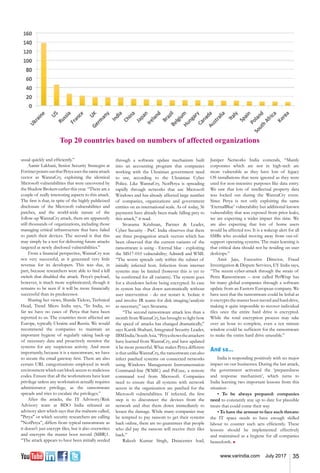
  • 57.
    57www.varindia.com July 2017 VARMOBILITY Honor unveils Honor 8 Pro priced at Rs 29,999 All-new Spice Brand launches a new portfolio of mobility devices InFocus presents itsTurbo 5 in Indian Market XOLO rolls out Era 1X Pro Smartphone at Rs.5,888/- Honor has launched Honor 8 Pro. With processing power, long lasting battery life and 14.47cm 2K display, the Honor 8 Pro with dual-lens camera is packed into an impossibly thin 6.97mm body. The Honor 8 Pro has been designed under the partnership with Amazon, G a m e l o f t , GoPro, Jaunt VR and Deep Silver Fishlabs to enrich digital lifestyles t h r o u g h e n h a n c e d s m a r t p h o n e experiences. The Honor 8 Pro offers market-leading specificationsbypushingthe boundary of smartphone design,providing2Kdisplay, extra-long battery life, dual camera setup and delivering powerful performance to InFocus has launched its Turbo5 smartphone under the new brand licensing agreement signed with Foxconn. This product is the first from a series of innovative product line-up especially developed for the Indian market, keeping in context the Indian consumers’ needs, under this new strategic partnership between InFocus and Foxconn. The Turbo 5 focussing on reliability and performance packs in a high capacity battery life smartphone of 5000 mAh. With an incredible 34 ensure best experiences across the scenarios that today’s smartphone users care most about. Honor can do this like no other due to its unique e-commerce business model and world- class R&D capabilities. India is one of the key markets for Honor and the company plans to grow exponentially with the new gamut of product offerings. The global smartphone major has revamped after sales services with over 250 service centers across the country. Spice brand, a joint venture between Transsion Holdings and Spice Mobility, have launched an all-new portfolio of 8 mobile devices, including 5 feature phones and 3 smartphones. The new product portfoliooffersaesthetically and stylishly designed phones with features that would stand out and appeal to the youth, and is priced between Rs.850 to Rs.9,500. In alignment with the fresh design created for the Indian youth, the products are segmented as F Series (Music, fun, fashion), K series (Creative & fashion), V Series (Value premium, with focus on performance and camera), and Z series which are essentially the feature phones, offering best-value & quality with great design. Sudhir Kumar, CEO, Spice Mobile under TranssionGroup,said, With the launch of the series, we have taken a step closer in creating an inclusive yet all-new powerful and rich digital experience for the young generation of India. Aligned with the brand identity and philosophy, Spice brand wants to fuel the existing culture of sharing amongst the Indian youth." days of standby time and doubling as a power bank, the Turbo 5 ensures endless entertainment. The Turbo 5 sports a 5.2inch HD IPS 2.5D Glass display that offers razor sharp display, clear and striking images. The device is powered with a 1.3 GHz Quad core processor and a 2GB/3GB RAM and 16GB/32GB ROM which is expandable up to 32GB via a microSD card. The fingerprint sensor has as a multipurpose usage, not only can it unlock the device but also start flashlight & click images. XOLOhaslaunched Era 1X Pro, a high- performance smartphone. The handset comes loaded with 2GB RAM and 16GB internal memory which is expandable up to 32 GB, making it the most favourable choice for consumers who are looking for a smooth multitasking phone in this price segment. To enhance the user’s experience, XOLO has done a seamless integration of hardware and software in this phone. It exhibits a premium design with a 5” HD Ultra bright display screen with a luminosity of 400and16.7millioncolours, designed for an enhanced viewingexperience.Also,the phone comes loaded with a memory combination of 2GB RAM and 16GB ROM which allows consumers ample space to store up to 4,000 images, 350 videos and 2,000 audio files in the smartphone. In terms of camera combination, Era 1X Pro is equipped with 8MP primary and 5MP front camera with Dual LED flash and comes with a new refreshed camera user interface called Pro mode which helps users to change the settings at the camera screen itself. The primary camera comes with a host of high-end “smart” features like slow-motion videos, time lapse videos, live photos, audio note, beauty mode, burst mode, panorama mode and screen mode. The camera sports a high precision 4P Largan lens that makes images look sharper and clearer. Moto E4 series launched with 5,000 mAh battery priced at Rs. 9,999 The new Moto E family, Moto E4 Series come with extra power to meet the requirements and make the smartphone experience smarter. With sharper looks and major upgrades, they deliver the things you want – all day battery, outstanding display and advanced camera capabilities – at just the right price. MotoE4Plus,outfitted with a vibrant, 13.97 cm (5.5”) HD display wrapped in smooth metal, it will be hard to put it down. With a 5000 mAh battery, you can go longer without worrying about recharging for up to 48 hours. Moto E4 Plus comes with the 10W rapid charger, which gives you hours of battery life in minutes of charging. The Moto E4 Plus comes with the dual SIM slots and lets you store as much as you want on the 32 GB internal storage that’s expandable up to 128 GB with a dedicated MicroSD card slot. Moto E4 Plus features a 13 MP autofocus rear camera with flash and a 5 MP front camera with a selfie flash and beautification mode for stunningly sharp photos – even in low light. Make your life faster with a quad-core processor and 4G VoLTE and ViLTE as Moto E4 Plus offers the speed and power you need to scroll through your favorite websites, play games and more – all without the wait. And with pure and latest Android 7.1.1, an updated version of the world’s most popular operating system, you can expect only the best with Moto E4 Plus.
  • 58.
    58 July 2017www.varindia.com NokiaTechnologies hires Gregory Lee as President Nokia has announced the appointment of Gregory Lee as President of Nokia Technologies and as member of the Group Leadership team, with immediate effect. Prior to Nokia, Lee served as President and CEO, Samsung Electronics, North America, with a focus on driving fast growth, profitability and operational excellence. In this capacity, Lee led all of Samsung’s businesses for North America, managing a portfolio of products including mobile phones and consumer electronics, as well as those in new market segments such as digital health, virtual reality devices and digital content. Lee will be based in California, reporting to Rajeev Suri, Chairman - Nokia. Autodesk names new President and CEO Autodesk has announced that its board of directors has appointed Andrew Anagnost, current interim co-chief executive officer and chief marketing officer, as the company’s new President and CEO, effective immediately. He will also join Autodesk’s board of directors. The company has also announced that Amar Hanspal, Senior VP, Chief Product Officer and Interim Co-CEO, has decided to leave the company. Anagnost, who holds a Ph.D. in Aeronautical Engineering and Computer Science from Stanford University, began his career at Lockheed Aeronautical Systems Company and as an NRC fellow at NASA Ames Research Center. After joining Autodesk in 1997, he held various technical and strategic roles. Nikhil Arora appointed Managing Director of GoDaddy India GoDaddy has announced the appointment of Nikhil Arora as Vice President and Managing Director for India. Nikhil will lead corporate strategy, business development and customer experience for GoDaddy in India. Prior to joining GoDaddy India, Nikhil led the Asia and India operations for WeWork.Previously,NikhilservedasVicePresidentandManagingDirector of Intuit India, where he led Intuit’s India business strategy, strengthened partnerships and capitalized on social, mobile and global market trends impacting small businesses. Nikhil has also worked at Laureate Education, ADP, Delphi Automotive and CBS Television. Dinesh Malkani resigns as President of Cisco India Dinesh Malkani, Cisco India and SAARC President, has resigned and is now believed to take on a leadership role at a start-up, but details of the same could not be ascertained. He will continue in his role until 31st July and remain associated with Cisco till the end of September. Dinesh has played a key role in driving its growth, talent and digital transformation initiatives in India. After his exit, Cisco will continue to execute on its long-term strategic focus on India through its investments in innovation, skills development and digital transformation. People aware of the development said the company has already conducted an internal and external search for Malkani’s replacement and will make an announcement in the next two weeks. Nitin Rakesh appointed as chair of NASSCOM IT Services Council National Association of Software and Services Companies (NASSCOM) has appointed Nitin Rakesh, Chief Executive Officer and Executive Director of Mphasis, as the Chair of the IT Services Council. Nitish Rakesh was elected and unanimously elected as its Chair. His vision is to transform India’s brand image from a cost competitive offshore destination to an essential technology partner and work towards bridging the gap between “Bangalore-and-Bay Area” both from an IP and start-up perspective. To power these core priorities, building a strong ecosystem to transform India as a technology destination is vital. Transsion appointsTathagat Jena to head marketing TheChinesemobileOEMgiantTRANSSION is setting its sights on the lucrative Indian handset market in the 6k – 20k price band. Tathagat Jena or “TJ” as he is called, joins them as Sr VP – Marketing and has been entrusted with the task to build a strong brand and run an efficient demand generation programme for the Tecno and Infinix brands. TJ is a seasoned marketer with nearly two decades of experience, almost half of which have been spent at Samsung, helping take it from the No. 4 brand in 2008 to numero uno status. In his nearly nine-year journey at Samsung, TJ has handled multiple roles in marketing and communication. Before that, he had worked at leading advertising agencies such as Leo Burnett, Ogilvy and Lowe. Sandeep Nagpal quits SAP, joins Cvent Sandeep Nagpal, who was with SAP earlier, has joined Cvent as its Vice President and Head of Marketing. In his previous stint, Sandeep had served at SAP as the Head of SME & Partner Marketing (VP), APAC & Japan. In this role, Sandeep was responsible for overseeing SAP's Partner, Ecosystem & Volume Business Marketing Strategy. It also included gaining market share for SAP, increasing the SAP brand affinity and purchase consideration among the small & mid market (SME) segment across APJ. He also managed strategic alliances, VARs & Ecosystem partners marketing programs including affiliate & influencer marketing, rebate/incentive programs and communications. He also held the position of Senior Director Marketing when he first joined SAP in 2010. Sandeep had earlier worked for Nokia as Head – Business Mobility & Commerce Solutions and Microsoft Corporation as Marketing Lead. Ziox Mobiles appoints Vikash Chandra to fuel online business Ziox Mobiles has announced the induction of Mr. Vikash Chandra as the General Manager – eCommerce & TV Shopping business. The brand poised to bring its focus and resources to online space. To fuel further growth, the company aims to strengthen its Online Business and e-commerce network. Through this strategic appointment, Ziox Mobiles will now advent its position in eCommerce domain. Ziox plans to fortify the online business with Vikash Chandra spearheading the operation. Reinforcing its position, the brand aims to accomplish online sales of up to 20% of the total sales in this FY 2017- 2018. Marketing data and analytics all concentrated to online sales that shall bring Ziox the opportunity to expand their reach to the region and beyond. Movers & Shakers
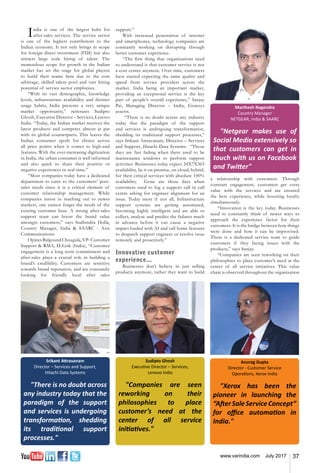
  • 59.
  • 60.
    60 July 2017www.varindia.com RNI - NO 72399/1999 Reg. No: DL-SW-1/4030/15-17Printing Date 18 & 19 Date of Posting 20 & 21 every month 60 pages including cover56 March 2017 www.varindia.com RNI - NO 72399/1999 Reg. No: DL-SW-1/4030/15-17Printing Date 18 & 19 Date of Posting 20 & 21 every month 56 pages including cover