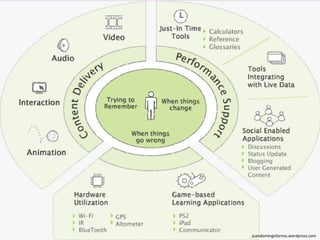
E- LEARNING
M-LEARNING
B-LEARNING
www.tttechworld.com
dcyadelaurav.blogspot.com
Prof. Lic. Norma Sandina
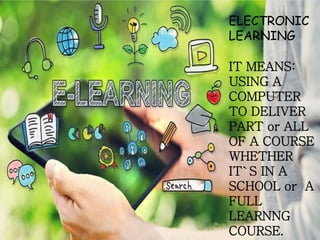
ELECTRONIC
LEARNING
IT MEANS:
USING A
COMPUTER
TO DELIVER
PART or ALL
OF A COURSE
WHETHER
IT`S IN A
SCHOOL or A
FULL
LEARNNG
COURSE.
• E-learning involves the use of a
computer or electronic device
(e.g. a mobile phone) in some
way to provide training,
educational or learning
material. (Derek Stockley
2003)
• E-learning can involve a greater variety of
equipment than online training or education, for
as the name implies, "online" involves using the
Internet or an Intranet. CD-ROM and DVD can be
used to provide learning materials.
• Distance education provided the base for e-
learning's development. E-learning can be "on
demand". It overcomes timing, attendance and
travel difficulties.
• saves time
• allows staff to complete the
course when and where they
like
• allows each individual to tackle the subject at
their own pace,
It…
BLENDED LEARNING
Blended learning is a formal education programme
in which a student learns at least in part through
delivery of content and instruction via digital and
online media with some element of student control
over time, place, path, or pace while still attending
a “brick-and-mortar” school structure, face-to-
face classroom.
Methods are combined with computer-mediated
activities.
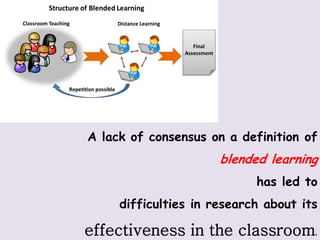
A lack of consensus on a definition of
blended learning
has led to
difficulties in research about its
effectiveness in the classroom.
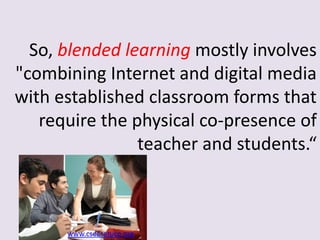
So, blended learning mostly involves
"combining Internet and digital media
with established classroom forms that
require the physical co-presence of
teacher and students.“
www.csee-etuce.org
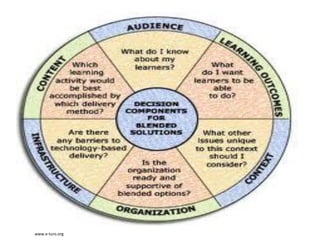
www.e-turo.org
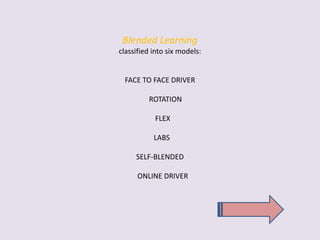
Blended Learning
classified into six models:
FACE TO FACE DRIVER
ROTATION
FLEX
LABS
SELF-BLENDED
ONLINE DRIVER
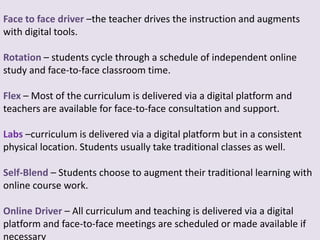
Face to face driver –the teacher drives the instruction and augments
with digital tools.
Rotation – students cycle through a schedule of independent online
study and face-to-face classroom time.
Flex – Most of the curriculum is delivered via a digital platform and
teachers are available for face-to-face consultation and support.
Labs –curriculum is delivered via a digital platform but in a consistent
physical location. Students usually take traditional classes as well.
Self-Blend – Students choose to augment their traditional learning with
online course work.
Online Driver – All curriculum and teaching is delivered via a digital
platform and face-to-face meetings are scheduled or made available if
necessary
It
• facilitates a simultaneous independent and collaborative
learning experience,
• is a major contributor to student satisfaction and success
in such courses.
• improves students` attitudes towards learning.
.
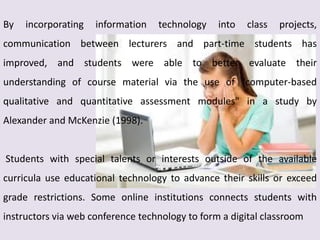
By incorporating information technology into class projects,
communication between lecturers and part-time students has
improved, and students were able to better evaluate their
understanding of course material via the use of "computer-based
qualitative and quantitative assessment modules" in a study by
Alexander and McKenzie (1998).
Students with special talents or interests outside of the available
curricula use educational technology to advance their skills or exceed
grade restrictions. Some online institutions connects students with
instructors via web conference technology to form a digital classroom
Blended learning has a strong dependence on the technical resources
with which the blended learning experience is delivered—these tools
need to be reliable, easy to use, and up to date in order for the use of
the Internet to have a meaningful impact on the learning experience.
Additionally, IT literacy can serve as a significant barrier for students
attempting to get access to the course materials, making the availability
of high quality technical support paramount.
In a study performed across
four different universities, it
was found that only half of
the students watched the
lecture videos on a regular
basis, and nearly 40% of
students watched several
weeks' worth of videos in
one sitting.
It has been observed
that the use of
lecture recording technologies
can result in students falling
behind on the material
M-LEARNING
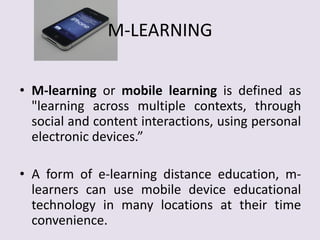
• M-learning or mobile learning is defined as
"learning across multiple contexts, through
social and content interactions, using personal
electronic devices.”
• A form of e-learning distance education, m-
learners can use mobile device educational
technology in many locations at their time
convenience.
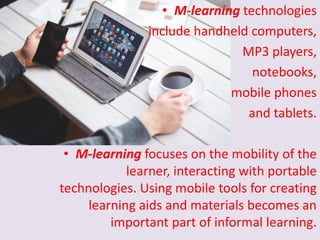
• M-learning technologies
include handheld computers,
MP3 players,
notebooks,
mobile phones
and tablets.
• M-learning focuses on the mobility of the
learner, interacting with portable
technologies. Using mobile tools for creating
learning aids and materials becomes an
important part of informal learning.
It is accessible from virtually anywhere.
Sharing is almost instantaneous among
everyone using the same content, which leads
to the reception of instant feedback and tips.
This highly active process has proven to increase
exam scores from the fiftieth to the seventieth
percentile, and cut the dropout rate in technical
fields by 22 percent.
IT is convenient …
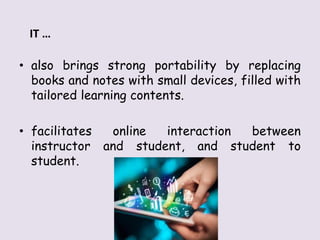
• also brings strong portability by replacing
books and notes with small devices, filled with
tailored learning contents.
• facilitates online interaction between
instructor and student, and student to
student.
IT …
juandomingofarnos.wordpress.com
Now … Get down to it!

E learning

  • 1.
  • 2.
    ELECTRONIC LEARNING IT MEANS: USING A COMPUTER TODELIVER PART or ALL OF A COURSE WHETHER IT`S IN A SCHOOL or A FULL LEARNNG COURSE.
  • 3.
    • E-learning involvesthe use of a computer or electronic device (e.g. a mobile phone) in some way to provide training, educational or learning material. (Derek Stockley 2003)
  • 4.
    • E-learning caninvolve a greater variety of equipment than online training or education, for as the name implies, "online" involves using the Internet or an Intranet. CD-ROM and DVD can be used to provide learning materials. • Distance education provided the base for e- learning's development. E-learning can be "on demand". It overcomes timing, attendance and travel difficulties.
  • 5.
    • saves time •allows staff to complete the course when and where they like • allows each individual to tackle the subject at their own pace, It…
  • 6.
    BLENDED LEARNING Blended learningis a formal education programme in which a student learns at least in part through delivery of content and instruction via digital and online media with some element of student control over time, place, path, or pace while still attending a “brick-and-mortar” school structure, face-to- face classroom. Methods are combined with computer-mediated activities.
  • 7.
    A lack ofconsensus on a definition of blended learning has led to difficulties in research about its effectiveness in the classroom.
  • 8.
    So, blended learningmostly involves "combining Internet and digital media with established classroom forms that require the physical co-presence of teacher and students.“ www.csee-etuce.org
  • 9.
  • 10.
    Blended Learning classified intosix models: FACE TO FACE DRIVER ROTATION FLEX LABS SELF-BLENDED ONLINE DRIVER
  • 11.
    Face to facedriver –the teacher drives the instruction and augments with digital tools. Rotation – students cycle through a schedule of independent online study and face-to-face classroom time. Flex – Most of the curriculum is delivered via a digital platform and teachers are available for face-to-face consultation and support. Labs –curriculum is delivered via a digital platform but in a consistent physical location. Students usually take traditional classes as well. Self-Blend – Students choose to augment their traditional learning with online course work. Online Driver – All curriculum and teaching is delivered via a digital platform and face-to-face meetings are scheduled or made available if necessary
  • 12.
    It • facilitates asimultaneous independent and collaborative learning experience, • is a major contributor to student satisfaction and success in such courses. • improves students` attitudes towards learning. .
  • 13.
    By incorporating informationtechnology into class projects, communication between lecturers and part-time students has improved, and students were able to better evaluate their understanding of course material via the use of "computer-based qualitative and quantitative assessment modules" in a study by Alexander and McKenzie (1998). Students with special talents or interests outside of the available curricula use educational technology to advance their skills or exceed grade restrictions. Some online institutions connects students with instructors via web conference technology to form a digital classroom
  • 14.
    Blended learning hasa strong dependence on the technical resources with which the blended learning experience is delivered—these tools need to be reliable, easy to use, and up to date in order for the use of the Internet to have a meaningful impact on the learning experience. Additionally, IT literacy can serve as a significant barrier for students attempting to get access to the course materials, making the availability of high quality technical support paramount.
  • 15.
    In a studyperformed across four different universities, it was found that only half of the students watched the lecture videos on a regular basis, and nearly 40% of students watched several weeks' worth of videos in one sitting. It has been observed that the use of lecture recording technologies can result in students falling behind on the material
  • 16.
    M-LEARNING • M-learning ormobile learning is defined as "learning across multiple contexts, through social and content interactions, using personal electronic devices.” • A form of e-learning distance education, m- learners can use mobile device educational technology in many locations at their time convenience.
  • 17.
    • M-learning technologies includehandheld computers, MP3 players, notebooks, mobile phones and tablets. • M-learning focuses on the mobility of the learner, interacting with portable technologies. Using mobile tools for creating learning aids and materials becomes an important part of informal learning.
  • 18.
    It is accessiblefrom virtually anywhere. Sharing is almost instantaneous among everyone using the same content, which leads to the reception of instant feedback and tips. This highly active process has proven to increase exam scores from the fiftieth to the seventieth percentile, and cut the dropout rate in technical fields by 22 percent. IT is convenient …
  • 19.
    • also bringsstrong portability by replacing books and notes with small devices, filled with tailored learning contents. • facilitates online interaction between instructor and student, and student to student. IT …
  • 20.
  • 21.
    Now … Getdown to it!