e-Learning Management System : A
Critical Study

Speaker: Kaustav Saha

11/28/2013

Kaustav Saha, DRTC, Indian Statistical
Institute

1
Overview
• Introduction
• Features
• eLMS Service Providers & Software
• Comparison of Systems

• Conclusion
11/28/2013

Kaustav Saha, DRTC, Indian Statistical
Institute

2
• Introduction
• Features
• eLMS Service Providers & Software
• Comparison of Systems

• Conclusion
11/28/2013

Kaustav Saha, DRTC, Indian Statistical
Institute

3
What is LMS?
• A Learning Management System (LMS) is a
software application for the administration,
documentation, tracking, reporting and
delivery of e-learning education courses or
training programs.

Source: http://bestcoursehub.com/home/1199/webinar-yawn-proof-your-elearning-without-busting-the-bank/#
11/28/2013

Kaustav Saha, DRTC, Indian Statistical
Institute

4
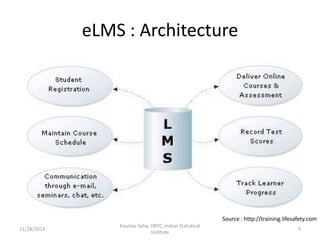
eLMS : Architecture

Source : http://training.lifesafety.com
11/28/2013

Kaustav Saha, DRTC, Indian Statistical
Institute

5
Why we use this?
•
•
•
•
•
•
•
•
•
•

Improved training costs
Decreased material costs
Increased productivity
Standardization
Real-time access
Improved retention
Personalized learning
Knowledge management
Encourage sharing
No Biasness

11/28/2013

Kaustav Saha, DRTC, Indian Statistical
Institute

6
eLMS: Requirements
• User friendly and compatibility to work.
• Rapid content creation, distribution and
authorizing tools.
• Support for the tools used in content creation
(such as Flash, Word, PowerPoint etc.)
• How the learning content is created and managed
as a “learning object”.
• Performance and extendibility of the
environment.
• Multi-Language support.
11/28/2013

Kaustav Saha, DRTC, Indian Statistical
Institute

7
• Introduction
• Features
• eLMS Service Providers & Software
• Comparison of Systems

• Conclusion
11/28/2013

Kaustav Saha, DRTC, Indian Statistical
Institute

8
Features
A. Communication Module
-

11/28/2013

Forum
Chat
E-mail
Announcements
Collaboration
Conferences

Kaustav Saha, DRTC, Indian Statistical
Institute

9
Features(2)
B. Learning Modules
-

Study materials
Exercise
Tests
Course Management
- Administration of course
- Assessment of tests

– Glossary / Encyclopedia

11/28/2013

Kaustav Saha, DRTC, Indian Statistical
Institute

10
Features(3)
C. Administration Modules
- User management
- Tracking
- Statistics
- Personal user profile

- Rights Management
- Installation of the new modules

11/28/2013

Kaustav Saha, DRTC, Indian Statistical
Institute

11
Overview
• Introduction
• Features
• eLMS Service Providers & Software
• Comparison of Systems

• Conclusion
11/28/2013

Kaustav Saha, DRTC, Indian Statistical
Institute

12
eLMS Service Providers
• INDIA
– E PG Pathshala by UGC
(epgp.inflibnet.ac.in/about.php)
– National Programme on Technology Enhanced
Learning (NPTEL) by 7 IITs & IISc Bangalore.
(http://nptel.iitm.ac.in)
– Indian Institute of Management, Bangalore
(http://iimb.linkstreetlearning.com)
– Indian Institute of Technology, Madras
(http://www.cse.iitm.ac.in/moodle)
11/28/2013

Kaustav Saha, DRTC, Indian Statistical
Institute

13
eLMS Service Providers (2)
• Other than India
– Mooc List (http://www.mooc-list.com)
– Canvas (https://www.canvas.net)
– edX (https://www.edx.org)
– Coursera (https://www.coursera.org)
– Khan Academy (https://www.khanacademy.org)
– University of Central Florida
(http://www.graduatecatalog.ucf.edu/programs/p
rogram.aspx?id=1484&tid=1276&tpm=1)
11/28/2013

Kaustav Saha, DRTC, Indian Statistical
Institute

14
edX

11/28/2013

Kaustav Saha, DRTC, Indian Statistical
Institute

15
eLMS Software
•
•
•
•
•
•
•
•

Open Source
Moodle
ATutor
dotLRN
Docebo
Dokeos
Claroline
Ilias
Sakai

11/28/2013

•
•
•
•
•
•

Commercial
Sumtotal
The Blackboard
Saba
Giunti labs
Plateau
eCollege

Kaustav Saha, DRTC, Indian Statistical
Institute

16
Some open source eLMS software
Overview

The latest version

Official website

Moodle

2.5.2

moodle.org

ATutor

2.1.1

atutor.ca

Sakai

2.9.3

sakaiproject.org

Claroline

1.11.8

claroline.net

2.1

dokeos.com

Dokeos

11/28/2013

Kaustav Saha, DRTC, Indian Statistical
Institute

17
Architecture of this Software
Name

Web Server

Development
Language

Database

Operating
System

Moodle

Apache

PHP

Mysql

Windows/
UNIX

ATutor

Apache

PHP

Mysql

Windows/
UNIX

Sakai

Apache
Tomcat

Java

MySql

Windows/
UNIX

Claroline

Apache

PHP

Mysql

Windows/
UNIX

Dokeos

Apache

PHP

Mysql

Windows/
UNIX

11/28/2013

Kaustav Saha, DRTC, Indian Statistical
Institute

18
Moodle
• Moodle (acronym for Modular ObjectOriented Dynamic Learning Environment) is
a free and open source e-learning system.
• Moodle was originally developed by Martin
Dougiamas to help educators create online
courses with focus on interaction and
collaborative construction of course content .
• The first version of Moodle was released in
August 2002.
Source: http://moodle.haywood.edu
11/28/2013

Kaustav Saha, DRTC, Indian Statistical
Institute

19
Moodle (2)
a) Major advantages:
• Tracking behavior of students more mature and perfect
• Function of chat is good, users could exchange easily
though it
• Tool of RSS is easy to subscript resources of the platform.
• Supporting more languages (almost 122 languages
through UTF-8).
b) Major shortcomings:
• Visiting different courses requires different account
numbers by one person
• The curriculum resources are not rich.
• Filename of link must be English, causing inconvenience
for users in other language.
11/28/2013

Kaustav Saha, DRTC, Indian Statistical
Institute

20
ATutor
•

ATutor is an open source & free learning
management system.

•

ATutor was first released in late 2002.

•

Developed by OCAD University research centre.

Source: https://www.amahi.org/apps/atutor
11/28/2013

Kaustav Saha, DRTC, Indian Statistical
Institute

21
ATutor (2)
a) Major advantage:
•
•
•
•

System is user friendly.
Uploading forms from users in bulk is convenient.
Uploading audio and video by Users.
It supports multi languages. (20 languages UTF-8
available)

b) Major shortcomings:
•
•
11/28/2013

But it is not efficient in supporting other languages.
Kinds of additional tools are few.
Kaustav Saha, DRTC, Indian Statistical
Institute

22
Sakai
•

•
•

Sakai is a community of academic institutions,
commercial organizations and individuals who
work together to develop a common
Collaboration and Learning Environment (CLE).
The Sakai CLE is a free Course Management
System. The Sakai CLE is used for teaching,
research and collaboration.
Sakai was developed by MIT, University of
Michigan, Stanford University and others.
Source : https://confluence.sakaiproject.org/display/COMM/Sakai+logo+policy

11/28/2013

Kaustav Saha, DRTC, Indian Statistical
Institute

23
Sakai (2)
a) Major advantage:
•
•
•
•

Facilitates easy exchange of information among web based
user communities.
It is very convenient to transplant one existent database to
the new platform.
It is easy to join and set up a more powerful platform.
Having more tools.

b) Major shortcomings:
•
•
•
11/28/2013

Architecture of system is complex.
Interface of system is confusing and is hard to operate.
Installation is very hard.
Kaustav Saha, DRTC, Indian Statistical
Institute

24
Claroline
• Claroline is a collaborative eLearning and
eWorking platform.
• This is a free and open source eLearning
software.
• It was developed by UCL/IPM and ECAM

11/28/2013

Source: http://clusters.wallonie.be/infopole-en/consortium-claroline.html?IDC=1649&IDD=6793
Kaustav Saha, DRTC, Indian Statistical
25
Institute
Claroline (2)
a)

Major advantage:
•
•
•

It is easy to create a course by user who has less
experience.
It manages achievement of students.
Group tool eases group learning.

b) Major shortcomings:
•
•

11/28/2013

Function of chat is not good, students not willing to
use it.
Tool attachment for students is few.

Kaustav Saha, DRTC, Indian Statistical
Institute

26
Dokeos
• Dokeos is an open source corporate learning
suite with four components:
– AUTHOR to build elearning content,
– eLMS to handle interaction with learners,
– SHOP to sell a course catalog, and
– EVALUATE for assessment and certification.
Source : http://dokeos.com/en/node/507
11/28/2013

Kaustav Saha, DRTC, Indian Statistical
Institute

27
Dokeos (2)
a) Major advantage:
•
•
•

Function of supporting video is stronger.
Online tests are perfect, provides many test types.
It is easy to create a learning path for teachers.

b) Major shortcomings:
•
•

11/28/2013

Lesser tools for students.
Not well equiped to support all languages, errors may
appear when browsed.

Kaustav Saha, DRTC, Indian Statistical
Institute

28
Overview
• Introduction
• Features
• eLMS Service Providers & Software
• Comparison of Systems

• Conclusion
11/28/2013

Kaustav Saha, DRTC, Indian Statistical
Institute

29
Comparison of Systems
Moodle

Yes

ATutor

Yes

Sakai

Yes

Claroline

Dokeos
11/28/2013

Yes

Yes

Yes

Yes

Yes

Yes

Yes

Yes

No

Yes

Yes

Yes

Yes

No

Yes

No

Yes

Yes

Yes

No

Yes

Yes

Yes

Yes

Yes

Yes

Kaustav Saha, DRTC, Indian Statistical
Institute

30
Comparison of Systems(2)
Modules

Study
Materials

Exercise

Moodle

Yes

Yes

Atutor

Yes

Sakai

Tests

Administr
ation

Assessme
nt

Glossary/
Encyclope
dia

Yes

Yes

Yes

Yes

No

Yes

Yes

Yes

Yes

No

Yes

Yes

Yes

Yes

Yes

Claroline

Yes

Yes

No

Yes

Yes

Yes

Dokeos

Yes

Yes

Yes

Yes

Yes

Yes

Names

11/28/2013

Course Management

Kaustav Saha, DRTC, Indian Statistical
Institute

31
Comparison of Systems(3)
Modules

User Management

Rights
Management

Installation
of the new
modules

Names

Tracking

Statistics

Personal user
profile

Moodle

Yes

Yes

Yes

Yes

Yes

Atutor

Yes

Yes

Yes

Yes

Yes

Sakai

Yes

Yes

Yes

Yes

Yes

Claroline

No

Yes

Yes

Yes

No

Dokeos

No

Yes

Yes

Yes

Yes

11/28/2013

Kaustav Saha, DRTC, Indian Statistical
Institute

32
Comparison of Systems (in points)
Name

Yes

No

Percentage (%)
(=((No of
yes/17)*100)

Moodle

17

0

100

Atutor

15

2

88.24

Sakai

15

2

88.24

Claroline

12

5

70.59

Dokeos

16

1

94.12

11/28/2013

Kaustav Saha, DRTC, Indian Statistical
Institute

33
Overview
• Introduction
• Features
• eLMS Service Providers & Software
• Comparison of Systems

• Conclusion
11/28/2013

Kaustav Saha, DRTC, Indian Statistical
Institute

34
Conclusion
• The present study focuses only on open source
eLMS.
• It was observed that Moodle evolved as the most
adaptable eLMS in comparison to the other
eLMS.
• Though all eLMS have many common features,
but there are variations.
• Though there are lots of e-learning systems, but
still there exists some problems with such
systems.
11/28/2013

Kaustav Saha, DRTC, Indian Statistical
Institute

35
Barriers of eLMS
• Personal barriers
– Attitude towards e-learning
– Learning style or preferences

• Organizational barriers
– Lack of time for study
– Interpersonal barriers
– Registration system problems

11/28/2013

Kaustav Saha, DRTC, Indian Statistical
Institute

36
Barriers of eLMS(2)
• Technological barriers
– Quality of e-learning platforms.
– Limitations of technical support.
– Loss of data.

• Content suitability barrier
– content bad-suited to the audience.
– Poorly constructed assessment.

11/28/2013

Kaustav Saha, DRTC, Indian Statistical
Institute

37
Barriers of eLMS(3)
• Instructional barriers
– Lack of progress report and feedback.
– Poor instructional design.
– Limited reference materials.
– Access and navigation problems.
– Unclear or inconsistent instructions.
– Inability to save work.
– Lack of learner technical skills and accessibility
issues
11/28/2013

Kaustav Saha, DRTC, Indian Statistical
Institute

38
Future of eLMS
A. Teacher’s function could not be embodied
well.
B. Diagnostic assessment is short.
C. Lacks in evaluation-centric and studentcentric approach.
D. Personalized service is sufficient.

11/28/2013

Kaustav Saha, DRTC, Indian Statistical
Institute

39
References
•
•
•
•
•
•

Atutor. http://www.atutor.ca
Claroline. http://www.claroline.net
Dokeos. http://www.dokeos.com
Moodle. http://www.moodle.org
Sakai. http://www. sakaiproject.org
The Rapid E- Learning Blog (http://www.articulate.com/rapidelearning/why-e-learning-is-so-effective)
• N. Ruiz Reyes, P. Vera Candeas, S. García Galán, R. Viciana, F. Cañadas, P.J.
Reche. Comparing open-source e-learning platforms from adaptivity point
of view, IEEE Xplore. 2009
• Sabine Graf & Beate List. An Evaluation of Open Source E-Learning
Platforms Stressing Adaptation Issues. Proceedings of the Fifth IEEE
International Conference on Advanced Learning Technologies (ICALT’05),
2005
11/28/2013

Kaustav Saha, DRTC, Indian Statistical
Institute

40
References (2)
•

•
•

•

•
•

Katarzyna Harezlak & Aleksandra Werner. Extension of the MOODLE e-learning
Platform with Database Management Mechanisms. IEEE Xplore. 2010.
TARIK MCHICHI, PASCAL ESTRAILLIER, KARIM AFDEL. Web 2.0 Based E-Learning.
IEEE Xplore. 2010.
George Suciu, Traian-Lucian Militaru, Cristian-George Cernat, Gyorgy Todoran,
Vlad-Andrei Poenaru. Platform for Online Collaboration and e-Learning in Open
Source Distributed Cloud Systems . 54th International Symposium ELMAR-2012,
12-14 September 2012, Zadar, Croatia.
Cansu Cigdem Aydin, Guzin Tirkes. Open Source Learning Management Systems in
E-Learning and Moodle. IEEE EDUCON Education Engineering 2010 – The Future of
Global Learning Engineering Education. 2010.
Sheo Kumar, Anil Kumar Gankotiya, Dr. (Mrs.) Kamlesh Dutta. Comparative Study of
MOODLE with other e-Learning Systems. IEEE Xplore, 2011.
P G Tadasad. Intregated Learning Management System. National Conference on
ILMS. Karnataka. 2012.

11/28/2013

Kaustav Saha, DRTC, Indian Statistical
Institute

41
Thank You

Source: http://temiville.files.wordpress.com/2011/10/bow.jpg?w=500
11/28/2013

Kaustav Saha, DRTC, Indian Statistical
Institute

42
Any Questions?

E-Mail id: kaustav@drtc.isibang.ac.in
Source: http://www.okmgma.com/contactu.cfm
11/28/2013

Kaustav Saha, DRTC, Indian Statistical
Institute

43

e-Learning Management System : a Critical Study

  • 1.
    e-Learning Management System: A Critical Study Speaker: Kaustav Saha 11/28/2013 Kaustav Saha, DRTC, Indian Statistical Institute 1
  • 2.
    Overview • Introduction • Features •eLMS Service Providers & Software • Comparison of Systems • Conclusion 11/28/2013 Kaustav Saha, DRTC, Indian Statistical Institute 2
  • 3.
    • Introduction • Features •eLMS Service Providers & Software • Comparison of Systems • Conclusion 11/28/2013 Kaustav Saha, DRTC, Indian Statistical Institute 3
  • 4.
    What is LMS? •A Learning Management System (LMS) is a software application for the administration, documentation, tracking, reporting and delivery of e-learning education courses or training programs. Source: http://bestcoursehub.com/home/1199/webinar-yawn-proof-your-elearning-without-busting-the-bank/# 11/28/2013 Kaustav Saha, DRTC, Indian Statistical Institute 4
  • 5.
    eLMS : Architecture Source: http://training.lifesafety.com 11/28/2013 Kaustav Saha, DRTC, Indian Statistical Institute 5
  • 6.
    Why we usethis? • • • • • • • • • • Improved training costs Decreased material costs Increased productivity Standardization Real-time access Improved retention Personalized learning Knowledge management Encourage sharing No Biasness 11/28/2013 Kaustav Saha, DRTC, Indian Statistical Institute 6
  • 7.
    eLMS: Requirements • Userfriendly and compatibility to work. • Rapid content creation, distribution and authorizing tools. • Support for the tools used in content creation (such as Flash, Word, PowerPoint etc.) • How the learning content is created and managed as a “learning object”. • Performance and extendibility of the environment. • Multi-Language support. 11/28/2013 Kaustav Saha, DRTC, Indian Statistical Institute 7
  • 8.
    • Introduction • Features •eLMS Service Providers & Software • Comparison of Systems • Conclusion 11/28/2013 Kaustav Saha, DRTC, Indian Statistical Institute 8
  • 9.
  • 10.
    Features(2) B. Learning Modules - Studymaterials Exercise Tests Course Management - Administration of course - Assessment of tests – Glossary / Encyclopedia 11/28/2013 Kaustav Saha, DRTC, Indian Statistical Institute 10
  • 11.
    Features(3) C. Administration Modules -User management - Tracking - Statistics - Personal user profile - Rights Management - Installation of the new modules 11/28/2013 Kaustav Saha, DRTC, Indian Statistical Institute 11
  • 12.
    Overview • Introduction • Features •eLMS Service Providers & Software • Comparison of Systems • Conclusion 11/28/2013 Kaustav Saha, DRTC, Indian Statistical Institute 12
  • 13.
    eLMS Service Providers •INDIA – E PG Pathshala by UGC (epgp.inflibnet.ac.in/about.php) – National Programme on Technology Enhanced Learning (NPTEL) by 7 IITs & IISc Bangalore. (http://nptel.iitm.ac.in) – Indian Institute of Management, Bangalore (http://iimb.linkstreetlearning.com) – Indian Institute of Technology, Madras (http://www.cse.iitm.ac.in/moodle) 11/28/2013 Kaustav Saha, DRTC, Indian Statistical Institute 13
  • 14.
    eLMS Service Providers(2) • Other than India – Mooc List (http://www.mooc-list.com) – Canvas (https://www.canvas.net) – edX (https://www.edx.org) – Coursera (https://www.coursera.org) – Khan Academy (https://www.khanacademy.org) – University of Central Florida (http://www.graduatecatalog.ucf.edu/programs/p rogram.aspx?id=1484&tid=1276&tpm=1) 11/28/2013 Kaustav Saha, DRTC, Indian Statistical Institute 14
  • 15.
    edX 11/28/2013 Kaustav Saha, DRTC,Indian Statistical Institute 15
  • 16.
  • 17.
    Some open sourceeLMS software Overview The latest version Official website Moodle 2.5.2 moodle.org ATutor 2.1.1 atutor.ca Sakai 2.9.3 sakaiproject.org Claroline 1.11.8 claroline.net 2.1 dokeos.com Dokeos 11/28/2013 Kaustav Saha, DRTC, Indian Statistical Institute 17
  • 18.
    Architecture of thisSoftware Name Web Server Development Language Database Operating System Moodle Apache PHP Mysql Windows/ UNIX ATutor Apache PHP Mysql Windows/ UNIX Sakai Apache Tomcat Java MySql Windows/ UNIX Claroline Apache PHP Mysql Windows/ UNIX Dokeos Apache PHP Mysql Windows/ UNIX 11/28/2013 Kaustav Saha, DRTC, Indian Statistical Institute 18
  • 19.
    Moodle • Moodle (acronymfor Modular ObjectOriented Dynamic Learning Environment) is a free and open source e-learning system. • Moodle was originally developed by Martin Dougiamas to help educators create online courses with focus on interaction and collaborative construction of course content . • The first version of Moodle was released in August 2002. Source: http://moodle.haywood.edu 11/28/2013 Kaustav Saha, DRTC, Indian Statistical Institute 19
  • 20.
    Moodle (2) a) Majoradvantages: • Tracking behavior of students more mature and perfect • Function of chat is good, users could exchange easily though it • Tool of RSS is easy to subscript resources of the platform. • Supporting more languages (almost 122 languages through UTF-8). b) Major shortcomings: • Visiting different courses requires different account numbers by one person • The curriculum resources are not rich. • Filename of link must be English, causing inconvenience for users in other language. 11/28/2013 Kaustav Saha, DRTC, Indian Statistical Institute 20
  • 21.
    ATutor • ATutor is anopen source & free learning management system. • ATutor was first released in late 2002. • Developed by OCAD University research centre. Source: https://www.amahi.org/apps/atutor 11/28/2013 Kaustav Saha, DRTC, Indian Statistical Institute 21
  • 22.
    ATutor (2) a) Majoradvantage: • • • • System is user friendly. Uploading forms from users in bulk is convenient. Uploading audio and video by Users. It supports multi languages. (20 languages UTF-8 available) b) Major shortcomings: • • 11/28/2013 But it is not efficient in supporting other languages. Kinds of additional tools are few. Kaustav Saha, DRTC, Indian Statistical Institute 22
  • 23.
    Sakai • • • Sakai is acommunity of academic institutions, commercial organizations and individuals who work together to develop a common Collaboration and Learning Environment (CLE). The Sakai CLE is a free Course Management System. The Sakai CLE is used for teaching, research and collaboration. Sakai was developed by MIT, University of Michigan, Stanford University and others. Source : https://confluence.sakaiproject.org/display/COMM/Sakai+logo+policy 11/28/2013 Kaustav Saha, DRTC, Indian Statistical Institute 23
  • 24.
    Sakai (2) a) Majoradvantage: • • • • Facilitates easy exchange of information among web based user communities. It is very convenient to transplant one existent database to the new platform. It is easy to join and set up a more powerful platform. Having more tools. b) Major shortcomings: • • • 11/28/2013 Architecture of system is complex. Interface of system is confusing and is hard to operate. Installation is very hard. Kaustav Saha, DRTC, Indian Statistical Institute 24
  • 25.
    Claroline • Claroline isa collaborative eLearning and eWorking platform. • This is a free and open source eLearning software. • It was developed by UCL/IPM and ECAM 11/28/2013 Source: http://clusters.wallonie.be/infopole-en/consortium-claroline.html?IDC=1649&IDD=6793 Kaustav Saha, DRTC, Indian Statistical 25 Institute
  • 26.
    Claroline (2) a) Major advantage: • • • Itis easy to create a course by user who has less experience. It manages achievement of students. Group tool eases group learning. b) Major shortcomings: • • 11/28/2013 Function of chat is not good, students not willing to use it. Tool attachment for students is few. Kaustav Saha, DRTC, Indian Statistical Institute 26
  • 27.
    Dokeos • Dokeos isan open source corporate learning suite with four components: – AUTHOR to build elearning content, – eLMS to handle interaction with learners, – SHOP to sell a course catalog, and – EVALUATE for assessment and certification. Source : http://dokeos.com/en/node/507 11/28/2013 Kaustav Saha, DRTC, Indian Statistical Institute 27
  • 28.
    Dokeos (2) a) Majoradvantage: • • • Function of supporting video is stronger. Online tests are perfect, provides many test types. It is easy to create a learning path for teachers. b) Major shortcomings: • • 11/28/2013 Lesser tools for students. Not well equiped to support all languages, errors may appear when browsed. Kaustav Saha, DRTC, Indian Statistical Institute 28
  • 29.
    Overview • Introduction • Features •eLMS Service Providers & Software • Comparison of Systems • Conclusion 11/28/2013 Kaustav Saha, DRTC, Indian Statistical Institute 29
  • 30.
  • 31.
  • 32.
    Comparison of Systems(3) Modules UserManagement Rights Management Installation of the new modules Names Tracking Statistics Personal user profile Moodle Yes Yes Yes Yes Yes Atutor Yes Yes Yes Yes Yes Sakai Yes Yes Yes Yes Yes Claroline No Yes Yes Yes No Dokeos No Yes Yes Yes Yes 11/28/2013 Kaustav Saha, DRTC, Indian Statistical Institute 32
  • 33.
    Comparison of Systems(in points) Name Yes No Percentage (%) (=((No of yes/17)*100) Moodle 17 0 100 Atutor 15 2 88.24 Sakai 15 2 88.24 Claroline 12 5 70.59 Dokeos 16 1 94.12 11/28/2013 Kaustav Saha, DRTC, Indian Statistical Institute 33
  • 34.
    Overview • Introduction • Features •eLMS Service Providers & Software • Comparison of Systems • Conclusion 11/28/2013 Kaustav Saha, DRTC, Indian Statistical Institute 34
  • 35.
    Conclusion • The presentstudy focuses only on open source eLMS. • It was observed that Moodle evolved as the most adaptable eLMS in comparison to the other eLMS. • Though all eLMS have many common features, but there are variations. • Though there are lots of e-learning systems, but still there exists some problems with such systems. 11/28/2013 Kaustav Saha, DRTC, Indian Statistical Institute 35
  • 36.
    Barriers of eLMS •Personal barriers – Attitude towards e-learning – Learning style or preferences • Organizational barriers – Lack of time for study – Interpersonal barriers – Registration system problems 11/28/2013 Kaustav Saha, DRTC, Indian Statistical Institute 36
  • 37.
    Barriers of eLMS(2) •Technological barriers – Quality of e-learning platforms. – Limitations of technical support. – Loss of data. • Content suitability barrier – content bad-suited to the audience. – Poorly constructed assessment. 11/28/2013 Kaustav Saha, DRTC, Indian Statistical Institute 37
  • 38.
    Barriers of eLMS(3) •Instructional barriers – Lack of progress report and feedback. – Poor instructional design. – Limited reference materials. – Access and navigation problems. – Unclear or inconsistent instructions. – Inability to save work. – Lack of learner technical skills and accessibility issues 11/28/2013 Kaustav Saha, DRTC, Indian Statistical Institute 38
  • 39.
    Future of eLMS A.Teacher’s function could not be embodied well. B. Diagnostic assessment is short. C. Lacks in evaluation-centric and studentcentric approach. D. Personalized service is sufficient. 11/28/2013 Kaustav Saha, DRTC, Indian Statistical Institute 39
  • 40.
    References • • • • • • Atutor. http://www.atutor.ca Claroline. http://www.claroline.net Dokeos.http://www.dokeos.com Moodle. http://www.moodle.org Sakai. http://www. sakaiproject.org The Rapid E- Learning Blog (http://www.articulate.com/rapidelearning/why-e-learning-is-so-effective) • N. Ruiz Reyes, P. Vera Candeas, S. García Galán, R. Viciana, F. Cañadas, P.J. Reche. Comparing open-source e-learning platforms from adaptivity point of view, IEEE Xplore. 2009 • Sabine Graf & Beate List. An Evaluation of Open Source E-Learning Platforms Stressing Adaptation Issues. Proceedings of the Fifth IEEE International Conference on Advanced Learning Technologies (ICALT’05), 2005 11/28/2013 Kaustav Saha, DRTC, Indian Statistical Institute 40
  • 41.
    References (2) • • • • • • Katarzyna Harezlak& Aleksandra Werner. Extension of the MOODLE e-learning Platform with Database Management Mechanisms. IEEE Xplore. 2010. TARIK MCHICHI, PASCAL ESTRAILLIER, KARIM AFDEL. Web 2.0 Based E-Learning. IEEE Xplore. 2010. George Suciu, Traian-Lucian Militaru, Cristian-George Cernat, Gyorgy Todoran, Vlad-Andrei Poenaru. Platform for Online Collaboration and e-Learning in Open Source Distributed Cloud Systems . 54th International Symposium ELMAR-2012, 12-14 September 2012, Zadar, Croatia. Cansu Cigdem Aydin, Guzin Tirkes. Open Source Learning Management Systems in E-Learning and Moodle. IEEE EDUCON Education Engineering 2010 – The Future of Global Learning Engineering Education. 2010. Sheo Kumar, Anil Kumar Gankotiya, Dr. (Mrs.) Kamlesh Dutta. Comparative Study of MOODLE with other e-Learning Systems. IEEE Xplore, 2011. P G Tadasad. Intregated Learning Management System. National Conference on ILMS. Karnataka. 2012. 11/28/2013 Kaustav Saha, DRTC, Indian Statistical Institute 41
  • 42.
  • 43.
    Any Questions? E-Mail id:kaustav@drtc.isibang.ac.in Source: http://www.okmgma.com/contactu.cfm 11/28/2013 Kaustav Saha, DRTC, Indian Statistical Institute 43

Editor's Notes