Using E-Learning at the University is meant to solve 5 main problems:
            1. Overuse of photocopies for learning material delivery
            2. Misused textbooks by students and faculty
            3. Consistency, efficiency and effectiveness of course delivery (Quality Control)
            4. Student engagement with learning materials, facilitators, and peers
            5. “Edgeless Classrooms” – Expanding enrolment with virtual classrooms


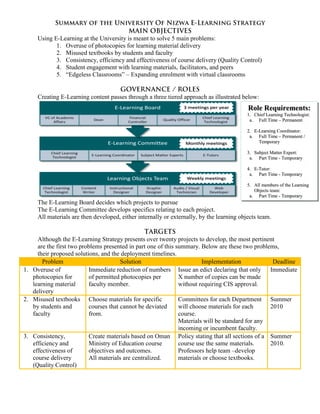
     Creating E-Learning content passes through a three tiered approach as illustrated below:
                                                                                           Role Requirements:
                                                                                           1. Chief Learning Technologist:
                                                                                            a. Full Time – Permanent

                                                                                           2. E-Learning Coordinator:
                                                                                            a. Full Time – Permanent /
                                                                                                Temporary

                                                                                           3. Subject Matter Expert:
                                                                                            a. Part Time - Temporary

                                                                                           4. E-Tutor:
                                                                                            a. Part Time - Temporary

                                                                                           5. All members of the Learning
                                                                                              Objects team:
                                                                                            a. Part Time - Temporary
     The E-Learning Board decides which projects to pursue
     The E-Learning Committee develops specifics relating to each project.
     All materials are then developed, either internally or externally, by the learning objects team.


     Although the E-Learning Strategy presents over twenty projects to develop, the most pertinent
     are the first two problems presented in part one of this summary. Below are these two problems,
     their proposed solutions, and the deployment timelines.
       Problem                          Solution                        Implementation             Deadline
1. Overuse of              Immediate reduction of numbers Issue an edict declaring that only      Immediate
   photocopies for         of permitted photocopies per        X number of copies can be made
   learning material       faculty member.                     without requiring CIS approval.
   delivery
2. Misused textbooks Choose materials for specific             Committees for each Department Summer
   by students and         courses that cannot be deviated     will choose materials for each     2010
   faculty                 from.                               course.
                                                               Materials will be standard for any
                                                               incoming or incumbent faculty.
3. Consistency,            Create materials based on Oman Policy stating that all sections of a Summer
   efficiency and          Ministry of Education course        course use the same materials.     2010.
   effectiveness of        objectives and outcomes.            Professors help team –develop
   course delivery         All materials are centralized.      materials or choose textbooks.
   (Quality Control)

E learn strat_summary

  • 1.
    Using E-Learning atthe University is meant to solve 5 main problems: 1. Overuse of photocopies for learning material delivery 2. Misused textbooks by students and faculty 3. Consistency, efficiency and effectiveness of course delivery (Quality Control) 4. Student engagement with learning materials, facilitators, and peers 5. “Edgeless Classrooms” – Expanding enrolment with virtual classrooms Creating E-Learning content passes through a three tiered approach as illustrated below: Role Requirements: 1. Chief Learning Technologist: a. Full Time – Permanent 2. E-Learning Coordinator: a. Full Time – Permanent / Temporary 3. Subject Matter Expert: a. Part Time - Temporary 4. E-Tutor: a. Part Time - Temporary 5. All members of the Learning Objects team: a. Part Time - Temporary The E-Learning Board decides which projects to pursue The E-Learning Committee develops specifics relating to each project. All materials are then developed, either internally or externally, by the learning objects team. Although the E-Learning Strategy presents over twenty projects to develop, the most pertinent are the first two problems presented in part one of this summary. Below are these two problems, their proposed solutions, and the deployment timelines. Problem Solution Implementation Deadline 1. Overuse of Immediate reduction of numbers Issue an edict declaring that only Immediate photocopies for of permitted photocopies per X number of copies can be made learning material faculty member. without requiring CIS approval. delivery 2. Misused textbooks Choose materials for specific Committees for each Department Summer by students and courses that cannot be deviated will choose materials for each 2010 faculty from. course. Materials will be standard for any incoming or incumbent faculty. 3. Consistency, Create materials based on Oman Policy stating that all sections of a Summer efficiency and Ministry of Education course course use the same materials. 2010. effectiveness of objectives and outcomes. Professors help team –develop course delivery All materials are centralized. materials or choose textbooks. (Quality Control)