E-commerce in India:
Present and Future
Dr.R.VASANTHAGOPAL
University of Kerala
Order A Tiffin Of Your Choice!
April 26, 2020 2Dr.R.Vasanthagopal
Buy Fish Online!
April 26, 2020 Dr.R.Vasanthagopal 3
April 26, 2020 4Dr.R.Vasanthagopal
E-commerce
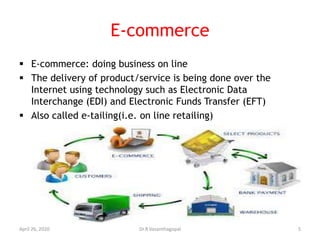
 E-commerce: doing business on line
 The delivery of product/service is being done over the
Internet using technology such as Electronic Data
Interchange (EDI) and Electronic Funds Transfer (EFT)
 Also called e-tailing(i.e. on line retailing)
April 26, 2020 5Dr.R.Vasanthagopal
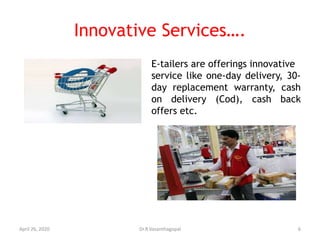
Innovative Services….
E-tailers are offerings innovative
service like one-day delivery, 30-
day replacement warranty, cash
on delivery (Cod), cash back
offers etc.
April 26, 2020 6Dr.R.Vasanthagopal
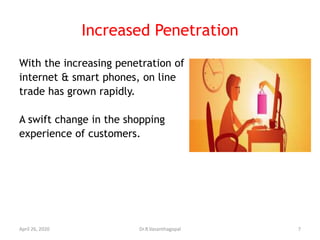
Increased Penetration
With the increasing penetration of
internet & smart phones, on line
trade has grown rapidly.
A swift change in the shopping
experience of customers.
April 26, 2020 7Dr.R.Vasanthagopal
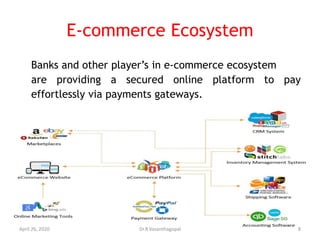
E-commerce Ecosystem
Banks and other player’s in e-commerce ecosystem
are providing a secured online platform to pay
effortlessly via payments gateways.
Cont
April 26, 2020 8Dr.R.Vasanthagopal
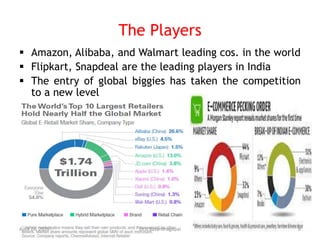
The Players
 Amazon, Alibaba, and Walmart leading cos. in the world
 Flipkart, Snapdeal are the leading players in India
 The entry of global biggies has taken the competition
to a new level
April 26, 2020 9Dr.R.Vasanthagopal
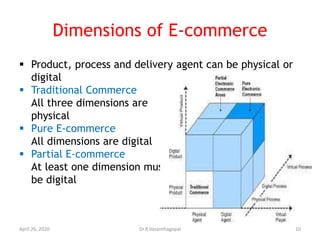
Dimensions of E-commerce
 Product, process and delivery agent can be physical or
digital
 Traditional Commerce
All three dimensions are
physical
 Pure E-commerce
All dimensions are digital
 Partial E-commerce
At least one dimension must
be digital
April 26, 2020 10Dr.R.Vasanthagopal
Why E-commerce is Important?
 Faster buying/selling procedure
 Easy to find products
 Buying/selling 24/7
 Low operational costs
 Better quality of services
 Easy to start and manage a business
 No need of physical company set-ups
 Possible to select products from different providers
without moving around physically.
April 26, 2020 11Dr.R.Vasanthagopal
An Interesting Case of IRCTC
(Indian Railway Catering and Tourism Corporation)
 Indian railway portal irctc.co.in has started its
operations in the year 2002.
 It has booked 29 tickets only on first day of launching.
 Today it books 13 lakh tickets a day.
 It is India’s one of the largest ecommerce companies
with a turnover of Rs 1506 crore in 2015-16
 IRCTC is the most successful ecommerce model in India
April 26, 2020 12Dr.R.Vasanthagopal
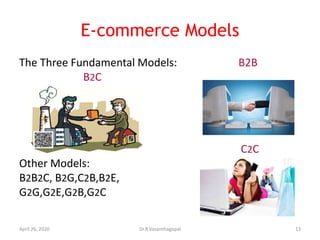
E-commerce Models
The Three Fundamental Models: B2B
B2C
C2C
Other Models:
B2B2C, B2G,C2B,B2E,
G2G,G2E,G2B,G2C
April 26, 2020 13Dr.R.Vasanthagopal
Present Status
 India is at the cusp of an e-commerce revolution
 Contributing over 4% to India’s GDP
 Growth rate of E-commerce market in India is 30%
(CAGR)
 Total value of business:
 2015-Rs.1.25 lakh crore; 2016-1.69 lakh crore; 2017-
220 crore
 2015 known as the ‘BILLION DOLLAR YEAR
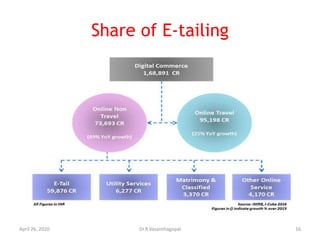
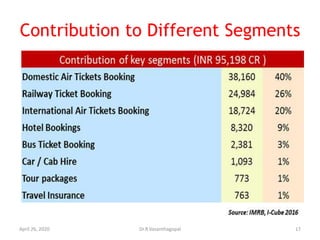
 Online travel accounts for nearly 61% of e-commerce
business while e-tailing contributes about 29%.
April 26, 2020 14Dr.R.Vasanthagopal
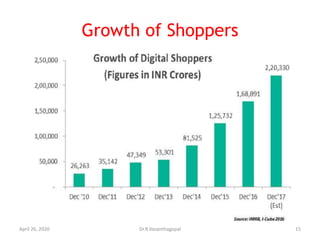
Growth of Shoppers
April 26, 2020 15Dr.R.Vasanthagopal
Share of E-tailing
April 26, 2020 16Dr.R.Vasanthagopal
Contribution to Different Segments
April 26, 2020 17Dr.R.Vasanthagopal
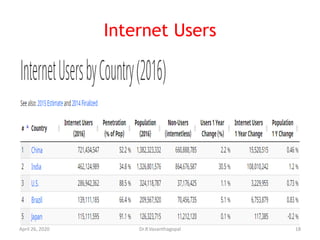
Internet Users
April 26, 2020 18Dr.R.Vasanthagopal
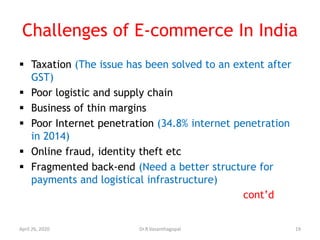
Challenges of E-commerce In India
 Taxation (The issue has been solved to an extent after
GST)
 Poor logistic and supply chain
 Business of thin margins
 Poor Internet penetration (34.8% internet penetration
in 2014)
 Online fraud, identity theft etc
 Fragmented back-end (Need a better structure for
payments and logistical infrastructure)
cont’d
April 26, 2020 19Dr.R.Vasanthagopal
Challenges of E-commerce In India
 Poor credit card penetration (currently only 2% of our
population holds a credit card)
 Increase in cyber crimes
 Price undercutting among E-commerce players
 Inconsistent behavior of Indian consumer
 Malware Attacks- Networks and servers of service
providers
 Payments (60-70% cash on delivery)
cont’d
April 26, 2020 20Dr.R.Vasanthagopal
Challenges of E-commerce In India
 Denial-of-Services(DOS) Attacks (Attack on a network to
disable the network by flooding it with useless traffic
or activity)
 Insufficient steps to protect the security
 Complications in transactions across the boarder
 Complex to manage supply chain and logistics
April 26, 2020 21Dr.R.Vasanthagopal
Who Can Face the Challenge?
“m” is increasingly replacing the “e” in E-commerce, as
more Indians get on to their smart phones to buy stuff
online. From a technology perspective, on the small
screen, discovery of the right products as well as
payments present 2 key challenges as well as
opportunities. Whoever can solve these challenges
faster and in a sustainable manner, can challenge the
status quo in e-commerce markets.
April 26, 2020 22Dr.R.Vasanthagopal
Future of E-commerce In India
 Internet penetration 34.8 crore (in 2016)
 Low priced smart phones
 Good internet coverage even in rural areas with
2G/3G/4G networks
 Growth of Tier II and Tier III cities
 Rise of the middle class people
 Increased usage of technology to shop
Cont’d
April 26, 2020 23Dr.R.Vasanthagopal
Future of E-commerce In India
 No. of internet users in India is only 46.3 crore (2017)
(34.8 %)(Users per year change=30.5%)
 Smart phones with different apps replace PCs for online
shopping.
 Social shopping
 Emergence of non banking players in the payment
industry
 Favourable demographics
 Busy lifestyles and lack of time for offline shopping
 Innovative vertical specific start ups
Cont’d
April 26, 2020 24Dr.R.Vasanthagopal
Future of E-commerce In India
 Growing acceptability of online payments
 Increasing mobile and internet penetration
 Merger and acquisitions (Flipkart acquired Myntra for
370 million USD, Ola Cabs acquired Taxi ForSure for 200
million USD)
 Presence of global players like Amazon, Alibaba etc.
 Newer technologies like analytics, social commerce, 3
D printing etc.
 High private equity investment (Soft bank advanced 627
million USD to Snapdeal)
April 26, 2020 25Dr.R.Vasanthagopal
Conclusion
 Customer is king for the brick-and-mortar stores
and the digital age e-retailers.
 Shopping online is getting easier and the
customer expectations are changing quickly.
 The e-tailers need to differentiate themselves
to not only attract customers but also to build
trust and loyalty.
April 26, 2020 26Dr.R.Vasanthagopal
Thank you
April 26, 2020 27Dr.R.Vasanthagopal

E commerce in India-Present and Future

  • 1.
    E-commerce in India: Presentand Future Dr.R.VASANTHAGOPAL University of Kerala
  • 2.
    Order A TiffinOf Your Choice! April 26, 2020 2Dr.R.Vasanthagopal
  • 3.
    Buy Fish Online! April26, 2020 Dr.R.Vasanthagopal 3
  • 4.
    April 26, 20204Dr.R.Vasanthagopal
  • 5.
    E-commerce  E-commerce: doingbusiness on line  The delivery of product/service is being done over the Internet using technology such as Electronic Data Interchange (EDI) and Electronic Funds Transfer (EFT)  Also called e-tailing(i.e. on line retailing) April 26, 2020 5Dr.R.Vasanthagopal
  • 6.
    Innovative Services…. E-tailers areofferings innovative service like one-day delivery, 30- day replacement warranty, cash on delivery (Cod), cash back offers etc. April 26, 2020 6Dr.R.Vasanthagopal
  • 7.
    Increased Penetration With theincreasing penetration of internet & smart phones, on line trade has grown rapidly. A swift change in the shopping experience of customers. April 26, 2020 7Dr.R.Vasanthagopal
  • 8.
    E-commerce Ecosystem Banks andother player’s in e-commerce ecosystem are providing a secured online platform to pay effortlessly via payments gateways. Cont April 26, 2020 8Dr.R.Vasanthagopal
  • 9.
    The Players  Amazon,Alibaba, and Walmart leading cos. in the world  Flipkart, Snapdeal are the leading players in India  The entry of global biggies has taken the competition to a new level April 26, 2020 9Dr.R.Vasanthagopal
  • 10.
    Dimensions of E-commerce Product, process and delivery agent can be physical or digital  Traditional Commerce All three dimensions are physical  Pure E-commerce All dimensions are digital  Partial E-commerce At least one dimension must be digital April 26, 2020 10Dr.R.Vasanthagopal
  • 11.
    Why E-commerce isImportant?  Faster buying/selling procedure  Easy to find products  Buying/selling 24/7  Low operational costs  Better quality of services  Easy to start and manage a business  No need of physical company set-ups  Possible to select products from different providers without moving around physically. April 26, 2020 11Dr.R.Vasanthagopal
  • 12.
    An Interesting Caseof IRCTC (Indian Railway Catering and Tourism Corporation)  Indian railway portal irctc.co.in has started its operations in the year 2002.  It has booked 29 tickets only on first day of launching.  Today it books 13 lakh tickets a day.  It is India’s one of the largest ecommerce companies with a turnover of Rs 1506 crore in 2015-16  IRCTC is the most successful ecommerce model in India April 26, 2020 12Dr.R.Vasanthagopal
  • 13.
    E-commerce Models The ThreeFundamental Models: B2B B2C C2C Other Models: B2B2C, B2G,C2B,B2E, G2G,G2E,G2B,G2C April 26, 2020 13Dr.R.Vasanthagopal
  • 14.
    Present Status  Indiais at the cusp of an e-commerce revolution  Contributing over 4% to India’s GDP  Growth rate of E-commerce market in India is 30% (CAGR)  Total value of business:  2015-Rs.1.25 lakh crore; 2016-1.69 lakh crore; 2017- 220 crore  2015 known as the ‘BILLION DOLLAR YEAR  Online travel accounts for nearly 61% of e-commerce business while e-tailing contributes about 29%. April 26, 2020 14Dr.R.Vasanthagopal
  • 15.
    Growth of Shoppers April26, 2020 15Dr.R.Vasanthagopal
  • 16.
    Share of E-tailing April26, 2020 16Dr.R.Vasanthagopal
  • 17.
    Contribution to DifferentSegments April 26, 2020 17Dr.R.Vasanthagopal
  • 18.
    Internet Users April 26,2020 18Dr.R.Vasanthagopal
  • 19.
    Challenges of E-commerceIn India  Taxation (The issue has been solved to an extent after GST)  Poor logistic and supply chain  Business of thin margins  Poor Internet penetration (34.8% internet penetration in 2014)  Online fraud, identity theft etc  Fragmented back-end (Need a better structure for payments and logistical infrastructure) cont’d April 26, 2020 19Dr.R.Vasanthagopal
  • 20.
    Challenges of E-commerceIn India  Poor credit card penetration (currently only 2% of our population holds a credit card)  Increase in cyber crimes  Price undercutting among E-commerce players  Inconsistent behavior of Indian consumer  Malware Attacks- Networks and servers of service providers  Payments (60-70% cash on delivery) cont’d April 26, 2020 20Dr.R.Vasanthagopal
  • 21.
    Challenges of E-commerceIn India  Denial-of-Services(DOS) Attacks (Attack on a network to disable the network by flooding it with useless traffic or activity)  Insufficient steps to protect the security  Complications in transactions across the boarder  Complex to manage supply chain and logistics April 26, 2020 21Dr.R.Vasanthagopal
  • 22.
    Who Can Facethe Challenge? “m” is increasingly replacing the “e” in E-commerce, as more Indians get on to their smart phones to buy stuff online. From a technology perspective, on the small screen, discovery of the right products as well as payments present 2 key challenges as well as opportunities. Whoever can solve these challenges faster and in a sustainable manner, can challenge the status quo in e-commerce markets. April 26, 2020 22Dr.R.Vasanthagopal
  • 23.
    Future of E-commerceIn India  Internet penetration 34.8 crore (in 2016)  Low priced smart phones  Good internet coverage even in rural areas with 2G/3G/4G networks  Growth of Tier II and Tier III cities  Rise of the middle class people  Increased usage of technology to shop Cont’d April 26, 2020 23Dr.R.Vasanthagopal
  • 24.
    Future of E-commerceIn India  No. of internet users in India is only 46.3 crore (2017) (34.8 %)(Users per year change=30.5%)  Smart phones with different apps replace PCs for online shopping.  Social shopping  Emergence of non banking players in the payment industry  Favourable demographics  Busy lifestyles and lack of time for offline shopping  Innovative vertical specific start ups Cont’d April 26, 2020 24Dr.R.Vasanthagopal
  • 25.
    Future of E-commerceIn India  Growing acceptability of online payments  Increasing mobile and internet penetration  Merger and acquisitions (Flipkart acquired Myntra for 370 million USD, Ola Cabs acquired Taxi ForSure for 200 million USD)  Presence of global players like Amazon, Alibaba etc.  Newer technologies like analytics, social commerce, 3 D printing etc.  High private equity investment (Soft bank advanced 627 million USD to Snapdeal) April 26, 2020 25Dr.R.Vasanthagopal
  • 26.
    Conclusion  Customer isking for the brick-and-mortar stores and the digital age e-retailers.  Shopping online is getting easier and the customer expectations are changing quickly.  The e-tailers need to differentiate themselves to not only attract customers but also to build trust and loyalty. April 26, 2020 26Dr.R.Vasanthagopal
  • 27.
    Thank you April 26,2020 27Dr.R.Vasanthagopal