Systems Administration Part Two of Network Management Lecture
Elements of IT Infrastrucuture that must be managed Enterprise network LAN Management Server Management Desktop Management Database Management Application Management Remote Access Management
Application Management Specification AMS: put together by HP, Tivoli, Oracle ARM: Application Response Management Also IETF standard WBEM : Web Based Enterprise Management Integrates SNMP & HTTP & DMI
Server Management & Systems Administration Monitoring Reporting Troubleshooting Diagnosing Server performance requires Software Modules on Servers
Configuration Management Single Sign-on Licence metering tools Automated S/W inventory tools Software distribution tools Handled by Policy Based Management tools Can manage more than one type of Computer
Client & Desktop Management Config & support of Workstations or Clients Hardware & OS more than Apps Architecture & Protocols proposed by “ Desktop Management Taskforce” (DMTF) Gives rise to DMI
Distributed Management Architecture An API that can be used by applications developers is known as  application response measurement (ARM)  and can measure several key application statistics
Client & Desktop Management In theory - Desktop Management & Enterprise Management must be able to interoperate Desktop Mgmt info stored in MIF ( Management Info Format ) Enterprise uses a  MIB ( Management Info Base ) MIB - MIF mapper required
Desktop Management Technology Suites of Applications Netwizard Tivoli IT Director Challenge is extending desktop management to Laptops S/Wdistribution, change analysis, job scheduling, asset monitoring, backup, virus protection
Database Management 2 ways of looking at it:  Distributed Database Management Enterprise Database Management
Distributed Database Management Build in self diagnosing intelligence referred to as ‘Instrumentation’ Software Agents that collect performance data and report it via SNMP 2 network related variables that can affect this are: Bandwidth & Latency No standard of what data should be gathered or how it should be reported.
Enterprise Database Management When companies combine - variety of databases  around the enterprise Consolidating distributed databases into an enterprise view
Enterprise Database Management Tools Global User Administration Security Management Heterogeneous data schema and content manipulation Effective troubleshooting Monitor for free space, runaway processes,high CPU utilisation, low swap space Should support: Oracle, Informix, SQL Server, Adaptive Server & DB2
Laptop Management Technology A Mobile MIF is available Information gathered: Battery levels ac Lines Docking status Device bays

E business solutions l07 systems admin

  • 1.
    Systems Administration PartTwo of Network Management Lecture
  • 2.
    Elements of ITInfrastrucuture that must be managed Enterprise network LAN Management Server Management Desktop Management Database Management Application Management Remote Access Management
  • 3.
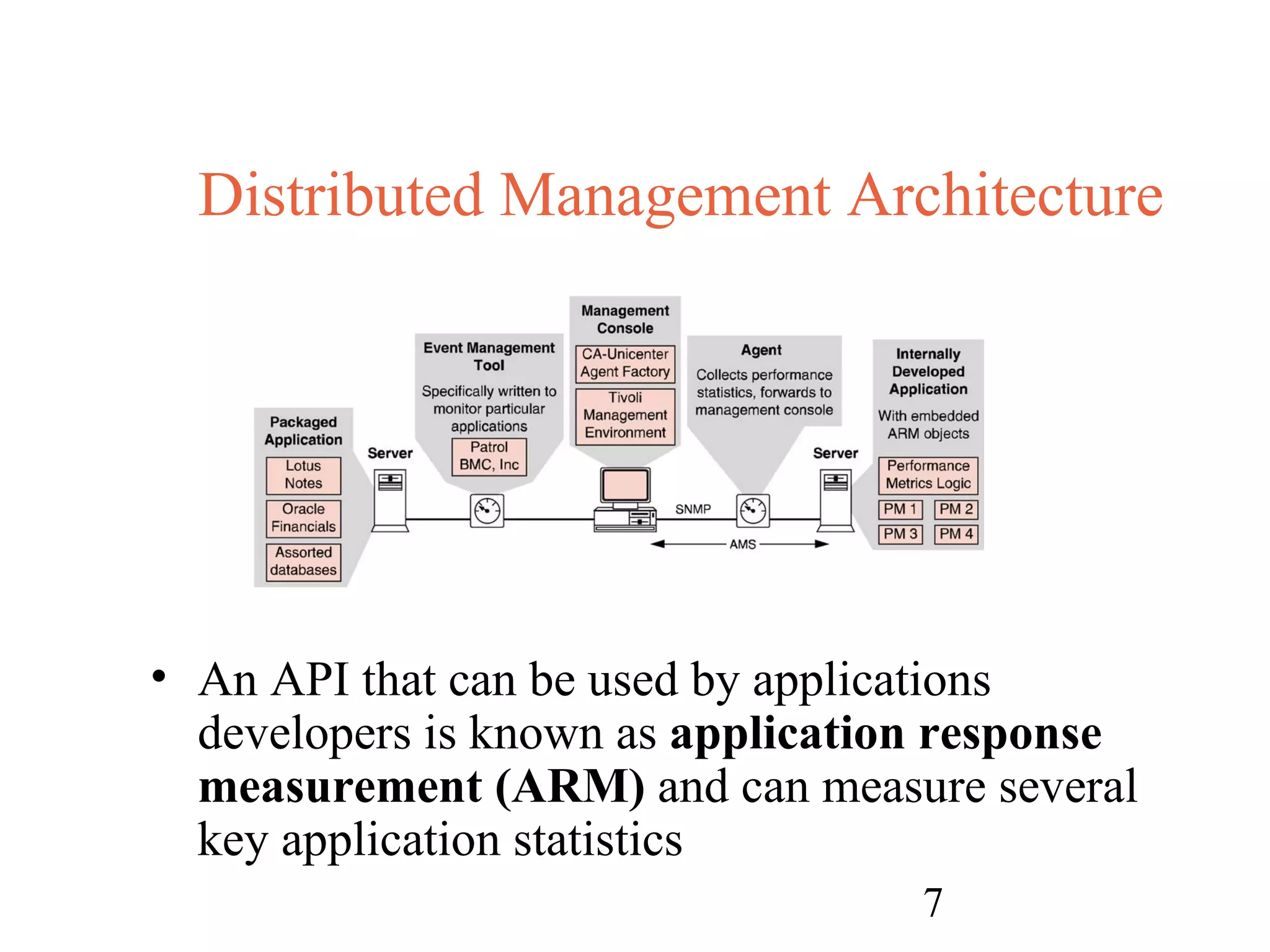
    Application Management SpecificationAMS: put together by HP, Tivoli, Oracle ARM: Application Response Management Also IETF standard WBEM : Web Based Enterprise Management Integrates SNMP & HTTP & DMI
  • 4.
    Server Management &Systems Administration Monitoring Reporting Troubleshooting Diagnosing Server performance requires Software Modules on Servers
  • 5.
    Configuration Management SingleSign-on Licence metering tools Automated S/W inventory tools Software distribution tools Handled by Policy Based Management tools Can manage more than one type of Computer
  • 6.
    Client & DesktopManagement Config & support of Workstations or Clients Hardware & OS more than Apps Architecture & Protocols proposed by “ Desktop Management Taskforce” (DMTF) Gives rise to DMI
  • 7.
    Distributed Management ArchitectureAn API that can be used by applications developers is known as application response measurement (ARM) and can measure several key application statistics
  • 8.
    Client & DesktopManagement In theory - Desktop Management & Enterprise Management must be able to interoperate Desktop Mgmt info stored in MIF ( Management Info Format ) Enterprise uses a MIB ( Management Info Base ) MIB - MIF mapper required
  • 9.
    Desktop Management TechnologySuites of Applications Netwizard Tivoli IT Director Challenge is extending desktop management to Laptops S/Wdistribution, change analysis, job scheduling, asset monitoring, backup, virus protection
  • 10.
    Database Management 2ways of looking at it: Distributed Database Management Enterprise Database Management
  • 11.
    Distributed Database ManagementBuild in self diagnosing intelligence referred to as ‘Instrumentation’ Software Agents that collect performance data and report it via SNMP 2 network related variables that can affect this are: Bandwidth & Latency No standard of what data should be gathered or how it should be reported.
  • 12.
    Enterprise Database ManagementWhen companies combine - variety of databases around the enterprise Consolidating distributed databases into an enterprise view
  • 13.
    Enterprise Database ManagementTools Global User Administration Security Management Heterogeneous data schema and content manipulation Effective troubleshooting Monitor for free space, runaway processes,high CPU utilisation, low swap space Should support: Oracle, Informix, SQL Server, Adaptive Server & DB2
  • 14.
    Laptop Management TechnologyA Mobile MIF is available Information gathered: Battery levels ac Lines Docking status Device bays

Editor's Notes

  • #3 Plessey NM system for packet switch network: Configuration tool Loader SERF Diagnostics Distributed Database Management Enterprise Database Management wide variety of the types of layer 7 software components network administrators need to watch over via monitoring and management tools - databases, Web servers, data backup copiers and business applications - and the wide variety of ways the tools track different types of components.
  • #4 More on DMI later
  • #6 Help desk Asset Management Electronic Software Distribution Licence Metering software
  • #8 Application management Specification (AMS) tries to overcome this Defines set of management objects that define: Distribution Dependencies Relationships Monitoring and Management Criteria Performance metrics ARM kit puts AMS into applications then all we need is ARM compatible Management consoles
  • #10 7 Suites mentioned in Text
  • #11 Mention that some relational database products (e.g., Oracle, SQL Server) contain their own "agents" that management products link to for activity measurement purposes.
  • #15 What is actually required?