Managing Interim Life Safety Measures (ILSM)  in Healthcare Construction
Pre-Construction Risk Assessment Before construction activity begins in a healthcare setting, it is important that the project team meet and discuss potential impacts to the existing life safety systems within the building.   The project team should be inclusive of facility staff, the owners project manager, contractors project manager, health and safety staff, life safety coordinator, affected and adjacent clinical managers/staff and infection control personnel. Life safety systems that should be evaluated for potential impairment should include but are not limited to sprinkler systems, horn/strobe devices, smoke detectors, heat detectors, fire and smoke walls and doors, and means of egress.
Construction Activities Conducting a thorough risk assessment process around potential impacts to life safety is just the beginning of having an effective ILSM program.  Communication and training of adjacent staff and personnel also plays an important role in an effective ILSM program. All steps from the risk assessment process through training and execution of ILSM should be documented. The authority having jurisdiction should be notified of all deficiencies prior to commencement of work.
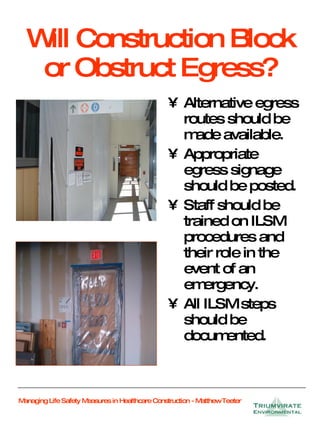
Will Construction Block or Obstruct Egress? Alternative egress routes should be made available. Appropriate egress signage should be posted. Staff should be trained on ILSM procedures and their role in the event of an emergency. All ILSM steps should be documented.
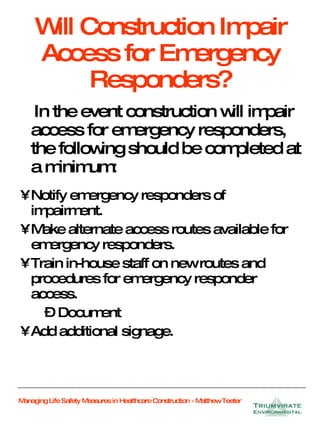
Will Construction Impair Access for Emergency Responders? In the event construction will impair access for emergency responders, the following should be completed at a minimum: Notify emergency responders of  impairment. Make alternate access routes available for emergency responders. Train in-house staff on new routes and procedures for emergency responder access. Document  Add additional signage.
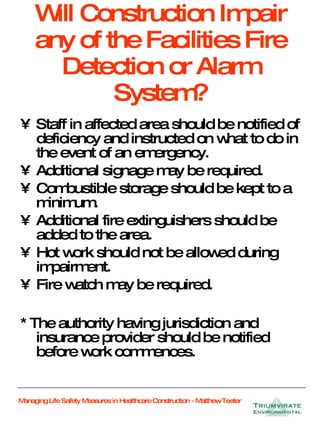
Will Construction Impair any of the Facilities Fire Detection or Alarm System? Staff in affected area should be notified of deficiency and instructed on what to do in the event of an emergency. Additional signage may be required. Combustible storage should be kept to a minimum. Additional fire extinguishers should be added to the area. Hot work should not be allowed during impairment. Fire watch may be required. * The authority having jurisdiction and insurance provider should be notified before work commences.
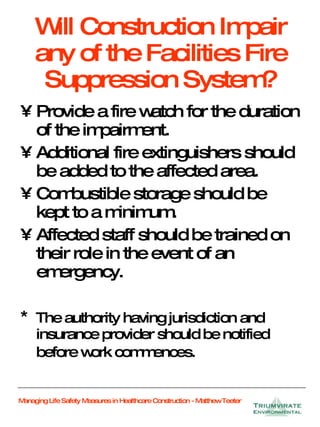
Will Construction Impair any of the Facilities Fire Suppression System? Provide a fire watch for the duration of the impairment. Additional fire extinguishers should be added to the affected area. Combustible storage should be kept to a minimum. Affected staff should be trained on their role in the event of an emergency. *  The authority having jurisdiction and insurance provider should be notified before work commences.
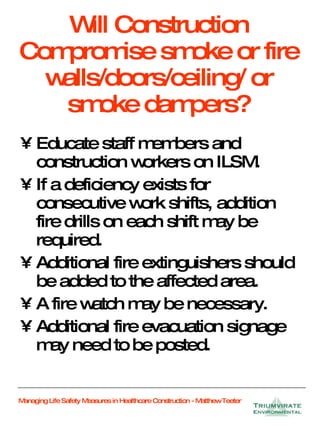
Will Construction Compromise smoke or fire walls/doors/ceiling/ or smoke dampers? Educate staff members and construction workers on ILSM. If a deficiency exists for consecutive work shifts, addition fire drills on each shift may be required. Additional fire extinguishers should be added to the affected area. A fire watch may be necessary. Additional fire evacuation signage may need to be posted.
Will Construction Affect the Fire Safety of Personnel in Adjacent Smoke Compartments? Additional fire evacuation signage may need to be posted. Educate staff members and construction workers on ILSM. Additional fire extinguishers may need to be added to the affected area.
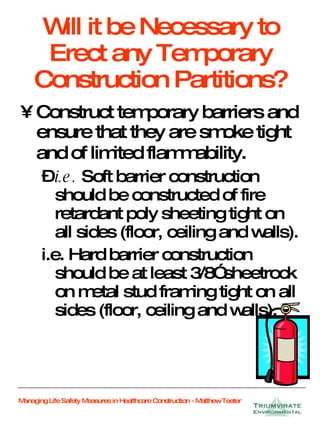
Will it be Necessary to Erect any Temporary Construction Partitions? Construct temporary barriers and ensure that they are smoke tight and of limited flammability . i.e.  Soft barrier construction should be constructed of fire retardant poly sheeting tight on all sides (floor, ceiling and walls). i.e. Hard barrier construction should be at least 3/8” sheetrock on metal stud framing tight on all sides (floor, ceiling and walls).
Will the Project Result in the Accumulation of Combustible Debris? Implement and document inspections of the construction areas. Develop and enforce procedures for storage, housekeeping and debris removal. Additional fire extinguishers may need to be added to the work area. A fire watch may be needed.
Summary An effective risk assessment and construction oversight program can mitigate the risks associated with healthcare construction. It is important that the healthcare facility manage ILSM around construction proactively and document all the steps taken to keep patients, visitors and staff  SAFE .

Interim Life Safety Measures in Healthcare Construction

  • 1.
    Managing Interim LifeSafety Measures (ILSM) in Healthcare Construction
  • 2.
    Pre-Construction Risk AssessmentBefore construction activity begins in a healthcare setting, it is important that the project team meet and discuss potential impacts to the existing life safety systems within the building. The project team should be inclusive of facility staff, the owners project manager, contractors project manager, health and safety staff, life safety coordinator, affected and adjacent clinical managers/staff and infection control personnel. Life safety systems that should be evaluated for potential impairment should include but are not limited to sprinkler systems, horn/strobe devices, smoke detectors, heat detectors, fire and smoke walls and doors, and means of egress.
  • 3.
    Construction Activities Conductinga thorough risk assessment process around potential impacts to life safety is just the beginning of having an effective ILSM program. Communication and training of adjacent staff and personnel also plays an important role in an effective ILSM program. All steps from the risk assessment process through training and execution of ILSM should be documented. The authority having jurisdiction should be notified of all deficiencies prior to commencement of work.
  • 4.
    Will Construction Blockor Obstruct Egress? Alternative egress routes should be made available. Appropriate egress signage should be posted. Staff should be trained on ILSM procedures and their role in the event of an emergency. All ILSM steps should be documented.
  • 5.
    Will Construction ImpairAccess for Emergency Responders? In the event construction will impair access for emergency responders, the following should be completed at a minimum: Notify emergency responders of impairment. Make alternate access routes available for emergency responders. Train in-house staff on new routes and procedures for emergency responder access. Document Add additional signage.
  • 6.
    Will Construction Impairany of the Facilities Fire Detection or Alarm System? Staff in affected area should be notified of deficiency and instructed on what to do in the event of an emergency. Additional signage may be required. Combustible storage should be kept to a minimum. Additional fire extinguishers should be added to the area. Hot work should not be allowed during impairment. Fire watch may be required. * The authority having jurisdiction and insurance provider should be notified before work commences.
  • 7.
    Will Construction Impairany of the Facilities Fire Suppression System? Provide a fire watch for the duration of the impairment. Additional fire extinguishers should be added to the affected area. Combustible storage should be kept to a minimum. Affected staff should be trained on their role in the event of an emergency. * The authority having jurisdiction and insurance provider should be notified before work commences.
  • 8.
    Will Construction Compromisesmoke or fire walls/doors/ceiling/ or smoke dampers? Educate staff members and construction workers on ILSM. If a deficiency exists for consecutive work shifts, addition fire drills on each shift may be required. Additional fire extinguishers should be added to the affected area. A fire watch may be necessary. Additional fire evacuation signage may need to be posted.
  • 9.
    Will Construction Affectthe Fire Safety of Personnel in Adjacent Smoke Compartments? Additional fire evacuation signage may need to be posted. Educate staff members and construction workers on ILSM. Additional fire extinguishers may need to be added to the affected area.
  • 10.
    Will it beNecessary to Erect any Temporary Construction Partitions? Construct temporary barriers and ensure that they are smoke tight and of limited flammability . i.e. Soft barrier construction should be constructed of fire retardant poly sheeting tight on all sides (floor, ceiling and walls). i.e. Hard barrier construction should be at least 3/8” sheetrock on metal stud framing tight on all sides (floor, ceiling and walls).
  • 11.
    Will the ProjectResult in the Accumulation of Combustible Debris? Implement and document inspections of the construction areas. Develop and enforce procedures for storage, housekeeping and debris removal. Additional fire extinguishers may need to be added to the work area. A fire watch may be needed.
  • 12.
    Summary An effectiverisk assessment and construction oversight program can mitigate the risks associated with healthcare construction. It is important that the healthcare facility manage ILSM around construction proactively and document all the steps taken to keep patients, visitors and staff SAFE .