Brussels Treaty Organization and
the Western European Union
21400361 - Abdirashid Diriye Kalmoy
Content
Historical background
The Brussels treaty
Member states
Western European Union(WEU)
 Flags
 Integration into NATO
Lisbon treaty : Abolishment
Reference/Sources
Historical background
• The treaty of Dunkirk: France and the United
Kingdom signed on 4 March 1947 the Treaty of
Alliance and Mutual Assistance. This was to
curb any possible German attack in the aftermath
of WW2.
• Post-war Western Europe felt the need to have
‘Bulwark Treaty’ against Communist USSR and
the possibility of German resurgent; Hence
Brussels Treaty.
The Brussels Treaty
• WW2 had weakened the military powers of
Western Europe States.
• Official name: The Treaty of Economic, Social
and Cultural Collaboration and Collective
Self-Defence.
• As a defence pledge the treaty of was signed
on 17 March 1948.
• Article 1 : ‘…..to promote the economic
recovery of Europe….’
The Brussels Treaty
• Article 3: ‘.. .understanding of the principles
which form the basis of their common civilization
and to promote cultural exchanges….’
• Article 4: ‘…military and other aid and
assistance to High Contracting Parties…’.
• In September 1948 , Western Union Defence
Organization was formed. Its consisted of WU
defence Committee and WU National chiefs of
Staff.
Member States
• France
• United Kingdom
• Belgium
• The Netherlands
• Luxembourg
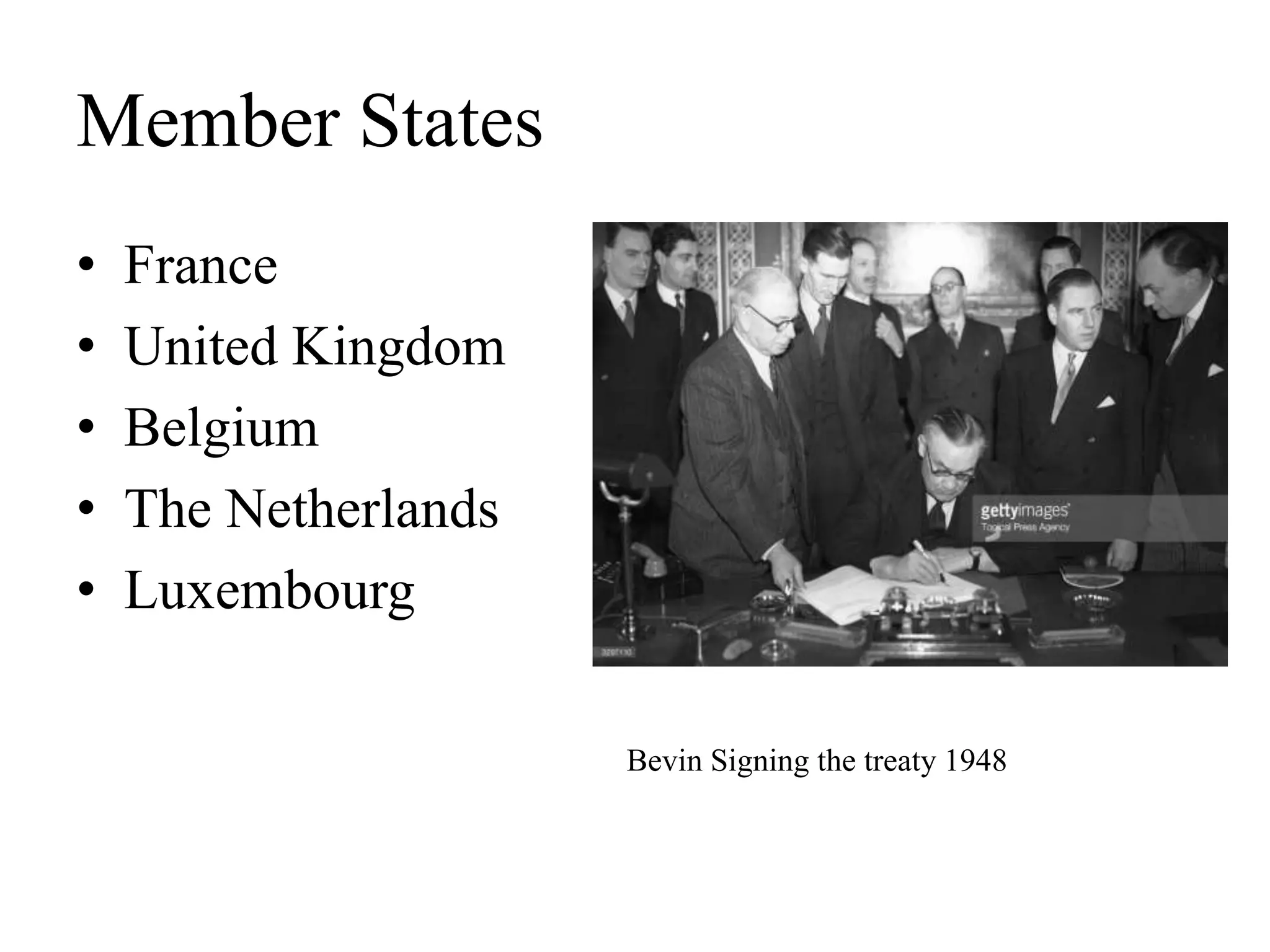
Bevin Signing the treaty 1948
Western European Union
• The Pleven Plan : Rene Pleven was a French
politician who was twice a premier in the
French fourth Republic.
• He convened the July 1950 Paris conference;
he argued for a European unified army that
will precede NATO.
Western Europe Union
• The 1948 Brussels Treaty was modified in the
frameworks of London and Paris Accords of
October 1954.
• Paris agreement preambles;
To create in Western Europe a firm basis for
European economic recovery.
To afford assistance to each other in resisting an
policy aggression.
To promote the unity and encourage the progressive
integration of Europe.
Western Europe Union
• 10 Member States *
(modified Brussels Treaty – 1954)
(also members of the EU and NATO)
Belgium Luxembourg France Netherlands Germany Portugal (1990)Greece
(1995)Spain (1990)Italy United Kingdom
• 6 Associate Members *
(Rome – 1992)
(also members of NATO)
Czech Republic (1999)Norway Hungary (1999)Poland (1999)Iceland Turkey
• 5 Observers *
(Rome – 1992)
(also members of the EU)
Austria (1995)Ireland Denmark Sweden (1995)Finland (1995)
• 7 Associate Partners *
(Kirchberg – 1994)
(all signatories of a Europe Agreement with the EU)
Bulgaria Romania Estonia Slovakia Latvia Slovenia (1996)Lithuania
Flags
1949 Flag
9-star layout designed in 1993.
Integration into NATO
• Division of Europe into two opposing spheres
was deemed imminent.
• USSR’s threats were perceived as existential.
• After the formation of NATO in 1949, the
Western Union Defence Organization
structures were absorbed into NATO from
December 1950 to April 1951.
Lisbon Treaty: Abolishment
• The Treaty of Lisbon ( The Reform Treaty)
amended two (TFEU and TEU) which formed
the constitutional basis of the EU.
• The Treaty entered into force on 1 December
2009, and it took over the WEU mutual defence
clause.
• The Treaty of Brussels were terminated on 31
March 2010 and consequently the activities of
WEU were terminated June 2011.
Reference/Sources
• https://www.britannica.com/event/Brussels-
Treaty-European-history-1948
• http://www.nato.int/cps/ic/natohq/official_texts
_17072.htm
• https://www.brussels.info/brussels-pact/
• https://www.britannica.com/topic/Western-
European-Union
• http://www.weu.int/
• http://www.newworldencyclopedia.org/entry/W
estern_European_Union

Dynamics of EU Integration

  • 1.
    Brussels Treaty Organizationand the Western European Union 21400361 - Abdirashid Diriye Kalmoy
  • 2.
    Content Historical background The Brusselstreaty Member states Western European Union(WEU)  Flags  Integration into NATO Lisbon treaty : Abolishment Reference/Sources
  • 3.
    Historical background • Thetreaty of Dunkirk: France and the United Kingdom signed on 4 March 1947 the Treaty of Alliance and Mutual Assistance. This was to curb any possible German attack in the aftermath of WW2. • Post-war Western Europe felt the need to have ‘Bulwark Treaty’ against Communist USSR and the possibility of German resurgent; Hence Brussels Treaty.
  • 4.
    The Brussels Treaty •WW2 had weakened the military powers of Western Europe States. • Official name: The Treaty of Economic, Social and Cultural Collaboration and Collective Self-Defence. • As a defence pledge the treaty of was signed on 17 March 1948. • Article 1 : ‘…..to promote the economic recovery of Europe….’
  • 5.
    The Brussels Treaty •Article 3: ‘.. .understanding of the principles which form the basis of their common civilization and to promote cultural exchanges….’ • Article 4: ‘…military and other aid and assistance to High Contracting Parties…’. • In September 1948 , Western Union Defence Organization was formed. Its consisted of WU defence Committee and WU National chiefs of Staff.
  • 6.
    Member States • France •United Kingdom • Belgium • The Netherlands • Luxembourg Bevin Signing the treaty 1948
  • 7.
    Western European Union •The Pleven Plan : Rene Pleven was a French politician who was twice a premier in the French fourth Republic. • He convened the July 1950 Paris conference; he argued for a European unified army that will precede NATO.
  • 8.
    Western Europe Union •The 1948 Brussels Treaty was modified in the frameworks of London and Paris Accords of October 1954. • Paris agreement preambles; To create in Western Europe a firm basis for European economic recovery. To afford assistance to each other in resisting an policy aggression. To promote the unity and encourage the progressive integration of Europe.
  • 9.
    Western Europe Union •10 Member States * (modified Brussels Treaty – 1954) (also members of the EU and NATO) Belgium Luxembourg France Netherlands Germany Portugal (1990)Greece (1995)Spain (1990)Italy United Kingdom • 6 Associate Members * (Rome – 1992) (also members of NATO) Czech Republic (1999)Norway Hungary (1999)Poland (1999)Iceland Turkey • 5 Observers * (Rome – 1992) (also members of the EU) Austria (1995)Ireland Denmark Sweden (1995)Finland (1995) • 7 Associate Partners * (Kirchberg – 1994) (all signatories of a Europe Agreement with the EU) Bulgaria Romania Estonia Slovakia Latvia Slovenia (1996)Lithuania
  • 10.
  • 11.
    Integration into NATO •Division of Europe into two opposing spheres was deemed imminent. • USSR’s threats were perceived as existential. • After the formation of NATO in 1949, the Western Union Defence Organization structures were absorbed into NATO from December 1950 to April 1951.
  • 12.
    Lisbon Treaty: Abolishment •The Treaty of Lisbon ( The Reform Treaty) amended two (TFEU and TEU) which formed the constitutional basis of the EU. • The Treaty entered into force on 1 December 2009, and it took over the WEU mutual defence clause. • The Treaty of Brussels were terminated on 31 March 2010 and consequently the activities of WEU were terminated June 2011.
  • 13.
    Reference/Sources • https://www.britannica.com/event/Brussels- Treaty-European-history-1948 • http://www.nato.int/cps/ic/natohq/official_texts _17072.htm •https://www.brussels.info/brussels-pact/ • https://www.britannica.com/topic/Western- European-Union • http://www.weu.int/ • http://www.newworldencyclopedia.org/entry/W estern_European_Union