)
)
)
)
)
)
)
)
)
’
English For Physics
Presented by Group 4
)
)
)
)
)
)
)
)
)
)
)
)
)
)
)
)
)
)
Moderator
Jesica Riby
)
)
)
)
)
)
)
)
)
)
)
)
)
)
)
)
)
)
Second Speaker Third Speaker Fourht Speaker Fifth Speaker
Ronaldo Putra
)
)
)
)
)
)
)
)
)
Tirza Mintasih Taqmawati Viora Herlanda
)
)
)
)
)
)
)
)
) Intro
)
)
)
)
)
)
)
)
)
)
)
)
)
)
)
)
)
) Intro
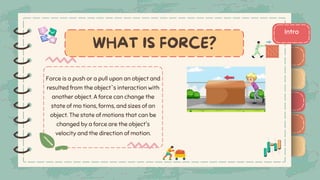
Force is a push or a pull upon an object and
resulted from the object`s interaction with
another object. A force can change the
state of mo tions, forms, and sizes of an
object. The state of motions that can be
changed by a force are the object's
velocity and the direction of motion.
)
)
)
)
)
)
)
)
)
)
)
)
)
)
)
)
)
)
01
Chapter 1
)
)
)
)
)
)
)
)
)
)
)
)
)
)
)
)
)
)
01
Chapter 1
Force is a vector quantity represented by the symbol F. Usually in SI unit, the
magnitude of force is represented in Newton (abbreviated N) and in MKS
system it is represented in kg m/s².
)
)
)
)
)
)
)
)
)
)
)
)
)
)
)
)
)
)
01
03
02
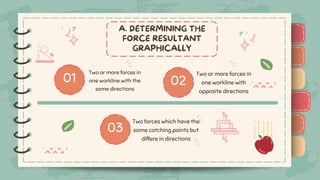
Two or more forces in
one workline with the
same directions
)
)
)
)
)
)
)
)
)
Two or more forces in
one workline with
opposite directions
Two forces which have the
same catching points but
differe in directions
)
)
)
)
)
)
)
)
)
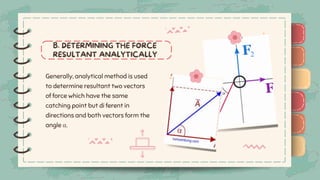
Generally, analytical method is used
to determine resultant two vectors
of force which have the same
catching point but di ferent in
directions and both vectors form the
angle α.
)
)
)
)
)
)
)
)
)
)
)
)
)
)
)
)
)
)
Chapter 2
02
)
)
)
)
)
)
)
)
)
)
)
)
)
)
)
)
)
)
)
)
)
)
)
)
)
)
)
Weight is the gravitational
force works on an object
which is near the earth
surface.
1. WEIGHT
The normal force is the
contact force which acts in
perpendicular di- rection to
the contact plane if two
objects are in contact of each
other.
2. NORMAL FORCE
)
)
)
)
)
)
)
)
)
)
)
)
)
)
)
)
)
)
String tensional force is the force
which is transmitted through a
string or wire when is tightly
pulled by forces acting on one
end of the string. The following
figure shows the string tensional
force experienced by an object.
4. STRING TENSIONAL FORCE
A friction causes the resistance to the
motion of a body. It means that in friction
phenomenon there is a force which opposes
the direction of objects motion, and that
force is called frictional force. The frictional
force is expressed by the symbol f and
distin- guished into static frictional force
and kinetic frictional force.
3. FRICTIONAL FORCE
)
)
)
)
)
)
)
)
)
Chapter 3
03
)
)
)
)
)
)
)
)
)
)
)
)
)
)
)
)
)
)
Chapter 3
03
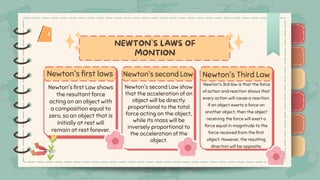
Newton's law is a law of motion which is the basic law of dynamics by
formulating forces on the influence of motion on certain objects.
)
)
)
)
)
)
)
)
)
)
)
)
)
)
)
)
)
)
Newton's first Law shows
the resultant force
acting on an object with
a composition equal to
zero, so an object that is
initially at rest will
remain at rest forever.
Newton's second Law show
that the acceleration of an
object will be directly
proportional to the total
force acting on the object,
while its mass will be
inversely proportional to
the acceleration of the
object.
Newton's 3rd law is that the force
of action and reaction shows that
every action will cause a reaction.
If an object exerts a force on
another object, then the object
receiving the force will exert a
force equal in magnitude to the
force received from the first
object. However, the resulting
direction will be opposite.
Newton's first laws Newton's second Law Newton's Third Law
)
)
)
)
)
)
)
)
)
)
)
)
)
)
)
)
)
)
Chapter 4
04
)
)
)
)
)
)
)
)
)
)
)
)
)
)
)
)
)
)
Chapter 4
04
The basic principles of Newton's law can be applied to solve simple problems
of dynamics, such as motion of object on smooth planes, rough planes,
inclined planes, motion of the object that connected to a pulley, weight of
object in the lift and in circular motion.
)
)
)
)
)
)
)
)
)
)
)
)
)
)
)
)
)
)
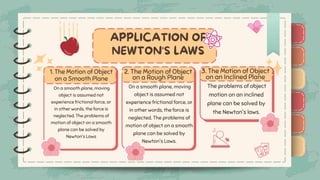
On a smooth plane, moving
object is assumed not
experience frictional force, or
in other words, the force is
neglected. The problems of
motion of object on a smooth
plane can be solved by
Newton's Laws
On a smooth plane, moving
object is assumed not
experience frictional force, or
in other words, the force is
neglected. The problems of
motion of object on a smooth
plane can be solved by
Newton's Laws.
The problems of object
motion on an inclined
plane can be solved by
the Newton's laws.
1. The Motion of Object
on a Smooth Plane
2. The Motion of Object
on a Rough Plane
3. The Motion of Object
on an Inclined Plane
)
)
)
)
)
)
)
)
)
)
)
)
)
)
)
)
)
)
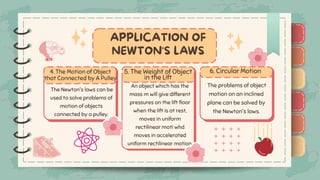
The Newton's laws can be
used to solve problems of
motion of objects
connected by a pulley.
An object which has the
mass m will give different
pressures on the lift floor
when the lift is at rest,
moves in uniform
rectilinear moti whd
moves in accelerated
uniform rectilinear motion.
4. The Motion of Object
that Connected by A Pulley
5. The Weight of Object
in the Lift
The problems of object
motion on an inclined
plane can be solved by
the Newton's laws.
6. Circular Motion
)
)
)
)
)
)
)
)
)
)
)
)
)
)
)
)
)
)
)
)
)
)
)
)
)
)
)
)
)
)
)
)
)
)
)
)
)
)
)
)
)
)
)
)
)
By Group 4

dynamics & Newton's laws Project Presentation.pptx

  • 1.
  • 2.
  • 3.
    ) ) ) ) ) ) ) ) ) Second Speaker ThirdSpeaker Fourht Speaker Fifth Speaker Ronaldo Putra ) ) ) ) ) ) ) ) ) Tirza Mintasih Taqmawati Viora Herlanda
  • 4.
  • 5.
    ) ) ) ) ) ) ) ) ) Intro Force isa push or a pull upon an object and resulted from the object`s interaction with another object. A force can change the state of mo tions, forms, and sizes of an object. The state of motions that can be changed by a force are the object's velocity and the direction of motion. ) ) ) ) ) ) ) ) )
  • 6.
  • 7.
    ) ) ) ) ) ) ) ) ) 01 Chapter 1 Force isa vector quantity represented by the symbol F. Usually in SI unit, the magnitude of force is represented in Newton (abbreviated N) and in MKS system it is represented in kg m/s². ) ) ) ) ) ) ) ) )
  • 8.
    ) ) ) ) ) ) ) ) ) 01 03 02 Two or moreforces in one workline with the same directions ) ) ) ) ) ) ) ) ) Two or more forces in one workline with opposite directions Two forces which have the same catching points but differe in directions
  • 9.
    ) ) ) ) ) ) ) ) ) Generally, analytical methodis used to determine resultant two vectors of force which have the same catching point but di ferent in directions and both vectors form the angle α. ) ) ) ) ) ) ) ) )
  • 10.
  • 11.
    ) ) ) ) ) ) ) ) ) ) ) ) ) ) ) ) ) ) Weight is thegravitational force works on an object which is near the earth surface. 1. WEIGHT The normal force is the contact force which acts in perpendicular di- rection to the contact plane if two objects are in contact of each other. 2. NORMAL FORCE
  • 12.
    ) ) ) ) ) ) ) ) ) ) ) ) ) ) ) ) ) ) String tensional forceis the force which is transmitted through a string or wire when is tightly pulled by forces acting on one end of the string. The following figure shows the string tensional force experienced by an object. 4. STRING TENSIONAL FORCE A friction causes the resistance to the motion of a body. It means that in friction phenomenon there is a force which opposes the direction of objects motion, and that force is called frictional force. The frictional force is expressed by the symbol f and distin- guished into static frictional force and kinetic frictional force. 3. FRICTIONAL FORCE
  • 13.
  • 14.
    ) ) ) ) ) ) ) ) ) Chapter 3 03 Newton's lawis a law of motion which is the basic law of dynamics by formulating forces on the influence of motion on certain objects. ) ) ) ) ) ) ) ) )
  • 15.
    ) ) ) ) ) ) ) ) ) Newton's first Lawshows the resultant force acting on an object with a composition equal to zero, so an object that is initially at rest will remain at rest forever. Newton's second Law show that the acceleration of an object will be directly proportional to the total force acting on the object, while its mass will be inversely proportional to the acceleration of the object. Newton's 3rd law is that the force of action and reaction shows that every action will cause a reaction. If an object exerts a force on another object, then the object receiving the force will exert a force equal in magnitude to the force received from the first object. However, the resulting direction will be opposite. Newton's first laws Newton's second Law Newton's Third Law ) ) ) ) ) ) ) ) )
  • 16.
  • 17.
    ) ) ) ) ) ) ) ) ) Chapter 4 04 The basicprinciples of Newton's law can be applied to solve simple problems of dynamics, such as motion of object on smooth planes, rough planes, inclined planes, motion of the object that connected to a pulley, weight of object in the lift and in circular motion. ) ) ) ) ) ) ) ) )
  • 18.
    ) ) ) ) ) ) ) ) ) On a smoothplane, moving object is assumed not experience frictional force, or in other words, the force is neglected. The problems of motion of object on a smooth plane can be solved by Newton's Laws On a smooth plane, moving object is assumed not experience frictional force, or in other words, the force is neglected. The problems of motion of object on a smooth plane can be solved by Newton's Laws. The problems of object motion on an inclined plane can be solved by the Newton's laws. 1. The Motion of Object on a Smooth Plane 2. The Motion of Object on a Rough Plane 3. The Motion of Object on an Inclined Plane ) ) ) ) ) ) ) ) )
  • 19.
    ) ) ) ) ) ) ) ) ) The Newton's lawscan be used to solve problems of motion of objects connected by a pulley. An object which has the mass m will give different pressures on the lift floor when the lift is at rest, moves in uniform rectilinear moti whd moves in accelerated uniform rectilinear motion. 4. The Motion of Object that Connected by A Pulley 5. The Weight of Object in the Lift The problems of object motion on an inclined plane can be solved by the Newton's laws. 6. Circular Motion ) ) ) ) ) ) ) ) )
  • 20.
  • 21.