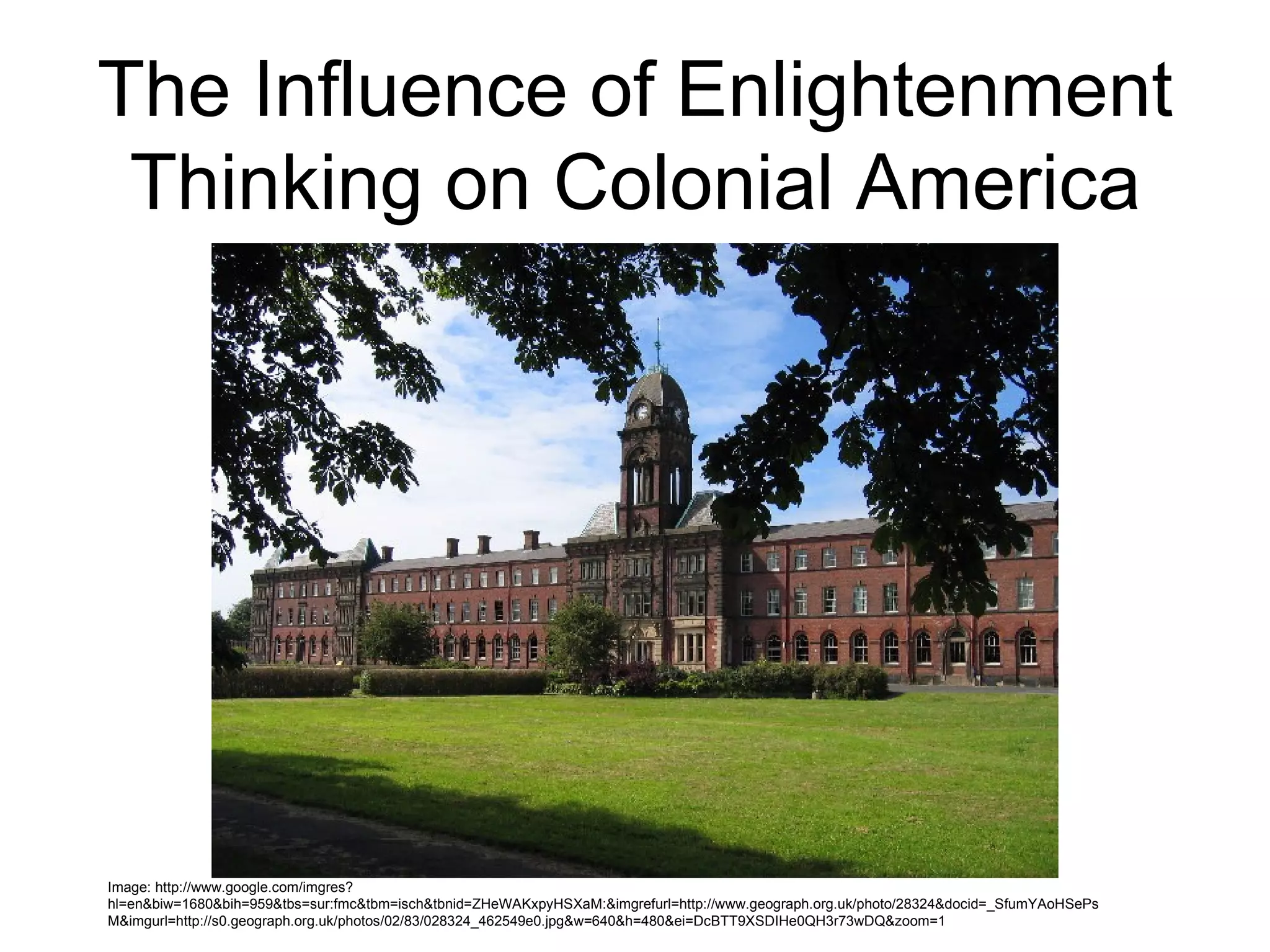
The Influence of Enlightenment
 Thinking on Colonial America


Image: http://www.google.com/imgres?
hl=en&biw=1680&bih=959&tbs=sur:fmc&tbm=isch&tbnid=ZHeWAKxpyHSXaM:&imgrefurl=http://www.geograph.org.uk/photo/28324&docid=_SfumYAoHSePs
M&imgurl=http://s0.geograph.org.uk/photos/02/83/028324_462549e0.jpg&w=640&h=480&ei=DcBTT9XSDIHe0QH3r73wDQ&zoom=1
Image: http://host3.images.cdn.fotopedia.com/flickr-1284272029-medium.jpg


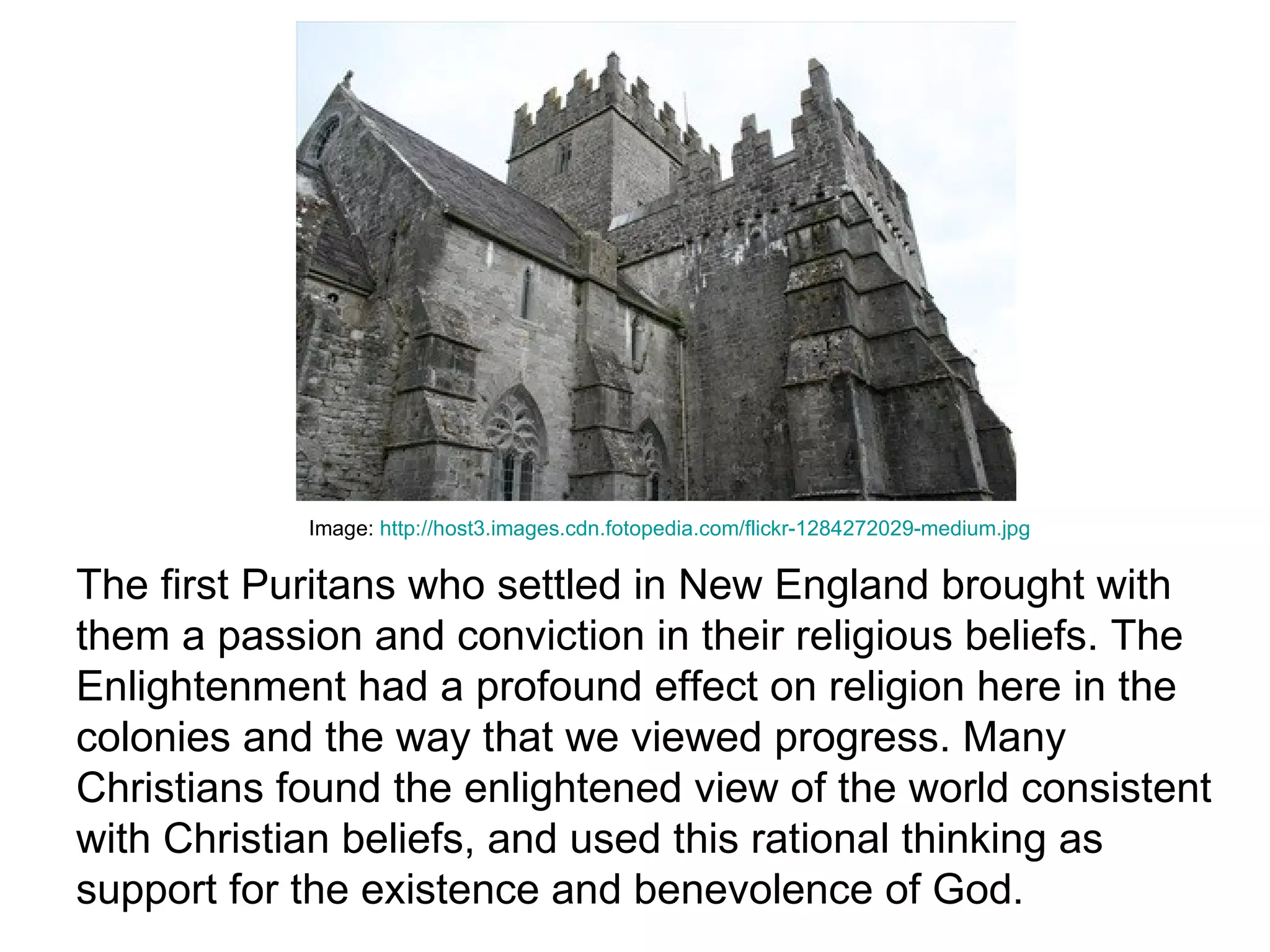
The first Puritans who settled in New England brought with
them a passion and conviction in their religious beliefs. The
Enlightenment had a profound effect on religion here in the
colonies and the way that we viewed progress. Many
Christians found the enlightened view of the world consistent
with Christian beliefs, and used this rational thinking as
support for the existence and benevolence of God.
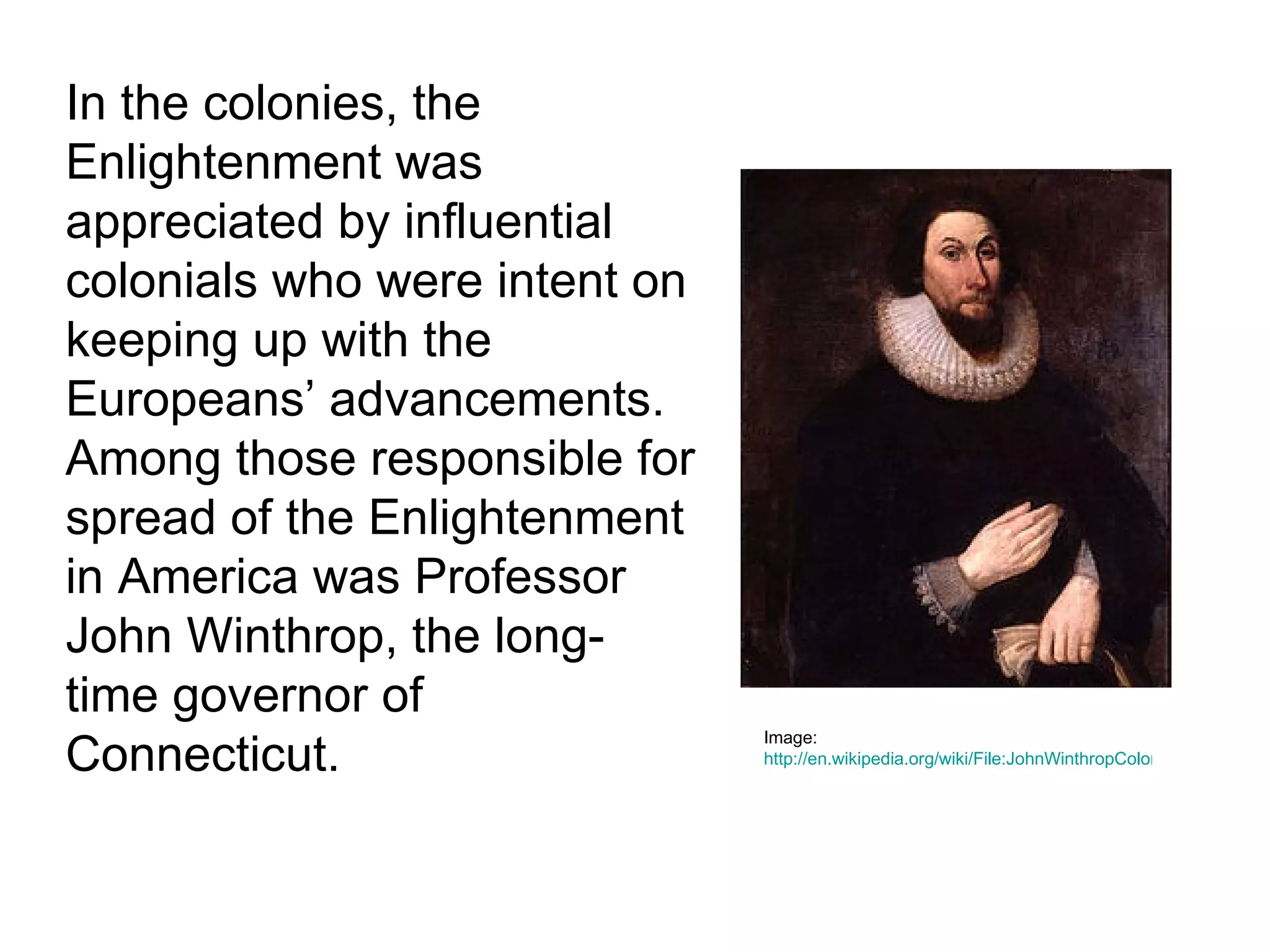
In the colonies, the
Enlightenment was
appreciated by influential
colonials who were intent on
keeping up with the
Europeans’ advancements.
Among those responsible for
spread of the Enlightenment
in America was Professor
John Winthrop, the long-
time governor of
Connecticut.
                               Image:
                               http://en.wikipedia.org/wiki/File:JohnWinthropColorPortrait.jpg
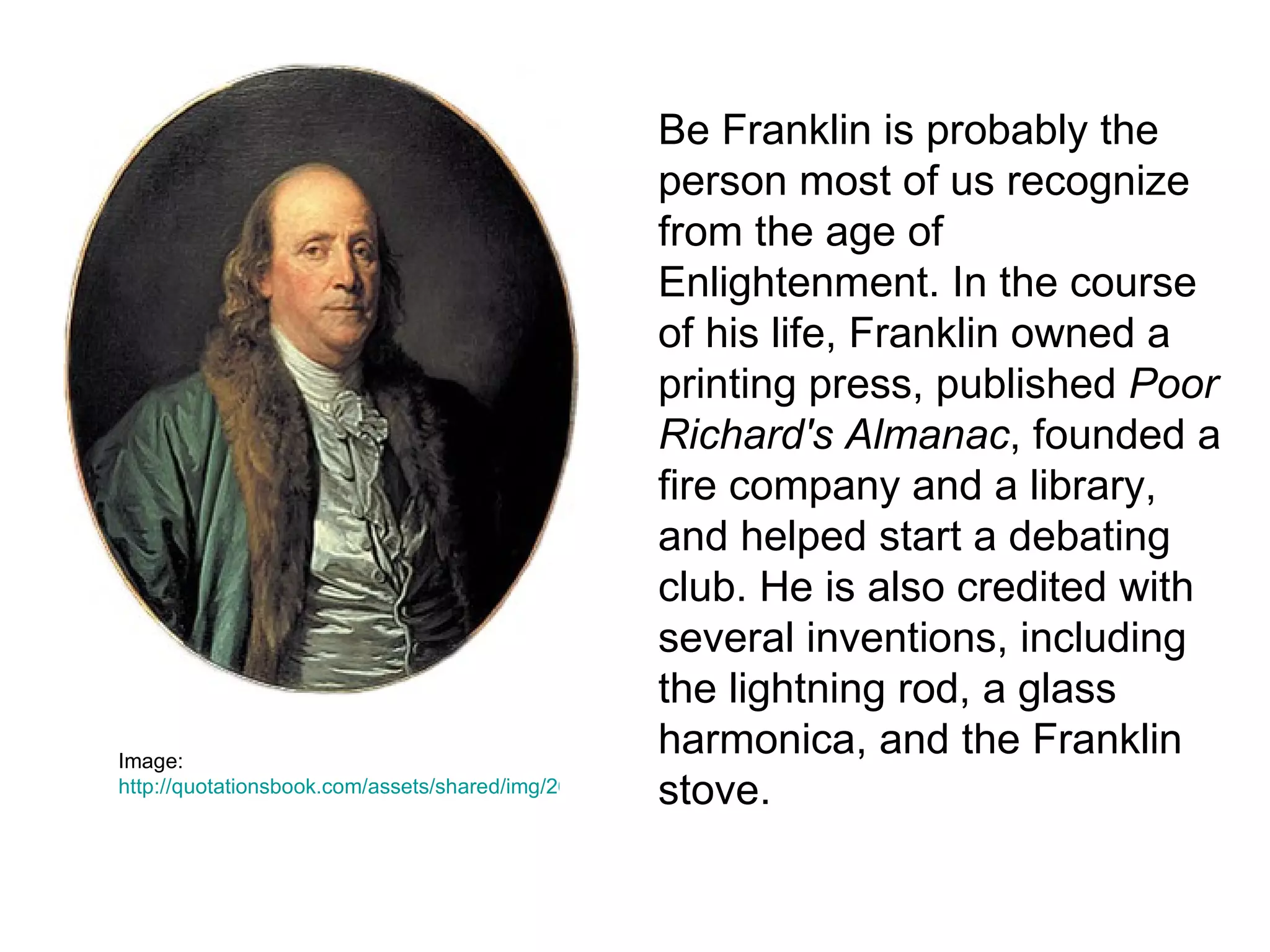
Be Franklin is probably the
                                                      person most of us recognize
                                                      from the age of
                                                      Enlightenment. In the course
                                                      of his life, Franklin owned a
                                                      printing press, published Poor
                                                      Richard's Almanac, founded a
                                                      fire company and a library,
                                                      and helped start a debating
                                                      club. He is also credited with
                                                      several inventions, including
                                                      the lightning rod, a glass
Image:
                                                      harmonica, and the Franklin
                                                      stove.
http://quotationsbook.com/assets/shared/img/2619/Benjamin_Franklin_by_Jean-Baptiste_Greuze.jpg
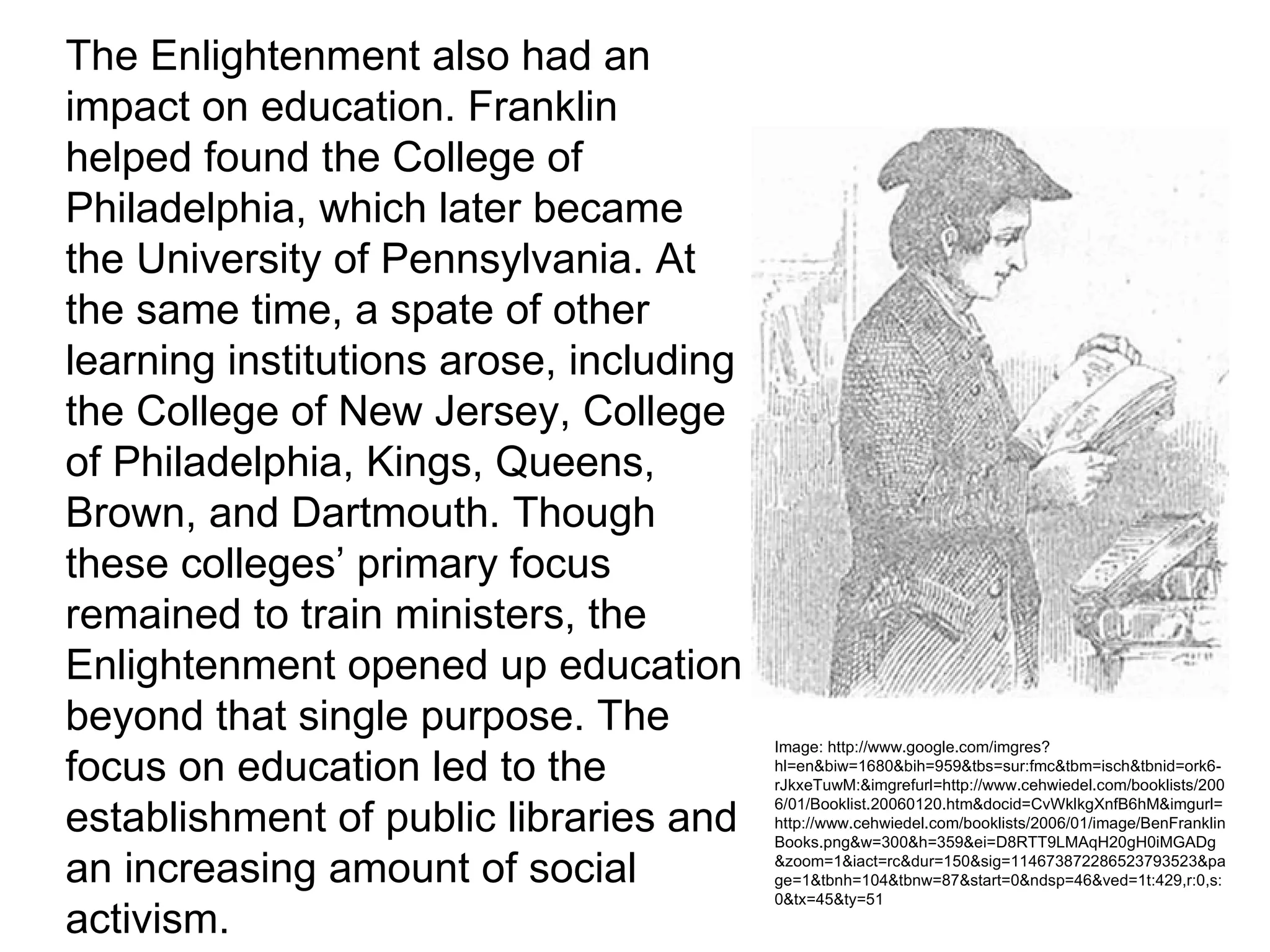
The Enlightenment also had an
impact on education. Franklin
helped found the College of
Philadelphia, which later became
the University of Pennsylvania. At
the same time, a spate of other
learning institutions arose, including
the College of New Jersey, College
of Philadelphia, Kings, Queens,
Brown, and Dartmouth. Though
these colleges’ primary focus
remained to train ministers, the
Enlightenment opened up education
beyond that single purpose. The
                                         Image: http://www.google.com/imgres?
focus on education led to the            hl=en&biw=1680&bih=959&tbs=sur:fmc&tbm=isch&tbnid=ork6-
                                         rJkxeTuwM:&imgrefurl=http://www.cehwiedel.com/booklists/200

establishment of public libraries and
                                         6/01/Booklist.20060120.htm&docid=CvWklkgXnfB6hM&imgurl=
                                         http://www.cehwiedel.com/booklists/2006/01/image/BenFranklin
                                         Books.png&w=300&h=359&ei=D8RTT9LMAqH20gH0iMGADg

an increasing amount of social           &zoom=1&iact=rc&dur=150&sig=114673872286523793523&pa
                                         ge=1&tbnh=104&tbnw=87&start=0&ndsp=46&ved=1t:429,r:0,s:
                                         0&tx=45&ty=51
activism.
The Enlightenment’s influence on eighteenth-century America
should not be underestimated. Advances in science and the
arts, along with increased religious freedom, carried over into
modern society. The focus on balance and order set the
groundwork for an American governing system that included
a balance of power. Our founding fathers believed that by
using reason and logic, we could create a better form of
government. And, this we did right here in America!


     Image:https://commons.wikimedia.org/wiki/File:US_flag_13_stars_%E2%80%93_Betsy_Ross.svg

Enlightenments influence on the colonies

  • 1.
    The Influence ofEnlightenment Thinking on Colonial America Image: http://www.google.com/imgres? hl=en&biw=1680&bih=959&tbs=sur:fmc&tbm=isch&tbnid=ZHeWAKxpyHSXaM:&imgrefurl=http://www.geograph.org.uk/photo/28324&docid=_SfumYAoHSePs M&imgurl=http://s0.geograph.org.uk/photos/02/83/028324_462549e0.jpg&w=640&h=480&ei=DcBTT9XSDIHe0QH3r73wDQ&zoom=1
  • 2.
    Image: http://host3.images.cdn.fotopedia.com/flickr-1284272029-medium.jpg The firstPuritans who settled in New England brought with them a passion and conviction in their religious beliefs. The Enlightenment had a profound effect on religion here in the colonies and the way that we viewed progress. Many Christians found the enlightened view of the world consistent with Christian beliefs, and used this rational thinking as support for the existence and benevolence of God.
  • 3.
    In the colonies,the Enlightenment was appreciated by influential colonials who were intent on keeping up with the Europeans’ advancements. Among those responsible for spread of the Enlightenment in America was Professor John Winthrop, the long- time governor of Connecticut. Image: http://en.wikipedia.org/wiki/File:JohnWinthropColorPortrait.jpg
  • 4.
    Be Franklin isprobably the person most of us recognize from the age of Enlightenment. In the course of his life, Franklin owned a printing press, published Poor Richard's Almanac, founded a fire company and a library, and helped start a debating club. He is also credited with several inventions, including the lightning rod, a glass Image: harmonica, and the Franklin stove. http://quotationsbook.com/assets/shared/img/2619/Benjamin_Franklin_by_Jean-Baptiste_Greuze.jpg
  • 5.
    The Enlightenment alsohad an impact on education. Franklin helped found the College of Philadelphia, which later became the University of Pennsylvania. At the same time, a spate of other learning institutions arose, including the College of New Jersey, College of Philadelphia, Kings, Queens, Brown, and Dartmouth. Though these colleges’ primary focus remained to train ministers, the Enlightenment opened up education beyond that single purpose. The Image: http://www.google.com/imgres? focus on education led to the hl=en&biw=1680&bih=959&tbs=sur:fmc&tbm=isch&tbnid=ork6- rJkxeTuwM:&imgrefurl=http://www.cehwiedel.com/booklists/200 establishment of public libraries and 6/01/Booklist.20060120.htm&docid=CvWklkgXnfB6hM&imgurl= http://www.cehwiedel.com/booklists/2006/01/image/BenFranklin Books.png&w=300&h=359&ei=D8RTT9LMAqH20gH0iMGADg an increasing amount of social &zoom=1&iact=rc&dur=150&sig=114673872286523793523&pa ge=1&tbnh=104&tbnw=87&start=0&ndsp=46&ved=1t:429,r:0,s: 0&tx=45&ty=51 activism.
  • 6.
    The Enlightenment’s influenceon eighteenth-century America should not be underestimated. Advances in science and the arts, along with increased religious freedom, carried over into modern society. The focus on balance and order set the groundwork for an American governing system that included a balance of power. Our founding fathers believed that by using reason and logic, we could create a better form of government. And, this we did right here in America! Image:https://commons.wikimedia.org/wiki/File:US_flag_13_stars_%E2%80%93_Betsy_Ross.svg