Dynamic Data: Communicated
Results in Ways that Reach
Diverse Audiences
Betsy Olson
Jessie Potterton
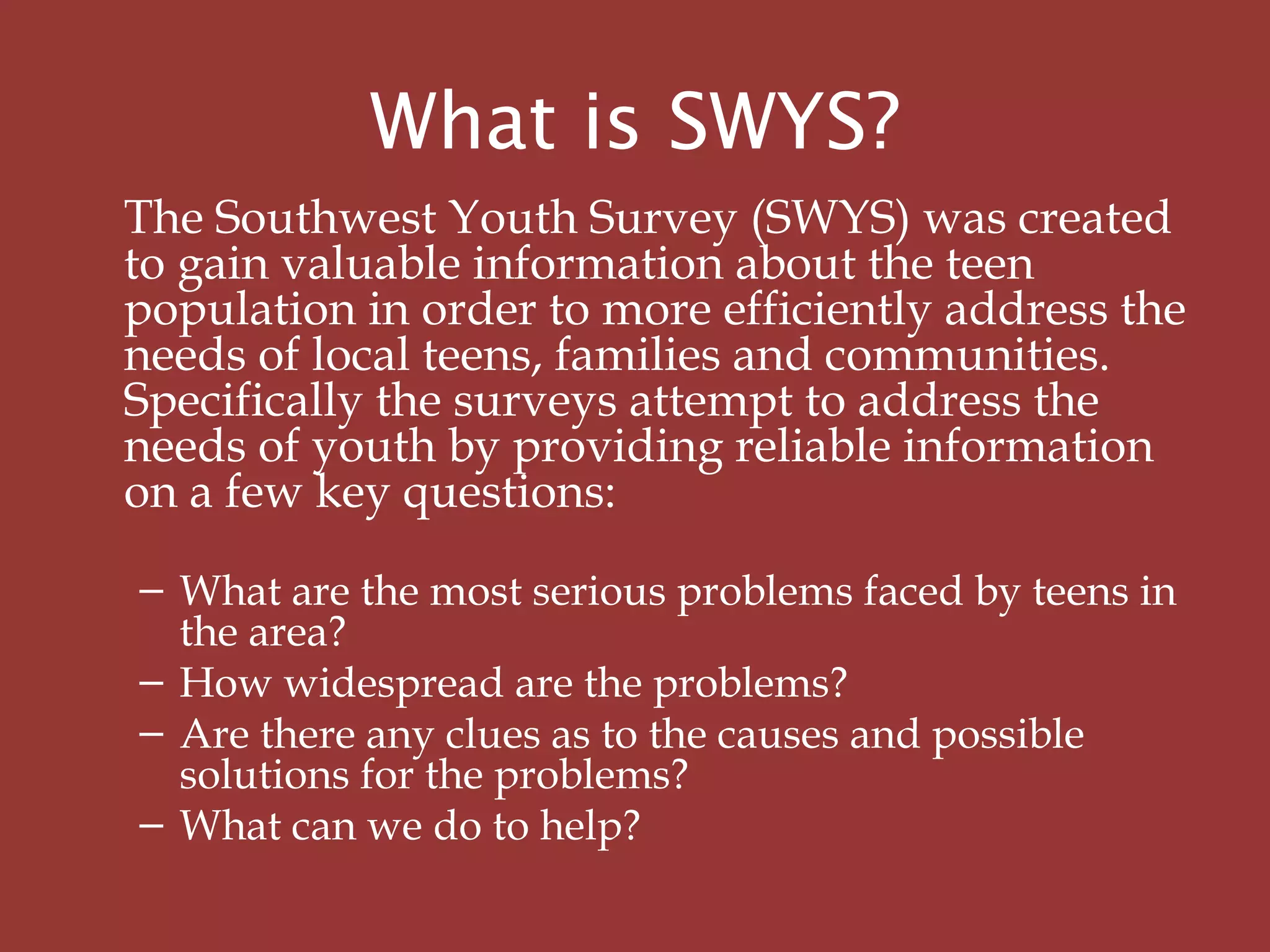
What is SWYS?
The Southwest Youth Survey (SWYS) was created
to gain valuable information about the teen
population in order to more efficiently address the
needs of local teens, families and communities.
Specifically the surveys attempt to address the
needs of youth by providing reliable information
on a few key questions:
– What are the most serious problems faced by teens in
the area?
– How widespread are the problems?
– Are there any clues as to the causes and possible
solutions for the problems?
– What can we do to help?
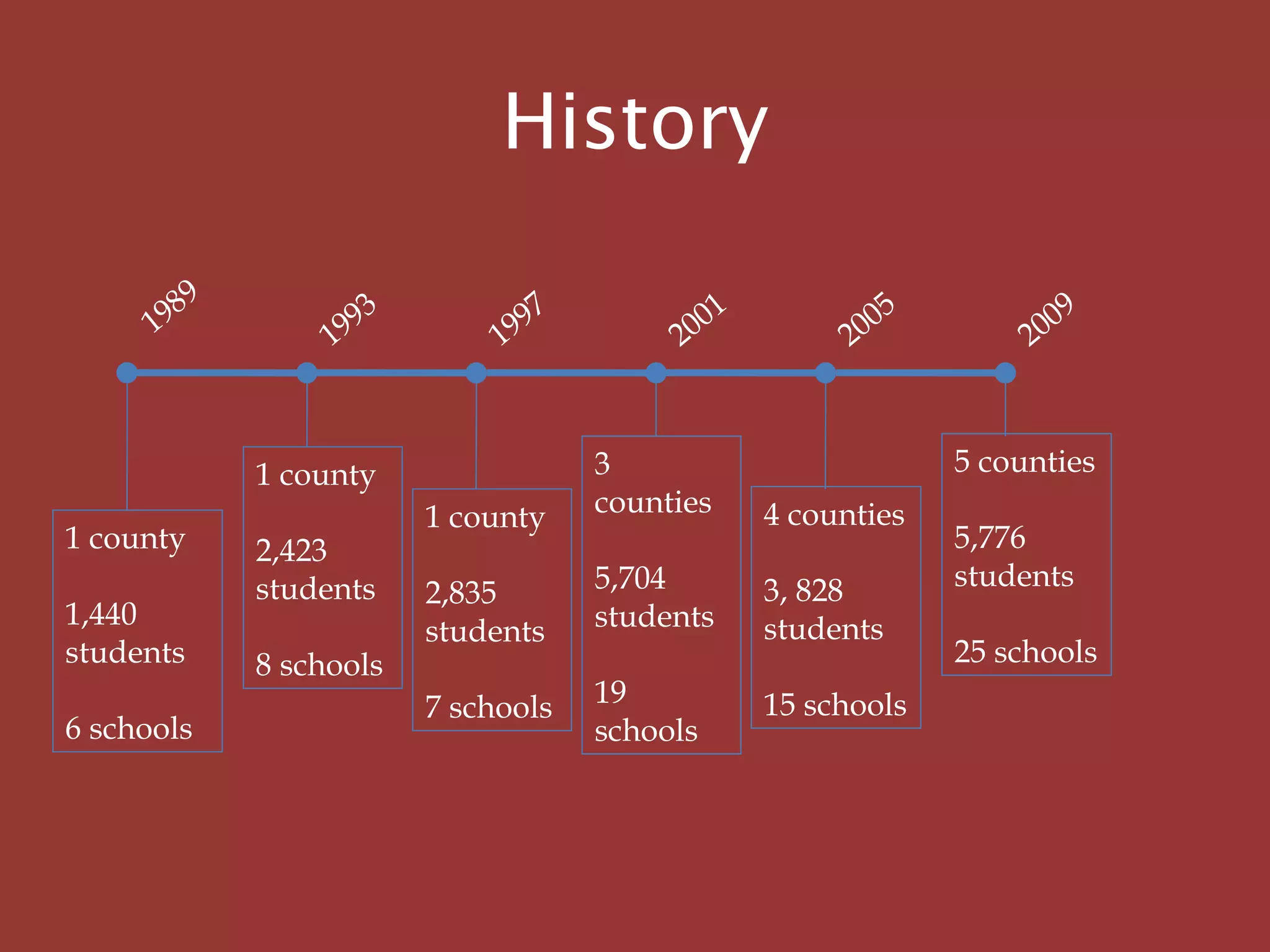
History
1989
1 county
1,440
students
6 schools
1 county
2,423
students
8 schools
1993
1 county
2,835
students
7 schools
1997
3
counties
5,704
students
19
schools
2001
4 counties
3, 828
students
15 schools
2005
5 counties
5,776
students
25 schools
2009
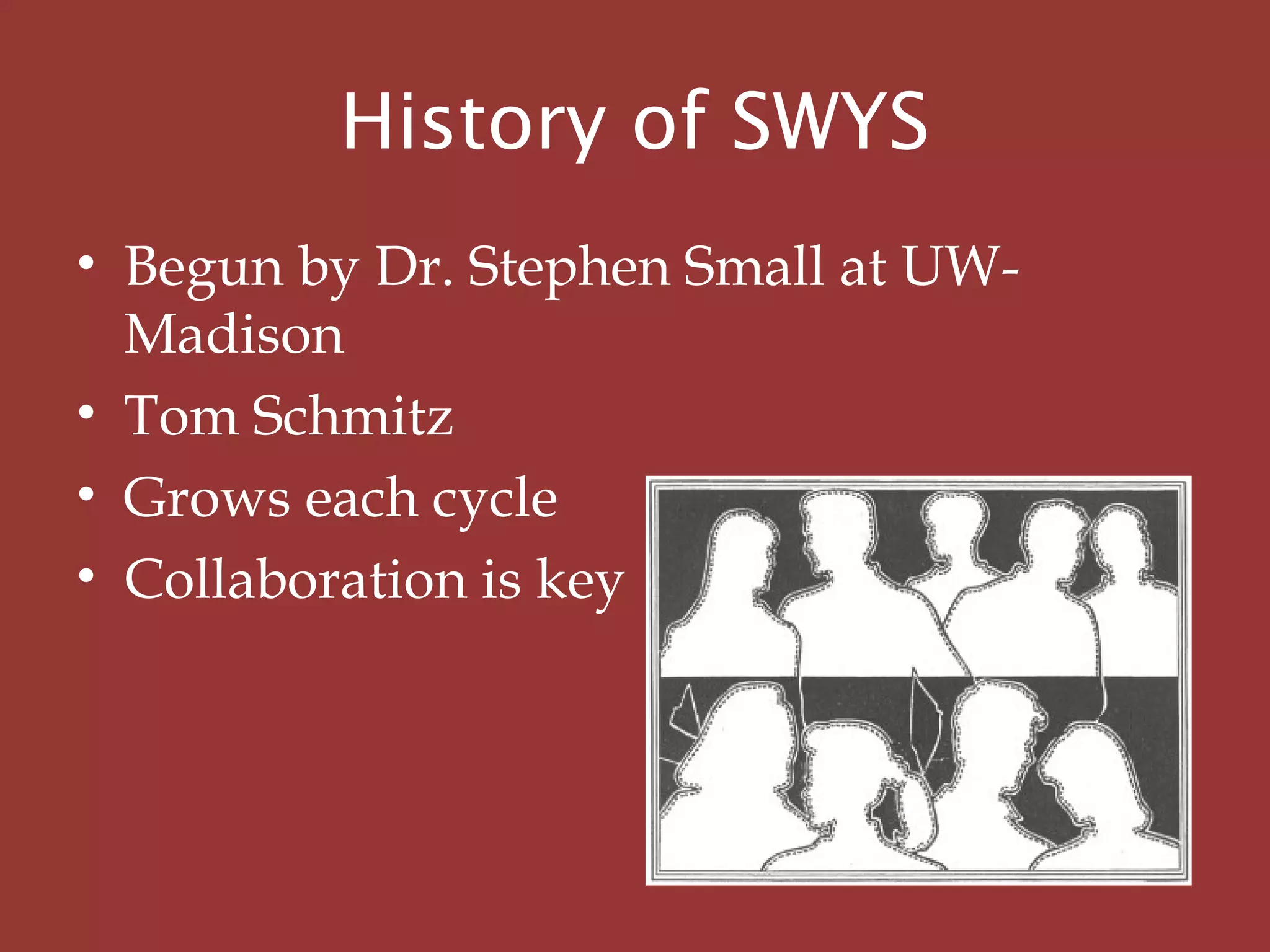
History of SWYS
• Begun by Dr. Stephen Small at UW-
Madison
• Tom Schmitz
• Grows each cycle
• Collaboration is key
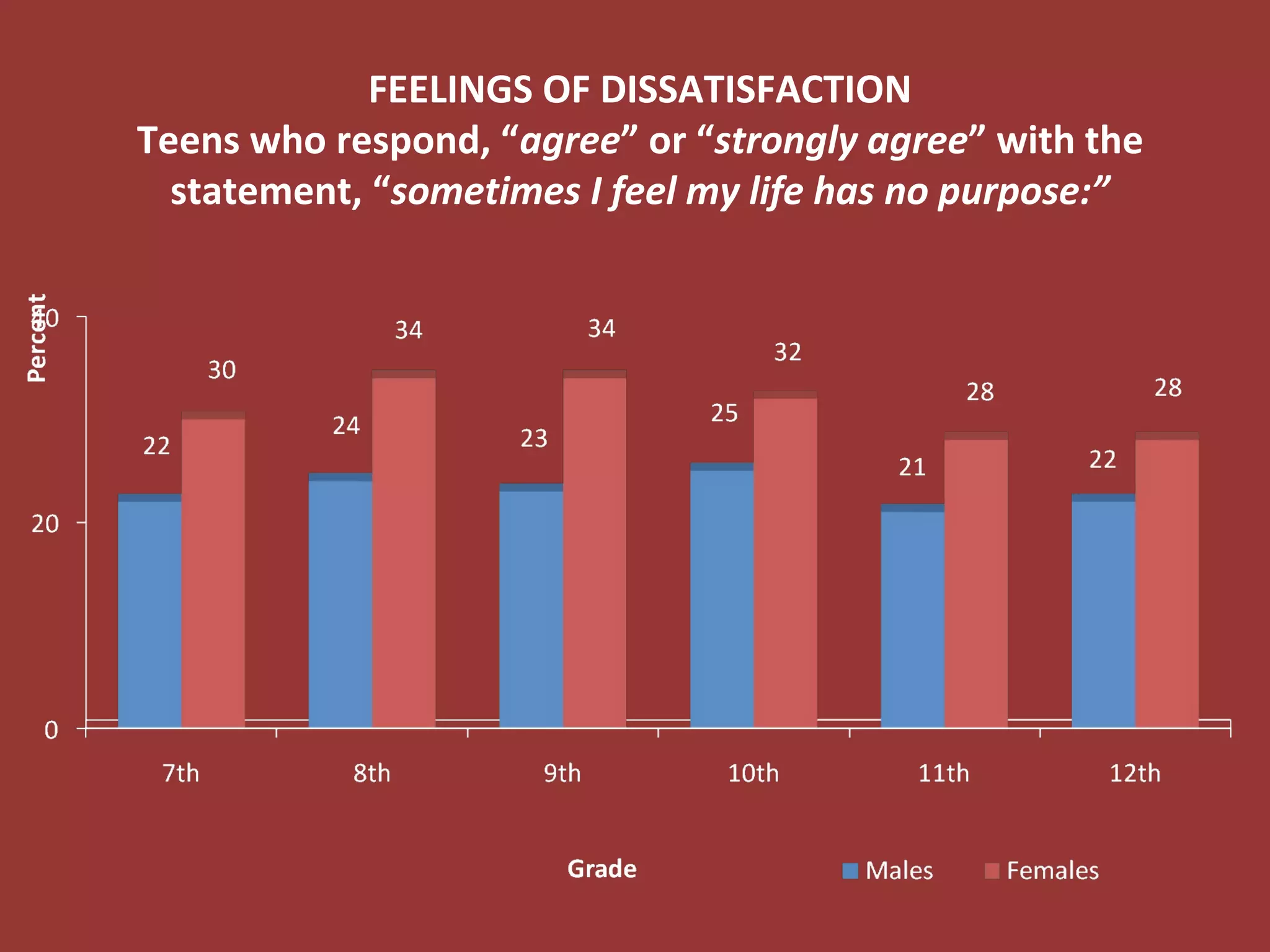
FEELINGS OF DISSATISFACTION
Teens who respond, “agree” or “strongly agree” with the
statement, “sometimes I feel my life has no purpose:”
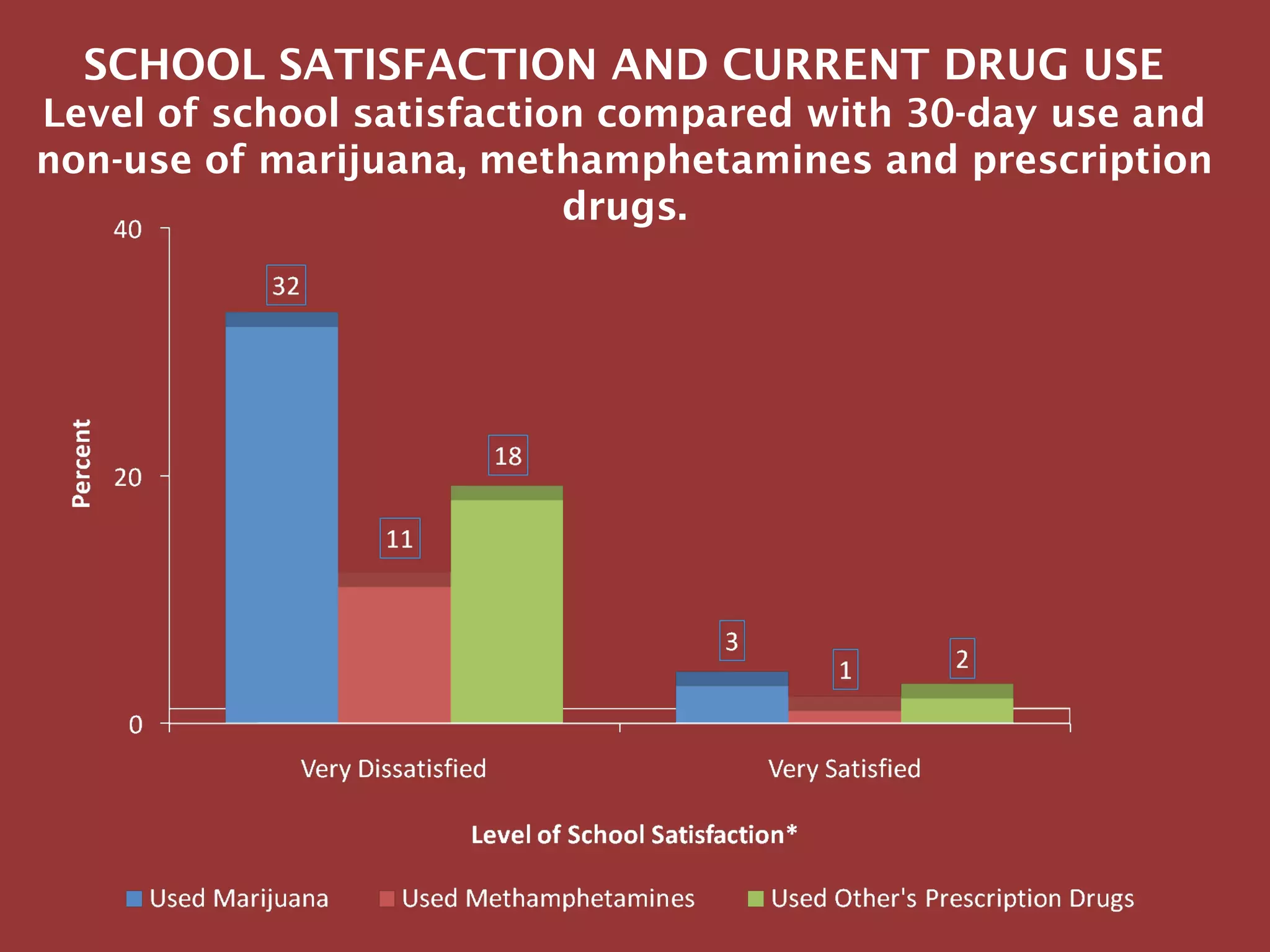
SCHOOL SATISFACTION AND CURRENT DRUG USE
Level of school satisfaction compared with 30-day use and
non-use of marijuana, methamphetamines and prescription
drugs.
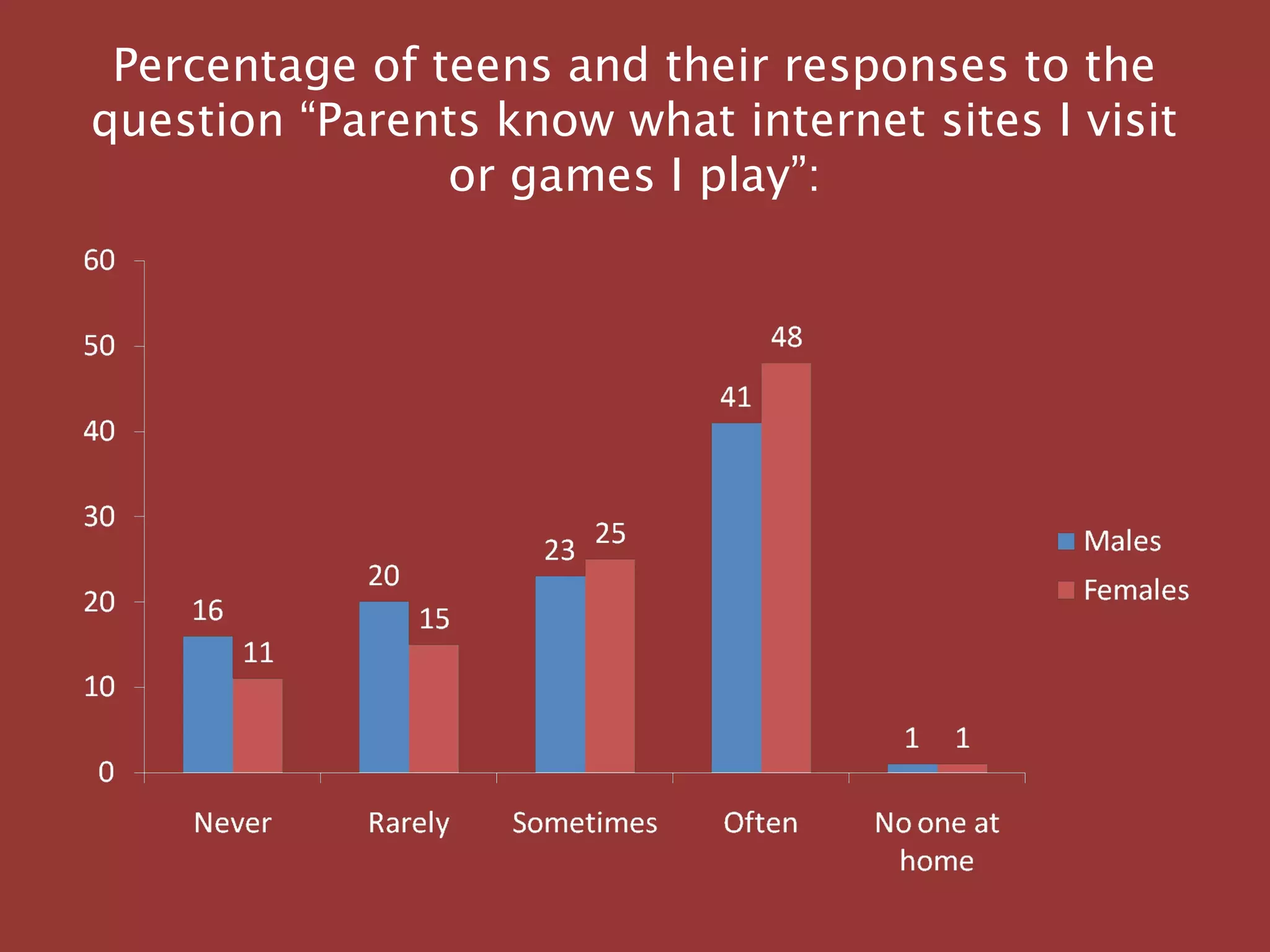
Percentage of teens and their responses to the
question “Parents know what internet sites I visit
or games I play”:
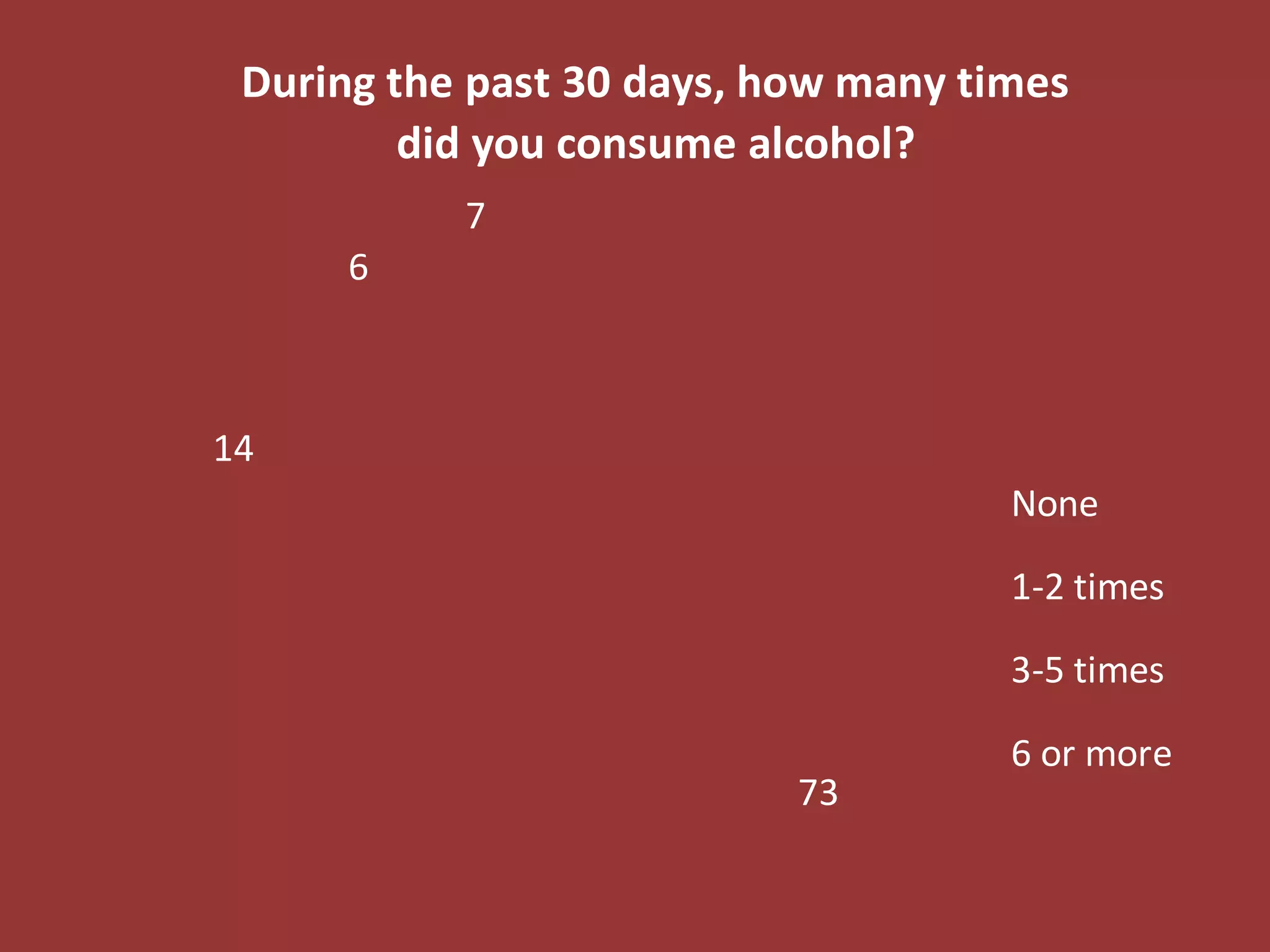
During the past 30 days, how many times
did you consume alcohol?
73
14
6
7
None
1-2 times
3-5 times
6 or more
So, what do we do if didn’t do a
survey in our county?
• Wisconsin Youth Risk Behavior Survey
(YRBS)
• Department of Public Instruction (DPI)
• Applied Population Lab (APL)
• Wisstat
• Any other ideas?
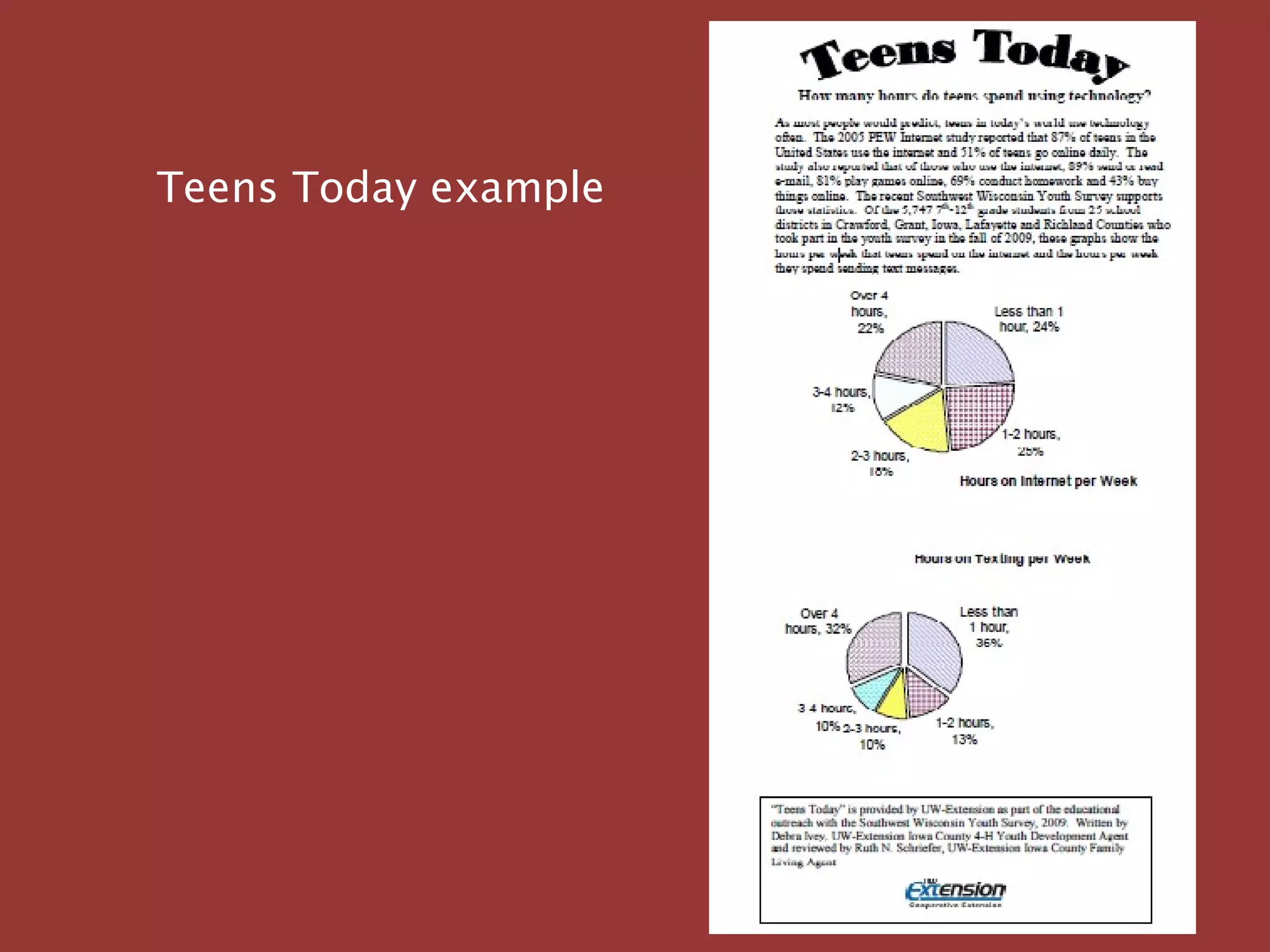
What do you do with the data?
• Teens Today
–Short “snippets” of information,
highlighting some of the data
–Teens Today were sent to local
media (newspaper, magazine,
radio, and put on website)
Teens Today example
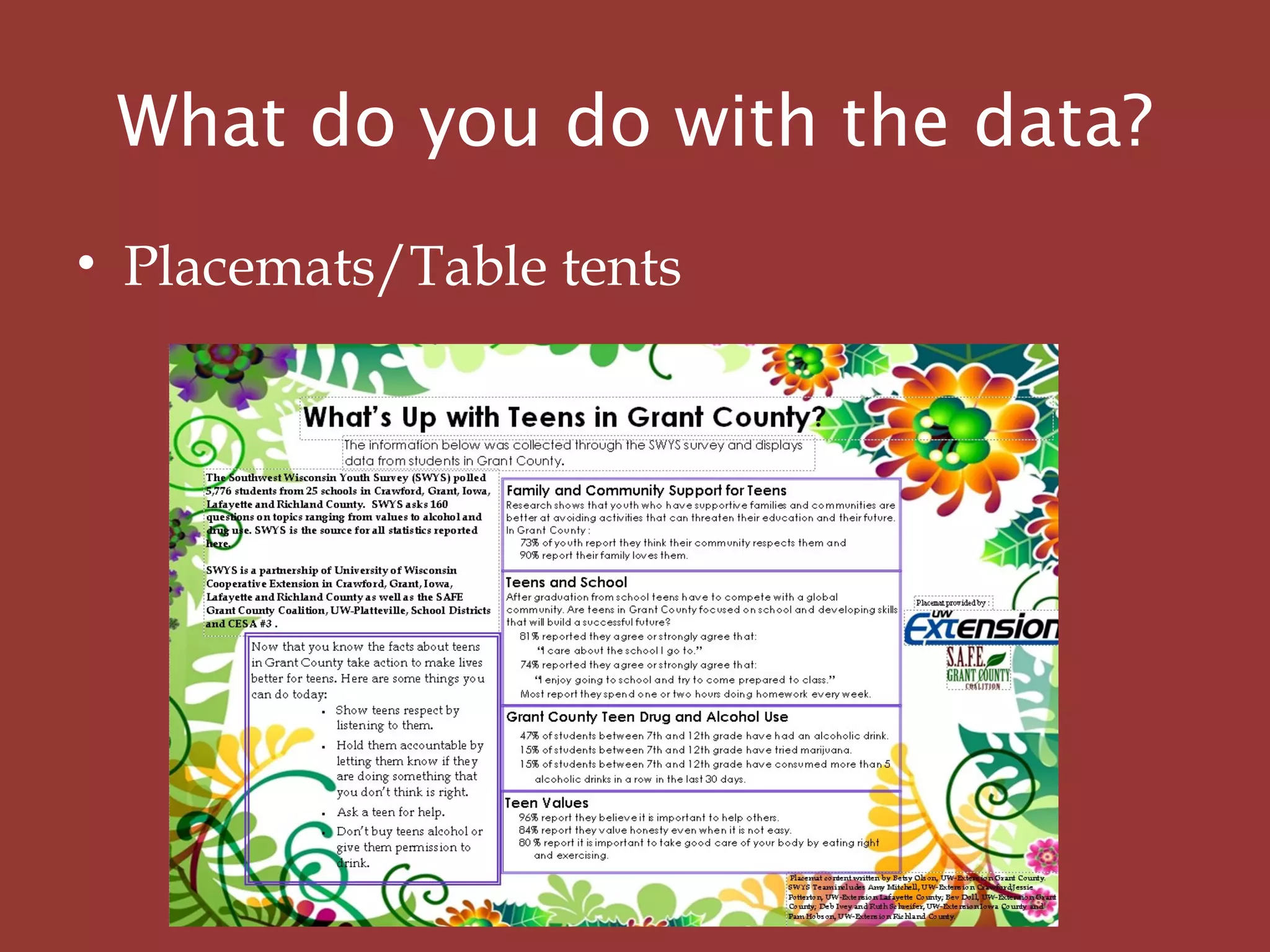
What do you do with the data?
• Placemats/Table tents
What do you do with the data?
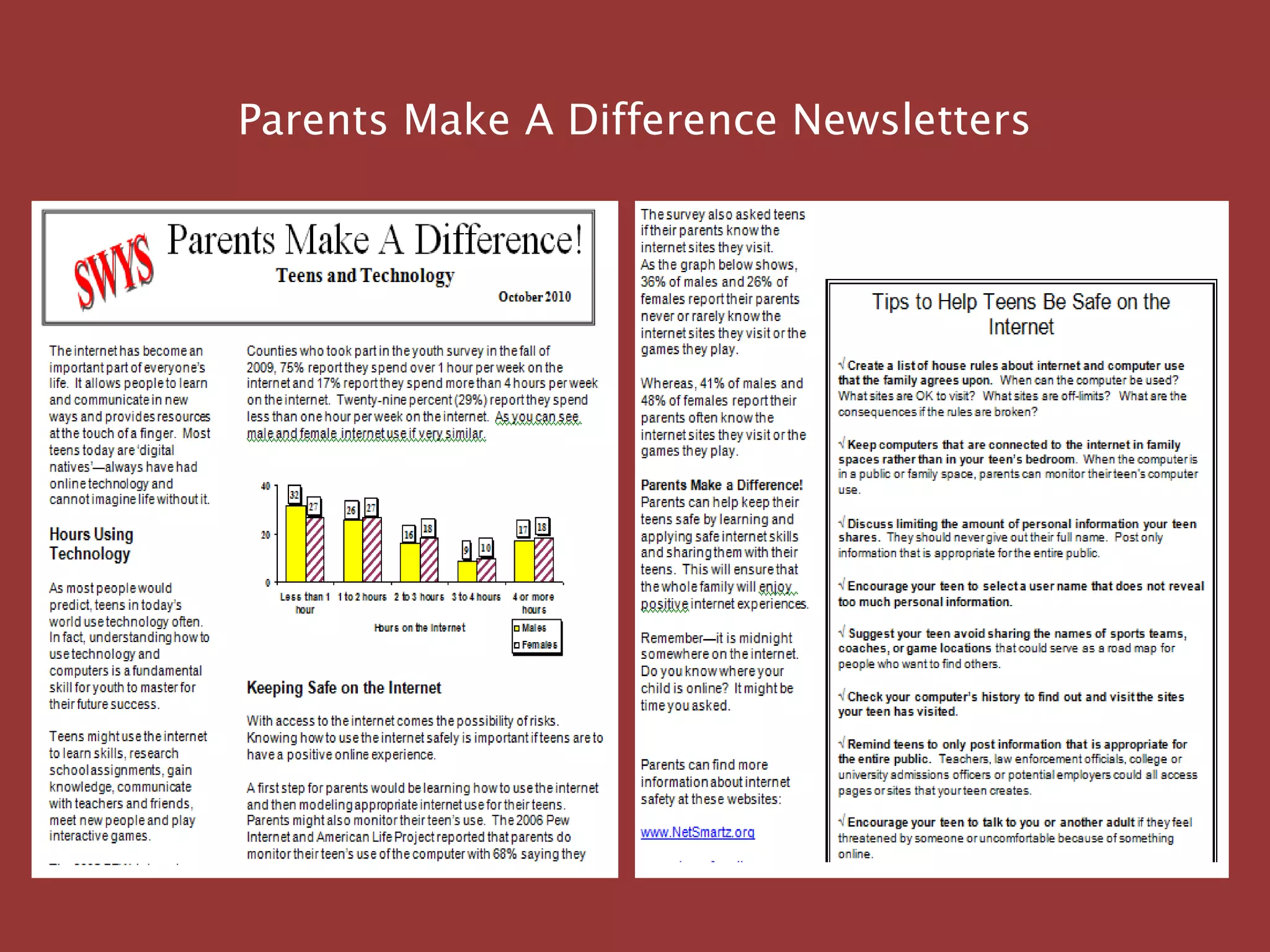
• “Parents Make A Difference” Newsletter
– Monthly newsletter submitted to schools to be
included in school newsletter, added to school
websites, etc.
– Most popular product of SWYS
– Topics will receive at least one, if not two,
newsletters (technology = tech and
cyberbullying)
Parents Make A Difference Newsletters
What do you do with the data?
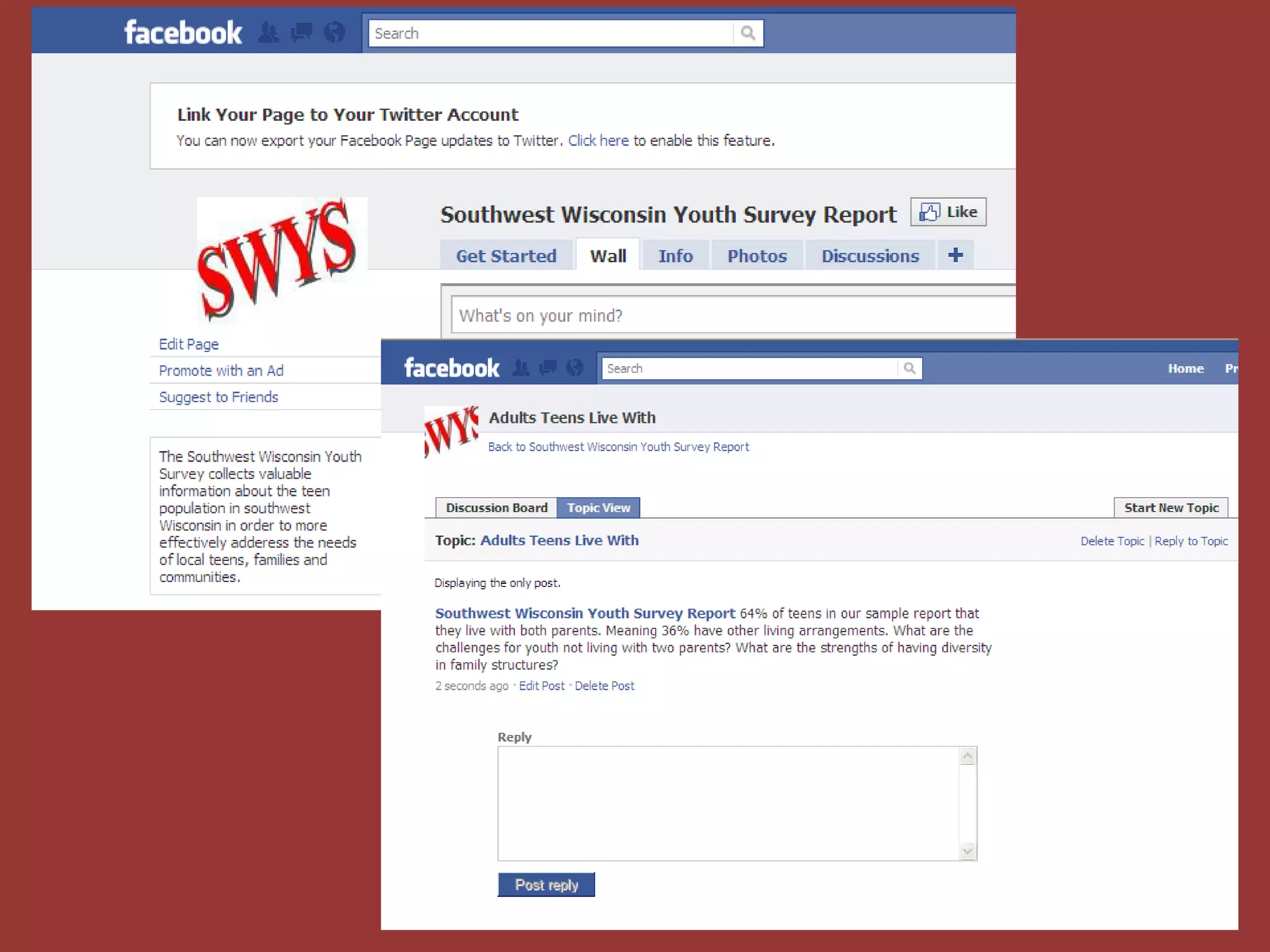
• Website
– Houses all information from current and past
SWYS surveys
– www.uwex.edu/ces/cty/grant/tap/index.htm
• News Articles (radio, paper)
What do you do with the data?
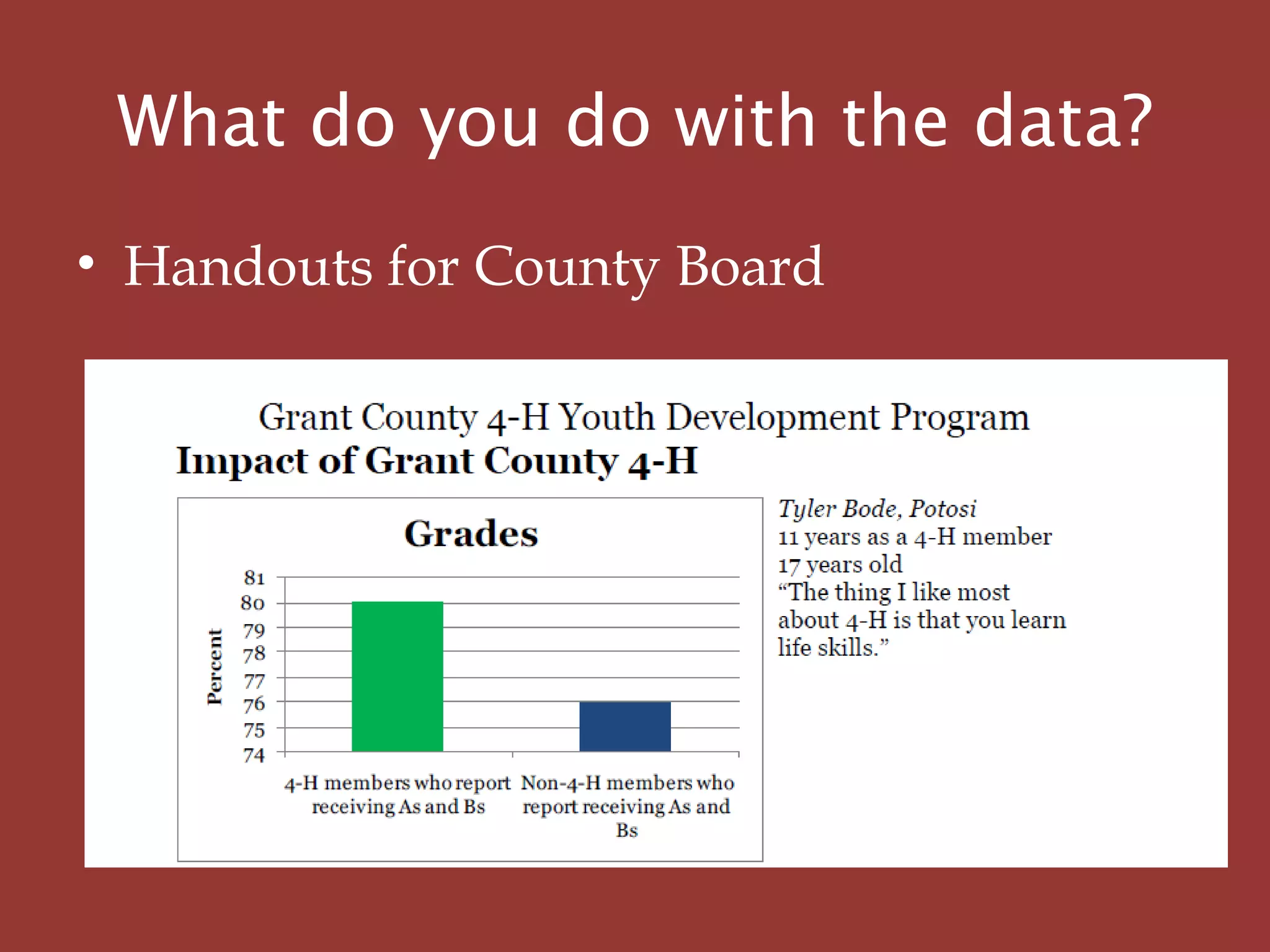
• Handouts for County Board
What do you do with the data?
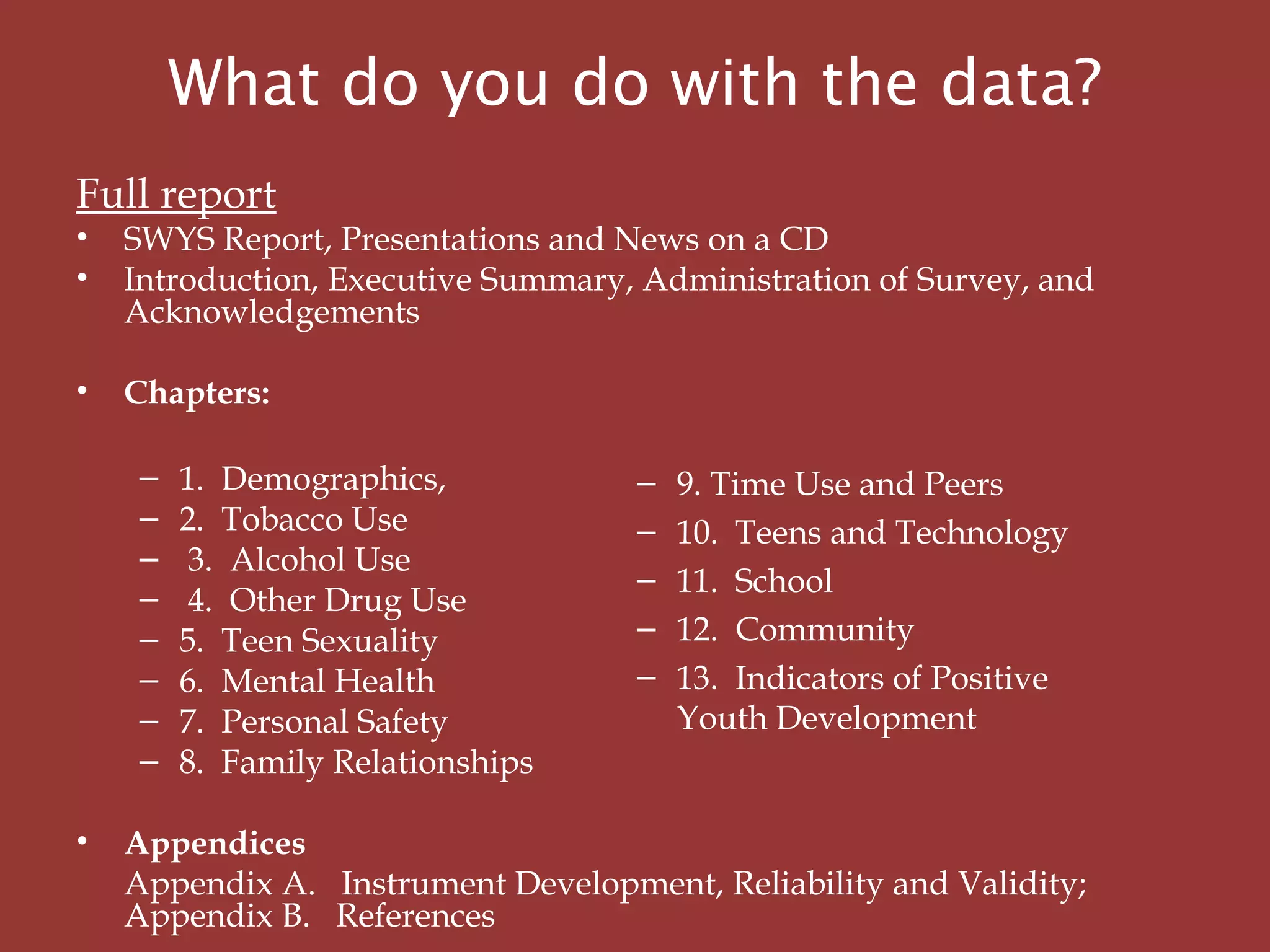
Full report
• SWYS Report, Presentations and News on a CD
• Introduction, Executive Summary, Administration of Survey, and
Acknowledgements
 
• Chapters:
– 1. Demographics,
– 2. Tobacco Use
– 3. Alcohol Use
– 4. Other Drug Use
– 5. Teen Sexuality
– 6. Mental Health
– 7. Personal Safety
– 8. Family Relationships
  
• Appendices
  Appendix A. Instrument Development, Reliability and Validity;
Appendix B. References
– 9. Time Use and Peers
– 10. Teens and Technology
– 11. School
– 12. Community
– 13. Indicators of Positive
Youth Development
What do you do with the data?
• Presentations
– School—classes, teachers, school board, school
counselors
– Foster Grandparents
– School Administration
– CESA
– County Board
– Special Interest groups
– CARE/Tobacco Free Council
– Prevent Suicide Groups
– Human Services/Social Services
– Sheriff’s Department
– Parent School Groups (PTA, PEP)
What do you do with the data?
• What other ways can you think of
presenting this type of information?
What audiences have we reached?
• Parent groups
• Community Partners
• Teachers/staff
• Students
• County Board
• School Board
• County Departments
Presentation Challenges
• Confidentiality of schools
• Promoting the opportunity of presenting
• Creativity of new presentation
• Keeping audience engaged
• Promoting opportunities to take action
• Data can get “stale” (4 years)
• Sifting through data to find impactful
information (smoking in 1999 vs. 2009)
Challenges with the survey
• Collaborating across five counties (don’t take
this on yourself!)
• Confidentiality of schools
• Validity/Reliability
• Cost for schools
• Compiling/tabulating results
• Administration of survey (during hours)
• Active vs. passive consent
• Institution Review Board Approval
• Distribution of reports
Questions?
• Betsy Olson, Grant County 4-H Youth
Development Agent
– betsy.olson@ces.uwex.edu
• Jessie Potterton, Lafayette County 4-H
Youth Development Educator
– jessica.potterton@ces.uwex.edu

Dynamic Data: Communicating Survey Results in Ways that Reach Diverse Audiences

  • 1.
    Dynamic Data: Communicated Resultsin Ways that Reach Diverse Audiences Betsy Olson Jessie Potterton
  • 2.
    What is SWYS? TheSouthwest Youth Survey (SWYS) was created to gain valuable information about the teen population in order to more efficiently address the needs of local teens, families and communities. Specifically the surveys attempt to address the needs of youth by providing reliable information on a few key questions: – What are the most serious problems faced by teens in the area? – How widespread are the problems? – Are there any clues as to the causes and possible solutions for the problems? – What can we do to help?
  • 3.
    History 1989 1 county 1,440 students 6 schools 1county 2,423 students 8 schools 1993 1 county 2,835 students 7 schools 1997 3 counties 5,704 students 19 schools 2001 4 counties 3, 828 students 15 schools 2005 5 counties 5,776 students 25 schools 2009
  • 4.
    History of SWYS •Begun by Dr. Stephen Small at UW- Madison • Tom Schmitz • Grows each cycle • Collaboration is key
  • 5.
    FEELINGS OF DISSATISFACTION Teenswho respond, “agree” or “strongly agree” with the statement, “sometimes I feel my life has no purpose:”
  • 6.
    SCHOOL SATISFACTION ANDCURRENT DRUG USE Level of school satisfaction compared with 30-day use and non-use of marijuana, methamphetamines and prescription drugs.
  • 7.
    Percentage of teensand their responses to the question “Parents know what internet sites I visit or games I play”:
  • 8.
    During the past30 days, how many times did you consume alcohol? 73 14 6 7 None 1-2 times 3-5 times 6 or more
  • 9.
    So, what dowe do if didn’t do a survey in our county? • Wisconsin Youth Risk Behavior Survey (YRBS) • Department of Public Instruction (DPI) • Applied Population Lab (APL) • Wisstat • Any other ideas?
  • 10.
    What do youdo with the data? • Teens Today –Short “snippets” of information, highlighting some of the data –Teens Today were sent to local media (newspaper, magazine, radio, and put on website)
  • 11.
  • 12.
    What do youdo with the data? • Placemats/Table tents
  • 13.
    What do youdo with the data? • “Parents Make A Difference” Newsletter – Monthly newsletter submitted to schools to be included in school newsletter, added to school websites, etc. – Most popular product of SWYS – Topics will receive at least one, if not two, newsletters (technology = tech and cyberbullying)
  • 14.
    Parents Make ADifference Newsletters
  • 15.
    What do youdo with the data? • Website – Houses all information from current and past SWYS surveys – www.uwex.edu/ces/cty/grant/tap/index.htm
  • 16.
    • News Articles(radio, paper) What do you do with the data?
  • 18.
    What do youdo with the data? • Handouts for County Board
  • 19.
    What do youdo with the data? Full report • SWYS Report, Presentations and News on a CD • Introduction, Executive Summary, Administration of Survey, and Acknowledgements   • Chapters: – 1. Demographics, – 2. Tobacco Use – 3. Alcohol Use – 4. Other Drug Use – 5. Teen Sexuality – 6. Mental Health – 7. Personal Safety – 8. Family Relationships    • Appendices   Appendix A. Instrument Development, Reliability and Validity; Appendix B. References – 9. Time Use and Peers – 10. Teens and Technology – 11. School – 12. Community – 13. Indicators of Positive Youth Development
  • 20.
    What do youdo with the data? • Presentations – School—classes, teachers, school board, school counselors – Foster Grandparents – School Administration – CESA – County Board – Special Interest groups – CARE/Tobacco Free Council – Prevent Suicide Groups – Human Services/Social Services – Sheriff’s Department – Parent School Groups (PTA, PEP)
  • 21.
    What do youdo with the data? • What other ways can you think of presenting this type of information?
  • 22.
    What audiences havewe reached? • Parent groups • Community Partners • Teachers/staff • Students • County Board • School Board • County Departments
  • 23.
    Presentation Challenges • Confidentialityof schools • Promoting the opportunity of presenting • Creativity of new presentation • Keeping audience engaged • Promoting opportunities to take action • Data can get “stale” (4 years) • Sifting through data to find impactful information (smoking in 1999 vs. 2009)
  • 24.
    Challenges with thesurvey • Collaborating across five counties (don’t take this on yourself!) • Confidentiality of schools • Validity/Reliability • Cost for schools • Compiling/tabulating results • Administration of survey (during hours) • Active vs. passive consent • Institution Review Board Approval • Distribution of reports
  • 25.
    Questions? • Betsy Olson,Grant County 4-H Youth Development Agent – betsy.olson@ces.uwex.edu • Jessie Potterton, Lafayette County 4-H Youth Development Educator – jessica.potterton@ces.uwex.edu

Editor's Notes

  • #3 Jessie
  • #5 UW-Extension in Grant County has been cooperating with local schools to assess student needs, concerns, behaviors and attitudes every four years since 1989. The 1989, 1993 and 1997 Teen Assessment Project (TAP) surveys were conducted under the direction of Dr. Stephen Small at the UW-Madison. TAP in Southwestern Wisconsin polled 1,440 students in 1989. In 2009 we polled over 5,700 students covering 5 counties. Collecting, interpreting, distributing and presenting this data takes a team. The work of seven people makes this project possible.
  • #6 Jessie
  • #11 Jessie
  • #14 Jessie
  • #16 Betsy
  • #21 Jessie