DXer REPORT Satellite DXer Mike Kohl, USA 
Mike‘s 
Antenna Tower 
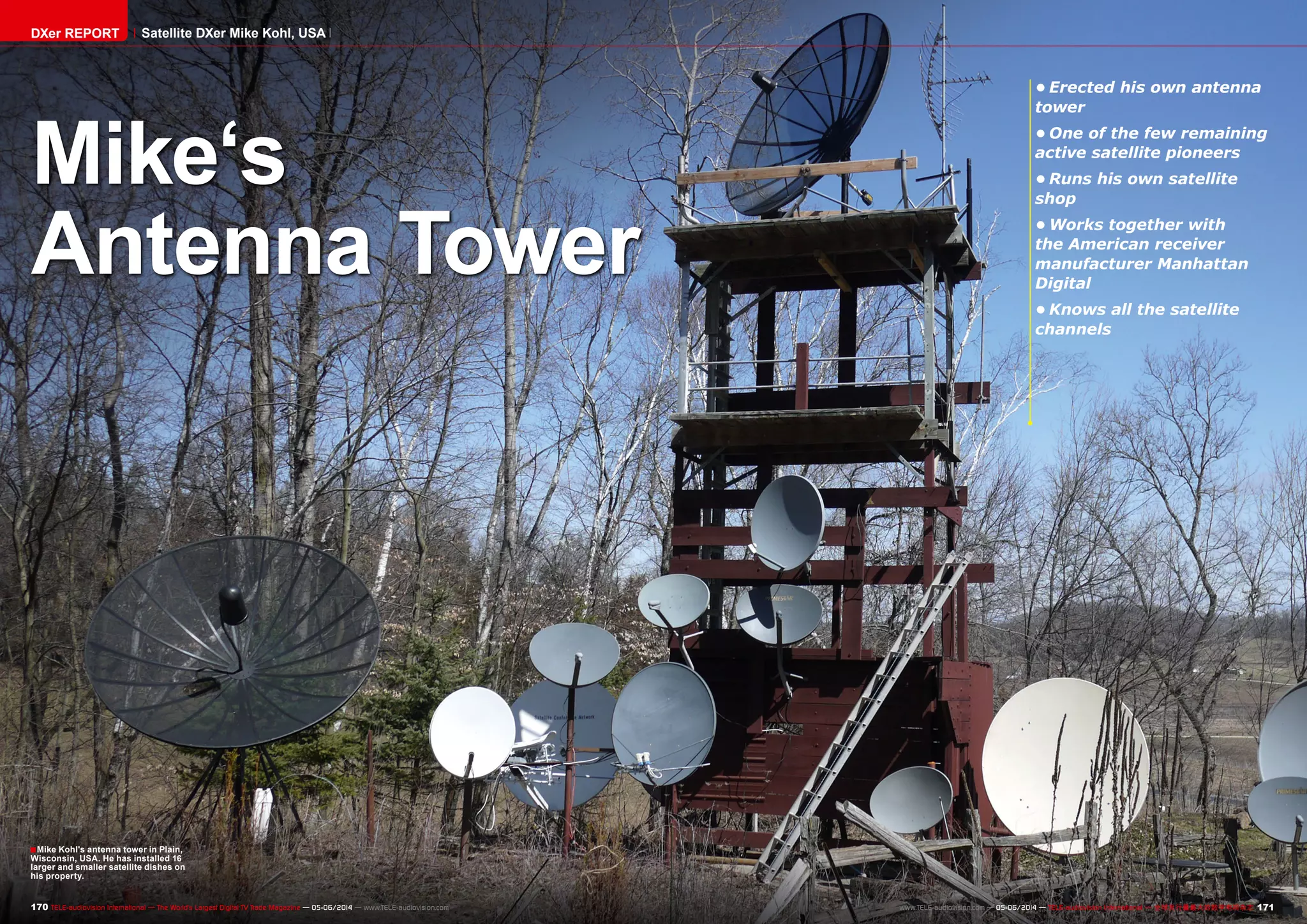
■Mike Kohl's antenna tower in Plain, 
Wisconsin, USA. He has installed 16 
larger and smaller satellite dishes on 
his property. 
• Erected his own antenna 
tower 
• One of the few remaining 
active satellite pioneers 
• Runs his own satellite 
shop 
• Works together with 
the American receiver 
manufacturer Manhattan 
Digital 
• Knows all the satellite 
channels 
170 TELE-audiovision International — The World‘s Largest Digital TV Trade Magazine — 05-06/2014 — www.TELE-audiovision.com www.TELE-audiovision.com — 05-06/2014 — TELE-audiovision International — 全球发行量最大的数字电视杂志171
DXer REPORT Satellite DXer Mike Kohl, USA 
Homemade 8m (26-foot) 
Antenna Tower 
Mike Kohl‘s dream has come true; 
many antenna lovers dream about hav-ing 
could mount their antennas. His prop-erty 
a reality: it‘s a wooded hill in the fertile 
landscape of Wisconsin. All of the lo-cal 
America‘s Dairyland. West of Wisconsin‘s 
capitol of Madison in the small town of 
Plain and directly on the main road is the 
hill that goes steeply up. The tower is at 
the top of the hill and greets visitors with 
his many satellite dishes. 
Mike Kohl explains to us how his tower 
came about: „When I bought this prop-erty 
they are now.“ He had two choices: chop 
down trees or erect a tower that would 
reach above the trees. Mike opted for the 
■ 
ëPlain, Madison, 
Wisconsin 
their very own tower on which they 
is large enough to make this dream 
license plates identify Wisconsin as 
in 1993 the trees were not as tall as 
latter choice: „In 2002 my 
neighbor helped me build my 
tower out of two old telephone 
poles.“ Mike set up three plat-forms. 
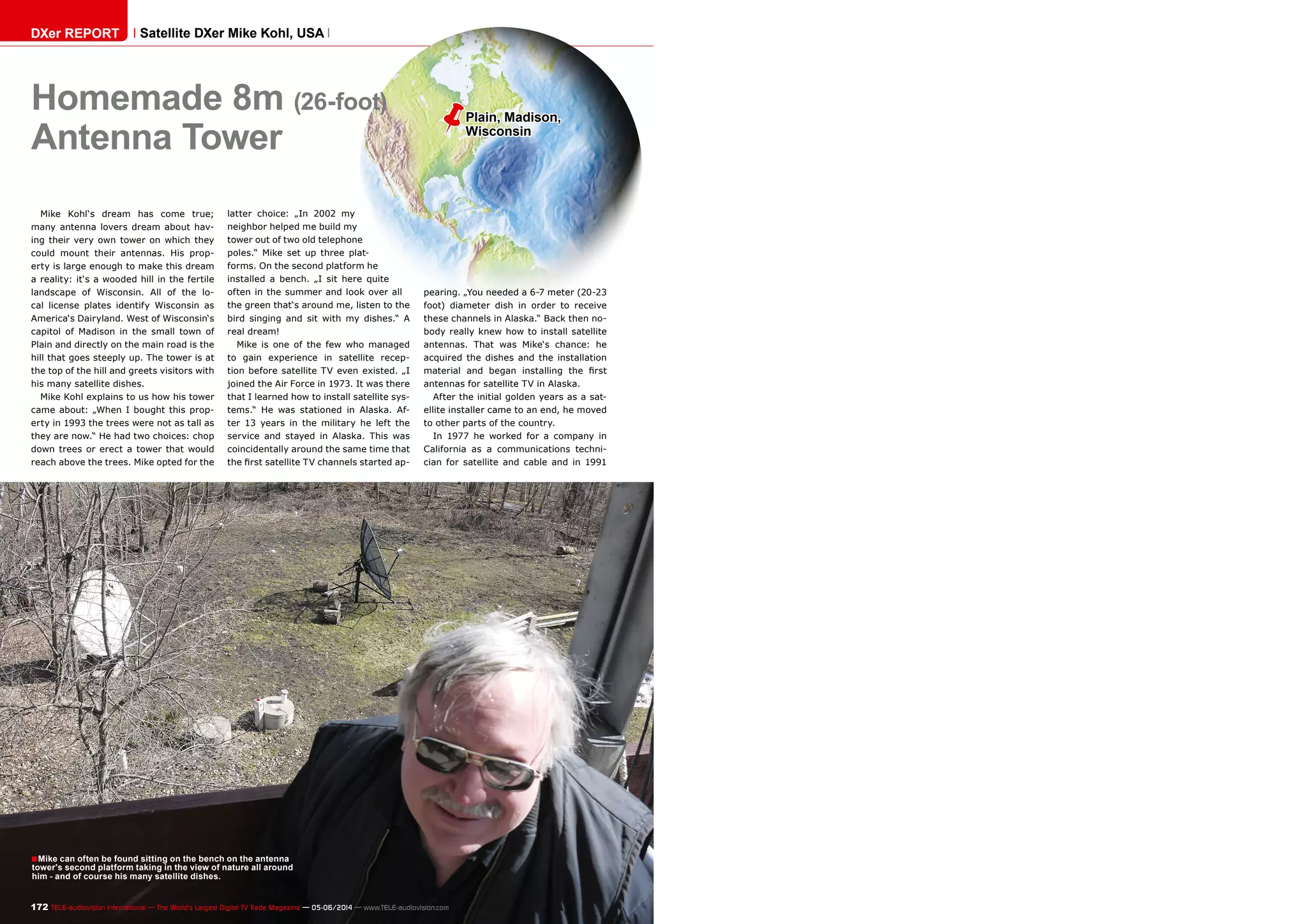
On the second platform he 
installed a bench. „I sit here quite 
often in the summer and look over all 
the green that‘s around me, listen to the 
bird singing and sit with my dishes.“ A 
real dream! 
Mike is one of the few who managed 
to gain experience in satellite recep-tion 
before satellite TV even existed. „I 
joined the Air Force in 1973. It was there 
that I learned how to install satellite sys-tems.“ 
He was stationed in Alaska. Af-ter 
13 years in the military he left the 
service and stayed in Alaska. This was 
coincidentally around the same time that 
the first satellite TV channels started ap- 
Mike can often be found sitting on the bench on the antenna 
tower's second platform taking in the view of nature all around 
him - and of course his many satellite dishes. 
pearing. „You needed a 6-7 meter (20-23 
foot) diameter dish in order to receive 
these channels in Alaska.“ Back then no-body 
172 TELE-audiovision International — The World‘s Largest Digital TV Trade Magazine — 05-06/2014 — www.TELE-audiovision.com 
really knew how to install satellite 
antennas. That was Mike‘s chance: he 
acquired the dishes and the installation 
material and began installing the first 
antennas for satellite TV in Alaska. 
After the initial golden years as a sat-ellite 
installer came to an end, he moved 
to other parts of the country. 
In 1977 he worked for a company in 
California as a communications techni-cian 
for satellite and cable and in 1991
1 
2 
3 
4 
5 
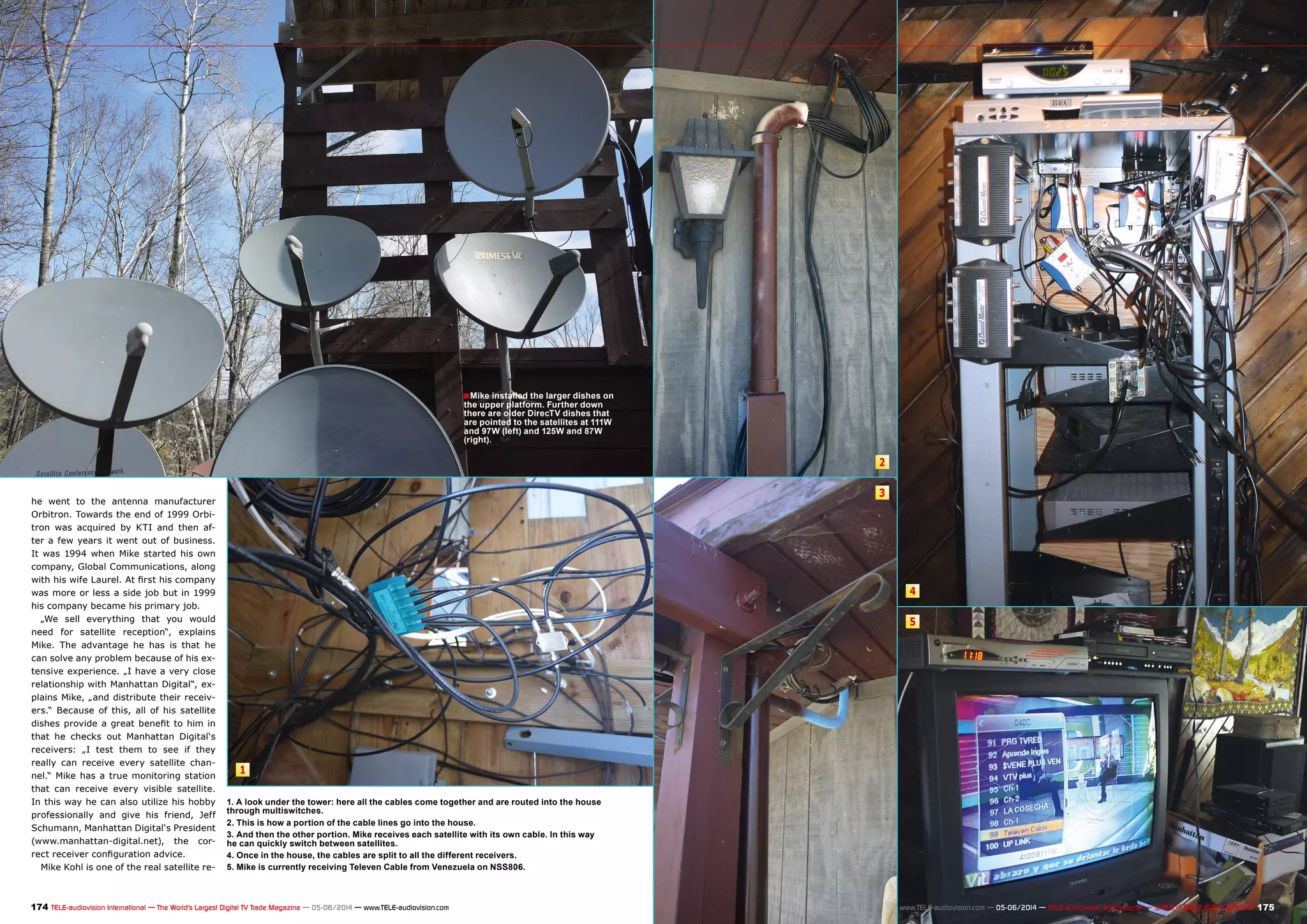
■Mike installed the larger dishes on 
the upper platform. Further down 
there are older DirecTV dishes that 
are pointed to the satellites at 111W 
and 97W (left) and 125W and 87W 
(right). 
1. A look under the tower: here all the cables come together and are routed into the house 
through multiswitches. 
2. This is how a portion of the cable lines go into the house. 
3. And then the other portion. Mike receives each satellite with its own cable. In this way 
he can quickly switch between satellites. 
4. Once in the house, the cables are split to all the different receivers. 
5. Mike is currently receiving Televen Cable from Venezuela on NSS806. 
he went to the antenna manufacturer 
Orbitron. Towards the end of 1999 Orbi-tron 
was acquired by KTI and then af-ter 
a few years it went out of business. 
It was 1994 when Mike started his own 
company, Global Communications, along 
with his wife Laurel. At first his company 
was more or less a side job but in 1999 
his company became his primary job. 
„We sell everything that you would 
need for satellite reception“, explains 
Mike. The advantage he has is that he 
can solve any problem because of his ex-tensive 
experience. „I have a very close 
relationship with Manhattan Digital“, ex-plains 
Mike, „and distribute their receiv-ers.“ 
Because of this, all of his satellite 
dishes provide a great benefit to him in 
that he checks out Manhattan Digital‘s 
receivers: „I test them to see if they 
really can receive every satellite chan-nel.“ 
Mike has a true monitoring station 
that can receive every visible satellite. 
In this way he can also utilize his hobby 
professionally and give his friend, Jeff 
Schumann, Manhattan Digital‘s President 
(www.manhattan-digital.net), the cor-rect 
receiver configuration advice. 
Mike Kohl is one of the real satellite re- 
174 TELE-audiovision International — The World‘s Largest Digital TV Trade Magazine — 05-06/2014 — www.TELE-audiovision.com www.TELE-audiovision.com — 05-06/2014 — TELE-audiovision International — 全球发行量最大的数字电视杂志175
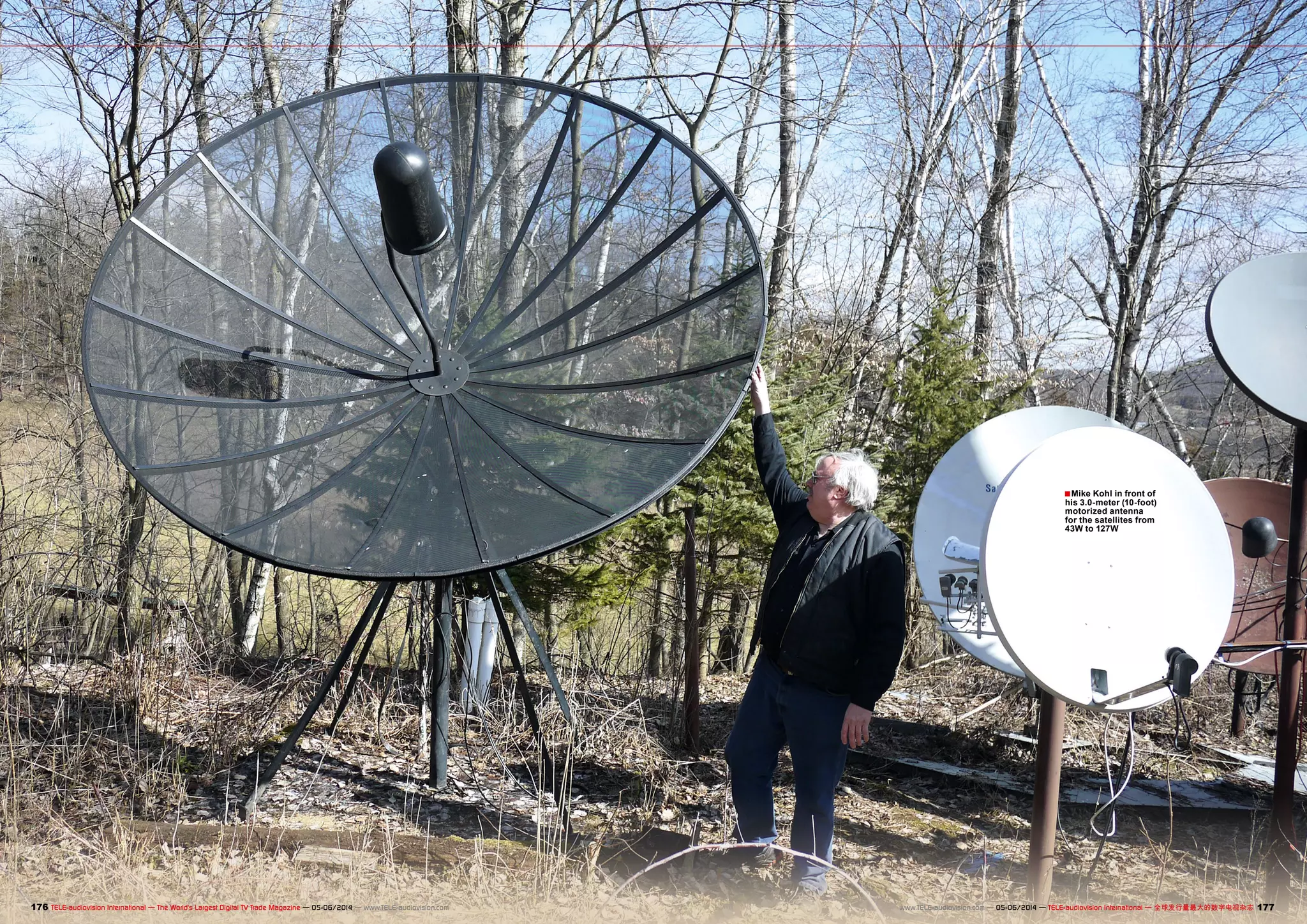
■Mike Kohl in front of 
his 3.0-meter (10-foot) 
motorized antenna 
for the satellites from 
43W to 127W 
176 TELE-audiovision International — The World‘s Largest Digital TV Trade Magazine — 05-06/2014 — www.TELE-audiovision.com www.TELE-audiovision.com — 05-06/2014 — TELE-audiovision International — 全球发行量最大的数字电视杂志177
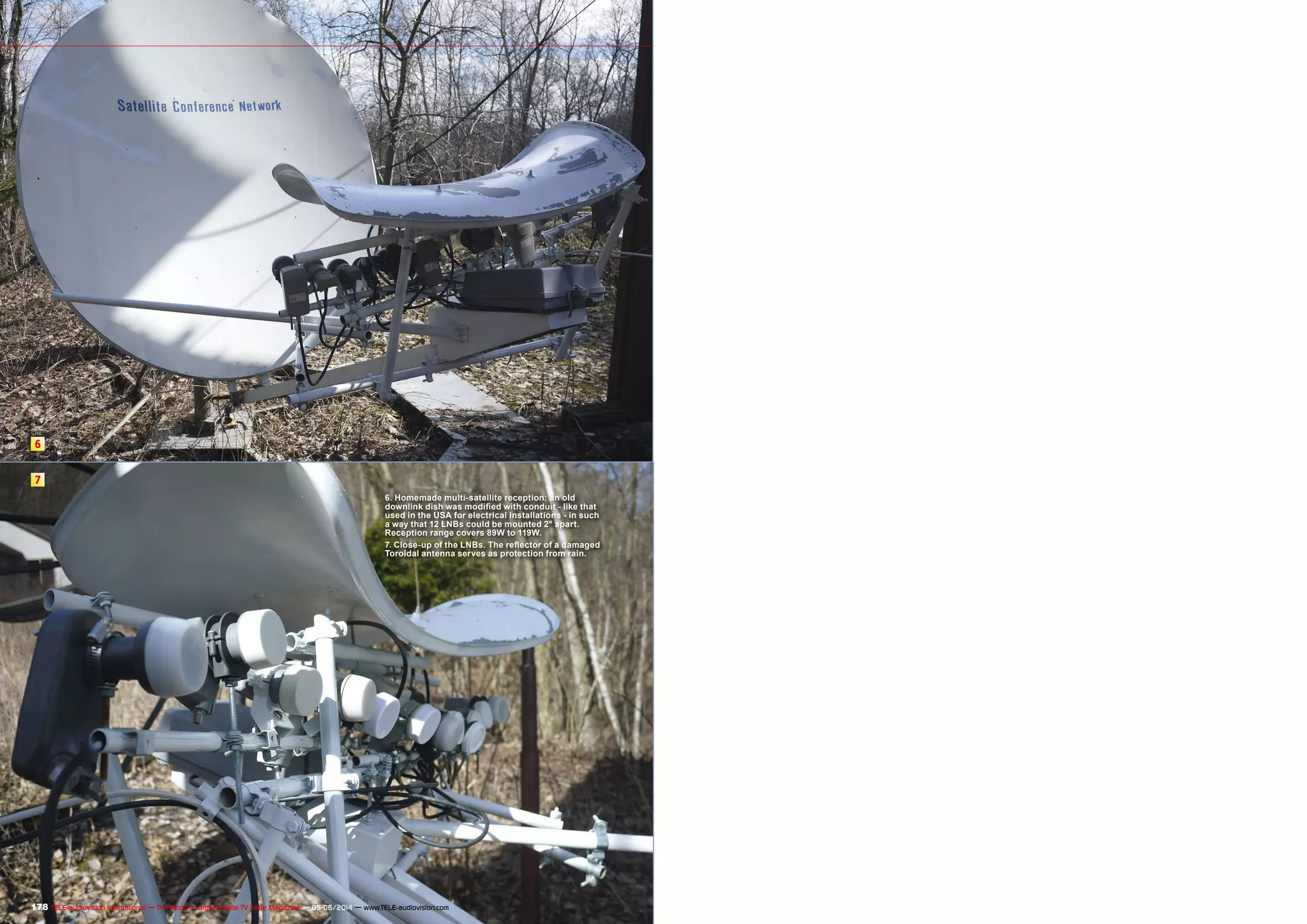
6 
7 
6. Homemade multi-satellite reception: an old 
downlink dish was modified with conduit - like that 
used in the USA for electrical installations - in such 
a way that 12 LNBs could be mounted 2° apart. 
Reception range covers 89W to 119W. 
7. Close-up of the LNBs. The reflector of a damaged 
Toroidal antenna serves as protection from rain. 
178 TELE-audiovision International — The World‘s Largest Digital TV Trade Magazine — 05-06/2014 — www.TELE-audiovision.com
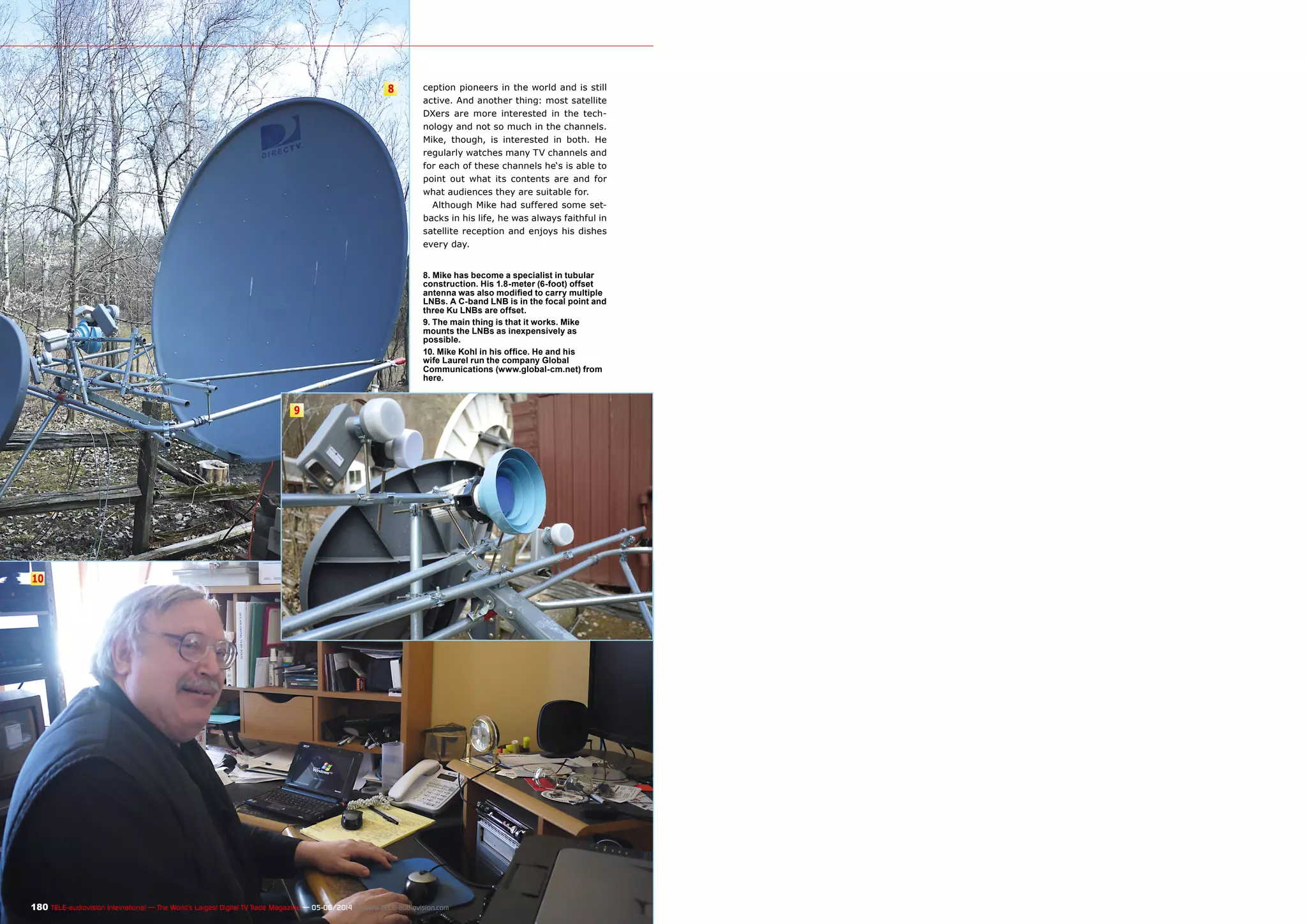
8 
9 
10 
ception pioneers in the world and is still 
active. And another thing: most satellite 
DXers are more interested in the tech-nology 
180 TELE-audiovision International — The World‘s Largest Digital TV Trade Magazine — 05-06/2014 — www.TELE-audiovision.com 
and not so much in the channels. 
Mike, though, is interested in both. He 
regularly watches many TV channels and 
for each of these channels he‘s is able to 
point out what its contents are and for 
what audiences they are suitable for. 
Although Mike had suffered some set-backs 
in his life, he was always faithful in 
satellite reception and enjoys his dishes 
every day. 
8. Mike has become a specialist in tubular 
construction. His 1.8-meter (6-foot) offset 
antenna was also modified to carry multiple 
LNBs. A C-band LNB is in the focal point and 
three Ku LNBs are offset. 
9. The main thing is that it works. Mike 
mounts the LNBs as inexpensively as 
possible. 
10. Mike Kohl in his office. He and his 
wife Laurel run the company Global 
Communications (www.global-cm.net) from 
here.

Dxer mikekohl

  • 1.
    DXer REPORT SatelliteDXer Mike Kohl, USA Mike‘s Antenna Tower ■Mike Kohl's antenna tower in Plain, Wisconsin, USA. He has installed 16 larger and smaller satellite dishes on his property. • Erected his own antenna tower • One of the few remaining active satellite pioneers • Runs his own satellite shop • Works together with the American receiver manufacturer Manhattan Digital • Knows all the satellite channels 170 TELE-audiovision International — The World‘s Largest Digital TV Trade Magazine — 05-06/2014 — www.TELE-audiovision.com www.TELE-audiovision.com — 05-06/2014 — TELE-audiovision International — 全球发行量最大的数字电视杂志171
  • 2.
    DXer REPORT SatelliteDXer Mike Kohl, USA Homemade 8m (26-foot) Antenna Tower Mike Kohl‘s dream has come true; many antenna lovers dream about hav-ing could mount their antennas. His prop-erty a reality: it‘s a wooded hill in the fertile landscape of Wisconsin. All of the lo-cal America‘s Dairyland. West of Wisconsin‘s capitol of Madison in the small town of Plain and directly on the main road is the hill that goes steeply up. The tower is at the top of the hill and greets visitors with his many satellite dishes. Mike Kohl explains to us how his tower came about: „When I bought this prop-erty they are now.“ He had two choices: chop down trees or erect a tower that would reach above the trees. Mike opted for the ■ ëPlain, Madison, Wisconsin their very own tower on which they is large enough to make this dream license plates identify Wisconsin as in 1993 the trees were not as tall as latter choice: „In 2002 my neighbor helped me build my tower out of two old telephone poles.“ Mike set up three plat-forms. On the second platform he installed a bench. „I sit here quite often in the summer and look over all the green that‘s around me, listen to the bird singing and sit with my dishes.“ A real dream! Mike is one of the few who managed to gain experience in satellite recep-tion before satellite TV even existed. „I joined the Air Force in 1973. It was there that I learned how to install satellite sys-tems.“ He was stationed in Alaska. Af-ter 13 years in the military he left the service and stayed in Alaska. This was coincidentally around the same time that the first satellite TV channels started ap- Mike can often be found sitting on the bench on the antenna tower's second platform taking in the view of nature all around him - and of course his many satellite dishes. pearing. „You needed a 6-7 meter (20-23 foot) diameter dish in order to receive these channels in Alaska.“ Back then no-body 172 TELE-audiovision International — The World‘s Largest Digital TV Trade Magazine — 05-06/2014 — www.TELE-audiovision.com really knew how to install satellite antennas. That was Mike‘s chance: he acquired the dishes and the installation material and began installing the first antennas for satellite TV in Alaska. After the initial golden years as a sat-ellite installer came to an end, he moved to other parts of the country. In 1977 he worked for a company in California as a communications techni-cian for satellite and cable and in 1991
  • 3.
    1 2 3 4 5 ■Mike installed the larger dishes on the upper platform. Further down there are older DirecTV dishes that are pointed to the satellites at 111W and 97W (left) and 125W and 87W (right). 1. A look under the tower: here all the cables come together and are routed into the house through multiswitches. 2. This is how a portion of the cable lines go into the house. 3. And then the other portion. Mike receives each satellite with its own cable. In this way he can quickly switch between satellites. 4. Once in the house, the cables are split to all the different receivers. 5. Mike is currently receiving Televen Cable from Venezuela on NSS806. he went to the antenna manufacturer Orbitron. Towards the end of 1999 Orbi-tron was acquired by KTI and then af-ter a few years it went out of business. It was 1994 when Mike started his own company, Global Communications, along with his wife Laurel. At first his company was more or less a side job but in 1999 his company became his primary job. „We sell everything that you would need for satellite reception“, explains Mike. The advantage he has is that he can solve any problem because of his ex-tensive experience. „I have a very close relationship with Manhattan Digital“, ex-plains Mike, „and distribute their receiv-ers.“ Because of this, all of his satellite dishes provide a great benefit to him in that he checks out Manhattan Digital‘s receivers: „I test them to see if they really can receive every satellite chan-nel.“ Mike has a true monitoring station that can receive every visible satellite. In this way he can also utilize his hobby professionally and give his friend, Jeff Schumann, Manhattan Digital‘s President (www.manhattan-digital.net), the cor-rect receiver configuration advice. Mike Kohl is one of the real satellite re- 174 TELE-audiovision International — The World‘s Largest Digital TV Trade Magazine — 05-06/2014 — www.TELE-audiovision.com www.TELE-audiovision.com — 05-06/2014 — TELE-audiovision International — 全球发行量最大的数字电视杂志175
  • 4.
    ■Mike Kohl infront of his 3.0-meter (10-foot) motorized antenna for the satellites from 43W to 127W 176 TELE-audiovision International — The World‘s Largest Digital TV Trade Magazine — 05-06/2014 — www.TELE-audiovision.com www.TELE-audiovision.com — 05-06/2014 — TELE-audiovision International — 全球发行量最大的数字电视杂志177
  • 5.
    6 7 6.Homemade multi-satellite reception: an old downlink dish was modified with conduit - like that used in the USA for electrical installations - in such a way that 12 LNBs could be mounted 2° apart. Reception range covers 89W to 119W. 7. Close-up of the LNBs. The reflector of a damaged Toroidal antenna serves as protection from rain. 178 TELE-audiovision International — The World‘s Largest Digital TV Trade Magazine — 05-06/2014 — www.TELE-audiovision.com
  • 6.
    8 9 10 ception pioneers in the world and is still active. And another thing: most satellite DXers are more interested in the tech-nology 180 TELE-audiovision International — The World‘s Largest Digital TV Trade Magazine — 05-06/2014 — www.TELE-audiovision.com and not so much in the channels. Mike, though, is interested in both. He regularly watches many TV channels and for each of these channels he‘s is able to point out what its contents are and for what audiences they are suitable for. Although Mike had suffered some set-backs in his life, he was always faithful in satellite reception and enjoys his dishes every day. 8. Mike has become a specialist in tubular construction. His 1.8-meter (6-foot) offset antenna was also modified to carry multiple LNBs. A C-band LNB is in the focal point and three Ku LNBs are offset. 9. The main thing is that it works. Mike mounts the LNBs as inexpensively as possible. 10. Mike Kohl in his office. He and his wife Laurel run the company Global Communications (www.global-cm.net) from here.