Watermanagement in the Netherlands Past, Present and Future Ruud Staverman   Rijkswaterstaat
 
The Netherlands: Population:  16 million inhabitants Area: 41.526 km2
The Netherlands: Population:  16 million inhabitants  Area: 41.526 km2  = US States Vermont + New Hampshire (1.8 million)
7000 Bc 5500 Bc
 
Precipitation and evapotranspiration
The Netherlands:  a Delta of 4  international rivers
Past:  A constant fight against the water Amsterdam Haarlem St Elisabeth flood of 1421 Alblasserwaard
Reclamation in the 17 th  Century  Drainage by windmills
Several floods
Landreclamation in the 20th century
Storm disaster of February 1 st , 1953
Flooded area in 1953,  1800 casualties FLOODED
The Deltaworks
Maeslantkering
Present:  the Vulnerability for flooding
 
the “(pair of) scissors”:  Subsidence  and  Sea level rise   Past  Present,  Future
Will this be the future? Dike Increase of water discharge Water level compared  to the surface level Soil subsidence = Zero level
Present and future : Urban development, the need for housing
What  future  to anticipate on? Sea level rise: 2050: + 0.4 m 2100: + 0.65 -  1.30 m 2200: + 2 -  4 m
Climate change (1): Seawater expands + ice melts: sealevel rises Period of heavy rainfall: damage Rivers discharge more water in the winter period Result: Increase risks of flooding
Climate change (2) Extreme droughts in summer: damage in agriculture, low waters: inland navigation, and additional soil subsidence Salt intrusion from the sea: Problems with intake of drinking water Damage for agriculture and industries Higher temperature of riverwater: Cooling problems for power plants
Future  River discharges: Summer: 1700 m 3 /s     700 m 3 /s in 2100 Winter: 16.000 m 3 /s     18.000 m 3 /s in 2100
R3294  E000418n Room for the Rhine branches
The high waters of 1993 and 1995 lead to the implementation of Delta (major rivers) plan
Future: We stay in the (floodprone) part of the Netherlands,  Solidarity among inhabitants and generations Work with natural processes “building with nature” Your solutions: Rivers? N orth Sea coast? IJsselmeer area?
 
? Rivers ?
Rivers:  De-poldering Building houses on raised platforms /mounds along the dike Overdiepse polder
Rivers:  Dike relocation Hondsbroekse Pleij
Rivers ‘ Room for the River’ Land aquisition on strategic locations International catchmentwise cooperation
A Deltaplan for the large rivers 39 Measures, until 2015
? N orth Sea coast   ?
North Sea Coast:  Nourishment works,  Follow the  sealevel rise  strandsuppletie onderwater suppletie
North Sea Coast:  Building with Nature, use sand from the Sea
? IJsselmeer area   ?
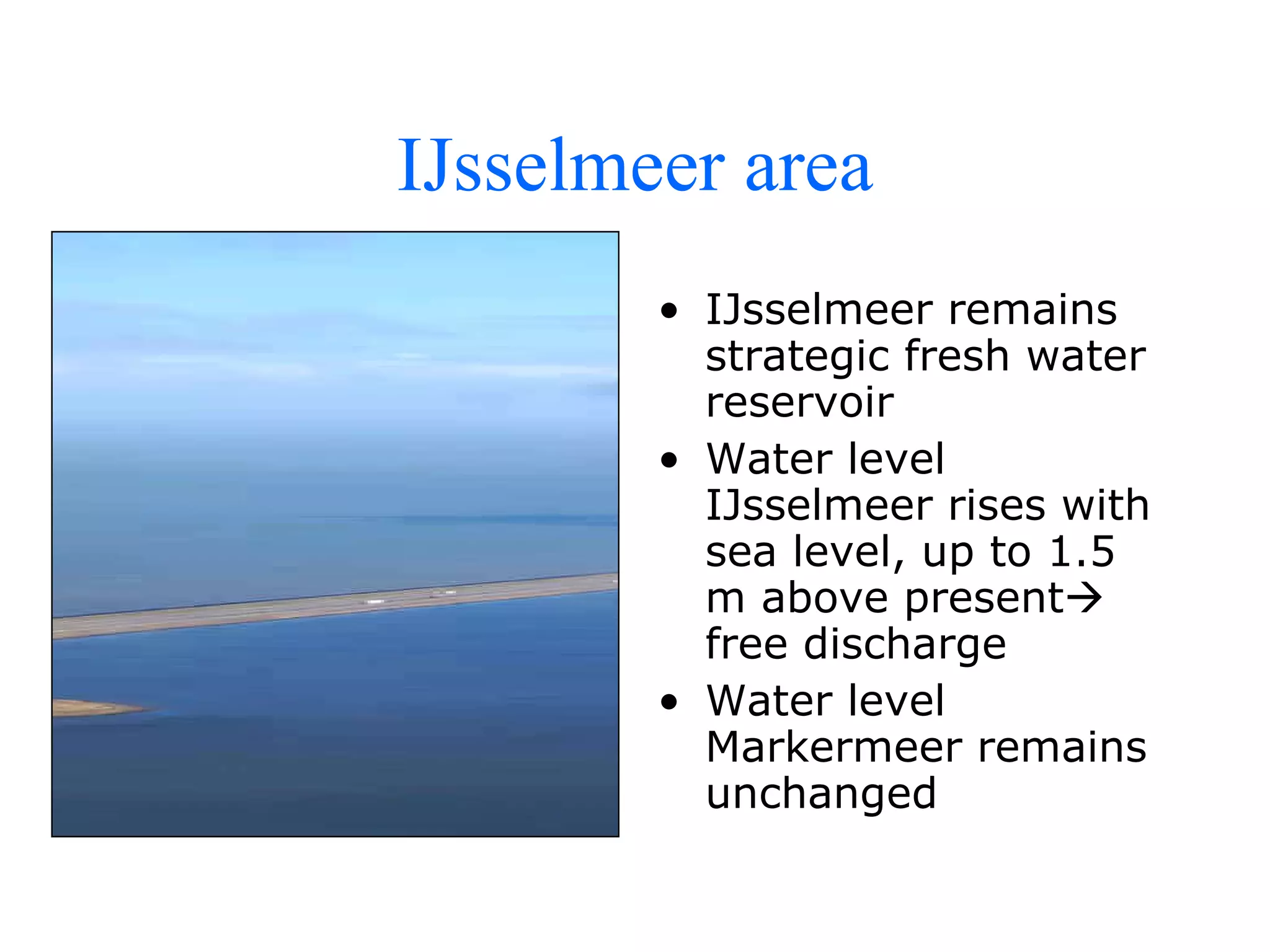
IJsselmeer area IJsselmeer remains strategic fresh water reservoir  Water level IJsselmeer rises with sea level, up to 1.5 m above present   free discharge Water level Markermeer remains unchanged
Costs: < 2050:  1,2 tot 1,6 billion euro /yr 2050 – 2100: 0,9 tot 1,5 billion euro /yr Beach nourishment for coastal land reclamation: 0.1 – 0.3 billion euro/yr
The End Thank you for your attention

Dutch Government Water Management

  • 1.
    Watermanagement in theNetherlands Past, Present and Future Ruud Staverman Rijkswaterstaat
  • 2.
  • 3.
    The Netherlands: Population: 16 million inhabitants Area: 41.526 km2
  • 4.
    The Netherlands: Population: 16 million inhabitants Area: 41.526 km2 = US States Vermont + New Hampshire (1.8 million)
  • 5.
  • 6.
  • 7.
  • 8.
    The Netherlands: a Delta of 4 international rivers
  • 9.
    Past: Aconstant fight against the water Amsterdam Haarlem St Elisabeth flood of 1421 Alblasserwaard
  • 10.
    Reclamation in the17 th Century Drainage by windmills
  • 11.
  • 12.
  • 13.
    Storm disaster ofFebruary 1 st , 1953
  • 14.
    Flooded area in1953, 1800 casualties FLOODED
  • 15.
  • 16.
  • 17.
    Present: theVulnerability for flooding
  • 18.
  • 19.
    the “(pair of)scissors”: Subsidence and Sea level rise Past Present, Future
  • 20.
    Will this bethe future? Dike Increase of water discharge Water level compared to the surface level Soil subsidence = Zero level
  • 21.
    Present and future: Urban development, the need for housing
  • 22.
    What future to anticipate on? Sea level rise: 2050: + 0.4 m 2100: + 0.65 - 1.30 m 2200: + 2 - 4 m
  • 23.
    Climate change (1):Seawater expands + ice melts: sealevel rises Period of heavy rainfall: damage Rivers discharge more water in the winter period Result: Increase risks of flooding
  • 24.
    Climate change (2)Extreme droughts in summer: damage in agriculture, low waters: inland navigation, and additional soil subsidence Salt intrusion from the sea: Problems with intake of drinking water Damage for agriculture and industries Higher temperature of riverwater: Cooling problems for power plants
  • 25.
    Future Riverdischarges: Summer: 1700 m 3 /s  700 m 3 /s in 2100 Winter: 16.000 m 3 /s  18.000 m 3 /s in 2100
  • 26.
    R3294 E000418nRoom for the Rhine branches
  • 27.
    The high watersof 1993 and 1995 lead to the implementation of Delta (major rivers) plan
  • 28.
    Future: We stayin the (floodprone) part of the Netherlands, Solidarity among inhabitants and generations Work with natural processes “building with nature” Your solutions: Rivers? N orth Sea coast? IJsselmeer area?
  • 29.
  • 30.
  • 31.
    Rivers: De-polderingBuilding houses on raised platforms /mounds along the dike Overdiepse polder
  • 32.
    Rivers: Dikerelocation Hondsbroekse Pleij
  • 33.
    Rivers ‘ Roomfor the River’ Land aquisition on strategic locations International catchmentwise cooperation
  • 34.
    A Deltaplan forthe large rivers 39 Measures, until 2015
  • 35.
    ? N orthSea coast ?
  • 36.
    North Sea Coast: Nourishment works, Follow the sealevel rise strandsuppletie onderwater suppletie
  • 37.
    North Sea Coast: Building with Nature, use sand from the Sea
  • 38.
  • 39.
    IJsselmeer area IJsselmeerremains strategic fresh water reservoir Water level IJsselmeer rises with sea level, up to 1.5 m above present  free discharge Water level Markermeer remains unchanged
  • 40.
    Costs: < 2050: 1,2 tot 1,6 billion euro /yr 2050 – 2100: 0,9 tot 1,5 billion euro /yr Beach nourishment for coastal land reclamation: 0.1 – 0.3 billion euro/yr
  • 41.
    The End Thankyou for your attention

Editor's Notes

  • #27 A typical cross section of our rivers consists of a navigation channel with groins, mostly embanked by low (summer) dikes, a flood plain and the main dikes.  
  • #33 Finally some examples of measures.