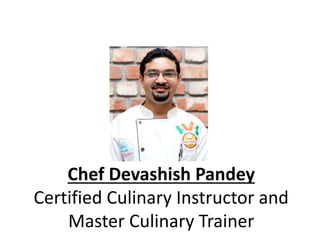
Chef Devashish Pandey
Certified Culinary Instructor and
Master Culinary Trainer
Dum cooking
Highlights
• Dum Biryani is a favourite, which is a one-pot
dish of aromatic spices
• The slow cooking works like magic to
beautifully infuse the flavours
• The ancient practice of dum cooking is
associated with Mughlai cuisine
Introduction
• Whenever the thought of biryani crosses the mind, a
word that is almost instantly linked with it is ‘dum’.
Dum Biryani is a favourite, which is a one-pot dish of
aromatic spices and delightful flavours - a result from
slow cooking the ingredients in a sealed, heavy
bottomed vessel for hours or even overnight in certain
cases. The slow cooking works like magic to beautifully
infuse the flavours from the various spices and herbs
and make the meat unbelievably tender. This style of
cooking, traditionally known as dum pukht, is of course
not just restricted to biryanis, but various other
preparations such as korma, nihari, haleem, raan, other
meat curries and even dal.
• The ancient practice of dum cooking is commonly associated
withMughlai cuisine and is often believed to have stemmed
from Persian cuisine or Central Asia. There are many stories
about its origin, but the most popular one links it to Nawab
Asaf-ud-Daulah, who was the wazir or ruler of Oudh/Awadh
during the late 1700s. In 1784, during the great famine, the
Nawab introduced a charitable initiative for his people with a
food-for-work programme. He wanted to construct a Moghul
architectural marvel - the Bara Imambara, which was one
among the many structures that the Nawab planned to build
in the city.Many people volunteered for the initiative, and to
feed the masses through day and night, the cooks employed
the method of dum pukht, wherein meat, vegetables, rice and
spices were put together in large vessels or handis, sealed
with dough and left to slow cook for hours. This system of
cooking proved to be the most convenient method to provide
meals to the large number of workers as well as make for
them a flavoursome meal without using excessive spices,
which were in short supply then.
How to Dum Cook
• Dum pukht can be translated as ‘dum’
meaning ‘breathe in’ and ‘pukht’ meaning ‘to
cook’. It basically refers to letting the dish
breathe in its own aroma or juices to make it
more flavourful. Therefore large handis are
sealed with dough or cloth to trap the steam,
which then cooks the meat or rice until
tender.
Recipes Dumphukht
• Chicken Dum Biryani
• Kashmiri Dum Aloo
• Guchchi Dum Pulao
• Hyderabadi Dum Murgh
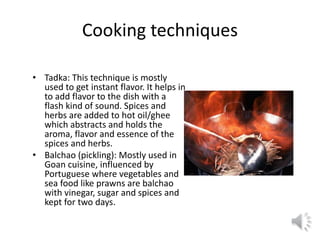
• Tadka: This technique is mostly
used to get instant flavor. It helps in
to add flavor to the dish with a
flash kind of sound. Spices and
herbs are added to hot oil/ghee
which abstracts and holds the
aroma, flavor and essence of the
spices and herbs.
• Balchao (pickling): Mostly used in
Goan cuisine, influenced by
Portuguese where vegetables and
sea food like prawns are balchao
with vinegar, sugar and spices and
kept for two days.
Cooking techniques
• Bhunao: Indian curry cooking. Oil is added to the pan with
some chopped onion and cumin seeds. Onions are all
browned desired herbs and spices are added. And small
quantity of water is added so that the ingredients don’t
stick to the pan. When oil start separating from the
mixture, that’s when you add your main ingredients like
meats and vegetables.
• Dhungar (smoke seasoning): It’s a very unique technique
which usually practiced in Rajasthan. Hot coal (charcoal) is
kept in a small katori and placed in the pot and on it hot
ghee is pored which gives you the flavor and smell of that
coal and a lid is quickly placed on the pot.
• Talna (frying): Frying is a process of cooking food in oil or
another fat, a method that was created in ancient Egypt
around 2500 BC. Frying is the fastest way to cook as it’s an
easiest way to transfer heat into the food with frying bot
deep and shallow.
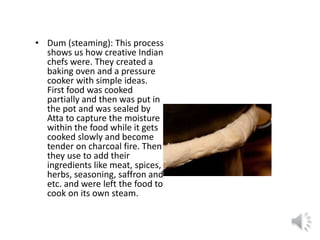
• Dum (steaming): This process
shows us how creative Indian
chefs were. They created a
baking oven and a pressure
cooker with simple ideas.
First food was cooked
partially and then was put in
the pot and was sealed by
Atta to capture the moisture
within the food while it gets
cooked slowly and become
tender on charcoal fire. Then
they use to add their
ingredients like meat, spices,
herbs, seasoning, saffron and
etc. and were left the food to
cook on its own steam.

Dum cooking

  • 1.
    Chef Devashish Pandey CertifiedCulinary Instructor and Master Culinary Trainer
  • 2.
  • 3.
    Highlights • Dum Biryaniis a favourite, which is a one-pot dish of aromatic spices • The slow cooking works like magic to beautifully infuse the flavours • The ancient practice of dum cooking is associated with Mughlai cuisine
  • 4.
    Introduction • Whenever thethought of biryani crosses the mind, a word that is almost instantly linked with it is ‘dum’. Dum Biryani is a favourite, which is a one-pot dish of aromatic spices and delightful flavours - a result from slow cooking the ingredients in a sealed, heavy bottomed vessel for hours or even overnight in certain cases. The slow cooking works like magic to beautifully infuse the flavours from the various spices and herbs and make the meat unbelievably tender. This style of cooking, traditionally known as dum pukht, is of course not just restricted to biryanis, but various other preparations such as korma, nihari, haleem, raan, other meat curries and even dal.
  • 5.
    • The ancientpractice of dum cooking is commonly associated withMughlai cuisine and is often believed to have stemmed from Persian cuisine or Central Asia. There are many stories about its origin, but the most popular one links it to Nawab Asaf-ud-Daulah, who was the wazir or ruler of Oudh/Awadh during the late 1700s. In 1784, during the great famine, the Nawab introduced a charitable initiative for his people with a food-for-work programme. He wanted to construct a Moghul architectural marvel - the Bara Imambara, which was one among the many structures that the Nawab planned to build in the city.Many people volunteered for the initiative, and to feed the masses through day and night, the cooks employed the method of dum pukht, wherein meat, vegetables, rice and spices were put together in large vessels or handis, sealed with dough and left to slow cook for hours. This system of cooking proved to be the most convenient method to provide meals to the large number of workers as well as make for them a flavoursome meal without using excessive spices, which were in short supply then.
  • 6.
    How to DumCook • Dum pukht can be translated as ‘dum’ meaning ‘breathe in’ and ‘pukht’ meaning ‘to cook’. It basically refers to letting the dish breathe in its own aroma or juices to make it more flavourful. Therefore large handis are sealed with dough or cloth to trap the steam, which then cooks the meat or rice until tender.
  • 7.
    Recipes Dumphukht • ChickenDum Biryani • Kashmiri Dum Aloo • Guchchi Dum Pulao • Hyderabadi Dum Murgh
  • 8.
    • Tadka: Thistechnique is mostly used to get instant flavor. It helps in to add flavor to the dish with a flash kind of sound. Spices and herbs are added to hot oil/ghee which abstracts and holds the aroma, flavor and essence of the spices and herbs. • Balchao (pickling): Mostly used in Goan cuisine, influenced by Portuguese where vegetables and sea food like prawns are balchao with vinegar, sugar and spices and kept for two days. Cooking techniques
  • 9.
    • Bhunao: Indiancurry cooking. Oil is added to the pan with some chopped onion and cumin seeds. Onions are all browned desired herbs and spices are added. And small quantity of water is added so that the ingredients don’t stick to the pan. When oil start separating from the mixture, that’s when you add your main ingredients like meats and vegetables. • Dhungar (smoke seasoning): It’s a very unique technique which usually practiced in Rajasthan. Hot coal (charcoal) is kept in a small katori and placed in the pot and on it hot ghee is pored which gives you the flavor and smell of that coal and a lid is quickly placed on the pot. • Talna (frying): Frying is a process of cooking food in oil or another fat, a method that was created in ancient Egypt around 2500 BC. Frying is the fastest way to cook as it’s an easiest way to transfer heat into the food with frying bot deep and shallow.
  • 10.
    • Dum (steaming):This process shows us how creative Indian chefs were. They created a baking oven and a pressure cooker with simple ideas. First food was cooked partially and then was put in the pot and was sealed by Atta to capture the moisture within the food while it gets cooked slowly and become tender on charcoal fire. Then they use to add their ingredients like meat, spices, herbs, seasoning, saffron and etc. and were left the food to cook on its own steam.