Ductile to brittle transition
Background
 During the world war II attention was dragged by
the brittle failure of welded Liberty ships and T-2
Tankers.
 Some of these ships completely broke into two
while in some instances ships were not completely
disabled.
 Most of the failures took place in the months of
winter and as a result of application of sudden
loading.
 These brittle fractures drew attention towards the
brittle fracture of mild steel which in actual
showed/shows ductile fracture.
 This was not the only case where brittle fracture
was a problem. Brittle fractures in tanks, pressure
vessels, pipelines and bridges were also
Factors for brittle fracture
It was evident and studied that three basic reasons
destined to the brittle fracture of ductile materials.
 A low temperature.
 A high strain rate or rapid rate of loading.
 Presence of stress concentrated region.
◦ It is not necessary that brittle fracture will occur when
all of these three conditions coexist.
◦ A rapid rate of loading multiplies the contribution of
above two effects towards brittle fracture. That is why
“impact tests” are carried out to study the brittle
behavior of ductile materials.
◦ In impact testing, rapid loading applied to the
specimen in which have produced the stress
concentrations, intentionally. Or rapid loading is
applied to the material at varying temperatures in the
presence of stress concentrated regions.
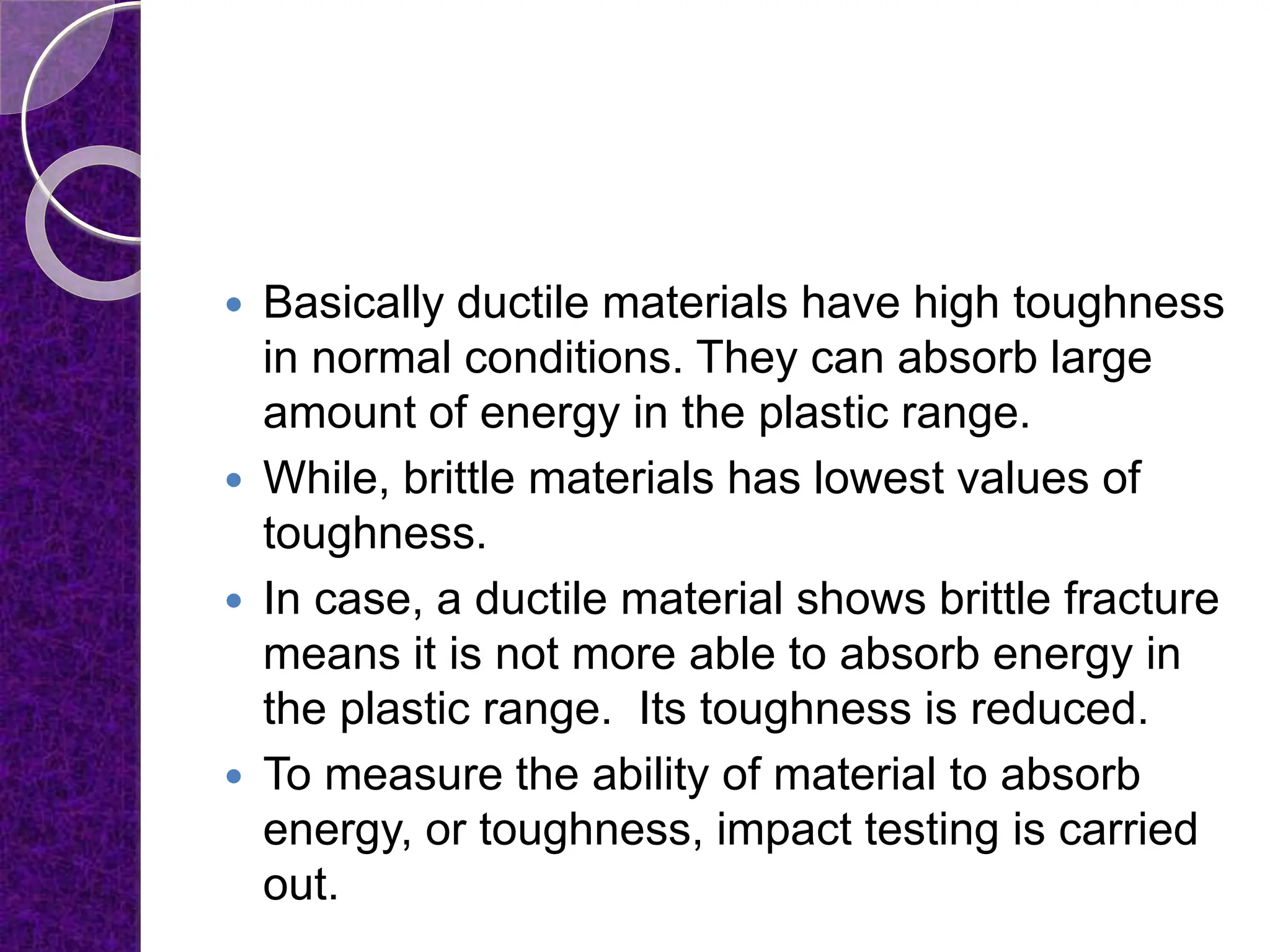
 Basically ductile materials have high toughness
in normal conditions. They can absorb large
amount of energy in the plastic range.
 While, brittle materials has lowest values of
toughness.
 In case, a ductile material shows brittle fracture
means it is not more able to absorb energy in
the plastic range. Its toughness is reduced.
 To measure the ability of material to absorb
energy, or toughness, impact testing is carried
out.
Impact test
 Impact test is carried out to measure the ability of
the material to absorb energy in the presence of
notch (stress concentration) by the application of
rapid rate of loading.
 Two types of impact tests are commonly employed.
◦ Charpy impact test
◦ Izod impact test
Charpy impact test
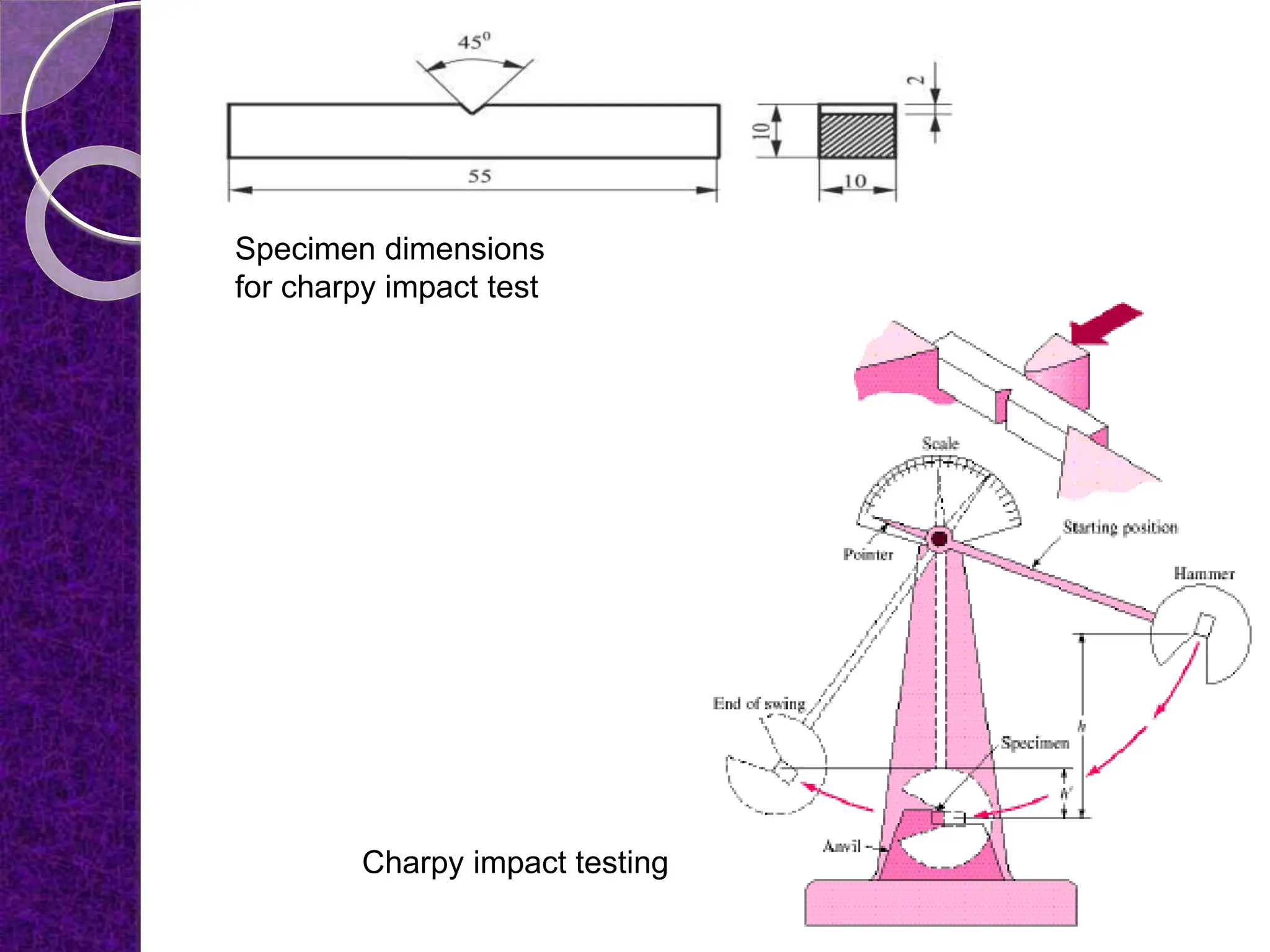
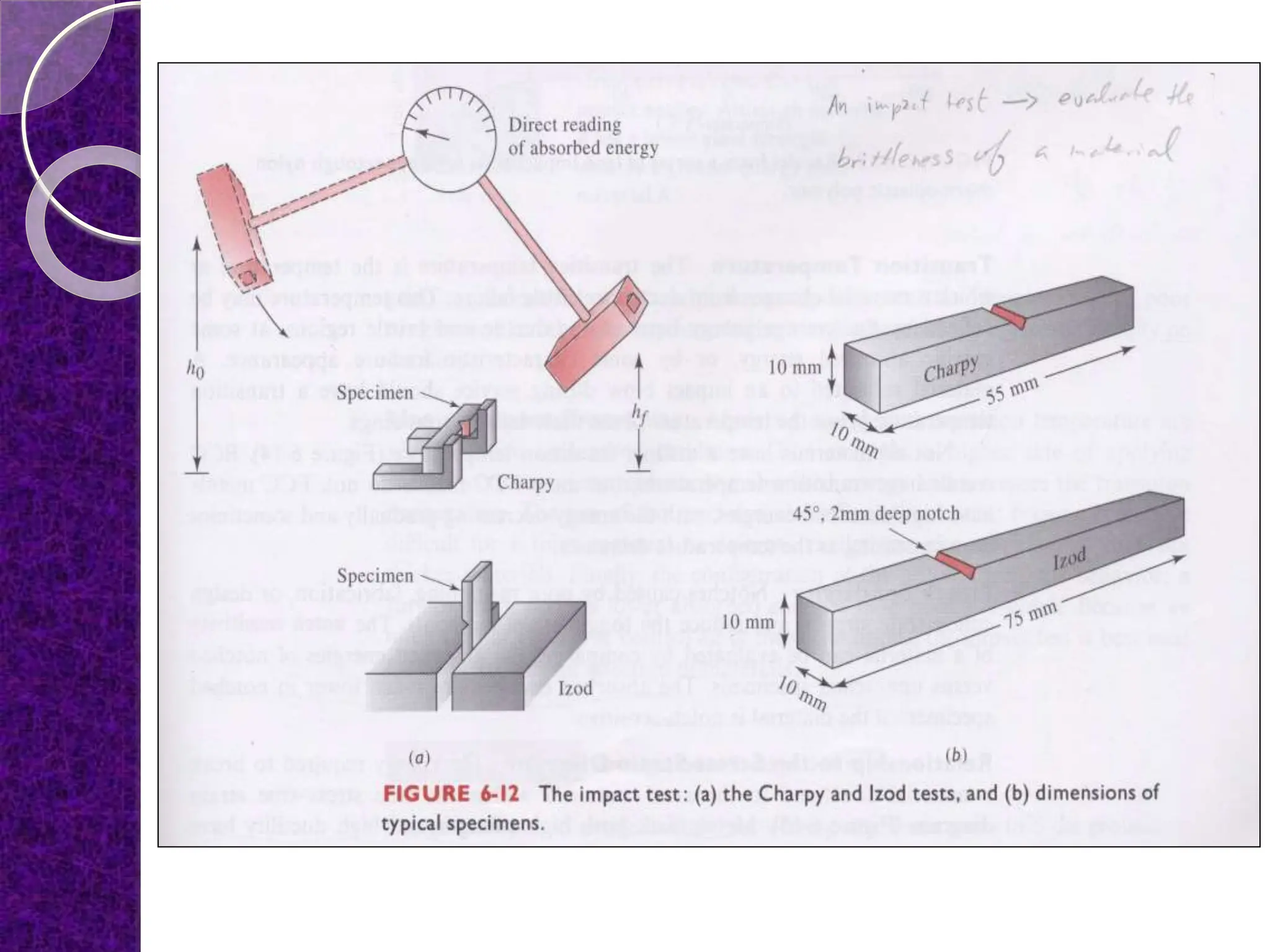
 A specimen of specified dimensions having a V
notch of 45o at the center of the specimen, is used
and supported at both ends as a simple beam.
 The specimen is struck on the opposite side and
directly behind the notch, with a pendulum
released from a known height.
 By knowing the mass of the pendulum and the
difference between its initial and final heights, the
energy absorbed by fracture can be measured.
Specimen dimensions
for charpy impact test
Charpy impact testing
Izod impact test
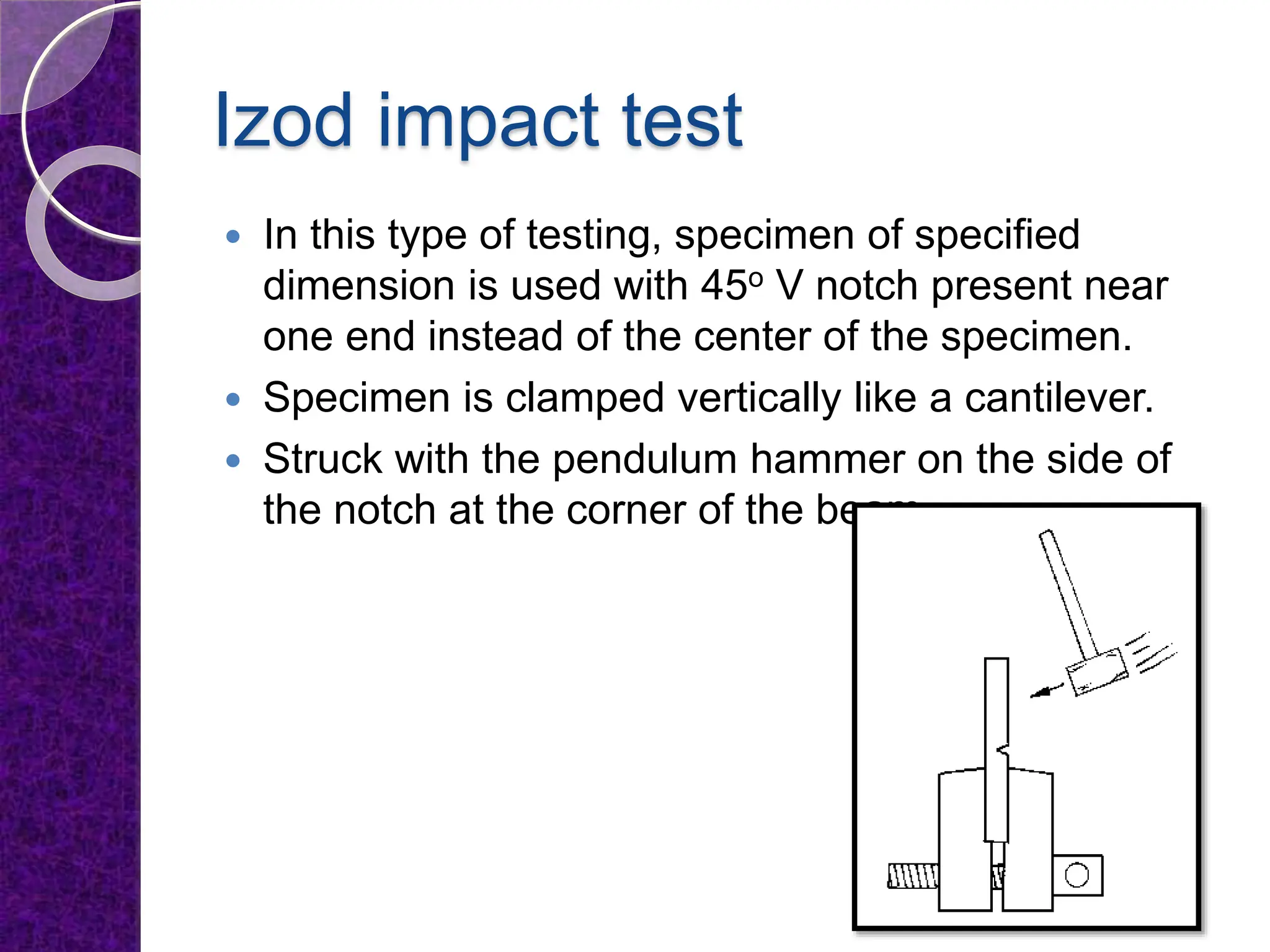
 In this type of testing, specimen of specified
dimension is used with 45o V notch present near
one end instead of the center of the specimen.
 Specimen is clamped vertically like a cantilever.
 Struck with the pendulum hammer on the side of
the notch at the corner of the beam.
Ductile – Brittle transition
temperature
 In both types of impact testing presence of notch is
studied alone, so far and resulting transition from
ductile to brittle behavior is studied.
 The effect of varying temperatures can also be
studied by providing a range of temperatures to the
notch specimen. So that the “low temperature” can
be found out for the given material at which it will
start behaving completely brittle.
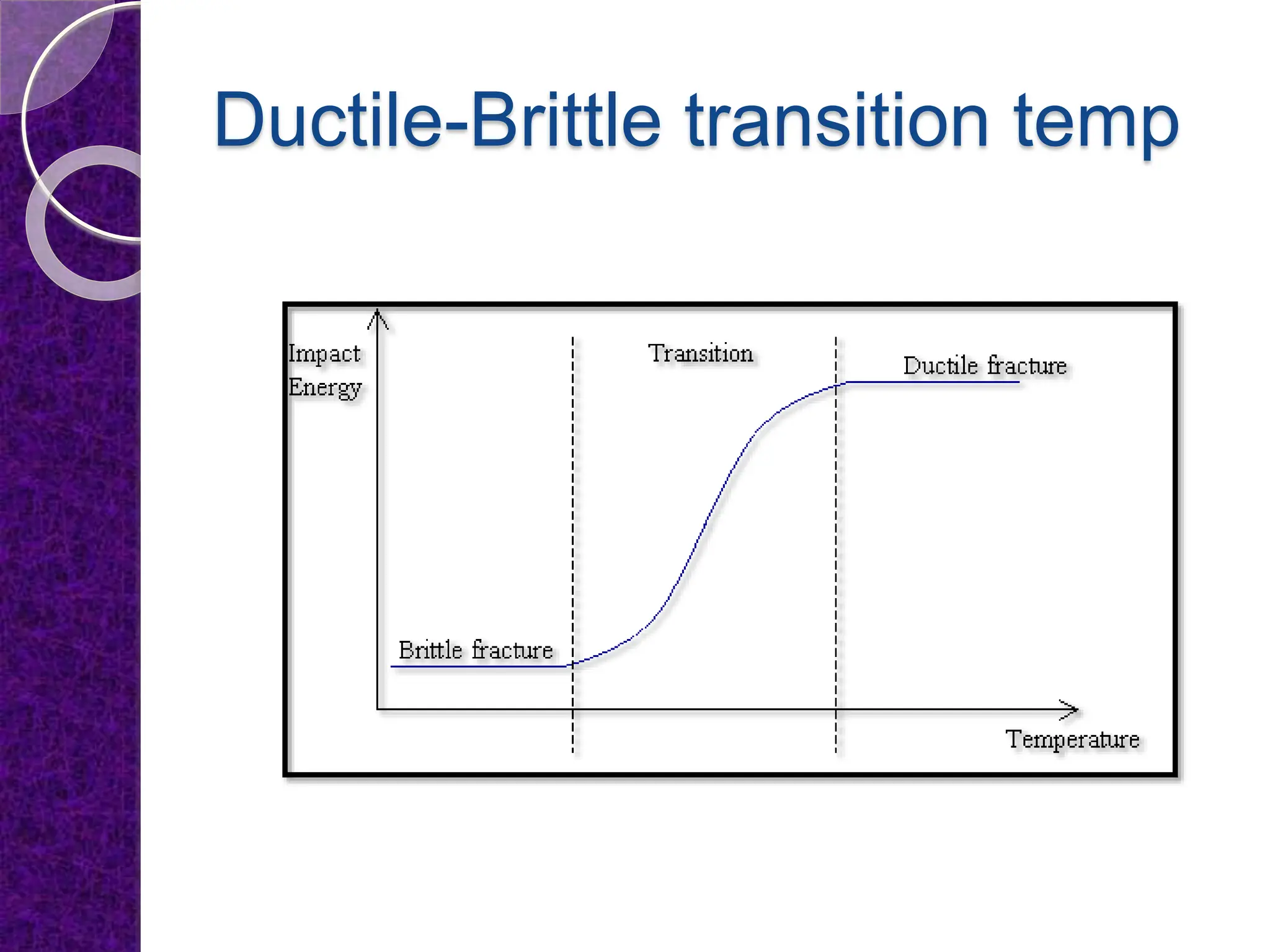
Ductile-Brittle transition temp
 To estimate the DBTT of the given material. The
material is undergone notched impact testing over
a range of temperatures.
 At high temperatures impact energy is relatively
large.
 As temperature drops the impact energy drops
suddenly over a very narrow temperature range.
 Below that temperature, impact energy has almost
constant but very small value.
 Ductile – brittle transition takes place over a range
of temperature instead of a sharp value of
temperature.
 Therefore it is difficult to define a single
temperature.
 Usually DBTT is taken that temperature at which
charpy V notch (CVN) energy value is 20J.
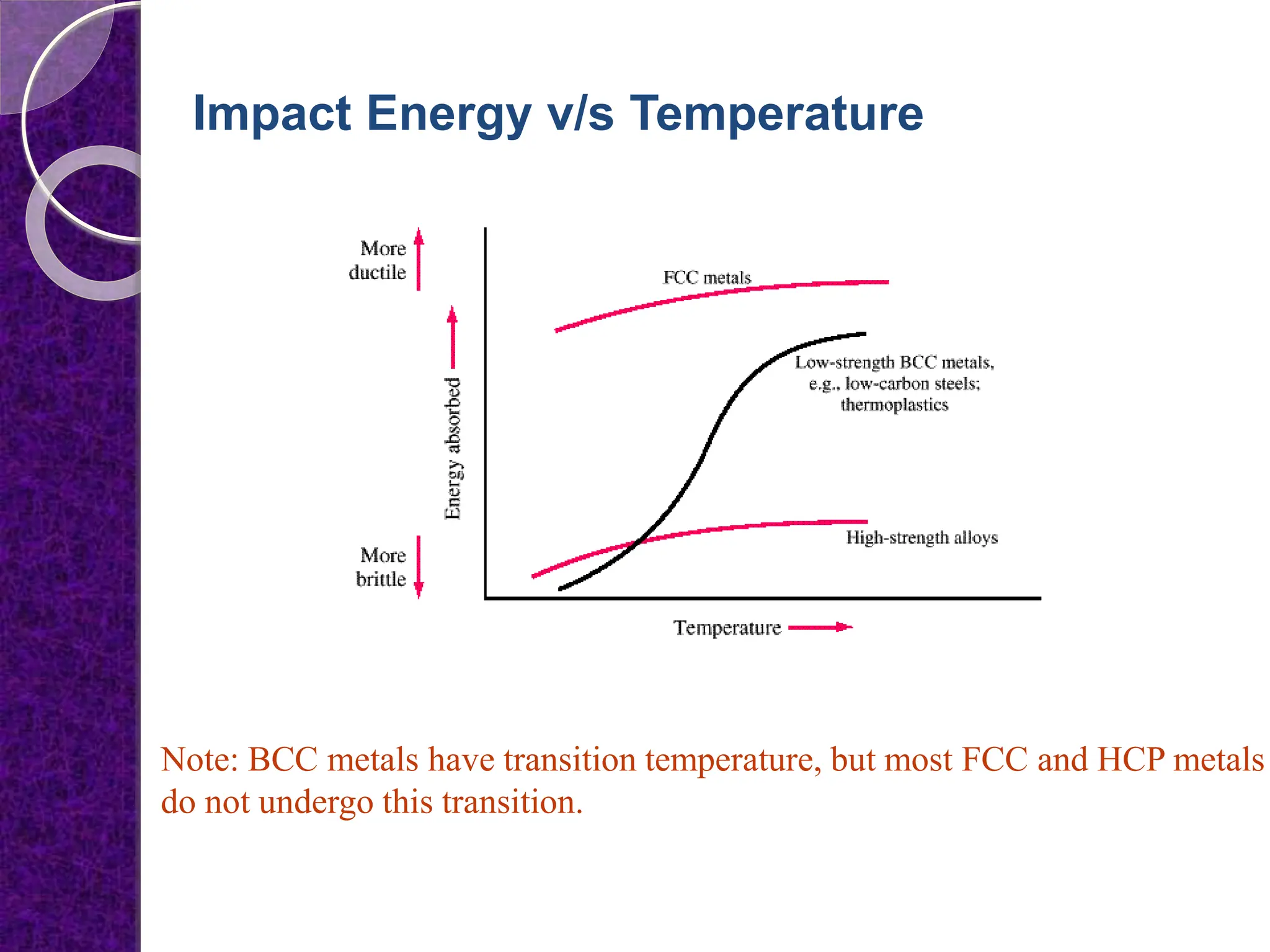
Note: BCC metals have transition temperature, but most FCC and HCP metals
do not undergo this transition.
Impact Energy v/s Temperature

DUCTILE TO BRITTLE TRANSITION of Materials

  • 1.
  • 2.
    Background  During theworld war II attention was dragged by the brittle failure of welded Liberty ships and T-2 Tankers.  Some of these ships completely broke into two while in some instances ships were not completely disabled.  Most of the failures took place in the months of winter and as a result of application of sudden loading.  These brittle fractures drew attention towards the brittle fracture of mild steel which in actual showed/shows ductile fracture.  This was not the only case where brittle fracture was a problem. Brittle fractures in tanks, pressure vessels, pipelines and bridges were also
  • 3.
    Factors for brittlefracture It was evident and studied that three basic reasons destined to the brittle fracture of ductile materials.  A low temperature.  A high strain rate or rapid rate of loading.  Presence of stress concentrated region. ◦ It is not necessary that brittle fracture will occur when all of these three conditions coexist. ◦ A rapid rate of loading multiplies the contribution of above two effects towards brittle fracture. That is why “impact tests” are carried out to study the brittle behavior of ductile materials. ◦ In impact testing, rapid loading applied to the specimen in which have produced the stress concentrations, intentionally. Or rapid loading is applied to the material at varying temperatures in the presence of stress concentrated regions.
  • 4.
     Basically ductilematerials have high toughness in normal conditions. They can absorb large amount of energy in the plastic range.  While, brittle materials has lowest values of toughness.  In case, a ductile material shows brittle fracture means it is not more able to absorb energy in the plastic range. Its toughness is reduced.  To measure the ability of material to absorb energy, or toughness, impact testing is carried out.
  • 5.
    Impact test  Impacttest is carried out to measure the ability of the material to absorb energy in the presence of notch (stress concentration) by the application of rapid rate of loading.  Two types of impact tests are commonly employed. ◦ Charpy impact test ◦ Izod impact test
  • 6.
    Charpy impact test A specimen of specified dimensions having a V notch of 45o at the center of the specimen, is used and supported at both ends as a simple beam.  The specimen is struck on the opposite side and directly behind the notch, with a pendulum released from a known height.  By knowing the mass of the pendulum and the difference between its initial and final heights, the energy absorbed by fracture can be measured.
  • 7.
    Specimen dimensions for charpyimpact test Charpy impact testing
  • 8.
    Izod impact test In this type of testing, specimen of specified dimension is used with 45o V notch present near one end instead of the center of the specimen.  Specimen is clamped vertically like a cantilever.  Struck with the pendulum hammer on the side of the notch at the corner of the beam.
  • 10.
    Ductile – Brittletransition temperature  In both types of impact testing presence of notch is studied alone, so far and resulting transition from ductile to brittle behavior is studied.  The effect of varying temperatures can also be studied by providing a range of temperatures to the notch specimen. So that the “low temperature” can be found out for the given material at which it will start behaving completely brittle.
  • 11.
  • 12.
     To estimatethe DBTT of the given material. The material is undergone notched impact testing over a range of temperatures.  At high temperatures impact energy is relatively large.  As temperature drops the impact energy drops suddenly over a very narrow temperature range.  Below that temperature, impact energy has almost constant but very small value.
  • 13.
     Ductile –brittle transition takes place over a range of temperature instead of a sharp value of temperature.  Therefore it is difficult to define a single temperature.  Usually DBTT is taken that temperature at which charpy V notch (CVN) energy value is 20J.
  • 14.
    Note: BCC metalshave transition temperature, but most FCC and HCP metals do not undergo this transition. Impact Energy v/s Temperature