ENGINEERING MATERIALS
Mechanical Properties and Testing
OUTLINE
 INTRODUCTION
 FUNDAMENTALS OF FRACTURE
 FRACTURE TOUGHNESS TESTING
 FATIGUE
 CRACK INITIATION AND PROPAGATION
 FACTORS THAT AFFECT FATIGUE LIFE
 ENVIRONMENTAL EFFECTS
INTRODUCTION
 The failure of engineering materials is almost always an
undesirable event for several reasons; these include
human lives that are put in jeopardy, economic losses, and
interference with the availability of products and services.
 Even though the causes of failure and the behavior of
materials may be known, prevention of failures is difficult
to guarantee.
 The three usual causes of failure are
 Improper materials selection and processing
 Inadequate component design
 Component misuse
FUNDAMENTALS OF FRACTURE
 Simple fracture is the separation of a body into two or
more pieces in response to an imposed stress that is static
(i.e., constant or slowly changing with time) and at
temperatures that are low relative to the melting
temperature of the material.
 Fracture can also occur from fatigue (when cyclic stresses
are imposed) and creep (time-dependent deformation,
normally at elevated temperatures)
FUNDAMENTALS OF FRACTURE
 Fracture, in response to tensile loading and at relatively
low temperatures, may occur by ductile and brittle modes.
 Ductile fracture is normally preferred because:
i. Preventive measures may be taken inasmuch as
evidence of plastic deformation indicate that fracture
is imminent, and
ii. More energy is required to induce ductile fracture
than for brittle fracture.
 For brittle materials, cracks are unstable—that is, crack
propagation, once started, will continue spontaneously
without an increase in stress level.
DUCTILE FRACTURE
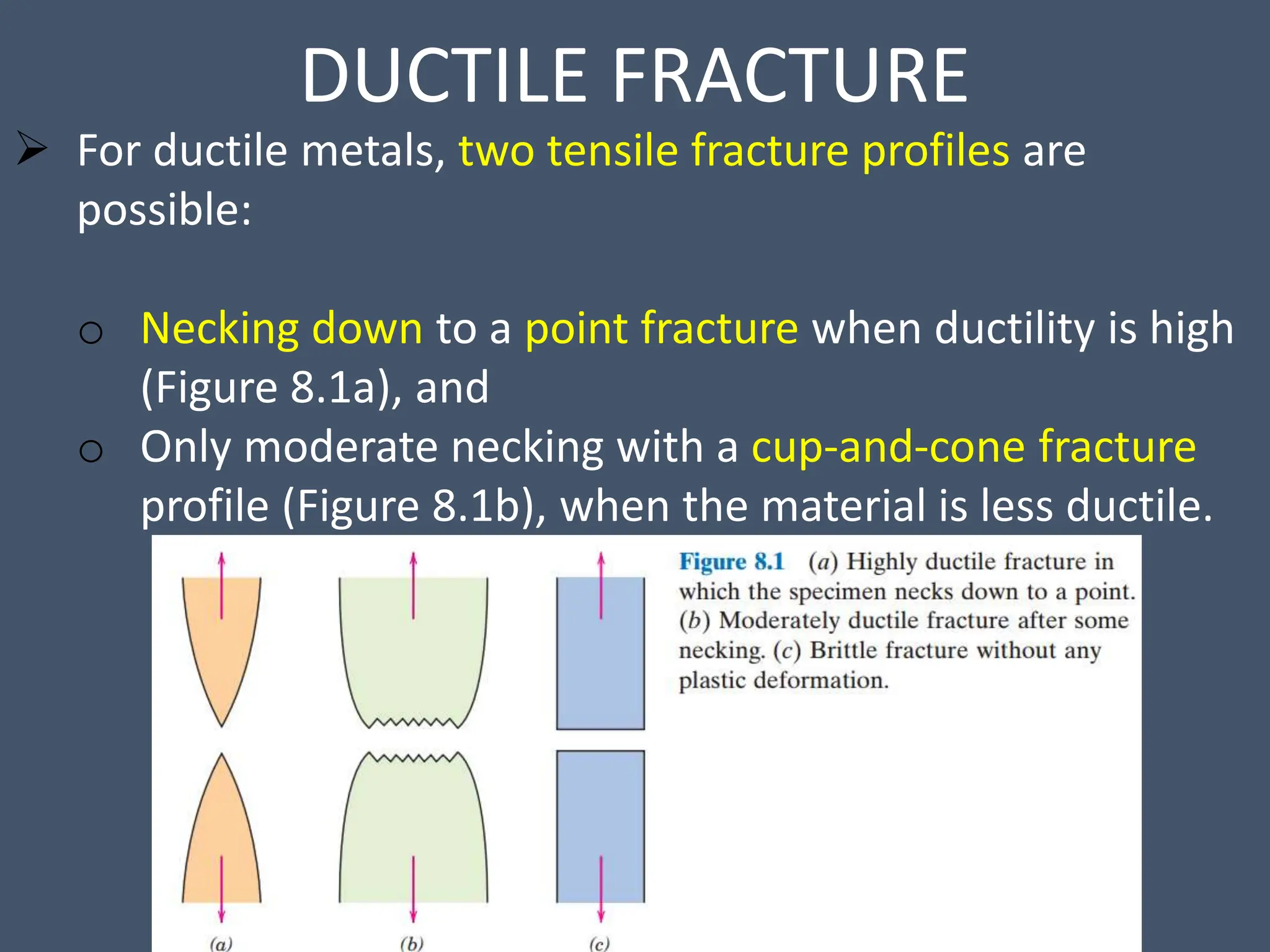
 For ductile metals, two tensile fracture profiles are
possible:
o Necking down to a point fracture when ductility is high
(Figure 8.1a), and
o Only moderate necking with a cup-and-cone fracture
profile (Figure 8.1b), when the material is less ductile.
DUCTILE FRACTURE
 The configuration shown in Figure 8.1a is found for
extremely soft metals, such as pure gold and lead at room
temperature, and other metals, polymers, and inorganic
glasses at elevated temperatures.
 These highly ductile materials neck down to a point
fracture, showing virtually 100% reduction in area.
DUCTILE FRACTURE
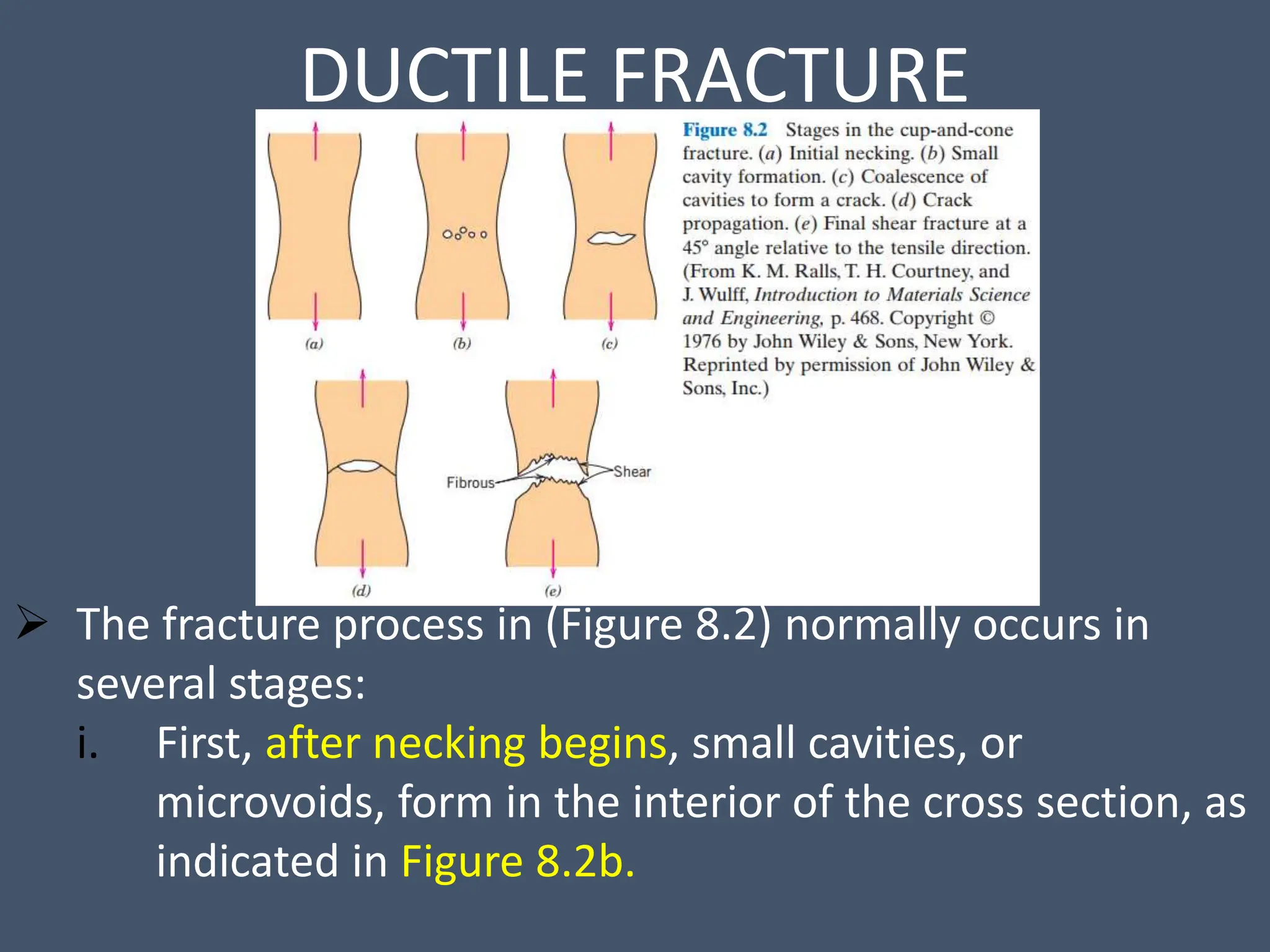
 The fracture process in (Figure 8.2) normally occurs in
several stages:
i. First, after necking begins, small cavities, or
microvoids, form in the interior of the cross section, as
indicated in Figure 8.2b.
DUCTILE FRACTURE
i. Next, as deformation continues, these microvoids
enlarge, come together, and coalesce to form an
elliptical crack, which has its long axis perpendicular to
the stress direction. The crack continues to grow in a
direction parallel to its major axis by this microvoid
coalescence process (Figure 8.2c).
ii. Finally, fracture ensues by the rapid propagation of a
crack around the outer perimeter of the neck (Figure
8.2d)
BRITTLE FRACTURE
 Brittle fracture takes place without any appreciable
deformation and by rapid crack propagation.
 For brittle fracture, the fracture surface is relatively flat
and perpendicular to the direction of the applied tensile
load (Figure 8.1c).
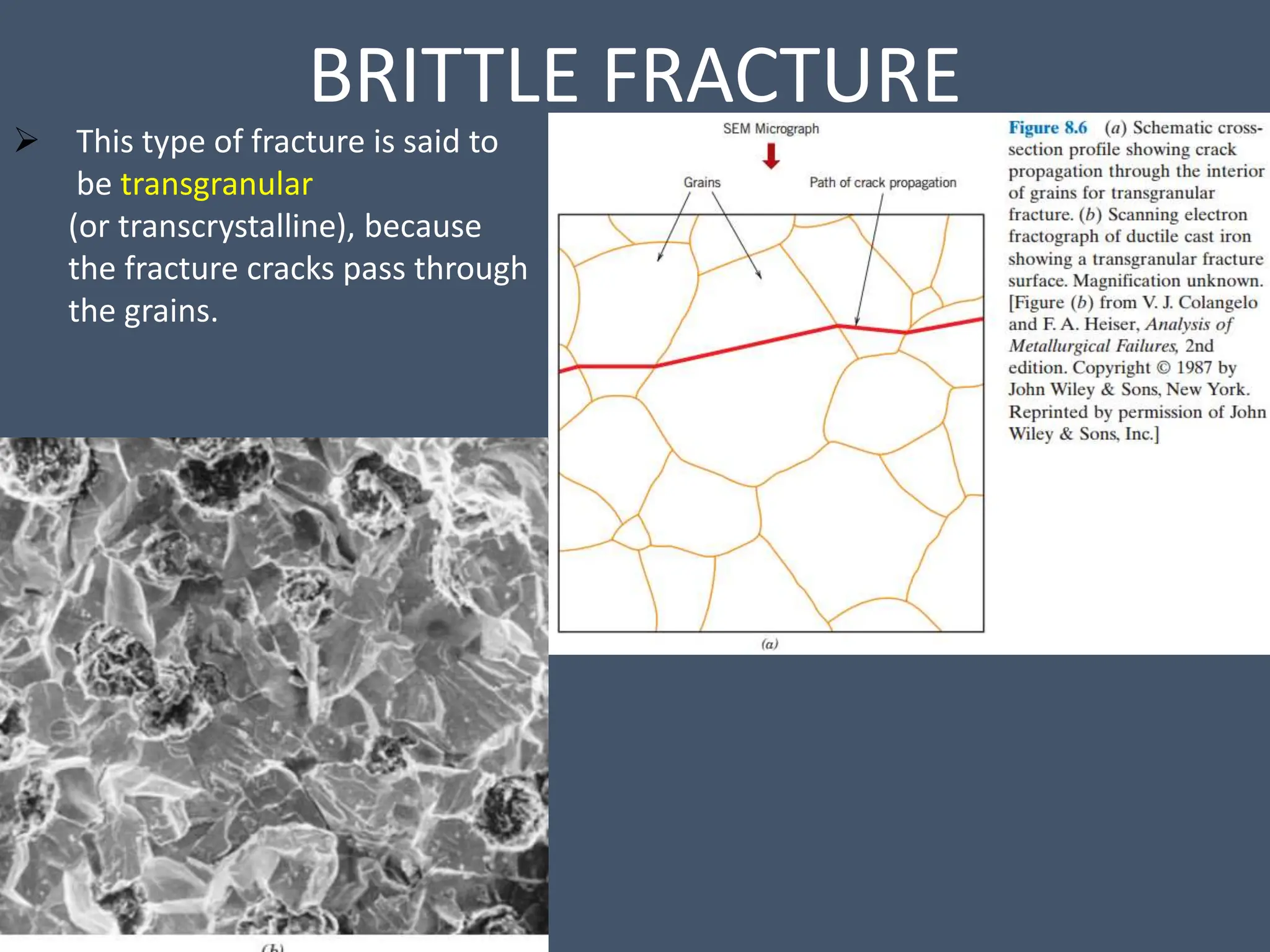
 For most brittle crystalline materials, crack propagation
corresponds to the successive and repeated breaking of
atomic bonds along specific crystallographic planes (Figure
8.6a); such a process is termed cleavage.
BRITTLE FRACTURE
 This type of fracture is said to
be transgranular
(or transcrystalline), because
the fracture cracks pass through
the grains.
BRITTLE FRACTURE
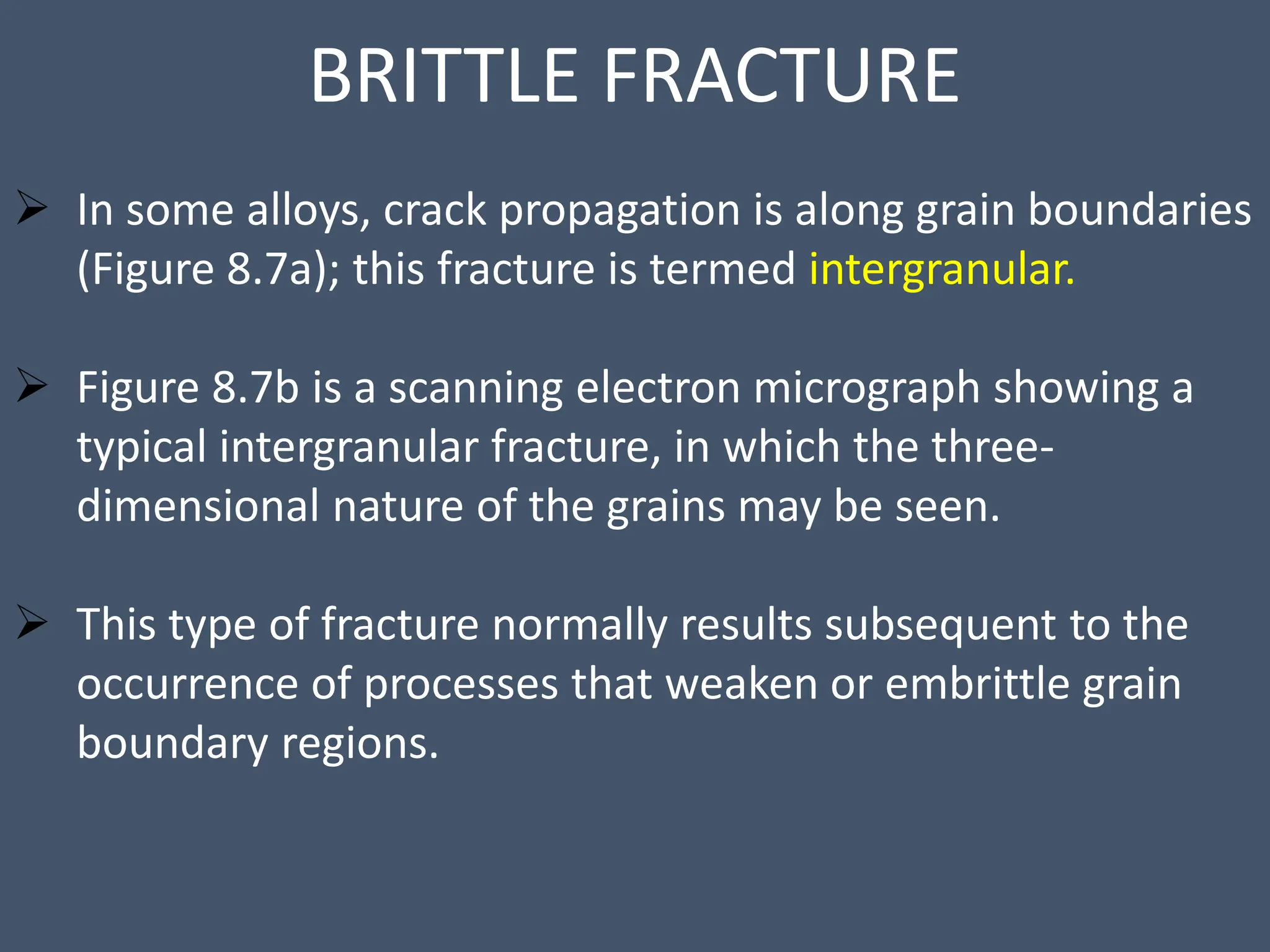
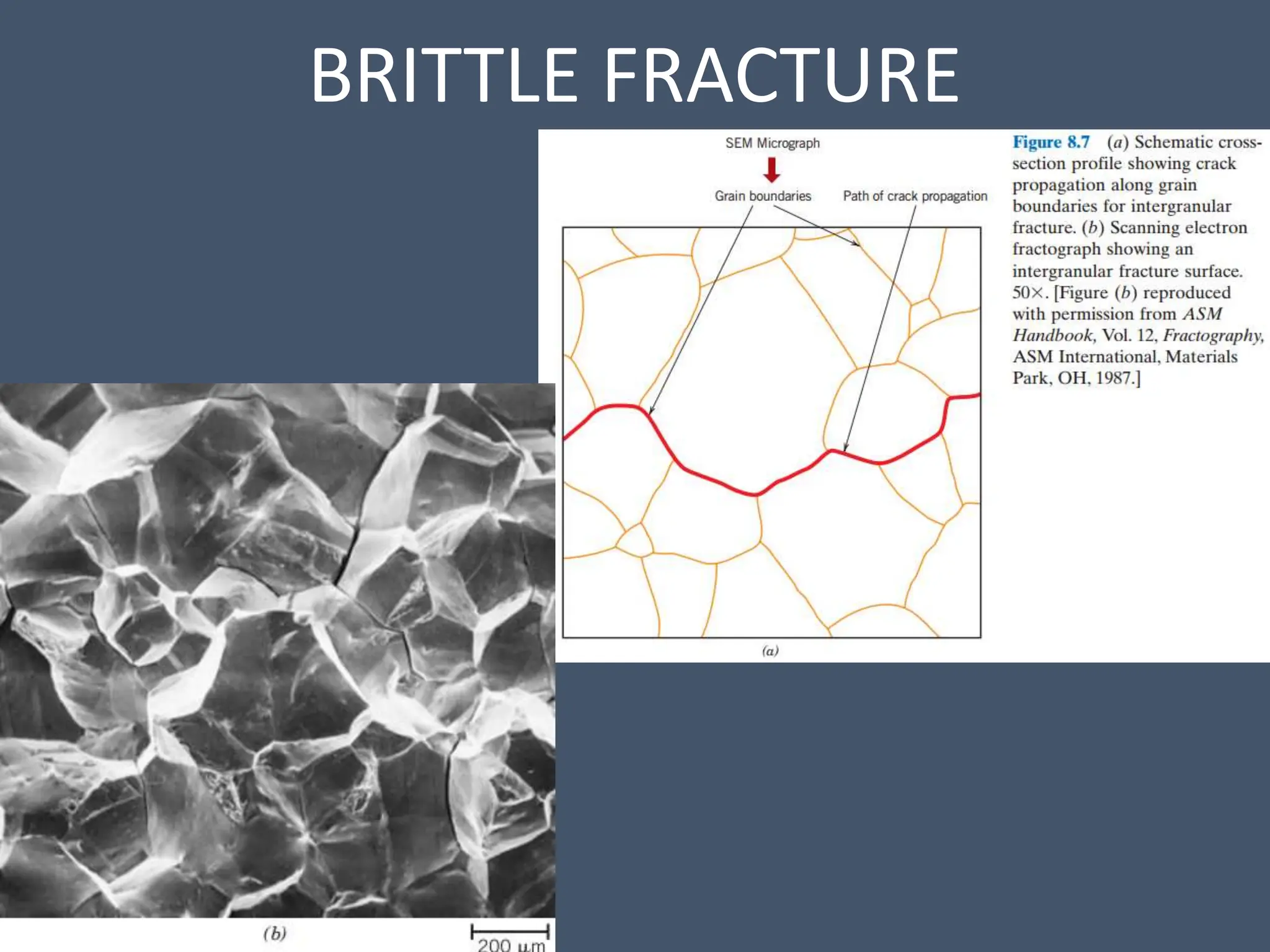
 In some alloys, crack propagation is along grain boundaries
(Figure 8.7a); this fracture is termed intergranular.
 Figure 8.7b is a scanning electron micrograph showing a
typical intergranular fracture, in which the three-
dimensional nature of the grains may be seen.
 This type of fracture normally results subsequent to the
occurrence of processes that weaken or embrittle grain
boundary regions.
BRITTLE FRACTURE
FRACTURE TOUGHNESS TESTING
 A number of different standardized tests have been
devised to measure the fracture toughness values for
structural materials.
 For each test type, the specimen (of specified geometry
and size) contains a preexisting defect, usually a sharp
crack that has been introduced.
 The test apparatus loads the specimen at a specified rate,
and also measures load and crack displacement values.
 Data are subjected to analyses to ensure that they meet
established criteria before the fracture toughness values
are deemed acceptable.
FRACTURE TOUGHNESS TESTING
 Most tests are for metals, but some have also been
developed for ceramics, polymers, and composites.
 Three factors that may cause a metal to experience a
ductile-to-brittle transition are exposure to:
1. Stresses at relatively low temperatures,
2. High strain rates(i.e., rate of deformation), and
3. The presence of a sharp notch.
FRACTURE TOUGHNESS TESTING
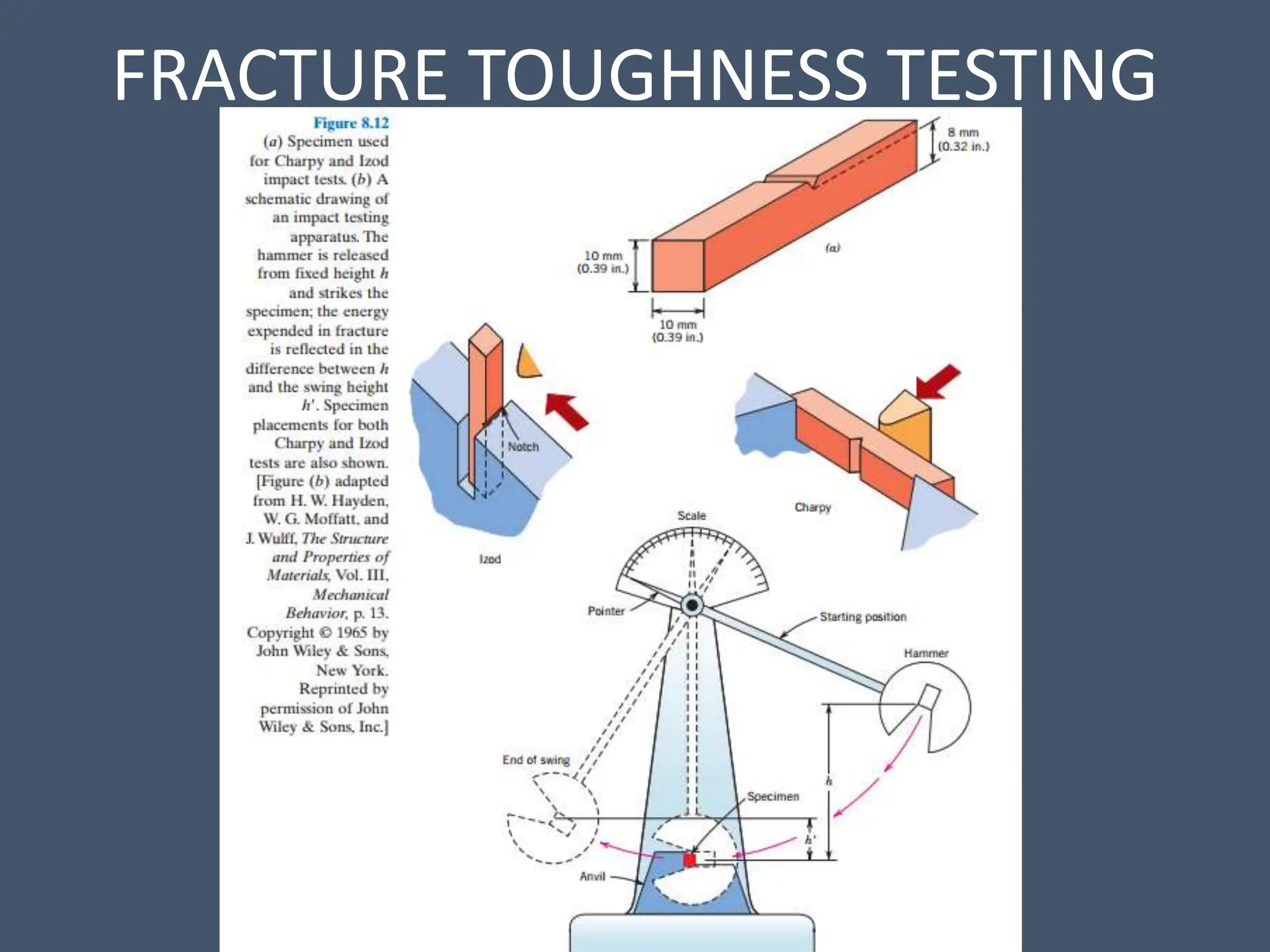
 Two standardized tests, the Charpy and Izod, were
designed and are still used to measure the impact energy
(sometimes also termed notch toughness).(Figure 8.12).
 The Charpy V-notch (CVN) technique is most commonly
used in the United States.
 For both Charpy and Izod, the specimen is in the shape of
a bar of square cross section, into which a V-notch is
machined (Figure 8.12a).
 The apparatus for making V-notch impact tests is
illustrated schematically in Figure 8.12b.
FRACTURE TOUGHNESS TESTING
 The load is applied as an impact blow from a weighted
pendulum hammer that is released from a cocked position
at a fixed height h.
 The specimen is positioned at the base as shown. Upon
release, a knife edge mounted on the pendulum strikes
and fractures the specimen at the notch, which acts as a
point of stress concentration for this high-velocity impact
blow.
 The pendulum continues its swing, rising to a maximum
height ℎ′, which is lower than h.
FRACTURE TOUGHNESS TESTING
 The energy absorption, computed from the difference
between h and ℎ′, is a measure of the impact energy.
 The primary difference between the Charpy and Izod
techniques lies in the manner of specimen support, as
illustrated in Figure 8.12b.
 Furthermore, these are termed impact tests in light of the
manner of load application.
FRACTURE TOUGHNESS TESTING
 Variables including specimen size and shape as well as
notch configuration and depth influence the test results.
 Both plane strain fracture toughness and these impact
tests have been used to determine the fracture properties
of materials.
 The former are quantitative in nature, in that a specific
property of the material is determined.
 The results of the impact tests, on the other hand, are
more qualitative and are of little use for design purposes.
FRACTURE TOUGHNESS TESTING
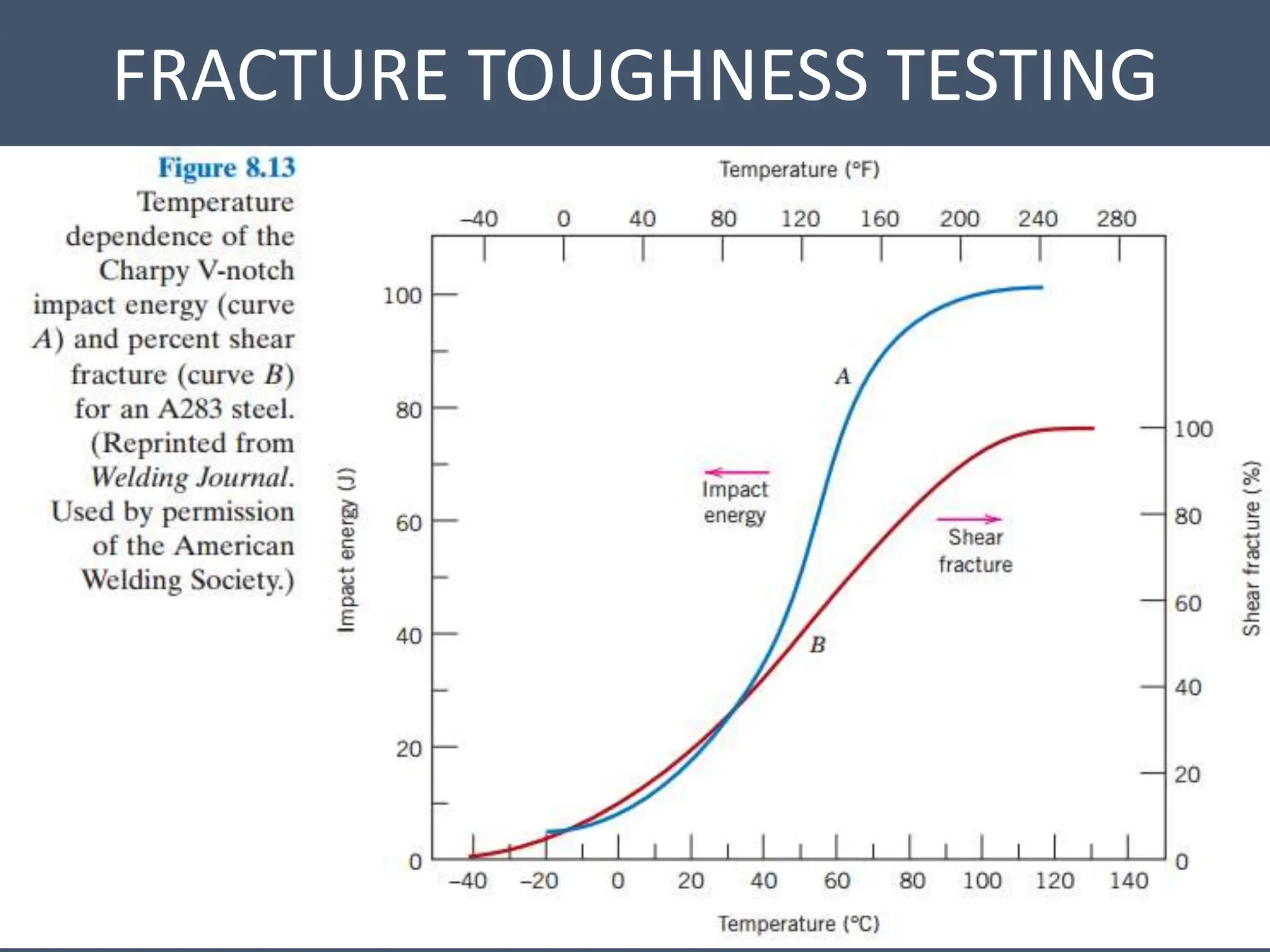
 One of the primary functions of Charpy and Izod tests is to
determine whether a material experiences a ductile-to-
brittle transition with decreasing temperature and, if so,
the range of temperatures over which it occurs.
 The ductile to-brittle transition is related to the
temperature dependence of the measured impact energy
absorption.
 This transition is represented for a steel by curve A in
Figure 8.13.
FRACTURE TOUGHNESS TESTING
 At higher temperatures the CVN energy is relatively large,
in correlation with a ductile mode of fracture.
 As the temperature is lowered, the impact energy drops
suddenly over a relatively narrow temperature range,
below which the energy has a constant but small value;
that is, the mode of fracture is brittle.
 On the basis of the temperature dependence of measured
impact energy (or appearance of the fracture surface), it is
possible to ascertain whether a material experiences a
ductile-to-brittle transition and the temperature range
over which such a transition occurs.
FRACTURE TOUGHNESS TESTING
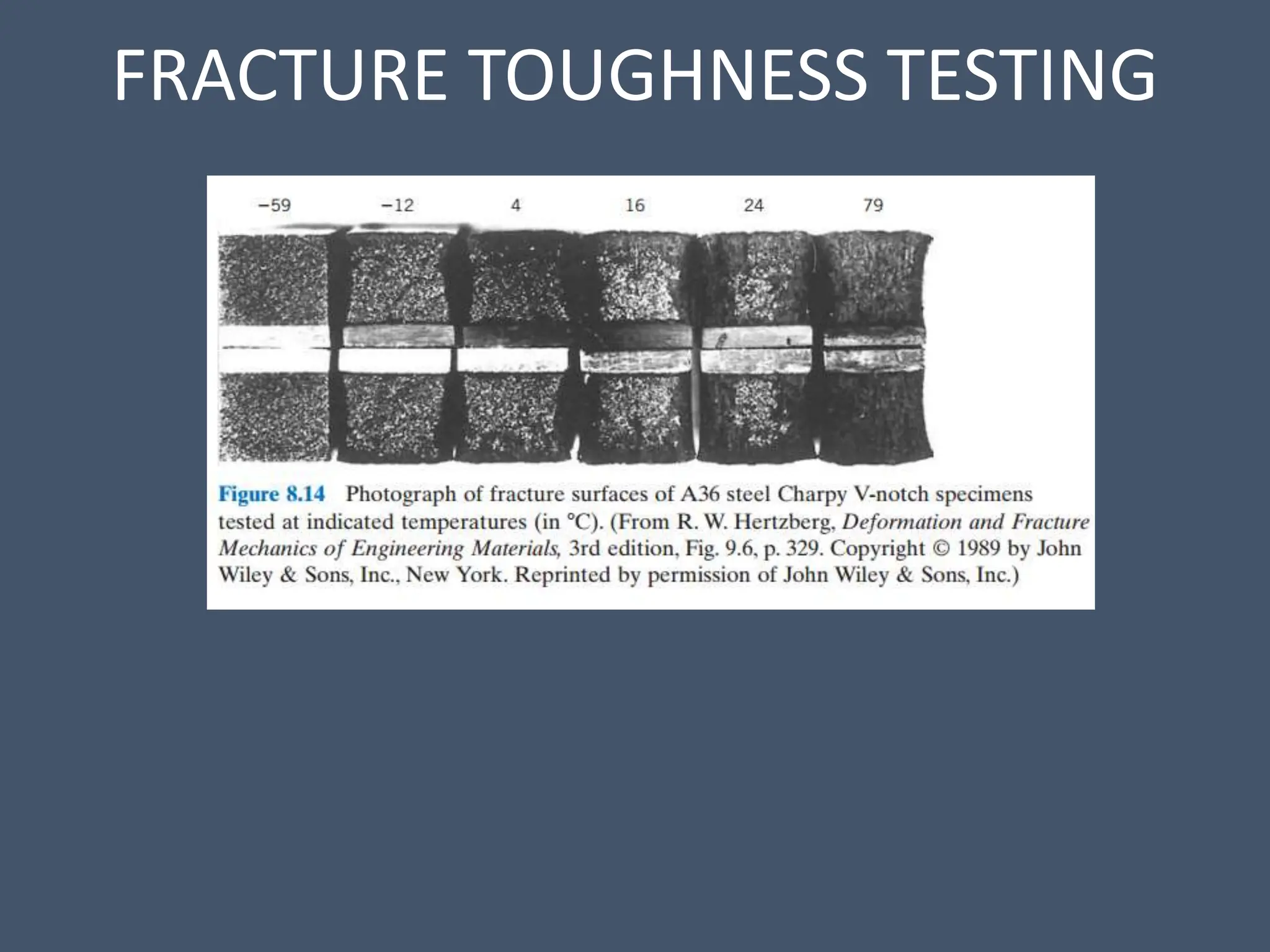
 Alternatively, appearance of the failure surface is indicative
of the nature of fracture and may be used in transition
temperature determinations.
 For ductile fracture this surface appears fibrous or dull (or
of shear character), as in the steel specimen of Figure 8.14
that was tested at 79°C.
 Conversely, totally brittle surfaces have a granular (shiny)
texture (or cleavage character) (the -59°C specimen, Figure
8.14).
FRACTURE TOUGHNESS TESTING
FATIGUE
 Fatigue is a form of failure that occurs in structures
subjected to dynamic and fluctuating stresses (e.g.,
bridges, aircraft, and machine components).
 The term fatigue is used because this type of failure
normally occurs after a lengthy period of repeated stress
or strain cycling.
 Fatigue is important inasmuch as it is the single largest
cause of failure in metals, estimated to comprise
approximately 90% of all metallic failures; polymers and
ceramics (except for glasses) are also susceptible to this
type of failure.
FATIGUE
 Fatigue is a common type of catastrophic failure wherein
the applied stress level fluctuates with time; it occurs
when the maximum stress level may be considerably lower
than the static tensile or yield strength.
 Fatigue failure is brittle like in nature even in normally
ductile metals, in that there is very little, if any, gross
plastic deformation associated with failure.
 The process occurs by the initiation and propagation of
cracks, and ordinarily the fracture surface is perpendicular
to the direction of an applied tensile stress.
FATIGUE
CYCLIC STRESSES
 The applied stress may be axial (tension–compression),
flexural (bending), or torsional (twisting) in nature.
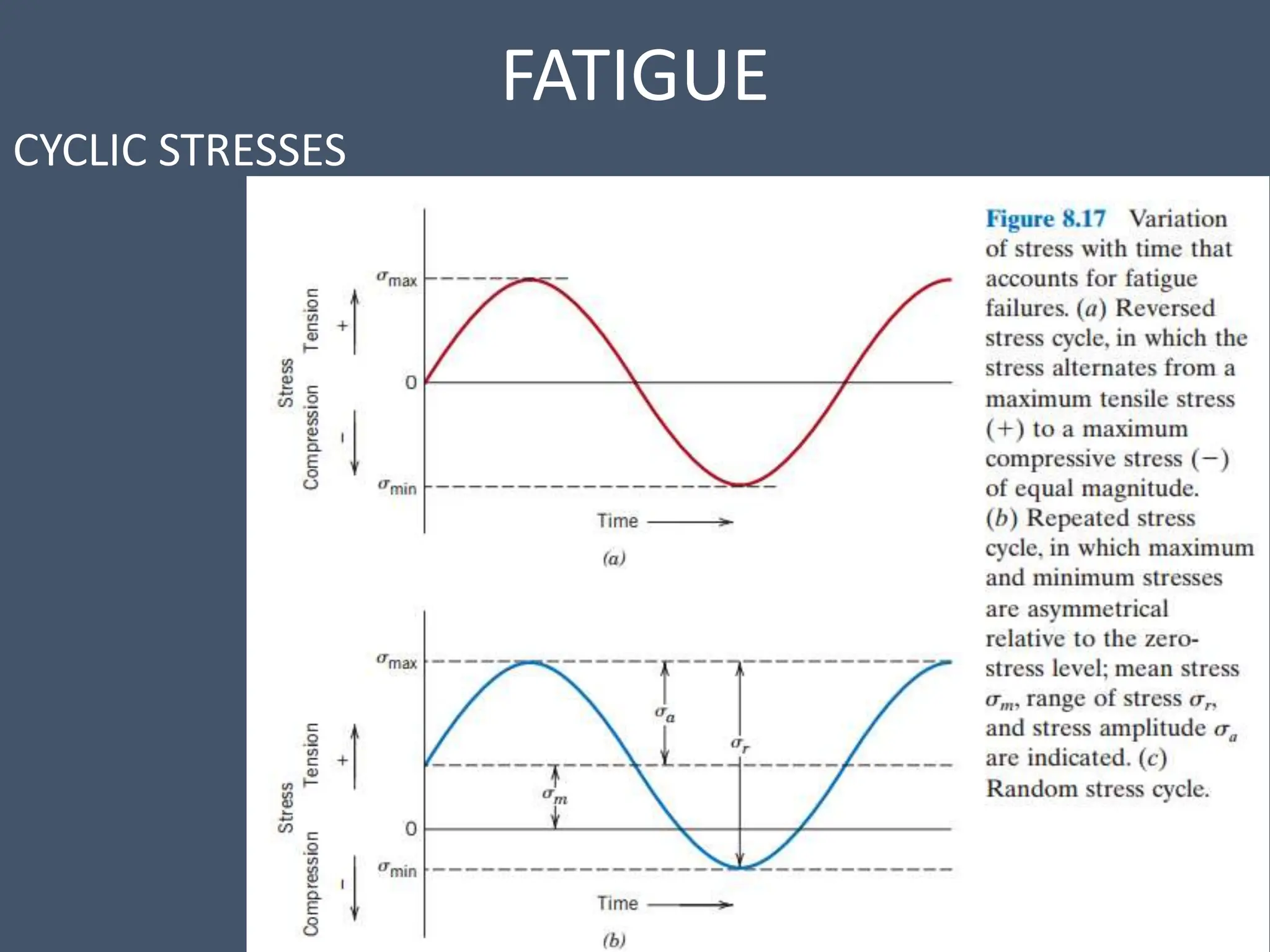
 Fluctuating stresses are categorized into three general
stress-versus-time cycle modes: reversed, repeated, and
random (Figure 8.17). Reversed and repeated are
characterized in terms of mean stress, range of stress, and
stress amplitude.
FATIGUE
CYCLIC STRESSES
FATIGUE
THE S–N CURVE
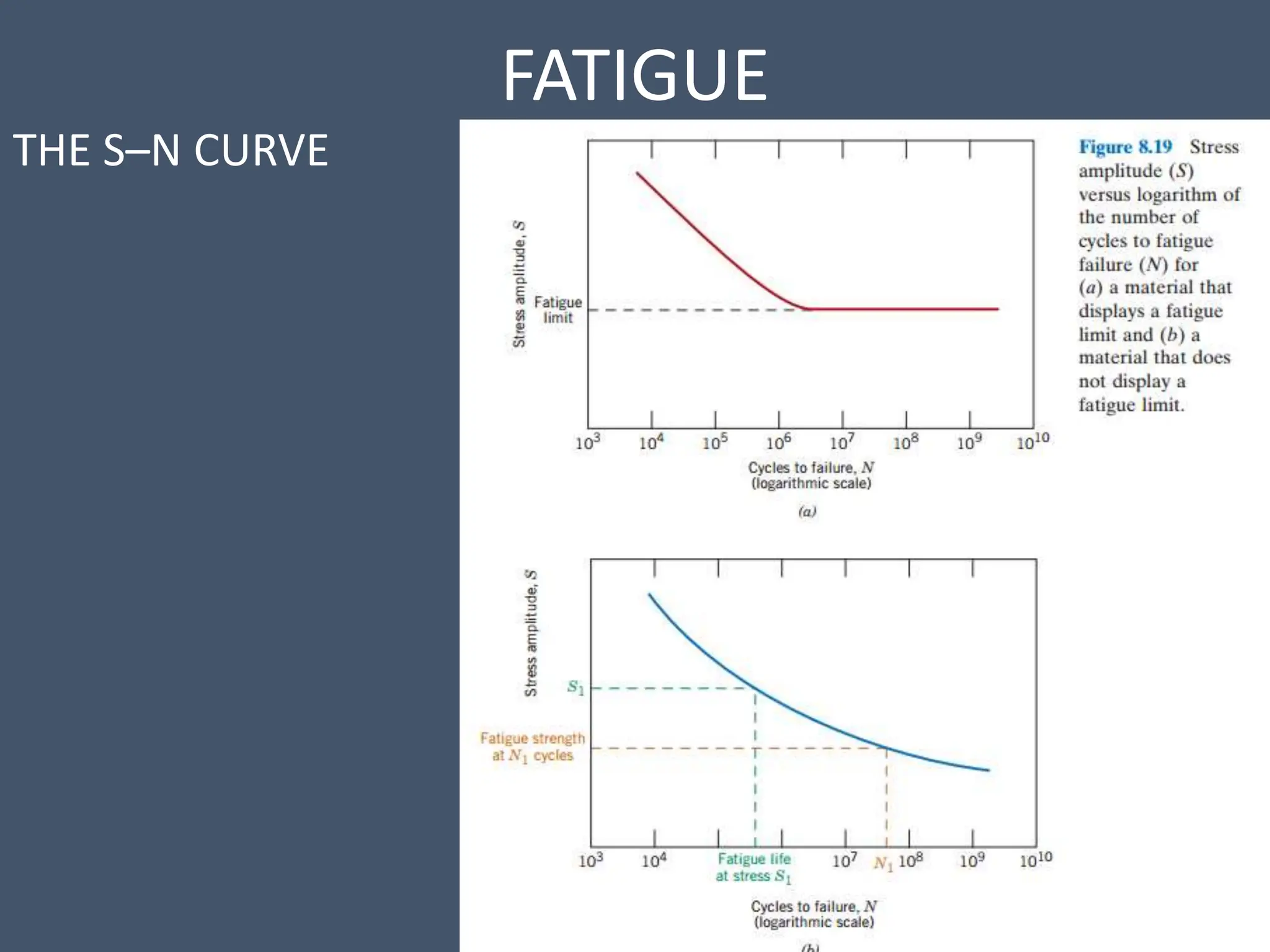
 Test data are plotted as stress (normally stress amplitude)
versus the logarithm of the number of cycles to failure.
 For many metals and alloys, stress diminishes continuously
with increasing number of cycles at failure; fatigue
strength and fatigue life are parameters used to
characterize the fatigue behavior of these materials (Figure
8.19b).
FATIGUE
THE S–N CURVE
FATIGUE
THE S–N CURVE
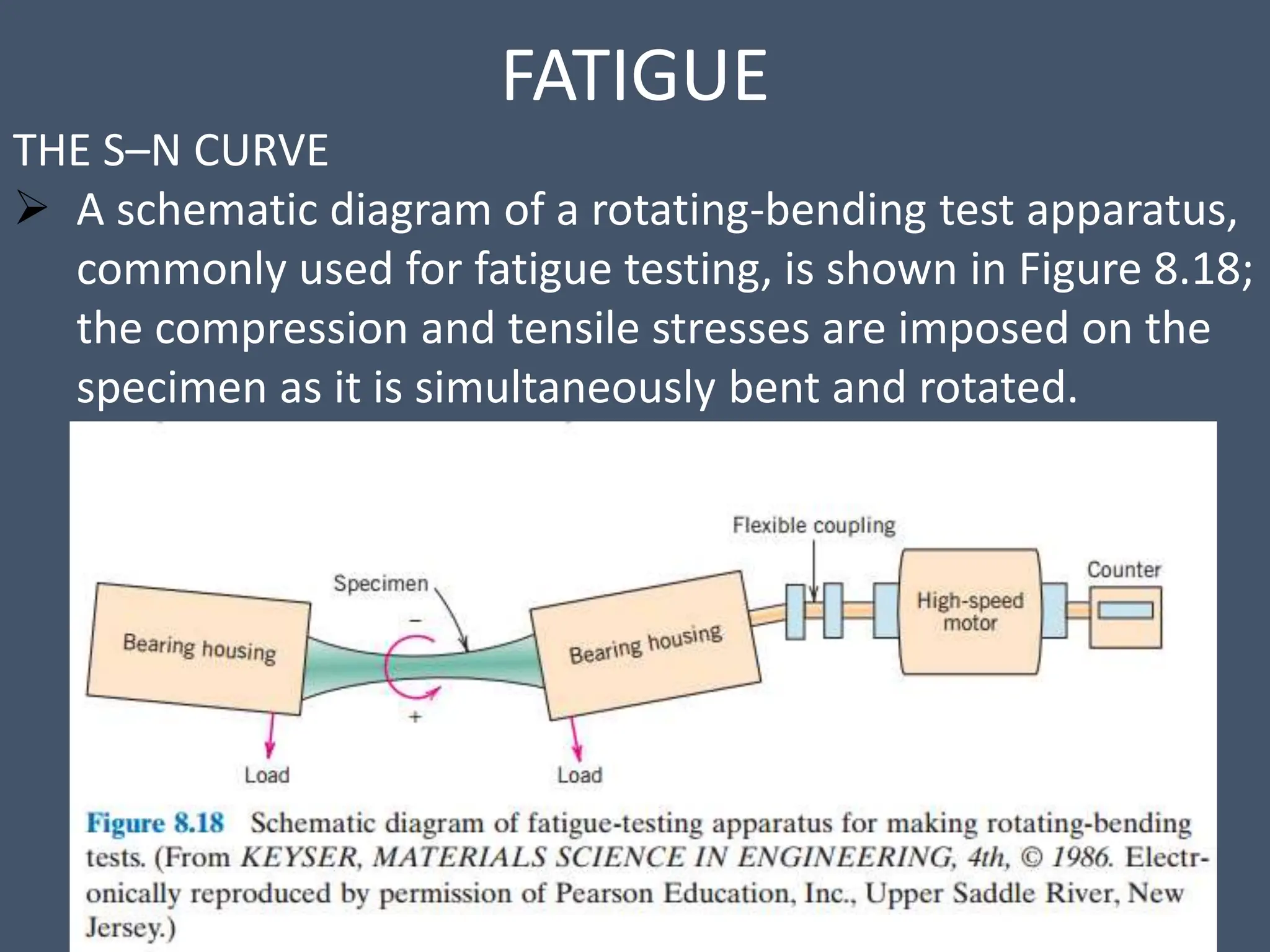
 A schematic diagram of a rotating-bending test apparatus,
commonly used for fatigue testing, is shown in Figure 8.18;
the compression and tensile stresses are imposed on the
specimen as it is simultaneously bent and rotated.
FATIGUE
THE S–N CURVE
 For other metals (e.g., ferrous and titanium alloys), at
some point, stress ceases to decrease with, and becomes
independent of, the number of cycles; the fatigue behavior
of these materials is expressed in terms of fatigue limit
(Figure 8.19a).
FATIGUE
THE S–N CURVE
 A series of tests are commenced by subjecting a specimen
to the stress cycling at a relatively large maximum stress
amplitude (𝜎𝑚𝑎𝑥), usually on the order of two-thirds of the
static tensile strength; the number of cycles to failure is
counted.
 This procedure is repeated on other specimens at
progressively decreasing maximum stress amplitudes. Data
are plotted as stress S versus the logarithm of the number
N of cycles to failure for each of the specimens.
FATIGUE
THE S–N CURVE
 Two distinct types of S–N behavior are observed, which
are represented schematically in Figure 8.19.
 As these plots indicate, the higher the magnitude of the
stress, the smaller the number of cycles the material is
capable of sustaining before failure.
 For some ferrous (iron base) and titanium alloys, the S–N
curve (Figure 8.19a) becomes horizontal at higher N
values; or there is a limiting stress level, called the fatigue
limit (also sometimes the endurance limit), below which
fatigue failure will not occur.
FATIGUE
THE S–N CURVE
 This fatigue limit represents the largest value of fluctuating
stress that will not cause failure for essentially an infinite
number of cycles.
 For many steels, fatigue limits range between 35% and
60% of the tensile strength.
 Most nonferrous alloys (e.g., aluminum, copper,
magnesium) do not have a fatigue limit, in that the S–N
curve continues its downward trend at increasingly greater
N values (Figure 8.19b).
FATIGUE
THE S–N CURVE
 Thus, fatigue will ultimately occur regardless of the
magnitude of the stress.
 For these materials, the fatigue response is specified as
fatigue strength, which is defined as the stress level at
which failure will occur for some specified number of
cycles (e.g., 107 cycles).
 The determination of fatigue strength is also
demonstrated in Figure 8.19b.
FATIGUE
THE S–N CURVE
 Another important parameter that characterizes a
material’s fatigue behavior is fatigue life 𝑁𝑓
 Fatigue life 𝑁𝑓 is the number of cycles to cause failure at a
specified stress level, as taken from the S–N plot (Figure
8.19b).
 Unfortunately, there always exists considerable scatter in
fatigue data—that is, a variation in the measured N value
for a number of specimens tested at the same stress level.
FATIGUE
THE S–N CURVE
 This variation may lead to significant design uncertainties
when fatigue life and/or fatigue limit (or strength) are
being considered.
 Fatigue S–N curves similar to those shown in Figure 8.19
represent “best fit” curves that have been drawn through
average-value data points.
FATIGUE
THE S–N CURVE
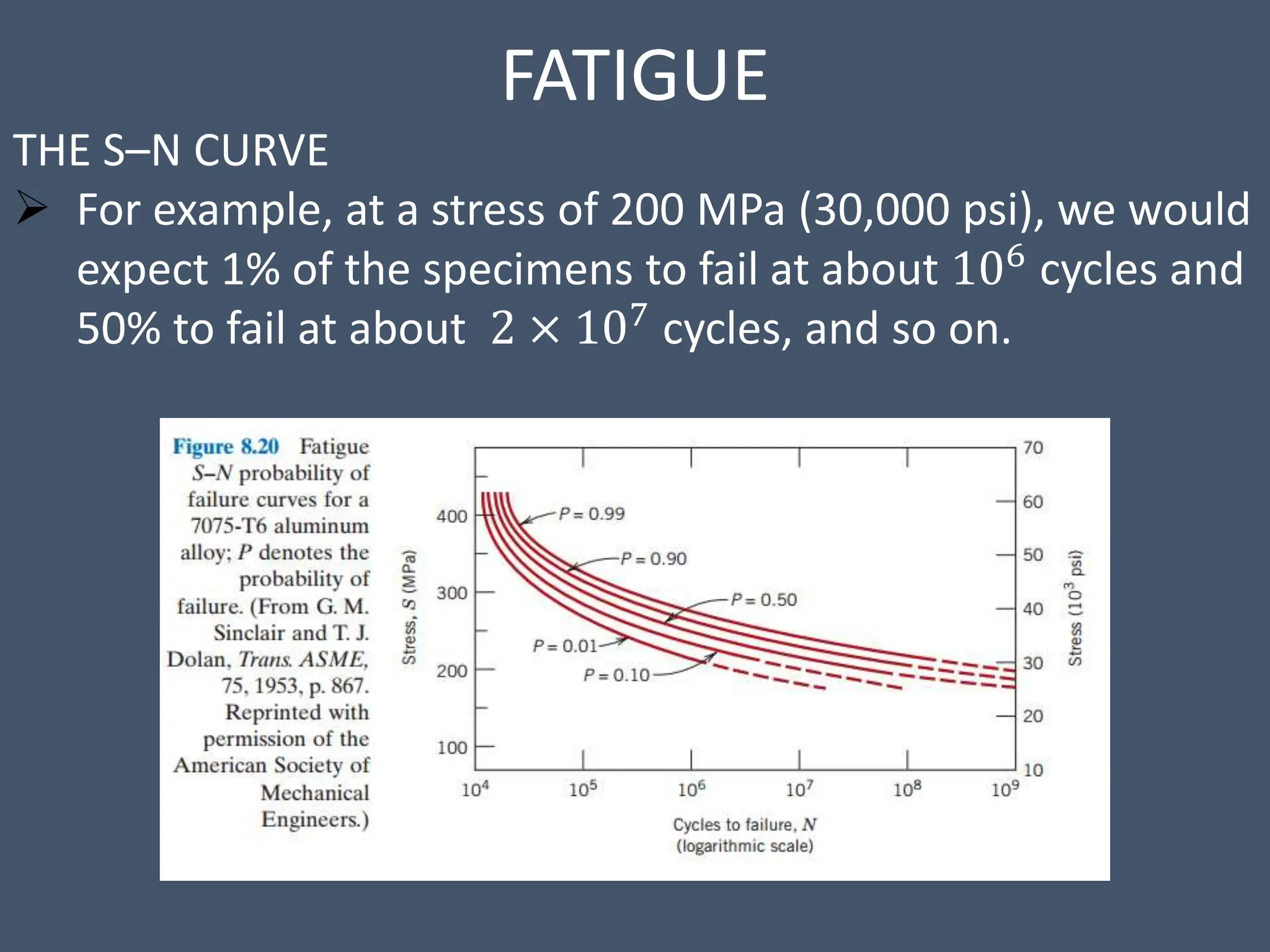
 Several statistical techniques have been developed to
specify fatigue life and fatigue limit in terms of
probabilities.
 One convenient way of representing data treated in this
manner is with a series of constant probability curves,
several of which are plotted in Figure 8.20.
 The P value associated with each curve represents the
probability of failure.
FATIGUE
THE S–N CURVE
 For example, at a stress of 200 MPa (30,000 psi), we would
expect 1% of the specimens to fail at about 106 cycles and
50% to fail at about 2 × 10⁷ cycles, and so on.
FATIGUE
THE S–N CURVE
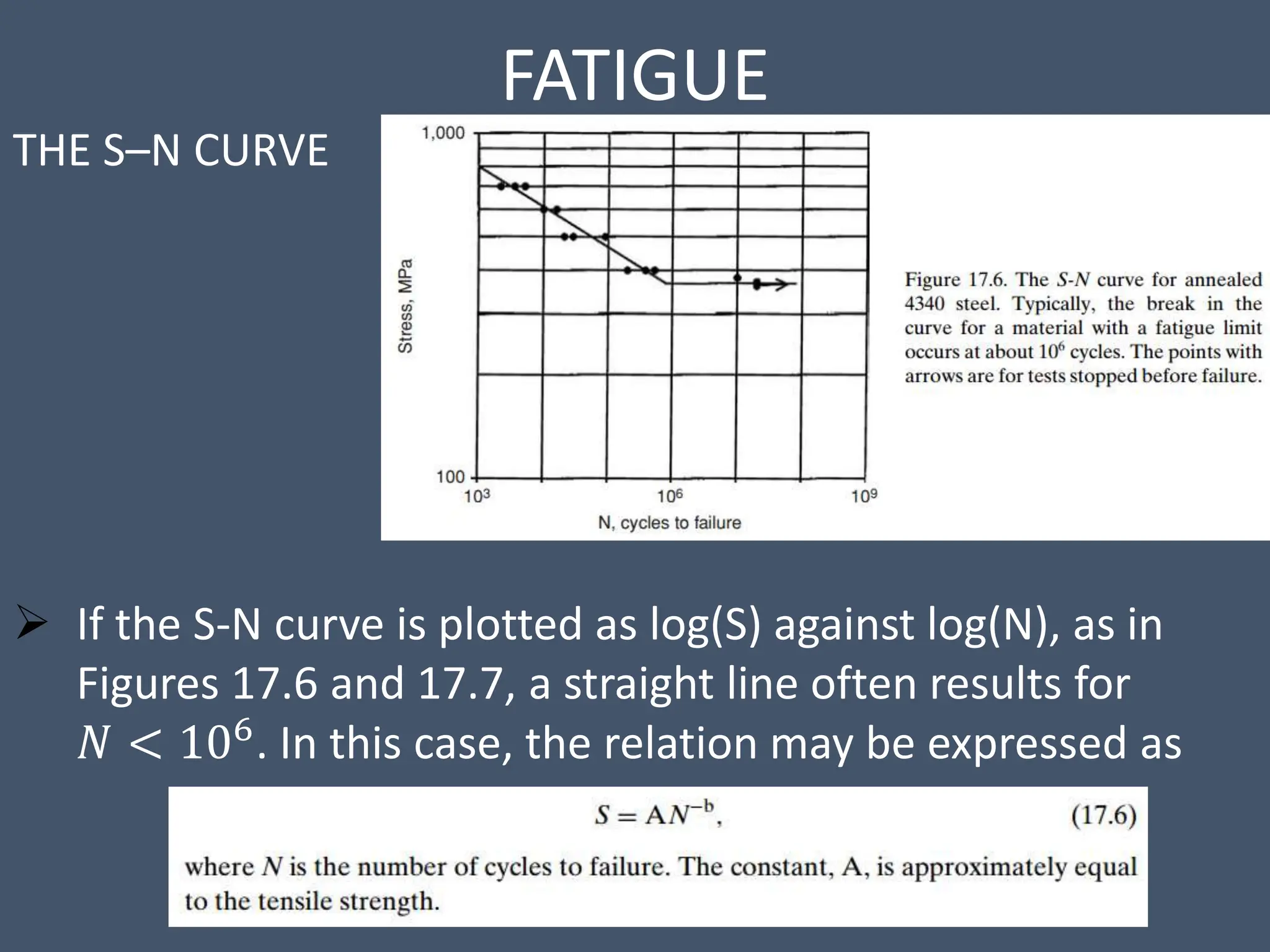
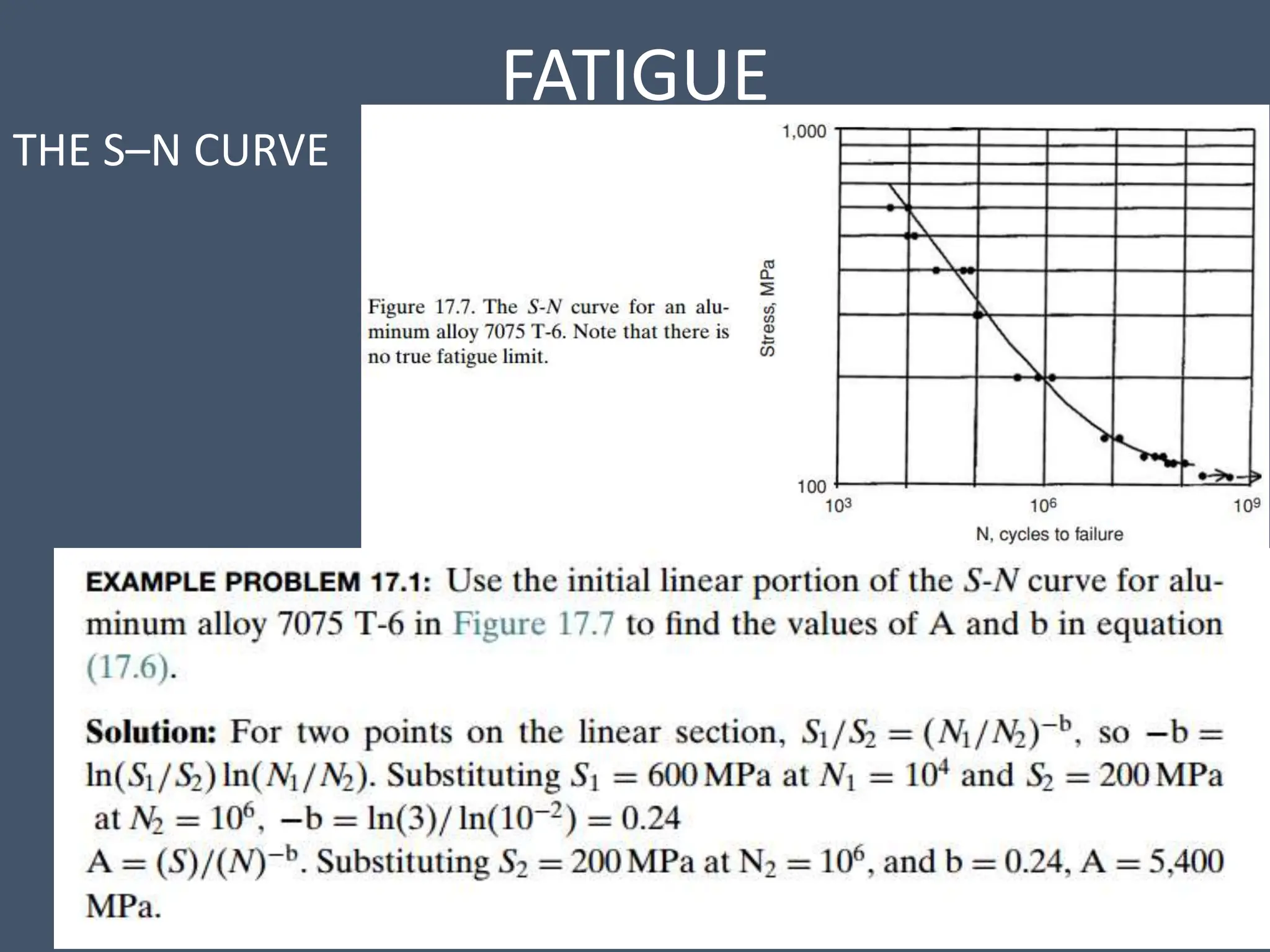
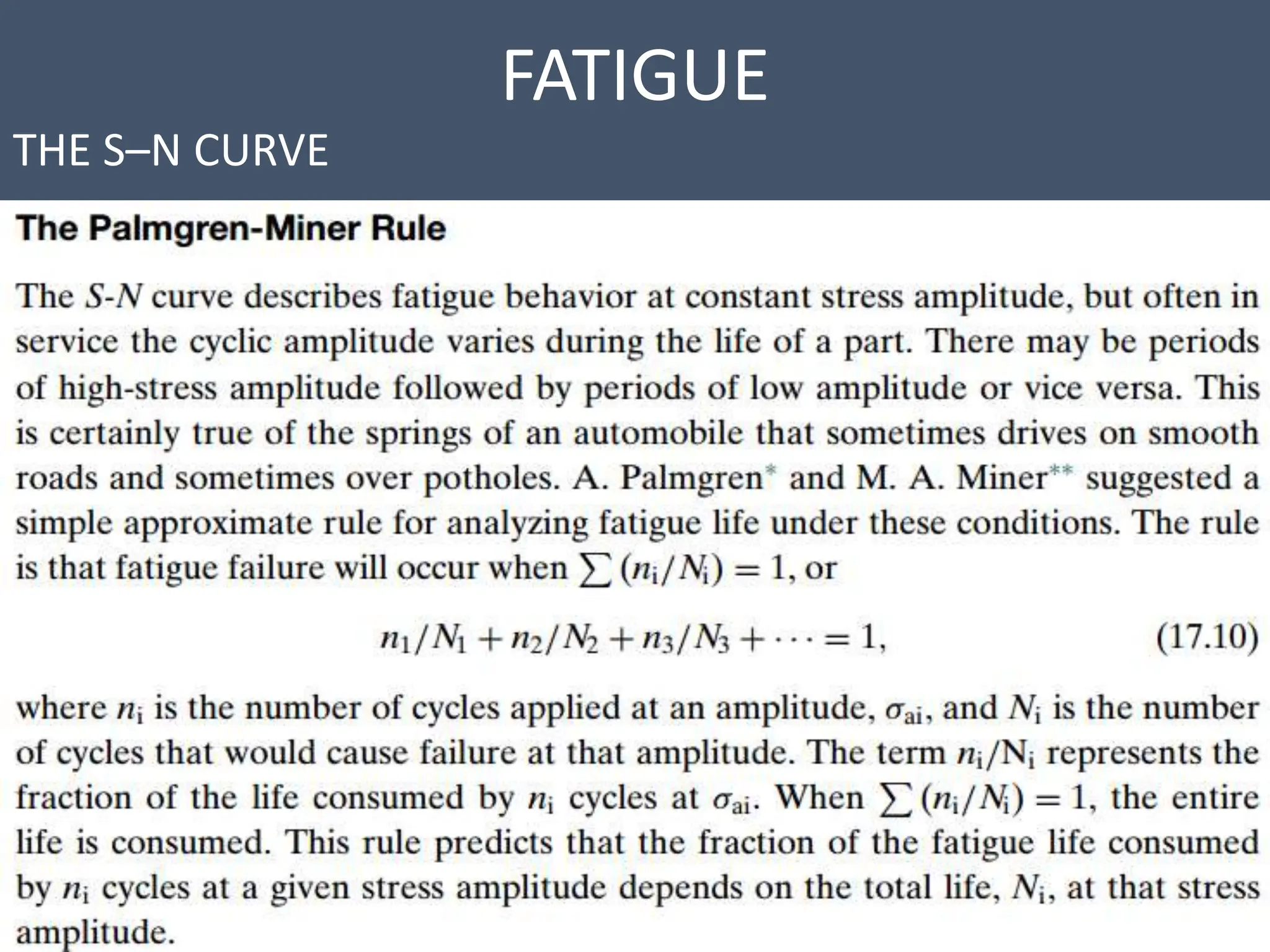
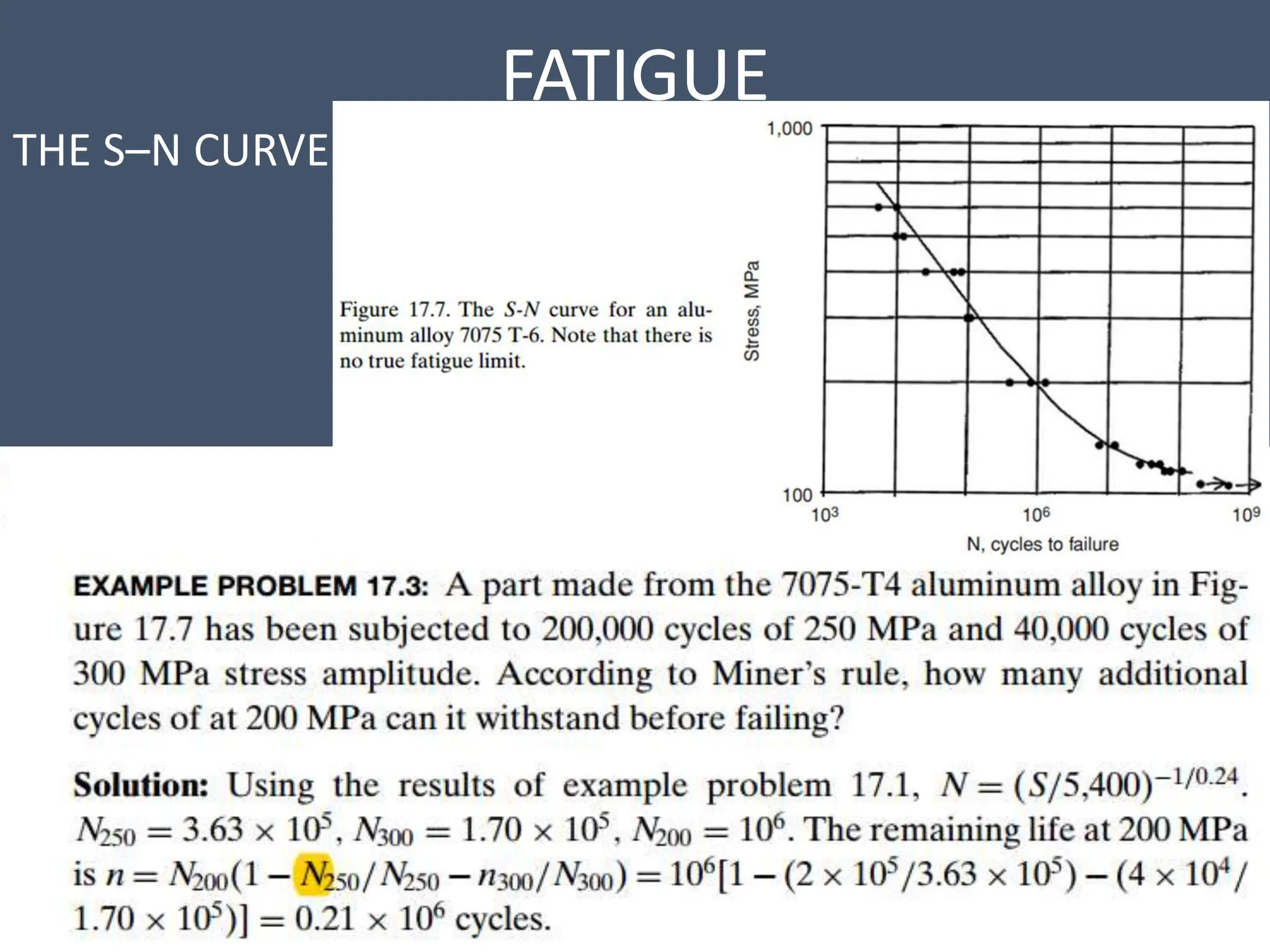
 If the S-N curve is plotted as log(S) against log(N), as in
Figures 17.6 and 17.7, a straight line often results for
𝑁 < 106. In this case, the relation may be expressed as
FATIGUE
THE S–N CURVE
FATIGUE
THE S–N CURVE
FATIGUE
THE S–N CURVE
FATIGUE
THE S–N CURVE
FATIGUE
THE S–N CURVE
CRACK INITIATION AND PROPAGATION
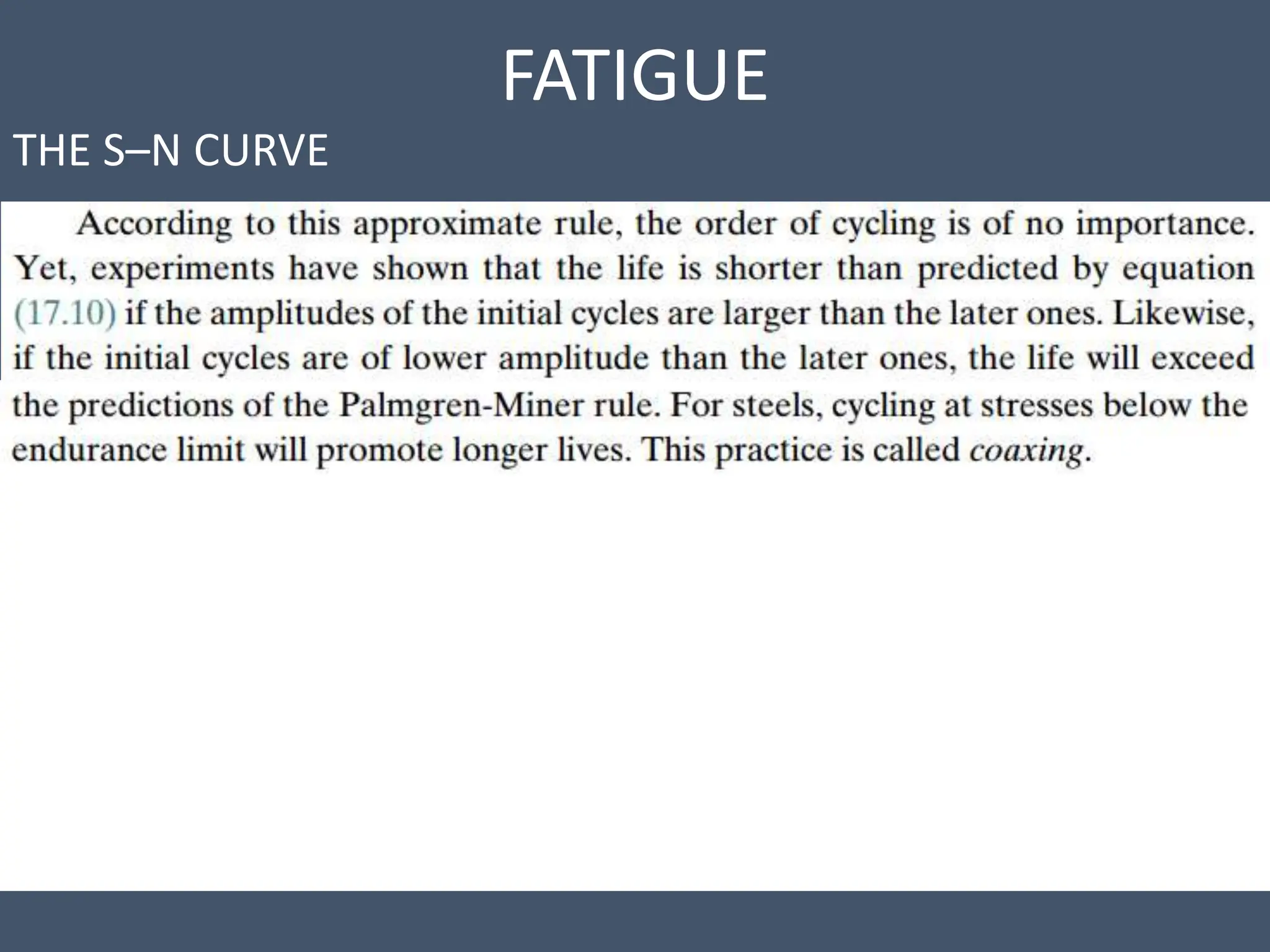
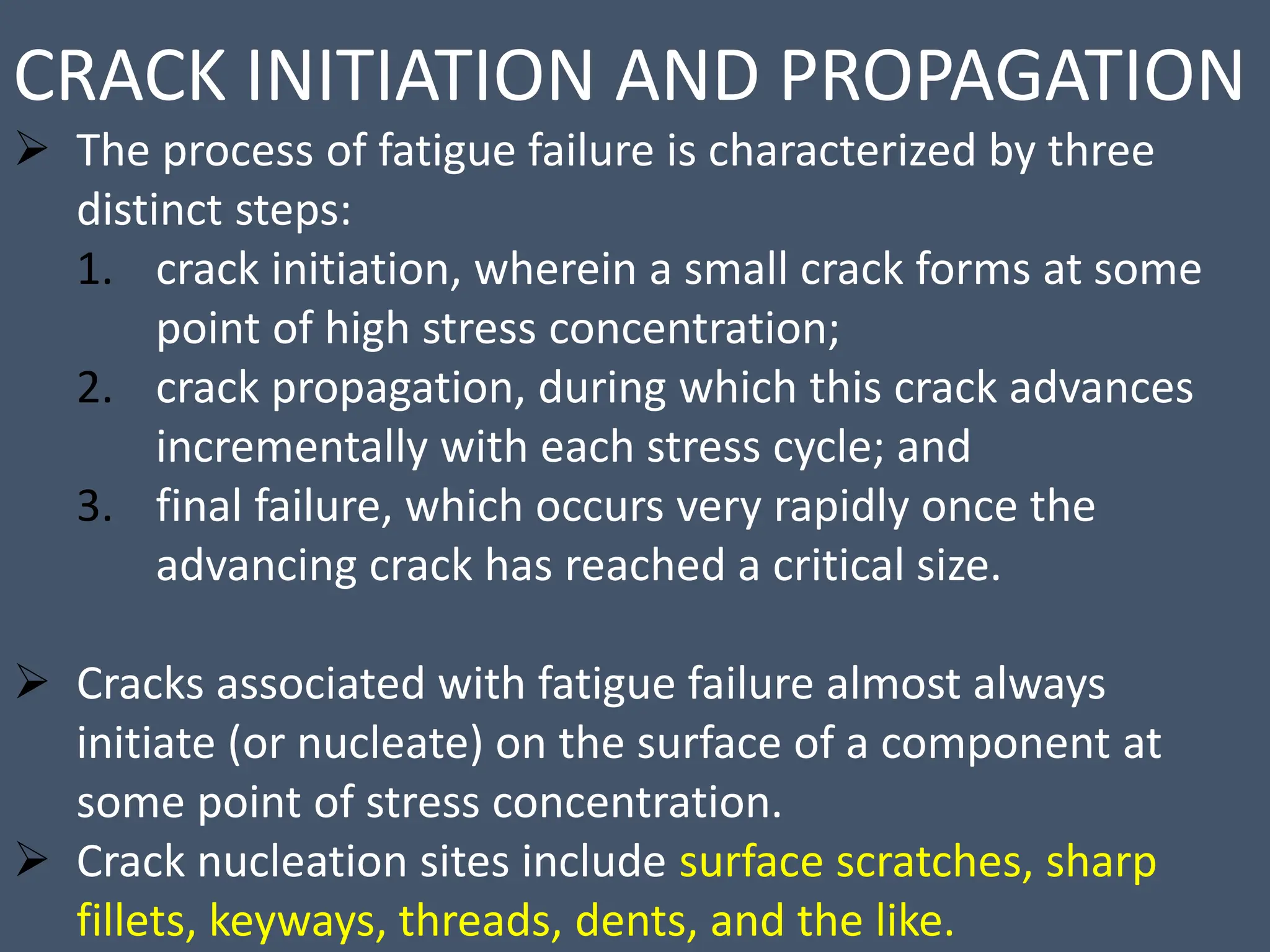
 The process of fatigue failure is characterized by three
distinct steps:
1. crack initiation, wherein a small crack forms at some
point of high stress concentration;
2. crack propagation, during which this crack advances
incrementally with each stress cycle; and
3. final failure, which occurs very rapidly once the
advancing crack has reached a critical size.
 Cracks associated with fatigue failure almost always
initiate (or nucleate) on the surface of a component at
some point of stress concentration.
 Crack nucleation sites include surface scratches, sharp
fillets, keyways, threads, dents, and the like.
FACTORS THAT AFFECT FATIGUE LIFE
 Measures that may be taken to extend fatigue life include
the following:
i. Reducing the mean stress level
ii. Eliminating sharp surface discontinuities
iii. Improving the surface finish by polishing
iv. Case hardening by using a carburizing or nitriding
process
ENVIRONMENTAL EFFECTS
 Thermal stresses may be induced in components that are
exposed to elevated temperature fluctuations and when
thermal expansion and/or contraction is restrained;
fatigue for these conditions is termed thermal fatigue.
 The presence of a chemically active environment may lead
to a reduction in fatigue life for corrosion fatigue.
Measures that may be taken to prevent this type of fatigue
include the following:
i. Application of a surface coating
ii. Utilization of a more corrosion-resistant material
iii. Reducing the corrosiveness of the environment
iv. Reducing the applied tensile stress level

ENGINEERING MATERIALS - Mechanical Properties and Testing.pptx

  • 1.
  • 2.
    OUTLINE  INTRODUCTION  FUNDAMENTALSOF FRACTURE  FRACTURE TOUGHNESS TESTING  FATIGUE  CRACK INITIATION AND PROPAGATION  FACTORS THAT AFFECT FATIGUE LIFE  ENVIRONMENTAL EFFECTS
  • 3.
    INTRODUCTION  The failureof engineering materials is almost always an undesirable event for several reasons; these include human lives that are put in jeopardy, economic losses, and interference with the availability of products and services.  Even though the causes of failure and the behavior of materials may be known, prevention of failures is difficult to guarantee.  The three usual causes of failure are  Improper materials selection and processing  Inadequate component design  Component misuse
  • 4.
    FUNDAMENTALS OF FRACTURE Simple fracture is the separation of a body into two or more pieces in response to an imposed stress that is static (i.e., constant or slowly changing with time) and at temperatures that are low relative to the melting temperature of the material.  Fracture can also occur from fatigue (when cyclic stresses are imposed) and creep (time-dependent deformation, normally at elevated temperatures)
  • 5.
    FUNDAMENTALS OF FRACTURE Fracture, in response to tensile loading and at relatively low temperatures, may occur by ductile and brittle modes.  Ductile fracture is normally preferred because: i. Preventive measures may be taken inasmuch as evidence of plastic deformation indicate that fracture is imminent, and ii. More energy is required to induce ductile fracture than for brittle fracture.  For brittle materials, cracks are unstable—that is, crack propagation, once started, will continue spontaneously without an increase in stress level.
  • 6.
    DUCTILE FRACTURE  Forductile metals, two tensile fracture profiles are possible: o Necking down to a point fracture when ductility is high (Figure 8.1a), and o Only moderate necking with a cup-and-cone fracture profile (Figure 8.1b), when the material is less ductile.
  • 7.
    DUCTILE FRACTURE  Theconfiguration shown in Figure 8.1a is found for extremely soft metals, such as pure gold and lead at room temperature, and other metals, polymers, and inorganic glasses at elevated temperatures.  These highly ductile materials neck down to a point fracture, showing virtually 100% reduction in area.
  • 8.
    DUCTILE FRACTURE  Thefracture process in (Figure 8.2) normally occurs in several stages: i. First, after necking begins, small cavities, or microvoids, form in the interior of the cross section, as indicated in Figure 8.2b.
  • 9.
    DUCTILE FRACTURE i. Next,as deformation continues, these microvoids enlarge, come together, and coalesce to form an elliptical crack, which has its long axis perpendicular to the stress direction. The crack continues to grow in a direction parallel to its major axis by this microvoid coalescence process (Figure 8.2c). ii. Finally, fracture ensues by the rapid propagation of a crack around the outer perimeter of the neck (Figure 8.2d)
  • 10.
    BRITTLE FRACTURE  Brittlefracture takes place without any appreciable deformation and by rapid crack propagation.  For brittle fracture, the fracture surface is relatively flat and perpendicular to the direction of the applied tensile load (Figure 8.1c).  For most brittle crystalline materials, crack propagation corresponds to the successive and repeated breaking of atomic bonds along specific crystallographic planes (Figure 8.6a); such a process is termed cleavage.
  • 11.
    BRITTLE FRACTURE  Thistype of fracture is said to be transgranular (or transcrystalline), because the fracture cracks pass through the grains.
  • 12.
    BRITTLE FRACTURE  Insome alloys, crack propagation is along grain boundaries (Figure 8.7a); this fracture is termed intergranular.  Figure 8.7b is a scanning electron micrograph showing a typical intergranular fracture, in which the three- dimensional nature of the grains may be seen.  This type of fracture normally results subsequent to the occurrence of processes that weaken or embrittle grain boundary regions.
  • 13.
  • 14.
    FRACTURE TOUGHNESS TESTING A number of different standardized tests have been devised to measure the fracture toughness values for structural materials.  For each test type, the specimen (of specified geometry and size) contains a preexisting defect, usually a sharp crack that has been introduced.  The test apparatus loads the specimen at a specified rate, and also measures load and crack displacement values.  Data are subjected to analyses to ensure that they meet established criteria before the fracture toughness values are deemed acceptable.
  • 15.
    FRACTURE TOUGHNESS TESTING Most tests are for metals, but some have also been developed for ceramics, polymers, and composites.  Three factors that may cause a metal to experience a ductile-to-brittle transition are exposure to: 1. Stresses at relatively low temperatures, 2. High strain rates(i.e., rate of deformation), and 3. The presence of a sharp notch.
  • 16.
    FRACTURE TOUGHNESS TESTING Two standardized tests, the Charpy and Izod, were designed and are still used to measure the impact energy (sometimes also termed notch toughness).(Figure 8.12).  The Charpy V-notch (CVN) technique is most commonly used in the United States.  For both Charpy and Izod, the specimen is in the shape of a bar of square cross section, into which a V-notch is machined (Figure 8.12a).  The apparatus for making V-notch impact tests is illustrated schematically in Figure 8.12b.
  • 17.
  • 18.
    FRACTURE TOUGHNESS TESTING The load is applied as an impact blow from a weighted pendulum hammer that is released from a cocked position at a fixed height h.  The specimen is positioned at the base as shown. Upon release, a knife edge mounted on the pendulum strikes and fractures the specimen at the notch, which acts as a point of stress concentration for this high-velocity impact blow.  The pendulum continues its swing, rising to a maximum height ℎ′, which is lower than h.
  • 19.
    FRACTURE TOUGHNESS TESTING The energy absorption, computed from the difference between h and ℎ′, is a measure of the impact energy.  The primary difference between the Charpy and Izod techniques lies in the manner of specimen support, as illustrated in Figure 8.12b.  Furthermore, these are termed impact tests in light of the manner of load application.
  • 20.
    FRACTURE TOUGHNESS TESTING Variables including specimen size and shape as well as notch configuration and depth influence the test results.  Both plane strain fracture toughness and these impact tests have been used to determine the fracture properties of materials.  The former are quantitative in nature, in that a specific property of the material is determined.  The results of the impact tests, on the other hand, are more qualitative and are of little use for design purposes.
  • 21.
    FRACTURE TOUGHNESS TESTING One of the primary functions of Charpy and Izod tests is to determine whether a material experiences a ductile-to- brittle transition with decreasing temperature and, if so, the range of temperatures over which it occurs.  The ductile to-brittle transition is related to the temperature dependence of the measured impact energy absorption.  This transition is represented for a steel by curve A in Figure 8.13.
  • 22.
  • 23.
    FRACTURE TOUGHNESS TESTING At higher temperatures the CVN energy is relatively large, in correlation with a ductile mode of fracture.  As the temperature is lowered, the impact energy drops suddenly over a relatively narrow temperature range, below which the energy has a constant but small value; that is, the mode of fracture is brittle.  On the basis of the temperature dependence of measured impact energy (or appearance of the fracture surface), it is possible to ascertain whether a material experiences a ductile-to-brittle transition and the temperature range over which such a transition occurs.
  • 24.
    FRACTURE TOUGHNESS TESTING Alternatively, appearance of the failure surface is indicative of the nature of fracture and may be used in transition temperature determinations.  For ductile fracture this surface appears fibrous or dull (or of shear character), as in the steel specimen of Figure 8.14 that was tested at 79°C.  Conversely, totally brittle surfaces have a granular (shiny) texture (or cleavage character) (the -59°C specimen, Figure 8.14).
  • 25.
  • 26.
    FATIGUE  Fatigue isa form of failure that occurs in structures subjected to dynamic and fluctuating stresses (e.g., bridges, aircraft, and machine components).  The term fatigue is used because this type of failure normally occurs after a lengthy period of repeated stress or strain cycling.  Fatigue is important inasmuch as it is the single largest cause of failure in metals, estimated to comprise approximately 90% of all metallic failures; polymers and ceramics (except for glasses) are also susceptible to this type of failure.
  • 27.
    FATIGUE  Fatigue isa common type of catastrophic failure wherein the applied stress level fluctuates with time; it occurs when the maximum stress level may be considerably lower than the static tensile or yield strength.  Fatigue failure is brittle like in nature even in normally ductile metals, in that there is very little, if any, gross plastic deformation associated with failure.  The process occurs by the initiation and propagation of cracks, and ordinarily the fracture surface is perpendicular to the direction of an applied tensile stress.
  • 28.
    FATIGUE CYCLIC STRESSES  Theapplied stress may be axial (tension–compression), flexural (bending), or torsional (twisting) in nature.  Fluctuating stresses are categorized into three general stress-versus-time cycle modes: reversed, repeated, and random (Figure 8.17). Reversed and repeated are characterized in terms of mean stress, range of stress, and stress amplitude.
  • 29.
  • 30.
    FATIGUE THE S–N CURVE Test data are plotted as stress (normally stress amplitude) versus the logarithm of the number of cycles to failure.  For many metals and alloys, stress diminishes continuously with increasing number of cycles at failure; fatigue strength and fatigue life are parameters used to characterize the fatigue behavior of these materials (Figure 8.19b).
  • 31.
  • 32.
    FATIGUE THE S–N CURVE A schematic diagram of a rotating-bending test apparatus, commonly used for fatigue testing, is shown in Figure 8.18; the compression and tensile stresses are imposed on the specimen as it is simultaneously bent and rotated.
  • 33.
    FATIGUE THE S–N CURVE For other metals (e.g., ferrous and titanium alloys), at some point, stress ceases to decrease with, and becomes independent of, the number of cycles; the fatigue behavior of these materials is expressed in terms of fatigue limit (Figure 8.19a).
  • 34.
    FATIGUE THE S–N CURVE A series of tests are commenced by subjecting a specimen to the stress cycling at a relatively large maximum stress amplitude (𝜎𝑚𝑎𝑥), usually on the order of two-thirds of the static tensile strength; the number of cycles to failure is counted.  This procedure is repeated on other specimens at progressively decreasing maximum stress amplitudes. Data are plotted as stress S versus the logarithm of the number N of cycles to failure for each of the specimens.
  • 35.
    FATIGUE THE S–N CURVE Two distinct types of S–N behavior are observed, which are represented schematically in Figure 8.19.  As these plots indicate, the higher the magnitude of the stress, the smaller the number of cycles the material is capable of sustaining before failure.  For some ferrous (iron base) and titanium alloys, the S–N curve (Figure 8.19a) becomes horizontal at higher N values; or there is a limiting stress level, called the fatigue limit (also sometimes the endurance limit), below which fatigue failure will not occur.
  • 36.
    FATIGUE THE S–N CURVE This fatigue limit represents the largest value of fluctuating stress that will not cause failure for essentially an infinite number of cycles.  For many steels, fatigue limits range between 35% and 60% of the tensile strength.  Most nonferrous alloys (e.g., aluminum, copper, magnesium) do not have a fatigue limit, in that the S–N curve continues its downward trend at increasingly greater N values (Figure 8.19b).
  • 37.
    FATIGUE THE S–N CURVE Thus, fatigue will ultimately occur regardless of the magnitude of the stress.  For these materials, the fatigue response is specified as fatigue strength, which is defined as the stress level at which failure will occur for some specified number of cycles (e.g., 107 cycles).  The determination of fatigue strength is also demonstrated in Figure 8.19b.
  • 38.
    FATIGUE THE S–N CURVE Another important parameter that characterizes a material’s fatigue behavior is fatigue life 𝑁𝑓  Fatigue life 𝑁𝑓 is the number of cycles to cause failure at a specified stress level, as taken from the S–N plot (Figure 8.19b).  Unfortunately, there always exists considerable scatter in fatigue data—that is, a variation in the measured N value for a number of specimens tested at the same stress level.
  • 39.
    FATIGUE THE S–N CURVE This variation may lead to significant design uncertainties when fatigue life and/or fatigue limit (or strength) are being considered.  Fatigue S–N curves similar to those shown in Figure 8.19 represent “best fit” curves that have been drawn through average-value data points.
  • 40.
    FATIGUE THE S–N CURVE Several statistical techniques have been developed to specify fatigue life and fatigue limit in terms of probabilities.  One convenient way of representing data treated in this manner is with a series of constant probability curves, several of which are plotted in Figure 8.20.  The P value associated with each curve represents the probability of failure.
  • 41.
    FATIGUE THE S–N CURVE For example, at a stress of 200 MPa (30,000 psi), we would expect 1% of the specimens to fail at about 106 cycles and 50% to fail at about 2 × 10⁷ cycles, and so on.
  • 42.
    FATIGUE THE S–N CURVE If the S-N curve is plotted as log(S) against log(N), as in Figures 17.6 and 17.7, a straight line often results for 𝑁 < 106. In this case, the relation may be expressed as
  • 43.
  • 44.
  • 45.
  • 46.
  • 47.
  • 48.
    CRACK INITIATION ANDPROPAGATION  The process of fatigue failure is characterized by three distinct steps: 1. crack initiation, wherein a small crack forms at some point of high stress concentration; 2. crack propagation, during which this crack advances incrementally with each stress cycle; and 3. final failure, which occurs very rapidly once the advancing crack has reached a critical size.  Cracks associated with fatigue failure almost always initiate (or nucleate) on the surface of a component at some point of stress concentration.  Crack nucleation sites include surface scratches, sharp fillets, keyways, threads, dents, and the like.
  • 49.
    FACTORS THAT AFFECTFATIGUE LIFE  Measures that may be taken to extend fatigue life include the following: i. Reducing the mean stress level ii. Eliminating sharp surface discontinuities iii. Improving the surface finish by polishing iv. Case hardening by using a carburizing or nitriding process
  • 50.
    ENVIRONMENTAL EFFECTS  Thermalstresses may be induced in components that are exposed to elevated temperature fluctuations and when thermal expansion and/or contraction is restrained; fatigue for these conditions is termed thermal fatigue.  The presence of a chemically active environment may lead to a reduction in fatigue life for corrosion fatigue. Measures that may be taken to prevent this type of fatigue include the following: i. Application of a surface coating ii. Utilization of a more corrosion-resistant material iii. Reducing the corrosiveness of the environment iv. Reducing the applied tensile stress level