T E C H N I C A L              N EW S L E T T E R

                               Impact and plastics

Introduction
The impact performance of plastics is one of the key functional performance characteristics,
but it is also one of the least well understood and the most difficult properties to measure and
predict. Impact strength can be defined as “the ability of a plastic to withstand a rapidly
applied load,” but as with most things in the plastics world, it is not always as simple as that.

Most are familiar with plastics that fail in a “brittle” manner at room temperature and are easy
to break, therefore having low impact strength.             Some examples of these plastics are
polystyrene, PMMA, and unplasticized PVC. Equally, most are familiar with plastics that fail in
a “ductile” manner at room temperature, are difficult to break and therefore will have a higher
impact strength, such as PE, PP and plasticized PVC.

The impact performance of plastics is important for many applications such as:
• Car parts (in collisions and in normal use)
• Aircraft parts
• Drinks bottles
• Electronics enclosures and components
• Storage containers
• Toys
Failure under impact is one of the main failure mechanisms for plastics. Understanding what
happens under impact loads is fundamental to producing products that are fit for purpose.

The ductile-brittle transition in plastics
The stress-strain curve for a typical plastic is highly dependent on the temperature at which
the material is tested. At low temperatures, most plastics behave as brittle materials and there
is very little deformation or strain before failure. At high temperatures, most plastics behave
as ductile materials and there is considerable deformation before failure. This typical behavior
and a range of intermediate responses are shown in Figure 1:


                                              Page 1 of 7


                             Copyright ©2010 Zeus Industrial Products, Inc.
Figure 1: The effect of temperature and loading rate (strain rate) on the stress-strain
                           curve of a typical plastic material.
In previous technical newsletters, we have discussed the idea of “time-temperature
equivalence,” where the response of many plastics to loads at high temperatures is the same
as the response at slow loading rates. The shape of the stress-strain curve is also affected by
the rate of loading (the strain rate) and increasing the loading rate has much the same effect
as decreasing the temperature. At high loading rates, most plastics behave as brittle materials
and there is very little deformation or strain before failure. At low strain rates, most plastics
behave as ductile materials and there is considerable deformation before failure.

This fundamental change in failure mode from ductile to brittle failure is called the “ductile-
brittle transition” and is present in many materials (not simply plastics, but also many metals).
The ductile-brittle transition is perhaps best shown by looking at the amount of energy needed
for fracture (the area under the stress-strain curve) and how this varies with temperature and
loading rate. A schematic representation of the ductile-brittle transition for many materials is
shown in Figure 2:

                                                                         Ductile-brittle
                                                                        transition area
                        Energy needed for fracture


                                                                                       Ductile fracture


                                                          Brittle fracture


                                                              Increasing temperature
                                                                         or
                                                         Decreasing loading rate (strain rate)

                                                     Figure 2: The ductile-brittle transition


                                                                       Page 2 of 7


                                                      Copyright ©2010 Zeus Industrial Products, Inc.
Increasing the temperature or decreasing the loading rate eventually changes the fracture
mode from brittle and increases the energy needed for fracture. It is important to note that the
ductile-brittle transition occurs over a range of temperatures/loading rates and not at a
specific temperature/loading rate. There is no single value for the ductile-brittle transition
temperature. For most plastics, the ductile-brittle transition occurs in the region of the glass
transition temperature (T g ).

The glass transition temperature (T g ) is the temperature at which the polymer chains stop
being able to slither over one another. This is when the plastic begins to stiffen up and
effectively becomes a glassy solid. As with the ductile-brittle transition, the glass transition
                                                                             o
takes place over a range of temperature (between 10-50 C/50-122⁰F). Once a plastic has
been cooled below T g then, in general, it is stable and no other transitions occur. At
temperatures greatly below T g , plastics act as stiff and glassy solids, impact resistance is
hugely decreased, and low energy brittle failure becomes the main cause of failure. At
temperatures greatly above T g , plastics act as rubbery solids and impact failure does not
generally occur.

The fractography of brittle and ductile failure
Fractography (the study of fracture surfaces) reveals a distinct difference between brittle and
ductile fracture surfaces. Brittle fracture is characterized by a shiny, smooth surface and there
are often “parabolic markings,” which tend to point back to the crack initiation point or region.
On the contrary, ductile fracture is characterized by a dull, rough surface and significant
amounts of surface deformation (tearing). This is shown in Figure 3:

     Parabolic markings           Shiny smooth surface                Tear markings             Dull rough surface


    Crack                                                         Crack
  initiation              Crack direction                       initiation             Crack direction
   region                                                        region


                   Brittle fracture surface                                      Ductile fracture surface

                    Figure 3: Fracture surfaces for brittle and ductile failure
This difference in the fracture surface reflects the difference in the energy needed for failure.
The smooth surface of brittle fracture is the result of rapid crack propagation where very little
energy is used to separate the crack surfaces. The rough dull surface of ductile fracture is the
result of slower crack propagation where a lot of energy is used to separate the crack
surfaces.

Impact failure of plastics
Impact failure of plastics is always brittle failure, uses low amounts of energy to propagate the
crack, and has relatively smooth crack surfaces (compared to ductile failure). Failure under
impact loading is very important to product designers because it is always rapid and
catastrophic. There is no “safety net” of ductile failure and yield.                     Thus, the result is a
complete failure of the product.

                                                     Page 3 of 7


                                    Copyright ©2010 Zeus Industrial Products, Inc.
Despite the importance of impact failure to product designers, assessing the resistance of
finished product to impact failure is very hard. The impact strength of a sample of a given
material is relatively easy to assess from the standard tests (see below). It is the translation of
this impact resistance number into useful design data that presents the “real” problem.

Testing for impact performance
Impact testing measures the amount of energy used to fracture the material and is relatively
easy to perform. Some of the most common methods used are:

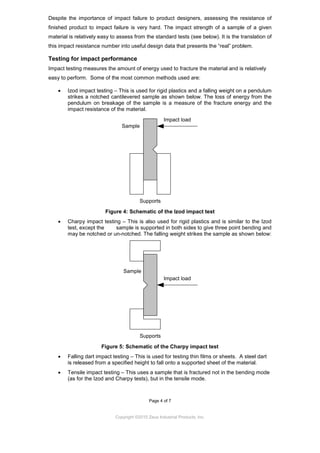
    •   Izod impact testing – This is used for rigid plastics and a falling weight on a pendulum
        strikes a notched cantilevered sample as shown below. The loss of energy from the
        pendulum on breakage of the sample is a measure of the fracture energy and the
        impact resistance of the material.
                                                     Impact load
                                Sample


                                         Supports

                         Figure 4: Schematic of the Izod impact test
    •   Charpy impact testing – This is also used for rigid plastics and is similar to the Izod
        test, except the    sample is supported in both sides to give three point bending and
        may be notched or un-notched. The falling weight strikes the sample as shown below:


                                 Sample
                                                     Impact load


                                         Supports

                       Figure 5: Schematic of the Charpy impact test
    •   Falling dart impact testing – This is used for testing thin films or sheets. A steel dart
        is released from a specified height to fall onto a supported sheet of the material.
    •   Tensile impact testing – This uses a sample that is fractured not in the bending mode
        (as for the Izod and Charpy tests), but in the tensile mode.


                                              Page 4 of 7


                             Copyright ©2010 Zeus Industrial Products, Inc.
Most of these tests provide similar results for similar materials and there is a very good
correlation between Izod and Charpy test results for plastics. Whichever method is used, the
fundamental problem is in relating the test results for a given material to the behavior of the
material in service, particularly when a complete product is considered. Impact testing can
provide a relative ranking of materials for a given test, but does not allow scale-up of the
results to larger samples and certainly does not allow assessment of the performance of a
given part in a specific application and under specific environmental conditions.

Toughness, which an impact test attempts to measure, is very sensitive to sample geometry
and loading conditions. Impact test results should therefore be used with great care. Testing
on production articles at the specific service conditions is necessary for confidence that the
product is suitable for use.

Improving the impact performance of materials and products
While it is difficult to predict the response of specific material or product design to impact
loading, there are a range of methods available to improve the impact performance of a
material or product. Designers need to be aware of these for both materials selection and
product design.

Materials
The impact resistance of a specific plastic is a function of many materials factors, but as a
general rule, any factor that improves the ductility of a plastic will increase the impact strength
of the material. The main methods used to improve impact performance of a material are:

        • Copolymers - Adding or grafting an impact resistant polymer to the main polymer
         chain can be use to form a copolymer with better impact properties. Perhaps the best
         know application of this method is the addition of butadiene rubber to styrene
         acrylonitrile (SAN) to produce acrylonitrile butadiene styrene (ABS). The rubbery
         butadiene molecules change the very brittle SAN into the more ductile and impact
         resistant ABS.

        • Blending polymers – Adding a second polymer (with better impact properties) to form
         a blend can improve impact performance. For example, adding PE-HD to PP can
         improve the impact performance of the PP. Addition of a rubbery material is
         particularly effective as the rubber phase deforms easily and slows down the crack.
         The addition of small amounts of rubber is used to improve the impact performance of
         PVC (i.e. impact modified PVC). Note: Producing a blend is not the same as forming
         a copolymer where the changes are in the actual polymer chains themselves.

    •    Plasticizers – The inclusion of plasticizers in plastics will make the plastic more
         flexible and increase the impact strength. One of the largest uses of this method is in
         PVC where plasticizers are used to convert the normally brittle unplasticized PVC into
         plasticized PVC with much better impact resistance.

    •    Crystallinity – High levels of crystallinity in a crystalline polymer tend to make the
         material stiffer and less impact resistant than similar materials with lower levels of
         crystallinity. This is because the large volumes of crystalline material tend to be
         difficult to move and reduce the ductility of the plastic.

    •    Reinforcement – Plastics containing reinforcements (e.g. fibers) are a special case for
         impact measurement. For most materials, high impact strength implies a “tough”
         ductile failure, but materials such as fiber reinforced polyesters can have very high

                                                Page 5 of 7


                               Copyright ©2010 Zeus Industrial Products, Inc.
impact strength as a complete material. This is despite the fact that the matrix fails in
        a brittle manner. This is because a large amount of energy is absorbed in the crack
        running along the fiber/matrix interface (debonding).
Product design
The main methods used to improve impact performance of a product are:
    •   Notch sensitivity – A notch or defect acts as a stress concentrator and impact failure
        will almost always occur at these stress concentrators. For any material, the presence
        of a notch or defect will reduce the impact strength because of high stress levels at
        the notch or defect. Reducing the radius of the notch or the effective defect radius will
        increase the impact strength and other stress related service properties. Product
        designers should recognize this and product designs should always include generous
        corner radii to remove stress concentrations. Increasing the number or size of
        notches present in the material or part will lead to a decrease in impact resistance.
        Note: Some materials are more sensitive to the presence of stress concentrators
        than others. They are termed “notch sensitive.” For these materials, the presence of a
        notch will reduce the impact strength even more than for materials that are relatively
        “notch insensitive.”
    •   Orientation – The impact strength of a material depends on the orientation of the
        polymer chains and will be less when the load is applied parallel to the polymer
        chains than when the load is applied across the polymer chains. Tooling designs or
        practices that lead to high degrees of post-molding orientation will result in products
        that are more susceptible to impact failure in certain directions.
Summary
Impact loading and the resultant brittle failure is a major cause of catastrophic failure in
plastics products. Designing products to be impact resistant is a combination of intelligent
materials selection and good design practices. The selection of the best material for impact
resistance can be assisted by testing, but test results provide a ranking of materials rather
than a design parameter. Design for impact resistance is critical. Product designers need not
only follow good design principles, but also be aware of the potential for tooling to adversely
affect the impact resistance of the final product.

How Zeus Can Help

Capitalizing on more than 40 years of polymer experience, Zeus is able to assist with material
selection and product development. Whether your application requires impact resistance or
high tensile strength, we can help you determine the material that is most suitable for your
application. With a technical inside and outside sales force backed up with engineering and
polymer experts, Zeus is prepared to assist in material selection and can provide product
samples for evaluation. A dedicated R&D department staffed with PHD polymer chemists
and supported by a world-class analytical lab allows Zeus an unparalleled position in polymer
development and customization.

Don’t miss the next newsletter
Thanks for joining us to discuss the impact performance of plastics. If you have any
questions about our advanced materials or engineered tubing, contact us at 1-800-526-3842
(toll-free) or e-mail directly at support@zeusinc.com. Samples are available.


The Zeus Polymer Minute
                                              Page 6 of 7


                             Copyright ©2010 Zeus Industrial Products, Inc.
Email: editor@zeusinc.com


Full Archive
Remember, our full archive (free to all newsletter subscribers) is located here:
http://www.zeusinc.com/technicalservices/technicalbulletins/technicalnewsletters.aspx


Subscribe/Unsubscribe

Contact Us
Additional technical support is available by contacting a Zeus technical account manager at:
(toll free) 1-800-526-3842 or international 0001-803-268-9500.

Zeus Industrial Products, Inc.
3737 Industrial Boulevard
Orangeburg, SC 29118
support@zeusinc.com


                                             Page 7 of 7


                            Copyright ©2010 Zeus Industrial Products, Inc.

Zeus impactand plastics

  • 1.
    T E CH N I C A L N EW S L E T T E R Impact and plastics Introduction The impact performance of plastics is one of the key functional performance characteristics, but it is also one of the least well understood and the most difficult properties to measure and predict. Impact strength can be defined as “the ability of a plastic to withstand a rapidly applied load,” but as with most things in the plastics world, it is not always as simple as that. Most are familiar with plastics that fail in a “brittle” manner at room temperature and are easy to break, therefore having low impact strength. Some examples of these plastics are polystyrene, PMMA, and unplasticized PVC. Equally, most are familiar with plastics that fail in a “ductile” manner at room temperature, are difficult to break and therefore will have a higher impact strength, such as PE, PP and plasticized PVC. The impact performance of plastics is important for many applications such as: • Car parts (in collisions and in normal use) • Aircraft parts • Drinks bottles • Electronics enclosures and components • Storage containers • Toys Failure under impact is one of the main failure mechanisms for plastics. Understanding what happens under impact loads is fundamental to producing products that are fit for purpose. The ductile-brittle transition in plastics The stress-strain curve for a typical plastic is highly dependent on the temperature at which the material is tested. At low temperatures, most plastics behave as brittle materials and there is very little deformation or strain before failure. At high temperatures, most plastics behave as ductile materials and there is considerable deformation before failure. This typical behavior and a range of intermediate responses are shown in Figure 1: Page 1 of 7 Copyright ©2010 Zeus Industrial Products, Inc.
  • 2.
    Figure 1: Theeffect of temperature and loading rate (strain rate) on the stress-strain curve of a typical plastic material. In previous technical newsletters, we have discussed the idea of “time-temperature equivalence,” where the response of many plastics to loads at high temperatures is the same as the response at slow loading rates. The shape of the stress-strain curve is also affected by the rate of loading (the strain rate) and increasing the loading rate has much the same effect as decreasing the temperature. At high loading rates, most plastics behave as brittle materials and there is very little deformation or strain before failure. At low strain rates, most plastics behave as ductile materials and there is considerable deformation before failure. This fundamental change in failure mode from ductile to brittle failure is called the “ductile- brittle transition” and is present in many materials (not simply plastics, but also many metals). The ductile-brittle transition is perhaps best shown by looking at the amount of energy needed for fracture (the area under the stress-strain curve) and how this varies with temperature and loading rate. A schematic representation of the ductile-brittle transition for many materials is shown in Figure 2: Ductile-brittle transition area Energy needed for fracture Ductile fracture Brittle fracture Increasing temperature or Decreasing loading rate (strain rate) Figure 2: The ductile-brittle transition Page 2 of 7 Copyright ©2010 Zeus Industrial Products, Inc.
  • 3.
    Increasing the temperatureor decreasing the loading rate eventually changes the fracture mode from brittle and increases the energy needed for fracture. It is important to note that the ductile-brittle transition occurs over a range of temperatures/loading rates and not at a specific temperature/loading rate. There is no single value for the ductile-brittle transition temperature. For most plastics, the ductile-brittle transition occurs in the region of the glass transition temperature (T g ). The glass transition temperature (T g ) is the temperature at which the polymer chains stop being able to slither over one another. This is when the plastic begins to stiffen up and effectively becomes a glassy solid. As with the ductile-brittle transition, the glass transition o takes place over a range of temperature (between 10-50 C/50-122⁰F). Once a plastic has been cooled below T g then, in general, it is stable and no other transitions occur. At temperatures greatly below T g , plastics act as stiff and glassy solids, impact resistance is hugely decreased, and low energy brittle failure becomes the main cause of failure. At temperatures greatly above T g , plastics act as rubbery solids and impact failure does not generally occur. The fractography of brittle and ductile failure Fractography (the study of fracture surfaces) reveals a distinct difference between brittle and ductile fracture surfaces. Brittle fracture is characterized by a shiny, smooth surface and there are often “parabolic markings,” which tend to point back to the crack initiation point or region. On the contrary, ductile fracture is characterized by a dull, rough surface and significant amounts of surface deformation (tearing). This is shown in Figure 3: Parabolic markings Shiny smooth surface Tear markings Dull rough surface Crack Crack initiation Crack direction initiation Crack direction region region Brittle fracture surface Ductile fracture surface Figure 3: Fracture surfaces for brittle and ductile failure This difference in the fracture surface reflects the difference in the energy needed for failure. The smooth surface of brittle fracture is the result of rapid crack propagation where very little energy is used to separate the crack surfaces. The rough dull surface of ductile fracture is the result of slower crack propagation where a lot of energy is used to separate the crack surfaces. Impact failure of plastics Impact failure of plastics is always brittle failure, uses low amounts of energy to propagate the crack, and has relatively smooth crack surfaces (compared to ductile failure). Failure under impact loading is very important to product designers because it is always rapid and catastrophic. There is no “safety net” of ductile failure and yield. Thus, the result is a complete failure of the product. Page 3 of 7 Copyright ©2010 Zeus Industrial Products, Inc.
  • 4.
    Despite the importanceof impact failure to product designers, assessing the resistance of finished product to impact failure is very hard. The impact strength of a sample of a given material is relatively easy to assess from the standard tests (see below). It is the translation of this impact resistance number into useful design data that presents the “real” problem. Testing for impact performance Impact testing measures the amount of energy used to fracture the material and is relatively easy to perform. Some of the most common methods used are: • Izod impact testing – This is used for rigid plastics and a falling weight on a pendulum strikes a notched cantilevered sample as shown below. The loss of energy from the pendulum on breakage of the sample is a measure of the fracture energy and the impact resistance of the material. Impact load Sample Supports Figure 4: Schematic of the Izod impact test • Charpy impact testing – This is also used for rigid plastics and is similar to the Izod test, except the sample is supported in both sides to give three point bending and may be notched or un-notched. The falling weight strikes the sample as shown below: Sample Impact load Supports Figure 5: Schematic of the Charpy impact test • Falling dart impact testing – This is used for testing thin films or sheets. A steel dart is released from a specified height to fall onto a supported sheet of the material. • Tensile impact testing – This uses a sample that is fractured not in the bending mode (as for the Izod and Charpy tests), but in the tensile mode. Page 4 of 7 Copyright ©2010 Zeus Industrial Products, Inc.
  • 5.
    Most of thesetests provide similar results for similar materials and there is a very good correlation between Izod and Charpy test results for plastics. Whichever method is used, the fundamental problem is in relating the test results for a given material to the behavior of the material in service, particularly when a complete product is considered. Impact testing can provide a relative ranking of materials for a given test, but does not allow scale-up of the results to larger samples and certainly does not allow assessment of the performance of a given part in a specific application and under specific environmental conditions. Toughness, which an impact test attempts to measure, is very sensitive to sample geometry and loading conditions. Impact test results should therefore be used with great care. Testing on production articles at the specific service conditions is necessary for confidence that the product is suitable for use. Improving the impact performance of materials and products While it is difficult to predict the response of specific material or product design to impact loading, there are a range of methods available to improve the impact performance of a material or product. Designers need to be aware of these for both materials selection and product design. Materials The impact resistance of a specific plastic is a function of many materials factors, but as a general rule, any factor that improves the ductility of a plastic will increase the impact strength of the material. The main methods used to improve impact performance of a material are: • Copolymers - Adding or grafting an impact resistant polymer to the main polymer chain can be use to form a copolymer with better impact properties. Perhaps the best know application of this method is the addition of butadiene rubber to styrene acrylonitrile (SAN) to produce acrylonitrile butadiene styrene (ABS). The rubbery butadiene molecules change the very brittle SAN into the more ductile and impact resistant ABS. • Blending polymers – Adding a second polymer (with better impact properties) to form a blend can improve impact performance. For example, adding PE-HD to PP can improve the impact performance of the PP. Addition of a rubbery material is particularly effective as the rubber phase deforms easily and slows down the crack. The addition of small amounts of rubber is used to improve the impact performance of PVC (i.e. impact modified PVC). Note: Producing a blend is not the same as forming a copolymer where the changes are in the actual polymer chains themselves. • Plasticizers – The inclusion of plasticizers in plastics will make the plastic more flexible and increase the impact strength. One of the largest uses of this method is in PVC where plasticizers are used to convert the normally brittle unplasticized PVC into plasticized PVC with much better impact resistance. • Crystallinity – High levels of crystallinity in a crystalline polymer tend to make the material stiffer and less impact resistant than similar materials with lower levels of crystallinity. This is because the large volumes of crystalline material tend to be difficult to move and reduce the ductility of the plastic. • Reinforcement – Plastics containing reinforcements (e.g. fibers) are a special case for impact measurement. For most materials, high impact strength implies a “tough” ductile failure, but materials such as fiber reinforced polyesters can have very high Page 5 of 7 Copyright ©2010 Zeus Industrial Products, Inc.
  • 6.
    impact strength asa complete material. This is despite the fact that the matrix fails in a brittle manner. This is because a large amount of energy is absorbed in the crack running along the fiber/matrix interface (debonding). Product design The main methods used to improve impact performance of a product are: • Notch sensitivity – A notch or defect acts as a stress concentrator and impact failure will almost always occur at these stress concentrators. For any material, the presence of a notch or defect will reduce the impact strength because of high stress levels at the notch or defect. Reducing the radius of the notch or the effective defect radius will increase the impact strength and other stress related service properties. Product designers should recognize this and product designs should always include generous corner radii to remove stress concentrations. Increasing the number or size of notches present in the material or part will lead to a decrease in impact resistance. Note: Some materials are more sensitive to the presence of stress concentrators than others. They are termed “notch sensitive.” For these materials, the presence of a notch will reduce the impact strength even more than for materials that are relatively “notch insensitive.” • Orientation – The impact strength of a material depends on the orientation of the polymer chains and will be less when the load is applied parallel to the polymer chains than when the load is applied across the polymer chains. Tooling designs or practices that lead to high degrees of post-molding orientation will result in products that are more susceptible to impact failure in certain directions. Summary Impact loading and the resultant brittle failure is a major cause of catastrophic failure in plastics products. Designing products to be impact resistant is a combination of intelligent materials selection and good design practices. The selection of the best material for impact resistance can be assisted by testing, but test results provide a ranking of materials rather than a design parameter. Design for impact resistance is critical. Product designers need not only follow good design principles, but also be aware of the potential for tooling to adversely affect the impact resistance of the final product. How Zeus Can Help Capitalizing on more than 40 years of polymer experience, Zeus is able to assist with material selection and product development. Whether your application requires impact resistance or high tensile strength, we can help you determine the material that is most suitable for your application. With a technical inside and outside sales force backed up with engineering and polymer experts, Zeus is prepared to assist in material selection and can provide product samples for evaluation. A dedicated R&D department staffed with PHD polymer chemists and supported by a world-class analytical lab allows Zeus an unparalleled position in polymer development and customization. Don’t miss the next newsletter Thanks for joining us to discuss the impact performance of plastics. If you have any questions about our advanced materials or engineered tubing, contact us at 1-800-526-3842 (toll-free) or e-mail directly at support@zeusinc.com. Samples are available. The Zeus Polymer Minute Page 6 of 7 Copyright ©2010 Zeus Industrial Products, Inc.
  • 7.
    Email: editor@zeusinc.com Full Archive Remember,our full archive (free to all newsletter subscribers) is located here: http://www.zeusinc.com/technicalservices/technicalbulletins/technicalnewsletters.aspx Subscribe/Unsubscribe Contact Us Additional technical support is available by contacting a Zeus technical account manager at: (toll free) 1-800-526-3842 or international 0001-803-268-9500. Zeus Industrial Products, Inc. 3737 Industrial Boulevard Orangeburg, SC 29118 support@zeusinc.com Page 7 of 7 Copyright ©2010 Zeus Industrial Products, Inc.