LLNL-PRES-XXXXXX
This work was performed under the auspices of the U.S. Department
of Energy by Lawrence Livermore National Laboratory under contract
DE-AC52-07NA27344. Lawrence Livermore National Security, LLC
Fokker-Planck Modeling of Heat
Conduction in NIF Hohlraums
HEDP Summer Student Presentation
25 August 2015
LLNL-PRES-676532
Lawrence Livermore National Laboratory LLNL-PRES-xxxxxx
2
Thanks to
•  Andy Cook and Summer Student Program
•  D. J. Strozzi (LLNL) – mentor
•  A. Tableman, B. Winjum (UCLA) – much help with OSHUN
•  I. Heinz (LLNL) – computer support
Lawrence Livermore National Laboratory LLNL-PRES-xxxxxx
3
Motivation
§  Electron heat conduction: long-standing issue in inertial fusion and
laser-produced plasmas
§  Local treatment for collision-dominated, short mean-free-path
plasma: Spitzer and Härm, Phys. Rev. 1953
§  Heat flux reduced from Spitzer-Härm by:
•  Non-locality: electrons with v=(2-4) thermal speed carry flux.
Less collisional than thermals. Become “de-localized,” no net flux
•  Return current instability: bulk electrons drift relative to ions
—  Triggers ion-acoustic instability
—  Recent interest on NIF and Omega: C. Thomas, M. Rosen
•  Magnetic fields: reduce heat flux across field
( )
3
... heat flux thermal conductivity
2
e e e
d
n T T
dt
κ κ= ∇ ⋅ + ≡ ∇ = ≡Q Q
Lawrence Livermore National Laboratory LLNL-PRES-xxxxxx
4
Relevance to NIF
§  Understanding heat flux is crucial to understanding ICF experiments
§  Electron Flux Limit f
•  Traditional “kludge” to match experimental data:
§  Pre-2009, low (x-ray) flux model
•  XSN atomic physics
•  f=0.05
§  Post-2009, high flux model (M. Rosen et al., High Energy Density
Physics, 2011) to match NIF data
•  DCA atomic physics
•  f=0.15
Q = min{ f *ne
me
vTe
3
, QSpitzer−H!!arm
}
Goal of this work:
Fokker-Planck modeling of heat flux in NIF hohlraums
Lawrence Livermore National Laboratory LLNL-PRES-xxxxxx
5
Kinetic Theory
§  Distribution function: f(x, v) = density of particles at phase-space
location (x, v)
§  Boltzmann equation: governs evolution of f for weak particle
correlations (for experts: f2 = f1* f1 molecular chaos assumption)
§  Fokker-Planck equation: small-angle scattering limit of
Boltzmann equation
§  Collisions entail many, small, independent momentum kicks,
e.g. weakly-coupled plasma (fails for strong coupling)
∂f
∂t
+ v⋅∇f +
q
m
E+
v×B
c
⋅∇v f =
δ f
δt collisions
δ f
δt collisions
= −
∂
∂v
⋅ f Δv%& '(+
1
2
∂
∂v
∂
∂v
: f ΔvΔv%& '(
Lawrence Livermore National Laboratory LLNL-PRES-xxxxxx
6
§  Developed by M. Tzoufras, maintained at UCLA by Prof. W. Mori’s
group
§  We use 1D relativistic Python version, kinetic electrons, fixed ions:
§  Spherical harmonic expansion in velocity space:
§  Collision Operators:
•  Electron-ion: immobile ions; pitch-angle scattering, or Lorentz gas:
damping rate increases with L mode number
•  Electron-electron (self collisions): included, complicated…
OSHUN: Vlasov-Fokker-Planck code
∂fe
∂t
+ v⋅∇fe −
eE
me
⋅∇v fe = Cee +Cei
v = v(cosϕ sinθ,sinϕ sinθ,cosθ)fe (r,v,t) = fl
m
m=−l
l
∑ (r,v,t)Pl
m
(cosθ)eimϕ
l=0
∞
∑
δ f
δt collisions
=υpa
∂µ
(1−µ2
)∂µ
f#
$
%
& → Cei
[ fl
m
]=
δ fl
m
δt ei
= −l(l +1)
ni
Γei
2v3
fl
m
E = E(z)ˆz
Lawrence Livermore National Laboratory LLNL-PRES-xxxxxx
7
§  Fluid variables: velocity moments of distribution
§  Fluid equations: moments of Boltzmann equation
Fluid Description, e.g. rad-hydro codes
Number density: n = f d3
∫ v
Drift velocity: u =
1
n
v∫ f d3
v
Temperature: T =
m
3n
| v − u |2
∫ f d3
v
Heat Flux: Q = (v − u)
m
2
| v − u |2
f d3
∫ v
Continuity Equation (n=0):
∂n
∂t
+ ∇⋅(nu) = 0
Momentum Transfer Equation (n=1): mn
∂
∂t
+ v⋅∇
$
%
&
'
(
)v = qn(E+ v×B)− ∇p+ R
Energy Transfer Equation (n=2):
∂
∂t
nmv2
2
+
3nkT
2
$
%
&
'
(
)− nqE⋅v + ∇⋅Q =
∂
∂t
nmv2
2
$
%
&
'
(
)
collisions
vn
f d3
v∫
Subject of
this work
Lawrence Livermore National Laboratory LLNL-PRES-xxxxxx
8
Spitzer-Härm Theory of Heat Flux
§  Local theory: mean free path << gradient scale lengths
§  Diffusive approximation: keep L=0,1:
§  Linearize f1 << f0, steady state d/dt=0, neglect e-e collisions here:
§  Steady-state: E field develops, so no net current
0 1
2
0 3/2
1 1
( , ) ( , ) ( , )
( , ) exp / 2 Maxwellian, ( ), ( ) vary in z
( , ) ( )cos
e
e e e e
e
f z f v z f z
n
f v z m v T n z T z
T
f z F v θ
= +
⎡ ⎤∝ −⎣ ⎦
=
v v
v
0 0
1z
z
f feE
v f
z m v
υ
∂ ∂
− ≅
∂ ∂
1
0
5
0
2
e e e
e
T dn dTE
J E
t en dz e dz
ε −∂
= − = → = − −
∂
Lawrence Livermore National Laboratory LLNL-PRES-xxxxxx
9
Spitzer-Härm heat flux carried by electrons
with vz = (2-4)x thermal speed
f0
f1
f0 + f1
qz0
qz0 + qz1
qz1
( )z x yf dv dv f= ∫ v
2
( )
2
z
x y z
z
q m
dv dv v v f
v
∂
=
∂ ∫ v
eT∇
Heat flux from f0(vz > 0) and f0(vz < 0) cancel.
Heat flux from f1 symmetric à net flux = red curve
Lawrence Livermore National Laboratory LLNL-PRES-xxxxxx
10
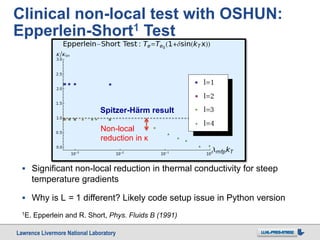
Clinical non-local test with OSHUN:
Epperlein-Short1 Test
§  Significant non-local reduction in thermal conductivity for steep
temperature gradients
§  Why is L = 1 different? Likely code setup issue in Python version
1E. Epperlein and R. Short, Phys. Fluids B (1991)
Spitzer-Härm result
Non-local
reduction in κ
Lawrence Livermore National Laboratory LLNL-PRES-xxxxxx
11
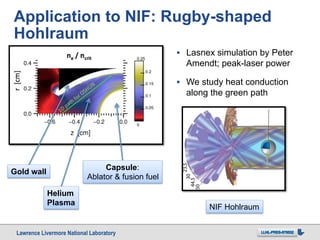
Application to NIF: Rugby-shaped
Hohlraum
§  Lasnex simulation by Peter
Amendt; peak-laser power
§  We study heat conduction
along the green path
Capsule:
Ablator & fusion fuel
Helium
Plasma
Gold wall
NIF Hohlraum
Lawrence Livermore National Laboratory LLNL-PRES-xxxxxx
12
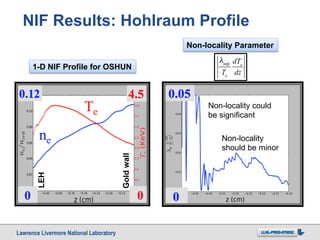
NIF Results: Hohlraum Profile
1-D NIF Profile for OSHUN
Non-locality Parameter
λmfp
Te
dTe
dz
Non-locality
should be minor
Non-locality could
be significant
LEH
Goldwall
Lawrence Livermore National Laboratory LLNL-PRES-xxxxxx
13
NIF Results: thermal conductivity
L = 2
L = 3
L = 4
Conductivity does not vary with
more L-modes
Spitzer-Härm Value
LEH:
Non-local
reduction
Gold wall:
Exceeds
Spitzer-Härm
Reflecting (non-periodic) boundaries
dx, dp, dt
dx/2, dp, dt
dx, dp/2, dt
dx, dp, dt/2
Grid size: Converged w.r.t. dx, dp
Slight dependence on dt
Lawrence Livermore National Laboratory LLNL-PRES-xxxxxx
14
Conclusions
•  OSHUN gives well-known non-local reduction of heat conduction with
steep temperature gradients
•  1D OSHUN runs on NIF profiles:
•  computationally cheap: less than 100 CPU-hours
•  Non-local reduction in heat conductivity in entrance hole
•  Exceeds Spitzer-Härm inside hohlraum - reflecting boundaries?
•  Mobile ions: capability being developed in OSHUN
•  Allow study of return current instability
•  2D simulations
•  Gold wall conditions
Future Work

Dublin- Talk 8.25.15 Final

  • 1.
    LLNL-PRES-XXXXXX This work wasperformed under the auspices of the U.S. Department of Energy by Lawrence Livermore National Laboratory under contract DE-AC52-07NA27344. Lawrence Livermore National Security, LLC Fokker-Planck Modeling of Heat Conduction in NIF Hohlraums HEDP Summer Student Presentation 25 August 2015 LLNL-PRES-676532
  • 2.
    Lawrence Livermore NationalLaboratory LLNL-PRES-xxxxxx 2 Thanks to •  Andy Cook and Summer Student Program •  D. J. Strozzi (LLNL) – mentor •  A. Tableman, B. Winjum (UCLA) – much help with OSHUN •  I. Heinz (LLNL) – computer support
  • 3.
    Lawrence Livermore NationalLaboratory LLNL-PRES-xxxxxx 3 Motivation §  Electron heat conduction: long-standing issue in inertial fusion and laser-produced plasmas §  Local treatment for collision-dominated, short mean-free-path plasma: Spitzer and Härm, Phys. Rev. 1953 §  Heat flux reduced from Spitzer-Härm by: •  Non-locality: electrons with v=(2-4) thermal speed carry flux. Less collisional than thermals. Become “de-localized,” no net flux •  Return current instability: bulk electrons drift relative to ions —  Triggers ion-acoustic instability —  Recent interest on NIF and Omega: C. Thomas, M. Rosen •  Magnetic fields: reduce heat flux across field ( ) 3 ... heat flux thermal conductivity 2 e e e d n T T dt κ κ= ∇ ⋅ + ≡ ∇ = ≡Q Q
  • 4.
    Lawrence Livermore NationalLaboratory LLNL-PRES-xxxxxx 4 Relevance to NIF §  Understanding heat flux is crucial to understanding ICF experiments §  Electron Flux Limit f •  Traditional “kludge” to match experimental data: §  Pre-2009, low (x-ray) flux model •  XSN atomic physics •  f=0.05 §  Post-2009, high flux model (M. Rosen et al., High Energy Density Physics, 2011) to match NIF data •  DCA atomic physics •  f=0.15 Q = min{ f *ne me vTe 3 , QSpitzer−H!!arm } Goal of this work: Fokker-Planck modeling of heat flux in NIF hohlraums
  • 5.
    Lawrence Livermore NationalLaboratory LLNL-PRES-xxxxxx 5 Kinetic Theory §  Distribution function: f(x, v) = density of particles at phase-space location (x, v) §  Boltzmann equation: governs evolution of f for weak particle correlations (for experts: f2 = f1* f1 molecular chaos assumption) §  Fokker-Planck equation: small-angle scattering limit of Boltzmann equation §  Collisions entail many, small, independent momentum kicks, e.g. weakly-coupled plasma (fails for strong coupling) ∂f ∂t + v⋅∇f + q m E+ v×B c ⋅∇v f = δ f δt collisions δ f δt collisions = − ∂ ∂v ⋅ f Δv%& '(+ 1 2 ∂ ∂v ∂ ∂v : f ΔvΔv%& '(
  • 6.
    Lawrence Livermore NationalLaboratory LLNL-PRES-xxxxxx 6 §  Developed by M. Tzoufras, maintained at UCLA by Prof. W. Mori’s group §  We use 1D relativistic Python version, kinetic electrons, fixed ions: §  Spherical harmonic expansion in velocity space: §  Collision Operators: •  Electron-ion: immobile ions; pitch-angle scattering, or Lorentz gas: damping rate increases with L mode number •  Electron-electron (self collisions): included, complicated… OSHUN: Vlasov-Fokker-Planck code ∂fe ∂t + v⋅∇fe − eE me ⋅∇v fe = Cee +Cei v = v(cosϕ sinθ,sinϕ sinθ,cosθ)fe (r,v,t) = fl m m=−l l ∑ (r,v,t)Pl m (cosθ)eimϕ l=0 ∞ ∑ δ f δt collisions =υpa ∂µ (1−µ2 )∂µ f# $ % & → Cei [ fl m ]= δ fl m δt ei = −l(l +1) ni Γei 2v3 fl m E = E(z)ˆz
  • 7.
    Lawrence Livermore NationalLaboratory LLNL-PRES-xxxxxx 7 §  Fluid variables: velocity moments of distribution §  Fluid equations: moments of Boltzmann equation Fluid Description, e.g. rad-hydro codes Number density: n = f d3 ∫ v Drift velocity: u = 1 n v∫ f d3 v Temperature: T = m 3n | v − u |2 ∫ f d3 v Heat Flux: Q = (v − u) m 2 | v − u |2 f d3 ∫ v Continuity Equation (n=0): ∂n ∂t + ∇⋅(nu) = 0 Momentum Transfer Equation (n=1): mn ∂ ∂t + v⋅∇ $ % & ' ( )v = qn(E+ v×B)− ∇p+ R Energy Transfer Equation (n=2): ∂ ∂t nmv2 2 + 3nkT 2 $ % & ' ( )− nqE⋅v + ∇⋅Q = ∂ ∂t nmv2 2 $ % & ' ( ) collisions vn f d3 v∫ Subject of this work
  • 8.
    Lawrence Livermore NationalLaboratory LLNL-PRES-xxxxxx 8 Spitzer-Härm Theory of Heat Flux §  Local theory: mean free path << gradient scale lengths §  Diffusive approximation: keep L=0,1: §  Linearize f1 << f0, steady state d/dt=0, neglect e-e collisions here: §  Steady-state: E field develops, so no net current 0 1 2 0 3/2 1 1 ( , ) ( , ) ( , ) ( , ) exp / 2 Maxwellian, ( ), ( ) vary in z ( , ) ( )cos e e e e e e f z f v z f z n f v z m v T n z T z T f z F v θ = + ⎡ ⎤∝ −⎣ ⎦ = v v v 0 0 1z z f feE v f z m v υ ∂ ∂ − ≅ ∂ ∂ 1 0 5 0 2 e e e e T dn dTE J E t en dz e dz ε −∂ = − = → = − − ∂
  • 9.
    Lawrence Livermore NationalLaboratory LLNL-PRES-xxxxxx 9 Spitzer-Härm heat flux carried by electrons with vz = (2-4)x thermal speed f0 f1 f0 + f1 qz0 qz0 + qz1 qz1 ( )z x yf dv dv f= ∫ v 2 ( ) 2 z x y z z q m dv dv v v f v ∂ = ∂ ∫ v eT∇ Heat flux from f0(vz > 0) and f0(vz < 0) cancel. Heat flux from f1 symmetric à net flux = red curve
  • 10.
    Lawrence Livermore NationalLaboratory LLNL-PRES-xxxxxx 10 Clinical non-local test with OSHUN: Epperlein-Short1 Test §  Significant non-local reduction in thermal conductivity for steep temperature gradients §  Why is L = 1 different? Likely code setup issue in Python version 1E. Epperlein and R. Short, Phys. Fluids B (1991) Spitzer-Härm result Non-local reduction in κ
  • 11.
    Lawrence Livermore NationalLaboratory LLNL-PRES-xxxxxx 11 Application to NIF: Rugby-shaped Hohlraum §  Lasnex simulation by Peter Amendt; peak-laser power §  We study heat conduction along the green path Capsule: Ablator & fusion fuel Helium Plasma Gold wall NIF Hohlraum
  • 12.
    Lawrence Livermore NationalLaboratory LLNL-PRES-xxxxxx 12 NIF Results: Hohlraum Profile 1-D NIF Profile for OSHUN Non-locality Parameter λmfp Te dTe dz Non-locality should be minor Non-locality could be significant LEH Goldwall
  • 13.
    Lawrence Livermore NationalLaboratory LLNL-PRES-xxxxxx 13 NIF Results: thermal conductivity L = 2 L = 3 L = 4 Conductivity does not vary with more L-modes Spitzer-Härm Value LEH: Non-local reduction Gold wall: Exceeds Spitzer-Härm Reflecting (non-periodic) boundaries dx, dp, dt dx/2, dp, dt dx, dp/2, dt dx, dp, dt/2 Grid size: Converged w.r.t. dx, dp Slight dependence on dt
  • 14.
    Lawrence Livermore NationalLaboratory LLNL-PRES-xxxxxx 14 Conclusions •  OSHUN gives well-known non-local reduction of heat conduction with steep temperature gradients •  1D OSHUN runs on NIF profiles: •  computationally cheap: less than 100 CPU-hours •  Non-local reduction in heat conductivity in entrance hole •  Exceeds Spitzer-Härm inside hohlraum - reflecting boundaries? •  Mobile ions: capability being developed in OSHUN •  Allow study of return current instability •  2D simulations •  Gold wall conditions Future Work