Adrian Sotelo
CS582
Spring 2009 Digipen Institute of
Technology
 DFS
 BFS
 Dykstra’s
 A*
 Dykstra’s and A* will find an optimal path
 If structure of the search space changes, the path
needs to be recomputed from scratch
 In real time applications this can be a problem with
having to traverse deformable terrain
 Also can be problematic if the structure of the
search space is not known
 Dynamic pathfinding algorithms will hold on
to their search data.
 If connections between nodes are lost or
created, data is modified and only effected
nodes are recalculated
 No need to start from scratch
Let’s review quickly how A* works.
 Graph
 Node
 Open List
 Closed List
 g(x) is the cost so far
from the start node to
the current node
 h(x) is the heuristic
being used to estimate
distance to the goal
 Children[] is a list of
children nodes or nodes
connected to the current
node
 List of nodes that
need to be examined
 Priority Queue sorted
by f(x)
 f(x) = g(x) + h(x)
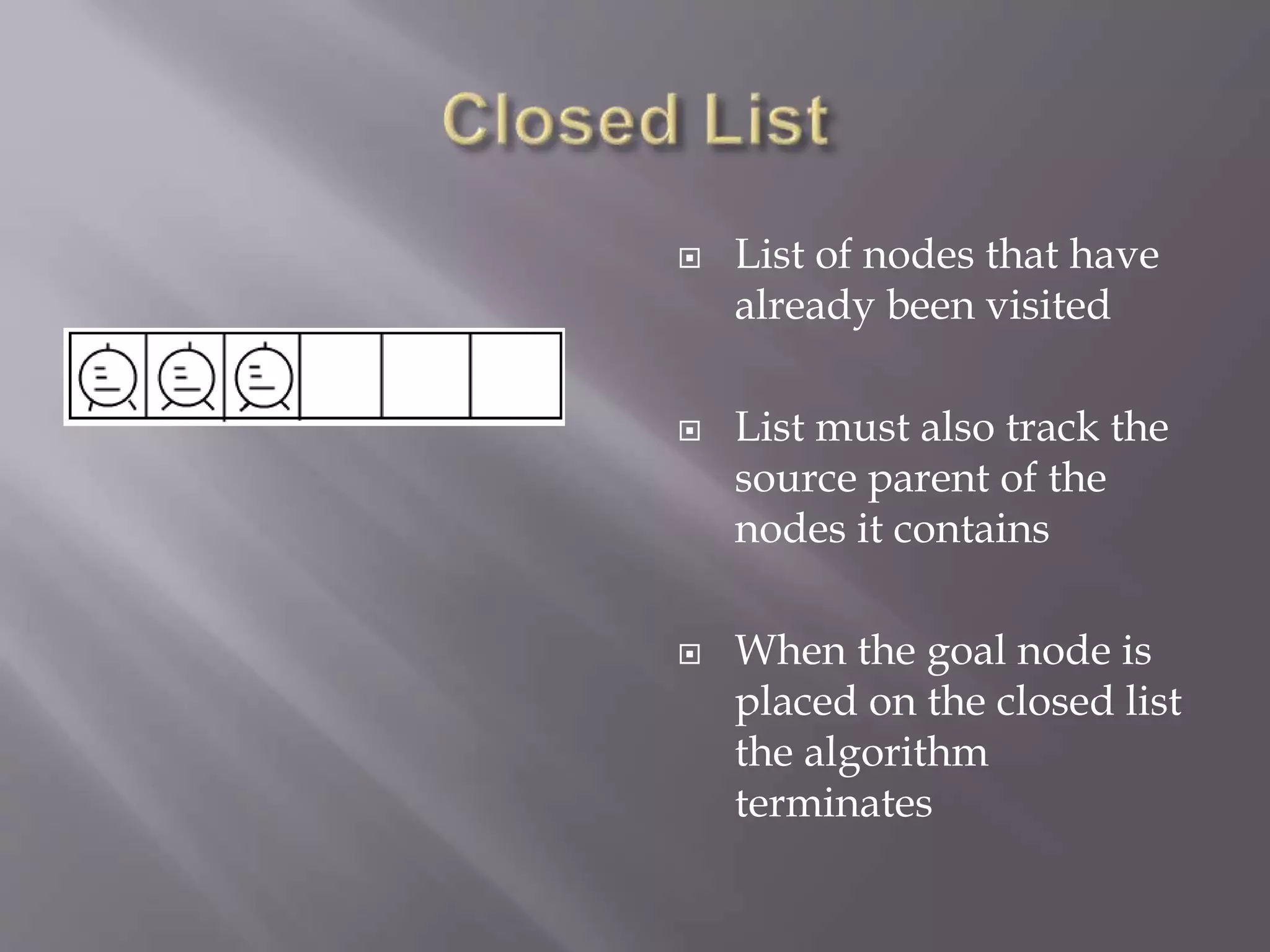
 List of nodes that have
already been visited
 List must also track the
source parent of the
nodes it contains
 When the goal node is
placed on the closed list
the algorithm
terminates
Openlist.Clear(); ClosedList.Clear();
currentNode = nil;
startNode.g(x) = 0;
Openlist.Push(startNode);
While currentNode != goalNode
currentNode = OpenList.Pop();
for each s in currentNode.Children[]
s.g(x) = currentNode.g(x) + c(currentNode, s);
OpenList.Push(s);
end for each
ClosedList.Push(currentNode);
End while
 Dynamic Pathfinding searches run the same
basic algorithm.
 However, when the search space is altered and
costs are changed they’ll handle these
inconsistencies.
 How does the algorithm detect these
inconsistencies?
 The answer lies in the introduction of a new value
into the mix
 This value is known as the Right Hand Side (rhs)
value.
 This value is equal to the cost to the parent of a
node plus the cost to travel to that node
 By comparing this value to the cost to the node we
can detect inconsistencies
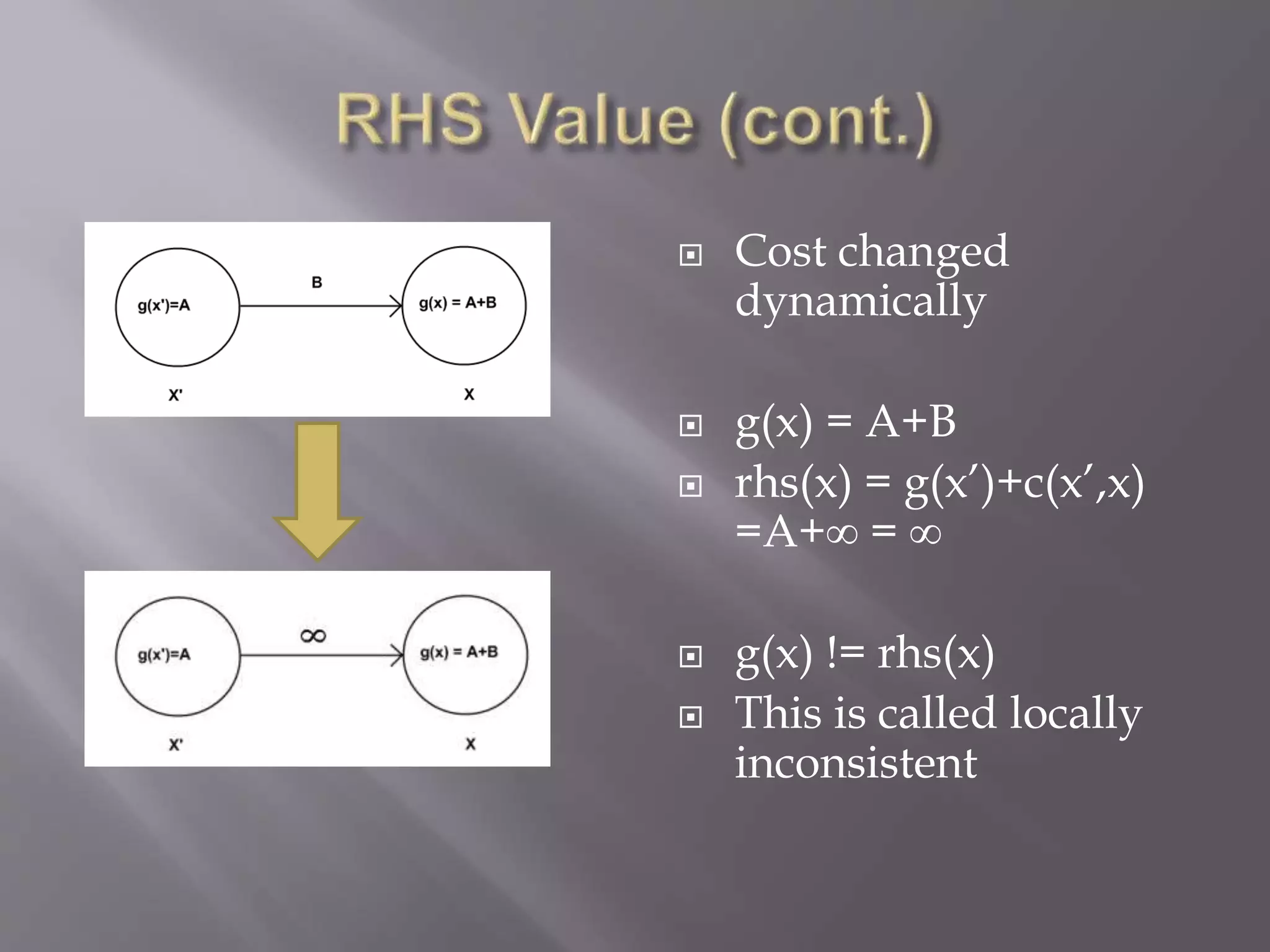
 g(x) = A+B
 rhs(x) = g(x’) + c(x’,x)
= A+B
 Under normal
circumstances
g(x)==rhs(x)
 This is known as
locally consistent
 Cost changed
dynamically
 g(x) = A+B
 rhs(x) = g(x’)+c(x’,x)
=A+∞ = ∞
 g(x) != rhs(x)
 This is called locally
inconsistent
 The idea of inconsistency contains within it a
lot of information both explicit and implicit
that will be exploited in our search algorithms
 Explicit data is used by the algorithm to update
nodes. The implicit data will be used by the
implementer to manage open lists.
 Inconsistency falls into two categories:
Underconsistency and Overconsisteny
 g(x) < rhs(x) is called underconsistency
 When a node is found to be underconsistent that
means that the path to the that node was made to
be more expensive.
 In a video game this would correspond to a wall or
an obstruction was created
 Nodes found to be underconsistent will need to be
reset and paths completely recalculated
 g(x) > rhs(x) is called overconsistency
 When a path is found to be overconsistent that means
that the path to that node was made to be less
expensive
 In a video game this would mean that a shortcut was
found or that an obstruction was cleared
 In the following algorithms the idea of overconsistency
is also used to manage the open list by exploiting the
fact that an overconsistant node implies that the
shortest path has been found to that node.
 This will be the first algorithm we explore as it
is the foundation of D* Lite
 The idea is that given a goal node you can find
a path by backtracking to the start node by
minimizing the rhs value.
 Because of this we do not need to manage a
Closed List (theoretically)
 Graph
 Node
 OpenList
 g(x) is the cost so far from
the start to the node
 h(x) is the heuristic
estimating the cost from x to
the goal
 rhs(x) = min(g(x’)+c(x’,x))
where x’ are the parents of x
 key(x) is a value used to sort
the open list
 Children[] is a list of node
that can be advanced to from
x
 Parents[] is a list of nodes
from which you can advance
to x
 As mentioned before the key of a node is a value
that is going to be used to sort the open list by
 The key is a touple value = [min(g(x),rhs(x)+h(x));
min(g(x),rhs(s)]
 These Keys are compared lexicographically So u <
v if (u.first < v.first OR u.first == v.first AND
u.second < v.second)
 More on this later
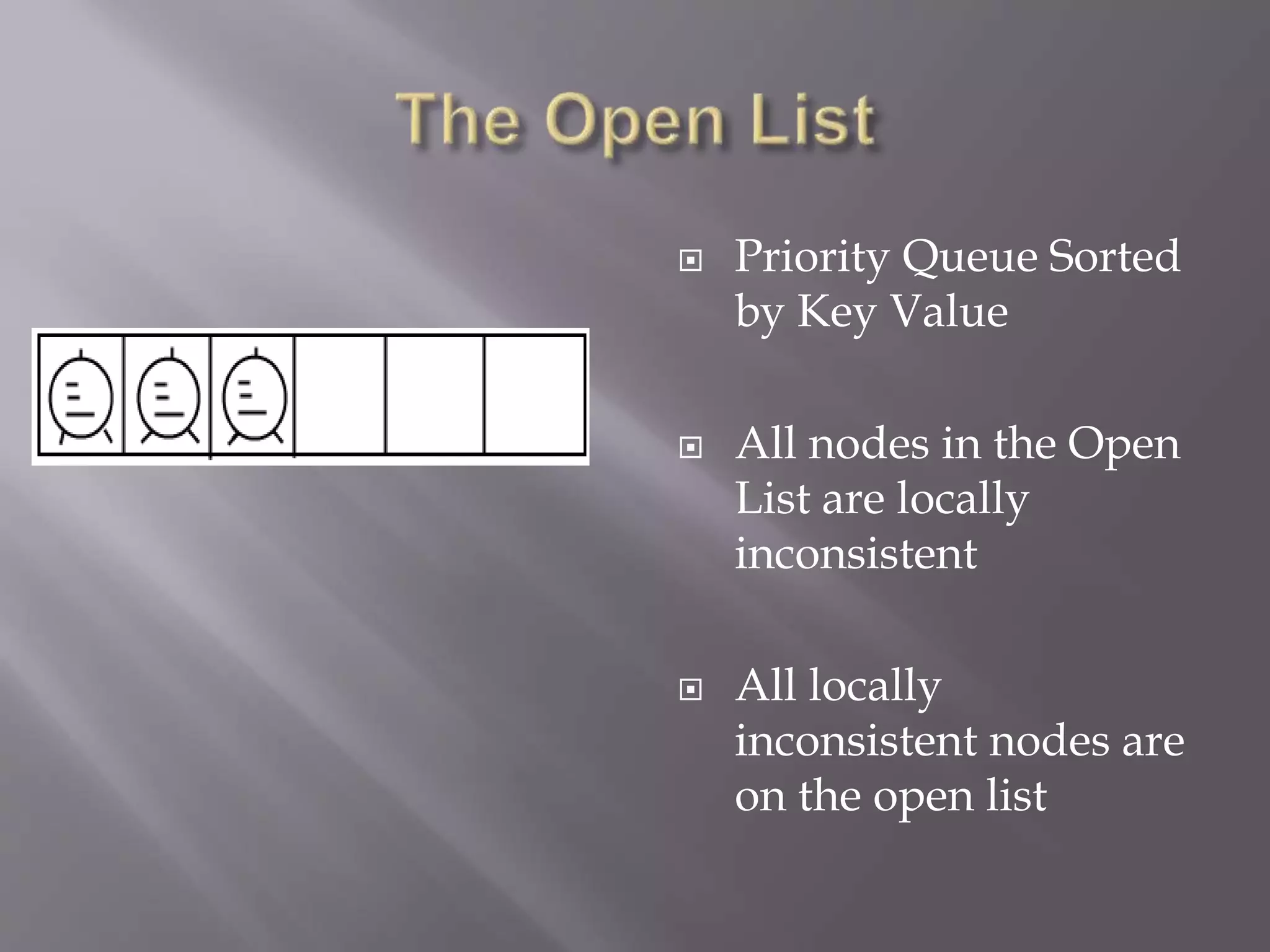
 Priority Queue Sorted
by Key Value
 All nodes in the Open
List are locally
inconsistent
 All locally
inconsistent nodes are
on the open list
For each s in Graph
s.g(x) = rhs(x) = ∞; (locally consistent)
end for each
startNode.rhs = 0; (overconsistent)
Forever
While(OpenList.Top().key<goal.key OR
goal is incosistent)
currentNode=OpenList.Pop();
if(currentNode is overconsistent)
currentNode.g(x) = currentNode.rhs(x); (Consistent)
else
currentNode.g(x)= ∞; (overconsistent OR consistent)
end if
for each s in currentNode.Children[]
update s.rhs(x); (consistent OR inconsistent)
end for each
End while
Wait for changes in Graph
For each connection (u, v) with changed cost
Update connection(u, v);
Make v locally inconsistent;
end for each
End forever
 ComputeShortestPath() runs that same as A* when
there are no changes to the Graph
 Only when when changes occur do inconsistencies
come into play
 Notice that this algorithm is constantly checking
for changes in the graph that means that the
OpenList is never reset and anytime
ComputeShortestPath() is called the openlist still
contains all the previous locally inconsistent nodes
as well as the new nodes recently made
inconsistent by the changes in the Graph
 Is only recalculating from a single start, goal
pair.
 What if we have already advanced when the
Graph changes?
 Good for calculating paths at some monitored
location, but not good for handling changes
while traveling
 Built on top of LPA*
 Takes into consideration path already traveled
 How does it do this?
 Heap reordering
 D* Lite will find the shortest path from the goal
node to the start node by minimizing rhs
values
 Key values are updated when a connection
changes not only with the new connection data,
but with the new amount the agent has
traveled
 As an agent advances along the path the start
node becomes the current node the agent is on
 So when connections change and keys need to
be calculated we need to update the heuristic
from being estimated cost from goal to original
start to estimated cost from goal node to new
start
 Because we’re moving toward the goal the
heuristic will be decreasing
 This decrease can be no more than h(startOrg,
startNew). This is due to the propery of the
heuristic being derived from a relaxed version
of the problem.
 So subtract that value from all keys?
 Because the we’re subtracting the same value
from all keys the order in the Priority Queue
does not change.
 So Instead why don’t we add that value to all
new calculated keys
 This way we avoid traversing the Queue
everytime connections change and heuristics
remain admissible
Dstar Lite
Dstar Lite

Dstar Lite

  • 1.
    Adrian Sotelo CS582 Spring 2009Digipen Institute of Technology
  • 2.
     DFS  BFS Dykstra’s  A*  Dykstra’s and A* will find an optimal path  If structure of the search space changes, the path needs to be recomputed from scratch  In real time applications this can be a problem with having to traverse deformable terrain  Also can be problematic if the structure of the search space is not known
  • 4.
     Dynamic pathfindingalgorithms will hold on to their search data.  If connections between nodes are lost or created, data is modified and only effected nodes are recalculated  No need to start from scratch
  • 5.
  • 6.
     Graph  Node Open List  Closed List
  • 7.
     g(x) isthe cost so far from the start node to the current node  h(x) is the heuristic being used to estimate distance to the goal  Children[] is a list of children nodes or nodes connected to the current node
  • 8.
     List ofnodes that need to be examined  Priority Queue sorted by f(x)  f(x) = g(x) + h(x)
  • 9.
     List ofnodes that have already been visited  List must also track the source parent of the nodes it contains  When the goal node is placed on the closed list the algorithm terminates
  • 10.
    Openlist.Clear(); ClosedList.Clear(); currentNode =nil; startNode.g(x) = 0; Openlist.Push(startNode); While currentNode != goalNode currentNode = OpenList.Pop(); for each s in currentNode.Children[] s.g(x) = currentNode.g(x) + c(currentNode, s); OpenList.Push(s); end for each ClosedList.Push(currentNode); End while
  • 12.
     Dynamic Pathfindingsearches run the same basic algorithm.  However, when the search space is altered and costs are changed they’ll handle these inconsistencies.  How does the algorithm detect these inconsistencies?
  • 13.
     The answerlies in the introduction of a new value into the mix  This value is known as the Right Hand Side (rhs) value.  This value is equal to the cost to the parent of a node plus the cost to travel to that node  By comparing this value to the cost to the node we can detect inconsistencies
  • 14.
     g(x) =A+B  rhs(x) = g(x’) + c(x’,x) = A+B  Under normal circumstances g(x)==rhs(x)  This is known as locally consistent
  • 15.
     Cost changed dynamically g(x) = A+B  rhs(x) = g(x’)+c(x’,x) =A+∞ = ∞  g(x) != rhs(x)  This is called locally inconsistent
  • 16.
     The ideaof inconsistency contains within it a lot of information both explicit and implicit that will be exploited in our search algorithms  Explicit data is used by the algorithm to update nodes. The implicit data will be used by the implementer to manage open lists.  Inconsistency falls into two categories: Underconsistency and Overconsisteny
  • 17.
     g(x) <rhs(x) is called underconsistency  When a node is found to be underconsistent that means that the path to the that node was made to be more expensive.  In a video game this would correspond to a wall or an obstruction was created  Nodes found to be underconsistent will need to be reset and paths completely recalculated
  • 18.
     g(x) >rhs(x) is called overconsistency  When a path is found to be overconsistent that means that the path to that node was made to be less expensive  In a video game this would mean that a shortcut was found or that an obstruction was cleared  In the following algorithms the idea of overconsistency is also used to manage the open list by exploiting the fact that an overconsistant node implies that the shortest path has been found to that node.
  • 19.
     This willbe the first algorithm we explore as it is the foundation of D* Lite  The idea is that given a goal node you can find a path by backtracking to the start node by minimizing the rhs value.  Because of this we do not need to manage a Closed List (theoretically)
  • 20.
  • 21.
     g(x) isthe cost so far from the start to the node  h(x) is the heuristic estimating the cost from x to the goal  rhs(x) = min(g(x’)+c(x’,x)) where x’ are the parents of x  key(x) is a value used to sort the open list  Children[] is a list of node that can be advanced to from x  Parents[] is a list of nodes from which you can advance to x
  • 22.
     As mentionedbefore the key of a node is a value that is going to be used to sort the open list by  The key is a touple value = [min(g(x),rhs(x)+h(x)); min(g(x),rhs(s)]  These Keys are compared lexicographically So u < v if (u.first < v.first OR u.first == v.first AND u.second < v.second)  More on this later
  • 23.
     Priority QueueSorted by Key Value  All nodes in the Open List are locally inconsistent  All locally inconsistent nodes are on the open list
  • 24.
    For each sin Graph s.g(x) = rhs(x) = ∞; (locally consistent) end for each startNode.rhs = 0; (overconsistent) Forever While(OpenList.Top().key<goal.key OR goal is incosistent) currentNode=OpenList.Pop(); if(currentNode is overconsistent) currentNode.g(x) = currentNode.rhs(x); (Consistent) else currentNode.g(x)= ∞; (overconsistent OR consistent) end if for each s in currentNode.Children[] update s.rhs(x); (consistent OR inconsistent) end for each End while Wait for changes in Graph For each connection (u, v) with changed cost Update connection(u, v); Make v locally inconsistent; end for each End forever
  • 26.
     ComputeShortestPath() runsthat same as A* when there are no changes to the Graph  Only when when changes occur do inconsistencies come into play  Notice that this algorithm is constantly checking for changes in the graph that means that the OpenList is never reset and anytime ComputeShortestPath() is called the openlist still contains all the previous locally inconsistent nodes as well as the new nodes recently made inconsistent by the changes in the Graph
  • 32.
     Is onlyrecalculating from a single start, goal pair.  What if we have already advanced when the Graph changes?  Good for calculating paths at some monitored location, but not good for handling changes while traveling
  • 33.
     Built ontop of LPA*  Takes into consideration path already traveled  How does it do this?
  • 34.
     Heap reordering D* Lite will find the shortest path from the goal node to the start node by minimizing rhs values  Key values are updated when a connection changes not only with the new connection data, but with the new amount the agent has traveled
  • 35.
     As anagent advances along the path the start node becomes the current node the agent is on  So when connections change and keys need to be calculated we need to update the heuristic from being estimated cost from goal to original start to estimated cost from goal node to new start
  • 36.
     Because we’removing toward the goal the heuristic will be decreasing  This decrease can be no more than h(startOrg, startNew). This is due to the propery of the heuristic being derived from a relaxed version of the problem.  So subtract that value from all keys?
  • 37.
     Because thewe’re subtracting the same value from all keys the order in the Priority Queue does not change.  So Instead why don’t we add that value to all new calculated keys  This way we avoid traversing the Queue everytime connections change and heuristics remain admissible