DS
RC

Data Science
Research Center

High Performance Distributed
Computing
Henri Bal
Vrije Universiteit Amsterdam
DS
RC

Outline

1. Development of the field
2. Highlights VU-HPDC group
3. Links to data science cycle
4. Conclusions
DS
RC

Developments

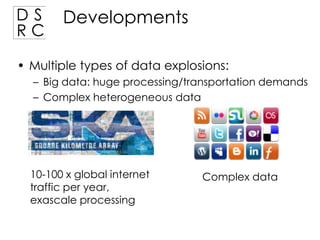
• Multiple types of data explosions:
– Big data: huge processing/transportation demands
– Complex heterogeneous data

10-100 x global internet
traffic per year,
exascale processing

Complex data
DS
RC

Developments

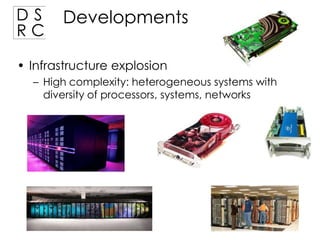
• Infrastructure explosion
– High complexity: heterogeneous systems with
diversity of processors, systems, networks
DS
RC

VU HPDC GROUP

• Bridge the gap between demanding
applications and complex infrastructure
• Distributed programming systems for
–
–
–
–

Clusters, grids, clouds
Heterogeneous systems (``Jungles”)
Accelerators (GPUs)
Clouds & mobile devices

• Applications: multimedia, semantic web,
model checking, games, astronomy,
astrophysics, climate modeling ….
DS
RC

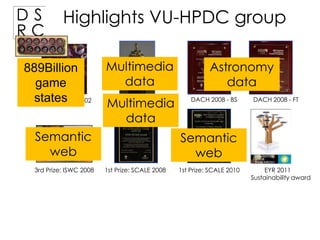
Highlights VU-HPDC group

889Billion
game
states 2002
Solved Awari

Multimedia
data
AAAI-VC 2007
Multimedia
data

Semantic
web
3rd Prize: ISWC 2008

Astronomy
data
DACH 2008 - BS

DACH 2008 - FT

Semantic
web
1st Prize: SCALE 2008

1st Prize: SCALE 2010

EYR 2011
Sustainability award
DS
RC

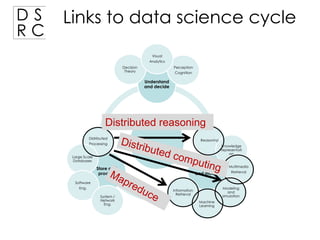
Links to data science cycle
Visual
Analytics
Perception
Cognition

Decision
Theory

Understand
and decide

Distributed reasoning
Distributed
Processing

Reasoning
Knowledge
representati
on

Large Scale
Databases

Store and
process
Software
Eng.
System /
Network
Eng.

Analyze
and model

Multimedia
Retrieval

Modeling
and
simulation

Information
Retrieval
Machine
Learning
DS
RC

Reasoning – Semantic Web

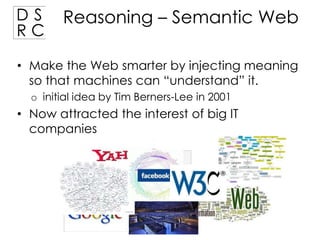
• Make the Web smarter by injecting meaning
so that machines can “understand” it.
o initial idea by Tim Berners-Lee in 2001

• Now attracted the interest of big IT
companies
DS
RC

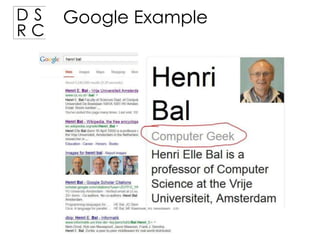
Google Example
DS
RC

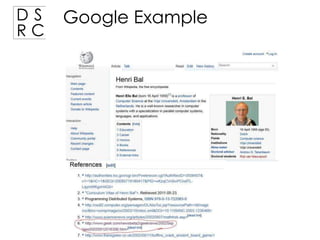
Google Example
DS
RC

Distributed Reasoning

• WebPIE: web-scale distributed reasoner
doing full materialization
• QueryPIE: distributed reasoning with
backward-chaining + pre-materialization of
schema-triples
• DynamiTE: maintains materialization after
updates (additions & removals)
 Challenge: real-time incremental
reasoning on web scale, combining new
(streaming) data & existing historic data
With: Jacopo Urbani, Alessandro Margara, Frank van Harmelen

COMMIT/
DS
R C Distributed Computing
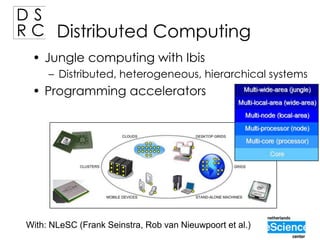
• Jungle computing with Ibis
– Distributed, heterogeneous, hierarchical systems

• Programming accelerators

With: NLeSC (Frank Seinstra, Rob van Nieuwpoort et al.)
DS
RC

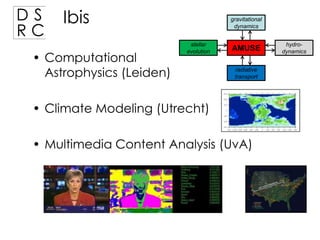
Ibis

• Computational
Astrophysics (Leiden)

gravitational
dynamics
stellar
evolution

AMUSE
radiative
transport

• Climate Modeling (Utrecht)
• Multimedia Content Analysis (UvA)

hydrodynamics
DS
RC

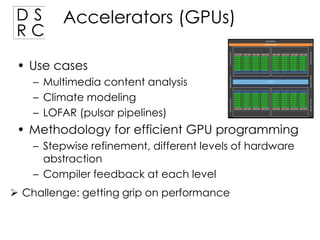
Accelerators (GPUs)
Host Interface
GigaThread Engine
GPC

GPC
SM

SM

SM

SM

SM

GPC
SM

SM

SM

SM

SM

SM

SM

GPC

Polymorph Engine
Polymorph Engine

Polymorph Engine
Polymorph Engine

SM

Polymorph Engine
Polymorph Engine

Memory Controller

Polymorph Engine
Polymorph Engine

Polymorph Engine
Polymorph Engine

Polymorph Engine
Polymorph Engine

Polymorph Engine
Polymorph Engine

Polymorph Engine
Polymorph Engine

Polymorph Engine
Polymorph Engine

Polymorph Engine
Polymorph Engine

Polymorph Engine
Polymorph Engine

L2 Cache

Polymorph Engine
Polymorph Engine

SM

Polymorph Engine
Polymorph Engine

SM

Polymorph Engine
Polymorph Engine

SM

Polymorph Engine
Polymorph Engine

SM

GPC

SM

Polymorph Engine
Polymorph Engine

SM

SM

SM

SM

SM

Raster Engine

GPC

SM

SM

SM

SM

SM

GPC

SM

Raster Engine

GPC

• Methodology for efficient GPU programming
– Stepwise refinement, different levels of hardware
abstraction
– Compiler feedback at each level
 Challenge: getting grip on performance

Memory Controller

Memory Controller

SM

Memory Controller

– Multimedia content analysis
– Climate modeling
– LOFAR (pulsar pipelines)

Raster Engine

SM

Memory Controller

• Use cases

Memory Controller

Raster Engine
SM
DS
RC

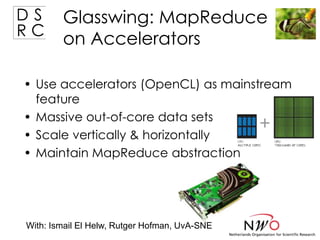
Glasswing: MapReduce
on Accelerators

• Use accelerators (OpenCL) as mainstream
feature
• Massive out-of-core data sets
• Scale vertically & horizontally
• Maintain MapReduce abstraction

With: Ismail El Helw, Rutger Hofman, UvA-SNE
DS
RC

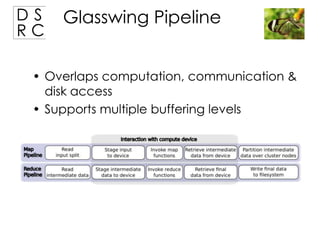
Glasswing Pipeline

• Overlaps computation, communication &
disk access
• Supports multiple buffering levels
DS
RC

Evaluation (DAS-4, EC2)

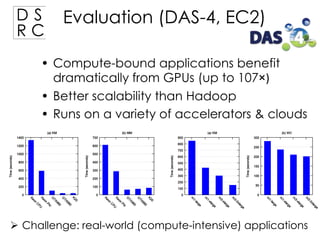
• Compute-bound applications benefit
dramatically from GPUs (up to 107×)
• Better scalability than Hadoop
• Runs on a variety of accelerators & clouds

 Challenge: real-world (compute-intensive) applications
DS
RC

Conclusions

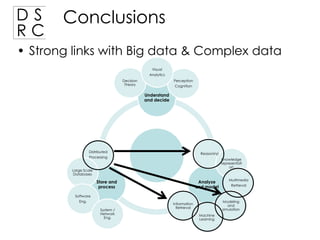
• Strong links with Big data & Complex data
Visual
Analytics
Perception
Cognition

Decision
Theory

Understand
and decide

Distributed
Processing

Reasoning
Knowledge
representati
on

Large Scale
Databases

Store and
process
Software
Eng.
System /
Network
Eng.

Analyze
and model

Multimedia
Retrieval

Modeling
and
simulation

Information
Retrieval
Machine
Learning

High Performance Distributed Computing and Data Science

  • 1.
    DS RC Data Science Research Center HighPerformance Distributed Computing Henri Bal Vrije Universiteit Amsterdam
  • 2.
    DS RC Outline 1. Development ofthe field 2. Highlights VU-HPDC group 3. Links to data science cycle 4. Conclusions
  • 3.
    DS RC Developments • Multiple typesof data explosions: – Big data: huge processing/transportation demands – Complex heterogeneous data 10-100 x global internet traffic per year, exascale processing Complex data
  • 4.
    DS RC Developments • Infrastructure explosion –High complexity: heterogeneous systems with diversity of processors, systems, networks
  • 5.
    DS RC VU HPDC GROUP •Bridge the gap between demanding applications and complex infrastructure • Distributed programming systems for – – – – Clusters, grids, clouds Heterogeneous systems (``Jungles”) Accelerators (GPUs) Clouds & mobile devices • Applications: multimedia, semantic web, model checking, games, astronomy, astrophysics, climate modeling ….
  • 6.
    DS RC Highlights VU-HPDC group 889Billion game states2002 Solved Awari Multimedia data AAAI-VC 2007 Multimedia data Semantic web 3rd Prize: ISWC 2008 Astronomy data DACH 2008 - BS DACH 2008 - FT Semantic web 1st Prize: SCALE 2008 1st Prize: SCALE 2010 EYR 2011 Sustainability award
  • 7.
    DS RC Links to datascience cycle Visual Analytics Perception Cognition Decision Theory Understand and decide Distributed reasoning Distributed Processing Reasoning Knowledge representati on Large Scale Databases Store and process Software Eng. System / Network Eng. Analyze and model Multimedia Retrieval Modeling and simulation Information Retrieval Machine Learning
  • 8.
    DS RC Reasoning – SemanticWeb • Make the Web smarter by injecting meaning so that machines can “understand” it. o initial idea by Tim Berners-Lee in 2001 • Now attracted the interest of big IT companies
  • 9.
  • 10.
  • 11.
    DS RC Distributed Reasoning • WebPIE:web-scale distributed reasoner doing full materialization • QueryPIE: distributed reasoning with backward-chaining + pre-materialization of schema-triples • DynamiTE: maintains materialization after updates (additions & removals)  Challenge: real-time incremental reasoning on web scale, combining new (streaming) data & existing historic data With: Jacopo Urbani, Alessandro Margara, Frank van Harmelen COMMIT/
  • 12.
    DS R C DistributedComputing • Jungle computing with Ibis – Distributed, heterogeneous, hierarchical systems • Programming accelerators With: NLeSC (Frank Seinstra, Rob van Nieuwpoort et al.)
  • 13.
  • 14.
    DS RC Accelerators (GPUs) Host Interface GigaThreadEngine GPC GPC SM SM SM SM SM GPC SM SM SM SM SM SM SM GPC Polymorph Engine Polymorph Engine Polymorph Engine Polymorph Engine SM Polymorph Engine Polymorph Engine Memory Controller Polymorph Engine Polymorph Engine Polymorph Engine Polymorph Engine Polymorph Engine Polymorph Engine Polymorph Engine Polymorph Engine Polymorph Engine Polymorph Engine Polymorph Engine Polymorph Engine Polymorph Engine Polymorph Engine Polymorph Engine Polymorph Engine L2 Cache Polymorph Engine Polymorph Engine SM Polymorph Engine Polymorph Engine SM Polymorph Engine Polymorph Engine SM Polymorph Engine Polymorph Engine SM GPC SM Polymorph Engine Polymorph Engine SM SM SM SM SM Raster Engine GPC SM SM SM SM SM GPC SM Raster Engine GPC • Methodology for efficient GPU programming – Stepwise refinement, different levels of hardware abstraction – Compiler feedback at each level  Challenge: getting grip on performance Memory Controller Memory Controller SM Memory Controller – Multimedia content analysis – Climate modeling – LOFAR (pulsar pipelines) Raster Engine SM Memory Controller • Use cases Memory Controller Raster Engine SM
  • 15.
    DS RC Glasswing: MapReduce on Accelerators •Use accelerators (OpenCL) as mainstream feature • Massive out-of-core data sets • Scale vertically & horizontally • Maintain MapReduce abstraction With: Ismail El Helw, Rutger Hofman, UvA-SNE
  • 16.
    DS RC Glasswing Pipeline • Overlapscomputation, communication & disk access • Supports multiple buffering levels
  • 17.
    DS RC Evaluation (DAS-4, EC2) •Compute-bound applications benefit dramatically from GPUs (up to 107×) • Better scalability than Hadoop • Runs on a variety of accelerators & clouds  Challenge: real-world (compute-intensive) applications
  • 18.
    DS RC Conclusions • Strong linkswith Big data & Complex data Visual Analytics Perception Cognition Decision Theory Understand and decide Distributed Processing Reasoning Knowledge representati on Large Scale Databases Store and process Software Eng. System / Network Eng. Analyze and model Multimedia Retrieval Modeling and simulation Information Retrieval Machine Learning