OpenMI – CIPRNet cooperation meeting 
Deltares – Delft (The Netherlands) – 31 October 2014 
Introduction to CIPRNet 
Erich Rome 
erich.rome@iais.fraunhofer.de
Agenda 
1. 
CIPRNet Facts 
2. 
“Critical” Infrastructures 
3. 
CIPRNet: Research Context, Activities, and new Capabilities 
4. 
Modelling, Simulation and Analysis of CI – Setting the Frame 
5. 
Summary – Aims of Meeting with OpenMI 
6. 
Questions & Answers 10-Nov-14 erich.rome@iais.fraunhofer.de 2
1. CIPRNet – Facts 
■ 
Critical Infrastructures Preparedness and Resilience Research Network 
■ 
Co-funded by: EU FP7 
■ 
Instrument: Network of Excellence (NoE) 
■ 
Start date: March 1, 2013 
■ 
Duration: 48 months 
■ 
Website: ciprnet.eu 10-Nov-14 erich.rome@iais.fraunhofer.de 3
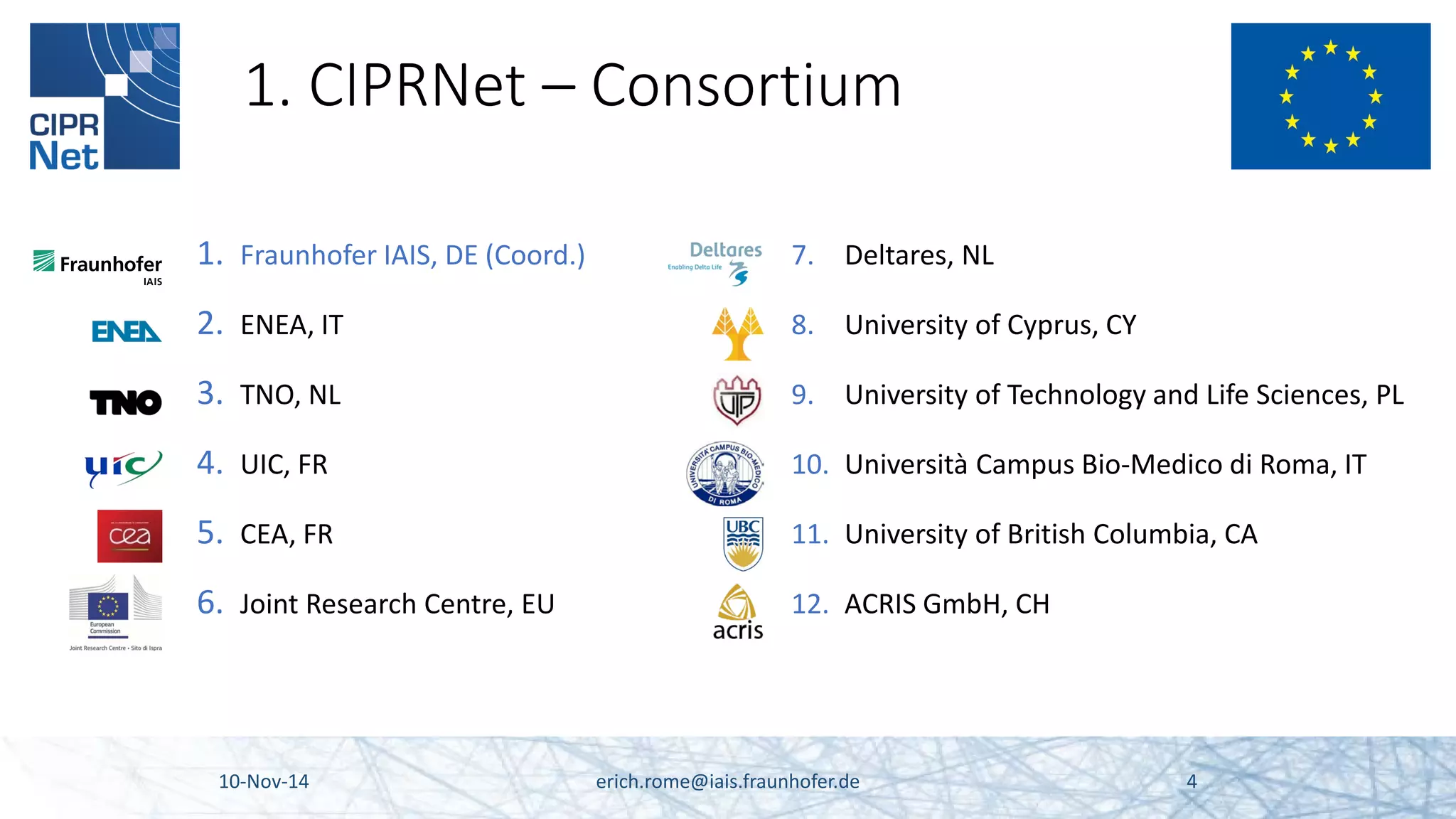
1. CIPRNet – Consortium 
1. 
Fraunhofer IAIS, DE (Coord.) 
2. 
ENEA, IT 
3. 
TNO, NL 
4. 
UIC, FR 
5. 
CEA, FR 
6. 
Joint Research Centre, EU 10-Nov-14 erich.rome@iais.fraunhofer.de 4 
7. 
Deltares, NL 
8. 
University of Cyprus, CY 
9. 
University of Technology and Life Sciences, PL 
10. 
Università Campus Bio-Medico di Roma, IT 
11. 
University of British Columbia, CA 
12. 
ACRIS GmbH, CH
2. “Critical” Infrastructures (CI) 10-Nov-14 erich.rome@iais.fraunhofer.de 5 
 
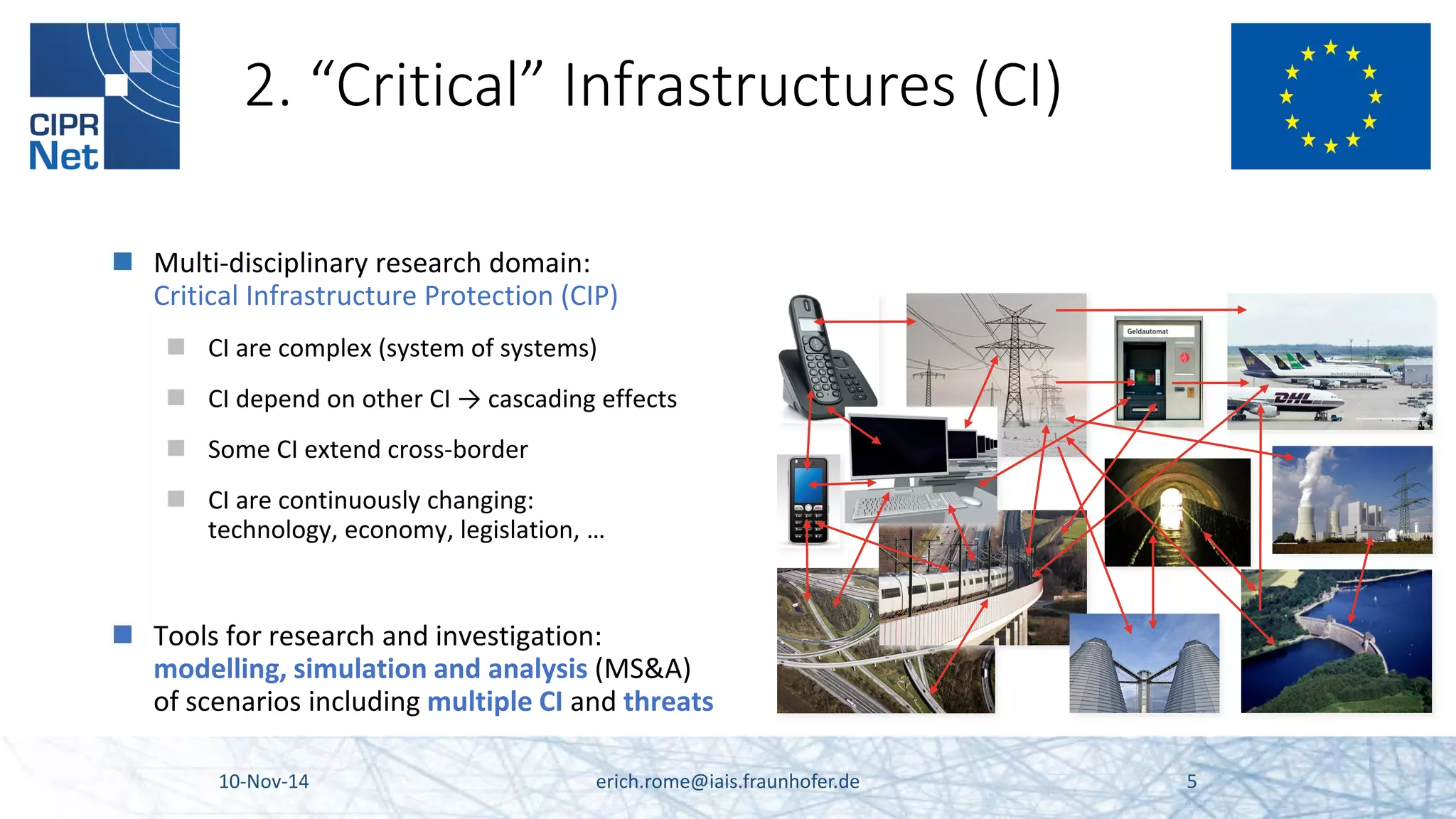
Multi-disciplinary research domain: Critical Infrastructure Protection (CIP) 
 
CI are complex (system of systems) 
 
CI depend on other CI → cascading effects 
 
Some CI extend cross-border 
 
CI are continuously changing: technology, economy, legislation, … 
 
Tools for research and investigation: modelling, simulation and analysis (MS&A) of scenarios including multiple CI and threats
2. “Critical” Infrastructures 
■ 
Since the late 1990s, the CI topic gained importance with the advent of new threats 
■ 
Year 2000 bug 
■ 
WTC attacks on 11.9.2001 
■ 
Climate change 
■ 
Follow-up activities 
■ 
Identification of CI 
■ 
Risk assessment of CI, following an all hazards approach 
■ 
Measures for protection of CI 
■ 
New research area: Critical Infrastructure Protection (CIP) 
■ 
The USA and Europe took different paths 10-Nov-14 erich.rome@iais.fraunhofer.de 6
2. “Critical” Infrastructures 
Definition of Critical Infrastructure according to ECI directive 
■ 
“A critical infrastructure (CI) consists of those assets and parts thereof which are essential for the maintenance of critical societal functions, including the supply chain, health, safety, security, economy or social well-being of people.” [EU2008] 
■ 
European CI (ECI) comprise CI of at least three Member States [EU2008] 
■ 
ECI sectors already identified [EU2008]: energy and transport CI 
■ 
National definitions vary, for example: 
■ 
Germany: 9 CI sectors 
■ 
The Netherlands: 12 CI sectors 
■ 
France: 11 “activity sectors of vital importance” 
■ 
2013: Review of ECI 10-Nov-14 erich.rome@iais.fraunhofer.de 7 
[EU2008] European Commission: Council Directive 2008/114/EC of 8 December 2008 on the identification and designation of European Critical Infrastructure and the assessment to improve their protection 
[EU2013] European Commission: 
CS Working Document SWD(2013)318 of 28.8.2013 
on a new approach to the European Programme for 
Critical Infrastructure Protection Making European 
Critical Infrastructures more secure
2. “Critical” Infrastructures 
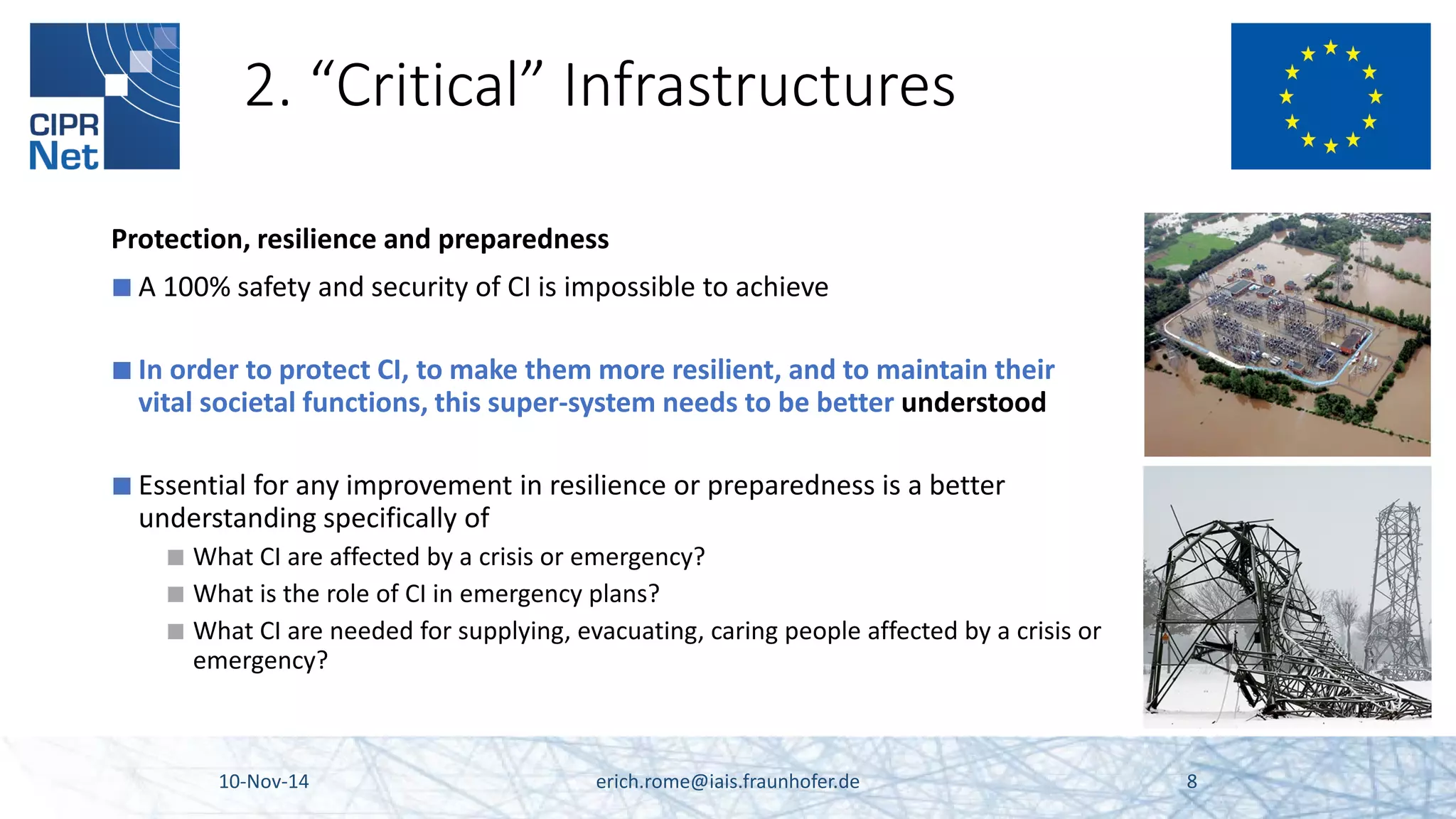
Protection, resilience and preparedness 
■ 
A 100% safety and security of CI is impossible to achieve 
■ 
In order to protect CI, to make them more resilient, and to maintain their vital societal functions, this super-system needs to be better understood 
■ 
Essential for any improvement in resilience or preparedness is a better understanding specifically of 
■ 
What CI are affected by a crisis or emergency? 
■ 
What is the role of CI in emergency plans? 
■ 
What CI are needed for supplying, evacuating, caring people affected by a crisis or emergency? 10-Nov-14 erich.rome@iais.fraunhofer.de 8
2. “Critical” Infrastructures 
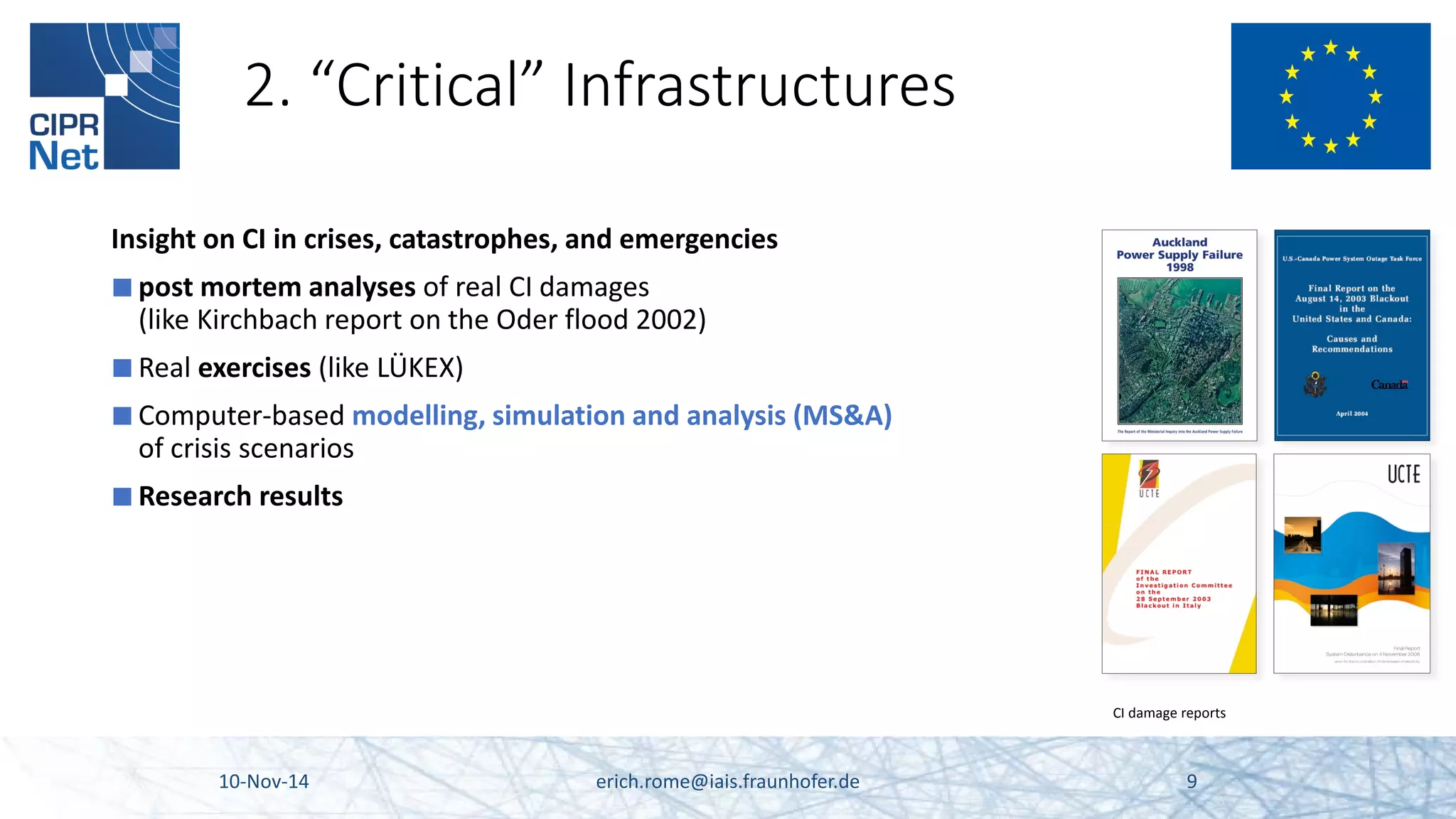
Insight on CI in crises, catastrophes, and emergencies 
■ 
post mortem analyses of real CI damages (like Kirchbach report on the Oder flood 2002) 
■ 
Real exercises (like LÜKEX) 
■ 
Computer-based modelling, simulation and analysis (MS&A) of crisis scenarios 
■ 
Research results 
10-Nov-14 erich.rome@iais.fraunhofer.de 9 
CI damage reports
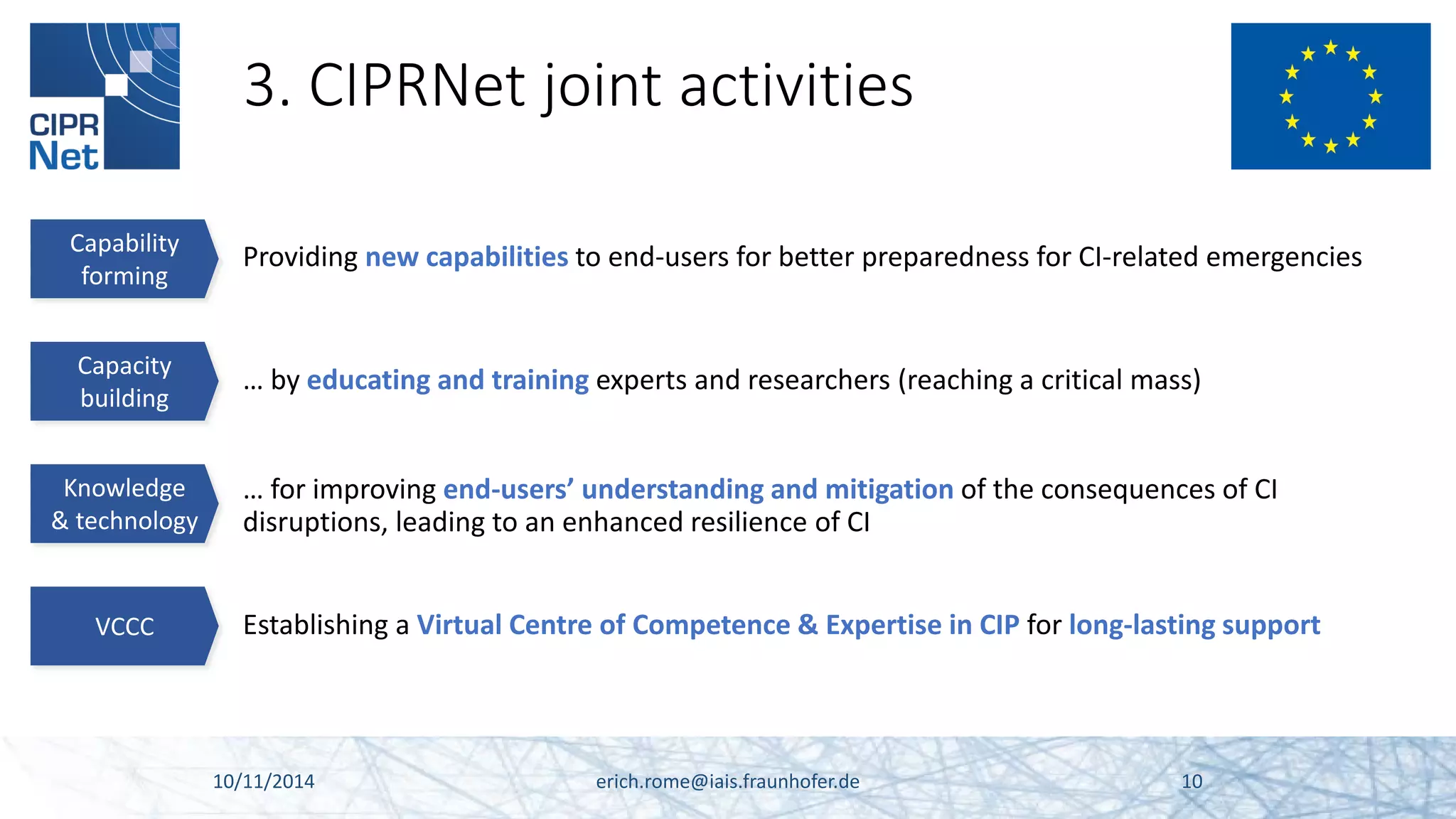
3. CIPRNet joint activities 10/11/2014 erich.rome@iais.fraunhofer.de 10 
Capacity 
building 
… by educating and training experts and researchers (reaching a critical mass) 
Knowledge & technology 
… for improving end-users’ understanding and mitigation of the consequences of CI disruptions, leading to an enhanced resilience of CI 
VCCC 
Establishing a Virtual Centre of Competence & Expertise in CIP for long-lasting support 
Capability 
forming 
Providing new capabilities to end-users for better preparedness for CI-related emergencies
3. CIPRNet’s new capabilities 
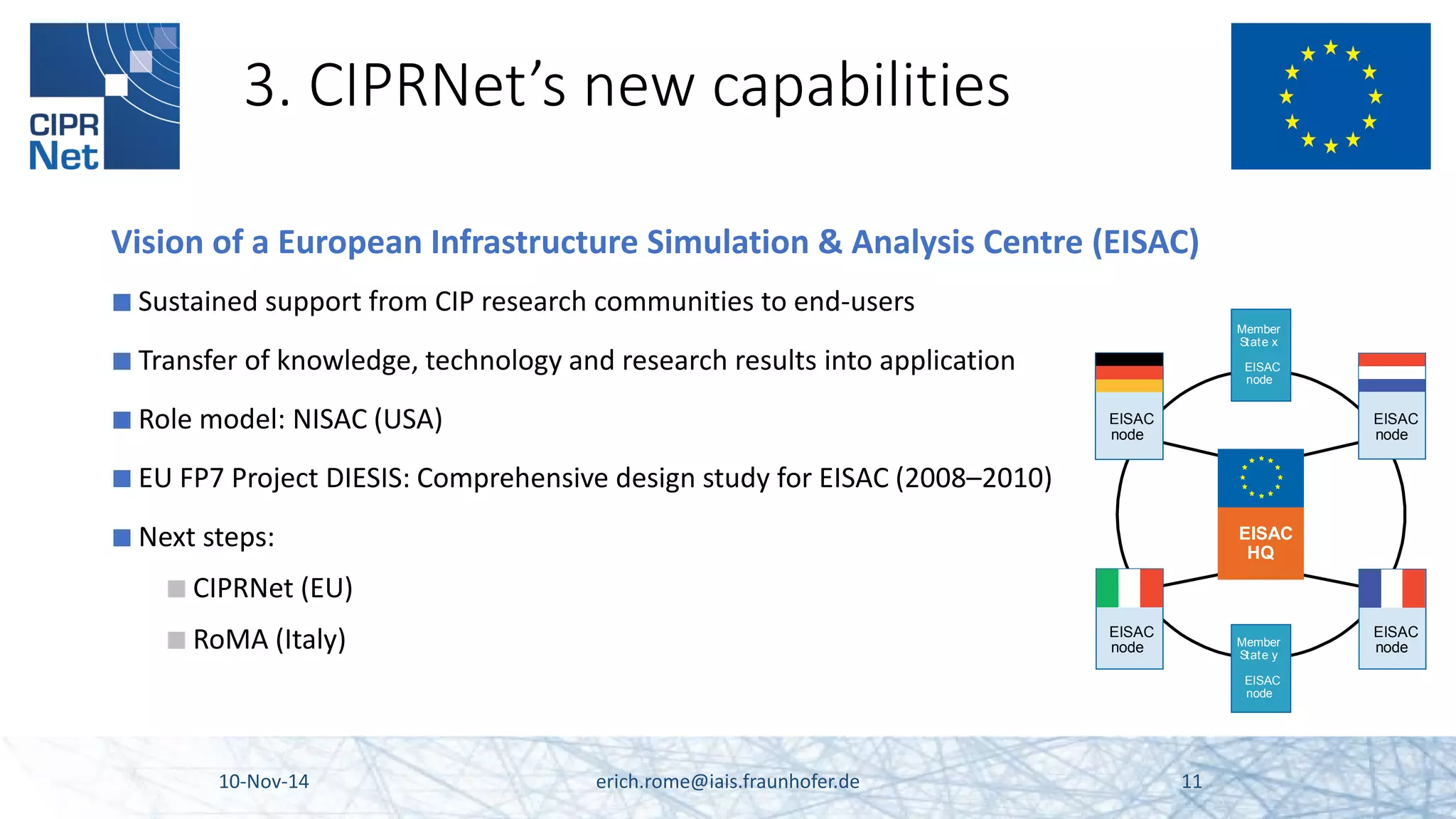
Vision of a European Infrastructure Simulation & Analysis Centre (EISAC) 
■ 
Sustained support from CIP research communities to end-users 
■ 
Transfer of knowledge, technology and research results into application 
■ 
Role model: NISAC (USA) 
■ 
EU FP7 Project DIESIS: Comprehensive design study for EISAC (2008–2010) 
■ 
Next steps: 
■ 
CIPRNet (EU) 
■ 
RoMA (Italy) 10-Nov-14 erich.rome@iais.fraunhofer.de 11 
MemberState xEISACnodeMemberState yEISACnodeEISACHQEISACnodeEISACnodeEISACnodeEISACnode
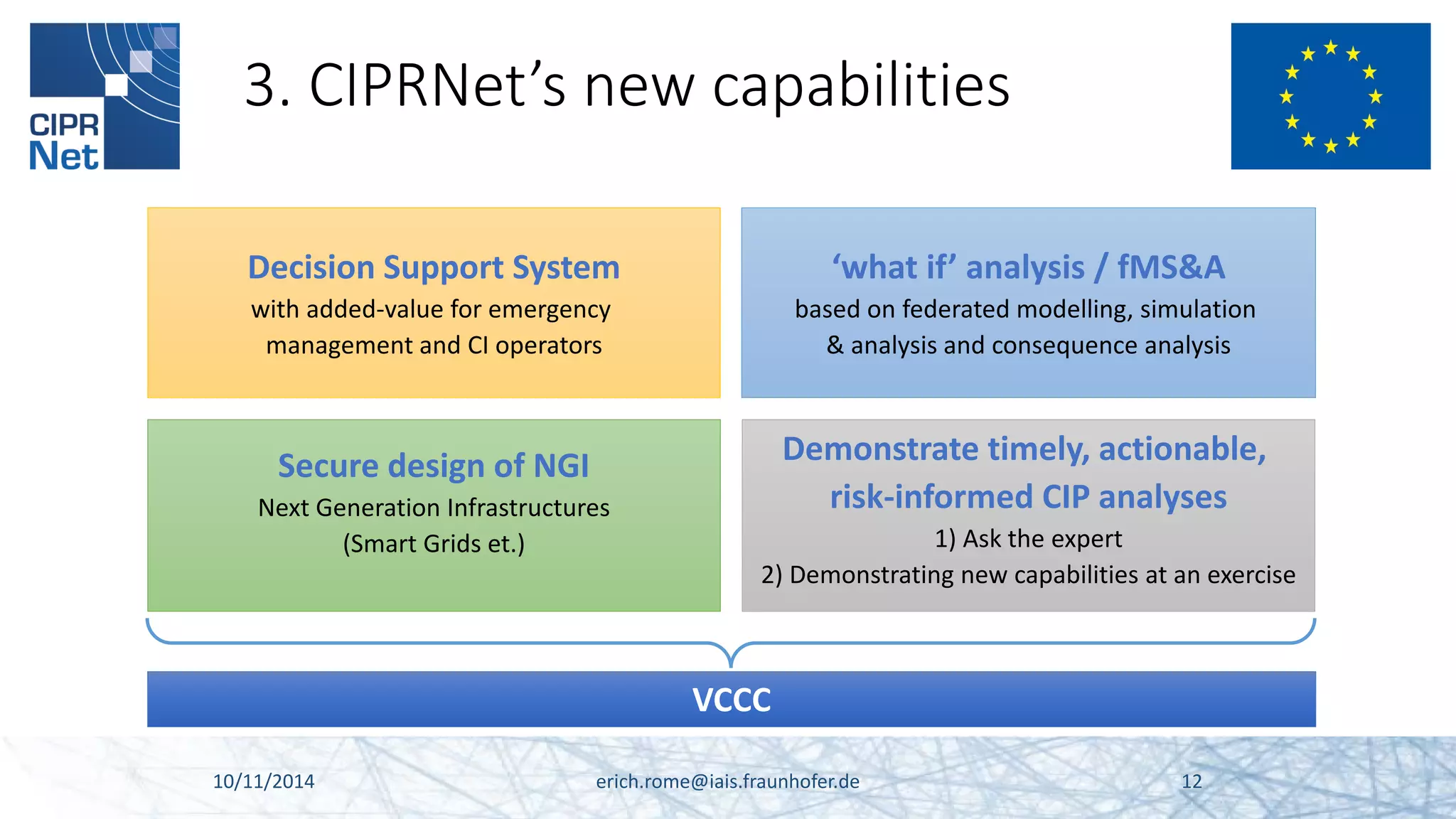
3. CIPRNet’s new capabilities 10/11/2014 erich.rome@iais.fraunhofer.de 12 
Secure design of NGI Next Generation Infrastructures (Smart Grids et.) 
‘what if’ analysis / fMS&A based on federated modelling, simulation & analysis and consequence analysis 
Decision Support System 
with added-value for emergency 
management and CI operators 
Demonstrate timely, actionable, 
risk-informed CIP analyses 
1) Ask the expert 
2) Demonstrating new capabilities at an exercise 
VCCC
3. CIPRNet’s new capabilities 
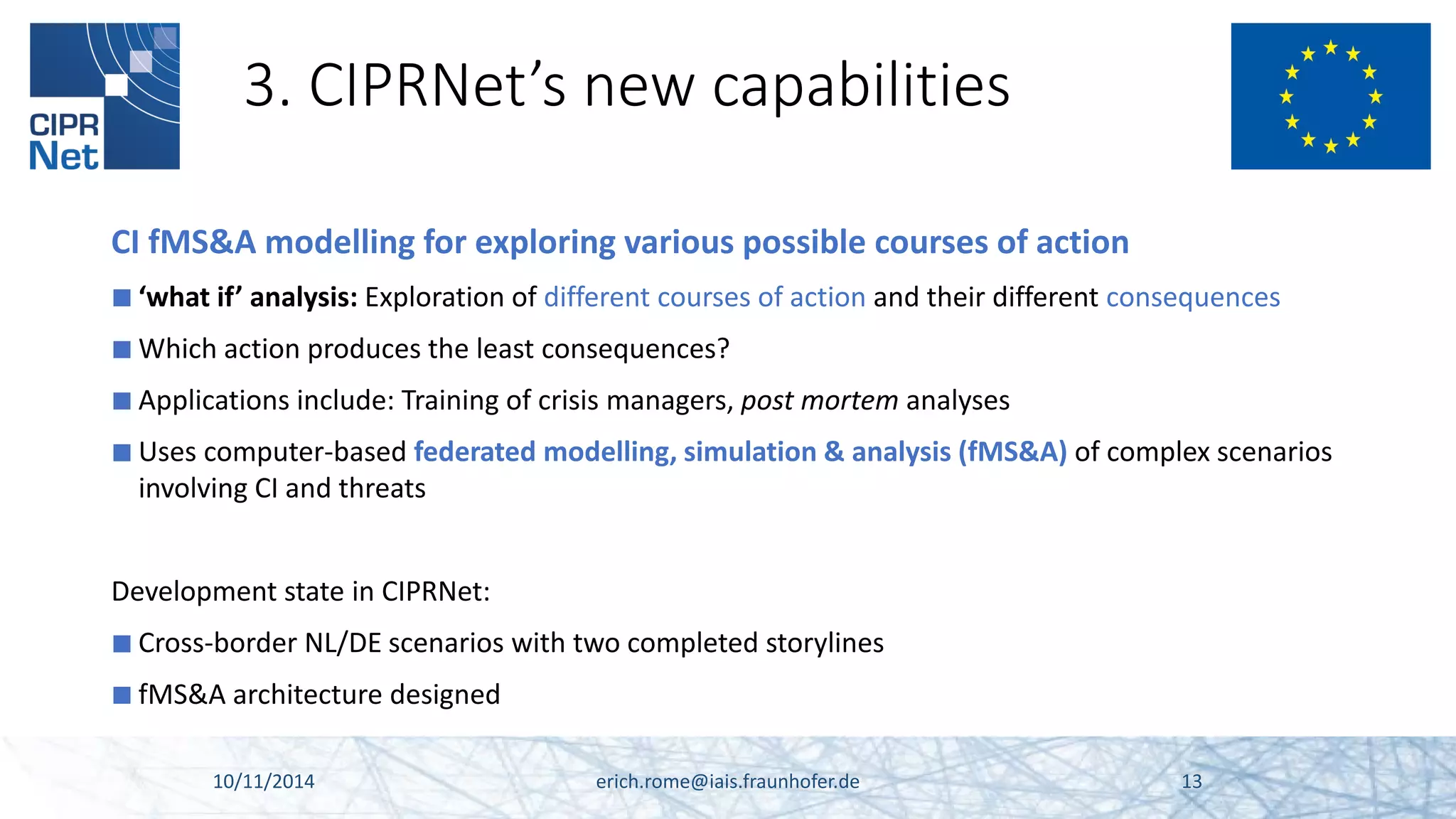
CI fMS&A modelling for exploring various possible courses of action 
■ 
‘what if’ analysis: Exploration of different courses of action and their different consequences 
■ 
Which action produces the least consequences? 
■ 
Applications include: Training of crisis managers, post mortem analyses 
■ 
Uses computer-based federated modelling, simulation & analysis (fMS&A) of complex scenarios involving CI and threats 
Development state in CIPRNet: 
■ 
Cross-border NL/DE scenarios with two completed storylines 
■ 
fMS&A architecture designed 10/11/2014 erich.rome@iais.fraunhofer.de 13
3. CIPRNet’s new capabilities 10-Nov-14 erich.rome@iais.fraunhofer.de 14 
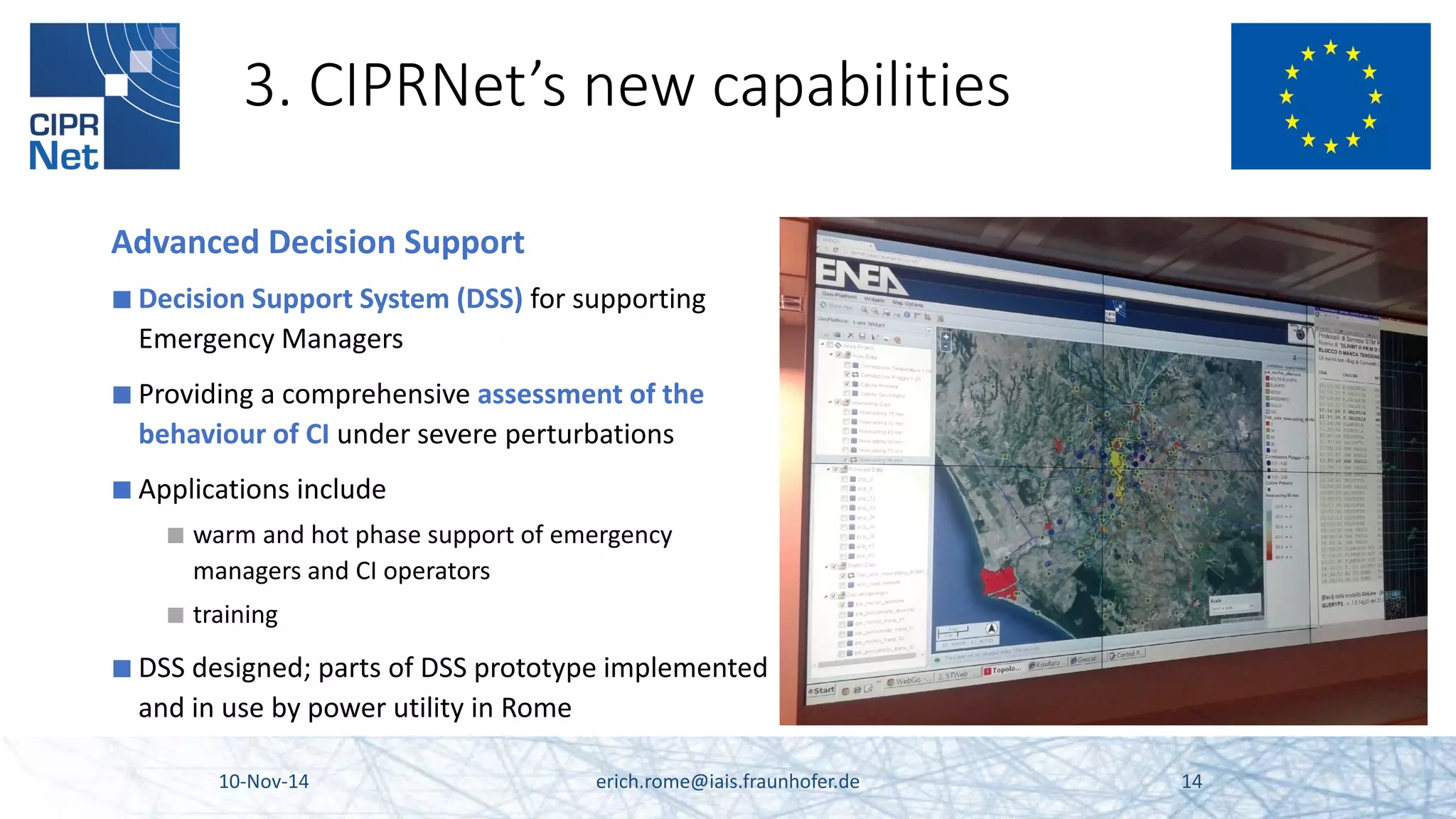
Advanced Decision Support 
■ 
Decision Support System (DSS) for supporting Emergency Managers 
■ 
Providing a comprehensive assessment of the behaviour of CI under severe perturbations 
■ 
Applications include 
■ 
warm and hot phase support of emergency managers and CI operators 
■ 
training 
■ 
DSS designed; parts of DSS prototype implemented and in use by power utility in Rome
5. Summary of CIPRNet intro 
■ 
CIPRNet undertakes a next step towards realising EISAC by capability forming and capacity building 
■ 
CIPRNet will deploy new capabilities to its initial audiences (crisis managers, CI operators) 
■ 
advanced decision support 
■ 
MS&A based ‘what if’ analyses with consequence analysis 
■ 
A core element of CIPRNet technologies and of CI(P) related research in general is MS&A 
■ 
CIPRNet is also active in community building 
■ 
One means are cooperation workshops with organisations, projects and networks 
■ 
European Reference Network for Critical Infrastructure Protection (ERN-CIP, 9/2013) 
■ 
European Safety, Reliability and Data Association (ESReDA, 5/2014) 10-Nov-14 erich.rome@iais.fraunhofer.de 15
5. CIPRNet coorperation workshops 
■ 
Particular interest in OpenMI: 
■ 
learn from OpenMI’s 
■ 
M&S interoperability approach 
■ 
experience with stakeholders 
■ 
successful approach of sustained technology and knowledge support 
■ 
enlarge our community 
■ 
raise awareness for larger CI context and aspects of water-related infrastructures 
■ 
show CIPRNet’s approaches to MS&A in larger and heterogenous scenarios 10-Nov-14 erich.rome@iais.fraunhofer.de 16
Thank you for your attention! 
8. Questions & Answers 10-Nov-14 erich.rome@iais.fraunhofer.de 17 
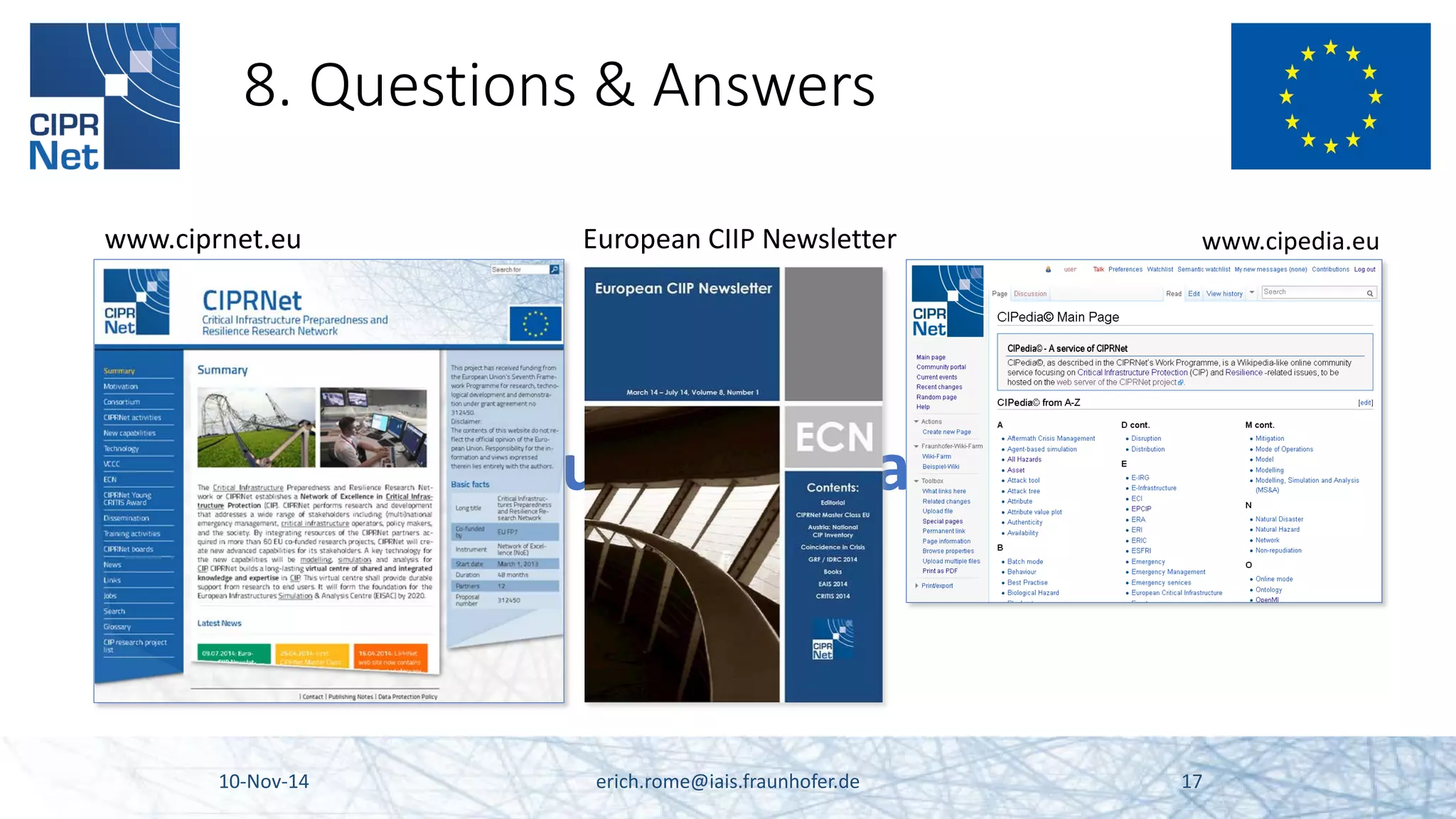
European CIIP Newsletter 
www.ciprnet.eu 
www.cipedia.eu

Dsd int 2014 - open mi symposium -cipr-net and openmi, erick rome, fraunhofer

  • 1.
    OpenMI – CIPRNetcooperation meeting Deltares – Delft (The Netherlands) – 31 October 2014 Introduction to CIPRNet Erich Rome erich.rome@iais.fraunhofer.de
  • 2.
    Agenda 1. CIPRNetFacts 2. “Critical” Infrastructures 3. CIPRNet: Research Context, Activities, and new Capabilities 4. Modelling, Simulation and Analysis of CI – Setting the Frame 5. Summary – Aims of Meeting with OpenMI 6. Questions & Answers 10-Nov-14 erich.rome@iais.fraunhofer.de 2
  • 3.
    1. CIPRNet –Facts ■ Critical Infrastructures Preparedness and Resilience Research Network ■ Co-funded by: EU FP7 ■ Instrument: Network of Excellence (NoE) ■ Start date: March 1, 2013 ■ Duration: 48 months ■ Website: ciprnet.eu 10-Nov-14 erich.rome@iais.fraunhofer.de 3
  • 4.
    1. CIPRNet –Consortium 1. Fraunhofer IAIS, DE (Coord.) 2. ENEA, IT 3. TNO, NL 4. UIC, FR 5. CEA, FR 6. Joint Research Centre, EU 10-Nov-14 erich.rome@iais.fraunhofer.de 4 7. Deltares, NL 8. University of Cyprus, CY 9. University of Technology and Life Sciences, PL 10. Università Campus Bio-Medico di Roma, IT 11. University of British Columbia, CA 12. ACRIS GmbH, CH
  • 5.
    2. “Critical” Infrastructures(CI) 10-Nov-14 erich.rome@iais.fraunhofer.de 5  Multi-disciplinary research domain: Critical Infrastructure Protection (CIP)  CI are complex (system of systems)  CI depend on other CI → cascading effects  Some CI extend cross-border  CI are continuously changing: technology, economy, legislation, …  Tools for research and investigation: modelling, simulation and analysis (MS&A) of scenarios including multiple CI and threats
  • 6.
    2. “Critical” Infrastructures ■ Since the late 1990s, the CI topic gained importance with the advent of new threats ■ Year 2000 bug ■ WTC attacks on 11.9.2001 ■ Climate change ■ Follow-up activities ■ Identification of CI ■ Risk assessment of CI, following an all hazards approach ■ Measures for protection of CI ■ New research area: Critical Infrastructure Protection (CIP) ■ The USA and Europe took different paths 10-Nov-14 erich.rome@iais.fraunhofer.de 6
  • 7.
    2. “Critical” Infrastructures Definition of Critical Infrastructure according to ECI directive ■ “A critical infrastructure (CI) consists of those assets and parts thereof which are essential for the maintenance of critical societal functions, including the supply chain, health, safety, security, economy or social well-being of people.” [EU2008] ■ European CI (ECI) comprise CI of at least three Member States [EU2008] ■ ECI sectors already identified [EU2008]: energy and transport CI ■ National definitions vary, for example: ■ Germany: 9 CI sectors ■ The Netherlands: 12 CI sectors ■ France: 11 “activity sectors of vital importance” ■ 2013: Review of ECI 10-Nov-14 erich.rome@iais.fraunhofer.de 7 [EU2008] European Commission: Council Directive 2008/114/EC of 8 December 2008 on the identification and designation of European Critical Infrastructure and the assessment to improve their protection [EU2013] European Commission: CS Working Document SWD(2013)318 of 28.8.2013 on a new approach to the European Programme for Critical Infrastructure Protection Making European Critical Infrastructures more secure
  • 8.
    2. “Critical” Infrastructures Protection, resilience and preparedness ■ A 100% safety and security of CI is impossible to achieve ■ In order to protect CI, to make them more resilient, and to maintain their vital societal functions, this super-system needs to be better understood ■ Essential for any improvement in resilience or preparedness is a better understanding specifically of ■ What CI are affected by a crisis or emergency? ■ What is the role of CI in emergency plans? ■ What CI are needed for supplying, evacuating, caring people affected by a crisis or emergency? 10-Nov-14 erich.rome@iais.fraunhofer.de 8
  • 9.
    2. “Critical” Infrastructures Insight on CI in crises, catastrophes, and emergencies ■ post mortem analyses of real CI damages (like Kirchbach report on the Oder flood 2002) ■ Real exercises (like LÜKEX) ■ Computer-based modelling, simulation and analysis (MS&A) of crisis scenarios ■ Research results 10-Nov-14 erich.rome@iais.fraunhofer.de 9 CI damage reports
  • 10.
    3. CIPRNet jointactivities 10/11/2014 erich.rome@iais.fraunhofer.de 10 Capacity building … by educating and training experts and researchers (reaching a critical mass) Knowledge & technology … for improving end-users’ understanding and mitigation of the consequences of CI disruptions, leading to an enhanced resilience of CI VCCC Establishing a Virtual Centre of Competence & Expertise in CIP for long-lasting support Capability forming Providing new capabilities to end-users for better preparedness for CI-related emergencies
  • 11.
    3. CIPRNet’s newcapabilities Vision of a European Infrastructure Simulation & Analysis Centre (EISAC) ■ Sustained support from CIP research communities to end-users ■ Transfer of knowledge, technology and research results into application ■ Role model: NISAC (USA) ■ EU FP7 Project DIESIS: Comprehensive design study for EISAC (2008–2010) ■ Next steps: ■ CIPRNet (EU) ■ RoMA (Italy) 10-Nov-14 erich.rome@iais.fraunhofer.de 11 MemberState xEISACnodeMemberState yEISACnodeEISACHQEISACnodeEISACnodeEISACnodeEISACnode
  • 12.
    3. CIPRNet’s newcapabilities 10/11/2014 erich.rome@iais.fraunhofer.de 12 Secure design of NGI Next Generation Infrastructures (Smart Grids et.) ‘what if’ analysis / fMS&A based on federated modelling, simulation & analysis and consequence analysis Decision Support System with added-value for emergency management and CI operators Demonstrate timely, actionable, risk-informed CIP analyses 1) Ask the expert 2) Demonstrating new capabilities at an exercise VCCC
  • 13.
    3. CIPRNet’s newcapabilities CI fMS&A modelling for exploring various possible courses of action ■ ‘what if’ analysis: Exploration of different courses of action and their different consequences ■ Which action produces the least consequences? ■ Applications include: Training of crisis managers, post mortem analyses ■ Uses computer-based federated modelling, simulation & analysis (fMS&A) of complex scenarios involving CI and threats Development state in CIPRNet: ■ Cross-border NL/DE scenarios with two completed storylines ■ fMS&A architecture designed 10/11/2014 erich.rome@iais.fraunhofer.de 13
  • 14.
    3. CIPRNet’s newcapabilities 10-Nov-14 erich.rome@iais.fraunhofer.de 14 Advanced Decision Support ■ Decision Support System (DSS) for supporting Emergency Managers ■ Providing a comprehensive assessment of the behaviour of CI under severe perturbations ■ Applications include ■ warm and hot phase support of emergency managers and CI operators ■ training ■ DSS designed; parts of DSS prototype implemented and in use by power utility in Rome
  • 15.
    5. Summary ofCIPRNet intro ■ CIPRNet undertakes a next step towards realising EISAC by capability forming and capacity building ■ CIPRNet will deploy new capabilities to its initial audiences (crisis managers, CI operators) ■ advanced decision support ■ MS&A based ‘what if’ analyses with consequence analysis ■ A core element of CIPRNet technologies and of CI(P) related research in general is MS&A ■ CIPRNet is also active in community building ■ One means are cooperation workshops with organisations, projects and networks ■ European Reference Network for Critical Infrastructure Protection (ERN-CIP, 9/2013) ■ European Safety, Reliability and Data Association (ESReDA, 5/2014) 10-Nov-14 erich.rome@iais.fraunhofer.de 15
  • 16.
    5. CIPRNet coorperationworkshops ■ Particular interest in OpenMI: ■ learn from OpenMI’s ■ M&S interoperability approach ■ experience with stakeholders ■ successful approach of sustained technology and knowledge support ■ enlarge our community ■ raise awareness for larger CI context and aspects of water-related infrastructures ■ show CIPRNet’s approaches to MS&A in larger and heterogenous scenarios 10-Nov-14 erich.rome@iais.fraunhofer.de 16
  • 17.
    Thank you foryour attention! 8. Questions & Answers 10-Nov-14 erich.rome@iais.fraunhofer.de 17 European CIIP Newsletter www.ciprnet.eu www.cipedia.eu