www.infrarisk-fp7.eu
INFRARISK
Consortium
INFRARISK works for safer European
Critical Infrastructures
This project has received funding from the
European Union’s Seventh Programme for
research, technological development and
demonstration under grant agreement No.
603960
The INFRARISK Consortium consists of 11
members from seven different countries. The
consortium represents a well balanced and strong
partnership among universities, research
institutions, SME’s, and Large Enterprise (LE).
Novel indicators for identifying critical
INFRAstructure at RISK from Natural Hazards
Project Coordinator ROD/ RODIS
Eugene O’Brien eugene.obrien@rod.ie
Dissemination Partner CSIC
M.J. Jimenez mj.jimenez@csic.es
In Europe, extreme natural hazard events are not
frequent but due to the complex interdependency
of our critical infrastructure systems these events
can have a devastating impact in any part of
Europe.
Protection against the impacts of natural hazards
must be guaranteed for people to work and live in
a secure and resilient environment. No activity,
including emergencies and rescue operations, can
be carried out with the loss of key buildings and
facilities, transport networks and an interruption
of essential supplies.
INFRARISK will develop reliable stress tests to
establish the resilience of European Critical
Infrastructures (CI) to rare low frequency extreme
events, thus contributing to the decision making
process on how to build safer in the future.
INFRARISK will focus on road and rail
infrastructure in Europe.
INFRARISK will enable infrastructure managers to
minimise the impact of extreme events by
providing them with the necessary tools to
develop robust mitigation and response
strategies.
Essential in the INFRARISK approach is the
dissemination aspect which involves several target
levels and the development of focused materials
and products to reach the widest audience
possible.
The INFRARISK project runs from October 2013
until September 2016
Artwork and layout: CSIC and Snap Consulting www.snapconsulting.es June 2014
Novel indicators for identifying critical
INFRAstructure at RISK from
Natural Hazards
The project in 3' at: http://goo.gl/6v1ONU
info@infrarisk-fp7.eu
infrarisk-fp7InfraRisk
Objectives
The EU funded FP7 project INFRARISK is a three-
year collaborative project to develop a stress test
framework to tackle the coupled impacts of
natural hazards on interdependent infrastructure
networks.
INFRARISK will focus on:
•  Developing a stress test structure for specific
natural hazards on CI networks and a framework
for linear infrastructure systems with wider
extents and many nodal points.
•  Considering the impacts of earthquakes, slope
failure, mass movement, and flooding on
European roads, highways and railroads (Ten-T
Core network).
•  Facilitating implementation through the
development of GIS based and web based stress
test algorithms for complex infrastructure
networks.
•  Testing the framework developed through the
simulation of complex case studies.
•  Exploitation strategies aimed at disseminating
the 'knowledge' and not just the results.
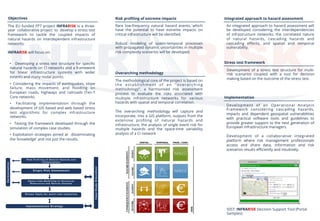
The methodological core of the project is based on
the establishment of an ‘’overarching
methodology’’, a harmonised risk assessment
process to evaluate the risks associated with
multiple infrastructure networks for various
hazards with spatial and temporal correlation.
The overarching methodology will capture and
incorporate, into a GIS platform, outputs from the
extensive profiling of natural hazards and
infrastructure, the analysis of single event risk for
multiple hazards and the space-time variability
analysis of a CI network
Development of an Operational Analysis
Framework considering cascading hazards,
impacts and dependent geospatial vulnerabilities
with practical software tools and guidelines to
provide greater support to the next generation of
European infrastructure managers.
Development of a collaborative integrated
platform where risk management professionals
access and share data, information and risk
scenarios results efficiently and intuitively.
An integrated approach to hazard assessment will
be developed considering the interdependencies
of infrastructure networks, the correlated nature
of natural hazards, cascading hazards and
cascading effects, and spatial and temporal
vulnerability.
Rare low-frequency natural hazard events, which
have the potential to have extreme impacts on
critical infrastructure will be identified.
Robust modeling of spatio-temporal processes
with propagated dynamic uncertainties in multiple
risk complexity scenarios will be developed.
Development of a stress test structure for multi-
risk scenarios coupled with a tool for decision
making based on the outcome of the stress test.
IDST: INFRARISK Decision Support Tool (Portal
Samples)
Risk profiling of extreme impacts
Overarching methodology
Integrated approach to hazard assessment
Stress test framework
Implementation
Harmonisation
R i s k P r o fi l i n g o f N a t u r a l H a z a r d s a n d
I n f r a s t r u c t u r e
Single Risk Assessment
S p a c e - T i m e M o d e l l i n g o f S t r u c t u r a l
B e h a v i o u r s a n d N a t u r a l H a z a r d s
S t r e s s Te s t s f o r m u l t i - r i s k s c e n a r i o s
Implementation Strategy
CaseStudySimulation

InfraRisk Brochure

  • 1.
    www.infrarisk-fp7.eu INFRARISK Consortium INFRARISK works forsafer European Critical Infrastructures This project has received funding from the European Union’s Seventh Programme for research, technological development and demonstration under grant agreement No. 603960 The INFRARISK Consortium consists of 11 members from seven different countries. The consortium represents a well balanced and strong partnership among universities, research institutions, SME’s, and Large Enterprise (LE). Novel indicators for identifying critical INFRAstructure at RISK from Natural Hazards Project Coordinator ROD/ RODIS Eugene O’Brien eugene.obrien@rod.ie Dissemination Partner CSIC M.J. Jimenez mj.jimenez@csic.es In Europe, extreme natural hazard events are not frequent but due to the complex interdependency of our critical infrastructure systems these events can have a devastating impact in any part of Europe. Protection against the impacts of natural hazards must be guaranteed for people to work and live in a secure and resilient environment. No activity, including emergencies and rescue operations, can be carried out with the loss of key buildings and facilities, transport networks and an interruption of essential supplies. INFRARISK will develop reliable stress tests to establish the resilience of European Critical Infrastructures (CI) to rare low frequency extreme events, thus contributing to the decision making process on how to build safer in the future. INFRARISK will focus on road and rail infrastructure in Europe. INFRARISK will enable infrastructure managers to minimise the impact of extreme events by providing them with the necessary tools to develop robust mitigation and response strategies. Essential in the INFRARISK approach is the dissemination aspect which involves several target levels and the development of focused materials and products to reach the widest audience possible. The INFRARISK project runs from October 2013 until September 2016 Artwork and layout: CSIC and Snap Consulting www.snapconsulting.es June 2014 Novel indicators for identifying critical INFRAstructure at RISK from Natural Hazards The project in 3' at: http://goo.gl/6v1ONU info@infrarisk-fp7.eu infrarisk-fp7InfraRisk
  • 2.
    Objectives The EU fundedFP7 project INFRARISK is a three- year collaborative project to develop a stress test framework to tackle the coupled impacts of natural hazards on interdependent infrastructure networks. INFRARISK will focus on: •  Developing a stress test structure for specific natural hazards on CI networks and a framework for linear infrastructure systems with wider extents and many nodal points. •  Considering the impacts of earthquakes, slope failure, mass movement, and flooding on European roads, highways and railroads (Ten-T Core network). •  Facilitating implementation through the development of GIS based and web based stress test algorithms for complex infrastructure networks. •  Testing the framework developed through the simulation of complex case studies. •  Exploitation strategies aimed at disseminating the 'knowledge' and not just the results. The methodological core of the project is based on the establishment of an ‘’overarching methodology’’, a harmonised risk assessment process to evaluate the risks associated with multiple infrastructure networks for various hazards with spatial and temporal correlation. The overarching methodology will capture and incorporate, into a GIS platform, outputs from the extensive profiling of natural hazards and infrastructure, the analysis of single event risk for multiple hazards and the space-time variability analysis of a CI network Development of an Operational Analysis Framework considering cascading hazards, impacts and dependent geospatial vulnerabilities with practical software tools and guidelines to provide greater support to the next generation of European infrastructure managers. Development of a collaborative integrated platform where risk management professionals access and share data, information and risk scenarios results efficiently and intuitively. An integrated approach to hazard assessment will be developed considering the interdependencies of infrastructure networks, the correlated nature of natural hazards, cascading hazards and cascading effects, and spatial and temporal vulnerability. Rare low-frequency natural hazard events, which have the potential to have extreme impacts on critical infrastructure will be identified. Robust modeling of spatio-temporal processes with propagated dynamic uncertainties in multiple risk complexity scenarios will be developed. Development of a stress test structure for multi- risk scenarios coupled with a tool for decision making based on the outcome of the stress test. IDST: INFRARISK Decision Support Tool (Portal Samples) Risk profiling of extreme impacts Overarching methodology Integrated approach to hazard assessment Stress test framework Implementation Harmonisation R i s k P r o fi l i n g o f N a t u r a l H a z a r d s a n d I n f r a s t r u c t u r e Single Risk Assessment S p a c e - T i m e M o d e l l i n g o f S t r u c t u r a l B e h a v i o u r s a n d N a t u r a l H a z a r d s S t r e s s Te s t s f o r m u l t i - r i s k s c e n a r i o s Implementation Strategy CaseStudySimulation