Dr. Imran Masood
drimranmasood@iub.edu.pk
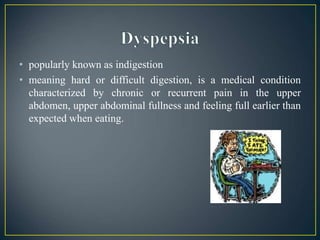
• popularly known as indigestion
• meaning hard or difficult digestion, is a medical condition
characterized by chronic or recurrent pain in the upper
abdomen, upper abdominal fullness and feeling full earlier than
expected when eating.
• The major pathophysiological mechanisms responsible
for functional dyspepsia include psychosocial factors and
alterations in motility and visceral sensation.
Approximately 50% of patients with functional dyspepsia
have motor disorders, such as impaired fundic relaxation,
antral dilation and/or hypomotility, gastroparesis, small
bowel dysmotility, or abnormal duodenogastric reflexes.
Patients typically present with gastric hypersensitivity
resulting from abnormal afferent function. The role of
Helicobacter pylori in functional dyspepsia is difficult to
define.
25-40 %, of which
50% self medicate
25% consult their G.P.
5% of G.P. consultations are for dyspepsia
Prescribed drugs and endoscopies cost £600M in 2000
OTC indigestion remedies sold for £100M in 2002
• Reflux oesophagitis 12%
• Duodenal ulcer 10%
• Gastric ulcer 6%
• Gastric carcinoma 1%
• Oesophageal carcinoma 0.5%
Non-erosive Reflux Disease
Functional (non-ulcer) dyspepsia
• GI bleeding (same day referral)
• Persistent vomiting
• Weight loss (progressive unintentional)
• Dysphagia
• Epigastric mass
• Anaemia due to possible GI blood loss
Thus all patients with new-onset dyspepsia should have
abdominal examination and FBC
• Consider possible causes outside upper GI tract
-Heart, lung, liver, gall bladder, pancreas, bowel
• Consider drugs and stop if possible
- Aspirin / NSAIDs, calcium antagonists, nitrates,
theophyllines, etidronate, steroids
• Alarm symptoms/signs (2 week referral)
• Unexplained and persistent recent-onset
dyspepsia without alarm symptoms
– Unexplained means no cause known
– Persistent implies present for a length of
time (NICE suggest 4-6 weeks)
– Recent-onset implies new-not a recurrent episode.
• Review medications for possible causes of dyspepsia
(calcium antagonists, nitrates, theophyllines,
bisphosphonates, corticosteroids and non-steroidal
anti-inflammatory drugs [NSAIDs]).
• In patients requiring referral, suspend NSAID use.
Endoscopic investigation is indicated for patients of any
age with dyspepsia when presenting with any of the
following:
• chronic gastrointestinal bleeding,
• progressive unintentional weight loss,
• progressive difficulty swallowing,
• persistent vomiting,
• Iron deficiency anaemia,
• epigastric mass
• suspicious barium meal
• Patients of any age, presenting with dyspepsia and
without alarm signs, is not necessary.
• However, in patients aged 55 years and older with unexplained
and persistent recent-onset dyspepsia alone, an urgent referral
for endoscopy should be made.
• Stress benign nature of dyspepsia
• Lifestyle advice
– Healthy eating
– Weight reduction
– Stop smoking
– Use of antacids
• Initial therapeutic strategies for dyspepsia are
empirical treatment with a proton pump inhibitor (PPI) or
testing for and treating H. pylori.
• There is currently insufficient evidence to guide which should
be offered first.
• A 2-week washout period following PPI use is necessary
before testing for H. pylori with a breath test or a stool antigen
test
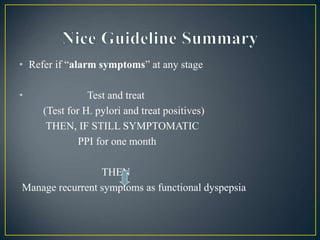
• Refer if “alarm symptoms” at any stage
• Test and treat
(Test for H. pylori and treat positives)
THEN, IF STILL SYMPTOMATIC
PPI for one month
THEN
Manage recurrent symptoms as functional dyspepsia
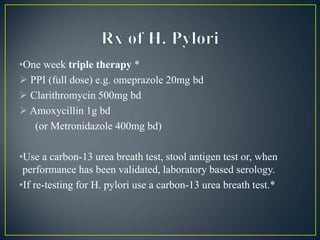
•One week triple therapy *
 PPI (full dose) e.g. omeprazole 20mg bd
 Clarithromycin 500mg bd
 Amoxycillin 1g bd
(or Metronidazole 400mg bd)
•Use a carbon-13 urea breath test, stool antigen test or, when
performance has been validated, laboratory based serology.
•If re-testing for H. pylori use a carbon-13 urea breath test.*

Drug induced GIT diseases (dyspepsia).ppt

  • 1.
  • 2.
    • popularly knownas indigestion • meaning hard or difficult digestion, is a medical condition characterized by chronic or recurrent pain in the upper abdomen, upper abdominal fullness and feeling full earlier than expected when eating.
  • 3.
    • The majorpathophysiological mechanisms responsible for functional dyspepsia include psychosocial factors and alterations in motility and visceral sensation. Approximately 50% of patients with functional dyspepsia have motor disorders, such as impaired fundic relaxation, antral dilation and/or hypomotility, gastroparesis, small bowel dysmotility, or abnormal duodenogastric reflexes. Patients typically present with gastric hypersensitivity resulting from abnormal afferent function. The role of Helicobacter pylori in functional dyspepsia is difficult to define.
  • 4.
    25-40 %, ofwhich 50% self medicate 25% consult their G.P. 5% of G.P. consultations are for dyspepsia Prescribed drugs and endoscopies cost £600M in 2000 OTC indigestion remedies sold for £100M in 2002
  • 5.
    • Reflux oesophagitis12% • Duodenal ulcer 10% • Gastric ulcer 6% • Gastric carcinoma 1% • Oesophageal carcinoma 0.5% Non-erosive Reflux Disease Functional (non-ulcer) dyspepsia
  • 6.
    • GI bleeding(same day referral) • Persistent vomiting • Weight loss (progressive unintentional) • Dysphagia • Epigastric mass • Anaemia due to possible GI blood loss Thus all patients with new-onset dyspepsia should have abdominal examination and FBC
  • 7.
    • Consider possiblecauses outside upper GI tract -Heart, lung, liver, gall bladder, pancreas, bowel • Consider drugs and stop if possible - Aspirin / NSAIDs, calcium antagonists, nitrates, theophyllines, etidronate, steroids
  • 8.
    • Alarm symptoms/signs(2 week referral) • Unexplained and persistent recent-onset dyspepsia without alarm symptoms – Unexplained means no cause known – Persistent implies present for a length of time (NICE suggest 4-6 weeks) – Recent-onset implies new-not a recurrent episode.
  • 9.
    • Review medicationsfor possible causes of dyspepsia (calcium antagonists, nitrates, theophyllines, bisphosphonates, corticosteroids and non-steroidal anti-inflammatory drugs [NSAIDs]). • In patients requiring referral, suspend NSAID use.
  • 10.
    Endoscopic investigation isindicated for patients of any age with dyspepsia when presenting with any of the following: • chronic gastrointestinal bleeding, • progressive unintentional weight loss, • progressive difficulty swallowing, • persistent vomiting, • Iron deficiency anaemia, • epigastric mass • suspicious barium meal
  • 11.
    • Patients ofany age, presenting with dyspepsia and without alarm signs, is not necessary. • However, in patients aged 55 years and older with unexplained and persistent recent-onset dyspepsia alone, an urgent referral for endoscopy should be made.
  • 12.
    • Stress benignnature of dyspepsia • Lifestyle advice – Healthy eating – Weight reduction – Stop smoking – Use of antacids
  • 13.
    • Initial therapeuticstrategies for dyspepsia are empirical treatment with a proton pump inhibitor (PPI) or testing for and treating H. pylori. • There is currently insufficient evidence to guide which should be offered first. • A 2-week washout period following PPI use is necessary before testing for H. pylori with a breath test or a stool antigen test
  • 14.
    • Refer if“alarm symptoms” at any stage • Test and treat (Test for H. pylori and treat positives) THEN, IF STILL SYMPTOMATIC PPI for one month THEN Manage recurrent symptoms as functional dyspepsia
  • 15.
    •One week tripletherapy *  PPI (full dose) e.g. omeprazole 20mg bd  Clarithromycin 500mg bd  Amoxycillin 1g bd (or Metronidazole 400mg bd) •Use a carbon-13 urea breath test, stool antigen test or, when performance has been validated, laboratory based serology. •If re-testing for H. pylori use a carbon-13 urea breath test.*