DrivingDriving
SafetySafety
WWW.USQC.US
Safe Driving
WWW.USQC.US
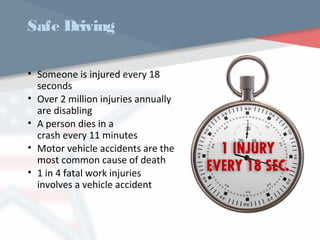
• Someone is injured every 18
seconds
• Over 2 million injuries annually
are disabling
• A person dies in a
crash every 11 minutes
• Motor vehicle accidents are the
most common cause of death
• 1 in 4 fatal work injuries
involves a vehicle accident
Driving Hazards
WWW.USQC.US
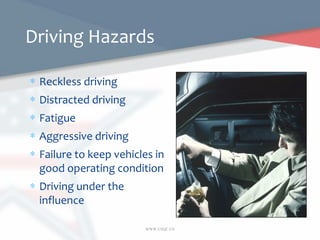
∗ Reckless driving
∗ Distracted driving
∗ Fatigue
∗ Aggressive driving
∗ Failure to keep vehicles in
good operating condition
∗ Driving under the
influence
Setting Up
• Adjust your seat so your arms are slightly bent at the elbows when
gripping the wheel.
• Keep your hands at the ten o’clock and two o’clock or nine o’clock and
three o’clock positions on the steering wheel.
• Hold the wheel tightly enough so your palms do not slip off.
• Adjust side mirrors so you can either see the door handles or angled
away to cover blind spots.
WWW.USQC.US
Adjusting Side Mirrors forBlind Spots
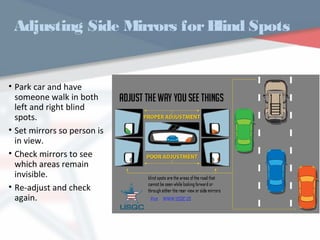
• Park car and have
someone walk in both
left and right blind
spots.
• Set mirrors so person is
in view.
• Check mirrors to see
which areas remain
invisible.
• Re-adjust and check
again.
WWW.USQC.US
Safe Driving Tips - Merging
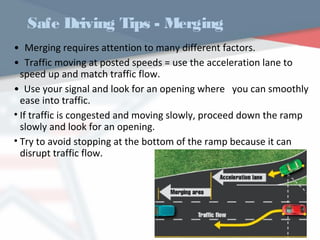
• Merging requires attention to many different factors.
• Traffic moving at posted speeds = use the acceleration lane to
speed up and match traffic flow.
• Use your signal and look for an opening where you can smoothly
ease into traffic.
• If traffic is congested and moving slowly, proceed down the ramp
slowly and look for an opening.
• Try to avoid stopping at the bottom of the ramp because it can
disrupt traffic flow.
WWW.USQC.US
WWW.USQC.US
Safe Driving Tips - Intersections
• Do not closely follow a large vehicle through an intersection
with stoplights. You can’t see if the light has changed.
• Leave enough space so you have a clear view of everything
before proceeding.
• When making a left turn, slow down and yield if there is not a
green arrow giving you the right-of-way.
• Don’t turn your wheels until you’re ready to move (if your
vehicle is hit from behind, you could be pushed into oncoming
traffic).
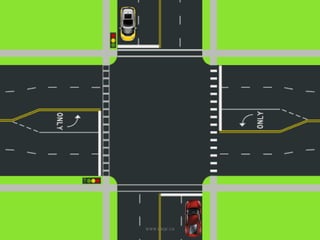
Safe Driving Tips - Four-Way Stop
• First car to arrive at an intersection with a four-way stop
(whether sign or traffic light) should be first to go.
• When it's unclear which vehicle arrived first, general rule
is driver to the right has the right-of-way.
• Don’t count on other drivers; proceed with caution.
WWW.USQC.US
WWW.USQC.US
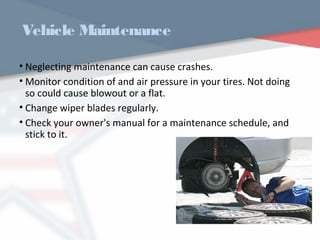
Vehicle Maintenance
• Neglecting maintenance can cause crashes.
• Monitor condition of and air pressure in your tires. Not doing
so could cause blowout or a flat.
• Change wiper blades regularly.
• Check your owner's manual for a maintenance schedule, and
stick to it.
WWW.USQC.US
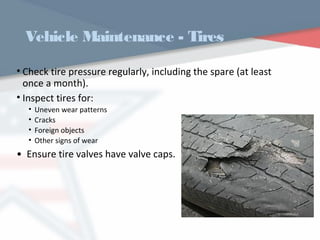
Vehicle Maintenance - Tires
• Check tire pressure regularly, including the spare (at least
once a month).
• Inspect tires for:
• Uneven wear patterns
• Cracks
• Foreign objects
• Other signs of wear
• Ensure tire valves have valve caps.
WWW.USQC.US
Vehicle Maintenance - Tires
• Check tire pressure before a long trip.
• Do not overload vehicle – check tire info placard for
maximum recommended load.
• If towing a trailer, remember that some weight of loaded
trailer is transferred to vehicle.
• Try not to strike curb when parking.
WWW.USQC.US
Flat Tire/Blowout - Highway
At the first sign of trouble:
• Firmly grip the steering wheel
• Do not slam on brakes
• Take foot off the gas pedal
• Work vehicle toward the shoulder or exit
• If changing lanes, use turn signals
• Steer as vehicle slows down
WWW.USQC.US
Flat Tire/Blowout - Highway
• Once off road, place reflective triangles
• Keep emergency flashers on
• Change tire, if you know how
• Keep away from traffic
• Call for professional help, if necessary
• Do not stand behind or next to vehicle
WWW.USQC.US
Safe Driving Skills
• Keep your eyes constantly moving: - Look up and
down the road - Look to the sides of the road
- Look into the rear view mirror
• Always leave yourself an out: - Try to find a
place to head if a crash occurs - Think about other drivers’
blind spots
• Don’t linger while passing.
• Don’t follow too closely (“tailgate”).
• Avoid “packs” of vehicles.
WWW.USQC.US
Safe Driving Skills
• Ensure other drivers see you – keep headlights on both day
and night.
• Always use turn signals well ahead of time.
• Never assume what other drivers will do.
• Maintain an average speed on highways; going too fast or
too slow creates a hazard.
WWW.USQC.US
Safe Driving Skills
• Use average traffic speed when merging.
• Think ahead – avoid making sudden movements when
exiting highways.
• Obey all traffic signs and signals.
• Keep your eyes on the road, not on a cell phone or music
device.
• Watch for pedestrians, bicyclists and motorcyclists.
• Scan the road ahead for animals.
WWW.USQC.US
Safe Driving Skills
Stopping on Highways:
• Don’t be a stationary object or semi-stationary obstacle.
• Stopping at the end of an entrance ramp is dangerous;
learn to time a safe merge.
• Avoid stopping on the shoulder of road; exit highway
before stopping, if possible.
WWW.USQC.US
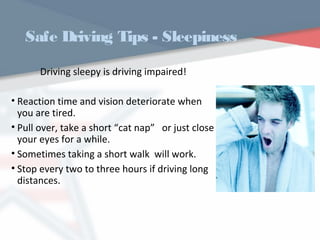
Safe Driving Tips - Sleepiness
Driving sleepy is driving impaired!
• Reaction time and vision deteriorate when
you are tired.
• Pull over, take a short “cat nap” or just close
your eyes for a while.
• Sometimes taking a short walk will work.
• Stop every two to three hours if driving long
distances.
WWW.USQC.US
Safe Driving Tips - Familiarization
Be familiar with your vehicle:
• Know what every button, switch and lever does.
• Know where the oil, brake fluid, engine coolant and
window washer reservoirs are.
• Know how to fill those reservoirs.
• Know what every indicator light means.
• Know how to operate basic items, such as the defroster,
wipers, radio and headlights.
WWW.USQC.US
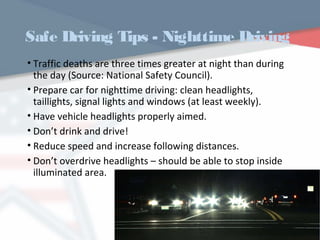
Safe Driving Tips - Nighttime Driving
• Traffic deaths are three times greater at night than during
the day (Source: National Safety Council).
• Prepare car for nighttime driving: clean headlights,
taillights, signal lights and windows (at least weekly).
• Have vehicle headlights properly aimed.
• Don’t drink and drive!
• Reduce speed and increase following distances.
• Don’t overdrive headlights – should be able to stop inside
illuminated area.
WWW.USQC.US
Safe Driving Tips –
Nighttime Driving
• When following a vehicle, keep your headlights on low
beam.
• If oncoming vehicle doesn’t turn high beams down, look to
the right side of road.
• If tired, stop and rest.
• If you have car problems, pull to the side of the road and
place reflective devices; turn on emergency flashers.
WWW.USQC.US
Safe Driving Tips - Seasonal Changes
• Winter driving = slippery roads, visibility issues, cold, etc.
• Spring = rain can cause slippery roads.
• Summer = high temperatures can cause vehicle problems;
there’s more traffic on roads.
• Fall = wet leaves on road can make it slippery.
• Daylight saving’s time = sun's position in sky changes
causing darkness and glare.
WWW.USQC.US
Safe Driving Tips - Rain
• Drive slowly and carefully – especially on curves.
• Steer and brake with a light touch.
• When slowing/stopping, do not brake hard or lock the
wheels – could cause skidding.
• Maintain mild pressure on the brake pedal.
• Adjust your speed to the wet road conditions.
WWW.USQC.US
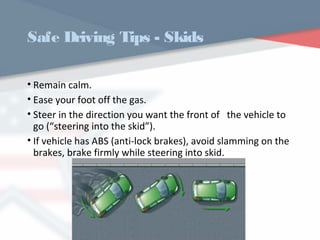
Safe Driving Tips - Skids
• Remain calm.
• Ease your foot off the gas.
• Steer in the direction you want the front of the vehicle to
go (“steering into the skid”).
• If vehicle has ABS (anti-lock brakes), avoid slamming on the
brakes, brake firmly while steering into skid.
WWW.USQC.US
Safe Driving Tips - Hydroplaning
• Occurs when water in front of tires builds up faster than
vehicle’s weight can push it out of the way.
• Water pressure causes vehicle to rise up and slide on thin
layer of water between tires and road.
• Can cause skidding, drifting out of lane, leaving roadway.
• To avoid: keep tires properly inflated, maintain good tread,
slow down, avoid puddles.
WWW.USQC.US
Safe Driving Tips - Hydroplaning
• If hydroplaning, do not brake or turn suddenly.
• Ease foot off gas until vehicle slows down and you can feel
the road again.
• If you need to brake, do so gently, with light pumping
actions.
• If vehicle has anti-lock brakes, brake normally.
WWW.USQC.US
Safe Driving Tips - Winter
• Ensure vehicle wiper blades are in good condition and
washer fluid is filled.
• Ensure vehicle battery is in good condition and
appropriately charged.
• Clear snow/ice from all windows, lights, hood, trunk and
top of vehicle before driving.
• Adjust your speed accordingly.
• Check tire pressure regularly.
• Dress warmly with layered clothing that is loose-fitting and
lightweight.
WWW.USQC.US
Safe Driving Tips - Winter
If in vehicle and stranded due to road conditions:
• Stay in vehicle.
• Display trouble sign (ex: brightly-colored
cloth on antenna).
• Occasionally run engine with heater on to
keep warm.
• Keep exhaust pipe free of snow and open a
window to avoid carbon monoxide poisoning.
• Watch for signs of frostbite and hypothermia.
WWW.USQC.US
Safe Driving Tips - Winter
If in vehicle and stranded due to road conditions:
• Do minor exercises to keep up circulation.
• Clap hands and move arms and legs frequently.
• Try not to stay in one position for too long.
• Use newspapers, maps, mats, etc., for warmth.
• Avoid drinking fluids containing caffeine or alcohol:
can quicken effects of cold.
WWW.USQC.US
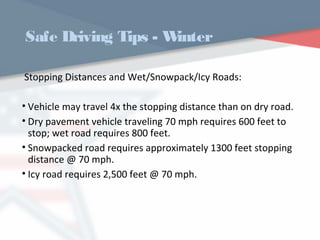
Safe Driving Tips - Winter
Stopping Distances and Wet/Snowpack/Icy Roads:
• Vehicle may travel 4x the stopping distance than on dry road.
• Dry pavement vehicle traveling 70 mph requires 600 feet to
stop; wet road requires 800 feet.
• Snowpacked road requires approximately 1300 feet stopping
distance @ 70 mph.
• Icy road requires 2,500 feet @ 70 mph.
WWW.USQC.US
Safe Driving Tips - Winter
Winterizing Vehicles:
• Ensure ice scraper and windshield de-icer are on board.
• Carry spare set of wiper blades.
• Carry kitty litter, oil dry or sand for traction.
• Carry blankets, flashlight, road flares.
• Have lock de-icer available.
WWW.USQC.US
Safe Driving Tips – Vehicle Fires
• Get yourself and all others out of and away from the vehicle.
• Move a safe distance from the vehicle and call fire department.
• Do not stand near vehicle bumpers.
• Remain away from vehicle; do not attempt to get back into burning
vehicle.
• If trained, are comfortable and fire is small, use appropriate fire
extinguisher.
• If you suspect fire under hood or in trunk, do not open.
WWW.USQC.US
Vehicle Safety - General
• Always use seatbelts!
• When backing up, use caution: if you have passenger, ask
them to get out and direct; if not, get out and check area
before backing.
• If vehicle is not operating properly, report and discontinue
use.
• Shut off motor and do not smoke or use cell phone while
refueling.
• Do not leave engine running in an unattended vehicle.
• Report all work accidents, no matter how minor, to your
supervisor.
WWW.USQC.US
Vehicle Safety - General
Inspect vehicle before driving:
• Ensure the horn, lights and turn signals work.
• Ensure tires are in good condition.
• Ensure brakes are working (test upon moving).
• Ensure emergency brake works.
• Check gauges after starting (e.g., fuel, battery, temperature, etc.)
to ensure they’re working.
WWW.USQC.US
Vehicle Safety - General
Distracted Driving:
• Nearly 6,000 people killed and 500,000 injured as a result of
distracted driving (2008; USDOT).
• Distracted driving is a factor in more than 20 percent of
crashes.
• Drivers on cell phones fail to see up to half of information in
driving environment.
• Do not text while driving – pull over!
• Pull over to talk on phone – even using a “hands free” device is
distracting.
WWW.USQC.US
Preventing Road Rage
• Don’t offend, don’t engage.
• Adjust your attitude (stay calm).
• Avoid cutting people off.
• Don’t tailgate or follow closely.
• Don’t make obscene/questionable gestures.
• Avoid eye contact.
• Don’t start a fight – give angry drivers lots of room.
WWW.USQC.US
Summary
• Operating a motor vehicle is dangerous, but it can also be a
pleasant experience.
• Use common sense, obey speed limits, drive defensively and
observe “road safety rules.”
• Distracted driving can be just as dangerous as alcohol-
impaired driving.
• Be careful, alert, courteous and safe.
• Have a safe trip!
WWW.USQC.US
Questions
WWW.USQC.US

Driving safety

  • 1.
  • 2.
    Safe Driving WWW.USQC.US • Someoneis injured every 18 seconds • Over 2 million injuries annually are disabling • A person dies in a crash every 11 minutes • Motor vehicle accidents are the most common cause of death • 1 in 4 fatal work injuries involves a vehicle accident
  • 3.
    Driving Hazards WWW.USQC.US ∗ Recklessdriving ∗ Distracted driving ∗ Fatigue ∗ Aggressive driving ∗ Failure to keep vehicles in good operating condition ∗ Driving under the influence
  • 4.
    Setting Up • Adjustyour seat so your arms are slightly bent at the elbows when gripping the wheel. • Keep your hands at the ten o’clock and two o’clock or nine o’clock and three o’clock positions on the steering wheel. • Hold the wheel tightly enough so your palms do not slip off. • Adjust side mirrors so you can either see the door handles or angled away to cover blind spots. WWW.USQC.US
  • 5.
    Adjusting Side MirrorsforBlind Spots • Park car and have someone walk in both left and right blind spots. • Set mirrors so person is in view. • Check mirrors to see which areas remain invisible. • Re-adjust and check again. WWW.USQC.US
  • 6.
    Safe Driving Tips- Merging • Merging requires attention to many different factors. • Traffic moving at posted speeds = use the acceleration lane to speed up and match traffic flow. • Use your signal and look for an opening where you can smoothly ease into traffic. • If traffic is congested and moving slowly, proceed down the ramp slowly and look for an opening. • Try to avoid stopping at the bottom of the ramp because it can disrupt traffic flow. WWW.USQC.US
  • 7.
    WWW.USQC.US Safe Driving Tips- Intersections • Do not closely follow a large vehicle through an intersection with stoplights. You can’t see if the light has changed. • Leave enough space so you have a clear view of everything before proceeding. • When making a left turn, slow down and yield if there is not a green arrow giving you the right-of-way. • Don’t turn your wheels until you’re ready to move (if your vehicle is hit from behind, you could be pushed into oncoming traffic).
  • 8.
    Safe Driving Tips- Four-Way Stop • First car to arrive at an intersection with a four-way stop (whether sign or traffic light) should be first to go. • When it's unclear which vehicle arrived first, general rule is driver to the right has the right-of-way. • Don’t count on other drivers; proceed with caution. WWW.USQC.US
  • 9.
  • 10.
    Vehicle Maintenance • Neglectingmaintenance can cause crashes. • Monitor condition of and air pressure in your tires. Not doing so could cause blowout or a flat. • Change wiper blades regularly. • Check your owner's manual for a maintenance schedule, and stick to it. WWW.USQC.US
  • 11.
    Vehicle Maintenance -Tires • Check tire pressure regularly, including the spare (at least once a month). • Inspect tires for: • Uneven wear patterns • Cracks • Foreign objects • Other signs of wear • Ensure tire valves have valve caps. WWW.USQC.US
  • 12.
    Vehicle Maintenance -Tires • Check tire pressure before a long trip. • Do not overload vehicle – check tire info placard for maximum recommended load. • If towing a trailer, remember that some weight of loaded trailer is transferred to vehicle. • Try not to strike curb when parking. WWW.USQC.US
  • 13.
    Flat Tire/Blowout -Highway At the first sign of trouble: • Firmly grip the steering wheel • Do not slam on brakes • Take foot off the gas pedal • Work vehicle toward the shoulder or exit • If changing lanes, use turn signals • Steer as vehicle slows down WWW.USQC.US
  • 14.
    Flat Tire/Blowout -Highway • Once off road, place reflective triangles • Keep emergency flashers on • Change tire, if you know how • Keep away from traffic • Call for professional help, if necessary • Do not stand behind or next to vehicle WWW.USQC.US
  • 15.
    Safe Driving Skills •Keep your eyes constantly moving: - Look up and down the road - Look to the sides of the road - Look into the rear view mirror • Always leave yourself an out: - Try to find a place to head if a crash occurs - Think about other drivers’ blind spots • Don’t linger while passing. • Don’t follow too closely (“tailgate”). • Avoid “packs” of vehicles. WWW.USQC.US
  • 16.
    Safe Driving Skills •Ensure other drivers see you – keep headlights on both day and night. • Always use turn signals well ahead of time. • Never assume what other drivers will do. • Maintain an average speed on highways; going too fast or too slow creates a hazard. WWW.USQC.US
  • 17.
    Safe Driving Skills •Use average traffic speed when merging. • Think ahead – avoid making sudden movements when exiting highways. • Obey all traffic signs and signals. • Keep your eyes on the road, not on a cell phone or music device. • Watch for pedestrians, bicyclists and motorcyclists. • Scan the road ahead for animals. WWW.USQC.US
  • 18.
    Safe Driving Skills Stoppingon Highways: • Don’t be a stationary object or semi-stationary obstacle. • Stopping at the end of an entrance ramp is dangerous; learn to time a safe merge. • Avoid stopping on the shoulder of road; exit highway before stopping, if possible. WWW.USQC.US
  • 19.
    Safe Driving Tips- Sleepiness Driving sleepy is driving impaired! • Reaction time and vision deteriorate when you are tired. • Pull over, take a short “cat nap” or just close your eyes for a while. • Sometimes taking a short walk will work. • Stop every two to three hours if driving long distances. WWW.USQC.US
  • 20.
    Safe Driving Tips- Familiarization Be familiar with your vehicle: • Know what every button, switch and lever does. • Know where the oil, brake fluid, engine coolant and window washer reservoirs are. • Know how to fill those reservoirs. • Know what every indicator light means. • Know how to operate basic items, such as the defroster, wipers, radio and headlights. WWW.USQC.US
  • 21.
    Safe Driving Tips- Nighttime Driving • Traffic deaths are three times greater at night than during the day (Source: National Safety Council). • Prepare car for nighttime driving: clean headlights, taillights, signal lights and windows (at least weekly). • Have vehicle headlights properly aimed. • Don’t drink and drive! • Reduce speed and increase following distances. • Don’t overdrive headlights – should be able to stop inside illuminated area. WWW.USQC.US
  • 22.
    Safe Driving Tips– Nighttime Driving • When following a vehicle, keep your headlights on low beam. • If oncoming vehicle doesn’t turn high beams down, look to the right side of road. • If tired, stop and rest. • If you have car problems, pull to the side of the road and place reflective devices; turn on emergency flashers. WWW.USQC.US
  • 23.
    Safe Driving Tips- Seasonal Changes • Winter driving = slippery roads, visibility issues, cold, etc. • Spring = rain can cause slippery roads. • Summer = high temperatures can cause vehicle problems; there’s more traffic on roads. • Fall = wet leaves on road can make it slippery. • Daylight saving’s time = sun's position in sky changes causing darkness and glare. WWW.USQC.US
  • 24.
    Safe Driving Tips- Rain • Drive slowly and carefully – especially on curves. • Steer and brake with a light touch. • When slowing/stopping, do not brake hard or lock the wheels – could cause skidding. • Maintain mild pressure on the brake pedal. • Adjust your speed to the wet road conditions. WWW.USQC.US
  • 25.
    Safe Driving Tips- Skids • Remain calm. • Ease your foot off the gas. • Steer in the direction you want the front of the vehicle to go (“steering into the skid”). • If vehicle has ABS (anti-lock brakes), avoid slamming on the brakes, brake firmly while steering into skid. WWW.USQC.US
  • 26.
    Safe Driving Tips- Hydroplaning • Occurs when water in front of tires builds up faster than vehicle’s weight can push it out of the way. • Water pressure causes vehicle to rise up and slide on thin layer of water between tires and road. • Can cause skidding, drifting out of lane, leaving roadway. • To avoid: keep tires properly inflated, maintain good tread, slow down, avoid puddles. WWW.USQC.US
  • 27.
    Safe Driving Tips- Hydroplaning • If hydroplaning, do not brake or turn suddenly. • Ease foot off gas until vehicle slows down and you can feel the road again. • If you need to brake, do so gently, with light pumping actions. • If vehicle has anti-lock brakes, brake normally. WWW.USQC.US
  • 28.
    Safe Driving Tips- Winter • Ensure vehicle wiper blades are in good condition and washer fluid is filled. • Ensure vehicle battery is in good condition and appropriately charged. • Clear snow/ice from all windows, lights, hood, trunk and top of vehicle before driving. • Adjust your speed accordingly. • Check tire pressure regularly. • Dress warmly with layered clothing that is loose-fitting and lightweight. WWW.USQC.US
  • 29.
    Safe Driving Tips- Winter If in vehicle and stranded due to road conditions: • Stay in vehicle. • Display trouble sign (ex: brightly-colored cloth on antenna). • Occasionally run engine with heater on to keep warm. • Keep exhaust pipe free of snow and open a window to avoid carbon monoxide poisoning. • Watch for signs of frostbite and hypothermia. WWW.USQC.US
  • 30.
    Safe Driving Tips- Winter If in vehicle and stranded due to road conditions: • Do minor exercises to keep up circulation. • Clap hands and move arms and legs frequently. • Try not to stay in one position for too long. • Use newspapers, maps, mats, etc., for warmth. • Avoid drinking fluids containing caffeine or alcohol: can quicken effects of cold. WWW.USQC.US
  • 31.
    Safe Driving Tips- Winter Stopping Distances and Wet/Snowpack/Icy Roads: • Vehicle may travel 4x the stopping distance than on dry road. • Dry pavement vehicle traveling 70 mph requires 600 feet to stop; wet road requires 800 feet. • Snowpacked road requires approximately 1300 feet stopping distance @ 70 mph. • Icy road requires 2,500 feet @ 70 mph. WWW.USQC.US
  • 32.
    Safe Driving Tips- Winter Winterizing Vehicles: • Ensure ice scraper and windshield de-icer are on board. • Carry spare set of wiper blades. • Carry kitty litter, oil dry or sand for traction. • Carry blankets, flashlight, road flares. • Have lock de-icer available. WWW.USQC.US
  • 33.
    Safe Driving Tips– Vehicle Fires • Get yourself and all others out of and away from the vehicle. • Move a safe distance from the vehicle and call fire department. • Do not stand near vehicle bumpers. • Remain away from vehicle; do not attempt to get back into burning vehicle. • If trained, are comfortable and fire is small, use appropriate fire extinguisher. • If you suspect fire under hood or in trunk, do not open. WWW.USQC.US
  • 34.
    Vehicle Safety -General • Always use seatbelts! • When backing up, use caution: if you have passenger, ask them to get out and direct; if not, get out and check area before backing. • If vehicle is not operating properly, report and discontinue use. • Shut off motor and do not smoke or use cell phone while refueling. • Do not leave engine running in an unattended vehicle. • Report all work accidents, no matter how minor, to your supervisor. WWW.USQC.US
  • 35.
    Vehicle Safety -General Inspect vehicle before driving: • Ensure the horn, lights and turn signals work. • Ensure tires are in good condition. • Ensure brakes are working (test upon moving). • Ensure emergency brake works. • Check gauges after starting (e.g., fuel, battery, temperature, etc.) to ensure they’re working. WWW.USQC.US
  • 36.
    Vehicle Safety -General Distracted Driving: • Nearly 6,000 people killed and 500,000 injured as a result of distracted driving (2008; USDOT). • Distracted driving is a factor in more than 20 percent of crashes. • Drivers on cell phones fail to see up to half of information in driving environment. • Do not text while driving – pull over! • Pull over to talk on phone – even using a “hands free” device is distracting. WWW.USQC.US
  • 37.
    Preventing Road Rage •Don’t offend, don’t engage. • Adjust your attitude (stay calm). • Avoid cutting people off. • Don’t tailgate or follow closely. • Don’t make obscene/questionable gestures. • Avoid eye contact. • Don’t start a fight – give angry drivers lots of room. WWW.USQC.US
  • 38.
    Summary • Operating amotor vehicle is dangerous, but it can also be a pleasant experience. • Use common sense, obey speed limits, drive defensively and observe “road safety rules.” • Distracted driving can be just as dangerous as alcohol- impaired driving. • Be careful, alert, courteous and safe. • Have a safe trip! WWW.USQC.US
  • 39.