DREAMBOT
Keshav Chintamani, Elias De Coninck, Geert Dorme
Mentored by Emanuel Skubowius (Fraunhofer IML)
Tractonomy Robotics
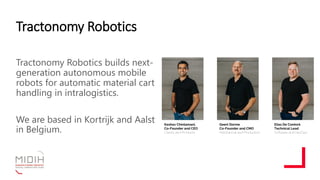
Tractonomy Robotics builds next-
generation autonomous mobile
robots for automatic material cart
handling in intralogistics.
We are based in Kortrijk and Aalst
in Belgium.
Keshav Chintamani,
Co-Founder and CEO
Clients and Products
Geert Dorme
Co-Founder and CMO
Mechanical and Production
Elias De Coninck
Technical Lead
Software and DevOps
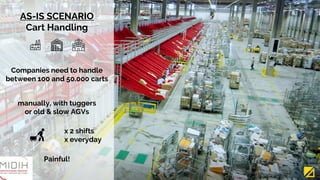
Companies need to handle
between 100 and 50.000 carts
x 2 shifts
x everyday
manually, with tuggers
or old & slow AGVs
AS-IS SCENARIO
Cart Handling
Painful!
© Tractonomy Robotics – Not for Redistribution3
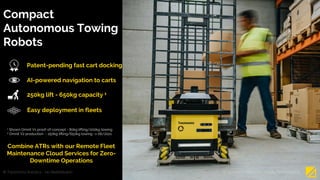
Compact
Autonomous Towing
Robots
1 Shown Omnit V1 proof-of-concept - 80kg lifting/200kg towing
2 Omnit V2 production - 250kg lifting/650kg towing -> 06/2021
AI-powered navigation to carts
250kg lift - 650kg capacity 1
Patent-pending fast cart docking
© Tractonomy Robotics – No Redistribution 4
Combine ATRs with our Remote Fleet
Maintenance Cloud Services for Zero-
Downtime Operations
Easy deployment in fleets
© Tractonomy Robotics – Not for Redistribution
© 2018 Tractonomy Robotics
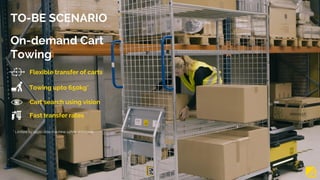
Towing upto 650kg*
Fast transfer rates
Cart search using vision
On-demand Cart
Towing
Flexible transfer of carts
* Limited by applicable machine safety standards
TO-BE SCENARIO
5
Objectives
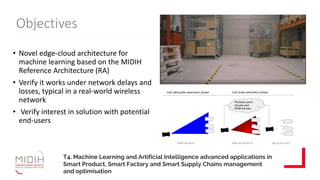
• Novel edge-cloud architecture for
machine learning based on the MIDIH
Reference Architecture (RA)
• Verify it works under network delays and
losses, typical in a real-world wireless
network
• Verify interest in solution with potential
end-users
T4. Machine Learning and Artificial Intelligence advanced applications in
Smart Product, Smart Factory and Smart Supply Chains management
and optimisation
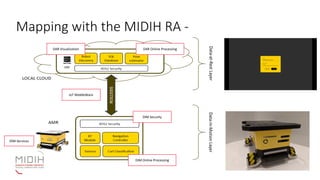
Mapping with the MIDIH RA -
DIM Online Processing
IoT MiddleWare
DIM Security
DIM Services
DAR Visualization DAR Online Processing
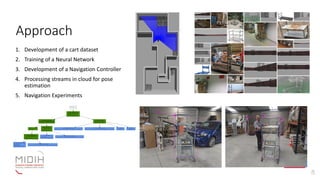
Approach
1. Development of a cart dataset
2. Training of a Neural Network
3. Development of a Navigation Controller
4. Processing streams in cloud for pose
estimation
5. Navigation Experiments
© Tractonomy Robotics - Confidential
Information
8
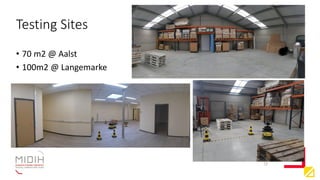
Testing Sites
• 70 m2 @ Aalst
• 100m2 @ Langemarke
9
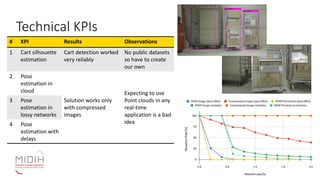
Technical KPIs
# KPI Results Observations
1 Cart silhouette
estimation
Cart detection worked
very reliably
No public datasets
so have to create
our own
2 Pose
estimation in
cloud
Solution works only
with compressed
images
Expecting to use
Point clouds in any
real-time
application is a bad
idea
3 Pose
estimation in
lossy networks
4 Pose
estimation with
delays
Business KPIs
# KPI Results Observations
5 Demonstrator Views COVID blocked any ability to offer live demonstrations.
However, the MIDIH results were always shown in our pitch deck and
we’ve had very positive responses including a paid study6 Interested Customers
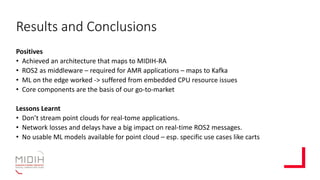
Results and Conclusions
Positives
• Achieved an architecture that maps to MIDIH-RA
• ROS2 as middleware – required for AMR applications – maps to Kafka
• ML on the edge worked -> suffered from embedded CPU resource issues
• Core components are the basis of our go-to-market
Lessons Learnt
• Don’t stream point clouds for real-tome applications.
• Network losses and delays have a big impact on real-time ROS2 messages.
• No usable ML models available for point cloud – esp. specific use cases like carts
THANK
YOU!

Dream bot tractonomy midih presentation oc2

  • 1.
    DREAMBOT Keshav Chintamani, EliasDe Coninck, Geert Dorme Mentored by Emanuel Skubowius (Fraunhofer IML)
  • 2.
    Tractonomy Robotics Tractonomy Roboticsbuilds next- generation autonomous mobile robots for automatic material cart handling in intralogistics. We are based in Kortrijk and Aalst in Belgium. Keshav Chintamani, Co-Founder and CEO Clients and Products Geert Dorme Co-Founder and CMO Mechanical and Production Elias De Coninck Technical Lead Software and DevOps
  • 3.
    Companies need tohandle between 100 and 50.000 carts x 2 shifts x everyday manually, with tuggers or old & slow AGVs AS-IS SCENARIO Cart Handling Painful! © Tractonomy Robotics – Not for Redistribution3
  • 4.
    Compact Autonomous Towing Robots 1 ShownOmnit V1 proof-of-concept - 80kg lifting/200kg towing 2 Omnit V2 production - 250kg lifting/650kg towing -> 06/2021 AI-powered navigation to carts 250kg lift - 650kg capacity 1 Patent-pending fast cart docking © Tractonomy Robotics – No Redistribution 4 Combine ATRs with our Remote Fleet Maintenance Cloud Services for Zero- Downtime Operations Easy deployment in fleets © Tractonomy Robotics – Not for Redistribution
  • 5.
    © 2018 TractonomyRobotics Towing upto 650kg* Fast transfer rates Cart search using vision On-demand Cart Towing Flexible transfer of carts * Limited by applicable machine safety standards TO-BE SCENARIO 5
  • 6.
    Objectives • Novel edge-cloudarchitecture for machine learning based on the MIDIH Reference Architecture (RA) • Verify it works under network delays and losses, typical in a real-world wireless network • Verify interest in solution with potential end-users T4. Machine Learning and Artificial Intelligence advanced applications in Smart Product, Smart Factory and Smart Supply Chains management and optimisation
  • 7.
    Mapping with theMIDIH RA - DIM Online Processing IoT MiddleWare DIM Security DIM Services DAR Visualization DAR Online Processing
  • 8.
    Approach 1. Development ofa cart dataset 2. Training of a Neural Network 3. Development of a Navigation Controller 4. Processing streams in cloud for pose estimation 5. Navigation Experiments © Tractonomy Robotics - Confidential Information 8
  • 9.
    Testing Sites • 70m2 @ Aalst • 100m2 @ Langemarke 9
  • 10.
    Technical KPIs # KPIResults Observations 1 Cart silhouette estimation Cart detection worked very reliably No public datasets so have to create our own 2 Pose estimation in cloud Solution works only with compressed images Expecting to use Point clouds in any real-time application is a bad idea 3 Pose estimation in lossy networks 4 Pose estimation with delays
  • 11.
    Business KPIs # KPIResults Observations 5 Demonstrator Views COVID blocked any ability to offer live demonstrations. However, the MIDIH results were always shown in our pitch deck and we’ve had very positive responses including a paid study6 Interested Customers
  • 12.
    Results and Conclusions Positives •Achieved an architecture that maps to MIDIH-RA • ROS2 as middleware – required for AMR applications – maps to Kafka • ML on the edge worked -> suffered from embedded CPU resource issues • Core components are the basis of our go-to-market Lessons Learnt • Don’t stream point clouds for real-tome applications. • Network losses and delays have a big impact on real-time ROS2 messages. • No usable ML models available for point cloud – esp. specific use cases like carts
  • 13.