DRAINAGE:
CLASS 9TH
RIVERS AND WATER SYSTEMS
Presented by Bijaya sir
PART: 2
Drainage: CBSE Class 9
Geography Chapter 3
A comprehensive guide to understanding India's river systems, drainage patterns, and
their vital role in shaping the nation's geography and economy. Master the concepts,
facts, and exam questions for CBSE Class 9.
Understanding Drainage
This chapter explores how water moves across India's diverse landscape, creating intricate networks of rivers that sustain millions of lives. From the
mighty Himalayas to the ancient Peninsular plateau, drainage systems tell the story of India's geographical evolution and human civilization.
What is Drainage?
The Natural Flow System
Drainage refers to the natural process by which water flows through
rivers, streams, and channels across the landscape. This system
removes excess water from the land and channels it toward larger
bodies of water like seas and oceans.
The drainage network includes the entire web of rivers, their
tributaries, and distributaries that work together to transport water
across a region.
Key Components
Main river channels that carry the bulk of water
Tributaries that feed water into larger rivers
Distributaries that branch off from main rivers
Underground drainage systems in certain regions
CBSE Exam Tip: Remember that drainage is not just about rivers4it's
the entire system of water movement across land.
What is a Drainage Basin?
Definition
A drainage basin, also called a watershed
or catchment area, is the land area where
all precipitation eventually drains into a
common river, lake, or outlet point.
Ganga Basin Example
The Ganga drainage basin covers
approximately 1 million square kilometers,
making it one of the world's largest. All
rainfall in this vast area ultimately flows
into the Ganga River system.
Boundary Features
Drainage basins are bounded by elevated
areas called water divides. These natural
barriers determine which direction water
will flow.
CBSE Question: Define drainage basin and give an example from India. Answer: A drainage basin is an area of land where precipitation
collects and drains into a common outlet. Example: The Ganga basin covers northern India.
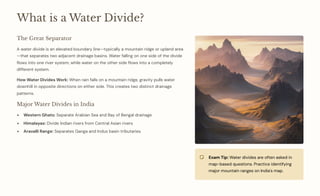
What is a Water Divide?
The Great Separator
A water divide is an elevated boundary line4typically a mountain ridge or upland area
4that separates two adjacent drainage basins. Water falling on one side of the divide
flows into one river system, while water on the other side flows into a completely
different system.
How Water Divides Work: When rain falls on a mountain ridge, gravity pulls water
downhill in opposite directions on either side. This creates two distinct drainage
patterns.
Major Water Divides in India
Western Ghats: Separate Arabian Sea and Bay of Bengal drainage
Himalayas: Divide Indian rivers from Central Asian rivers
Aravalli Range: Separates Ganga and Indus basin tributaries
Exam Tip: Water divides are often asked in
map-based questions. Practice identifying
major mountain ranges on India's map.
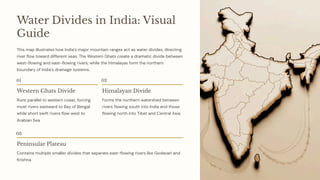
Water Divides in India: Visual
Guide
This map illustrates how India's major mountain ranges act as water divides, directing
river flow toward different seas. The Western Ghats create a dramatic divide between
west-flowing and east-flowing rivers, while the Himalayas form the northern
boundary of India's drainage systems.
01
Western Ghats Divide
Runs parallel to western coast, forcing
most rivers eastward to Bay of Bengal
while short swift rivers flow west to
Arabian Sea
02
Himalayan Divide
Forms the northern watershed between
rivers flowing south into India and those
flowing north into Tibet and Central Asia
03
Peninsular Plateau
Contains multiple smaller divides that separate east-flowing rivers like Godavari and
Krishna
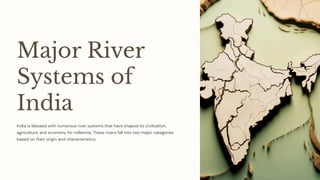
Major River
Systems of
India
India is blessed with numerous river systems that have shaped its civilization,
agriculture, and economy for millennia. These rivers fall into two major categories
based on their origin and characteristics.
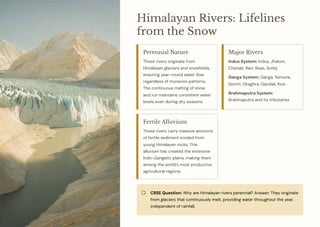
Himalayan Rivers: Lifelines
from the Snow
Perennial Nature
These rivers originate from
Himalayan glaciers and snowfields,
ensuring year-round water flow
regardless of monsoon patterns.
The continuous melting of snow
and ice maintains consistent water
levels even during dry seasons.
Major Rivers
Indus System: Indus, Jhelum,
Chenab, Ravi, Beas, Sutlej
Ganga System: Ganga, Yamuna,
Gomti, Ghaghra, Gandak, Kosi
Brahmaputra System:
Brahmaputra and its tributaries
Fertile Alluvium
These rivers carry massive amounts
of fertile sediment eroded from
young Himalayan rocks. This
alluvium has created the extensive
Indo-Gangetic plains, making them
among the world's most productive
agricultural regions.
CBSE Question: Why are Himalayan rivers perennial? Answer: They originate
from glaciers that continuously melt, providing water throughout the year,
independent of rainfall.
Peninsular Rivers: Seasonal and Plateau-Born
Characteristics of Peninsular Rivers
These rivers originate from the ancient Peninsular plateau and central
highlands. Unlike Himalayan rivers, they are primarily rain-fed and
seasonal, with water flow heavily dependent on monsoon rainfall
patterns.
During summer months, many smaller tributaries may dry up
completely, making these rivers significantly less reliable for year-
round irrigation compared to their Himalayan counterparts.
Major Peninsular Rivers
Godavari (1,465 km): Longest peninsular river, called "Dakshin
Ganga"
Krishna: Second longest, major irrigation source
Mahanadi: Important for Odisha and Chhattisgarh
Kaveri: Sacred river of the south
Narmada & Tapi: West-flowing rift valley rivers
Flow Direction Pattern
Most peninsular rivers flow eastward into the Bay of Bengal, following
the general slope of the plateau. Notable exceptions are Narmada and
Tapi, which flow westward through rift valleys into the Arabian Sea.
CBSE Question: Name the longest peninsular river and state one feature. Answer: Godavari (1,465 km) is the longest peninsular river. It is
seasonal and rain-fed, flowing into the Bay of Bengal.
Key Facts: River Origins and Features
Indus River Origin
Originates near Mansarovar Lake
in Tibet at an elevation of about
5,182 meters. Flows through
Ladakh, Pakistan, and empties into
the Arabian Sea after traveling
2,900 km.
Ganga River Origin
Originates from Gangotri Glacier
in Uttarakhand. The main stream,
Bhagirathi, emerges from the
glacier at Gaumukh at 3,900
meters elevation.
Devprayag Confluence
The two headstreams Bhagirathi
and Alaknanda meet at
Devprayag to form the Ganga. This
sacred confluence is one of the
Panch Prayag.
Rift Valley Rivers
Narmada and Tapi flow westward
through rift valleys (structural
troughs) formed by faulting. These
are the only major west-flowing
peninsular rivers.
CBSE Question: Name the two headstreams of Ganga and where they meet. Answer: Bhagirathi and Alaknanda meet at Devprayag to form
the Ganga.
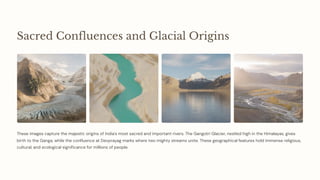
Sacred Confluences and Glacial Origins
These images capture the majestic origins of India's most sacred and important rivers. The Gangotri Glacier, nestled high in the Himalayas, gives
birth to the Ganga, while the confluence at Devprayag marks where two mighty streams unite. These geographical features hold immense religious,
cultural, and ecological significance for millions of people.
East-Flowing vs West-Flowing Rivers of Peninsular
India
East-Flowing Rivers
Major Rivers: Godavari, Krishna, Kaveri, Mahanadi
Flow into Bay of Bengal following plateau slope
Form large fertile deltas (Godavari delta, Krishna-Godavari delta)
Have extensive tributary networks covering vast areas
Longer courses with gradual gradients
Support major agricultural zones in coastal plains
West-Flowing Rivers
Major Rivers: Narmada, Tapi, and coastal streams
Flow into Arabian Sea through rift valleys or Western Ghats
Form estuaries instead of deltas (submerged river mouths)
Fewer and shorter tributaries due to Western Ghats proximity
Steeper gradients with faster flow rates
Limited agricultural plains along their courses
CBSE Question: Distinguish between east-flowing and west-flowing rivers of Peninsular India. Answer: East-flowing rivers (Godavari,
Krishna) form deltas, have large tributary networks, and drain into Bay of Bengal. West-flowing rivers (Narmada, Tapi) form estuaries, have
fewer tributaries, and drain into Arabian Sea through rift valleys.
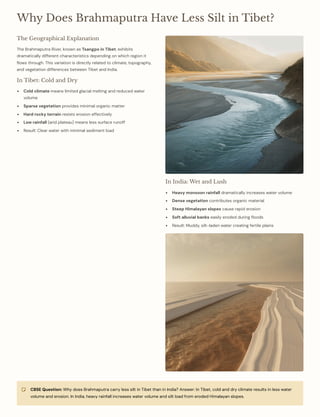
Why Does Brahmaputra Have Less Silt in Tibet?
The Geographical Explanation
The Brahmaputra River, known as Tsangpo in Tibet, exhibits
dramatically different characteristics depending on which region it
flows through. This variation is directly related to climate, topography,
and vegetation differences between Tibet and India.
In Tibet: Cold and Dry
Cold climate means limited glacial melting and reduced water
volume
Sparse vegetation provides minimal organic matter
Hard rocky terrain resists erosion effectively
Low rainfall (arid plateau) means less surface runoff
Result: Clear water with minimal sediment load
In India: Wet and Lush
Heavy monsoon rainfall dramatically increases water volume
Dense vegetation contributes organic material
Steep Himalayan slopes cause rapid erosion
Soft alluvial banks easily eroded during floods
Result: Muddy, silt-laden water creating fertile plains
CBSE Question: Why does Brahmaputra carry less silt in Tibet than in India? Answer: In Tibet, cold and dry climate results in less water
volume and erosion. In India, heavy rainfall increases water volume and silt load from eroded Himalayan slopes.
Economic
Importance of
Rivers and
Lakes
India's water bodies are not merely geographical features4they are the lifeblood of
the nation's economy, supporting agriculture, industry, power generation, and millions
of livelihoods. Understanding their economic value is crucial for sustainable
development.
Rivers and Lakes: Economic Benefits
Irrigation and Agriculture
Rivers provide water for extensive irrigation systems
supporting India's agricultural economy. Canal networks from
rivers like Ganga, Godavari, and Krishna irrigate millions of
hectares, enabling multiple cropping seasons and food
security for the nation.
Drinking Water and Industry
Major cities and towns depend on rivers for municipal water
supply. Industries require massive water quantities for
manufacturing, cooling, and processing. Rivers provide clean
water essential for both domestic and industrial needs.
Fisheries and Aquaculture
Rivers and lakes support inland fisheries employing millions of
people. Fresh water bodies provide fish protein for nutrition
and generate income for fishing communities. Lakes like Chilika
are renowned for their biodiversity and commercial fishing.
Inland Navigation
Major rivers serve as waterways for transporting goods and
passengers. The Ganga, Brahmaputra, and backwaters of
Kerala facilitate cost-effective cargo movement, reducing road
transport burden and pollution.
Hydroelectric Power
Dams on rivers generate clean renewable energy. Projects like
Bhakra Nangal, Hirakud, and Sardar Sarovar produce thousands
of megawatts, powering homes and industries while reducing
dependence on fossil fuels.
Tourism and Recreation
Scenic lakes and rivers attract tourists, generating revenue and
employment. Dal Lake, Nainital, and river rafting destinations
contribute significantly to local economies through hospitality,
recreation, and cultural tourism.
CBSE Question: Explain any three economic uses of rivers. Answer: (1) Irrigation for agriculture (2) Hydroelectric power generation (3)
Inland navigation for transportation. Additional uses include drinking water supply and fisheries.
Natural vs Man-Made Lakes in India
Natural Lakes
Wular Lake (Jammu & Kashmir) - Largest freshwater lake in India,
formed by tectonic activity
Dal Lake (Jammu & Kashmir) - Famous for houseboats and
shikaras, tourism hub
Nainital Lake (Uttarakhand) - Scenic hill station lake of glacial
origin
Chilika Lake (Odisha) - Largest brackish water lagoon, important
for migratory birds
Sambhar Lake (Rajasthan) - Largest saline lake in India, salt
production center
Man-Made Lakes (Reservoirs)
Gobind Sagar (Punjab) - Created by Bhakra Dam on Sutlej River
Hirakud Reservoir (Odisha) - One of longest dams in world on
Mahanadi River
Nagarjuna Sagar (Telangana) - Large reservoir on Krishna River for
irrigation
Rana Pratap Sagar (Rajasthan) - Part of Chambal Valley Project
Indira Sagar (Madhya Pradesh) - Largest reservoir by volume in
India
Natural lakes form through geological processes like glacial activity, tectonic movements, or river meandering, while man-made lakes are created by
constructing dams across rivers. Both serve crucial economic and ecological functions, though man-made reservoirs are specifically designed for
irrigation, power generation, and flood control.
CBSE Question: Distinguish between natural and man-made lakes with examples. Answer: Natural lakes form naturally through geological
processes (e.g., Wular, Dal, Chilika). Man-made lakes are artificial reservoirs created by dams (e.g., Gobind Sagar, Hirakud, Nagarjuna Sagar).
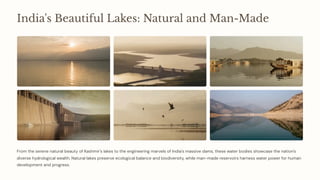
India's Beautiful Lakes: Natural and Man-Made
From the serene natural beauty of Kashmir's lakes to the engineering marvels of India's massive dams, these water bodies showcase the nation's
diverse hydrological wealth. Natural lakes preserve ecological balance and biodiversity, while man-made reservoirs harness water power for human
development and progress.
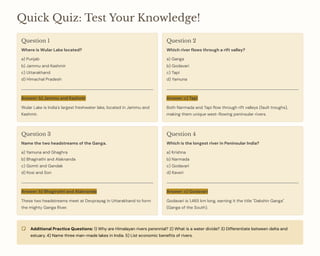
Comparing Himalayan and Peninsular Rivers
Himalayan Rivers
Perennial Nature
Fed by glaciers and snowmelt, ensuring year-round flow
regardless of seasonal rainfall patterns
Long and Deep
Extremely long courses (Ganga: 2,525 km, Brahmaputra: 2,900
km) with deep channels carved through soft alluvium
Heavy Silt Load
Carry enormous quantities of sediment eroded from young, soft
Himalayan rocks, making water appear muddy
Form Large Deltas
Massive deltaic deposits (Ganga-Brahmaputra delta is world's
largest) support dense populations and agriculture
Support Navigation
Deep water and consistent flow enable cargo vessels and
passenger boats on major stretches
Young Rivers
Geologically young with active erosion, frequently changing
courses, prone to flooding
Peninsular Rivers
Seasonal Flow
Rain-fed rivers dependent on monsoons, with significantly
reduced flow or dry stretches in summer months
Shorter and Shallower
Relatively shorter courses (Godavari: 1,465 km) with shallower
channels carved through hard rock
Less Silt
Carry less sediment as they flow through stable, hard Peninsular
rocks resistant to erosion
Small or No Deltas
Limited sediment deposition creates smaller deltas; west-
flowing rivers form estuaries instead
Less Navigable
Shallow depths, seasonal flow, and rocky beds limit navigation;
small boats only on certain stretches
Old Rivers
Geologically ancient with stable courses, well-adjusted to hard
rock terrain, less prone to flooding
CBSE Question: Compare and contrast Himalayan and Peninsular rivers (any 4 points). Answer: (1) Himalayan rivers are perennial;
Peninsular rivers are seasonal (2) Himalayan rivers are longer and deeper; Peninsular rivers are shorter and shallower (3) Himalayan rivers
carry heavy silt and form large deltas; Peninsular rivers carry less silt (4) Himalayan rivers are navigable; Peninsular rivers are less
navigable.
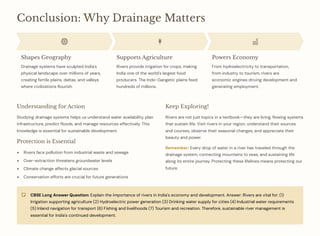
Quick Quiz: Test Your Knowledge!
Question 1
Where is Wular Lake located?
a) Punjab
b) Jammu and Kashmir
c) Uttarakhand
d) Himachal Pradesh
Answer: b) Jammu and Kashmir
Wular Lake is India's largest freshwater lake, located in Jammu and
Kashmir.
Question 2
Which river flows through a rift valley?
a) Ganga
b) Godavari
c) Tapi
d) Yamuna
Answer: c) Tapi
Both Narmada and Tapi flow through rift valleys (fault troughs),
making them unique west-flowing peninsular rivers.
Question 3
Name the two headstreams of the Ganga.
a) Yamuna and Ghaghra
b) Bhagirathi and Alaknanda
c) Gomti and Gandak
d) Kosi and Son
Answer: b) Bhagirathi and Alaknanda
These two headstreams meet at Devprayag in Uttarakhand to form
the mighty Ganga River.
Question 4
Which is the longest river in Peninsular India?
a) Krishna
b) Narmada
c) Godavari
d) Kaveri
Answer: c) Godavari
Godavari is 1,465 km long, earning it the title "Dakshin Ganga"
(Ganga of the South).
Additional Practice Questions: 1) Why are Himalayan rivers perennial? 2) What is a water divide? 3) Differentiate between delta and
estuary. 4) Name three man-made lakes in India. 5) List economic benefits of rivers.
Conclusion: Why Drainage Matters
Shapes Geography
Drainage systems have sculpted India's
physical landscape over millions of years,
creating fertile plains, deltas, and valleys
where civilizations flourish.
Supports Agriculture
Rivers provide irrigation for crops, making
India one of the world's largest food
producers. The Indo-Gangetic plains feed
hundreds of millions.
Powers Economy
From hydroelectricity to transportation,
from industry to tourism, rivers are
economic engines driving development and
generating employment.
Understanding for Action
Studying drainage systems helps us understand water availability, plan
infrastructure, predict floods, and manage resources effectively. This
knowledge is essential for sustainable development.
Protection is Essential
Rivers face pollution from industrial waste and sewage
Over-extraction threatens groundwater levels
Climate change affects glacial sources
Conservation efforts are crucial for future generations
Keep Exploring!
Rivers are not just topics in a textbook4they are living, flowing systems
that sustain life. Visit rivers in your region, understand their sources
and courses, observe their seasonal changes, and appreciate their
beauty and power.
Remember: Every drop of water in a river has traveled through the
drainage system, connecting mountains to seas, and sustaining life
along its entire journey. Protecting these lifelines means protecting our
future.
CBSE Long Answer Question: Explain the importance of rivers in India's economy and development. Answer: Rivers are vital for: (1)
Irrigation supporting agriculture (2) Hydroelectric power generation (3) Drinking water supply for cities (4) Industrial water requirements
(5) Inland navigation for transport (6) Fishing and livelihoods (7) Tourism and recreation. Therefore, sustainable river management is
essential for India's continued development.

Drainage-CBSE-Class-9-Geography-Chapter-3.pdf

  • 1.
    DRAINAGE: CLASS 9TH RIVERS ANDWATER SYSTEMS Presented by Bijaya sir PART: 2
  • 2.
    Drainage: CBSE Class9 Geography Chapter 3 A comprehensive guide to understanding India's river systems, drainage patterns, and their vital role in shaping the nation's geography and economy. Master the concepts, facts, and exam questions for CBSE Class 9.
  • 3.
    Understanding Drainage This chapterexplores how water moves across India's diverse landscape, creating intricate networks of rivers that sustain millions of lives. From the mighty Himalayas to the ancient Peninsular plateau, drainage systems tell the story of India's geographical evolution and human civilization.
  • 4.
    What is Drainage? TheNatural Flow System Drainage refers to the natural process by which water flows through rivers, streams, and channels across the landscape. This system removes excess water from the land and channels it toward larger bodies of water like seas and oceans. The drainage network includes the entire web of rivers, their tributaries, and distributaries that work together to transport water across a region. Key Components Main river channels that carry the bulk of water Tributaries that feed water into larger rivers Distributaries that branch off from main rivers Underground drainage systems in certain regions CBSE Exam Tip: Remember that drainage is not just about rivers4it's the entire system of water movement across land.
  • 5.
    What is aDrainage Basin? Definition A drainage basin, also called a watershed or catchment area, is the land area where all precipitation eventually drains into a common river, lake, or outlet point. Ganga Basin Example The Ganga drainage basin covers approximately 1 million square kilometers, making it one of the world's largest. All rainfall in this vast area ultimately flows into the Ganga River system. Boundary Features Drainage basins are bounded by elevated areas called water divides. These natural barriers determine which direction water will flow. CBSE Question: Define drainage basin and give an example from India. Answer: A drainage basin is an area of land where precipitation collects and drains into a common outlet. Example: The Ganga basin covers northern India.
  • 6.
    What is aWater Divide? The Great Separator A water divide is an elevated boundary line4typically a mountain ridge or upland area 4that separates two adjacent drainage basins. Water falling on one side of the divide flows into one river system, while water on the other side flows into a completely different system. How Water Divides Work: When rain falls on a mountain ridge, gravity pulls water downhill in opposite directions on either side. This creates two distinct drainage patterns. Major Water Divides in India Western Ghats: Separate Arabian Sea and Bay of Bengal drainage Himalayas: Divide Indian rivers from Central Asian rivers Aravalli Range: Separates Ganga and Indus basin tributaries Exam Tip: Water divides are often asked in map-based questions. Practice identifying major mountain ranges on India's map.
  • 7.
    Water Divides inIndia: Visual Guide This map illustrates how India's major mountain ranges act as water divides, directing river flow toward different seas. The Western Ghats create a dramatic divide between west-flowing and east-flowing rivers, while the Himalayas form the northern boundary of India's drainage systems. 01 Western Ghats Divide Runs parallel to western coast, forcing most rivers eastward to Bay of Bengal while short swift rivers flow west to Arabian Sea 02 Himalayan Divide Forms the northern watershed between rivers flowing south into India and those flowing north into Tibet and Central Asia 03 Peninsular Plateau Contains multiple smaller divides that separate east-flowing rivers like Godavari and Krishna
  • 8.
    Major River Systems of India Indiais blessed with numerous river systems that have shaped its civilization, agriculture, and economy for millennia. These rivers fall into two major categories based on their origin and characteristics.
  • 9.
    Himalayan Rivers: Lifelines fromthe Snow Perennial Nature These rivers originate from Himalayan glaciers and snowfields, ensuring year-round water flow regardless of monsoon patterns. The continuous melting of snow and ice maintains consistent water levels even during dry seasons. Major Rivers Indus System: Indus, Jhelum, Chenab, Ravi, Beas, Sutlej Ganga System: Ganga, Yamuna, Gomti, Ghaghra, Gandak, Kosi Brahmaputra System: Brahmaputra and its tributaries Fertile Alluvium These rivers carry massive amounts of fertile sediment eroded from young Himalayan rocks. This alluvium has created the extensive Indo-Gangetic plains, making them among the world's most productive agricultural regions. CBSE Question: Why are Himalayan rivers perennial? Answer: They originate from glaciers that continuously melt, providing water throughout the year, independent of rainfall.
  • 10.
    Peninsular Rivers: Seasonaland Plateau-Born Characteristics of Peninsular Rivers These rivers originate from the ancient Peninsular plateau and central highlands. Unlike Himalayan rivers, they are primarily rain-fed and seasonal, with water flow heavily dependent on monsoon rainfall patterns. During summer months, many smaller tributaries may dry up completely, making these rivers significantly less reliable for year- round irrigation compared to their Himalayan counterparts. Major Peninsular Rivers Godavari (1,465 km): Longest peninsular river, called "Dakshin Ganga" Krishna: Second longest, major irrigation source Mahanadi: Important for Odisha and Chhattisgarh Kaveri: Sacred river of the south Narmada & Tapi: West-flowing rift valley rivers Flow Direction Pattern Most peninsular rivers flow eastward into the Bay of Bengal, following the general slope of the plateau. Notable exceptions are Narmada and Tapi, which flow westward through rift valleys into the Arabian Sea. CBSE Question: Name the longest peninsular river and state one feature. Answer: Godavari (1,465 km) is the longest peninsular river. It is seasonal and rain-fed, flowing into the Bay of Bengal.
  • 11.
    Key Facts: RiverOrigins and Features Indus River Origin Originates near Mansarovar Lake in Tibet at an elevation of about 5,182 meters. Flows through Ladakh, Pakistan, and empties into the Arabian Sea after traveling 2,900 km. Ganga River Origin Originates from Gangotri Glacier in Uttarakhand. The main stream, Bhagirathi, emerges from the glacier at Gaumukh at 3,900 meters elevation. Devprayag Confluence The two headstreams Bhagirathi and Alaknanda meet at Devprayag to form the Ganga. This sacred confluence is one of the Panch Prayag. Rift Valley Rivers Narmada and Tapi flow westward through rift valleys (structural troughs) formed by faulting. These are the only major west-flowing peninsular rivers. CBSE Question: Name the two headstreams of Ganga and where they meet. Answer: Bhagirathi and Alaknanda meet at Devprayag to form the Ganga.
  • 12.
    Sacred Confluences andGlacial Origins These images capture the majestic origins of India's most sacred and important rivers. The Gangotri Glacier, nestled high in the Himalayas, gives birth to the Ganga, while the confluence at Devprayag marks where two mighty streams unite. These geographical features hold immense religious, cultural, and ecological significance for millions of people.
  • 13.
    East-Flowing vs West-FlowingRivers of Peninsular India East-Flowing Rivers Major Rivers: Godavari, Krishna, Kaveri, Mahanadi Flow into Bay of Bengal following plateau slope Form large fertile deltas (Godavari delta, Krishna-Godavari delta) Have extensive tributary networks covering vast areas Longer courses with gradual gradients Support major agricultural zones in coastal plains West-Flowing Rivers Major Rivers: Narmada, Tapi, and coastal streams Flow into Arabian Sea through rift valleys or Western Ghats Form estuaries instead of deltas (submerged river mouths) Fewer and shorter tributaries due to Western Ghats proximity Steeper gradients with faster flow rates Limited agricultural plains along their courses CBSE Question: Distinguish between east-flowing and west-flowing rivers of Peninsular India. Answer: East-flowing rivers (Godavari, Krishna) form deltas, have large tributary networks, and drain into Bay of Bengal. West-flowing rivers (Narmada, Tapi) form estuaries, have fewer tributaries, and drain into Arabian Sea through rift valleys.
  • 14.
    Why Does BrahmaputraHave Less Silt in Tibet? The Geographical Explanation The Brahmaputra River, known as Tsangpo in Tibet, exhibits dramatically different characteristics depending on which region it flows through. This variation is directly related to climate, topography, and vegetation differences between Tibet and India. In Tibet: Cold and Dry Cold climate means limited glacial melting and reduced water volume Sparse vegetation provides minimal organic matter Hard rocky terrain resists erosion effectively Low rainfall (arid plateau) means less surface runoff Result: Clear water with minimal sediment load In India: Wet and Lush Heavy monsoon rainfall dramatically increases water volume Dense vegetation contributes organic material Steep Himalayan slopes cause rapid erosion Soft alluvial banks easily eroded during floods Result: Muddy, silt-laden water creating fertile plains CBSE Question: Why does Brahmaputra carry less silt in Tibet than in India? Answer: In Tibet, cold and dry climate results in less water volume and erosion. In India, heavy rainfall increases water volume and silt load from eroded Himalayan slopes.
  • 15.
    Economic Importance of Rivers and Lakes India'swater bodies are not merely geographical features4they are the lifeblood of the nation's economy, supporting agriculture, industry, power generation, and millions of livelihoods. Understanding their economic value is crucial for sustainable development.
  • 16.
    Rivers and Lakes:Economic Benefits Irrigation and Agriculture Rivers provide water for extensive irrigation systems supporting India's agricultural economy. Canal networks from rivers like Ganga, Godavari, and Krishna irrigate millions of hectares, enabling multiple cropping seasons and food security for the nation. Drinking Water and Industry Major cities and towns depend on rivers for municipal water supply. Industries require massive water quantities for manufacturing, cooling, and processing. Rivers provide clean water essential for both domestic and industrial needs. Fisheries and Aquaculture Rivers and lakes support inland fisheries employing millions of people. Fresh water bodies provide fish protein for nutrition and generate income for fishing communities. Lakes like Chilika are renowned for their biodiversity and commercial fishing. Inland Navigation Major rivers serve as waterways for transporting goods and passengers. The Ganga, Brahmaputra, and backwaters of Kerala facilitate cost-effective cargo movement, reducing road transport burden and pollution. Hydroelectric Power Dams on rivers generate clean renewable energy. Projects like Bhakra Nangal, Hirakud, and Sardar Sarovar produce thousands of megawatts, powering homes and industries while reducing dependence on fossil fuels. Tourism and Recreation Scenic lakes and rivers attract tourists, generating revenue and employment. Dal Lake, Nainital, and river rafting destinations contribute significantly to local economies through hospitality, recreation, and cultural tourism. CBSE Question: Explain any three economic uses of rivers. Answer: (1) Irrigation for agriculture (2) Hydroelectric power generation (3) Inland navigation for transportation. Additional uses include drinking water supply and fisheries.
  • 17.
    Natural vs Man-MadeLakes in India Natural Lakes Wular Lake (Jammu & Kashmir) - Largest freshwater lake in India, formed by tectonic activity Dal Lake (Jammu & Kashmir) - Famous for houseboats and shikaras, tourism hub Nainital Lake (Uttarakhand) - Scenic hill station lake of glacial origin Chilika Lake (Odisha) - Largest brackish water lagoon, important for migratory birds Sambhar Lake (Rajasthan) - Largest saline lake in India, salt production center Man-Made Lakes (Reservoirs) Gobind Sagar (Punjab) - Created by Bhakra Dam on Sutlej River Hirakud Reservoir (Odisha) - One of longest dams in world on Mahanadi River Nagarjuna Sagar (Telangana) - Large reservoir on Krishna River for irrigation Rana Pratap Sagar (Rajasthan) - Part of Chambal Valley Project Indira Sagar (Madhya Pradesh) - Largest reservoir by volume in India Natural lakes form through geological processes like glacial activity, tectonic movements, or river meandering, while man-made lakes are created by constructing dams across rivers. Both serve crucial economic and ecological functions, though man-made reservoirs are specifically designed for irrigation, power generation, and flood control. CBSE Question: Distinguish between natural and man-made lakes with examples. Answer: Natural lakes form naturally through geological processes (e.g., Wular, Dal, Chilika). Man-made lakes are artificial reservoirs created by dams (e.g., Gobind Sagar, Hirakud, Nagarjuna Sagar).
  • 18.
    India's Beautiful Lakes:Natural and Man-Made From the serene natural beauty of Kashmir's lakes to the engineering marvels of India's massive dams, these water bodies showcase the nation's diverse hydrological wealth. Natural lakes preserve ecological balance and biodiversity, while man-made reservoirs harness water power for human development and progress.
  • 19.
    Comparing Himalayan andPeninsular Rivers Himalayan Rivers Perennial Nature Fed by glaciers and snowmelt, ensuring year-round flow regardless of seasonal rainfall patterns Long and Deep Extremely long courses (Ganga: 2,525 km, Brahmaputra: 2,900 km) with deep channels carved through soft alluvium Heavy Silt Load Carry enormous quantities of sediment eroded from young, soft Himalayan rocks, making water appear muddy Form Large Deltas Massive deltaic deposits (Ganga-Brahmaputra delta is world's largest) support dense populations and agriculture Support Navigation Deep water and consistent flow enable cargo vessels and passenger boats on major stretches Young Rivers Geologically young with active erosion, frequently changing courses, prone to flooding Peninsular Rivers Seasonal Flow Rain-fed rivers dependent on monsoons, with significantly reduced flow or dry stretches in summer months Shorter and Shallower Relatively shorter courses (Godavari: 1,465 km) with shallower channels carved through hard rock Less Silt Carry less sediment as they flow through stable, hard Peninsular rocks resistant to erosion Small or No Deltas Limited sediment deposition creates smaller deltas; west- flowing rivers form estuaries instead Less Navigable Shallow depths, seasonal flow, and rocky beds limit navigation; small boats only on certain stretches Old Rivers Geologically ancient with stable courses, well-adjusted to hard rock terrain, less prone to flooding CBSE Question: Compare and contrast Himalayan and Peninsular rivers (any 4 points). Answer: (1) Himalayan rivers are perennial; Peninsular rivers are seasonal (2) Himalayan rivers are longer and deeper; Peninsular rivers are shorter and shallower (3) Himalayan rivers carry heavy silt and form large deltas; Peninsular rivers carry less silt (4) Himalayan rivers are navigable; Peninsular rivers are less navigable.
  • 20.
    Quick Quiz: TestYour Knowledge! Question 1 Where is Wular Lake located? a) Punjab b) Jammu and Kashmir c) Uttarakhand d) Himachal Pradesh Answer: b) Jammu and Kashmir Wular Lake is India's largest freshwater lake, located in Jammu and Kashmir. Question 2 Which river flows through a rift valley? a) Ganga b) Godavari c) Tapi d) Yamuna Answer: c) Tapi Both Narmada and Tapi flow through rift valleys (fault troughs), making them unique west-flowing peninsular rivers. Question 3 Name the two headstreams of the Ganga. a) Yamuna and Ghaghra b) Bhagirathi and Alaknanda c) Gomti and Gandak d) Kosi and Son Answer: b) Bhagirathi and Alaknanda These two headstreams meet at Devprayag in Uttarakhand to form the mighty Ganga River. Question 4 Which is the longest river in Peninsular India? a) Krishna b) Narmada c) Godavari d) Kaveri Answer: c) Godavari Godavari is 1,465 km long, earning it the title "Dakshin Ganga" (Ganga of the South). Additional Practice Questions: 1) Why are Himalayan rivers perennial? 2) What is a water divide? 3) Differentiate between delta and estuary. 4) Name three man-made lakes in India. 5) List economic benefits of rivers.
  • 21.
    Conclusion: Why DrainageMatters Shapes Geography Drainage systems have sculpted India's physical landscape over millions of years, creating fertile plains, deltas, and valleys where civilizations flourish. Supports Agriculture Rivers provide irrigation for crops, making India one of the world's largest food producers. The Indo-Gangetic plains feed hundreds of millions. Powers Economy From hydroelectricity to transportation, from industry to tourism, rivers are economic engines driving development and generating employment. Understanding for Action Studying drainage systems helps us understand water availability, plan infrastructure, predict floods, and manage resources effectively. This knowledge is essential for sustainable development. Protection is Essential Rivers face pollution from industrial waste and sewage Over-extraction threatens groundwater levels Climate change affects glacial sources Conservation efforts are crucial for future generations Keep Exploring! Rivers are not just topics in a textbook4they are living, flowing systems that sustain life. Visit rivers in your region, understand their sources and courses, observe their seasonal changes, and appreciate their beauty and power. Remember: Every drop of water in a river has traveled through the drainage system, connecting mountains to seas, and sustaining life along its entire journey. Protecting these lifelines means protecting our future. CBSE Long Answer Question: Explain the importance of rivers in India's economy and development. Answer: Rivers are vital for: (1) Irrigation supporting agriculture (2) Hydroelectric power generation (3) Drinking water supply for cities (4) Industrial water requirements (5) Inland navigation for transport (6) Fishing and livelihoods (7) Tourism and recreation. Therefore, sustainable river management is essential for India's continued development.