Class 9th - Geography
Drainage
Full Chapter Explanation
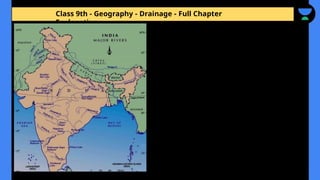
Class 9th - Geography - Drainage - Full Chapter Explanation
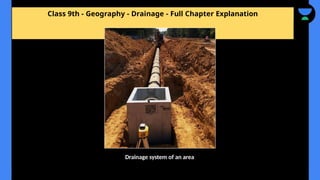
Drainage system of an area
Class 9th - Geography - Drainage - Full Chapter Explanation
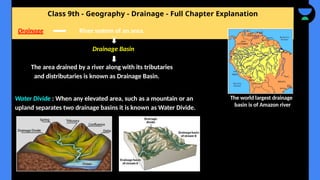
Drainage River system of an area.
Drainage Basin
The area drained by a river along with its tributaries
and distributaries is known as Drainage Basin.
Water Divide : When any elevated area, such as a mountain or an
upland separates two drainage basins it is known as Water Divide.
The world largest drainage
basin is of Amazon river
Class 9th - Geography - Drainage - Full Chapter Explanation
What we are going to study in this chapter?
❖ Drainage patterns
❖ Drainage systems in India
➢ The Himalayan Rivers
➢ The Peninsular Rivers
❖ The Himalayas Rivers: [The Indus, the Ganga, and the Brahmaputra]
❖ The Peninsular Rivers: [The Narmada, the Tapi, the Godavari, the Mahanadi, the Krishna
and the Kaveri]
❖ Lakes
❖ Role of Rivers in the Economy
❖ River Pollution
Class 9th - Geography - Drainage - Full Chapter Explanation
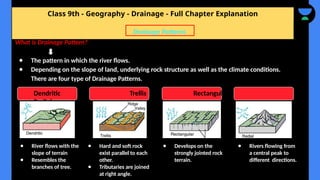
Drainage Patterns
What is Drainage Pattern?
● The pattern in which the river flows.
● Depending on the slope of land, underlying rock structure as well as the climate conditions.
There are four type of Drainage Patterns.
Dendritic Trellis Rectangular
Radial
● River flows with the
slope of terrain
● Resembles the
branches of tree.
● Hard and soft rock
exist parallel to each
other.
● Tributaries are joined
at right angle.
● Develops on the
strongly jointed rock
terrain.
● Rivers flowing from
a central peak to
different directions.
Class 9th - Geography - Drainage - Full Chapter Explanation
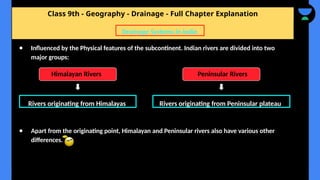
● Apart from the originating point, Himalayan and Peninsular rivers also have various other
differences.
Drainage Systems in India
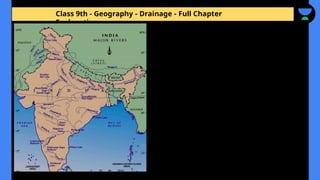
Rivers originating from Himalayas
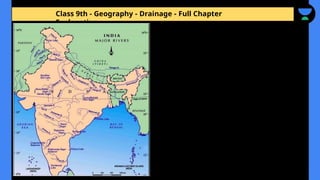
● Influenced by the Physical features of the subcontinent. Indian rivers are divided into two
major groups:
Himalayan Rivers Peninsular Rivers
Rivers originating from Peninsular plateau
Class 9th - Geography - Drainage - Full Chapter
Explanation
Class 9th - Geography - Drainage - Full Chapter Explanation
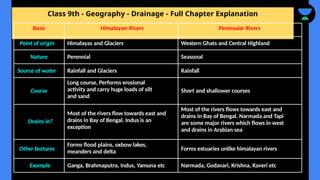
Basic Himalayan Rivers Peninsular Rivers
Point of origin Himalayas and Glaciers Western Ghats and Central Highland
Nature Perennial Seasonal
Source of water Rainfall and Glaciers Rainfall
Course
Long course, Performs erosional
activity and carry huge loads of silt
and sand
Short and shallower courses
Drains in?
Most of the rivers flow towards east and
drains in Bay of Bengal. Indus is an
exception
Most of the rivers flows towards east and
drains in Bay of Bengal. Narmada and Tapi
are some major rivers which flows in west
and drains in Arabian sea
Other features
Forms flood plains, oxbow lakes,
meanders and delta Forms estuaries unlike himalayan rivers
Example Ganga, Brahmaputra, Indus, Yamuna etc Narmada, Godavari, Krishna, Kaveri etc
Class 9th - Geography - Drainage - Full Chapter Explanation
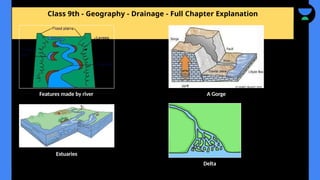
A Gorge
Features made by river
Estuaries
Delta
Class 9th - Geography - Drainage - Full Chapter Explanation
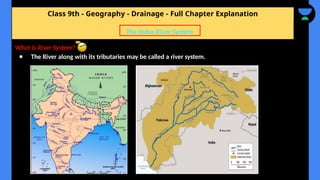
What is River System?
● The River along with its tributaries may be called a river system.
The Indus River System
Class 9th - Geography - Drainage - Full Chapter Explanation
● Rises in Tibet. Near lake Mansarovar.
Enters India from Ladakh
It is joined by the tributaries such as the Zaskar,
the Nurba, the Shyok and the Hunza.
Further flowing from the Baltistan and Gilgit,
Indus is joined by other tributaries such as the
Satluj, the Ravi, the Chenab and the Jhelum at
Mithankot in Pakistan.
Flowing Southwards Indus finally drains into
Arabian Sea.
River Indus
● Total length of 2900 km.
● Title over a third of Indus basin is
located in India.
Major part flows from Pakistan
Do you know? = Indus water treaty [1960]
Class 9th - Geography - Drainage - Full Chapter Explanation
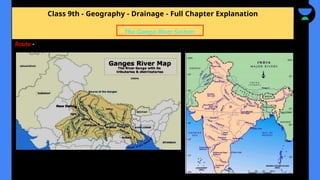
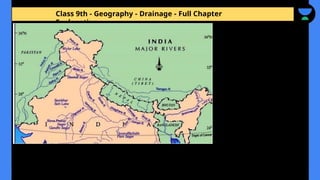
Route -
The Ganga River System
Class 9th - Geography - Drainage - Full Chapter Explanation
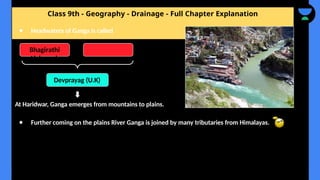
At Haridwar, Ganga emerges from mountains to plains.
● Further coming on the plains River Ganga is joined by many tributaries from Himalayas.
● Headwaters of Ganga is called
Bhagirathi
Alaknanda
Devprayag (U.K)
Class 9th - Geography - Drainage - Full Chapter Explanation
● These Rivers floods parts of the
Northern plains every year.
Causing damage to life and property
but at same time they enrich the soil
for agricultural use.
Do you know
Left Bank tributaries of Ganga Right bank tributaries of Ganga
● The Yamuna
● The Ghaghara
● The Gandak
● Kosi
[Rises from the glaciers in Himalayas]
● The Chambal
● The Betwa
● The Son
[Rises from Semi-arid part of Peninsular]
● They have a shorter courses and do not
carry much water.
The Namami Gange Programme
Class 9th - Geography - Drainage - Full Chapter
Explanation
Class 9th - Geography - Drainage - Full Chapter Explanation
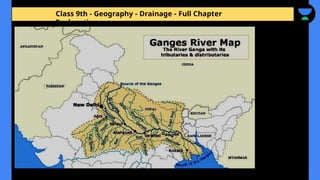
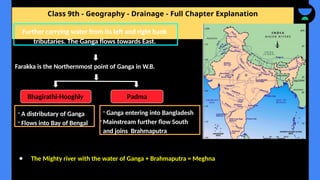
Farakka is the Northernmost point of Ganga in W.B.
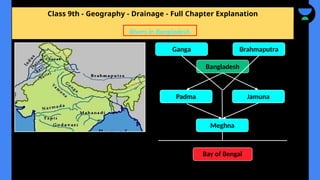
● The Mighty river with the water of Ganga + Brahmaputra = Meghna
Further carrying water from its left and right bank
tributaries. The Ganga flows towards East.
Padma
Bhagirathi-Hooghly
- A distributary of Ganga
- Flows into Bay of Bengal
- Ganga entering into Bangladesh
-Mainstream further flow South
and joins Brahmaputra
Class 9th - Geography - Drainage - Full Chapter Explanation
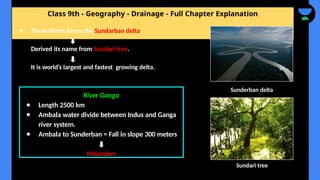
● These Rivers forms the Sundarban delta.
Derived its name from Sundari tree.
It is world’s largest and fastest growing delta.
River Ganga
● Length 2500 km
● Ambala water divide between Indus and Ganga
river system.
● Ambala to Sunderban = Fall in slope 300 meters
Meanders
Sunderban delta
Sundari tree
Class 9th - Geography - Drainage - Full Chapter
Explanation
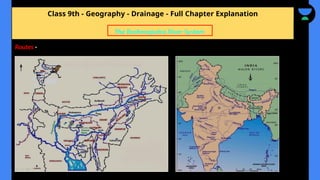
Class 9th - Geography - Drainage - Full Chapter Explanation
Routes -
The Brahmaputra River System
Class 9th - Geography - Drainage - Full Chapter Explanation
Rises in Tibet; East of Mansarovar lake
[Mansarovar lake = Water divide]
Slightly longer than the Indus and most of its course lies
outside India.
From Namcha Barwa, it takes ‘U’ turn and enters into
India in Arunachal Pradesh.
Here, it is known as Dihang, joined by other tributaries
such as Dibang, the Lohit etc.
Volume of water in river varies in Tibet and India.
Why?
Class 9th - Geography - Drainage - Full Chapter Explanation
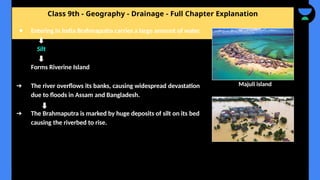
● Entering in India Brahmaputra carries a large amount of water.
Silt
Forms Riverine Island
➔ The river overflows its banks, causing widespread devastation
due to floods in Assam and Bangladesh.
➔ The Brahmaputra is marked by huge deposits of silt on its bed
causing the riverbed to rise.
Majuli island
Class 9th - Geography - Drainage - Full Chapter Explanation
Rivers in Bangladesh
Ganga Brahmaputra
Bangladesh
Padma Jamuna
Meghna
Bay of Bengal
Class 9th - Geography - Drainage - Full Chapter Explanation
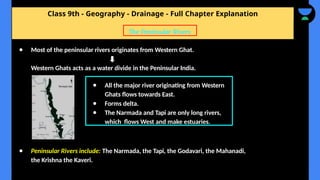
● Most of the peninsular rivers originates from Western Ghat.
Western Ghats acts as a water divide in the Peninsular India.
● Peninsular Rivers include: The Narmada, the Tapi, the Godavari, the Mahanadi,
the Krishna the Kaveri.
The Peninsular Rivers
● All the major river originating from Western
Ghats flows towards East.
● Forms delta.
● The Narmada and Tapi are only long rivers,
which flows West and make estuaries.
Class 9th - Geography - Drainage - Full Chapter
Explanation
Class 9th - Geography - Drainage - Full Chapter Explanation
The Narmada Basin
Rises in the Amarkantak hills
● Flows west in Rift valley due to faulting
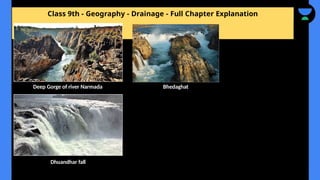
● River Narmada flows through deep gorge, forming
picturesque location. [The ‘Marble rocks’, near
Jabalpur, where the Narmada flows through a deep
gorge, and the ‘Dhuandhar falls]
● Most of the tributaries of Narmada are short and
joins at right angle. [Rectangular pattern]
● River flows in the parts of M.P and Gujarat.
Amarkantak point
Class 9th - Geography - Drainage - Full Chapter Explanation
Deep Gorge of river Narmada
Dhuandhar fall
Bhedaghat
Class 9th - Geography - Drainage - Full Chapter Explanation
● Rises in Satpura range in Betul district of
Madhya Pradesh.
● It also flows in Rift valley parallel to Narmada
but shorter in length.
● Flows through three states [M.P, Gujarat and
Maharashtra]
● Drains in Arabian sea.
Tapi Basin
Are there only two west flowing rivers?
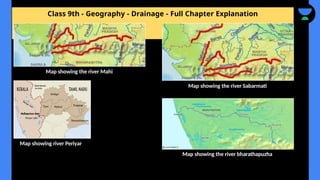
No, there are west flowing coastal rivers but
their length is short.
E.g. The Sabarmati, the Mahi, the
Bharathapuzha and the Periyar
Class 9th - Geography - Drainage - Full Chapter Explanation
Map showing the river Mahi
Map showing river Periyar
Map showing the river Sabarmati
Map showing the river bharathapuzha
Class 9th - Geography - Drainage - Full Chapter Explanation
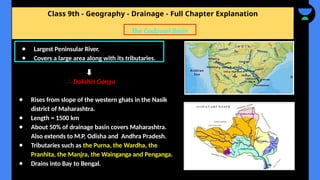
∴ Dakshin Ganga
● Rises from slope of the western ghats in the Nasik
district of Maharashtra.
● Length = 1500 km
● About 50% of drainage basin covers Maharashtra.
Also extends to M.P, Odisha and Andhra Pradesh.
● Tributaries such as the Purna, the Wardha, the
Pranhita, the Manjra, the Wainganga and Penganga.
● Drains into Bay to Bengal.
The Godavari Basin
● Largest Peninsular River.
● Covers a large area along with its tributaries.
Class 9th - Geography - Drainage - Full Chapter Explanation
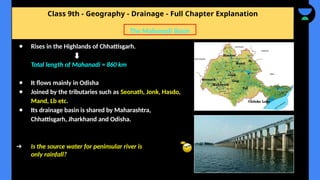
● Rises in the Highlands of Chhattisgarh.
Total length of Mahanadi = 860 km
● It flows mainly in Odisha
● Joined by the tributaries such as Seonath, Jonk, Hasdo,
Mand, Lb etc.
● Its drainage basin is shared by Maharashtra,
Chhattisgarh, Jharkhand and Odisha.
➔ Is the source water for peninsular river is
only rainfall?
The Mahanadi Basin
Class 9th - Geography - Drainage - Full Chapter Explanation
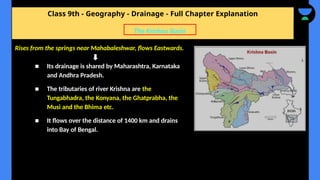
Rises from the springs near Mahabaleshwar, flows Eastwards.
■ Its drainage is shared by Maharashtra, Karnataka
and Andhra Pradesh.
■ The tributaries of river Krishna are the
Tungabhadra, the Konyana, the Ghatprabha, the
Musi and the Bhima etc.
■ It flows over the distance of 1400 km and drains
into Bay of Bengal.
The Krishna Basin
Class 9th - Geography - Drainage - Full Chapter
Explanation
Class 9th - Geography - Drainage - Full Chapter Explanation
❖ Rises in the Brahmagiri range of Western Ghats
[Karnataka]
Flows West and drains in Bay of Bengal in South
of Cuddalore in Tamil Nadu
● The total length of river is about 760 km.
● Its main tributaries are Amravati, Bhavani,
Hemavati and Kabini covering the parts of
Karnataka, Kerala and Tamil Nadu.
The Kaveri Basin
Class 9th - Geography - Drainage - Full Chapter Explanation
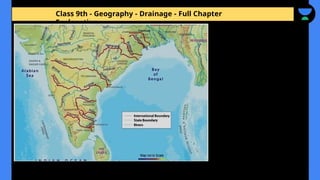
● There are some smaller rivers which flows towards East such as -
Do you know?
● 71 percent of the world’s surface is covered with water, but 97 per
cent of that is salt water.
● Of the 3 percent that is available as freshwater, three quarters of it is
trapped as ice.
Do you know?
● The river Kaveri makes the second biggest waterfall in India, known as
Shivasamudram Falls. The hydroelectric power generated from the
falls is supplied to Mysore, Bengaluru and the Kolar Gold Field.
The Damodar
The Brahmani
The Baitarani
The Subarnarekha
Class 9th - Geography - Drainage - Full Chapter
Explanation
Class 9th - Geography - Drainage - Full Chapter Explanation
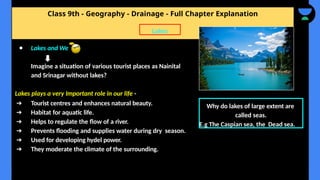
● Lakes and We
Imagine a situation of various tourist places as Nainital
and Srinagar without lakes?
Lakes plays a very Important role in our life -
➔ Tourist centres and enhances natural beauty.
➔ Habitat for aquatic life.
➔ Helps to regulate the flow of a river.
➔ Prevents flooding and supplies water during dry season.
➔ Used for developing hydel power.
➔ They moderate the climate of the surrounding.
Lakes
Why do lakes of large extent are
called seas.
E.g The Caspian sea, the Dead sea.
Class 9th - Geography - Drainage - Full Chapter Explanation
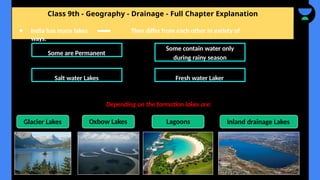
● India has many lakes They differ from each other in variety of
ways.
Some are Permanent
Some contain water only
during rainy season
Salt water Lakes Fresh water Laker
Glacier Lakes
Depending on the formation lakes are:
Oxbow Lakes Lagoons Inland drainage Lakes
Class 9th - Geography - Drainage - Full Chapter Explanation
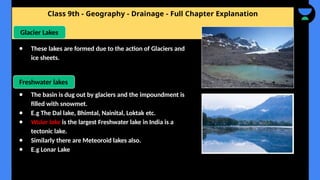
Glacier Lakes
● These lakes are formed due to the action of Glaciers and
ice sheets.
Freshwater lakes
● The basin is dug out by glaciers and the impoundment is
filled with snowmet.
● E.g The Dal lake, Bhimtal, Nainital, Loktak etc.
● Wular lake is the largest Freshwater lake in India is a
tectonic lake.
● Similarly there are Meteoroid lakes also.
● E.g Lonar Lake
Class 9th - Geography - Drainage - Full Chapter Explanation
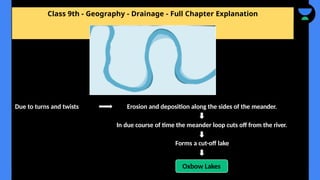
Due to turns and twists Erosion and deposition along the sides of the meander.
In due course of time the meander loop cuts off from the river.
Forms a cut-off lake
Oxbow Lakes
Class 9th - Geography - Drainage - Full Chapter Explanation
Lagoons
● Another important type of lakes.
● Mostly lagoons are salt water lakes [connected with sea]
● Lagoons are a shallow body of water separated from a larger
Body of water by barrier islands or reefs.
● Example of lagoon lakes are Chilika lake, the Pulicat lake and
Kolleru lake.
Chilika Lake Kolleru Lake
Class 9th - Geography - Drainage - Full Chapter
Explanation
Class 9th - Geography - Dranage - Full Chapter Explanation
● Apart from these natural lakes there are lake which
are constructed by humans known as Human made
or Artificial lakes.
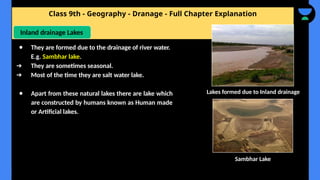
Inland drainage Lakes
● They are formed due to the drainage of river water.
E.g. Sambhar lake.
➔ They are sometimes seasonal.
➔ Most of the time they are salt water lake.
Sambhar Lake
Lakes formed due to Inland drainage
Class 9th - Geography - Drainage - Full Chapter Explanation
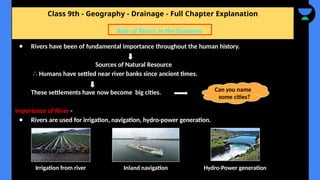
● Rivers have been of fundamental importance throughout the human history.
Sources of Natural Resource
∴ Humans have settled near river banks since ancient times.
These settlements have now become big cities.
Importance of River -
● Rivers are used for irrigation, navigation, hydro-power generation.
Role of Rivers in the Economy
Can you name
some cities?
Irrigation from river Inland navigation Hydro-Power generation
Class 9th - Geography - Drainage - Full Chapter Explanation
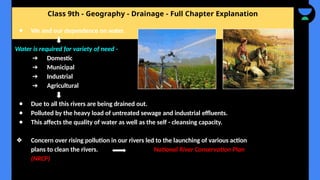
● We and our dependence on water.
Water is required for variety of need -
➔ Domestic
➔ Municipal
➔ Industrial
➔ Agricultural
● Due to all this rivers are being drained out.
● Polluted by the heavy load of untreated sewage and industrial effluents.
● This affects the quality of water as well as the self - cleansing capacity.
❖ Concern over rising pollution in our rivers led to the launching of various action
plans to clean the rivers. National River Conservation Plan
(NRCP)
Drainage  full chapter explanation..pptx

Drainage full chapter explanation..pptx

  • 1.
    Class 9th -Geography Drainage Full Chapter Explanation
  • 2.
    Class 9th -Geography - Drainage - Full Chapter Explanation Drainage system of an area
  • 3.
    Class 9th -Geography - Drainage - Full Chapter Explanation Drainage River system of an area. Drainage Basin The area drained by a river along with its tributaries and distributaries is known as Drainage Basin. Water Divide : When any elevated area, such as a mountain or an upland separates two drainage basins it is known as Water Divide. The world largest drainage basin is of Amazon river
  • 4.
    Class 9th -Geography - Drainage - Full Chapter Explanation What we are going to study in this chapter? ❖ Drainage patterns ❖ Drainage systems in India ➢ The Himalayan Rivers ➢ The Peninsular Rivers ❖ The Himalayas Rivers: [The Indus, the Ganga, and the Brahmaputra] ❖ The Peninsular Rivers: [The Narmada, the Tapi, the Godavari, the Mahanadi, the Krishna and the Kaveri] ❖ Lakes ❖ Role of Rivers in the Economy ❖ River Pollution
  • 5.
    Class 9th -Geography - Drainage - Full Chapter Explanation Drainage Patterns What is Drainage Pattern? ● The pattern in which the river flows. ● Depending on the slope of land, underlying rock structure as well as the climate conditions. There are four type of Drainage Patterns. Dendritic Trellis Rectangular Radial ● River flows with the slope of terrain ● Resembles the branches of tree. ● Hard and soft rock exist parallel to each other. ● Tributaries are joined at right angle. ● Develops on the strongly jointed rock terrain. ● Rivers flowing from a central peak to different directions.
  • 6.
    Class 9th -Geography - Drainage - Full Chapter Explanation ● Apart from the originating point, Himalayan and Peninsular rivers also have various other differences. Drainage Systems in India Rivers originating from Himalayas ● Influenced by the Physical features of the subcontinent. Indian rivers are divided into two major groups: Himalayan Rivers Peninsular Rivers Rivers originating from Peninsular plateau
  • 7.
    Class 9th -Geography - Drainage - Full Chapter Explanation
  • 8.
    Class 9th -Geography - Drainage - Full Chapter Explanation Basic Himalayan Rivers Peninsular Rivers Point of origin Himalayas and Glaciers Western Ghats and Central Highland Nature Perennial Seasonal Source of water Rainfall and Glaciers Rainfall Course Long course, Performs erosional activity and carry huge loads of silt and sand Short and shallower courses Drains in? Most of the rivers flow towards east and drains in Bay of Bengal. Indus is an exception Most of the rivers flows towards east and drains in Bay of Bengal. Narmada and Tapi are some major rivers which flows in west and drains in Arabian sea Other features Forms flood plains, oxbow lakes, meanders and delta Forms estuaries unlike himalayan rivers Example Ganga, Brahmaputra, Indus, Yamuna etc Narmada, Godavari, Krishna, Kaveri etc
  • 9.
    Class 9th -Geography - Drainage - Full Chapter Explanation A Gorge Features made by river Estuaries Delta
  • 10.
    Class 9th -Geography - Drainage - Full Chapter Explanation What is River System? ● The River along with its tributaries may be called a river system. The Indus River System
  • 11.
    Class 9th -Geography - Drainage - Full Chapter Explanation ● Rises in Tibet. Near lake Mansarovar. Enters India from Ladakh It is joined by the tributaries such as the Zaskar, the Nurba, the Shyok and the Hunza. Further flowing from the Baltistan and Gilgit, Indus is joined by other tributaries such as the Satluj, the Ravi, the Chenab and the Jhelum at Mithankot in Pakistan. Flowing Southwards Indus finally drains into Arabian Sea. River Indus ● Total length of 2900 km. ● Title over a third of Indus basin is located in India. Major part flows from Pakistan Do you know? = Indus water treaty [1960]
  • 12.
    Class 9th -Geography - Drainage - Full Chapter Explanation Route - The Ganga River System
  • 13.
    Class 9th -Geography - Drainage - Full Chapter Explanation At Haridwar, Ganga emerges from mountains to plains. ● Further coming on the plains River Ganga is joined by many tributaries from Himalayas. ● Headwaters of Ganga is called Bhagirathi Alaknanda Devprayag (U.K)
  • 14.
    Class 9th -Geography - Drainage - Full Chapter Explanation ● These Rivers floods parts of the Northern plains every year. Causing damage to life and property but at same time they enrich the soil for agricultural use. Do you know Left Bank tributaries of Ganga Right bank tributaries of Ganga ● The Yamuna ● The Ghaghara ● The Gandak ● Kosi [Rises from the glaciers in Himalayas] ● The Chambal ● The Betwa ● The Son [Rises from Semi-arid part of Peninsular] ● They have a shorter courses and do not carry much water. The Namami Gange Programme
  • 15.
    Class 9th -Geography - Drainage - Full Chapter Explanation
  • 16.
    Class 9th -Geography - Drainage - Full Chapter Explanation Farakka is the Northernmost point of Ganga in W.B. ● The Mighty river with the water of Ganga + Brahmaputra = Meghna Further carrying water from its left and right bank tributaries. The Ganga flows towards East. Padma Bhagirathi-Hooghly - A distributary of Ganga - Flows into Bay of Bengal - Ganga entering into Bangladesh -Mainstream further flow South and joins Brahmaputra
  • 17.
    Class 9th -Geography - Drainage - Full Chapter Explanation ● These Rivers forms the Sundarban delta. Derived its name from Sundari tree. It is world’s largest and fastest growing delta. River Ganga ● Length 2500 km ● Ambala water divide between Indus and Ganga river system. ● Ambala to Sunderban = Fall in slope 300 meters Meanders Sunderban delta Sundari tree
  • 18.
    Class 9th -Geography - Drainage - Full Chapter Explanation
  • 19.
    Class 9th -Geography - Drainage - Full Chapter Explanation Routes - The Brahmaputra River System
  • 20.
    Class 9th -Geography - Drainage - Full Chapter Explanation Rises in Tibet; East of Mansarovar lake [Mansarovar lake = Water divide] Slightly longer than the Indus and most of its course lies outside India. From Namcha Barwa, it takes ‘U’ turn and enters into India in Arunachal Pradesh. Here, it is known as Dihang, joined by other tributaries such as Dibang, the Lohit etc. Volume of water in river varies in Tibet and India. Why?
  • 21.
    Class 9th -Geography - Drainage - Full Chapter Explanation ● Entering in India Brahmaputra carries a large amount of water. Silt Forms Riverine Island ➔ The river overflows its banks, causing widespread devastation due to floods in Assam and Bangladesh. ➔ The Brahmaputra is marked by huge deposits of silt on its bed causing the riverbed to rise. Majuli island
  • 22.
    Class 9th -Geography - Drainage - Full Chapter Explanation Rivers in Bangladesh Ganga Brahmaputra Bangladesh Padma Jamuna Meghna Bay of Bengal
  • 23.
    Class 9th -Geography - Drainage - Full Chapter Explanation ● Most of the peninsular rivers originates from Western Ghat. Western Ghats acts as a water divide in the Peninsular India. ● Peninsular Rivers include: The Narmada, the Tapi, the Godavari, the Mahanadi, the Krishna the Kaveri. The Peninsular Rivers ● All the major river originating from Western Ghats flows towards East. ● Forms delta. ● The Narmada and Tapi are only long rivers, which flows West and make estuaries.
  • 24.
    Class 9th -Geography - Drainage - Full Chapter Explanation
  • 25.
    Class 9th -Geography - Drainage - Full Chapter Explanation The Narmada Basin Rises in the Amarkantak hills ● Flows west in Rift valley due to faulting ● River Narmada flows through deep gorge, forming picturesque location. [The ‘Marble rocks’, near Jabalpur, where the Narmada flows through a deep gorge, and the ‘Dhuandhar falls] ● Most of the tributaries of Narmada are short and joins at right angle. [Rectangular pattern] ● River flows in the parts of M.P and Gujarat. Amarkantak point
  • 26.
    Class 9th -Geography - Drainage - Full Chapter Explanation Deep Gorge of river Narmada Dhuandhar fall Bhedaghat
  • 27.
    Class 9th -Geography - Drainage - Full Chapter Explanation ● Rises in Satpura range in Betul district of Madhya Pradesh. ● It also flows in Rift valley parallel to Narmada but shorter in length. ● Flows through three states [M.P, Gujarat and Maharashtra] ● Drains in Arabian sea. Tapi Basin Are there only two west flowing rivers? No, there are west flowing coastal rivers but their length is short. E.g. The Sabarmati, the Mahi, the Bharathapuzha and the Periyar
  • 28.
    Class 9th -Geography - Drainage - Full Chapter Explanation Map showing the river Mahi Map showing river Periyar Map showing the river Sabarmati Map showing the river bharathapuzha
  • 29.
    Class 9th -Geography - Drainage - Full Chapter Explanation ∴ Dakshin Ganga ● Rises from slope of the western ghats in the Nasik district of Maharashtra. ● Length = 1500 km ● About 50% of drainage basin covers Maharashtra. Also extends to M.P, Odisha and Andhra Pradesh. ● Tributaries such as the Purna, the Wardha, the Pranhita, the Manjra, the Wainganga and Penganga. ● Drains into Bay to Bengal. The Godavari Basin ● Largest Peninsular River. ● Covers a large area along with its tributaries.
  • 30.
    Class 9th -Geography - Drainage - Full Chapter Explanation ● Rises in the Highlands of Chhattisgarh. Total length of Mahanadi = 860 km ● It flows mainly in Odisha ● Joined by the tributaries such as Seonath, Jonk, Hasdo, Mand, Lb etc. ● Its drainage basin is shared by Maharashtra, Chhattisgarh, Jharkhand and Odisha. ➔ Is the source water for peninsular river is only rainfall? The Mahanadi Basin
  • 31.
    Class 9th -Geography - Drainage - Full Chapter Explanation Rises from the springs near Mahabaleshwar, flows Eastwards. ■ Its drainage is shared by Maharashtra, Karnataka and Andhra Pradesh. ■ The tributaries of river Krishna are the Tungabhadra, the Konyana, the Ghatprabha, the Musi and the Bhima etc. ■ It flows over the distance of 1400 km and drains into Bay of Bengal. The Krishna Basin
  • 32.
    Class 9th -Geography - Drainage - Full Chapter Explanation
  • 33.
    Class 9th -Geography - Drainage - Full Chapter Explanation ❖ Rises in the Brahmagiri range of Western Ghats [Karnataka] Flows West and drains in Bay of Bengal in South of Cuddalore in Tamil Nadu ● The total length of river is about 760 km. ● Its main tributaries are Amravati, Bhavani, Hemavati and Kabini covering the parts of Karnataka, Kerala and Tamil Nadu. The Kaveri Basin
  • 34.
    Class 9th -Geography - Drainage - Full Chapter Explanation ● There are some smaller rivers which flows towards East such as - Do you know? ● 71 percent of the world’s surface is covered with water, but 97 per cent of that is salt water. ● Of the 3 percent that is available as freshwater, three quarters of it is trapped as ice. Do you know? ● The river Kaveri makes the second biggest waterfall in India, known as Shivasamudram Falls. The hydroelectric power generated from the falls is supplied to Mysore, Bengaluru and the Kolar Gold Field. The Damodar The Brahmani The Baitarani The Subarnarekha
  • 35.
    Class 9th -Geography - Drainage - Full Chapter Explanation
  • 36.
    Class 9th -Geography - Drainage - Full Chapter Explanation ● Lakes and We Imagine a situation of various tourist places as Nainital and Srinagar without lakes? Lakes plays a very Important role in our life - ➔ Tourist centres and enhances natural beauty. ➔ Habitat for aquatic life. ➔ Helps to regulate the flow of a river. ➔ Prevents flooding and supplies water during dry season. ➔ Used for developing hydel power. ➔ They moderate the climate of the surrounding. Lakes Why do lakes of large extent are called seas. E.g The Caspian sea, the Dead sea.
  • 37.
    Class 9th -Geography - Drainage - Full Chapter Explanation ● India has many lakes They differ from each other in variety of ways. Some are Permanent Some contain water only during rainy season Salt water Lakes Fresh water Laker Glacier Lakes Depending on the formation lakes are: Oxbow Lakes Lagoons Inland drainage Lakes
  • 38.
    Class 9th -Geography - Drainage - Full Chapter Explanation Glacier Lakes ● These lakes are formed due to the action of Glaciers and ice sheets. Freshwater lakes ● The basin is dug out by glaciers and the impoundment is filled with snowmet. ● E.g The Dal lake, Bhimtal, Nainital, Loktak etc. ● Wular lake is the largest Freshwater lake in India is a tectonic lake. ● Similarly there are Meteoroid lakes also. ● E.g Lonar Lake
  • 39.
    Class 9th -Geography - Drainage - Full Chapter Explanation Due to turns and twists Erosion and deposition along the sides of the meander. In due course of time the meander loop cuts off from the river. Forms a cut-off lake Oxbow Lakes
  • 40.
    Class 9th -Geography - Drainage - Full Chapter Explanation Lagoons ● Another important type of lakes. ● Mostly lagoons are salt water lakes [connected with sea] ● Lagoons are a shallow body of water separated from a larger Body of water by barrier islands or reefs. ● Example of lagoon lakes are Chilika lake, the Pulicat lake and Kolleru lake. Chilika Lake Kolleru Lake
  • 41.
    Class 9th -Geography - Drainage - Full Chapter Explanation
  • 42.
    Class 9th -Geography - Dranage - Full Chapter Explanation ● Apart from these natural lakes there are lake which are constructed by humans known as Human made or Artificial lakes. Inland drainage Lakes ● They are formed due to the drainage of river water. E.g. Sambhar lake. ➔ They are sometimes seasonal. ➔ Most of the time they are salt water lake. Sambhar Lake Lakes formed due to Inland drainage
  • 43.
    Class 9th -Geography - Drainage - Full Chapter Explanation ● Rivers have been of fundamental importance throughout the human history. Sources of Natural Resource ∴ Humans have settled near river banks since ancient times. These settlements have now become big cities. Importance of River - ● Rivers are used for irrigation, navigation, hydro-power generation. Role of Rivers in the Economy Can you name some cities? Irrigation from river Inland navigation Hydro-Power generation
  • 44.
    Class 9th -Geography - Drainage - Full Chapter Explanation ● We and our dependence on water. Water is required for variety of need - ➔ Domestic ➔ Municipal ➔ Industrial ➔ Agricultural ● Due to all this rivers are being drained out. ● Polluted by the heavy load of untreated sewage and industrial effluents. ● This affects the quality of water as well as the self - cleansing capacity. ❖ Concern over rising pollution in our rivers led to the launching of various action plans to clean the rivers. National River Conservation Plan (NRCP)