FOLLOWING AND CHALLENGING
CONVENTIONS: INSPIRATION
FROM EXISTING PRODUCTS
CONTENTS PAGES
LOGOS AND SUBHEADINGS
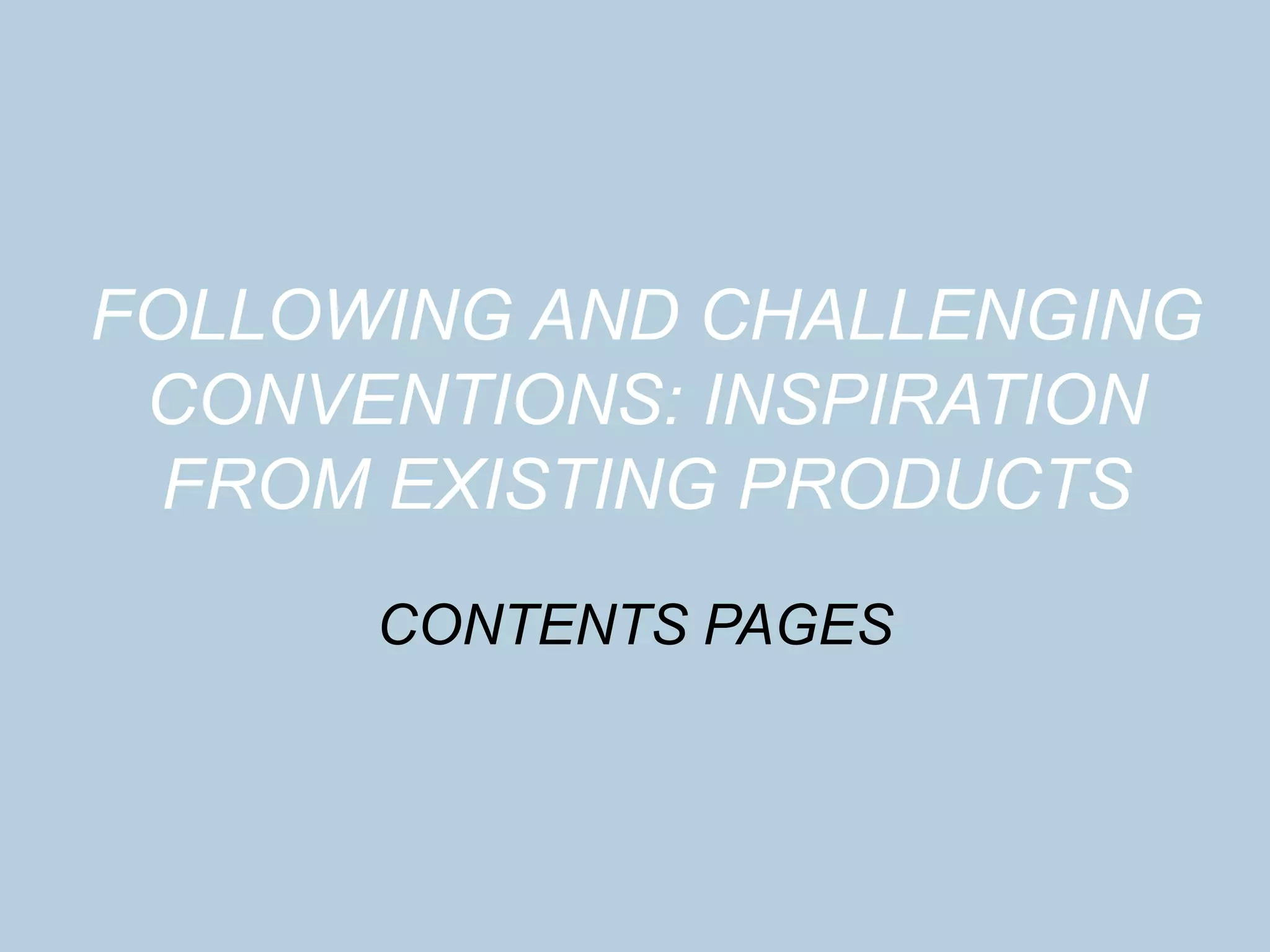
A convention of double page spreads is
a small subheading in one corner that
tells the reader what kind of feature the
article is – an interview, a review etc. It
is also often paired with the logo of the
magazine. These images are examples
of magazines Q, Billboard, NME and
Vibe following this convention. Some of
them use both a subheading and a
logo, and some use just one or the
other. I chose to use both myself,
positioning the logo and the title ‘Strings
Exclusive’ in the top left corner of my
double page spread in order to follow
conventions.
MAIN IMAGES
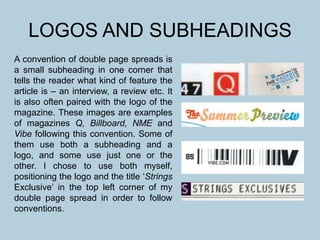
Main images on double
page spreads conventionally
take up at least one whole
page, often overlapping onto
two. The examples here
from NME, Vibe, Billboard
and Q demonstrate how the
image framing can range
from mid-shot to close up,
depending on the amount of
people in the picture. I
chose to do a mid- to long-
shot in order to depict both
of my artists clearly. I also
used an image that took up
only one page as I didn’t
want any of it to become
less visible within the page
fold.
DROP CAPS
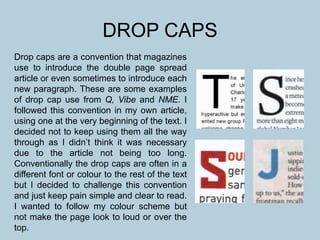
Drop caps are a convention that magazines
use to introduce the double page spread
article or even sometimes to introduce each
new paragraph. These are some examples
of drop cap use from Q, Vibe and NME. I
followed this convention in my own article,
using one at the very beginning of the text. I
decided not to keep using them all the way
through as I didn’t think it was necessary
due to the article not being too long.
Conventionally the drop caps are often in a
different font or colour to the rest of the text
but I decided to challenge this convention
and just keep pain simple and clear to read.
I wanted to follow my colour scheme but
not make the page look to loud or over the
top.
PULL QUOTES
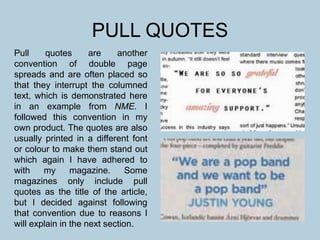
Pull quotes are another
convention of double page
spreads and are often placed so
that they interrupt the columned
text, which is demonstrated here
in an example from NME. I
followed this convention in my
own product. The quotes are also
usually printed in a different font
or colour to make them stand out
which again I have adhered to
with my magazine. Some
magazines only include pull
quotes as the title of the article,
but I decided against following
that convention due to reasons I
will explain in the next section.
TITLES
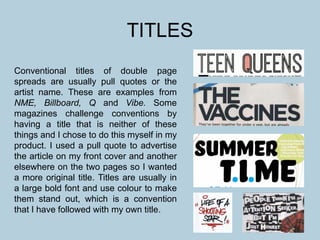
Conventional titles of double page
spreads are usually pull quotes or the
artist name. These are examples from
NME, Billboard, Q and Vibe. Some
magazines challenge conventions by
having a title that is neither of these
things and I chose to do this myself in my
product. I used a pull quote to advertise
the article on my front cover and another
elsewhere on the two pages so I wanted
a more original title. Titles are usually in
a large bold font and use colour to make
them stand out, which is a convention
that I have followed with my own title.
PAGE NUMBERS
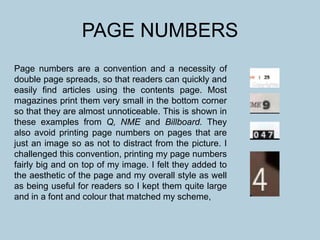
Page numbers are a convention and a necessity of
double page spreads, so that readers can quickly and
easily find articles using the contents page. Most
magazines print them very small in the bottom corner
so that they are almost unnoticeable. This is shown in
these examples from Q, NME and Billboard. They
also avoid printing page numbers on pages that are
just an image so as not to distract from the picture. I
challenged this convention, printing my page numbers
fairly big and on top of my image. I felt they added to
the aesthetic of the page and my overall style as well
as being useful for readers so I kept them quite large
and in a font and colour that matched my scheme,
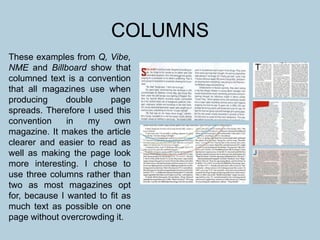
COLUMNS
These examples from Q, Vibe,
NME and Billboard show that
columned text is a convention
that all magazines use when
producing double page
spreads. Therefore I used this
convention in my own
magazine. It makes the article
clearer and easier to read as
well as making the page look
more interesting. I chose to
use three columns rather than
two as most magazines opt
for, because I wanted to fit as
much text as possible on one
page without overcrowding it.
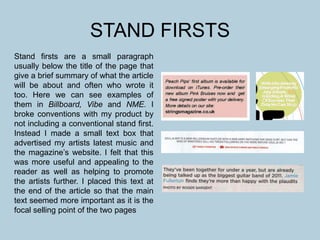
STAND FIRSTS
Stand firsts are a small paragraph
usually below the title of the page that
give a brief summary of what the article
will be about and often who wrote it
too. Here we can see examples of
them in Billboard, Vibe and NME. I
broke conventions with my product by
not including a conventional stand first.
Instead I made a small text box that
advertised my artists latest music and
the magazine’s website. I felt that this
was more useful and appealing to the
reader as well as helping to promote
the artists further. I placed this text at
the end of the article so that the main
text seemed more important as it is the
focal selling point of the two pages

Dps conventions

  • 1.
    FOLLOWING AND CHALLENGING CONVENTIONS:INSPIRATION FROM EXISTING PRODUCTS CONTENTS PAGES
  • 2.
    LOGOS AND SUBHEADINGS Aconvention of double page spreads is a small subheading in one corner that tells the reader what kind of feature the article is – an interview, a review etc. It is also often paired with the logo of the magazine. These images are examples of magazines Q, Billboard, NME and Vibe following this convention. Some of them use both a subheading and a logo, and some use just one or the other. I chose to use both myself, positioning the logo and the title ‘Strings Exclusive’ in the top left corner of my double page spread in order to follow conventions.
  • 3.
    MAIN IMAGES Main imageson double page spreads conventionally take up at least one whole page, often overlapping onto two. The examples here from NME, Vibe, Billboard and Q demonstrate how the image framing can range from mid-shot to close up, depending on the amount of people in the picture. I chose to do a mid- to long- shot in order to depict both of my artists clearly. I also used an image that took up only one page as I didn’t want any of it to become less visible within the page fold.
  • 4.
    DROP CAPS Drop capsare a convention that magazines use to introduce the double page spread article or even sometimes to introduce each new paragraph. These are some examples of drop cap use from Q, Vibe and NME. I followed this convention in my own article, using one at the very beginning of the text. I decided not to keep using them all the way through as I didn’t think it was necessary due to the article not being too long. Conventionally the drop caps are often in a different font or colour to the rest of the text but I decided to challenge this convention and just keep pain simple and clear to read. I wanted to follow my colour scheme but not make the page look to loud or over the top.
  • 5.
    PULL QUOTES Pull quotesare another convention of double page spreads and are often placed so that they interrupt the columned text, which is demonstrated here in an example from NME. I followed this convention in my own product. The quotes are also usually printed in a different font or colour to make them stand out which again I have adhered to with my magazine. Some magazines only include pull quotes as the title of the article, but I decided against following that convention due to reasons I will explain in the next section.
  • 6.
    TITLES Conventional titles ofdouble page spreads are usually pull quotes or the artist name. These are examples from NME, Billboard, Q and Vibe. Some magazines challenge conventions by having a title that is neither of these things and I chose to do this myself in my product. I used a pull quote to advertise the article on my front cover and another elsewhere on the two pages so I wanted a more original title. Titles are usually in a large bold font and use colour to make them stand out, which is a convention that I have followed with my own title.
  • 7.
    PAGE NUMBERS Page numbersare a convention and a necessity of double page spreads, so that readers can quickly and easily find articles using the contents page. Most magazines print them very small in the bottom corner so that they are almost unnoticeable. This is shown in these examples from Q, NME and Billboard. They also avoid printing page numbers on pages that are just an image so as not to distract from the picture. I challenged this convention, printing my page numbers fairly big and on top of my image. I felt they added to the aesthetic of the page and my overall style as well as being useful for readers so I kept them quite large and in a font and colour that matched my scheme,
  • 8.
    COLUMNS These examples fromQ, Vibe, NME and Billboard show that columned text is a convention that all magazines use when producing double page spreads. Therefore I used this convention in my own magazine. It makes the article clearer and easier to read as well as making the page look more interesting. I chose to use three columns rather than two as most magazines opt for, because I wanted to fit as much text as possible on one page without overcrowding it.
  • 9.
    STAND FIRSTS Stand firstsare a small paragraph usually below the title of the page that give a brief summary of what the article will be about and often who wrote it too. Here we can see examples of them in Billboard, Vibe and NME. I broke conventions with my product by not including a conventional stand first. Instead I made a small text box that advertised my artists latest music and the magazine’s website. I felt that this was more useful and appealing to the reader as well as helping to promote the artists further. I placed this text at the end of the article so that the main text seemed more important as it is the focal selling point of the two pages