Probing quantum coherence in arrays of superconducting qubits
Alexandra M. Liguori, Susana F. Huelga, Martin B. Plenio
Institut f¨ur Theoretische Physik, Universit¨at Ulm
15th
March 2011, DPG, Dresden
A. Liguori Probing quantum coherence in arrays of superconducting qubits
Outilne
1 Original dynamic localisation effect
2 Dynamic localisation in superconducting qubit chains as tool to evaluate
coherence in system
A. Liguori Probing quantum coherence in arrays of superconducting qubits
Dynamic localisation on infinite chain
Time-dependent Hamiltonian ( = 1)
H(t) = V
m=+∞
m=−∞
(σ+
mσ−
m+1 + σ−
mσ+
m+1
) −
m=+∞
m=−∞
(E0 + E1) cos(ωt)σ+
mσ−
m ,
V coupling strength between nearest-neighbours
σ±
m = (σx
m ± iσy
m)/2 acting on m-th site (σx
and σy
Pauli matrices)
E0 energy difference between adjacent sites, ω frequency
Mean-square displacement as function of E1 oscillates sinusoidally
Interaction picture → effective Hamiltonian with JE0
ω
Bessel function
Heff
I = V
m=+∞
m=−∞
JE0
ω
(
E1
ω
)(σ+
mσ−
m+1 + σ−
mσ+
m+1) ,
RESULTS [Dunlap&Kenkre, PRB (1986); Holthaus&Hone, Phil. Mag. B (1996)]
Argument of Bessel function is oscillatory function of time, with oscillation
frequency proportional to magnitude of electric field, i.e.
if E0 = nω, n ∈ R, and E1/ω is a zero of Bessel function J
then mean-square displacement oscillates sinusoidally ⇒ initially localised
particle remains localised ⇔ DYNAMICAL LOCALISATION
A. Liguori Probing quantum coherence in arrays of superconducting qubits
Dynamic localisation on infinite chain
Time-dependent Hamiltonian ( = 1)
H(t) = V
m=+∞
m=−∞
(σ+
mσ−
m+1 + σ−
mσ+
m+1
) −
m=+∞
m=−∞
(E0 + E1) cos(ωt)σ+
mσ−
m ,
V coupling strength between nearest-neighbours
σ±
m = (σx
m ± iσy
m)/2 acting on m-th site (σx
and σy
Pauli matrices)
E0 energy difference between adjacent sites, ω frequency
Mean-square displacement as function of E1 oscillates sinusoidally
Interaction picture → effective Hamiltonian with JE0
ω
Bessel function
Heff
I = V
m=+∞
m=−∞
JE0
ω
(
E1
ω
)(σ+
mσ−
m+1 + σ−
mσ+
m+1) ,
RESULTS [Dunlap&Kenkre, PRB (1986); Holthaus&Hone, Phil. Mag. B (1996)]
Argument of Bessel function is oscillatory function of time, with oscillation
frequency proportional to magnitude of electric field, i.e.
if E0 = nω, n ∈ R, and E1/ω is a zero of Bessel function J
then mean-square displacement oscillates sinusoidally ⇒ initially localised
particle remains localised ⇔ DYNAMICAL LOCALISATION
A. Liguori Probing quantum coherence in arrays of superconducting qubits
Dynamic localisation on finite chain
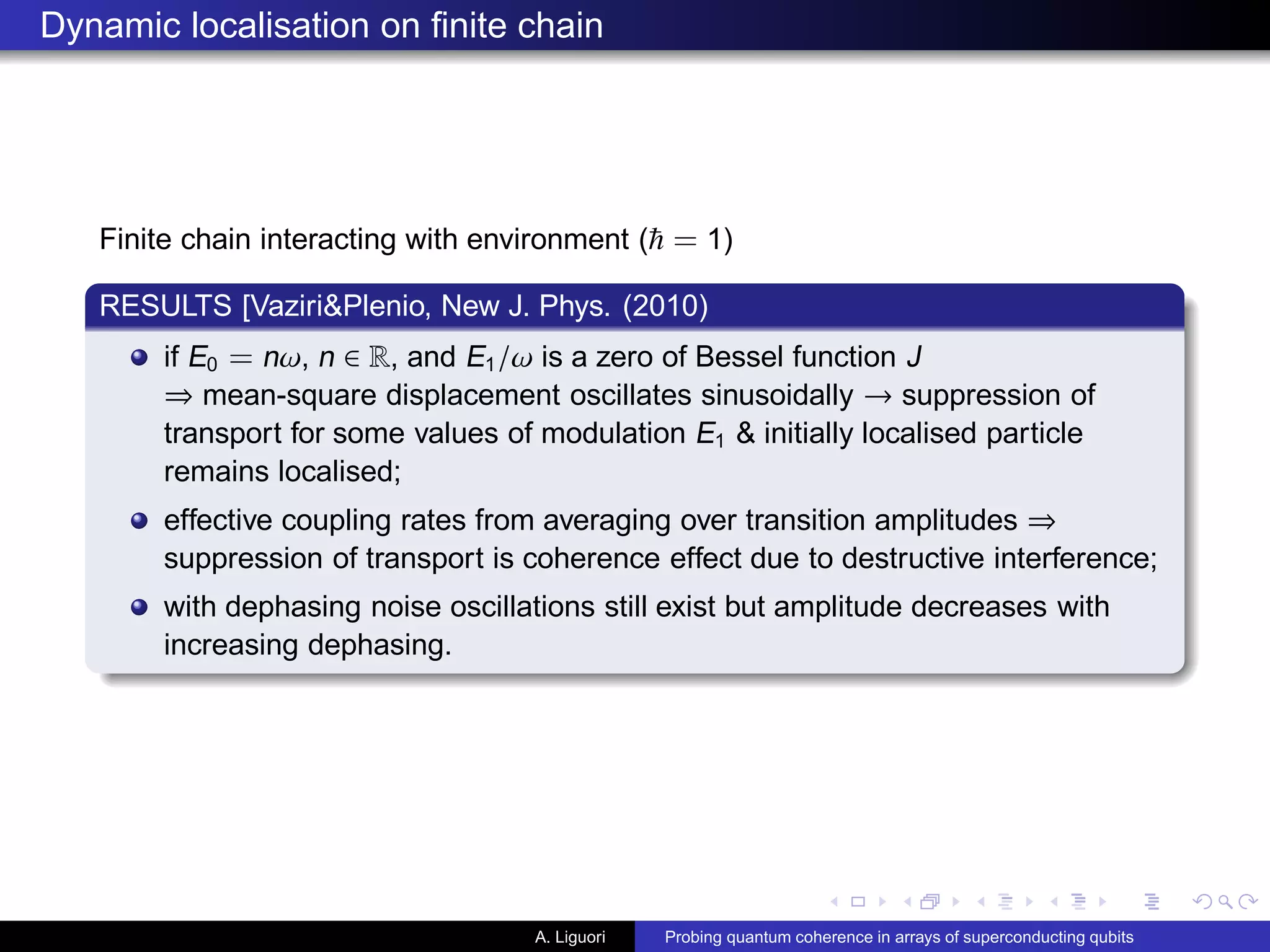
Finite chain interacting with environment ( = 1)
RESULTS [Vaziri&Plenio, New J. Phys. (2010)
if E0 = nω, n ∈ R, and E1/ω is a zero of Bessel function J
⇒ mean-square displacement oscillates sinusoidally → suppression of
transport for some values of modulation E1 & initially localised particle
remains localised;
effective coupling rates from averaging over transition amplitudes ⇒
suppression of transport is coherence effect due to destructive interference;
with dephasing noise oscillations still exist but amplitude decreases with
increasing dephasing.
A. Liguori Probing quantum coherence in arrays of superconducting qubits
Superconducting qubits
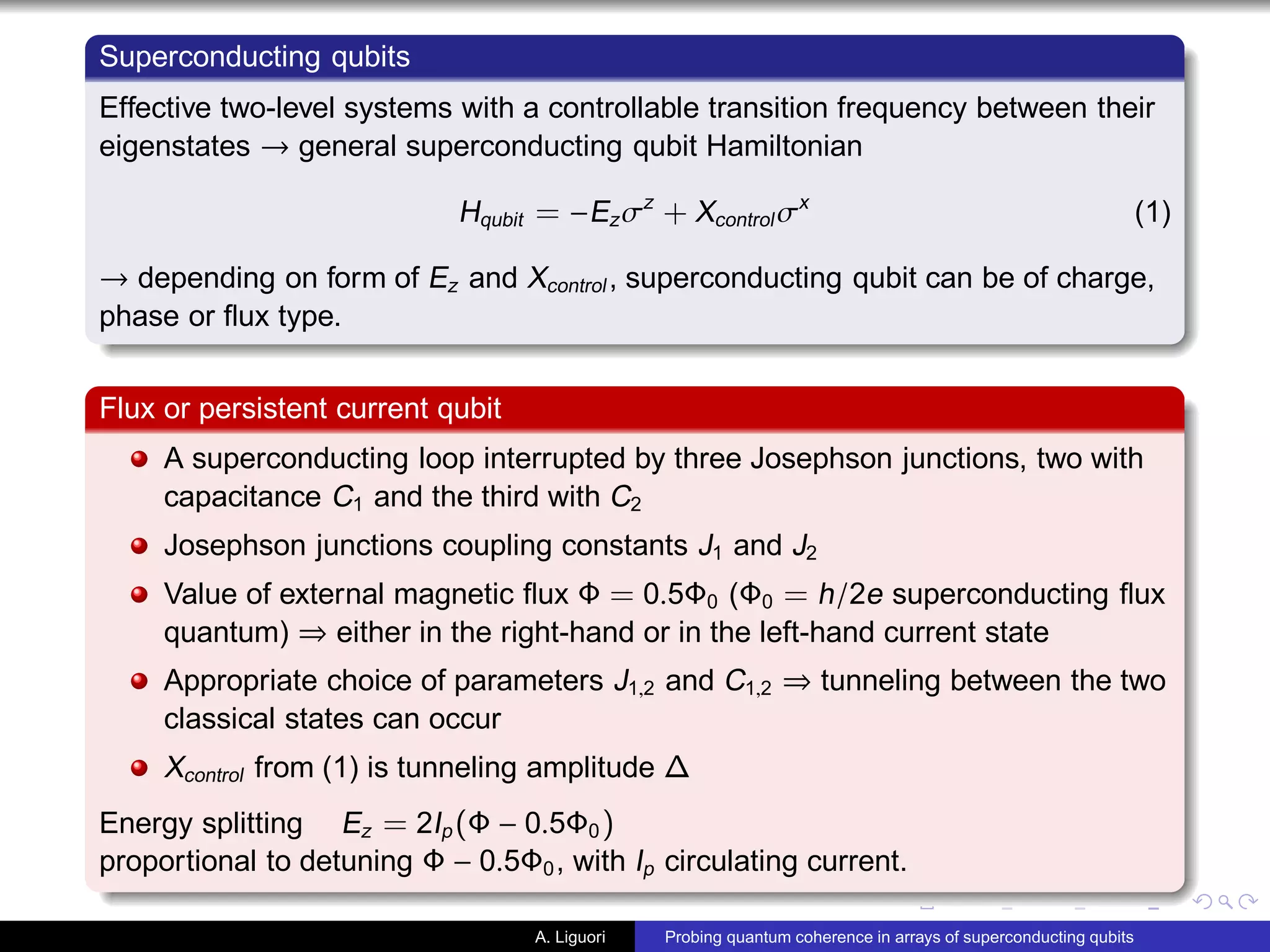
Effective two-level systems with a controllable transition frequency between their
eigenstates → general superconducting qubit Hamiltonian
Hqubit = −Ezσz
+ Xcontrol σx
(1)
→ depending on form of Ez and Xcontrol , superconducting qubit can be of charge,
phase or flux type.
Flux or persistent current qubit
A superconducting loop interrupted by three Josephson junctions, two with
capacitance C1 and the third with C2
Josephson junctions coupling constants J1 and J2
Value of external magnetic flux Φ = 0.5Φ0 (Φ0 = h/2e superconducting flux
quantum) ⇒ either in the right-hand or in the left-hand current state
Appropriate choice of parameters J1,2 and C1,2 ⇒ tunneling between the two
classical states can occur
Xcontrol from (1) is tunneling amplitude ∆
Energy splitting Ez = 2Ip(Φ − 0.5Φ0)
proportional to detuning Φ − 0.5Φ0, with Ip circulating current.
A. Liguori Probing quantum coherence in arrays of superconducting qubits
Dynamic localisation in a chain of superconducting qubits
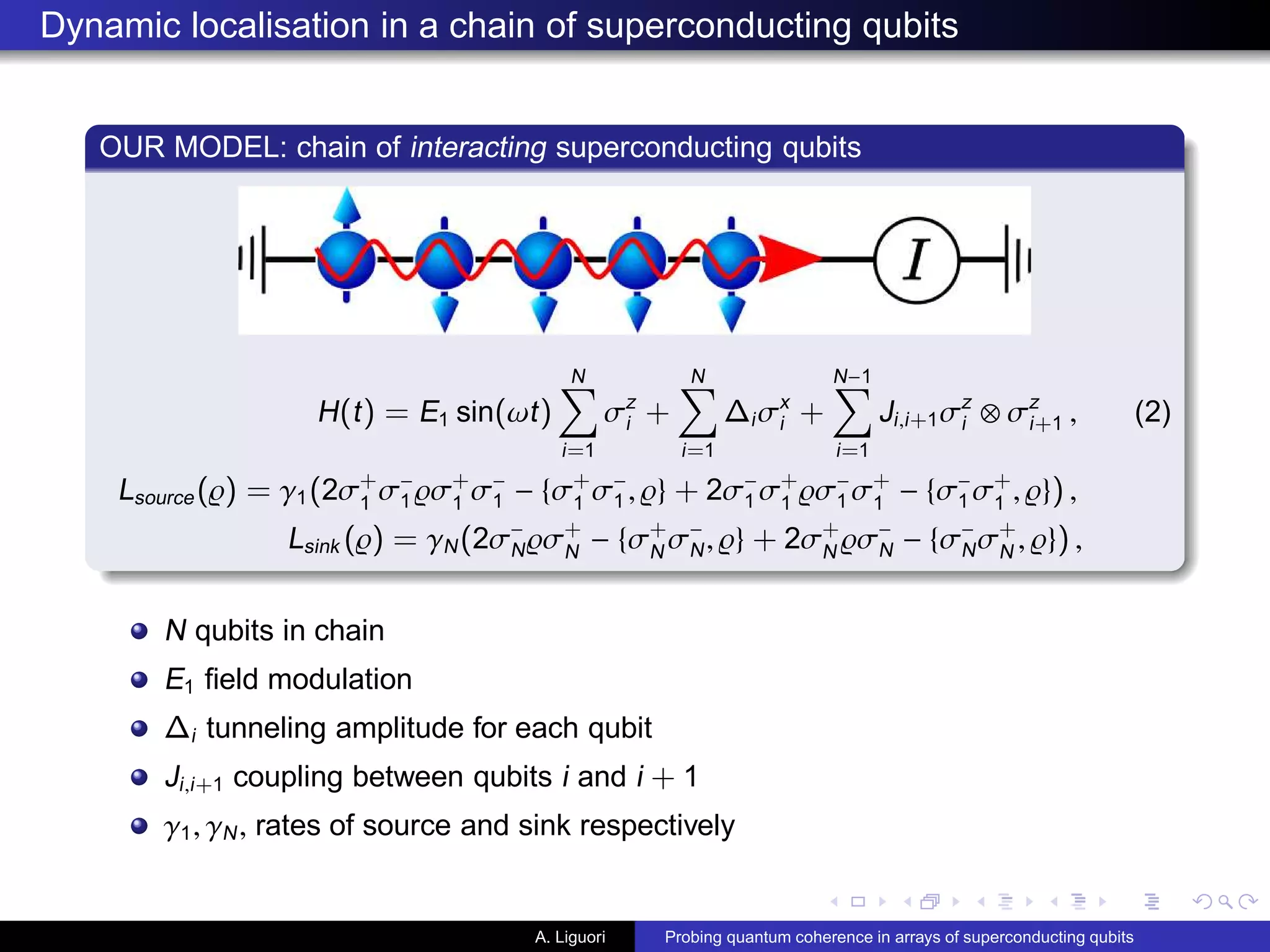
OUR MODEL: chain of interacting superconducting qubits
H(t) = E1 sin(ωt)
N
i=1
σz
i +
N
i=1
∆iσx
i +
N−1
i=1
Ji,i+1σz
i ⊗ σz
i+1 , (2)
Lsource(̺) = γ1(2σ+
1
σ−
1 ̺σ+
1
σ−
1 − {σ+
1
σ−
1 , ̺} + 2σ−
1 σ+
1
̺σ−
1 σ+
1
− {σ−
1 σ+
1
, ̺}) ,
Lsink (̺) = γN(2σ−
N̺σ+
N
− {σ+
N
σ−
N, ̺} + 2σ+
N
̺σ−
N − {σ−
Nσ+
N
, ̺}) ,
N qubits in chain
E1 field modulation
∆i tunneling amplitude for each qubit
Ji,i+1 coupling between qubits i and i + 1
γ1, γN, rates of source and sink respectively
A. Liguori Probing quantum coherence in arrays of superconducting qubits
Dynamic localisation in a chain of superconducting qubits
Quantum dynamical eq. for finite chain interacting with environment ( = 1)
d̺
dt
= −i[H, ̺] + Lsource(̺) + Lsink (̺) + Ldeph (̺)
with
Ldeph (̺) = γdeph
N
i=1
(2σ+
i
σ−
i ̺σ+
i
σ−
i − {σ+
i
σ−
i , ̺})
γdeph rate of dephasing noise.
Study current I as function of field modulation E1 in (2):
I = lim
t→∞
dpsink
dt
(t)
with psink (t) =
T
0
2γN̺N,N (t)dt, ̺N,N reduced density matrix of last site of chain.
A. Liguori Probing quantum coherence in arrays of superconducting qubits
Dynamic localisation in a chain of superconducting qubits
Quantum dynamical eq. for finite chain interacting with environment ( = 1)
d̺
dt
= −i[H, ̺] + Lsource(̺) + Lsink (̺) + Ldeph (̺)
with
Ldeph (̺) = γdeph
N
i=1
(2σ+
i
σ−
i ̺σ+
i
σ−
i − {σ+
i
σ−
i , ̺})
γdeph rate of dephasing noise.
Study current I as function of field modulation E1 in (2):
I = lim
t→∞
dpsink
dt
(t)
with psink (t) =
T
0
2γN̺N,N (t)dt, ̺N,N reduced density matrix of last site of chain.
A. Liguori Probing quantum coherence in arrays of superconducting qubits
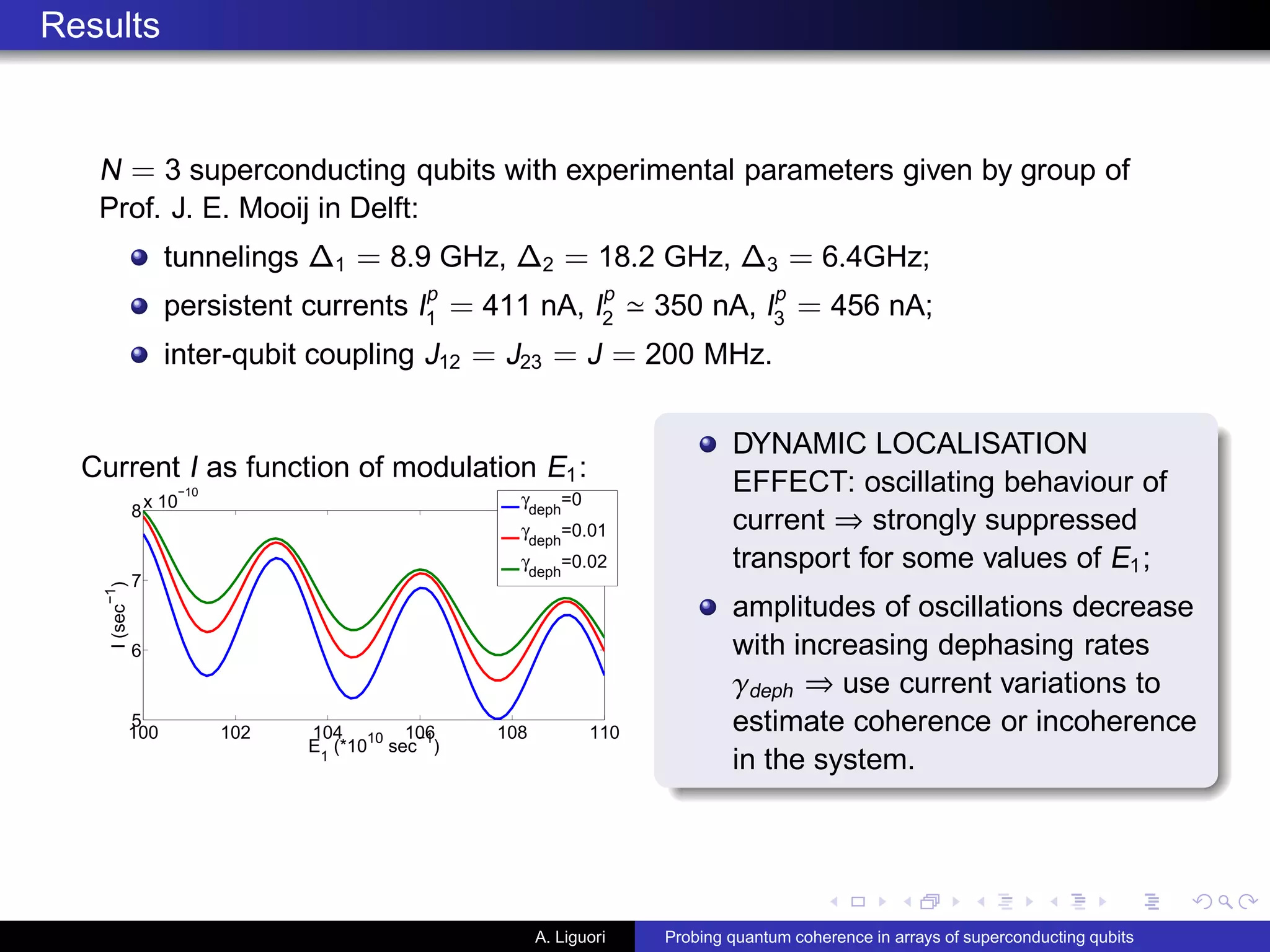
Results
N = 3 superconducting qubits with experimental parameters given by group of
Prof. J. E. Mooij in Delft:
tunnelings ∆1 = 8.9 GHz, ∆2 = 18.2 GHz, ∆3 = 6.4GHz;
persistent currents I
p
1 = 411 nA, I
p
2 ≃ 350 nA, I
p
3 = 456 nA;
inter-qubit coupling J12 = J23 = J = 200 MHz.
Current I as function of modulation E1:
100 102 104 106 108 110
5
6
7
8
x 10
−10
E1
(*1010
sec−1
)
I(sec−1
)
γdeph
=0
γdeph
=0.01
γdeph
=0.02
DYNAMIC LOCALISATION
EFFECT: oscillating behaviour of
current ⇒ strongly suppressed
transport for some values of E1;
amplitudes of oscillations decrease
with increasing dephasing rates
γdeph ⇒ use current variations to
estimate coherence or incoherence
in the system.
A. Liguori Probing quantum coherence in arrays of superconducting qubits
5 5.2 5.4 5.6 5.8 6
6.7
6.8
6.9
7
7.1
7.2
I (sec*10
−10
)
C(*10
−4
) Incoherence measure C [Vaziri&Plenio,
New J. Phys. (2010)]:
C =
k l
|̺k,k ̺l,l − ̺k,l̺l,k |
⇒ C as function of I for given value of E1
at which first resonance can be found
Conclusions
1 DYNAMIC LOCALISATION IN SUPERCONDUCTING QUBIT CHAIN:
oscillating behaviour of current ⇒ strongly suppressed transport for some
values of E1;
2 amplitudes of oscillations decrease with increasing dephasing ⇒ use current
variations to estimate coherence or incoherence in the system;
3 (2) ⇒ incoherence measure C can be used as effective tool to estimate
presence of coherence in superconducting qubit chain by measuring current
I at fixed E1.
A. Liguori Probing quantum coherence in arrays of superconducting qubits
5 5.2 5.4 5.6 5.8 6
6.7
6.8
6.9
7
7.1
7.2
I (sec*10
−10
)
C(*10
−4
) Incoherence measure C [Vaziri&Plenio,
New J. Phys. (2010)]:
C =
k l
|̺k,k ̺l,l − ̺k,l̺l,k |
⇒ C as function of I for given value of E1
at which first resonance can be found
Conclusions
1 DYNAMIC LOCALISATION IN SUPERCONDUCTING QUBIT CHAIN:
oscillating behaviour of current ⇒ strongly suppressed transport for some
values of E1;
2 amplitudes of oscillations decrease with increasing dephasing ⇒ use current
variations to estimate coherence or incoherence in the system;
3 (2) ⇒ incoherence measure C can be used as effective tool to estimate
presence of coherence in superconducting qubit chain by measuring current
I at fixed E1.
A. Liguori Probing quantum coherence in arrays of superconducting qubits

DPG_Talk_March2011_AlexandraM_Liguori

  • 1.
    Probing quantum coherencein arrays of superconducting qubits Alexandra M. Liguori, Susana F. Huelga, Martin B. Plenio Institut f¨ur Theoretische Physik, Universit¨at Ulm 15th March 2011, DPG, Dresden A. Liguori Probing quantum coherence in arrays of superconducting qubits
  • 2.
    Outilne 1 Original dynamiclocalisation effect 2 Dynamic localisation in superconducting qubit chains as tool to evaluate coherence in system A. Liguori Probing quantum coherence in arrays of superconducting qubits
  • 3.
    Dynamic localisation oninfinite chain Time-dependent Hamiltonian ( = 1) H(t) = V m=+∞ m=−∞ (σ+ mσ− m+1 + σ− mσ+ m+1 ) − m=+∞ m=−∞ (E0 + E1) cos(ωt)σ+ mσ− m , V coupling strength between nearest-neighbours σ± m = (σx m ± iσy m)/2 acting on m-th site (σx and σy Pauli matrices) E0 energy difference between adjacent sites, ω frequency Mean-square displacement as function of E1 oscillates sinusoidally Interaction picture → effective Hamiltonian with JE0 ω Bessel function Heff I = V m=+∞ m=−∞ JE0 ω ( E1 ω )(σ+ mσ− m+1 + σ− mσ+ m+1) , RESULTS [Dunlap&Kenkre, PRB (1986); Holthaus&Hone, Phil. Mag. B (1996)] Argument of Bessel function is oscillatory function of time, with oscillation frequency proportional to magnitude of electric field, i.e. if E0 = nω, n ∈ R, and E1/ω is a zero of Bessel function J then mean-square displacement oscillates sinusoidally ⇒ initially localised particle remains localised ⇔ DYNAMICAL LOCALISATION A. Liguori Probing quantum coherence in arrays of superconducting qubits
  • 4.
    Dynamic localisation oninfinite chain Time-dependent Hamiltonian ( = 1) H(t) = V m=+∞ m=−∞ (σ+ mσ− m+1 + σ− mσ+ m+1 ) − m=+∞ m=−∞ (E0 + E1) cos(ωt)σ+ mσ− m , V coupling strength between nearest-neighbours σ± m = (σx m ± iσy m)/2 acting on m-th site (σx and σy Pauli matrices) E0 energy difference between adjacent sites, ω frequency Mean-square displacement as function of E1 oscillates sinusoidally Interaction picture → effective Hamiltonian with JE0 ω Bessel function Heff I = V m=+∞ m=−∞ JE0 ω ( E1 ω )(σ+ mσ− m+1 + σ− mσ+ m+1) , RESULTS [Dunlap&Kenkre, PRB (1986); Holthaus&Hone, Phil. Mag. B (1996)] Argument of Bessel function is oscillatory function of time, with oscillation frequency proportional to magnitude of electric field, i.e. if E0 = nω, n ∈ R, and E1/ω is a zero of Bessel function J then mean-square displacement oscillates sinusoidally ⇒ initially localised particle remains localised ⇔ DYNAMICAL LOCALISATION A. Liguori Probing quantum coherence in arrays of superconducting qubits
  • 5.
    Dynamic localisation onfinite chain Finite chain interacting with environment ( = 1) RESULTS [Vaziri&Plenio, New J. Phys. (2010) if E0 = nω, n ∈ R, and E1/ω is a zero of Bessel function J ⇒ mean-square displacement oscillates sinusoidally → suppression of transport for some values of modulation E1 & initially localised particle remains localised; effective coupling rates from averaging over transition amplitudes ⇒ suppression of transport is coherence effect due to destructive interference; with dephasing noise oscillations still exist but amplitude decreases with increasing dephasing. A. Liguori Probing quantum coherence in arrays of superconducting qubits
  • 6.
    Superconducting qubits Effective two-levelsystems with a controllable transition frequency between their eigenstates → general superconducting qubit Hamiltonian Hqubit = −Ezσz + Xcontrol σx (1) → depending on form of Ez and Xcontrol , superconducting qubit can be of charge, phase or flux type. Flux or persistent current qubit A superconducting loop interrupted by three Josephson junctions, two with capacitance C1 and the third with C2 Josephson junctions coupling constants J1 and J2 Value of external magnetic flux Φ = 0.5Φ0 (Φ0 = h/2e superconducting flux quantum) ⇒ either in the right-hand or in the left-hand current state Appropriate choice of parameters J1,2 and C1,2 ⇒ tunneling between the two classical states can occur Xcontrol from (1) is tunneling amplitude ∆ Energy splitting Ez = 2Ip(Φ − 0.5Φ0) proportional to detuning Φ − 0.5Φ0, with Ip circulating current. A. Liguori Probing quantum coherence in arrays of superconducting qubits
  • 7.
    Dynamic localisation ina chain of superconducting qubits OUR MODEL: chain of interacting superconducting qubits H(t) = E1 sin(ωt) N i=1 σz i + N i=1 ∆iσx i + N−1 i=1 Ji,i+1σz i ⊗ σz i+1 , (2) Lsource(̺) = γ1(2σ+ 1 σ− 1 ̺σ+ 1 σ− 1 − {σ+ 1 σ− 1 , ̺} + 2σ− 1 σ+ 1 ̺σ− 1 σ+ 1 − {σ− 1 σ+ 1 , ̺}) , Lsink (̺) = γN(2σ− N̺σ+ N − {σ+ N σ− N, ̺} + 2σ+ N ̺σ− N − {σ− Nσ+ N , ̺}) , N qubits in chain E1 field modulation ∆i tunneling amplitude for each qubit Ji,i+1 coupling between qubits i and i + 1 γ1, γN, rates of source and sink respectively A. Liguori Probing quantum coherence in arrays of superconducting qubits
  • 8.
    Dynamic localisation ina chain of superconducting qubits Quantum dynamical eq. for finite chain interacting with environment ( = 1) d̺ dt = −i[H, ̺] + Lsource(̺) + Lsink (̺) + Ldeph (̺) with Ldeph (̺) = γdeph N i=1 (2σ+ i σ− i ̺σ+ i σ− i − {σ+ i σ− i , ̺}) γdeph rate of dephasing noise. Study current I as function of field modulation E1 in (2): I = lim t→∞ dpsink dt (t) with psink (t) = T 0 2γN̺N,N (t)dt, ̺N,N reduced density matrix of last site of chain. A. Liguori Probing quantum coherence in arrays of superconducting qubits
  • 9.
    Dynamic localisation ina chain of superconducting qubits Quantum dynamical eq. for finite chain interacting with environment ( = 1) d̺ dt = −i[H, ̺] + Lsource(̺) + Lsink (̺) + Ldeph (̺) with Ldeph (̺) = γdeph N i=1 (2σ+ i σ− i ̺σ+ i σ− i − {σ+ i σ− i , ̺}) γdeph rate of dephasing noise. Study current I as function of field modulation E1 in (2): I = lim t→∞ dpsink dt (t) with psink (t) = T 0 2γN̺N,N (t)dt, ̺N,N reduced density matrix of last site of chain. A. Liguori Probing quantum coherence in arrays of superconducting qubits
  • 10.
    Results N = 3superconducting qubits with experimental parameters given by group of Prof. J. E. Mooij in Delft: tunnelings ∆1 = 8.9 GHz, ∆2 = 18.2 GHz, ∆3 = 6.4GHz; persistent currents I p 1 = 411 nA, I p 2 ≃ 350 nA, I p 3 = 456 nA; inter-qubit coupling J12 = J23 = J = 200 MHz. Current I as function of modulation E1: 100 102 104 106 108 110 5 6 7 8 x 10 −10 E1 (*1010 sec−1 ) I(sec−1 ) γdeph =0 γdeph =0.01 γdeph =0.02 DYNAMIC LOCALISATION EFFECT: oscillating behaviour of current ⇒ strongly suppressed transport for some values of E1; amplitudes of oscillations decrease with increasing dephasing rates γdeph ⇒ use current variations to estimate coherence or incoherence in the system. A. Liguori Probing quantum coherence in arrays of superconducting qubits
  • 11.
    5 5.2 5.45.6 5.8 6 6.7 6.8 6.9 7 7.1 7.2 I (sec*10 −10 ) C(*10 −4 ) Incoherence measure C [Vaziri&Plenio, New J. Phys. (2010)]: C = k l |̺k,k ̺l,l − ̺k,l̺l,k | ⇒ C as function of I for given value of E1 at which first resonance can be found Conclusions 1 DYNAMIC LOCALISATION IN SUPERCONDUCTING QUBIT CHAIN: oscillating behaviour of current ⇒ strongly suppressed transport for some values of E1; 2 amplitudes of oscillations decrease with increasing dephasing ⇒ use current variations to estimate coherence or incoherence in the system; 3 (2) ⇒ incoherence measure C can be used as effective tool to estimate presence of coherence in superconducting qubit chain by measuring current I at fixed E1. A. Liguori Probing quantum coherence in arrays of superconducting qubits
  • 12.
    5 5.2 5.45.6 5.8 6 6.7 6.8 6.9 7 7.1 7.2 I (sec*10 −10 ) C(*10 −4 ) Incoherence measure C [Vaziri&Plenio, New J. Phys. (2010)]: C = k l |̺k,k ̺l,l − ̺k,l̺l,k | ⇒ C as function of I for given value of E1 at which first resonance can be found Conclusions 1 DYNAMIC LOCALISATION IN SUPERCONDUCTING QUBIT CHAIN: oscillating behaviour of current ⇒ strongly suppressed transport for some values of E1; 2 amplitudes of oscillations decrease with increasing dephasing ⇒ use current variations to estimate coherence or incoherence in the system; 3 (2) ⇒ incoherence measure C can be used as effective tool to estimate presence of coherence in superconducting qubit chain by measuring current I at fixed E1. A. Liguori Probing quantum coherence in arrays of superconducting qubits