J a m e s S a r y e r w i n n i e
A case study in multi-threading, multi-processing, and asyncio
Downloading a Billion Files in Python
@ j s a r y e r
Our Task
Our Task
There is a remote server that stores files
Our Task
There is a remote server that stores files
The files can be accessed through a REST API
Our Task
There is a remote server that stores files
The files can be accessed through a REST API
Our task is to download all the files on the
remote server to our client machine
Our Task (the details)
What client machine will this run on?
Our Task (the details)
We have one machine we can use, 16 cores, 64GB memory
What client machine will this run on?
Our Task (the details)
We have one machine we can use, 16 cores, 64GB memory
What client machine will this run on?
What about the network between the client and server?
Our Task (the details)
We have one machine we can use, 16 cores, 64GB memory
Our client machine is on the same network as the service with remote files
What client machine will this run on?
What about the network between the client and server?
Our Task (the details)
We have one machine we can use, 16 cores, 64GB memory
Our client machine is on the same network as the service with remote files
What client machine will this run on?
What about the network between the client and server?
How many files are on the remote server?
Our Task (the details)
We have one machine we can use, 16 cores, 64GB memory
Our client machine is on the same network as the service with remote files
Approximately one billion files, 100 bytes per file
What client machine will this run on?
What about the network between the client and server?
How many files are on the remote server?
Our Task (the details)
We have one machine we can use, 16 cores, 64GB memory
Our client machine is on the same network as the service with remote files
Approximately one billion files, 100 bytes per file
What client machine will this run on?
What about the network between the client and server?
How many files are on the remote server?
When do you need this done?
Our Task (the details)
We have one machine we can use, 16 cores, 64GB memory
Our client machine is on the same network as the service with remote files
Approximately one billion files, 100 bytes per file
What client machine will this run on?
What about the network between the client and server?
How many files are on the remote server?
Please have this done as soon as possible
When do you need this done?
Files
Page Page Page
File Server Rest API
File Server Rest API GET /list
Files
Page Page
FileNames
NextMarker
File Server Rest API GET /list
Files
Page Page
FileNames
NextMarker
{"FileNames": [
"file1", "file2", ...],
"NextMarker": "pagination-token"}
File Server Rest API GET /list?next-marker=token
Files
Page Page
FileNames
NextMarker
File Server Rest API GET /list?next-marker=token
Files
Page Page
FileNames
NextMarker
{"FileNames": [
"file1", "file2", ...],
"NextMarker": "pagination-token"}
File Server Rest API
GET /list
GET /get/{filename}
{"FileNames": ["file1", "file2", ...]}
{"FileNames": ["file1", "file2", ...],
"NextMarker": "pagination-token"}
(File blob content)
GET /list?next-marker={token}
Caveats
This is a simplified case study.
The results shown here don't necessarily generalize.
Not an apples to apples comparison, each approach does things slightly different
Sometimes concrete examples can be helpful
Caveats
This is a simplified case study.
The results shown here don't necessarily generalize.
Not an apples to apples comparison, each approach does things slightly different
Always profile and test for yourself
Sometimes concrete examples can be helpful
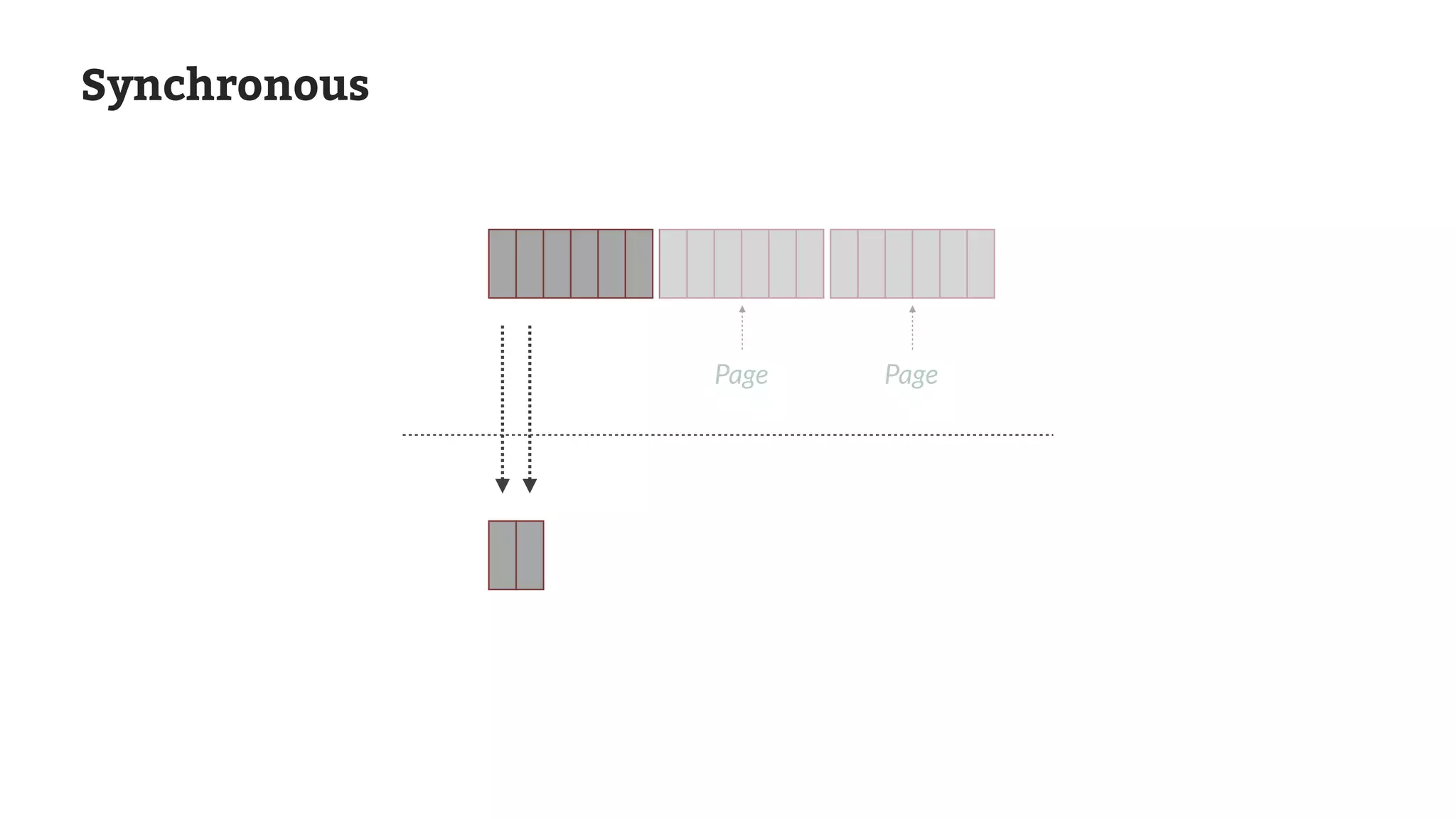
Synchronous
Version
Simplest thing that could possibly work.
Synchronous
Page Page Page
Synchronous
PagePage
Synchronous
PagePage
Synchronous
PagePage
Synchronous
PagePage
Synchronous
PagePage
Synchronous
PagePage
Synchronous
PagePage
Synchronous
Page
Synchronous
Page
Synchronous
Page
Synchronous
Page
Synchronous
Page
Synchronous
Page
Synchronous
Page
def download_files(host, port, outdir):
hostname = f'http://{host}:{port}'
list_url = f'{hostname}/list'
get_url = f'{hostname}/get'
response = requests.get(list_url)
response.raise_for_status()
content = json.loads(response.content)
while True:
for filename in content['FileNames']:
remote_url = f'{get_url}/{filename}'
download_file(remote_url,
os.path.join(outdir, filename))
if 'NextMarker' not in content:
break
response = requests.get(
f'{list_url}?next-marker={content["NextFile"]}')
response.raise_for_status()
content = json.loads(response.content)
def download_files(host, port, outdir):
hostname = f'http://{host}:{port}'
list_url = f'{hostname}/list'
get_url = f'{hostname}/get'
response = requests.get(list_url)
response.raise_for_status()
content = json.loads(response.content)
while True:
for filename in content['FileNames']:
remote_url = f'{get_url}/{filename}'
download_file(remote_url,
os.path.join(outdir, filename))
if 'NextMarker' not in content:
break
response = requests.get(
f'{list_url}?next-marker={content["NextMarker"]}')
response.raise_for_status()
content = json.loads(response.content)
def download_files(host, port, outdir):
hostname = f'http://{host}:{port}'
list_url = f'{hostname}/list'
get_url = f'{hostname}/get'
response = requests.get(list_url)
response.raise_for_status()
content = json.loads(response.content)
while True:
for filename in content['FileNames']:
remote_url = f'{get_url}/{filename}'
download_file(remote_url,
os.path.join(outdir, filename))
if 'NextMarker' not in content:
break
response = requests.get(
f'{list_url}?next-marker={content["NextMarker"]}')
response.raise_for_status()
content = json.loads(response.content)
def download_files(host, port, outdir):
hostname = f'http://{host}:{port}'
list_url = f'{hostname}/list'
get_url = f'{hostname}/get'
response = requests.get(list_url)
response.raise_for_status()
content = json.loads(response.content)
while True:
for filename in content['FileNames']:
remote_url = f'{get_url}/{filename}'
download_file(remote_url,
os.path.join(outdir, filename))
if 'NextMarker' not in content:
break
response = requests.get(
f'{list_url}?next-marker={content["NextMarker"]}')
response.raise_for_status()
content = json.loads(response.content)
def download_files(host, port, outdir):
hostname = f'http://{host}:{port}'
list_url = f'{hostname}/list'
get_url = f'{hostname}/get'
response = requests.get(list_url)
response.raise_for_status()
content = json.loads(response.content)
while True:
for filename in content['FileNames']:
remote_url = f'{get_url}/{filename}'
download_file(remote_url,
os.path.join(outdir, filename))
if 'NextMarker' not in content:
break
response = requests.get(
f'{list_url}?next-marker={content["NextMarker"]}')
response.raise_for_status()
content = json.loads(response.content)
def download_files(host, port, outdir):
hostname = f'http://{host}:{port}'
list_url = f'{hostname}/list'
get_url = f'{hostname}/get'
response = requests.get(list_url)
response.raise_for_status()
content = json.loads(response.content)
while True:
for filename in content['FileNames']:
remote_url = f'{get_url}/{filename}'
download_file(remote_url,
os.path.join(outdir, filename))
if 'NextMarker' not in content:
break
response = requests.get(
f'{list_url}?next-marker={content["NextFile"]}')
response.raise_for_status()
content = json.loads(response.content)
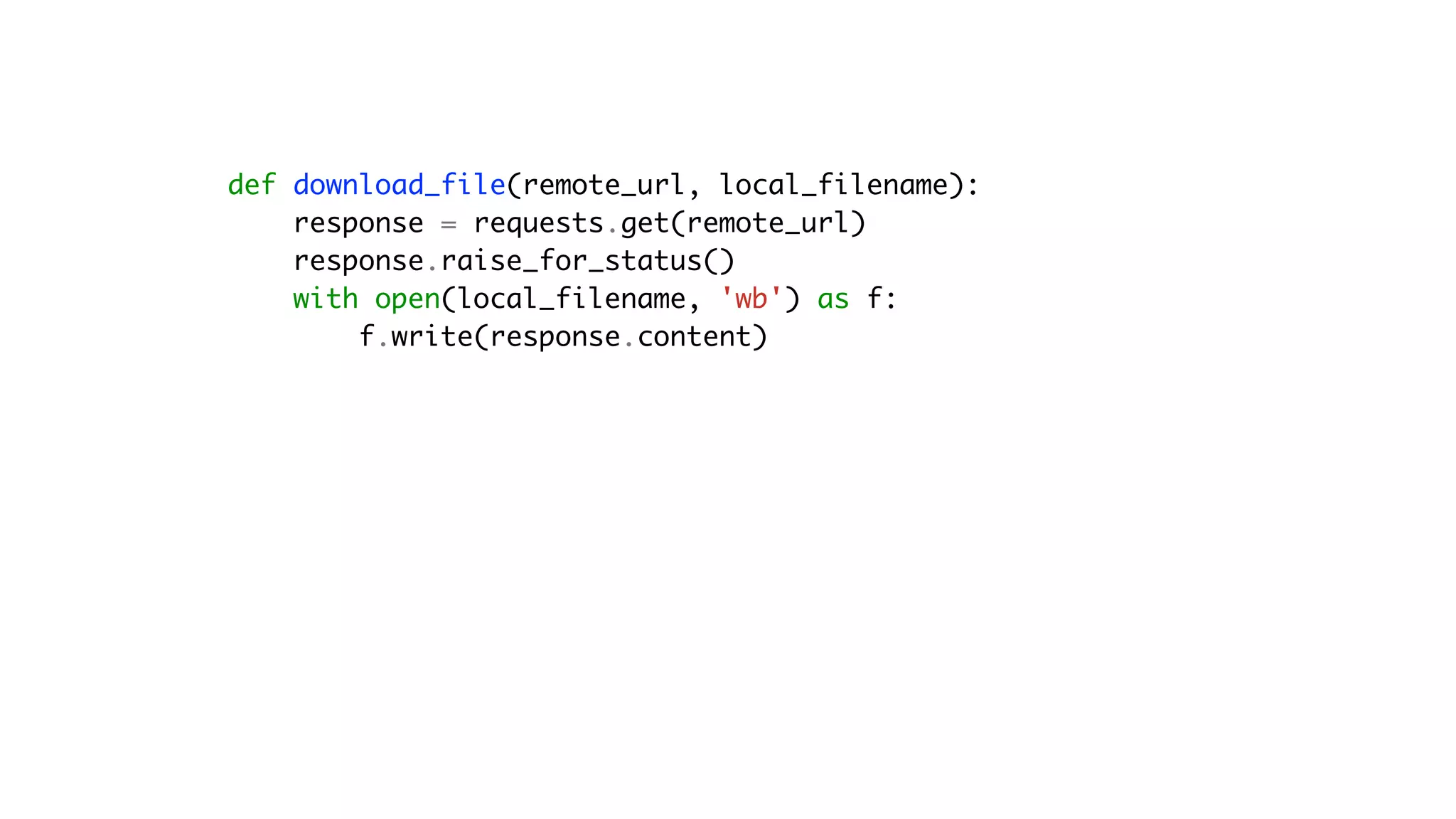
def download_file(remote_url, local_filename):
response = requests.get(remote_url)
response.raise_for_status()
with open(local_filename, 'wb') as f:
f.write(response.content)
Synchronous Results
One request 0.003 seconds
Synchronous Results
One request 0.003 seconds
One billion requests 3,000,000 seconds
Synchronous Results
833.3 hours
One request 0.003 seconds
One billion requests 3,000,000 seconds
Synchronous Results
833.3 hours
34.7 days
One request 0.003 seconds
One billion requests 3,000,000 seconds
Synchronous Results
Multithreading
Multithreading
List Files can't be parallelized.
queue.Queue
But Get File can be parallelized.
Multithreading
List Files can't be parallelized.
queue.Queue
But Get File can be parallelized.
Multithreading
List Files can't be parallelized.
One thread calls List Files and puts
the filenames on a queue.Queue
queue.Queue
But Get File can be parallelized.
Multithreading
List Files can't be parallelized.
WorkerThread-1
WorkerThread-2
WorkerThread-3
One thread calls List Files and puts
the filenames on a queue.Queue
queue.Queue
But Get File can be parallelized.
Multithreading
List Files can't be parallelized.
WorkerThread-1
WorkerThread-2
WorkerThread-3
One thread calls List Files and puts
the filenames on a queue.Queue
queue.Queue
But Get File can be parallelized.
Multithreading
List Files can't be parallelized.
WorkerThread-1
WorkerThread-2
WorkerThread-3
One thread calls List Files and puts
the filenames on a queue.Queue
queue.Queue
But Get File can be parallelized.
Multithreading
List Files can't be parallelized.
WorkerThread-1
WorkerThread-2
WorkerThread-3
One thread calls List Files and puts
the filenames on a queue.Queue
queue.Queue
Results Queue
Result thread prints progress, tracks
overall results, failures, etc.
def download_files(host, port, outdir, num_threads):
# ... same constants as before ...
work_queue = queue.Queue(MAX_SIZE)
result_queue = queue.Queue(MAX_SIZE)
threads = []
for i in range(num_threads):
t = threading.Thread(
target=worker_thread, args=(work_queue, result_queue))
t.start()
threads.append(t)
result_thread = threading.Thread(target=result_poller,
args=(result_queue,))
result_thread.start()
threads.append(result_thread)
# ...
def download_files(host, port, outdir, num_threads):
# ... same constants as before ...
work_queue = queue.Queue(MAX_SIZE)
result_queue = queue.Queue(MAX_SIZE)
threads = []
for i in range(num_threads):
t = threading.Thread(
target=worker_thread, args=(work_queue, result_queue))
t.start()
threads.append(t)
result_thread = threading.Thread(target=result_poller,
args=(result_queue,))
result_thread.start()
threads.append(result_thread)
# ...
response = requests.get(list_url)
response.raise_for_status()
content = json.loads(response.content)
while True:
for filename in content['FileNames']:
remote_url = f'{get_url}/{filename}'
outfile = os.path.join(outdir, filename)
work_queue.put((remote_url, outfile))
if 'NextFile' not in content:
break
response = requests.get(
f'{list_url}?next-marker={content["NextFile"]}')
response.raise_for_status()
content = json.loads(response.content)
response = requests.get(list_url)
response.raise_for_status()
content = json.loads(response.content)
while True:
for filename in content['FileNames']:
remote_url = f'{get_url}/{filename}'
outfile = os.path.join(outdir, filename)
work_queue.put((remote_url, outfile))
if 'NextFile' not in content:
break
response = requests.get(
f'{list_url}?next-marker={content["NextFile"]}')
response.raise_for_status()
content = json.loads(response.content)
def worker_thread(work_queue, result_queue):
while True:
work = work_queue.get()
if work is _SHUTDOWN:
return
remote_url, outfile = work
download_file(remote_url, outfile)
result_queue.put(_SUCCESS)
def worker_thread(work_queue, result_queue):
while True:
work = work_queue.get()
if work is _SHUTDOWN:
return
remote_url, outfile = work
download_file(remote_url, outfile)
result_queue.put(_SUCCESS)
Multithreaded Results - 10 threads
One request 0.0036 seconds
Multithreaded Results - 10 threads
One request 0.0036 seconds
One billion requests 3,600,000 seconds
1000.0 hours
41.6 days
Multithreaded Results - 10 threads
Multithreaded Results - 100 threads
One request 0.0042 seconds
Multithreaded Results - 100 threads
One request 0.0042 seconds
One billion requests 4,200,000 seconds
1166.67 hours
48.6 days
Multithreaded Results - 100 threads
Why?
Not necessarily IO bound due to low latency and small file size
GIL contention, overhead of passing data through queues
Things to keep in mind
The real code is more complicated, ctrl-c, graceful shutdown, etc.
Debugging is much harder, non-deterministic
The more you stray from stdlib abstractions, more likely to encounter race conditions
Can't use concurrent.futures map() because of large number of files
Multiprocessing
Our Task (the details)
We have one machine we can use, 16 cores, 64GB memory
Our client machine is on the same network as the service with remote files
Approximately one billion files, 100 bytes per file
What client machine will this run on?
What about the network between the client and server?
How many files are on the remote server?
Please have this done as soon as possible
When do you need this done?
Multiprocessing
WorkerProcess-1
WorkerProcess-2
WorkerProcess-3
Download one page at a time in
parallel across multiple processes
Multiprocessing
WorkerProcess-1
WorkerProcess-2
WorkerProcess-3
Download one page at a time in
parallel across multiple processes
Multiprocessing
WorkerProcess-1
WorkerProcess-2
WorkerProcess-3
Download one page at a time in
parallel across multiple processes
Multiprocessing
WorkerProcess-1
WorkerProcess-2
WorkerProcess-3
Download one page at a time in
parallel across multiple processes
from concurrent import futures
def download_files(host, port, outdir):
hostname = f'http://{host}:{port}'
list_url = f'{hostname}/list'
all_pages = iter_all_pages(list_url)
downloader = Downloader(host, port, outdir)
with futures.ProcessPoolExecutor() as executor:
for page in all_pages:
future_to_filename = {}
for filename in page:
future = executor.submit(downloader.download,
filename)
future_to_filename[future] = filename
for future in futures.as_completed(future_to_filename):
future.result()
from concurrent import futures
def download_files(host, port, outdir):
hostname = f'http://{host}:{port}'
list_url = f'{hostname}/list'
all_pages = iter_all_pages(list_url)
downloader = Downloader(host, port, outdir)
with futures.ProcessPoolExecutor() as executor:
for page in all_pages:
future_to_filename = {}
for filename in page:
future = executor.submit(downloader.download,
filename)
future_to_filename[future] = filename
for future in futures.as_completed(future_to_filename):
future.result()
from concurrent import futures
def download_files(host, port, outdir):
hostname = f'http://{host}:{port}'
list_url = f'{hostname}/list'
all_pages = iter_all_pages(list_url)
downloader = Downloader(host, port, outdir)
with futures.ProcessPoolExecutor() as executor:
for page in all_pages:
future_to_filename = {}
for filename in page:
future = executor.submit(downloader.download,
filename)
future_to_filename[future] = filename
for future in futures.as_completed(future_to_filename):
future.result()
Start parallel downloads
from concurrent import futures
def download_files(host, port, outdir):
hostname = f'http://{host}:{port}'
list_url = f'{hostname}/list'
all_pages = iter_all_pages(list_url)
downloader = Downloader(host, port, outdir)
with futures.ProcessPoolExecutor() as executor:
for page in all_pages:
future_to_filename = {}
for filename in page:
future = executor.submit(downloader.download,
filename)
future_to_filename[future] = filename
for future in futures.as_completed(future_to_filename):
future.result()
Wait for downloads to finish
def iter_all_pages(list_url):
session = requests.Session()
response = session.get(list_url)
response.raise_for_status()
content = json.loads(response.content)
while True:
yield content['FileNames']
if 'NextFile' not in content:
break
response = session.get(
f'{list_url}?next-marker={content["NextFile"]}')
response.raise_for_status()
content = json.loads(response.content)
class Downloader:
# ...
def download(self, filename):
remote_url = f'{self.get_url}/{filename}'
response = self.session.get(remote_url)
response.raise_for_status()
outfile = os.path.join(self.outdir, filename)
with open(outfile, 'wb') as f:
f.write(response.content)
Multiprocessing Results - 16 processes
One request 0.00032 seconds
Multiprocessing Results - 16 processes
One request 0.00032 seconds
One billion requests 320,000 seconds
88.88 hours
Multiprocessing Results - 16 processes
One request 0.00032 seconds
One billion requests 320,000 seconds
88.88 hours
Multiprocessing Results - 16 processes
3.7 days
Things to keep in mind
Speed improvements due to truly running in parallel
Debugging is much harder, non-deterministic, pdb doesn't work out of the box
IPC overhead between processes higher than threads
Tradeoff between entirely in parallel vs. parallel chunks
Asyncio
Asyncio
Create an asyncio.Task for each file.
This immediately starts the download.
Asyncio
Create an asyncio.Task for each file.
This immediately starts the download.
Asyncio
Create an asyncio.Task for each file.
This immediately starts the download.
Asyncio
Create an asyncio.Task for each file.
This immediately starts the download.
Asyncio
Create an asyncio.Task for each file.
This immediately starts the download.
Asyncio
Create an asyncio.Task for each file.
This immediately starts the download.
Asyncio
Create an asyncio.Task for each file.
This immediately starts the download.
Asyncio
Create an asyncio.Task for each file.
This immediately starts the download.
Move on to the next page and start
creating tasks.
Asyncio
Create an asyncio.Task for each file.
This immediately starts the download.
Move on to the next page and start
creating tasks.
Asyncio
Create an asyncio.Task for each file.
This immediately starts the download.
Move on to the next page and start
creating tasks.
Asyncio
Create an asyncio.Task for each file.
This immediately starts the download.
Move on to the next page and start
creating tasks.
Meanwhile tasks from the first page
will finish downloading their file.
Asyncio
Create an asyncio.Task for each file.
This immediately starts the download.
Move on to the next page and start
creating tasks.
Meanwhile tasks from the first page
will finish downloading their file.
Asyncio
Create an asyncio.Task for each file.
This immediately starts the download.
Move on to the next page and start
creating tasks.
Meanwhile tasks from the first page
will finish downloading their file.
Asyncio
Create an asyncio.Task for each file.
This immediately starts the download.
Move on to the next page and start
creating tasks.
Meanwhile tasks from the first page
will finish downloading their file.
Asyncio
Create an asyncio.Task for each file.
This immediately starts the download.
Move on to the next page and start
creating tasks.
Meanwhile tasks from the first page
will finish downloading their file.
Asyncio
Create an asyncio.Task for each file.
This immediately starts the download.
Move on to the next page and start
creating tasks.
Meanwhile tasks from the first page
will finish downloading their file.
Asyncio
Create an asyncio.Task for each file.
This immediately starts the download.
Move on to the next page and start
creating tasks.
Meanwhile tasks from the first page
will finish downloading their file.
Asyncio
Create an asyncio.Task for each file.
This immediately starts the download.
Move on to the next page and start
creating tasks.
Meanwhile tasks from the first page
will finish downloading their file.
Asyncio
Create an asyncio.Task for each file.
This immediately starts the download.
Move on to the next page and start
creating tasks.
Meanwhile tasks from the first page
will finish downloading their file.
Asyncio
Create an asyncio.Task for each file.
This immediately starts the download.
Move on to the next page and start
creating tasks.
Meanwhile tasks from the first page
will finish downloading their file.
Asyncio
Create an asyncio.Task for each file.
This immediately starts the download.
Move on to the next page and start
creating tasks.
Meanwhile tasks from the first page
will finish downloading their file.
Asyncio
Create an asyncio.Task for each file.
This immediately starts the download.
Move on to the next page and start
creating tasks.
Meanwhile tasks from the first page
will finish downloading their file.
All in a single process
All in a single thread
Switch tasks when
waiting for IO
Should keep CPU busy
import asyncio
from aiohttp import ClientSession
import uvloop
async def download_files(host, port, outdir):
hostname = f'http://{host}:{port}'
list_url = f'{hostname}/list'
get_url = f'{hostname}/get'
semaphore = asyncio.Semaphore(MAX_CONCURRENT)
task_queue = asyncio.Queue(MAX_SIZE)
asyncio.create_task(results_worker(task_queue))
async with ClientSession() as session:
async for filename in iter_all_files(session, list_url):
remote_url = f'{get_url}/{filename}'
task = asyncio.create_task(
download_file(session, semaphore, remote_url,
os.path.join(outdir, filename))
)
await task_queue.put(task)
import asyncio
from aiohttp import ClientSession
import uvloop
async def download_files(host, port, outdir):
hostname = f'http://{host}:{port}'
list_url = f'{hostname}/list'
get_url = f'{hostname}/get'
semaphore = asyncio.Semaphore(MAX_CONCURRENT)
task_queue = asyncio.Queue(MAX_SIZE)
asyncio.create_task(results_worker(task_queue))
async with ClientSession() as session:
async for filename in iter_all_files(session, list_url):
remote_url = f'{get_url}/{filename}'
task = asyncio.create_task(
download_file(session, semaphore, remote_url,
os.path.join(outdir, filename))
)
await task_queue.put(task)
import asyncio
from aiohttp import ClientSession
import uvloop
async def download_files(host, port, outdir):
hostname = f'http://{host}:{port}'
list_url = f'{hostname}/list'
get_url = f'{hostname}/get'
semaphore = asyncio.Semaphore(MAX_CONCURRENT)
task_queue = asyncio.Queue(MAX_SIZE)
asyncio.create_task(results_worker(task_queue))
async with ClientSession() as session:
async for filename in iter_all_files(session, list_url):
remote_url = f'{get_url}/{filename}'
task = asyncio.create_task(
download_file(session, semaphore, remote_url,
os.path.join(outdir, filename))
)
await task_queue.put(task)
import asyncio
from aiohttp import ClientSession
import uvloop
async def download_files(host, port, outdir):
hostname = f'http://{host}:{port}'
list_url = f'{hostname}/list'
get_url = f'{hostname}/get'
semaphore = asyncio.Semaphore(MAX_CONCURRENT)
task_queue = asyncio.Queue(MAX_SIZE)
asyncio.create_task(results_worker(task_queue))
async with ClientSession() as session:
async for filename in iter_all_files(session, list_url):
remote_url = f'{get_url}/{filename}'
task = asyncio.create_task(
download_file(session, semaphore, remote_url,
os.path.join(outdir, filename))
)
await task_queue.put(task)
import asyncio
from aiohttp import ClientSession
import uvloop
async def download_files(host, port, outdir):
hostname = f'http://{host}:{port}'
list_url = f'{hostname}/list'
get_url = f'{hostname}/get'
semaphore = asyncio.Semaphore(MAX_CONCURRENT)
task_queue = asyncio.Queue(MAX_SIZE)
asyncio.create_task(results_worker(task_queue))
async with ClientSession() as session:
async for filename in iter_all_files(session, list_url):
remote_url = f'{get_url}/{filename}'
task = asyncio.create_task(
download_file(session, semaphore, remote_url,
os.path.join(outdir, filename))
)
await task_queue.put(task)
async def iter_all_files(session, list_url):
async with session.get(list_url) as response:
if response.status != 200:
raise RuntimeError(f"Bad status code: {response.status}")
content = json.loads(await response.read())
while True:
for filename in content['FileNames']:
yield filename
if 'NextFile' not in content:
return
next_page_url = f'{list_url}?next-marker={content["NextFile"]}'
async with session.get(next_page_url) as response:
if response.status != 200:
raise RuntimeError(f"Bad status code: {response.status}")
content = json.loads(await response.read())
async def iter_all_files(session, list_url):
async with session.get(list_url) as response:
if response.status != 200:
raise RuntimeError(f"Bad status code: {response.status}")
content = json.loads(await response.read())
while True:
for filename in content['FileNames']:
yield filename
if 'NextFile' not in content:
return
next_page_url = f'{list_url}?next-marker={content["NextFile"]}'
async with session.get(next_page_url) as response:
if response.status != 200:
raise RuntimeError(f"Bad status code: {response.status}")
content = json.loads(await response.read())
async def download_file(session, semaphore, remote_url, local_filename):
async with semaphore:
async with session.get(remote_url) as response:
contents = await response.read()
# Sync version.
with open(local_filename, 'wb') as f:
f.write(contents)
return local_filename
async def download_file(session, semaphore, remote_url, local_filename):
async with semaphore:
async with session.get(remote_url) as response:
contents = await response.read()
# Sync version.
with open(local_filename, 'wb') as f:
f.write(contents)
return local_filename
Asyncio Results
One request 0.00056 seconds
Asyncio Results
One request 0.00056 seconds
One billion requests 560,000 seconds
155.55 hours
6.48 days
Asyncio Results
Summary
Approach Single	Request	Time	(s) Days
Synchronous
0.003 34.7
Multithread
0.0036 41.6
Multiprocess
0.00032 3.7
Asyncio
0.00056 6.5
Asyncio and
Multiprocessing
Asyncio and
Multiprocessing
and Multithreading
WorkerProcess-1
WorkerProcess-1
Thread-2
Thread-1
WorkerProcess-1
EventLoop
Thread-2
Thread-1
Queue
WorkerProcess-1
EventLoop
Thread-2
Thread-1
Queue
WorkerProcess-2
EventLoop
Thread-2
Thread-1
Queue
Main process
Input Queue
Output Queue
WorkerProcess-1
EventLoop
Thread-2
Thread-1
Queue
WorkerProcess-2
EventLoop
Thread-2
Thread-1
Queue
Main process
Input Queue
Output Queue
The Input/Output queues
contain pagination tokens
foo
WorkerProcess-1
EventLoop
Thread-2
Thread-1
Queue
WorkerProcess-2
EventLoop
Thread-2
Thread-1
Queue
Main process
Input Queue
Output Queue
The Input/Output queues
contain pagination tokens
foo
WorkerProcess-1
EventLoop
Thread-2
Thread-1
Queue
WorkerProcess-2
EventLoop
Thread-2
Thread-1
Queue
Main process
Input Queue
Output Queue
foo
The main thread of the worker process is
a bridge to the event loop running on a
separate thread. It sends the pagination
token to the async Queue.
WorkerProcess-1
EventLoop
Thread-2
Thread-1
Queue
WorkerProcess-2
EventLoop
Thread-2
Thread-1
Queue
Main process
Input Queue
Output Queue
foo
The event loop makes the List call
with the provided pagination token "foo".
WorkerProcess-1
EventLoop
Thread-2
Thread-1
Queue
WorkerProcess-2
EventLoop
Thread-2
Thread-1
Queue
Main process
Input Queue
Output Queue
foo
The event loop makes the List call
with the provided pagination token "foo".
{"FileNames": [...],
"NextMarker": "bar"}
WorkerProcess-1
EventLoop
Thread-2
Thread-1
Queue
WorkerProcess-2
EventLoop
Thread-2
Thread-1
Queue
Main process
Input Queue
Output Queue
bar	
The next pagination token "bar", eventually
makes its way back to the main process.
WorkerProcess-1
EventLoop
Thread-2
Thread-1
Queue
WorkerProcess-2
EventLoop
Thread-2
Thread-1
Queue
Main process
Input Queue
Output Queue
bar	
The next pagination token "bar", eventually
makes its way back to the main process.
WorkerProcess-1
EventLoop
Thread-2
Thread-1
Queue
WorkerProcess-2
EventLoop
Thread-2
Thread-1
Queue
Main process
Input Queue
Output Queue
bar	
While another process starts goes through
the same steps, WorkerProcess-1 is
downloading 1000 files using asyncio.
WorkerProcess-1
EventLoop
Thread-2
Thread-1
Queue
WorkerProcess-2
EventLoop
Thread-2
Thread-1
Queue
Main process
Input Queue
Output Queue
bar
WorkerProcess-1
EventLoop
Thread-2
Thread-1
Queue
WorkerProcess-2
EventLoop
Thread-2
Thread-1
Queue
Main process
Input Queue
Output Queue
bar	
We get to leverage all our cores.1.
WorkerProcess-1
EventLoop
Thread-2
Thread-1
Queue
WorkerProcess-2
EventLoop
Thread-2
Thread-1
Queue
Main process
Input Queue
Output Queue
bar	
We get to leverage all our cores.1.
We download individual files
efficiently with asyncio.
2.
WorkerProcess-1
EventLoop
Thread-2
Thread-1
Queue
WorkerProcess-2
EventLoop
Thread-2
Thread-1
Queue
Main process
Input Queue
Output Queue
bar	
We get to leverage all our cores.1.
We download individual files
efficiently with asyncio.
2.
Minimal IPC overhead, only passing
pagination tokens across processes, only
one per thousand files.
3.
Combo Results
One request 0.0000303 seconds
Combo Results
One request 0.0000303 seconds
One billion requests 30,300 seconds
Combo Results
One request 0.0000303 seconds
8.42 hours
One billion requests 30,300 seconds
Combo Results
Summary
Approach Single	Request	Time	(s) Days
Synchronous
0.003 34.7
Multithread
0.0036 41.6
Multiprocess
0.00032 3.7
Asyncio
0.00056 6.5
Combo
0.0000303 0.35
Tradeoff between simplicity and speed
Multiple orders of magnitude difference based on approach used
Lessons Learned
Need to have max bounds when using queueing or any task scheduling
Thanks!
J a m e s S a r y e r w i n n i e @ j s a r y e r

Downloading a Billion Files in Python

  • 1.
    J a me s S a r y e r w i n n i e A case study in multi-threading, multi-processing, and asyncio Downloading a Billion Files in Python @ j s a r y e r
  • 2.
  • 3.
    Our Task There isa remote server that stores files
  • 4.
    Our Task There isa remote server that stores files The files can be accessed through a REST API
  • 5.
    Our Task There isa remote server that stores files The files can be accessed through a REST API Our task is to download all the files on the remote server to our client machine
  • 6.
    Our Task (thedetails)
  • 7.
    Our Task (thedetails) What client machine will this run on?
  • 8.
    Our Task (thedetails) We have one machine we can use, 16 cores, 64GB memory What client machine will this run on?
  • 9.
    Our Task (thedetails) We have one machine we can use, 16 cores, 64GB memory What client machine will this run on? What about the network between the client and server?
  • 10.
    Our Task (thedetails) We have one machine we can use, 16 cores, 64GB memory Our client machine is on the same network as the service with remote files What client machine will this run on? What about the network between the client and server?
  • 11.
    Our Task (thedetails) We have one machine we can use, 16 cores, 64GB memory Our client machine is on the same network as the service with remote files What client machine will this run on? What about the network between the client and server? How many files are on the remote server?
  • 12.
    Our Task (thedetails) We have one machine we can use, 16 cores, 64GB memory Our client machine is on the same network as the service with remote files Approximately one billion files, 100 bytes per file What client machine will this run on? What about the network between the client and server? How many files are on the remote server?
  • 13.
    Our Task (thedetails) We have one machine we can use, 16 cores, 64GB memory Our client machine is on the same network as the service with remote files Approximately one billion files, 100 bytes per file What client machine will this run on? What about the network between the client and server? How many files are on the remote server? When do you need this done?
  • 14.
    Our Task (thedetails) We have one machine we can use, 16 cores, 64GB memory Our client machine is on the same network as the service with remote files Approximately one billion files, 100 bytes per file What client machine will this run on? What about the network between the client and server? How many files are on the remote server? Please have this done as soon as possible When do you need this done?
  • 15.
  • 16.
    File Server RestAPI GET /list Files Page Page FileNames NextMarker
  • 17.
    File Server RestAPI GET /list Files Page Page FileNames NextMarker {"FileNames": [ "file1", "file2", ...], "NextMarker": "pagination-token"}
  • 18.
    File Server RestAPI GET /list?next-marker=token Files Page Page FileNames NextMarker
  • 19.
    File Server RestAPI GET /list?next-marker=token Files Page Page FileNames NextMarker {"FileNames": [ "file1", "file2", ...], "NextMarker": "pagination-token"}
  • 20.
    File Server RestAPI GET /list GET /get/{filename} {"FileNames": ["file1", "file2", ...]} {"FileNames": ["file1", "file2", ...], "NextMarker": "pagination-token"} (File blob content) GET /list?next-marker={token}
  • 21.
    Caveats This is asimplified case study. The results shown here don't necessarily generalize. Not an apples to apples comparison, each approach does things slightly different Sometimes concrete examples can be helpful
  • 22.
    Caveats This is asimplified case study. The results shown here don't necessarily generalize. Not an apples to apples comparison, each approach does things slightly different Always profile and test for yourself Sometimes concrete examples can be helpful
  • 23.
  • 24.
  • 25.
  • 26.
  • 27.
  • 28.
  • 29.
  • 30.
  • 31.
  • 32.
  • 33.
  • 34.
  • 35.
  • 36.
  • 37.
  • 38.
  • 39.
    def download_files(host, port,outdir): hostname = f'http://{host}:{port}' list_url = f'{hostname}/list' get_url = f'{hostname}/get' response = requests.get(list_url) response.raise_for_status() content = json.loads(response.content) while True: for filename in content['FileNames']: remote_url = f'{get_url}/{filename}' download_file(remote_url, os.path.join(outdir, filename)) if 'NextMarker' not in content: break response = requests.get( f'{list_url}?next-marker={content["NextFile"]}') response.raise_for_status() content = json.loads(response.content)
  • 40.
    def download_files(host, port,outdir): hostname = f'http://{host}:{port}' list_url = f'{hostname}/list' get_url = f'{hostname}/get' response = requests.get(list_url) response.raise_for_status() content = json.loads(response.content) while True: for filename in content['FileNames']: remote_url = f'{get_url}/{filename}' download_file(remote_url, os.path.join(outdir, filename)) if 'NextMarker' not in content: break response = requests.get( f'{list_url}?next-marker={content["NextMarker"]}') response.raise_for_status() content = json.loads(response.content)
  • 41.
    def download_files(host, port,outdir): hostname = f'http://{host}:{port}' list_url = f'{hostname}/list' get_url = f'{hostname}/get' response = requests.get(list_url) response.raise_for_status() content = json.loads(response.content) while True: for filename in content['FileNames']: remote_url = f'{get_url}/{filename}' download_file(remote_url, os.path.join(outdir, filename)) if 'NextMarker' not in content: break response = requests.get( f'{list_url}?next-marker={content["NextMarker"]}') response.raise_for_status() content = json.loads(response.content)
  • 42.
    def download_files(host, port,outdir): hostname = f'http://{host}:{port}' list_url = f'{hostname}/list' get_url = f'{hostname}/get' response = requests.get(list_url) response.raise_for_status() content = json.loads(response.content) while True: for filename in content['FileNames']: remote_url = f'{get_url}/{filename}' download_file(remote_url, os.path.join(outdir, filename)) if 'NextMarker' not in content: break response = requests.get( f'{list_url}?next-marker={content["NextMarker"]}') response.raise_for_status() content = json.loads(response.content)
  • 43.
    def download_files(host, port,outdir): hostname = f'http://{host}:{port}' list_url = f'{hostname}/list' get_url = f'{hostname}/get' response = requests.get(list_url) response.raise_for_status() content = json.loads(response.content) while True: for filename in content['FileNames']: remote_url = f'{get_url}/{filename}' download_file(remote_url, os.path.join(outdir, filename)) if 'NextMarker' not in content: break response = requests.get( f'{list_url}?next-marker={content["NextMarker"]}') response.raise_for_status() content = json.loads(response.content)
  • 44.
    def download_files(host, port,outdir): hostname = f'http://{host}:{port}' list_url = f'{hostname}/list' get_url = f'{hostname}/get' response = requests.get(list_url) response.raise_for_status() content = json.loads(response.content) while True: for filename in content['FileNames']: remote_url = f'{get_url}/{filename}' download_file(remote_url, os.path.join(outdir, filename)) if 'NextMarker' not in content: break response = requests.get( f'{list_url}?next-marker={content["NextFile"]}') response.raise_for_status() content = json.loads(response.content)
  • 45.
    def download_file(remote_url, local_filename): response= requests.get(remote_url) response.raise_for_status() with open(local_filename, 'wb') as f: f.write(response.content)
  • 46.
  • 47.
    One request 0.003seconds Synchronous Results
  • 48.
    One request 0.003seconds One billion requests 3,000,000 seconds Synchronous Results
  • 49.
    833.3 hours One request0.003 seconds One billion requests 3,000,000 seconds Synchronous Results
  • 50.
    833.3 hours 34.7 days Onerequest 0.003 seconds One billion requests 3,000,000 seconds Synchronous Results
  • 51.
  • 52.
    Multithreading List Files can'tbe parallelized. queue.Queue But Get File can be parallelized.
  • 53.
    Multithreading List Files can'tbe parallelized. queue.Queue But Get File can be parallelized.
  • 54.
    Multithreading List Files can'tbe parallelized. One thread calls List Files and puts the filenames on a queue.Queue queue.Queue But Get File can be parallelized.
  • 55.
    Multithreading List Files can'tbe parallelized. WorkerThread-1 WorkerThread-2 WorkerThread-3 One thread calls List Files and puts the filenames on a queue.Queue queue.Queue But Get File can be parallelized.
  • 56.
    Multithreading List Files can'tbe parallelized. WorkerThread-1 WorkerThread-2 WorkerThread-3 One thread calls List Files and puts the filenames on a queue.Queue queue.Queue But Get File can be parallelized.
  • 57.
    Multithreading List Files can'tbe parallelized. WorkerThread-1 WorkerThread-2 WorkerThread-3 One thread calls List Files and puts the filenames on a queue.Queue queue.Queue But Get File can be parallelized.
  • 58.
    Multithreading List Files can'tbe parallelized. WorkerThread-1 WorkerThread-2 WorkerThread-3 One thread calls List Files and puts the filenames on a queue.Queue queue.Queue Results Queue Result thread prints progress, tracks overall results, failures, etc.
  • 59.
    def download_files(host, port,outdir, num_threads): # ... same constants as before ... work_queue = queue.Queue(MAX_SIZE) result_queue = queue.Queue(MAX_SIZE) threads = [] for i in range(num_threads): t = threading.Thread( target=worker_thread, args=(work_queue, result_queue)) t.start() threads.append(t) result_thread = threading.Thread(target=result_poller, args=(result_queue,)) result_thread.start() threads.append(result_thread) # ...
  • 60.
    def download_files(host, port,outdir, num_threads): # ... same constants as before ... work_queue = queue.Queue(MAX_SIZE) result_queue = queue.Queue(MAX_SIZE) threads = [] for i in range(num_threads): t = threading.Thread( target=worker_thread, args=(work_queue, result_queue)) t.start() threads.append(t) result_thread = threading.Thread(target=result_poller, args=(result_queue,)) result_thread.start() threads.append(result_thread) # ...
  • 61.
    response = requests.get(list_url) response.raise_for_status() content= json.loads(response.content) while True: for filename in content['FileNames']: remote_url = f'{get_url}/{filename}' outfile = os.path.join(outdir, filename) work_queue.put((remote_url, outfile)) if 'NextFile' not in content: break response = requests.get( f'{list_url}?next-marker={content["NextFile"]}') response.raise_for_status() content = json.loads(response.content)
  • 62.
    response = requests.get(list_url) response.raise_for_status() content= json.loads(response.content) while True: for filename in content['FileNames']: remote_url = f'{get_url}/{filename}' outfile = os.path.join(outdir, filename) work_queue.put((remote_url, outfile)) if 'NextFile' not in content: break response = requests.get( f'{list_url}?next-marker={content["NextFile"]}') response.raise_for_status() content = json.loads(response.content)
  • 63.
    def worker_thread(work_queue, result_queue): whileTrue: work = work_queue.get() if work is _SHUTDOWN: return remote_url, outfile = work download_file(remote_url, outfile) result_queue.put(_SUCCESS)
  • 64.
    def worker_thread(work_queue, result_queue): whileTrue: work = work_queue.get() if work is _SHUTDOWN: return remote_url, outfile = work download_file(remote_url, outfile) result_queue.put(_SUCCESS)
  • 65.
  • 66.
    One request 0.0036seconds Multithreaded Results - 10 threads
  • 67.
    One request 0.0036seconds One billion requests 3,600,000 seconds 1000.0 hours 41.6 days Multithreaded Results - 10 threads
  • 68.
  • 69.
    One request 0.0042seconds Multithreaded Results - 100 threads
  • 70.
    One request 0.0042seconds One billion requests 4,200,000 seconds 1166.67 hours 48.6 days Multithreaded Results - 100 threads
  • 71.
    Why? Not necessarily IObound due to low latency and small file size GIL contention, overhead of passing data through queues
  • 72.
    Things to keepin mind The real code is more complicated, ctrl-c, graceful shutdown, etc. Debugging is much harder, non-deterministic The more you stray from stdlib abstractions, more likely to encounter race conditions Can't use concurrent.futures map() because of large number of files
  • 73.
  • 74.
    Our Task (thedetails) We have one machine we can use, 16 cores, 64GB memory Our client machine is on the same network as the service with remote files Approximately one billion files, 100 bytes per file What client machine will this run on? What about the network between the client and server? How many files are on the remote server? Please have this done as soon as possible When do you need this done?
  • 75.
  • 76.
  • 77.
  • 78.
  • 79.
    from concurrent importfutures def download_files(host, port, outdir): hostname = f'http://{host}:{port}' list_url = f'{hostname}/list' all_pages = iter_all_pages(list_url) downloader = Downloader(host, port, outdir) with futures.ProcessPoolExecutor() as executor: for page in all_pages: future_to_filename = {} for filename in page: future = executor.submit(downloader.download, filename) future_to_filename[future] = filename for future in futures.as_completed(future_to_filename): future.result()
  • 80.
    from concurrent importfutures def download_files(host, port, outdir): hostname = f'http://{host}:{port}' list_url = f'{hostname}/list' all_pages = iter_all_pages(list_url) downloader = Downloader(host, port, outdir) with futures.ProcessPoolExecutor() as executor: for page in all_pages: future_to_filename = {} for filename in page: future = executor.submit(downloader.download, filename) future_to_filename[future] = filename for future in futures.as_completed(future_to_filename): future.result()
  • 81.
    from concurrent importfutures def download_files(host, port, outdir): hostname = f'http://{host}:{port}' list_url = f'{hostname}/list' all_pages = iter_all_pages(list_url) downloader = Downloader(host, port, outdir) with futures.ProcessPoolExecutor() as executor: for page in all_pages: future_to_filename = {} for filename in page: future = executor.submit(downloader.download, filename) future_to_filename[future] = filename for future in futures.as_completed(future_to_filename): future.result() Start parallel downloads
  • 82.
    from concurrent importfutures def download_files(host, port, outdir): hostname = f'http://{host}:{port}' list_url = f'{hostname}/list' all_pages = iter_all_pages(list_url) downloader = Downloader(host, port, outdir) with futures.ProcessPoolExecutor() as executor: for page in all_pages: future_to_filename = {} for filename in page: future = executor.submit(downloader.download, filename) future_to_filename[future] = filename for future in futures.as_completed(future_to_filename): future.result() Wait for downloads to finish
  • 83.
    def iter_all_pages(list_url): session =requests.Session() response = session.get(list_url) response.raise_for_status() content = json.loads(response.content) while True: yield content['FileNames'] if 'NextFile' not in content: break response = session.get( f'{list_url}?next-marker={content["NextFile"]}') response.raise_for_status() content = json.loads(response.content)
  • 84.
    class Downloader: # ... defdownload(self, filename): remote_url = f'{self.get_url}/{filename}' response = self.session.get(remote_url) response.raise_for_status() outfile = os.path.join(self.outdir, filename) with open(outfile, 'wb') as f: f.write(response.content)
  • 85.
  • 86.
    One request 0.00032seconds Multiprocessing Results - 16 processes
  • 87.
    One request 0.00032seconds One billion requests 320,000 seconds 88.88 hours Multiprocessing Results - 16 processes
  • 88.
    One request 0.00032seconds One billion requests 320,000 seconds 88.88 hours Multiprocessing Results - 16 processes 3.7 days
  • 89.
    Things to keepin mind Speed improvements due to truly running in parallel Debugging is much harder, non-deterministic, pdb doesn't work out of the box IPC overhead between processes higher than threads Tradeoff between entirely in parallel vs. parallel chunks
  • 90.
  • 91.
    Asyncio Create an asyncio.Taskfor each file. This immediately starts the download.
  • 92.
    Asyncio Create an asyncio.Taskfor each file. This immediately starts the download.
  • 93.
    Asyncio Create an asyncio.Taskfor each file. This immediately starts the download.
  • 94.
    Asyncio Create an asyncio.Taskfor each file. This immediately starts the download.
  • 95.
    Asyncio Create an asyncio.Taskfor each file. This immediately starts the download.
  • 96.
    Asyncio Create an asyncio.Taskfor each file. This immediately starts the download.
  • 97.
    Asyncio Create an asyncio.Taskfor each file. This immediately starts the download.
  • 98.
    Asyncio Create an asyncio.Taskfor each file. This immediately starts the download. Move on to the next page and start creating tasks.
  • 99.
    Asyncio Create an asyncio.Taskfor each file. This immediately starts the download. Move on to the next page and start creating tasks.
  • 100.
    Asyncio Create an asyncio.Taskfor each file. This immediately starts the download. Move on to the next page and start creating tasks.
  • 101.
    Asyncio Create an asyncio.Taskfor each file. This immediately starts the download. Move on to the next page and start creating tasks. Meanwhile tasks from the first page will finish downloading their file.
  • 102.
    Asyncio Create an asyncio.Taskfor each file. This immediately starts the download. Move on to the next page and start creating tasks. Meanwhile tasks from the first page will finish downloading their file.
  • 103.
    Asyncio Create an asyncio.Taskfor each file. This immediately starts the download. Move on to the next page and start creating tasks. Meanwhile tasks from the first page will finish downloading their file.
  • 104.
    Asyncio Create an asyncio.Taskfor each file. This immediately starts the download. Move on to the next page and start creating tasks. Meanwhile tasks from the first page will finish downloading their file.
  • 105.
    Asyncio Create an asyncio.Taskfor each file. This immediately starts the download. Move on to the next page and start creating tasks. Meanwhile tasks from the first page will finish downloading their file.
  • 106.
    Asyncio Create an asyncio.Taskfor each file. This immediately starts the download. Move on to the next page and start creating tasks. Meanwhile tasks from the first page will finish downloading their file.
  • 107.
    Asyncio Create an asyncio.Taskfor each file. This immediately starts the download. Move on to the next page and start creating tasks. Meanwhile tasks from the first page will finish downloading their file.
  • 108.
    Asyncio Create an asyncio.Taskfor each file. This immediately starts the download. Move on to the next page and start creating tasks. Meanwhile tasks from the first page will finish downloading their file.
  • 109.
    Asyncio Create an asyncio.Taskfor each file. This immediately starts the download. Move on to the next page and start creating tasks. Meanwhile tasks from the first page will finish downloading their file.
  • 110.
    Asyncio Create an asyncio.Taskfor each file. This immediately starts the download. Move on to the next page and start creating tasks. Meanwhile tasks from the first page will finish downloading their file.
  • 111.
    Asyncio Create an asyncio.Taskfor each file. This immediately starts the download. Move on to the next page and start creating tasks. Meanwhile tasks from the first page will finish downloading their file.
  • 112.
    Asyncio Create an asyncio.Taskfor each file. This immediately starts the download. Move on to the next page and start creating tasks. Meanwhile tasks from the first page will finish downloading their file. All in a single process All in a single thread Switch tasks when waiting for IO Should keep CPU busy
  • 113.
    import asyncio from aiohttpimport ClientSession import uvloop async def download_files(host, port, outdir): hostname = f'http://{host}:{port}' list_url = f'{hostname}/list' get_url = f'{hostname}/get' semaphore = asyncio.Semaphore(MAX_CONCURRENT) task_queue = asyncio.Queue(MAX_SIZE) asyncio.create_task(results_worker(task_queue)) async with ClientSession() as session: async for filename in iter_all_files(session, list_url): remote_url = f'{get_url}/{filename}' task = asyncio.create_task( download_file(session, semaphore, remote_url, os.path.join(outdir, filename)) ) await task_queue.put(task)
  • 114.
    import asyncio from aiohttpimport ClientSession import uvloop async def download_files(host, port, outdir): hostname = f'http://{host}:{port}' list_url = f'{hostname}/list' get_url = f'{hostname}/get' semaphore = asyncio.Semaphore(MAX_CONCURRENT) task_queue = asyncio.Queue(MAX_SIZE) asyncio.create_task(results_worker(task_queue)) async with ClientSession() as session: async for filename in iter_all_files(session, list_url): remote_url = f'{get_url}/{filename}' task = asyncio.create_task( download_file(session, semaphore, remote_url, os.path.join(outdir, filename)) ) await task_queue.put(task)
  • 115.
    import asyncio from aiohttpimport ClientSession import uvloop async def download_files(host, port, outdir): hostname = f'http://{host}:{port}' list_url = f'{hostname}/list' get_url = f'{hostname}/get' semaphore = asyncio.Semaphore(MAX_CONCURRENT) task_queue = asyncio.Queue(MAX_SIZE) asyncio.create_task(results_worker(task_queue)) async with ClientSession() as session: async for filename in iter_all_files(session, list_url): remote_url = f'{get_url}/{filename}' task = asyncio.create_task( download_file(session, semaphore, remote_url, os.path.join(outdir, filename)) ) await task_queue.put(task)
  • 116.
    import asyncio from aiohttpimport ClientSession import uvloop async def download_files(host, port, outdir): hostname = f'http://{host}:{port}' list_url = f'{hostname}/list' get_url = f'{hostname}/get' semaphore = asyncio.Semaphore(MAX_CONCURRENT) task_queue = asyncio.Queue(MAX_SIZE) asyncio.create_task(results_worker(task_queue)) async with ClientSession() as session: async for filename in iter_all_files(session, list_url): remote_url = f'{get_url}/{filename}' task = asyncio.create_task( download_file(session, semaphore, remote_url, os.path.join(outdir, filename)) ) await task_queue.put(task)
  • 117.
    import asyncio from aiohttpimport ClientSession import uvloop async def download_files(host, port, outdir): hostname = f'http://{host}:{port}' list_url = f'{hostname}/list' get_url = f'{hostname}/get' semaphore = asyncio.Semaphore(MAX_CONCURRENT) task_queue = asyncio.Queue(MAX_SIZE) asyncio.create_task(results_worker(task_queue)) async with ClientSession() as session: async for filename in iter_all_files(session, list_url): remote_url = f'{get_url}/{filename}' task = asyncio.create_task( download_file(session, semaphore, remote_url, os.path.join(outdir, filename)) ) await task_queue.put(task)
  • 118.
    async def iter_all_files(session,list_url): async with session.get(list_url) as response: if response.status != 200: raise RuntimeError(f"Bad status code: {response.status}") content = json.loads(await response.read()) while True: for filename in content['FileNames']: yield filename if 'NextFile' not in content: return next_page_url = f'{list_url}?next-marker={content["NextFile"]}' async with session.get(next_page_url) as response: if response.status != 200: raise RuntimeError(f"Bad status code: {response.status}") content = json.loads(await response.read())
  • 119.
    async def iter_all_files(session,list_url): async with session.get(list_url) as response: if response.status != 200: raise RuntimeError(f"Bad status code: {response.status}") content = json.loads(await response.read()) while True: for filename in content['FileNames']: yield filename if 'NextFile' not in content: return next_page_url = f'{list_url}?next-marker={content["NextFile"]}' async with session.get(next_page_url) as response: if response.status != 200: raise RuntimeError(f"Bad status code: {response.status}") content = json.loads(await response.read())
  • 120.
    async def download_file(session,semaphore, remote_url, local_filename): async with semaphore: async with session.get(remote_url) as response: contents = await response.read() # Sync version. with open(local_filename, 'wb') as f: f.write(contents) return local_filename
  • 121.
    async def download_file(session,semaphore, remote_url, local_filename): async with semaphore: async with session.get(remote_url) as response: contents = await response.read() # Sync version. with open(local_filename, 'wb') as f: f.write(contents) return local_filename
  • 122.
  • 123.
    One request 0.00056seconds Asyncio Results
  • 124.
    One request 0.00056seconds One billion requests 560,000 seconds 155.55 hours 6.48 days Asyncio Results
  • 125.
    Summary Approach Single Request Time (s) Days Synchronous 0.00334.7 Multithread 0.0036 41.6 Multiprocess 0.00032 3.7 Asyncio 0.00056 6.5
  • 126.
  • 127.
  • 128.
  • 129.
  • 130.
  • 131.
  • 132.
  • 133.
  • 134.
    WorkerProcess-1 EventLoop Thread-2 Thread-1 Queue WorkerProcess-2 EventLoop Thread-2 Thread-1 Queue Main process Input Queue OutputQueue foo The main thread of the worker process is a bridge to the event loop running on a separate thread. It sends the pagination token to the async Queue.
  • 135.
  • 136.
    WorkerProcess-1 EventLoop Thread-2 Thread-1 Queue WorkerProcess-2 EventLoop Thread-2 Thread-1 Queue Main process Input Queue OutputQueue foo The event loop makes the List call with the provided pagination token "foo". {"FileNames": [...], "NextMarker": "bar"}
  • 137.
    WorkerProcess-1 EventLoop Thread-2 Thread-1 Queue WorkerProcess-2 EventLoop Thread-2 Thread-1 Queue Main process Input Queue OutputQueue bar The next pagination token "bar", eventually makes its way back to the main process.
  • 138.
    WorkerProcess-1 EventLoop Thread-2 Thread-1 Queue WorkerProcess-2 EventLoop Thread-2 Thread-1 Queue Main process Input Queue OutputQueue bar The next pagination token "bar", eventually makes its way back to the main process.
  • 139.
    WorkerProcess-1 EventLoop Thread-2 Thread-1 Queue WorkerProcess-2 EventLoop Thread-2 Thread-1 Queue Main process Input Queue OutputQueue bar While another process starts goes through the same steps, WorkerProcess-1 is downloading 1000 files using asyncio.
  • 140.
  • 141.
  • 142.
    WorkerProcess-1 EventLoop Thread-2 Thread-1 Queue WorkerProcess-2 EventLoop Thread-2 Thread-1 Queue Main process Input Queue OutputQueue bar We get to leverage all our cores.1. We download individual files efficiently with asyncio. 2.
  • 143.
    WorkerProcess-1 EventLoop Thread-2 Thread-1 Queue WorkerProcess-2 EventLoop Thread-2 Thread-1 Queue Main process Input Queue OutputQueue bar We get to leverage all our cores.1. We download individual files efficiently with asyncio. 2. Minimal IPC overhead, only passing pagination tokens across processes, only one per thousand files. 3.
  • 144.
  • 145.
    One request 0.0000303seconds Combo Results
  • 146.
    One request 0.0000303seconds One billion requests 30,300 seconds Combo Results
  • 147.
    One request 0.0000303seconds 8.42 hours One billion requests 30,300 seconds Combo Results
  • 148.
    Summary Approach Single Request Time (s) Days Synchronous 0.00334.7 Multithread 0.0036 41.6 Multiprocess 0.00032 3.7 Asyncio 0.00056 6.5 Combo 0.0000303 0.35
  • 149.
    Tradeoff between simplicityand speed Multiple orders of magnitude difference based on approach used Lessons Learned Need to have max bounds when using queueing or any task scheduling
  • 150.
    Thanks! J a me s S a r y e r w i n n i e @ j s a r y e r