‘Down by Law’
1986 Jim Jarmusch
By Harry, Amy, Blake and Kai.
Synopsis:
“It's not where you start - it’s where you start
again.” - https://letterboxd.com/film/down-by-law/
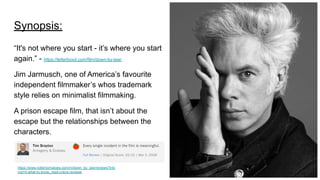
Jim Jarmusch, one of America’s favourite
independent filmmaker’s whos trademark
style relies on minimalist filmmaking.
A prison escape film, that isn’t about the
escape but the relationships between the
characters.
https://www.rottentomatoes.com/m/down_by_law/reviews?intc
mp=rt-what-to-know_read-critics-reviews
Cinematography in Down By Law
● The Cinematographer for this film was Robby Muller. This is his first collaboration with Jim Jarmusch. Working on mystery train, dead man and ghost dog:
the way of the samurai. He was given creative control over how the film would be shot with only 2 notes from the director, that there be no zoom lenses
used and that the story is “a fairy tale”.
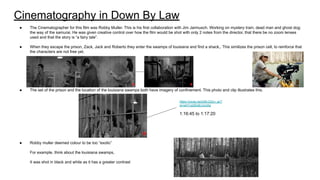
● When they escape the prison, Zack, Jack and Roberto they enter the swamps of louisiana and find a shack,. This similizes the prison cell, to reinforce that
the characters are not free yet.
● The set of the prison and the location of the louisiana swamps both have imagery of confinement. This photo and clip illustrates this.
● Robby muller deemed colour to be too “exotic”
For example, think about the louisiana swamps,
It was shot in black and white as it has a greater contrast
https://youtu.be/jnBLG2yn_ac?
si=wH1vp00o6rJJvz0g
1:16:45 to 1:17:20
Cinematography continued
● There are no close-ups, on characters and subjects.
● Robby Muller said this,”I rather leave it to the audiences to have their own discoveries without patronizing them”
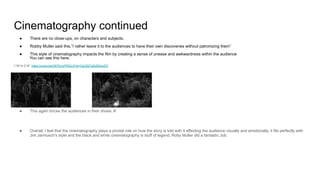
● This style of cinematography impacts the film by creating a sense of unease and awkwardness within the audience
You can see this here:
1:50 to 2:20 https://youtu.be/UEPg1yPWGL4?si=CqLEEFgEj26UcuDY
● This again forces the audiences in their shoes. #
● Overall, I feel that the cinematography plays a pivotal role on how the story is told with it affecting the audience visually and emotionally, it fits perfectly with
Jim Jarmusch's style and the black and white cinematography is stuff of legend. Roby Muller did a fantastic Job.
Mise en scene
What choices were made in the Mise en scene?
● The film uses the prison wall as a canvas to add images to enhance the scene, like add a tally chart or a window drawn by the characters.
● These pictures also show us things about the characters, like how the childish Bob draws a window because he wants to go outside compared to the more boring but practical tally drawn by Zack.
https://youtu.be/aGqWh8ZAZX0?si=TfajyBIBXOdghwNw
● Production design was by Janet densmore, although this is not her standard job as this is the only time she took on a job like this. She also had 2 credits as a writer on Tony Bravo in Scenes from a
Forgotten Cinema and 2 episodes of the big easy.
● The film could be said to have 3 main sections. The pre-prison section, the prison section and the post-prison section. The mise en scene of each section gives each a unique aesthetic.
● The pre-prison section takes place in New Orleans. These shots were done on location. The very first few shots we see is of the scenery of New Orleans, which may trick people into believing that the
location will actually matter to the story. But then we fade into one of our main characters. This is a subtle hint that the characters are the focus more so than the scenarios they find themselves in. This
shot hints at the fact that the film doesn’t actually care about the specific location, as each of the three sections of the movie will take place in different locations.
● This paradoxically makes the location even more meaningful, as each section of the film has a unique feel because of it. In this case, the comparative mundanity of the location. Most of the time it’s shot
in the same perfectly level shot.
● The second section of the film is the prison section. We spend the entire section in a single prison cell. The film keeps this from being boring by, as I’ve said above, having the characters use the prison
walls as a canvas to add new images to the scenery.
● All 3 of the main characters wear the same prison uniform but differentiate by wearing things on their heads, for example a fishnet.
● The scenery gives obvious symbolism to confinement and the desire for freedom with the prison bars. But a slightly more subtle aspect is the drawing of a window that Bob draws. The prison cell doesn’t
provide the basic accommodation of even being able to see the outside so Bob tries to gain the cold comfort of a drawing. This combined with the lack of high angle shots( meaning that we are always
either below or at their level, encouraging us to identify with them) means that we fully understand why they would desire to escape prison beyond the fact that 2 of them were framed for crimes they didn’t
commit.
● The post-prison section of the film takes place in the woods. The scenery adds a slight level of paranoia as the characters are being hunted in a densely packed location where anyone could be hiding in
the trees.
● Another thing to note is that the characters are still wearing their prison uniforms at this time, showing how they’re not truly free as they are still being hunted. This section of the film has the most variety
of scenery of all the sections, since the characters are on the run and need to do things like move from a lake to a boat house.
● In conclusion, the mise en scene of the film gives a slightly bleak image of the characters oppression and lack of freedom. The pre-prison section shows this the least through its oppression from how
mundane the location is. It’s not something you wouldn’t see anywhere else on the world.
● The prison section is the most obvious in its lack of freedom, being a prison cell. The enclosed space forcing the characters to add drawings to feel even a small ounce of freedom.
● The post-prison section shows the characters lack of freedom through the paranoia that is caused by being hunted by the law. In the end the final shot of the film is of a crossroads as the characters are
literally divided.
Editing: How does editing impact the film?
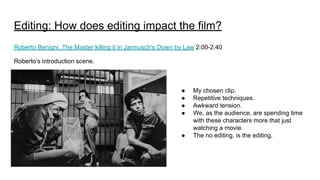
Roberto Benigni..The Master killing it in Jarmusch's Down by Law 2:00-2:40
Roberto’s introduction scene.
● My chosen clip.
● Repetitive techniques.
● Awkward tension.
● We, as the audience, are spending time
with these characters more that just
watching a movie.
● The no editing, is the editing.
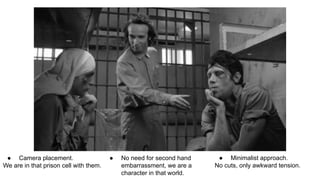
● Camera placement.
We are in that prison cell with them.
● No need for second hand
embarrassment, we are a
character in that world.
● Minimalist approach.
No cuts, only awkward tension.
● The camera lingers (example)
Unnecessary to the storyline but builds that personal relationship between the
characters and the viewer.
https://youtu.be/jnBLG2yn_ac?si=WGEGxdQ3rxt-Czu0&t=1190 19:50-20:00
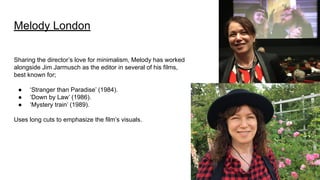
Melody London
Sharing the director’s love for minimalism, Melody has worked
alongside Jim Jarmusch as the editor in several of his films,
best known for;
● ‘Stranger than Paradise’ (1984).
● ‘Down by Law’ (1986).
● ‘Mystery train’ (1989).
Uses long cuts to emphasize the film’s visuals.
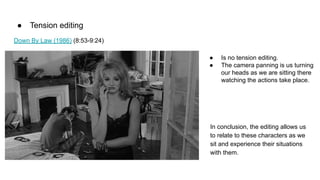
● Tension editing
Down By Law (1986) (8:53-9:24)
● Is no tension editing.
● The camera panning is us turning
our heads as we are sitting there
watching the actions take place.
In conclusion, the editing allows us
to relate to these characters as we
sit and experience their situations
with them.
Sound
Bibliography
Amy - Editing
● https://mubi.com/en/cast/jim-jarmusch
● https://www.youtube.com/watch?v=whuF4dxKpio
● https://facts.net/movie/46-facts-about-the-movie-down-by-l
aw/
● https://womenfilmeditors.princeton.edu/london-melody/
● https://www.senscritique.com/film/Down_by_Law/973233
● https://screengrabsaz.wordpress.com/2014/03/04/down-b
y-law/
● https://artemisnt.blogspot.com/2012/06/down-by-law-1986
.html
● https://www.mainemedia.edu/faculty/list/melody-london/
Harry - Mis-En-Scene
● https://youtu.be/aGqWh8ZAZX0?si=TfajyBIBXOdghwNw
● https://youtu.be/9WKTNwd1lB4?si=I93LnenbiBBc9tr1
● https://images.app.goo.gl/a1pLoaznycooQRp5A
Blake - Cinematography
● https://youtu.be/jnBLG2yn_ac?si=wH1vp00o6rJJvz0g
● https://youtu.be/UEPg1yPWGL4?si=CqLEEFgEj26UcuDY
● Cinematography Masterclass: Legendary DP Robby Müller Explains
His Approach to Film (nofilmschool.com)
● https://youtu.be/FcIHKVuNu6E?si=jKP1IdAbstzbnBQA
● Robby Muller’s Polaroid book
THANK YOU!

‘Down by Law’ (1).pdf

  • 1.
    ‘Down by Law’ 1986Jim Jarmusch By Harry, Amy, Blake and Kai.
  • 2.
    Synopsis: “It's not whereyou start - it’s where you start again.” - https://letterboxd.com/film/down-by-law/ Jim Jarmusch, one of America’s favourite independent filmmaker’s whos trademark style relies on minimalist filmmaking. A prison escape film, that isn’t about the escape but the relationships between the characters. https://www.rottentomatoes.com/m/down_by_law/reviews?intc mp=rt-what-to-know_read-critics-reviews
  • 3.
    Cinematography in DownBy Law ● The Cinematographer for this film was Robby Muller. This is his first collaboration with Jim Jarmusch. Working on mystery train, dead man and ghost dog: the way of the samurai. He was given creative control over how the film would be shot with only 2 notes from the director, that there be no zoom lenses used and that the story is “a fairy tale”. ● When they escape the prison, Zack, Jack and Roberto they enter the swamps of louisiana and find a shack,. This similizes the prison cell, to reinforce that the characters are not free yet. ● The set of the prison and the location of the louisiana swamps both have imagery of confinement. This photo and clip illustrates this. ● Robby muller deemed colour to be too “exotic” For example, think about the louisiana swamps, It was shot in black and white as it has a greater contrast https://youtu.be/jnBLG2yn_ac? si=wH1vp00o6rJJvz0g 1:16:45 to 1:17:20
  • 4.
    Cinematography continued ● Thereare no close-ups, on characters and subjects. ● Robby Muller said this,”I rather leave it to the audiences to have their own discoveries without patronizing them” ● This style of cinematography impacts the film by creating a sense of unease and awkwardness within the audience You can see this here: 1:50 to 2:20 https://youtu.be/UEPg1yPWGL4?si=CqLEEFgEj26UcuDY ● This again forces the audiences in their shoes. # ● Overall, I feel that the cinematography plays a pivotal role on how the story is told with it affecting the audience visually and emotionally, it fits perfectly with Jim Jarmusch's style and the black and white cinematography is stuff of legend. Roby Muller did a fantastic Job.
  • 5.
    Mise en scene Whatchoices were made in the Mise en scene? ● The film uses the prison wall as a canvas to add images to enhance the scene, like add a tally chart or a window drawn by the characters. ● These pictures also show us things about the characters, like how the childish Bob draws a window because he wants to go outside compared to the more boring but practical tally drawn by Zack. https://youtu.be/aGqWh8ZAZX0?si=TfajyBIBXOdghwNw ● Production design was by Janet densmore, although this is not her standard job as this is the only time she took on a job like this. She also had 2 credits as a writer on Tony Bravo in Scenes from a Forgotten Cinema and 2 episodes of the big easy. ● The film could be said to have 3 main sections. The pre-prison section, the prison section and the post-prison section. The mise en scene of each section gives each a unique aesthetic. ● The pre-prison section takes place in New Orleans. These shots were done on location. The very first few shots we see is of the scenery of New Orleans, which may trick people into believing that the location will actually matter to the story. But then we fade into one of our main characters. This is a subtle hint that the characters are the focus more so than the scenarios they find themselves in. This shot hints at the fact that the film doesn’t actually care about the specific location, as each of the three sections of the movie will take place in different locations. ● This paradoxically makes the location even more meaningful, as each section of the film has a unique feel because of it. In this case, the comparative mundanity of the location. Most of the time it’s shot in the same perfectly level shot. ● The second section of the film is the prison section. We spend the entire section in a single prison cell. The film keeps this from being boring by, as I’ve said above, having the characters use the prison walls as a canvas to add new images to the scenery. ● All 3 of the main characters wear the same prison uniform but differentiate by wearing things on their heads, for example a fishnet. ● The scenery gives obvious symbolism to confinement and the desire for freedom with the prison bars. But a slightly more subtle aspect is the drawing of a window that Bob draws. The prison cell doesn’t provide the basic accommodation of even being able to see the outside so Bob tries to gain the cold comfort of a drawing. This combined with the lack of high angle shots( meaning that we are always either below or at their level, encouraging us to identify with them) means that we fully understand why they would desire to escape prison beyond the fact that 2 of them were framed for crimes they didn’t commit. ● The post-prison section of the film takes place in the woods. The scenery adds a slight level of paranoia as the characters are being hunted in a densely packed location where anyone could be hiding in the trees. ● Another thing to note is that the characters are still wearing their prison uniforms at this time, showing how they’re not truly free as they are still being hunted. This section of the film has the most variety of scenery of all the sections, since the characters are on the run and need to do things like move from a lake to a boat house. ● In conclusion, the mise en scene of the film gives a slightly bleak image of the characters oppression and lack of freedom. The pre-prison section shows this the least through its oppression from how mundane the location is. It’s not something you wouldn’t see anywhere else on the world. ● The prison section is the most obvious in its lack of freedom, being a prison cell. The enclosed space forcing the characters to add drawings to feel even a small ounce of freedom. ● The post-prison section shows the characters lack of freedom through the paranoia that is caused by being hunted by the law. In the end the final shot of the film is of a crossroads as the characters are literally divided.
  • 6.
    Editing: How doesediting impact the film? Roberto Benigni..The Master killing it in Jarmusch's Down by Law 2:00-2:40 Roberto’s introduction scene. ● My chosen clip. ● Repetitive techniques. ● Awkward tension. ● We, as the audience, are spending time with these characters more that just watching a movie. ● The no editing, is the editing.
  • 7.
    ● Camera placement. Weare in that prison cell with them. ● No need for second hand embarrassment, we are a character in that world. ● Minimalist approach. No cuts, only awkward tension.
  • 8.
    ● The cameralingers (example) Unnecessary to the storyline but builds that personal relationship between the characters and the viewer. https://youtu.be/jnBLG2yn_ac?si=WGEGxdQ3rxt-Czu0&t=1190 19:50-20:00
  • 9.
    Melody London Sharing thedirector’s love for minimalism, Melody has worked alongside Jim Jarmusch as the editor in several of his films, best known for; ● ‘Stranger than Paradise’ (1984). ● ‘Down by Law’ (1986). ● ‘Mystery train’ (1989). Uses long cuts to emphasize the film’s visuals.
  • 10.
    ● Tension editing DownBy Law (1986) (8:53-9:24) ● Is no tension editing. ● The camera panning is us turning our heads as we are sitting there watching the actions take place. In conclusion, the editing allows us to relate to these characters as we sit and experience their situations with them.
  • 11.
  • 12.
    Bibliography Amy - Editing ●https://mubi.com/en/cast/jim-jarmusch ● https://www.youtube.com/watch?v=whuF4dxKpio ● https://facts.net/movie/46-facts-about-the-movie-down-by-l aw/ ● https://womenfilmeditors.princeton.edu/london-melody/ ● https://www.senscritique.com/film/Down_by_Law/973233 ● https://screengrabsaz.wordpress.com/2014/03/04/down-b y-law/ ● https://artemisnt.blogspot.com/2012/06/down-by-law-1986 .html ● https://www.mainemedia.edu/faculty/list/melody-london/ Harry - Mis-En-Scene ● https://youtu.be/aGqWh8ZAZX0?si=TfajyBIBXOdghwNw ● https://youtu.be/9WKTNwd1lB4?si=I93LnenbiBBc9tr1 ● https://images.app.goo.gl/a1pLoaznycooQRp5A Blake - Cinematography ● https://youtu.be/jnBLG2yn_ac?si=wH1vp00o6rJJvz0g ● https://youtu.be/UEPg1yPWGL4?si=CqLEEFgEj26UcuDY ● Cinematography Masterclass: Legendary DP Robby Müller Explains His Approach to Film (nofilmschool.com) ● https://youtu.be/FcIHKVuNu6E?si=jKP1IdAbstzbnBQA ● Robby Muller’s Polaroid book
  • 13.