1
For computer
scientists
Prof. Dorit Aharonov
School of computer science and engineering
Hebrew university, Jerusalem, Israel
Quantum computation
What is a computation
La Segrada Familia
(Barcelona)
Architect: Gaudi
What is a computation?
A
Q
B C A
Turing machine, 1936
≈
Computation
(Algorithm)
Output
011000
Input
0111001
Universal computation models:
Uniform
Circuits
≈
≈
Game of life
Rules:
A living site:
stays alive if it has
2 or 3 live neighbors
Otherwise dies
A dead site:
comes to life
if it has exctly 3
living neighbors
5
Quantum computation is the only computational model which
credibly challenges the Extended Church Turing thesis
The Extended Church Turing thesis:
“Any physically realizable computational model can be
simulated efficiently by a randomized Turing machine”
A corner stone thesis in computer science:
≈ ≈
The Extended Church-Turing thesis (ECTT)
6
Bird’s view on Quantum computation
Inherently different from standard
“classical” computers. We believe that
it will be exponentially more powerful
for certain tasks.
6
6
Philosophy
of Science
Physics of many particles
(non universal computations)
Cryptography
Algorithms
technology
Polynomial time
Quantum
algorithm for
factoring
Shor[’94]
Deutsch
Josza [‘92]
Bernstein
Vazirani[‘93]
Simon
[‘94]
7
About this school
Goal: Intro to quantum computation & complexity
Some important notions, results, open questions
Note: We will not cover many important things…
(A partial list will be provided & updated )
Two remarks:
1) The lectures are intertwined, not independent!
2) The TA sessions are mainly exercises.
Do them! We rely on them in the next lecture.
8
Intro Lecture:
Qubits
Part 1: The principles of quantum Physics
Part2: The qubit
Part 3: Measurements
Part 4: Dynamics
Part 5: Two qubits
9
Part I:
The principles of Quantum Physics
10
The two slit experiment
Part A: bullets
11
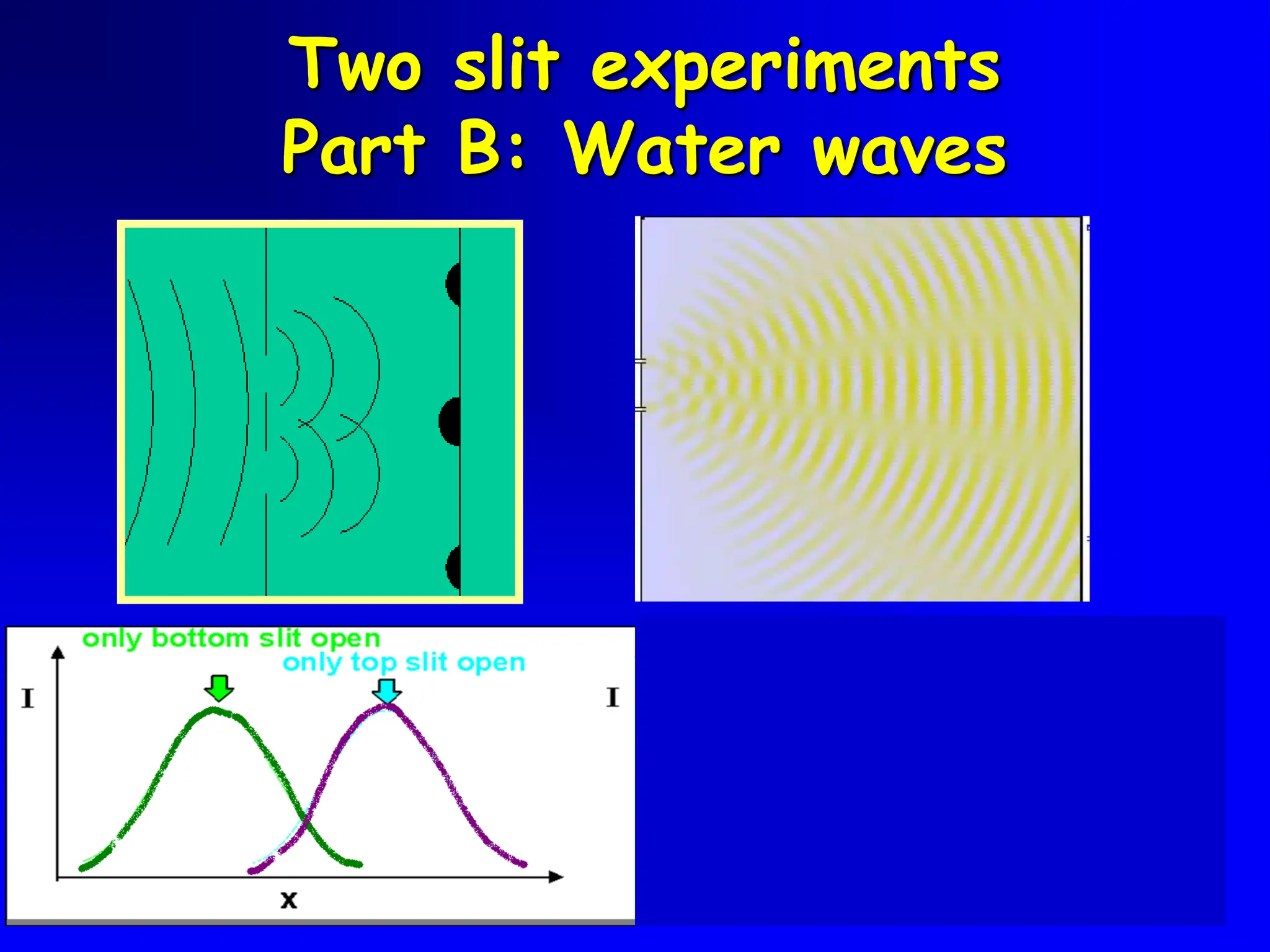
Two slit experiments
Part B: Water waves
12
Two slit experiment
Part C: electrons
Interference pattern for particles!
13
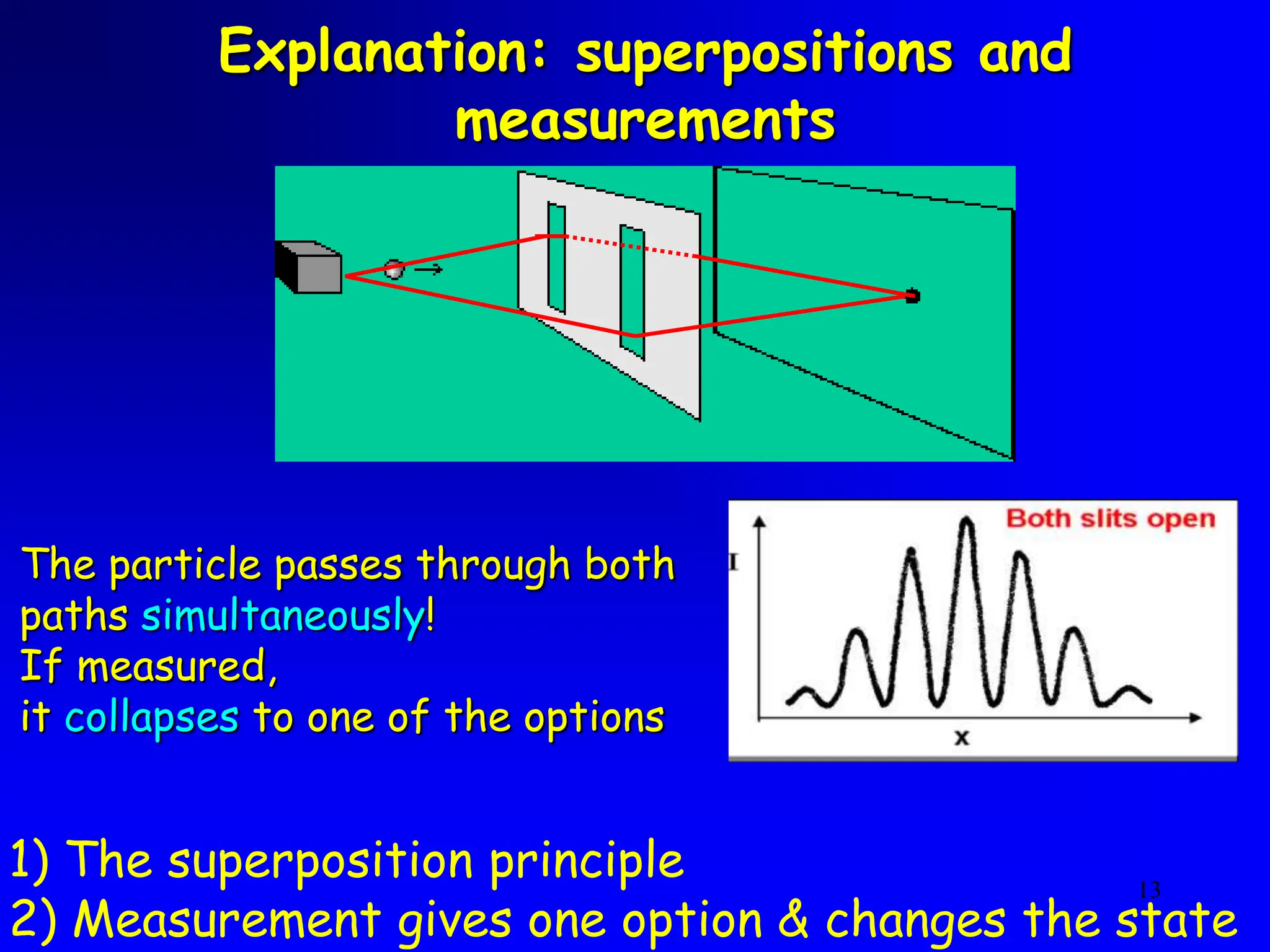
Explanation: superpositions and
measurements
The particle passes through both
paths simultaneously!
If measured,
it collapses to one of the options
1) The superposition principle
2) Measurement gives one option & changes the state
14
Part II:
The Qubit
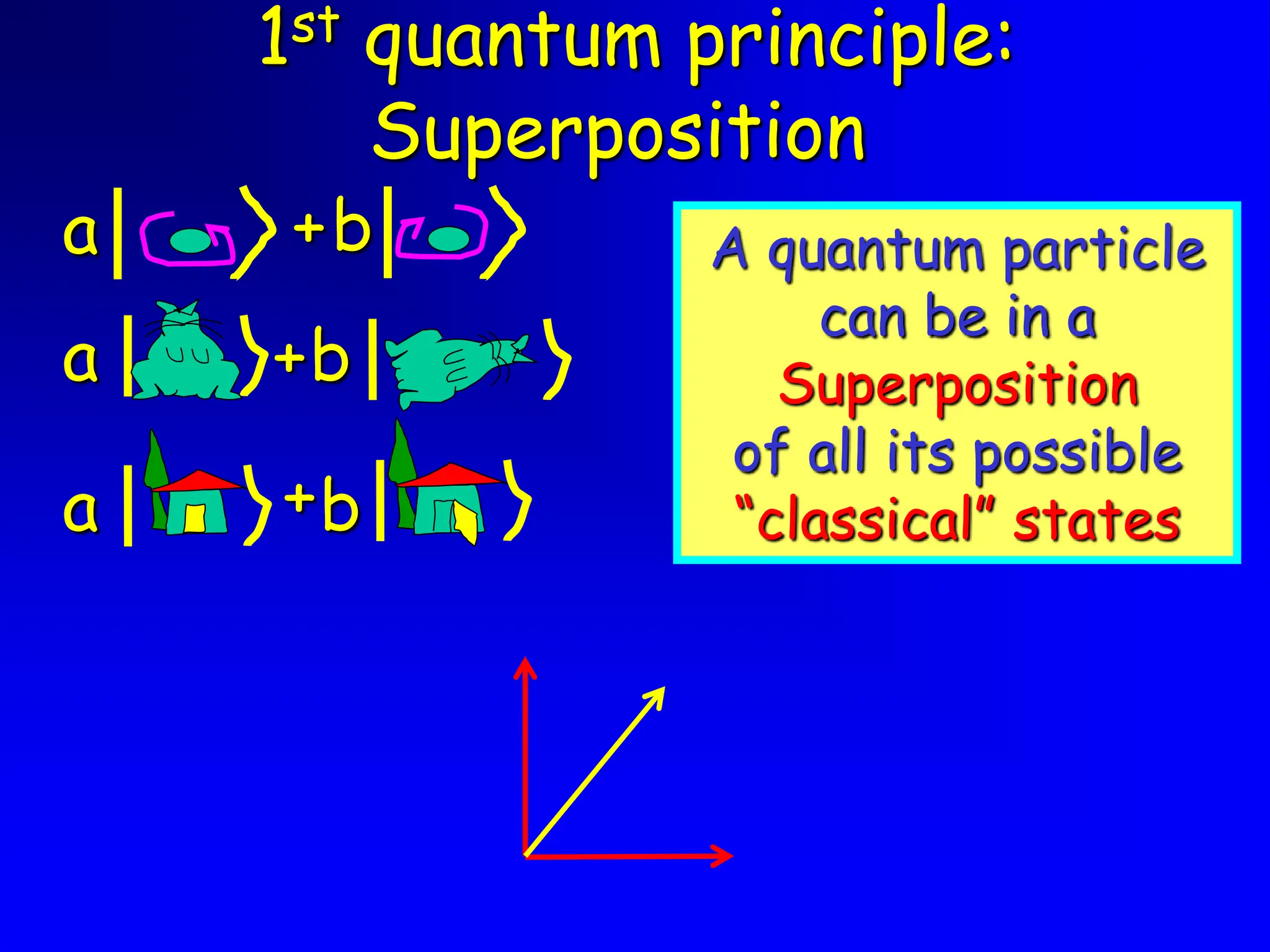
A quantum particle
can be in a
Superposition
of all its possible
“classical” states
+
+
+
a b
a
b
b
a
1st quantum principle:
Superposition
The elementary quantum
information unit:
The qubit can be in either one of the
States: 0,1
As well as in any linear combination!
 a vector in a 2 dim Hilbert space
+
a b
0 1
Qubit = Quantum bit
On the board:
Dirac notation
Vector notation
Transpose
Inner products
density matrix
We can also
talk about qudits,
Of higher dim.
|0
|1
17
Part III:
Measurements
18
The quantum measurement
+
a b
When a quantum particle is measured
the answer is Probabilistic
The Superposition collapses
to one of its possible classical states
|b|2
|a|2
0
0 1
1
Those (weird!) aspects have been
tested in thousands of experiments
2nd principle
measurement
Projective measurements
A projective measurement is described
by a Hermitian matrix M.
M has eigenvectors (eigenspaces) with
associated real eigenvalues
+
a b
0 1
1
0 On the board:
Measure with respect to Z
Prob=inner product squared
Measure X: The +/- basis
Probablity for 𝛱 a projection
Expected value of measurement:
Direct expression and as Tr(Mρ)
Uncertainty principle
The classical outcome is eigenvalue 𝛌 with probability =
norm squared of projection on the corresponsing eigenspace
& the state collapses to this projection and renormlized
20
Part IV:
Dynamics
21
Dynamics
On the board:
From the differential equation to unitary evolution
(eigenvalues which are primitive roots of unity)
Unitary as preserving inner product
Schrodinger’s equation:
Discrete time evolution:
The Hamiltonian
(A Hermitian operator)
22
Quantum Gates
On the board:
Applying X,Z on computational basis states of a qubit
Linearity
Applying Hadamard on basis states and measuring (“coin flip”)
Interference & path integrals
On the board:
compute weights,
repeat with measurement in the middle
H H
|0 |0
|1
|0
|1
24
Part V:
Two qubits
The superposition principle for
more qubits
one two
The state of n quantum bits is a superposition of
all 2n possible configurations,
each with its own weight!
three
The space of two qubits
 
0
,
1
|
1
,
0
|
2
1

 
The computational Basis
for the two qubits space
The EPR state:
27
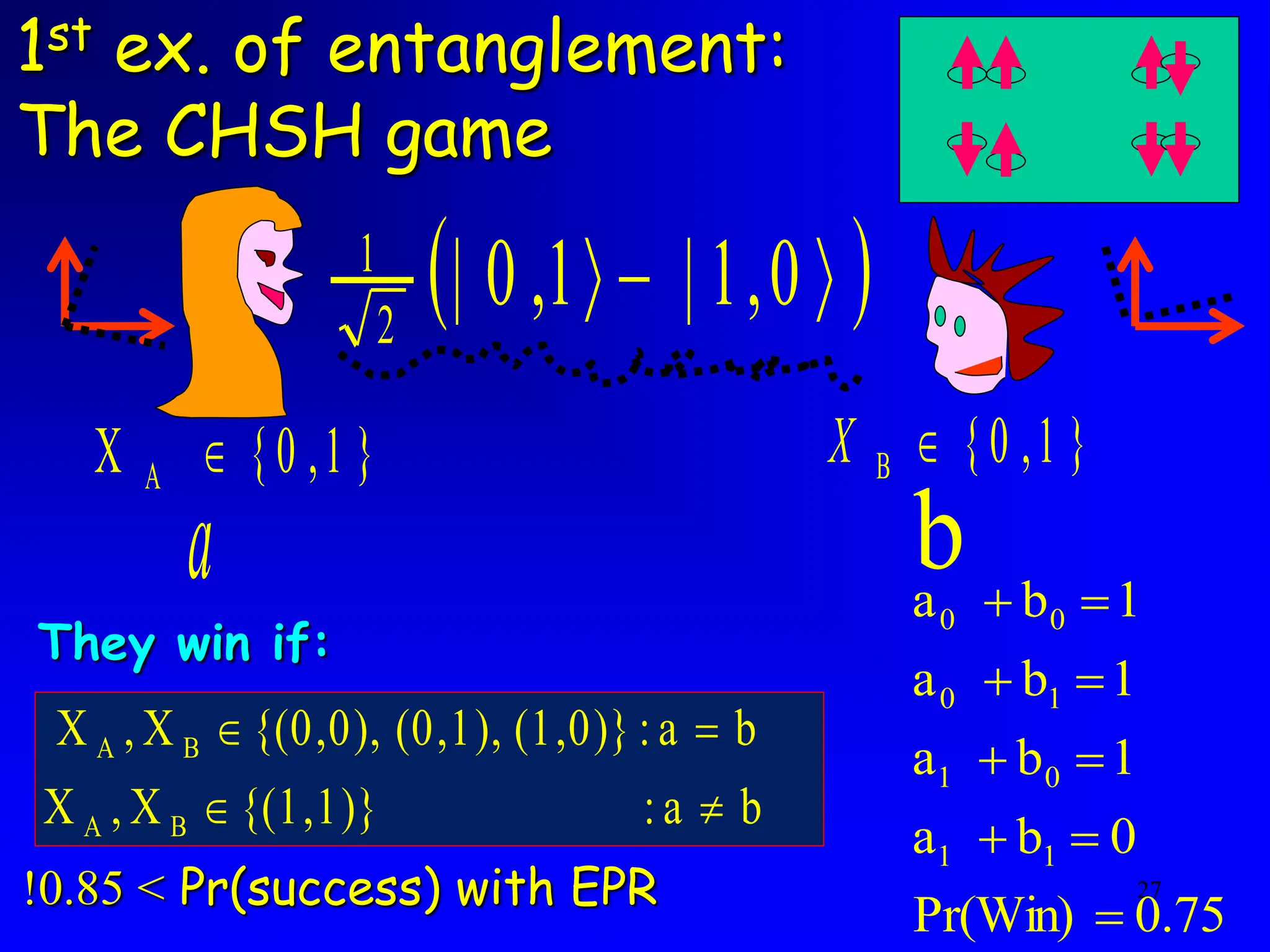
1st ex. of entanglement:
The CHSH game
{ 0 ,1 }
B 
X
a b
0.75
Pr(Win)
0
b
a
1
b
a
1
b
a
1
b
a
1
1
0
1
1
0
0
0









 
0
,
1
|
1
,
0
|
2
1

 
They win if:
>
0.85
! Pr(success) with EPR
{0 ,1 }
X A 
b
a
:
{(1,1)}
X
,
X
b
a
:
(1,0)}
(0,1),
{(0,0),
X
,
X
B
A
B
A





dorit-day1-1.pptedefefgfgjjjjjf2iufhhbfiurb

  • 1.
    1 For computer scientists Prof. DoritAharonov School of computer science and engineering Hebrew university, Jerusalem, Israel Quantum computation
  • 2.
    What is acomputation La Segrada Familia (Barcelona) Architect: Gaudi
  • 3.
    What is acomputation? A Q B C A Turing machine, 1936 ≈ Computation (Algorithm) Output 011000 Input 0111001 Universal computation models: Uniform Circuits ≈ ≈
  • 4.
    Game of life Rules: Aliving site: stays alive if it has 2 or 3 live neighbors Otherwise dies A dead site: comes to life if it has exctly 3 living neighbors
  • 5.
    5 Quantum computation isthe only computational model which credibly challenges the Extended Church Turing thesis The Extended Church Turing thesis: “Any physically realizable computational model can be simulated efficiently by a randomized Turing machine” A corner stone thesis in computer science: ≈ ≈ The Extended Church-Turing thesis (ECTT)
  • 6.
    6 Bird’s view onQuantum computation Inherently different from standard “classical” computers. We believe that it will be exponentially more powerful for certain tasks. 6 6 Philosophy of Science Physics of many particles (non universal computations) Cryptography Algorithms technology Polynomial time Quantum algorithm for factoring Shor[’94] Deutsch Josza [‘92] Bernstein Vazirani[‘93] Simon [‘94]
  • 7.
    7 About this school Goal:Intro to quantum computation & complexity Some important notions, results, open questions Note: We will not cover many important things… (A partial list will be provided & updated ) Two remarks: 1) The lectures are intertwined, not independent! 2) The TA sessions are mainly exercises. Do them! We rely on them in the next lecture.
  • 8.
    8 Intro Lecture: Qubits Part 1:The principles of quantum Physics Part2: The qubit Part 3: Measurements Part 4: Dynamics Part 5: Two qubits
  • 9.
    9 Part I: The principlesof Quantum Physics
  • 10.
    10 The two slitexperiment Part A: bullets
  • 11.
  • 12.
    12 Two slit experiment PartC: electrons Interference pattern for particles!
  • 13.
    13 Explanation: superpositions and measurements Theparticle passes through both paths simultaneously! If measured, it collapses to one of the options 1) The superposition principle 2) Measurement gives one option & changes the state
  • 14.
  • 15.
    A quantum particle canbe in a Superposition of all its possible “classical” states + + + a b a b b a 1st quantum principle: Superposition
  • 16.
    The elementary quantum informationunit: The qubit can be in either one of the States: 0,1 As well as in any linear combination!  a vector in a 2 dim Hilbert space + a b 0 1 Qubit = Quantum bit On the board: Dirac notation Vector notation Transpose Inner products density matrix We can also talk about qudits, Of higher dim. |0 |1
  • 17.
  • 18.
    18 The quantum measurement + ab When a quantum particle is measured the answer is Probabilistic The Superposition collapses to one of its possible classical states |b|2 |a|2 0 0 1 1 Those (weird!) aspects have been tested in thousands of experiments 2nd principle measurement
  • 19.
    Projective measurements A projectivemeasurement is described by a Hermitian matrix M. M has eigenvectors (eigenspaces) with associated real eigenvalues + a b 0 1 1 0 On the board: Measure with respect to Z Prob=inner product squared Measure X: The +/- basis Probablity for 𝛱 a projection Expected value of measurement: Direct expression and as Tr(Mρ) Uncertainty principle The classical outcome is eigenvalue 𝛌 with probability = norm squared of projection on the corresponsing eigenspace & the state collapses to this projection and renormlized
  • 20.
  • 21.
    21 Dynamics On the board: Fromthe differential equation to unitary evolution (eigenvalues which are primitive roots of unity) Unitary as preserving inner product Schrodinger’s equation: Discrete time evolution: The Hamiltonian (A Hermitian operator)
  • 22.
    22 Quantum Gates On theboard: Applying X,Z on computational basis states of a qubit Linearity Applying Hadamard on basis states and measuring (“coin flip”)
  • 23.
    Interference & pathintegrals On the board: compute weights, repeat with measurement in the middle H H |0 |0 |1 |0 |1
  • 24.
  • 25.
    The superposition principlefor more qubits one two The state of n quantum bits is a superposition of all 2n possible configurations, each with its own weight! three
  • 26.
    The space oftwo qubits   0 , 1 | 1 , 0 | 2 1    The computational Basis for the two qubits space The EPR state:
  • 27.
    27 1st ex. ofentanglement: The CHSH game { 0 ,1 } B  X a b 0.75 Pr(Win) 0 b a 1 b a 1 b a 1 b a 1 1 0 1 1 0 0 0            0 , 1 | 1 , 0 | 2 1    They win if: > 0.85 ! Pr(success) with EPR {0 ,1 } X A  b a : {(1,1)} X , X b a : (1,0)} (0,1), {(0,0), X , X B A B A    

Editor's Notes

  • #2 Unit vector
  • #3 Very different than the turing machine…
  • #4 Very different than the turing machine…
  • #5 Very different than the turing machine…
  • #8 ---------------------------------------
  • #9 ---------------------------------------
  • #10 ---------------------------------------
  • #11 Unit vector
  • #12 Unit vector
  • #13 Unit vector
  • #14 Unit vector
  • #15 Very different than the turing machine…
  • #16 Unit vector
  • #17 Very different than the turing machine…
  • #18 Very different than the turing machine…
  • #19 Unit vector
  • #20 Very different than the turing machine…
  • #21 Very different than the turing machine…
  • #22 Very different than the turing machine…
  • #23 Very different than the turing machine…
  • #24 Nucleos spin – in a large constant magnetic field, apply a perturbation of an oscilating magnetic field in resonant frequency. Generates rotations of the spin.
  • #25 From time to time I will be using more technical terms, as parts of remarks. Ignore than if you don’t understand them- they are meant for references for those who do understand, but are not necessary For the rest of the talk. The few technical terms I will need will be explained in detail.