DOOR:
Descriptive Ontology of Ontology Relations

                 Carlo Allocca
         Mathieu d’Aquin, Enrico Motta

            Knowledge Media Institute
              The Open University
               Milton Keynes, UK
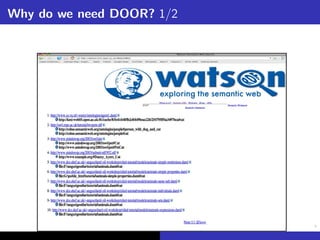
Why do we need DOOR? 1/2
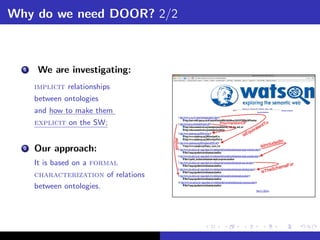
Why do we need DOOR? 2/2


  1    We are investigating:
      implicit relationships
      between ontologies
      and how to make them
      explicit on the SW;


  2   Our approach:
      It is based on a formal
      characterization of relations
      between ontologies.
Which Methodology is DOOR based on?
     Three main sources are taken into consideration to identify
     relevant ontology relations:


                                      OWL


     Three important requirements to build DOOR are:
         the relations have to be general enough to be applied to multiple
         domains;
         the relations have to be sufficiently intuitive to reflect general meaning;
         the relations have to be formally defined.


     A Top-Down approach is used to analyze and formalize
     ontology relations;
Main steps of the Approach 1/5


                                      1   The outcome is a list of relevant relations e.g.:
 1   Identifying the top relations,
                                          includedIn, equivalentTo, similarTo,
     w.r.t. the three resources.
                                          previousVersion, import, etc;
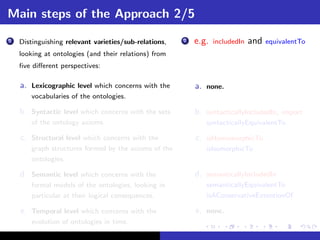
Main steps of the Approach 2/5
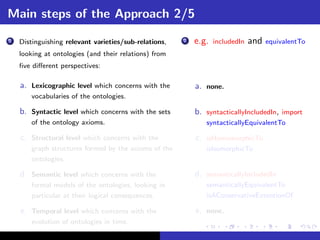
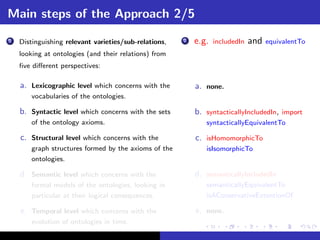
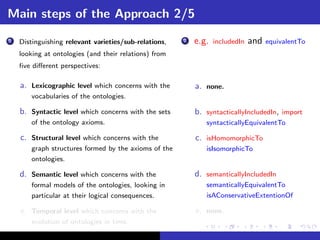
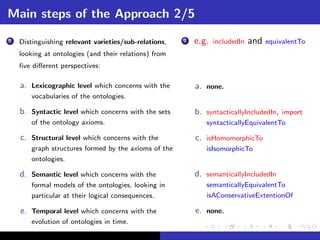
2   Distinguishing relevant varieties/sub-relations,   2   e.g.   includedIn   and   equivalentTo
    looking at ontologies (and their relations) from       carlodakbjgfsjkgfs
    five different perspectives:                             Ivettdakbjgfsjkgfs


    a. Lexicographic level which concerns with the         a. none.
        vocabularies of the ontologies.

    b. Syntactic level which concerns with the sets        b. syntacticallyIncludedIn, import
        of the ontology axioms.                                syntacticallyEquivalentTo

    c. Structural level which concerns with the            c. isHomomorphicTo
        graph structures formed by the axioms of the           isIsomorphicTo
        ontologies.

    d. Semantic level which concerns with the              d. semanticallyIncludedIn
        formal models of the ontologies, looking in            semanticallyEquivalentTo
        particular at their logical consequences.              isAConservativeExtentionOf

    e. Temporal level which concerns with the              e. none.
        evolution of ontologies in time.
Main steps of the Approach 2/5
2   Distinguishing relevant varieties/sub-relations,   2   e.g.   includedIn   and   equivalentTo
    looking at ontologies (and their relations) from       carlodakbjgfsjkgfs
    five different perspectives:                             Ivettdakbjgfsjkgfs


    a. Lexicographic level which concerns with the         a. none.
        vocabularies of the ontologies.

    b. Syntactic level which concerns with the sets        b. syntacticallyIncludedIn, import
        of the ontology axioms.                                syntacticallyEquivalentTo

    c. Structural level which concerns with the            c. isHomomorphicTo
        graph structures formed by the axioms of the           isIsomorphicTo
        ontologies.

    d. Semantic level which concerns with the              d. semanticallyIncludedIn
        formal models of the ontologies, looking in            semanticallyEquivalentTo
        particular at their logical consequences.              isAConservativeExtentionOf

    e. Temporal level which concerns with the              e. none.
        evolution of ontologies in time.
Main steps of the Approach 2/5
2   Distinguishing relevant varieties/sub-relations,   2   e.g.   includedIn   and   equivalentTo
    looking at ontologies (and their relations) from       carlodakbjgfsjkgfs
    five different perspectives:                             Ivettdakbjgfsjkgfs


    a. Lexicographic level which concerns with the         a. none.
        vocabularies of the ontologies.

    b. Syntactic level which concerns with the sets        b. syntacticallyIncludedIn, import
        of the ontology axioms.                                syntacticallyEquivalentTo

    c. Structural level which concerns with the            c. isHomomorphicTo
        graph structures formed by the axioms of the           isIsomorphicTo
        ontologies.

    d. Semantic level which concerns with the              d. semanticallyIncludedIn
        formal models of the ontologies, looking in            semanticallyEquivalentTo
        particular at their logical consequences.              isAConservativeExtentionOf

    e. Temporal level which concerns with the              e. none.
        evolution of ontologies in time.
Main steps of the Approach 2/5
2   Distinguishing relevant varieties/sub-relations,   2   e.g.   includedIn   and   equivalentTo
    looking at ontologies (and their relations) from       carlodakbjgfsjkgfs
    five different perspectives:                             Ivettdakbjgfsjkgfs


    a. Lexicographic level which concerns with the         a. none.
        vocabularies of the ontologies.

    b. Syntactic level which concerns with the sets        b. syntacticallyIncludedIn, import
        of the ontology axioms.                                syntacticallyEquivalentTo

    c. Structural level which concerns with the            c. isHomomorphicTo
        graph structures formed by the axioms of the           isIsomorphicTo
        ontologies.

    d. Semantic level which concerns with the              d. semanticallyIncludedIn
        formal models of the ontologies, looking in            semanticallyEquivalentTo
        particular at their logical consequences.              isAConservativeExtentionOf

    e. Temporal level which concerns with the              e. none.
        evolution of ontologies in time.
Main steps of the Approach 2/5
2   Distinguishing relevant varieties/sub-relations,   2   e.g.   includedIn   and   equivalentTo
    looking at ontologies (and their relations) from       carlodakbjgfsjkgfs
    five different perspectives:                             Ivettdakbjgfsjkgfs


    a. Lexicographic level which concerns with the         a. none.
        vocabularies of the ontologies.

    b. Syntactic level which concerns with the sets        b. syntacticallyIncludedIn, import
        of the ontology axioms.                                syntacticallyEquivalentTo

    c. Structural level which concerns with the            c. isHomomorphicTo
        graph structures formed by the axioms of the           isIsomorphicTo
        ontologies.

    d. Semantic level which concerns with the              d. semanticallyIncludedIn
        formal models of the ontologies, looking in            semanticallyEquivalentTo
        particular at their logical consequences.              isAConservativeExtentionOf

    e. Temporal level which concerns with the              e. none.
        evolution of ontologies in time.
Main steps of the Approach 2/5
2   Distinguishing relevant varieties/sub-relations,   2   e.g.   includedIn   and   equivalentTo
    looking at ontologies (and their relations) from       carlodakbjgfsjkgfs
    five different perspectives:                             Ivettdakbjgfsjkgfs


    a. Lexicographic level which concerns with the         a. none.
        vocabularies of the ontologies.

    b. Syntactic level which concerns with the sets        b. syntacticallyIncludedIn, import
        of the ontology axioms.                                syntacticallyEquivalentTo

    c. Structural level which concerns with the            c. isHomomorphicTo
        graph structures formed by the axioms of the           isIsomorphicTo
        ontologies.

    d. Semantic level which concerns with the              d. semanticallyIncludedIn
        formal models of the ontologies, looking in            semanticallyEquivalentTo
        particular at their logical consequences.              isAConservativeExtentionOf

    e. Temporal level which concerns with the              e. none.
        evolution of ontologies in time.
Main steps of the Approach 3/5


3
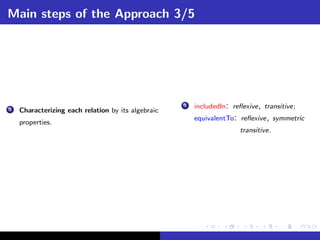
                                                    3   includedIn: reflexive , transitive;
    Characterizing each relation by its algebraic
                                                        equivalentTo: reflexive , symmetric
    properties.
                                                                       transitive.
Main steps of the Approach 4/5


                                                                 includedIn
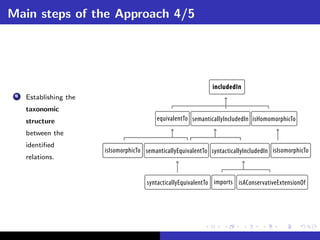
 4   Establishing the
     taxonomic
     structure                             equivalentTo semanticallyIncludedIn isHomomorphicTo

     between the
     identified
                        isIsomorphicTo semanticallyEquivalentTo syntacticallyIncludedIn isIsomorphicTo
     relations.


                                        syntacticallyEquivalentTo imports isAConservativeExtensionOf
Main steps of the Approach 5/5


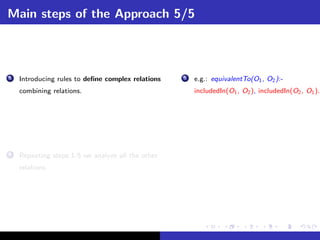
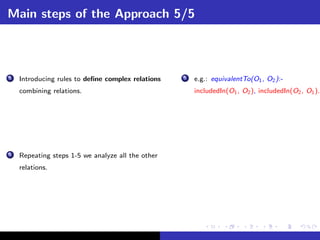
5   Introducing rules to define complex relations   5   e.g.: equivalentTo(O1 , O2 ):-
    combining relations.                               includedIn(O1 , O2 ), includedIn(O2 , O1 ).


6   Repeating steps 1-5 we analyze all the other
    relations.
Main steps of the Approach 5/5


5   Introducing rules to define complex relations   5   e.g.: equivalentTo(O1 , O2 ):-
    combining relations.                               includedIn(O1 , O2 ), includedIn(O2 , O1 ).


6   Repeating steps 1-5 we analyze all the other
    relations.
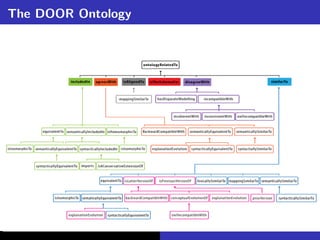
The DOOR Ontology


g
SimilarTo 1/2


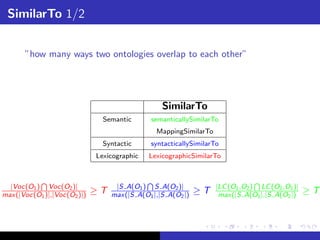
       ”how many ways two ontologies overlap to each other”


                                                 SimilarTo
                               Semantic       semanticallySimilarTo
                                               MappingSimilarTo
                               Syntactic      syntacticallySimilarTo
                             Lexicographic   LexicographicSimilarTo


  |Voc(O1 ) Voc(O2 )|              |S A(O1 ) S A(O2 )|            |LC (O1 ,O2 ) LC (O2 ,O1 )|
max(|Voc(O1 )|,|Voc(O2 )|)   ≥T   max(|S A(O1 |,|S A(O2 |)   ≥T    max(|S A(O1 |,|S A(O2 |)     ≥T
SimilarTo 2/2
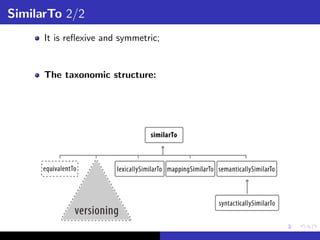
      It is reflexive and symmetric;


      The taxonomic structure:
Versioning 1/2

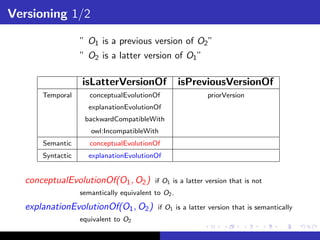
                  ” O1 is a previous version of O2 ”
                  ” O2 is a latter version of O1 ”

                  isLatterVersionOf                 isPreviousVersionOf
      Temporal       conceptualEvolutionOf                  priorVersion
                    explanationEvolutionOf
                   backwardCompatibleWith
                     owl:IncompatibleWith
      Semantic       conceptualEvolutionOf
      Syntactic     explanationEvolutionOf


  conceptualEvolutionOf(O1 , O2 )         if O1 is a latter version that is not
                  semantically equivalent to O2 .

  explanationEvolutionOf(O1 , O2 )         if O1 is a latter version that is semantically
                  equivalent to O2
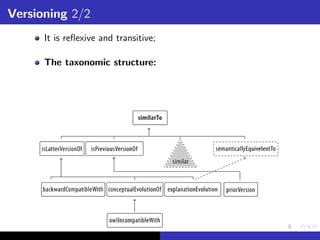
Versioning 2/2
      It is reflexive and transitive;

      The taxonomic structure:
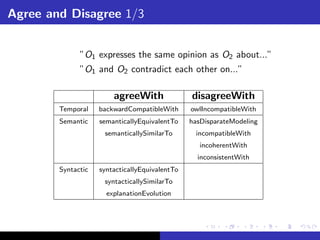
Agree and Disagree 1/3


              ”O1 expresses the same opinion as O2 about...”
              ”O1 and O2 contradict each other on...”

                        agreeWith               disagreeWith
        Temporal    backwardCompatibleWith      owlIncompatibleWith
        Semantic    semanticallyEquivalentTo    hasDisparateModeling
                     semanticallySimilarTo       incompatibleWith
                                                   incoherentWith
                                                  inconsistentWith
        Syntactic   syntacticallyEquivalentTo
                     syntacticallySimilarTo
                      explanationEvolution
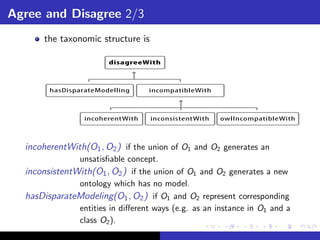
Agree and Disagree 2/3
       the taxonomic structure is

                        disagreeWith


        hasDisparateModelling      incompatibleWith


                 incoherentWith     inconsistentWith   owlIncompatibleWith


  incoherentWith(O1 , O2 ) if the union of O1 and O2 generates an
               unsatisfiable concept.
  inconsistentWith(O1 , O2 ) if the union of O1 and O2 generates a new
               ontology which has no model.
  hasDisparateModeling(O1 , O2 ) if O1 and O2 represent corresponding
               entities in different ways (e.g. as an instance in O1 and a
               class O2 ).
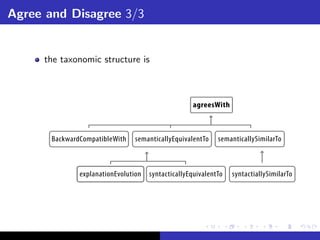
Agree and Disagree 3/3


     the taxonomic structure is


                                                    agreesWith


       BackwardCompatibleWith    semanticallyEquivalentTo    semanticallySimilarTo


               explanationEvolution   syntacticallyEquivalentTo   syntactiallySimilarTo
Conclusion and Future

     We designed the DOOR ontology, which formalizes relations
     existing between ontologies on the SW;


     We presented the methodology on which DOOR is based on;


     What is next:
         keep developing DOOR;


     Using the DOOR Ontology
         KANNEL;
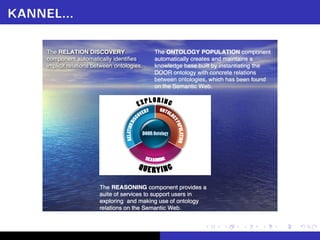
KANNEL...
DOOR ontology

DOOR ontology

  • 1.
    DOOR: Descriptive Ontology ofOntology Relations Carlo Allocca Mathieu d’Aquin, Enrico Motta Knowledge Media Institute The Open University Milton Keynes, UK
  • 2.
    Why do weneed DOOR? 1/2
  • 3.
    Why do weneed DOOR? 2/2 1 We are investigating: implicit relationships between ontologies and how to make them explicit on the SW; 2 Our approach: It is based on a formal characterization of relations between ontologies.
  • 4.
    Which Methodology isDOOR based on? Three main sources are taken into consideration to identify relevant ontology relations: OWL Three important requirements to build DOOR are: the relations have to be general enough to be applied to multiple domains; the relations have to be sufficiently intuitive to reflect general meaning; the relations have to be formally defined. A Top-Down approach is used to analyze and formalize ontology relations;
  • 5.
    Main steps ofthe Approach 1/5 1 The outcome is a list of relevant relations e.g.: 1 Identifying the top relations, includedIn, equivalentTo, similarTo, w.r.t. the three resources. previousVersion, import, etc;
  • 6.
    Main steps ofthe Approach 2/5 2 Distinguishing relevant varieties/sub-relations, 2 e.g. includedIn and equivalentTo looking at ontologies (and their relations) from carlodakbjgfsjkgfs five different perspectives: Ivettdakbjgfsjkgfs a. Lexicographic level which concerns with the a. none. vocabularies of the ontologies. b. Syntactic level which concerns with the sets b. syntacticallyIncludedIn, import of the ontology axioms. syntacticallyEquivalentTo c. Structural level which concerns with the c. isHomomorphicTo graph structures formed by the axioms of the isIsomorphicTo ontologies. d. Semantic level which concerns with the d. semanticallyIncludedIn formal models of the ontologies, looking in semanticallyEquivalentTo particular at their logical consequences. isAConservativeExtentionOf e. Temporal level which concerns with the e. none. evolution of ontologies in time.
  • 7.
    Main steps ofthe Approach 2/5 2 Distinguishing relevant varieties/sub-relations, 2 e.g. includedIn and equivalentTo looking at ontologies (and their relations) from carlodakbjgfsjkgfs five different perspectives: Ivettdakbjgfsjkgfs a. Lexicographic level which concerns with the a. none. vocabularies of the ontologies. b. Syntactic level which concerns with the sets b. syntacticallyIncludedIn, import of the ontology axioms. syntacticallyEquivalentTo c. Structural level which concerns with the c. isHomomorphicTo graph structures formed by the axioms of the isIsomorphicTo ontologies. d. Semantic level which concerns with the d. semanticallyIncludedIn formal models of the ontologies, looking in semanticallyEquivalentTo particular at their logical consequences. isAConservativeExtentionOf e. Temporal level which concerns with the e. none. evolution of ontologies in time.
  • 8.
    Main steps ofthe Approach 2/5 2 Distinguishing relevant varieties/sub-relations, 2 e.g. includedIn and equivalentTo looking at ontologies (and their relations) from carlodakbjgfsjkgfs five different perspectives: Ivettdakbjgfsjkgfs a. Lexicographic level which concerns with the a. none. vocabularies of the ontologies. b. Syntactic level which concerns with the sets b. syntacticallyIncludedIn, import of the ontology axioms. syntacticallyEquivalentTo c. Structural level which concerns with the c. isHomomorphicTo graph structures formed by the axioms of the isIsomorphicTo ontologies. d. Semantic level which concerns with the d. semanticallyIncludedIn formal models of the ontologies, looking in semanticallyEquivalentTo particular at their logical consequences. isAConservativeExtentionOf e. Temporal level which concerns with the e. none. evolution of ontologies in time.
  • 9.
    Main steps ofthe Approach 2/5 2 Distinguishing relevant varieties/sub-relations, 2 e.g. includedIn and equivalentTo looking at ontologies (and their relations) from carlodakbjgfsjkgfs five different perspectives: Ivettdakbjgfsjkgfs a. Lexicographic level which concerns with the a. none. vocabularies of the ontologies. b. Syntactic level which concerns with the sets b. syntacticallyIncludedIn, import of the ontology axioms. syntacticallyEquivalentTo c. Structural level which concerns with the c. isHomomorphicTo graph structures formed by the axioms of the isIsomorphicTo ontologies. d. Semantic level which concerns with the d. semanticallyIncludedIn formal models of the ontologies, looking in semanticallyEquivalentTo particular at their logical consequences. isAConservativeExtentionOf e. Temporal level which concerns with the e. none. evolution of ontologies in time.
  • 10.
    Main steps ofthe Approach 2/5 2 Distinguishing relevant varieties/sub-relations, 2 e.g. includedIn and equivalentTo looking at ontologies (and their relations) from carlodakbjgfsjkgfs five different perspectives: Ivettdakbjgfsjkgfs a. Lexicographic level which concerns with the a. none. vocabularies of the ontologies. b. Syntactic level which concerns with the sets b. syntacticallyIncludedIn, import of the ontology axioms. syntacticallyEquivalentTo c. Structural level which concerns with the c. isHomomorphicTo graph structures formed by the axioms of the isIsomorphicTo ontologies. d. Semantic level which concerns with the d. semanticallyIncludedIn formal models of the ontologies, looking in semanticallyEquivalentTo particular at their logical consequences. isAConservativeExtentionOf e. Temporal level which concerns with the e. none. evolution of ontologies in time.
  • 11.
    Main steps ofthe Approach 2/5 2 Distinguishing relevant varieties/sub-relations, 2 e.g. includedIn and equivalentTo looking at ontologies (and their relations) from carlodakbjgfsjkgfs five different perspectives: Ivettdakbjgfsjkgfs a. Lexicographic level which concerns with the a. none. vocabularies of the ontologies. b. Syntactic level which concerns with the sets b. syntacticallyIncludedIn, import of the ontology axioms. syntacticallyEquivalentTo c. Structural level which concerns with the c. isHomomorphicTo graph structures formed by the axioms of the isIsomorphicTo ontologies. d. Semantic level which concerns with the d. semanticallyIncludedIn formal models of the ontologies, looking in semanticallyEquivalentTo particular at their logical consequences. isAConservativeExtentionOf e. Temporal level which concerns with the e. none. evolution of ontologies in time.
  • 12.
    Main steps ofthe Approach 3/5 3 3 includedIn: reflexive , transitive; Characterizing each relation by its algebraic equivalentTo: reflexive , symmetric properties. transitive.
  • 13.
    Main steps ofthe Approach 4/5 includedIn 4 Establishing the taxonomic structure equivalentTo semanticallyIncludedIn isHomomorphicTo between the identified isIsomorphicTo semanticallyEquivalentTo syntacticallyIncludedIn isIsomorphicTo relations. syntacticallyEquivalentTo imports isAConservativeExtensionOf
  • 14.
    Main steps ofthe Approach 5/5 5 Introducing rules to define complex relations 5 e.g.: equivalentTo(O1 , O2 ):- combining relations. includedIn(O1 , O2 ), includedIn(O2 , O1 ). 6 Repeating steps 1-5 we analyze all the other relations.
  • 15.
    Main steps ofthe Approach 5/5 5 Introducing rules to define complex relations 5 e.g.: equivalentTo(O1 , O2 ):- combining relations. includedIn(O1 , O2 ), includedIn(O2 , O1 ). 6 Repeating steps 1-5 we analyze all the other relations.
  • 16.
  • 17.
    SimilarTo 1/2 ”how many ways two ontologies overlap to each other” SimilarTo Semantic semanticallySimilarTo MappingSimilarTo Syntactic syntacticallySimilarTo Lexicographic LexicographicSimilarTo |Voc(O1 ) Voc(O2 )| |S A(O1 ) S A(O2 )| |LC (O1 ,O2 ) LC (O2 ,O1 )| max(|Voc(O1 )|,|Voc(O2 )|) ≥T max(|S A(O1 |,|S A(O2 |) ≥T max(|S A(O1 |,|S A(O2 |) ≥T
  • 18.
    SimilarTo 2/2 It is reflexive and symmetric; The taxonomic structure:
  • 19.
    Versioning 1/2 ” O1 is a previous version of O2 ” ” O2 is a latter version of O1 ” isLatterVersionOf isPreviousVersionOf Temporal conceptualEvolutionOf priorVersion explanationEvolutionOf backwardCompatibleWith owl:IncompatibleWith Semantic conceptualEvolutionOf Syntactic explanationEvolutionOf conceptualEvolutionOf(O1 , O2 ) if O1 is a latter version that is not semantically equivalent to O2 . explanationEvolutionOf(O1 , O2 ) if O1 is a latter version that is semantically equivalent to O2
  • 20.
    Versioning 2/2 It is reflexive and transitive; The taxonomic structure:
  • 21.
    Agree and Disagree1/3 ”O1 expresses the same opinion as O2 about...” ”O1 and O2 contradict each other on...” agreeWith disagreeWith Temporal backwardCompatibleWith owlIncompatibleWith Semantic semanticallyEquivalentTo hasDisparateModeling semanticallySimilarTo incompatibleWith incoherentWith inconsistentWith Syntactic syntacticallyEquivalentTo syntacticallySimilarTo explanationEvolution
  • 22.
    Agree and Disagree2/3 the taxonomic structure is disagreeWith hasDisparateModelling incompatibleWith incoherentWith inconsistentWith owlIncompatibleWith incoherentWith(O1 , O2 ) if the union of O1 and O2 generates an unsatisfiable concept. inconsistentWith(O1 , O2 ) if the union of O1 and O2 generates a new ontology which has no model. hasDisparateModeling(O1 , O2 ) if O1 and O2 represent corresponding entities in different ways (e.g. as an instance in O1 and a class O2 ).
  • 23.
    Agree and Disagree3/3 the taxonomic structure is agreesWith BackwardCompatibleWith semanticallyEquivalentTo semanticallySimilarTo explanationEvolution syntacticallyEquivalentTo syntactiallySimilarTo
  • 24.
    Conclusion and Future We designed the DOOR ontology, which formalizes relations existing between ontologies on the SW; We presented the methodology on which DOOR is based on; What is next: keep developing DOOR; Using the DOOR Ontology KANNEL;
  • 25.