Constructive Description
Logics: what, why and how?
       Valeria de Paiva
    Intelligent System Lab
   Palo Alto Research Center

CRR 2006 – Riva del Garda
Outline

   Motivation
   Textual Inference Logic
   Constructive description logic I
   Constructive description logic II
   Related work
   Discussion
An applied logician’s job is never
done…
   When modeling an implemented system as a
    logic you can start from the system


   Or you can start from logics that could fit it
   Hopefully the two meet up…
Motivation: Logic for Text
Understanding
   A logic for reasoning about questions and
    answers using formulae automatically created
    from texts in English
   Logic used both to create logical
    representation of information and to
    answer/solve/infer questions
   How?
   Build upon decades of work on NLP at PARC
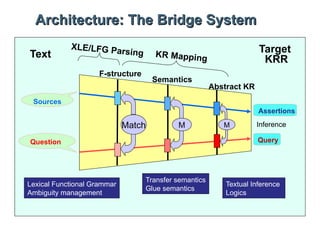
Architecture: The Bridge System
            XLE/LFG Pa                                                 Target
Text                  r      sing     KR Mapping
                                                                        KRR
                     F-structure
                                     Semantics
                                                         Abstract KR
 Sources
                                                                       Assertions

                             Match           M              M          Inference

Question                                                               Query


                                    Transfer semantics
Lexical Functional Grammar                                   Textual Inference
                                    Glue semantics
 Text
Ambiguity management                                         Logics
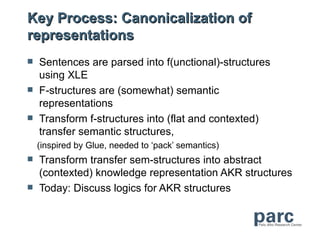
Key Process: Canonicalization of
representations
   Sentences are parsed into f(unctional)-structures
    using XLE
   F-structures are (somewhat) semantic
    representations
   Transform f-structures into (flat and contexted)
    transfer semantic structures,
    (inspired by Glue, needed to ‘pack’ semantics)
   Transform transfer sem-structures into abstract
    (contexted) knowledge representation AKR structures
   Today: Discuss logics for AKR structures
PRED fire<Ed, boy>

Abstract KR: “Ed fired the boy.”               TENSE past
                                               SUBJ [ PRED Ed ]

                                                       PRED boy
                                               OBJ
                                                       DEF +


(subconcept Ed3 Person)
(subconcept boy2 MaleChild)
(subconcept fire_ev1 DischargeWithPrejudice)         Conceptual
(role fire_ev1 performedBy Ed3)
(role fire_ev1 objectActedOn boy2)

(context t)
(instantiable Ed3 t)
                                                     Contextual
(instantiable boy2 t)
(instantiable fire_ev1 t)

(temporalRel startsAfterEndingOf Now                 Temporal
  fire_ev1)
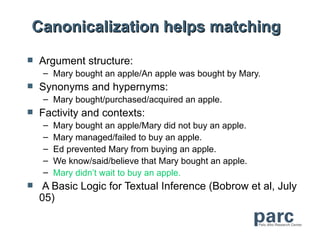
Canonicalization helps matching
   Argument structure:
    – Mary bought an apple/An apple was bought by Mary.
   Synonyms and hypernyms:
    – Mary bought/purchased/acquired an apple.
   Factivity and contexts:
    –   Mary bought an apple/Mary did not buy an apple.
    –   Mary managed/failed to buy an apple.
    –   Ed prevented Mary from buying an apple.
    –   We know/said/believe that Mary bought an apple.
    –   Mary didn’t wait to buy an apple.
    A Basic Logic for Textual Inference (Bobrow et al, July
    05)
Textual Inference Logic (TIL)

   A contexted version of a description logic
    with concepts and roles
   Cyc concepts: Person, MaleChild,,
    DischargeWithPrejudice, etc..
   Cyc Roles: objectActedOn, performedBy,
    infoTransferred, etc
   Dynamic concepts like Ed3 and fire_ev1
   WordNet/VerbNet as fallback mechanisms
   Limitations  move to new ontology
    WordNet/VerbNet
Ed fired the boy.
 context(t),
 instantiable(‘Ed##0',t),
 instantiable('boy##3',t),
 instantiable('fire##1',t),
 role('Agent','fire##1',‘Ed##0'),
 role('Theme','fire##1','boy##3'),
subconcept(‘Ed##0',[[7626,4576]]),
subconcept('boy##3',[[10131706],[9725282],[10464570],[9500236])
 (A1, subconcept('fire##1',[[1124984],[1123061],[1123474]])),
 (A2, subconcept('fire##1',[[2379472]])),
  temporalRel(startsAfterEndingOf,'Now','fire##1')
So far starting from the system…


                   For off-the-shelf
                    logical systems:
                     –   Modal logic
                     –   Hybrid logic
                     –   Description logic
                     –   MCS/LMS
                     –   FOL/ HOL
                     –   Intensional Logic
                     –   Etc…
TIL as logic of contexts?

   Context as Constructive Modality
    (Context2003/CRR2005)
   But TIL constructive and contexted
    description logic
   Must provide constructive description logic
    and then contexted description logic!
   Today’s talk: constructive description logic
   What are the options?
What Are Description Logics?
   A family of logic based Knowledge Representation
    formalisms
    – Descendants of semantic networks and KL-ONE
    – Describe domain in terms of concepts (classes), roles
      (properties, relationships) and individuals
   Distinguished by:
    – Formal semantics (typically model theoretic)
        » Decidable fragments of FOL (often contained in C2)
        » Closely related to Propositional Modal, Hybrid & Dynamic
          Logics
        » Closely related to Guarded Fragment
    – Provision of inference services
        » Decision procedures for key problems (satisfiability,
          subsumption, etc)
        » Implemented systems (highly optimised)
                                           Thanks Ian Horrocks!
DL Basics
   Concepts (formulae)
    – E.g., Person, Doctor, HappyParent, (Doctor t Lawyer)
   Roles (modalities)
    – E.g., hasChild, loves
   Individuals (nominals)
    – E.g., John, Mary, Italy
   Operators (for forming concepts and roles) restricted so
    that:
    – Satisfiability/subsumption is decidable and, if possible, of low
      complexity
    – No need for explicit use of variables
        » Restricted form of 9 and 8 (direct correspondence with hii and [i])
    – Features such as counting (graded modalities) succinctly
      expressed
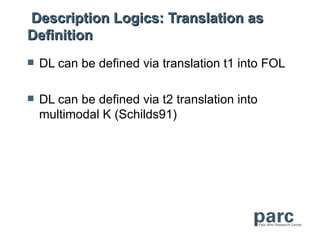
Description Logics: Translation as
Definition
   DL can be defined via translation t1 into FOL

   DL can be defined via t2 translation into
    multimodal K (Schilds91)
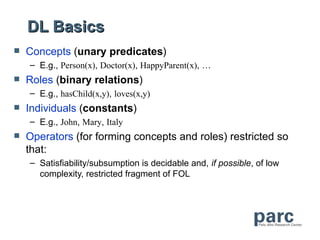
DL Basics
   Concepts (unary predicates)
    – E.g., Person(x), Doctor(x), HappyParent(x), …
   Roles (binary relations)
    – E.g., hasChild(x,y), loves(x,y)
   Individuals (constants)
    – E.g., John, Mary, Italy
   Operators (for forming concepts and roles) restricted so
    that:
    – Satisfiability/subsumption is decidable and, if possible, of low
      complexity, restricted fragment of FOL
DL Basics
   Concepts (propositional formulae)
    – E.g., Person, Doctor, HappyParent, (Doctor t Lawyer)
   Roles (modalities)
    – E.g., hasChild, loves
   Individuals (nominals)
    – E.g., John, Mary, Italy
   Operators (for forming concepts and roles) restricted so
    that:
    – Satisfiability/subsumption is decidable and, if possible, of low
      complexity
    – No need for explicit use of variables
        » Restricted form of 9 and 8 (direct correspondence with hii and [i])
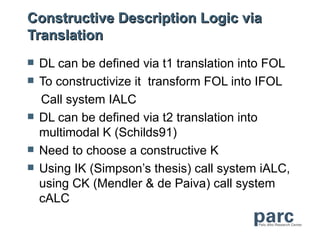
Constructive Description Logic via
Translation
   DL can be defined via t1 translation into FOL
   To constructivize it transform FOL into IFOL
    Call system IALC
   DL can be defined via t2 translation into
    multimodal K (Schilds91)
   Need to choose a constructive K
   Using IK (Simpson’s thesis) call system iALC,
    using CK (Mendler & de Paiva) call system
    cALC
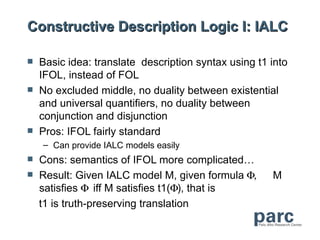
Constructive Description Logic I: IALC

   Basic idea: translate description syntax using t1 into
    IFOL, instead of FOL
   No excluded middle, no duality between existential
    and universal quantifiers, no duality between
    conjunction and disjunction
   Pros: IFOL fairly standard
    – Can provide IALC models easily
   Cons: semantics of IFOL more complicated…
   Result: Given IALC model M, given formula Φ,      M
    satisfies Φ iff M satisfies t1(Φ), that is
    t1 is truth-preserving translation
Constructive Description Logic II: iALC
and cALC
   Basic idea: translate description syntax using
    t2 into constructive modal logic, instead of
    modal Kn.
   Which constructive K?
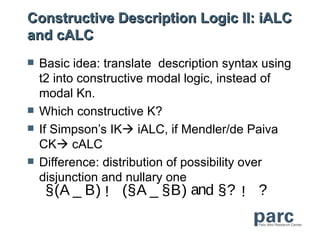
   If Simpson’s IK iALC, if Mendler/de Paiva
    CK cALC
   Difference: distribution of possibility over
    disjunction and nullary one
     §(A _ B) ! (§A _ §B) and §? ! ?
Constructive Description Logic II: iALC

   Note that translation t2 into constructive
    modal logic is the same for both iALC and
    cALC, just the target language change.
   For iALC, can use our work on intuitionistic
    hybrid logic
   Models easily described
   Framework: several modal logics + geometric
    theories
   Referee’s remark: complexity?
Constructive Description Logic II:
cALC
   For cALC, can use our work on an extended
    Curry-Howard isomorphism for constructive
    modal logic
   No Framework: can only do S4 and K
   Can do Kripke models and categorical
    models
   Haven’t investigated interpolation, decidability
    or complexity
Related Work

   Odintsov and Wansing’s “Inconsistent-
    tolerant description logic I and II”
    – Motivation is paraconsistency, not constructivity
   Hofmann’s “Proof theoretical Approach to DL”
    – Motivation is fixpoints in description logics and
      their complexity
   Straccia’s and Patel-Schneider’s papers on 4-
    valued description logic
    – Motivations are fuzziness and uncertainty
Discussion

   This is very preliminary
   While it is true that constructive reasoning multiply
    concepts, there should be criteria to identify best
    system(s?)
   Part of bigger programme of constructivizing logics
    for computer science
   Want to keep criteria both from theory and
    applications
   Next steps: criteria from modal/hybrid logic,
    bisimulations, complexity bounds, temporal logics,
    etc…
References
   Natural Deduction and Context as (Constructive) Modality (V. de
    Paiva). In Proceedings of the 4th International and
    Interdisciplinary Conference CONTEXT 2003, Stanford, CA,
    USA, Springer Lecture Notes in Artificial Intelligence, vol 2680,
    2003.
   Constructive CK for Contexts (M. Mendler, V de Paiva), In
    Proceedings of the Worskhop on Context Representation and
    Reasoning, Paris, France, July 2005.
    Intuitionistic Hybrid Logic (T. Brauner, V. de Paiva), Presented
    at Methods for Modalities 3, LORIA, Nancy, France, September
    22-23, 2003. Full paper to appear in Journal of Applied Logic.
   A Basic Logic for Textual inference (D. Bobrow, C. Condoravdi,
    R. Crouch, R. Kaplan, L. Karttunen, T. King, V. de Paiva and A.
    Zaenen), In Procs. of the AAAI Workshop on Inference for
    Textual Question Answering, Pittsburgh PA, July 2005.
Thanks!

Constructive Description Logics 2006

  • 1.
    Constructive Description Logics: what,why and how? Valeria de Paiva Intelligent System Lab Palo Alto Research Center CRR 2006 – Riva del Garda
  • 2.
    Outline  Motivation  Textual Inference Logic  Constructive description logic I  Constructive description logic II  Related work  Discussion
  • 3.
    An applied logician’sjob is never done…  When modeling an implemented system as a logic you can start from the system  Or you can start from logics that could fit it  Hopefully the two meet up…
  • 4.
    Motivation: Logic forText Understanding  A logic for reasoning about questions and answers using formulae automatically created from texts in English  Logic used both to create logical representation of information and to answer/solve/infer questions  How?  Build upon decades of work on NLP at PARC
  • 5.
    Architecture: The BridgeSystem XLE/LFG Pa Target Text r sing KR Mapping KRR F-structure Semantics Abstract KR Sources Assertions Match M M Inference Question Query Transfer semantics Lexical Functional Grammar Textual Inference Glue semantics Text Ambiguity management Logics
  • 6.
    Key Process: Canonicalizationof representations  Sentences are parsed into f(unctional)-structures using XLE  F-structures are (somewhat) semantic representations  Transform f-structures into (flat and contexted) transfer semantic structures, (inspired by Glue, needed to ‘pack’ semantics)  Transform transfer sem-structures into abstract (contexted) knowledge representation AKR structures  Today: Discuss logics for AKR structures
  • 7.
    PRED fire<Ed, boy> AbstractKR: “Ed fired the boy.” TENSE past SUBJ [ PRED Ed ] PRED boy OBJ DEF + (subconcept Ed3 Person) (subconcept boy2 MaleChild) (subconcept fire_ev1 DischargeWithPrejudice) Conceptual (role fire_ev1 performedBy Ed3) (role fire_ev1 objectActedOn boy2) (context t) (instantiable Ed3 t) Contextual (instantiable boy2 t) (instantiable fire_ev1 t) (temporalRel startsAfterEndingOf Now Temporal fire_ev1)
  • 8.
    Canonicalization helps matching  Argument structure: – Mary bought an apple/An apple was bought by Mary.  Synonyms and hypernyms: – Mary bought/purchased/acquired an apple.  Factivity and contexts: – Mary bought an apple/Mary did not buy an apple. – Mary managed/failed to buy an apple. – Ed prevented Mary from buying an apple. – We know/said/believe that Mary bought an apple. – Mary didn’t wait to buy an apple.  A Basic Logic for Textual Inference (Bobrow et al, July 05)
  • 9.
    Textual Inference Logic(TIL)  A contexted version of a description logic with concepts and roles  Cyc concepts: Person, MaleChild,, DischargeWithPrejudice, etc..  Cyc Roles: objectActedOn, performedBy, infoTransferred, etc  Dynamic concepts like Ed3 and fire_ev1  WordNet/VerbNet as fallback mechanisms  Limitations  move to new ontology WordNet/VerbNet
  • 10.
    Ed fired theboy. context(t), instantiable(‘Ed##0',t), instantiable('boy##3',t), instantiable('fire##1',t), role('Agent','fire##1',‘Ed##0'), role('Theme','fire##1','boy##3'), subconcept(‘Ed##0',[[7626,4576]]), subconcept('boy##3',[[10131706],[9725282],[10464570],[9500236]) (A1, subconcept('fire##1',[[1124984],[1123061],[1123474]])), (A2, subconcept('fire##1',[[2379472]])), temporalRel(startsAfterEndingOf,'Now','fire##1')
  • 11.
    So far startingfrom the system… For off-the-shelf logical systems: – Modal logic – Hybrid logic – Description logic – MCS/LMS – FOL/ HOL – Intensional Logic – Etc…
  • 12.
    TIL as logicof contexts?  Context as Constructive Modality (Context2003/CRR2005)  But TIL constructive and contexted description logic  Must provide constructive description logic and then contexted description logic!  Today’s talk: constructive description logic  What are the options?
  • 13.
    What Are DescriptionLogics?  A family of logic based Knowledge Representation formalisms – Descendants of semantic networks and KL-ONE – Describe domain in terms of concepts (classes), roles (properties, relationships) and individuals  Distinguished by: – Formal semantics (typically model theoretic) » Decidable fragments of FOL (often contained in C2) » Closely related to Propositional Modal, Hybrid & Dynamic Logics » Closely related to Guarded Fragment – Provision of inference services » Decision procedures for key problems (satisfiability, subsumption, etc) » Implemented systems (highly optimised) Thanks Ian Horrocks!
  • 14.
    DL Basics  Concepts (formulae) – E.g., Person, Doctor, HappyParent, (Doctor t Lawyer)  Roles (modalities) – E.g., hasChild, loves  Individuals (nominals) – E.g., John, Mary, Italy  Operators (for forming concepts and roles) restricted so that: – Satisfiability/subsumption is decidable and, if possible, of low complexity – No need for explicit use of variables » Restricted form of 9 and 8 (direct correspondence with hii and [i]) – Features such as counting (graded modalities) succinctly expressed
  • 15.
    Description Logics: Translationas Definition  DL can be defined via translation t1 into FOL  DL can be defined via t2 translation into multimodal K (Schilds91)
  • 16.
    DL Basics  Concepts (unary predicates) – E.g., Person(x), Doctor(x), HappyParent(x), …  Roles (binary relations) – E.g., hasChild(x,y), loves(x,y)  Individuals (constants) – E.g., John, Mary, Italy  Operators (for forming concepts and roles) restricted so that: – Satisfiability/subsumption is decidable and, if possible, of low complexity, restricted fragment of FOL
  • 17.
    DL Basics  Concepts (propositional formulae) – E.g., Person, Doctor, HappyParent, (Doctor t Lawyer)  Roles (modalities) – E.g., hasChild, loves  Individuals (nominals) – E.g., John, Mary, Italy  Operators (for forming concepts and roles) restricted so that: – Satisfiability/subsumption is decidable and, if possible, of low complexity – No need for explicit use of variables » Restricted form of 9 and 8 (direct correspondence with hii and [i])
  • 18.
    Constructive Description Logicvia Translation  DL can be defined via t1 translation into FOL  To constructivize it transform FOL into IFOL Call system IALC  DL can be defined via t2 translation into multimodal K (Schilds91)  Need to choose a constructive K  Using IK (Simpson’s thesis) call system iALC, using CK (Mendler & de Paiva) call system cALC
  • 19.
    Constructive Description LogicI: IALC  Basic idea: translate description syntax using t1 into IFOL, instead of FOL  No excluded middle, no duality between existential and universal quantifiers, no duality between conjunction and disjunction  Pros: IFOL fairly standard – Can provide IALC models easily  Cons: semantics of IFOL more complicated…  Result: Given IALC model M, given formula Φ, M satisfies Φ iff M satisfies t1(Φ), that is t1 is truth-preserving translation
  • 20.
    Constructive Description LogicII: iALC and cALC  Basic idea: translate description syntax using t2 into constructive modal logic, instead of modal Kn.  Which constructive K?  If Simpson’s IK iALC, if Mendler/de Paiva CK cALC  Difference: distribution of possibility over disjunction and nullary one §(A _ B) ! (§A _ §B) and §? ! ?
  • 21.
    Constructive Description LogicII: iALC  Note that translation t2 into constructive modal logic is the same for both iALC and cALC, just the target language change.  For iALC, can use our work on intuitionistic hybrid logic  Models easily described  Framework: several modal logics + geometric theories  Referee’s remark: complexity?
  • 22.
    Constructive Description LogicII: cALC  For cALC, can use our work on an extended Curry-Howard isomorphism for constructive modal logic  No Framework: can only do S4 and K  Can do Kripke models and categorical models  Haven’t investigated interpolation, decidability or complexity
  • 23.
    Related Work  Odintsov and Wansing’s “Inconsistent- tolerant description logic I and II” – Motivation is paraconsistency, not constructivity  Hofmann’s “Proof theoretical Approach to DL” – Motivation is fixpoints in description logics and their complexity  Straccia’s and Patel-Schneider’s papers on 4- valued description logic – Motivations are fuzziness and uncertainty
  • 24.
    Discussion  This is very preliminary  While it is true that constructive reasoning multiply concepts, there should be criteria to identify best system(s?)  Part of bigger programme of constructivizing logics for computer science  Want to keep criteria both from theory and applications  Next steps: criteria from modal/hybrid logic, bisimulations, complexity bounds, temporal logics, etc…
  • 25.
    References  Natural Deduction and Context as (Constructive) Modality (V. de Paiva). In Proceedings of the 4th International and Interdisciplinary Conference CONTEXT 2003, Stanford, CA, USA, Springer Lecture Notes in Artificial Intelligence, vol 2680, 2003.  Constructive CK for Contexts (M. Mendler, V de Paiva), In Proceedings of the Worskhop on Context Representation and Reasoning, Paris, France, July 2005.  Intuitionistic Hybrid Logic (T. Brauner, V. de Paiva), Presented at Methods for Modalities 3, LORIA, Nancy, France, September 22-23, 2003. Full paper to appear in Journal of Applied Logic.  A Basic Logic for Textual inference (D. Bobrow, C. Condoravdi, R. Crouch, R. Kaplan, L. Karttunen, T. King, V. de Paiva and A. Zaenen), In Procs. of the AAAI Workshop on Inference for Textual Question Answering, Pittsburgh PA, July 2005.
  • 26.